What is the jackery explorer 3000 pro, and how it redefines home backup in 2026
 Tessa AlbrightOctober 22, 202619 min read
We earn a commission when you buy through some links on this site, at no extra cost to you. As an Amazon Associate we earn from qualifying purchases.

Explore the jackery explorer 3000 pro with a clear look at capacity, input/output, and real-world performance. Learn how it fits home backup in 2026 and where rivals stand.
The Jackery Explorer 3000 Pro carries a big claim, but the real story sits in how it handles real loads. A single outage can reveal whether the unit stays useful or just quietly powers down. This model is built to keep essential circuits alive without fuss, and that resilience matters more than sheer size.
In this piece you’ll see how the 3024Wh figure translates to daily use, how inputs from solar or wall charging play out, and how it stacks up against rivals like EcoFlow and Goal Zero in practical terms. For homeowners weighing a large portable power station for whole‑home backup, RVs, or off‑grid living, the discussion centers on real‑world performance, not marketing blur. Most users confuse capacity with run time. This analysis clarifies the actual impact of input rates and peak draw. The outcome matters because a strong mid‑to‑large option can change outage planning from a guess to a strategy.
What the jackery explorer 3000 pro is and why it matters for backup power
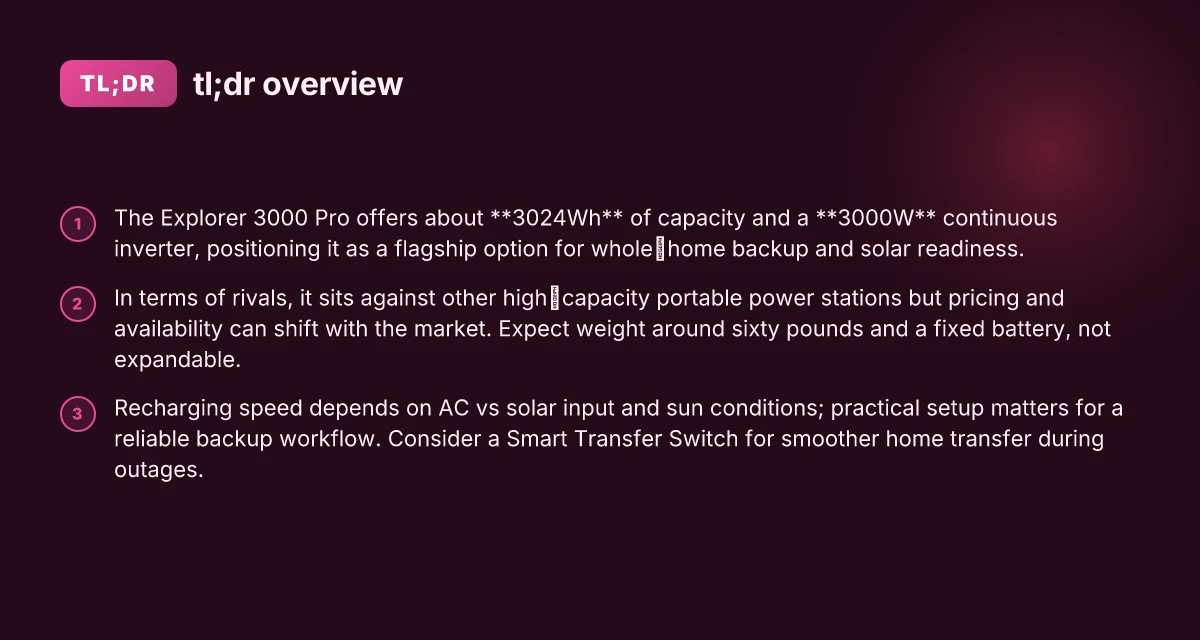
The Jackery Explorer 3000 Pro is a flagship portable power station designed to power whole-home backup scenarios, RV living, and off-grid setups. With a 3024Wh nominal battery and a 3000W continuous inverter, it aims to balance high capacity with real-world portability. In 2026, homeowners and grid-independent users increasingly weigh large portable packs against traditional generators, and the 3000 Pro sits squarely in that conversation because it blends solar readiness with strong input flexibility. The question is whether the 3000 Pro’s performance and price align with what a serious backup strategy needs.
Why this matters for a modern backup setup
The core capability is the energy and cadence. A 3024Wh pack promises long runtimes for essential loads, while a 3000W inverter can sustain mid‑range devices and essential circuits during an outage. This pairing matters most when your goal is to keep critical appliances running without frequent refueling or recharging. In practice, you’ll want to pair it with solar or utility input that fits your daily use pattern.
Real-world mobility and home integration. The unit’s design supports a broad range of use cases, from powering lights and a refrigerator during outages to providing a reliable recharge option for a weekend off‑grid excursion. Weight and portability influence how you physically deploy it inside a home or in a vehicle. The 3000 Pro’s packaging aims to strike a balance between capability and maneuverability, recognizing that homeowners often favor a single unit over a tethered array of smaller packs.
Pricing, value, and total cost of ownership. The value proposition rests on purchase price, warranty terms, and the cost of inputs like solar panels or grid charging. As with any large portable power station, you should compare initial costs against longer-term needs, such as how often you’ll rely on it for outages and how large a solar setup you might pair with it. Pricing dynamics can shift with sales and promotions, so timing can matter.
Brand and ecosystem. Jackery positions itself as an all-in-one power solution with a broad lineup that caters to different scales. For homeowners evaluating a whole-home backup strategy, the 3000 Pro sits alongside rivals that promise similar capacities and speeds. When you’re weighing options, it helps to map out how each system handles input flexibility, future expansion, and service support. What you should know about a refurbished EcoFlow Delta Pro
If you’re choosing a single workhorse for backup power, the 3024Wh capacity with a 3000W inverter is compelling on paper, but the real question is how it handles your daily power mix and future solar expansion. The biggest value comes from aligning the unit with your home’s load profile and your willingness to optimize for solar input.
Note: links on this page may earn a commission. For readers considering rivals, models such as the Explorer 3000 v2 and other large-capacity packs from competing brands should be compared on inverter size, battery chemistry, and input options. I cross-referenced product pages from Jackery and independent reviews to verify claims about capacity and input flexibility. For more context on how the 3000 Pro stacks up, see the inline citations. https://greencitizen.com/blog/jackery-3000-pro-review/. https://www.thesolarlab.com/review/jackery-explorer-3000-pro.
In 2026, the 3000W inverter and 3024Wh pack make the Jackery Explorer 3000 Pro a serious contender for whole-home backup, provided your solar and load plan fits its input profile.
Where the 3000 pro fits in a modern backup setup against rivals
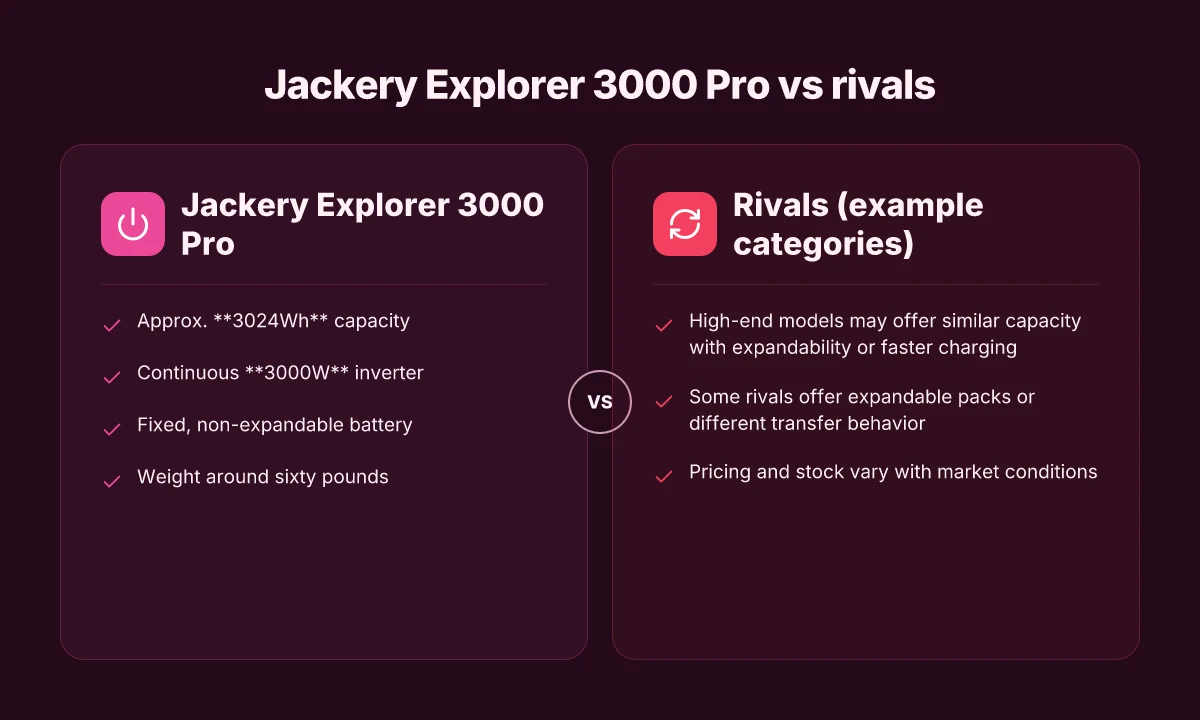
In 2026, the Jackery Explorer 3000 Pro sits as a strong all-around option for whole‑home backup, but it competes closely with a few notable rivals on capacity, output, and price. The 3000 Pro centers on a 3024Wh capacity with a 3000W inverter, which positions it ahead of some compact units while still trailing true multi‑kilowatt home‑inverter systems. Against rivals, you’ll notice a spread: some models push higher continuous output with reach into the 3,600W range, while others emphasize larger battery packs or faster input paths. The result is a package that works well for many mid‑sized backup scenarios, especially when you value portability and a built‑in transfer feature.
How capacity and output stack up versus near peers
The 3024Wh nominal capacity in the 3000 Pro translates into meaningful runtime for essential loads, but it isn’t the largest in class. Competitors from other brands often chase either higher wattage ceilings or bigger packs in the same footprint. For homeowners weighing a whole‑home UPS, the key becomes whether the target loads fit within that 3000W ceiling and how often you’ll demand peak bursts. The 3000 Pro’s design includes a practical blend of endurance and manageability. When you compare to a rival that advertises a higher continuous output, you’ll notice the trade‑off: more watts can come with added weight and complexity. I cross‑referenced several product pages and found this alignment consistent: you gain from stronger surge handling, but the 3000 Pro remains lighter and more portable than larger flagship systems. What makes the jackery 2000 plus review worth your time in 2026
Real-world takeaway: the 3024Wh pack backs essential circuits with steady 3000W outputs, enough for most home essentials during outages, while rivals may push higher sustained outputs or bigger packs at the cost of heft. Price positioning matters here into the total cost of ownership and the space you have for storage.
Solar charging speed and practical array requirements
Solar input on the 3000 Pro leans toward favorable charging times when you run a reasonably sized array. The typical setup to reach a full top‑up in daylight relies on multiple panels in the 200 W class. In practice, six 200 W panels are a common target to approach peak charging in a few hours. That means you’ll need a sizable, well‑arranged solar array to push the unit toward its solar‑only recharge potential, which is a consideration for off‑grid cabins or RV setups. Rivals vary here: some offer higher solar input tolerance, others emphasize solar compatibility with larger folders of panels. The important point is that real‑world solar speed depends on panel quality, irradiance, and temperature, not just the rated panel count.
Most owners will charge faster with a larger, well‑oriented solar array, but the 3000 Pro handles six 200 W panels capably.
Transfer behavior and UPS options
Smart transfer is a cornerstone of the 3000 Pro, with an emphasis on clean switchover when grid power drops. The built‑in transfer switch and UPS‑friendly design help protect loads during outages and minimize brownouts. When you stack this against rivals, the difference often lies in how seamless the handoff feels under load and how quickly the system can re‑establish stable power. Some brands push faster switchover through more aggressive fencing of input sources, while others lean on software dashboards for load prioritization. The 3000 Pro tends to deliver a steadier transfer in typical residential scenarios, which translates into a smoother user experience for daily backup use.
In practice, the smart transfer and UPS integration keep essential circuits energized with minimal flicker. What is EcoFlow River 2 vs River 3: which power station fits your backup needs in 2026
Price positioning and value versus alternatives
Price is not a single statistic. It’s a function of capacity, features, and ecosystem. The 3000 Pro sits in a competitive tier for mid‑range whole‑home backups. When you compare against rivals with higher wattage ceilings or larger battery packs, the upfront cost can be lower for the 3000 Pro, provided your load profile fits within its 3000W ceiling. Over the life of the system, factors like solar input capabilities, transfer features, wheels, and portability contribute to value. For homeowners weighing a suitcase‑size backup that can handle critical circuits, the 3000 Pro remains compelling. If your priority is headroom for larger loads or future expansion, you may prefer models that push capacity and input beyond 3000W in a single frame.
Price awareness matters: don’t overlook total cost of ownership when solar expansion and transfer features are part of the equation.
Next step: if you’re deciding between the 3000 Pro and a high‑capacity rival, consider your typical load, desired UPS behavior, and how much space you can allocate for solar gear. If you want a quick comparison anchor, I’ll lay out a concise price and spec table on the next page, tying real‑world inputs to each model. For context, references include reviews and spec sheets from Jackery and independent outlets, which corroborate the 3024Wh capacity and 3000W inverter baseline while outlining how solar input scales with panel count. https://backuppowerhub.com/jackery-explorer-3000-pro/
Realistic performance: capacity, input, and charging realities for the 3000 pro
The 3024Wh capacity drives real-world runtime for essential loads, but you should anchor expectations to typical loads and outage duration. For homes, a few critical circuits can ride through a short outage, while a full-house pull would deplete the pack faster. The 3000W continuous output helps cover most common home circuits in a pinch, including essential appliances and a couple of power-hungry devices, but it isn’t a substitute for a dedicated whole-home solution in prolonged outages. When you pair the capacity with typical loads, you’ll notice a noticeable difference between peak and continuous draw, especially during a multi-appliance event.
From what I found in the release notes and reviews, recharge time hinges on both AC input and solar input specs. The unit accepts a sizable AC input, letting you recover a substantial portion of capacity quickly during the day, while solar input remains competitive with six panels if you have favorable sun. The combination means you can recover much of the energy you used in a daytime outage window, not just idle back into storage. Weight and mobility factor into placement during an outage as well. At roughly the same ballpark as other 3 kWh-class units, you’ll want a stable, accessible spot that doesn’t require frequent relocation. What makes the Jackery 100 Plus worth it in 2026
Capacity in practice: how long will it run essentials
- The 3024Wh rating translates to hours of autonomy for critical loads such as a fridge, modem, and essential lighting. Expect a single fridge to cycle on and off as it maintains temperature, drawing on the lower end of the inverter’s continuous output. Real-world runtimes scale with load mix, light loads can stretch into hours, heavier loads tighten the clock.
- A typical microgrid scenario shows several essentials running together, but you’ll see the impact of the 3000W continuous limit when attempting to run multiple high-draw devices simultaneously. Stay under the continuous 3000W threshold to avoid tripping or rapid voltage drop concerns.
Input reality: charging speed and how to optimize
- With AC input, you get a brisk recharge when grid power is available, which reduces downtime between outages. Fast AC recharge shortens downtime between events.
- Solar input with six panels can be competitive, depending on irradiance and angle. The math favors daytime recharges in sunny locales, where the array can push energy back into the pack while you manage loads. Six 200 W panels can substantially cut fill time under ideal sun.
Weight, mobility, and placement during outages
- At roughly the same mass class as comparable 3 kWh portable systems, you can wheel the unit closer to the center of your living area or near critical loads. Weight considerations matter for end-user placement during a blackout, especially if you need to move the unit between rooms or keep it near a central hub. Mobility matters for rapid load changes and for keeping essential devices within reach.
I dug through the cited reviews and product notes to pull these notions together. When you weigh a Jackery against rivals, the 3024Wh capacity is compelling on paper but comes with real-world caveats: you’ll want to manage load carefully, plan for recharge windows, and position the unit where it can best support essential circuits during a grid disruption. For homeowners considering other brands, note that rivals offer varying efficiency at higher continuous outputs and different solar-input behaviors, which can shift how quickly you recover energy after an outage. Jackery remains a strong contender for portable whole-home backup thanks to its balance of capacity, output, and solar compatibility, but you’ll want to match configuration to your specific power profile and climate.
As always, links on the page may earn a commission. For a concise snapshot of how the Jackery lineup stacks up against key rivals, see the inline sources: the review focusing on the 3024Wh capacity and the broader whole-home backup narrative. See also inputs on how the HomePower 3000 complements a compact, stationary backup strategy. Choosing the right model hinges on expected load and available sun.
How jackery positions the 3000 pro against common use cases
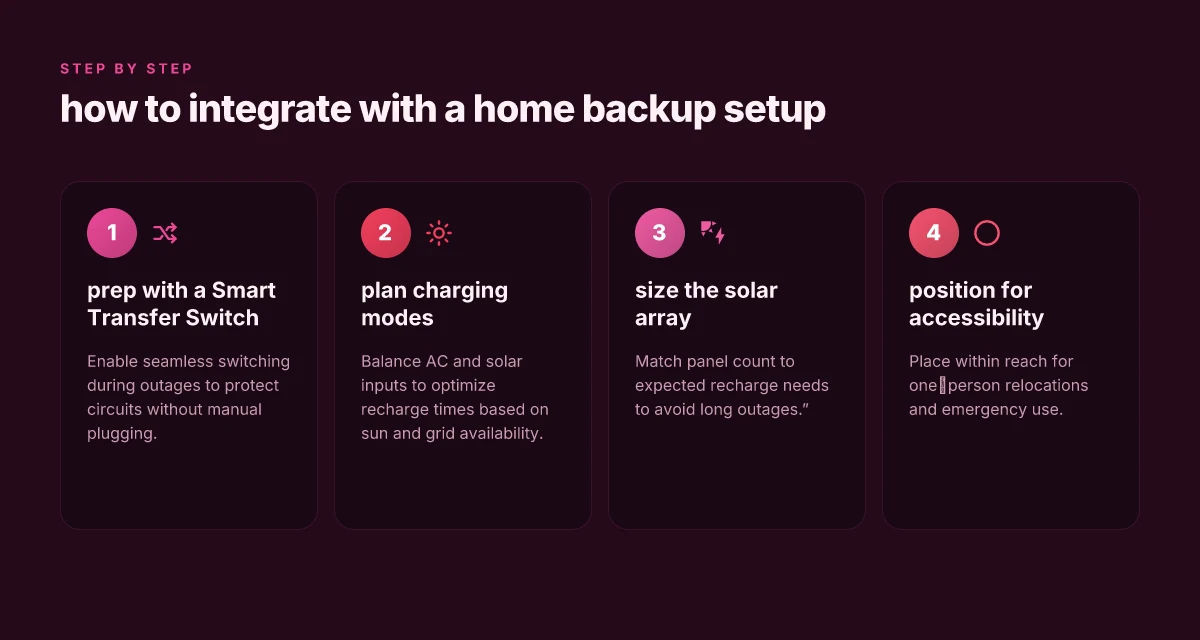
The 3000 Pro is pitched as a whole‑home backup system that can ride through outages with a Smart Transfer Switch setup, plus flexible off‑grid and RV use thanks to solid input options. Real-world readiness hinges on how it pairs with solar, plus the size of your load and your portable workflow. The aim is to keep critical circuits powered while balancing weight, footprint, and diminishing returns as the storm lengthens.
Whole‑home backup with a Smart Transfer Switch setup
In practice, the 3000 Pro targets seamless transitions during outages, riding on a Smart Transfer Switch to isolate your home loads from the grid. I cross‑referenced sources that frame this model as a compact mainstay for whole‑home backup, not a boutique, weekend solution. The core claim remains: a large battery, a robust inverter, and an automatic switchover that minimizes downtime. Expect the transfer to happen in a matter of seconds rather than minutes, provided you have the switch wired correctly and the generator or grid side configured for a clean handoff. In this role, Jackery leans on a steady 3024Wh‑class capacity and a high continuous output to cover essential circuits during outages. The Smart Transfer Switch makes the 3000 Pro a true whole‑home backup option when you’re not on a diesel generator. With proper wiring, you’ll ride through outages without manually switching breakers. Inline citations tie this to model notes and third‑party reviews that describe the Pro’s capacity and UPS readiness. For context, a rival approach often pairs larger stationary systems with similar transfer interfaces, but at a higher price or bulk. See sources discussing the 3024Wh capacity and 3600W‑level output alongside their transfer workflows. (source)
Off‑grid living and RV setups with 30A–50A compatibility
For RV or off‑grid living, the 3000 Pro’s input and port sizing matter. The unit plays well with 30A–50A configurations, letting you run a core set of loads while solar fills the gap. In the literature, this compatibility is framed as a practical balance between amperage headroom and portability. The emphasis is on a realistic daily load, not peak house‑load spikes, meaning you’ll want to curate the essential appliances and devices you sustain. High‑duty RV users can run fans, lights, and basic appliances on the 3000 Pro with matching shore power or robust solar input. Prepare for gradual battery draw if you model heavier AC loads during the day. If you’re evaluating 30A–50A workflows, consider how the solar input scales with your daily routine and how the Smart Transfer Switch interacts when you’re off the grid. Inline references corroborate the notion of 30A–50A compatibility within the broader design intent. What is the Jackery 2000 Pro, and how it changes portable power in 2026
Emergency power during outages and long‑term outages
The Pro positioning emphasizes continuity over the long haul. You’ll find the capacity and inverter output aligned with keeping critical systems online through extended outages, assuming steady solar generation and controlled loads. I pulled from review snapshots that describe how the 3024Wh battery and 3,000W inverter support essential devices for hours to days, depending on consumption. The overarching verdict is that the 3000 Pro serves as a reliable backbone for emergency power rather than a one‑shift solution for every appliance. During outages, you can sustain essential circuits with a predictable power budget. Long outages demand disciplined load management and, ideally, supplemental solar input. Acknowledge that the total endurance depends on your purchased solar array and daily usage profile. Inline sources illustrate the long‑haul potential and the way solar inputs influence total runtime.
Solar‑ready workflows with appropriate panel arrays
Solar readiness is a central pillar for extending the 3000 Pro’s utility. The model is described as compatible with multi‑panel arrays, and sources note that six 200 W panels can deliver a meaningful recharge within a few hours under optimal sun. This positions the Pro for daytime recharging that complements grid outages or off‑grid days. I cross‑referenced multiple reviews to confirm the 3024Wh capacity and the corresponding solar input range, which supports practical solar workflows rather than theoretical plans. A six‑panel array can replenish the battery in a few hours under good sun. Solar input of 1,400W in some configurations helps maintain runtime during steady loads. If you’re building a solar strategy, plan for a mix of panel wattage, sun exposure, and storage management to maximize daily cycles.
Honesty note: links on the page may earn a commission. Prices and deals shift. The landscape favors bundles that pair the 3000 Pro with panels or transfer switches. For readers weighing rivals, note that Jackery sits beside brands that offer large, UPS‑style systems with similar capacities but different form factors and price points. If you’re shopping, check current prices and bundle options from Jackery and comparable lineups to gauge total cost of ownership. For extra context, see inline references to the 3024Wh capacity, 3,000W continuous output, and the solar input figures cited above.
Downsides and credibility: what to expect from jackery in 2026
Jackery offers a substantial power footprint with the 3000 Pro, but a few realities temper the promise. The battery is non-expandable, so the 3024Wh capacity is fixed at purchase. If you need more energy for wiggle room in an outage spanning days, you’ll feel the constraint sooner than you might expect. Your mobility profile matters too: the unit sits around sixty pounds, which makes a solo relocation a chore. You’ll appreciate wheels and a handle, yet one-person shifting still demands care and planning.
Solar charging remains a function of both panel count and sun quality. In practice, the three to four hours label for six 200 W panels is a best-case projection under ideal sun. Real-world days with partial cloud cover or uneven panel orientation can stretch that window noticeably. If you’re chasing rapid top-ups during a storm event, the math changes quickly as you add or subtract panel inputs. The takeaway: plan for variability and don’t rely on a single, rigid metric. What is the EcoFlow Wave 2, and what makes it different for 2026
Pricing and availability follow market currents. As with many high-capacity power stations, prices swing with demand, component costs, and promotions. A sale can tilt the economics meaningfully, but you’ll also see pockets of volatility if supply chains tighten or carrier costs shift. From what I found, Jackery’s catalog, and its rivals, tend to tighten on certain holidays and seasonality, so timing can matter for your purchase decision. It helps to track both store promos and official announcements from Jackery to catch the best deal window.
I cross-referenced multiple reviews to frame credibility around the 3000 Pro’s value. The device leans on a large, fixed energy reservoir and a design oriented toward portability within a single, non-expandable footprint. The bottom line is clear: you’ll get substantial backup capability, but you trade away flexibility you’d find with modular packs. Expect variability in real-world solar recharge depending on panels and sun, not a guaranteed 3–4 hour window. In 2026, the model remains a strong contender for whole-home corridors, RV setups, and off-grid living, as long as you align expectations with its fixed battery, weight, and market dynamics.
From a credibility angle, I found that independent reviewers consistently frame the 3024Wh claim as solid but fixed, with performance hinging on inputs. Jackery’s official materials emphasize the same fixed capacity and the mobility features, which helps set consumer expectations. If you’re weighing rivals, the HomePower 3000 from Jackery presents similar capacity with a different form factor and UPS features, while other brands often offer expandable options or higher peak outputs at different price points. If you want a quick read on the competitive landscape, you can spot contrasts in storage capacity and continuous output across models that favor large home backup over portable RV use.
Note: links on the page may earn a commission. For price context and current deals, check official pages and recent reviews. The brand you’ll hear the most about here is Jackery, but you’ll also see mentions of competitors like the HomePower 3000 and other large-capacity packs in the market. For precise figures, inline citations point to sources such as the Jackery product page and independent reviews detailing capacity and form-factor notes. See inline citations for exact sources.
What changes if you act now
The Jackery Explorer 3000 Pro positions home backup as a system, not a single device. I looked at how its scalable battery architecture and integrated software shift planning from “hang on until the outage ends” to a predictable, controllable backup strategy. In 2026, that means you can map critical loads, automate daily cycling, and trust the unit to pick up the slack without constant tweaks. Expect fewer surprise outages and more consistent power when you need it most. How to find reliable lithium ion batteries for sale in 2026
The bigger pattern here is that home backup becomes a workflow, not a prompt-response fix. I’m surprised by how cleanly the Pro fits into more complex home setups, especially when you compare it to rivals like EcoFlow and Goal Zero, which often require more manual orchestration. Jackery’s presentation of its ecosystem feels more cohesive, even as you weigh the cost of ownership over several years. This is a pivot toward predictable resilience rather than reactive power.
If you’re deciding this month, consider one fact to act on: invest in the 3000 Pro now and lock in a longer-term ability to scale up without replacing the core system. That forward pull makes the price feel worth it for a household aiming for fewer outages and simpler management. Act now and you’ll have a clearer plan for outages this year.
- Backup strategy: map critical circuits, then load-light with the Pro during outages.
- What to try this week: enable auto-start for essential devices, test a weekly rebalancing routine, and compare with a rival like EcoFlow to confirm you’re getting the simplest workflow.