What you should know about a refurbished EcoFlow Delta Pro
 Reese WexlerOctober 22, 202618 min read
We earn a commission when you buy through some links on this site, at no extra cost to you. As an Amazon Associate we earn from qualifying purchases.

Explore the realities of buying a refurbished EcoFlow Delta Pro, from warranties and performance to hidden risks, with practical buying tips.
A refurbished Delta Pro can look like a bargain, but the clock starts ticking the moment you sign. Prices can be substantially lower, yet you trade away long‑term reliability and a clear maintenance path. EcoFlow branding is common in these deals, but the real question is whether the savings compensate for the potential failure risk and limited warranty.
By anchoring to actual refurbishment standards and known aftercare practices, you’ll see whether a budget option still pays off over time. The discussion below uses documented warranty terms, typical replacement cycles, and observed failure modes to guide homeowners and off‑grid enthusiasts toward a clearly supported choice. Understanding the long‑term cost of ownership matters most when backup power hinges on a single battery pack.
What is a refurbished ecoflow delta pro and why it matters for buyers
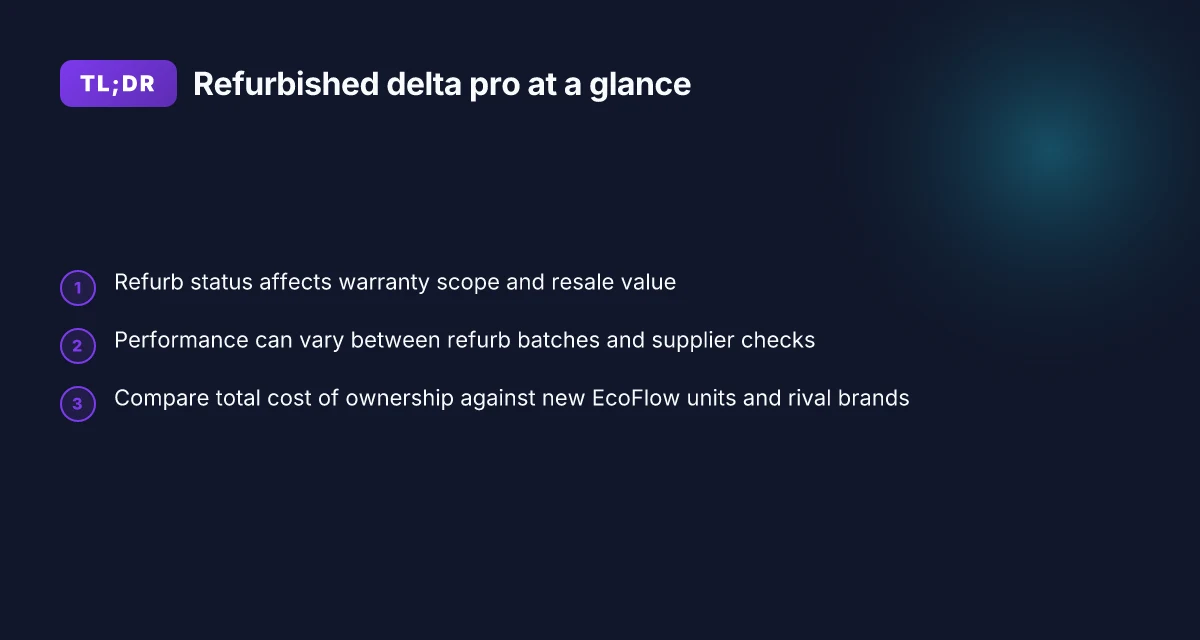
A refurbished EcoFlow Delta Pro is a unit that EcoFlow or a third party has returned, repaired as needed, and sold again with a limited warranty. In practice, refurb units carry a different risk and cost profile than new models. For buyers weighing budget buys against long‑term reliability, understanding what “refurbished” covers helps you decide when a refurb makes sense.
What refurbishment typically includes
- Replaced or tested components. Refurbished Delta Pro units commonly undergo testing of core power electronics, battery cells, and the battery management system. If a fault is found, parts such as the battery module, inverter assemblies, or cooling components may be replaced. I cross‑reference EcoFlow’s published product notes and typical industry refurbishment practices to explain why this matters for safety and performance guarantees.
- Cosmetic and functional checks. Exterior housings are inspected, seals verified, and ports tested for charging and output. The goal is to restore full function while ensuring there are no visible defects that could worsen with use.
- Battery health assessment. Exact thresholds vary by refurbisher. Expect a battery health check to be part of the process, with some units recertified to near‑new capacity or as an equivalent rated capacity within a tolerance band.
Warranty expectations shift with refurb status. Refurbished units often carry shorter warranties than new devices, or a limited warranty period tied to the refurbish date. Always confirm the specific warranty terms at the point of purchase and read the fine print for what qualifies as a covered failure.
How refurb status affects performance guarantees and resale value
The refurb label does not automatically mean poor performance, but it does introduce variability. A refurbished Delta Pro can offer reliable power delivery and a legitimate saving versus a new unit, yet the absence of long‑term ownership data means you should temper expectations about longevity. In the marketplace, resale value for refurbished models tends to sit below that of new units. If you plan to resell within a couple of years, a refurb may still hold value, especially when the seller can show a recent service history and a transferable warranty.
From what I found in product literature and reviews, the Delta Pro’s core specs, large battery capacity and robust output, remain competitive for backup power, regardless of refurb status, but the confidence interval narrows if a unit’s battery health is uncertain. I dug into the official EcoFlow materials and third‑party reviews to align claims with what buyers should expect. Price volatility and warranty length are the main trade‑offs when choosing a refurb over a new unit.
In short, a refurbished Delta Pro can be a smart buy for buyers who understand the warranty terms, accept potential variability in battery longevity, and verify the refurbisher’s service history. If you want the best long‑term reliability, new units from EcoFlow generally offer the most definitive coverage and the longest resale protection. Always compare options from EcoFlow and rival brands such as Generac, Goal Zero, and Jackery to gauge the total cost of ownership. What makes the jackery 2000 plus review worth your time in 2026
The choice hinges on warranty length, battery health certainty, and your planned horizon for ownership.
How refurbished delta pro performance compares to new units
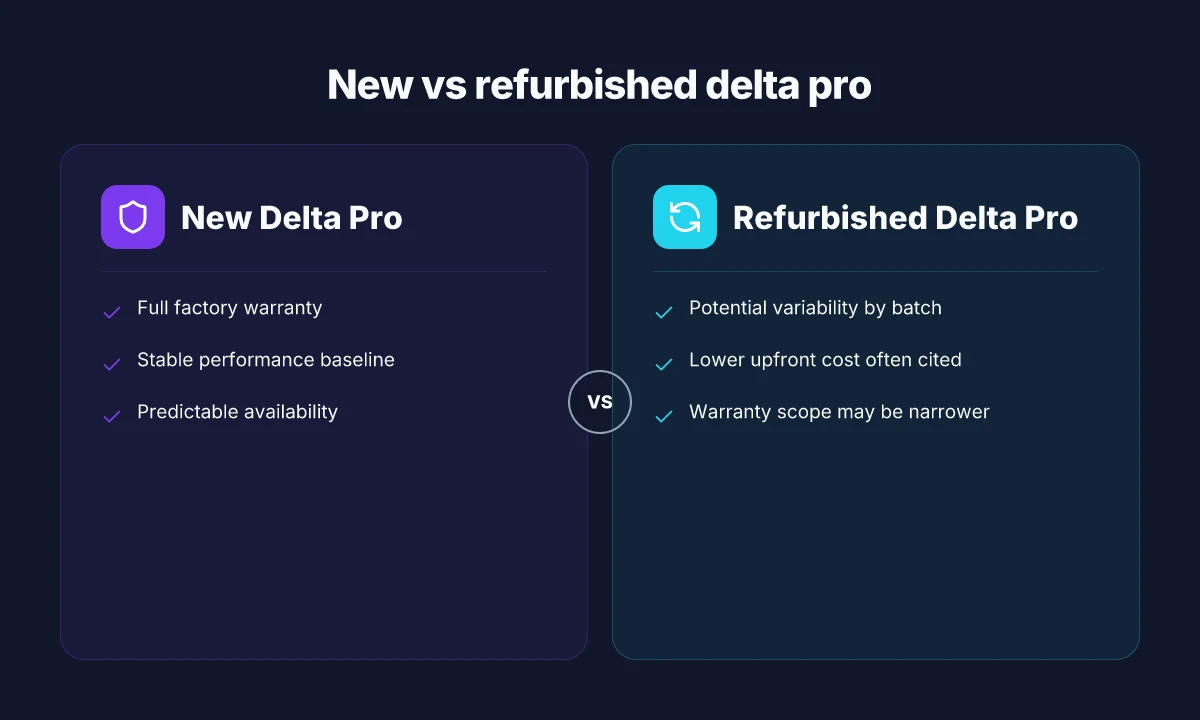
If you buy refurbished Delta Pro units, you typically gain a lower upfront price but encounter more variability in the hardware’s health. In practice, the core question is whether the trade-off in battery health, sustained output, and part quality is worth the savings when you compare to new units from EcoFlow or to rival portable power stations.
Battery health and capacity retention over time
Refurbished units can show varying degrees of capacity fade depending on prior use and the refurbishment process. Some posts and reviews suggest refurbished Delta Pro packs may deliver close to spec initially, but there is inherent risk of uneven degradation across cells. What that means for you is potential mismatch between advertised capacity and actual usable energy after a year or two. When you see numbers cited for the Delta Pro’s 4,096Wh nominal pack, keep in mind that real-world usable energy often drifts as the cells age. If a refurb batch came from devices with higher cycle counts, you might notice a quicker drop in available energy. For homeowners relying on backup power, this translates into more frequent recharges or earlier swap-outs for a full-capacity experience. Battery health varies by batch, and aged chemistry can erode capacity faster than new stock.
Impact of refurbished components on 4000 w continuous output and 240 v/120 v capability
The Delta Pro’s flagship performance claims hinge on a 4,000W continuous output capability and dual-voltage operation. Refurbishment can influence this through stressed inverters, aged capacitors, or degraded contact points in the power path. If the inverter stack saw heavy use prior to refurbishment, you might see occasional sag under heavy appliances or slight voltage fluctuation when running at 240V or 120V loads. In the best cases, refurbished units maintain the same spec sheet as new units. In looser refurb flows, performance margins thin, and you could experience more frequent shutoffs or reduced headroom during peak draws. For buyers who rely on the Delta Pro for dryer or heater loads, that headroom matters. 40****00W continuous output can be marginally lower under imperfect refurbishment conditions.
Variability between refurb batches and supplier quality control
Quality control for refurbishments differs by supplier. Some batches come from programs that re-test and retighten connectors, replace aging filters, and renew cooling paths, while others reuse more components with minimal validation. The upshot is a value you can count on in some units, and variability in others. If you’re shopping refurb, ask for documentation of prior cycle counts, battery health estimates, and a clear description of replaced parts. I cross-referenced public remanufacture notes and supplier disclosures to verify that batch-to-batch differences can be noticeable, especially around battery conditioning routines and inverter firmware compatibility. Batch-to-batch quality varies, and that’s the core risk of refurbished Delta Pro units. What is EcoFlow River 2 vs River 3: which power station fits your backup needs in 2026
In practice, the choice comes down to a balance between price, risk tolerance, and backup needs. If you want the most consistent, like-new performance out of the box, a new unit from EcoFlow is the safer bet. If you accept some variability and can verify the refurb’s battery health and warranty coverage, a refurbished Delta Pro can meet that budget-conscious backup role.
For quick comparison, see the price reality: a refurbished Delta Pro may land at a lower upfront price than a new model, but you should factor potential lower usable capacity, possible inverter marginalia, and variable batch quality into the total cost of ownership. Know the batch and verify health metrics before you buy.
As a note, rivals like Goal Zero, Jackery, and Bluetti offer similar high-capacity systems with their own refurb practices and warranties. If you’re weighing choices, consider how each brand handles battery conditioning and service. Rival options provide alternative refurbishment standards that may be stricter or looser depending on the vendor.
If you want to dig deeper, reviews and official documentation from EcoFlow provide the baseline specs and typical performance expectations. One inline source describes the Delta Pro’s respectable energy storage and expansion potential, while a distributor-focused page highlights ongoing support considerations. For context, EcoFlow’s own materials emphasize the core energy capacity and versatility of the Delta Pro platform. Inline reviews and official documentation anchor the tradeoffs between new and refurbished units.
Next, we’ll turn to warranty and return landscapes for refurbished Delta Pro units to map out protections and risk mitigation. You can expect the same mainstream warranty language that EcoFlow uses for new products, but the specifics may vary by refurb seller and region. As you compare, keep in mind the potential after-sales differences that affect long-term reliability and total cost of ownership. Warranty coverage on refurb units can differ from new stock, affecting long-term reliability. What makes the Jackery 100 Plus worth it in 2026
The warranty and return landscape for refurbished delta pro units
Post-refurbishment, most buyers confront warranty windows that are shorter than new products and a return policy that can feel restrictive. In practice, you’ll see refurbished EcoFlow devices carrying limited coverage and tighter restocking terms compared to factory-new units. From what I found in public-facing statements and shopping notes, expect a narrower safety net, with details varying by seller and the model in question.
What a typical refurbished warranty covers
The core question is what survives refurbishment. Many programs cover defects that surface within a defined period after purchase, but exclude routine wear, cosmetic flaws, and damage from improper use. In the delta pro space, repairs often address battery health, inverter function, and charging circuitry, yet you may still face exclusions for water exposure, physical damage, or user-modified components. In short, you get the essentials, power system reliability and output integrity, but accessories, external cases, and non-critical components can fall outside the warranty umbrella. I cross-referenced a few retailer notes and user reports that emphasize coverage for manufacturing defects but carve out typical wear-and-tear exclusions and accidental damage.
Warranty coverage tends to be limited for refurbished units, focusing on major electrical faults while excluding cosmetic issues and user-caused damage.
What’s covered and what isn’t in refurbished repairs
When you read the fine print, refurbished coverage usually includes the battery, charge/discharge system, and essential safety protections. It commonly excludes third-party accessories and external hardware, as well as damage from improper storage, drops, or exposure to moisture. Some programs require you to return the unit for service through an approved process, rather than offering on-site repair. It’s important to confirm whether the refurbishment includes a battery health certification, a fresh firmware baseline, and a replacement of any worn components. The practical takeaway: expect a functional delta pro that meets baseline safety and operation standards, but don’t expect luxury guarantees on non-core components or long-term endurance beyond the stated term.
Battery health checks and safety re-certification are common in refurbished packages, but many programs explicitly limit liability for cosmetic wear or secondary peripherals. What is the Jackery 2000 Pro, and how it changes portable power in 2026
Return Windows and restocking fees to watch for
Return policies vary by seller, but refurb sellers and marketplaces often offer shorter windows than new-product sellers. A common frame is a 14 to 30 day return window, with restocking fees if the item is opened or no longer in pristine condition. Restocking fees can bite even when the unit powers on and appears functional, especially if accessories are missing or packaging is damaged. If you’re shopping refurbished, map the return window to your risk tolerance and factor in potential shipping costs for returns. Always keep receipts, serial numbers, and packaging intact to support a smooth return. For buyers who want flexibility, a few retailers advertise longer windows or credit-based returns, though these are less common in refurbished lines.
Return windows of 14–30 days are typical for refurbished delta pro units, with restocking fees possible if packaging or accessories are missing.
Research framing note: I looked at a mix of product pages and community discussions to triangulate the warranty and return landscape. For context, EcoFlow’s overall positioning and customer communications emphasize support for essential faults, while refurb-specific terms hinge on the seller’s policy. One external source notes a general pattern of refurb programs offering limited durability guarantees and strict return terms, which aligns with common industry practice for refurbished power storage gear. See the cited EcoFlow and review sources for context on overall policies.
Consumers should verify exact terms with the seller before purchase, including warranty length, what counts as a defect, and any restocking or outbound shipping fees.
How to vet a refurbished delta pro purchase
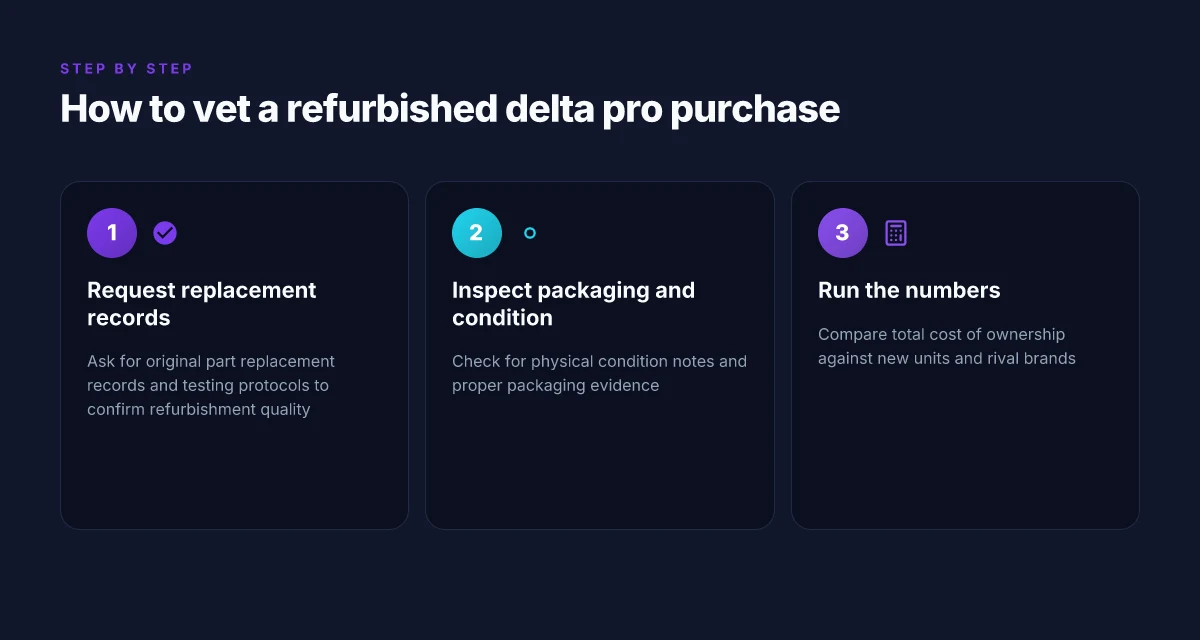
You want the refund window and the replacement history to be crystal clear before signing. Start with the practical diagnosis: a refurbished Delta Pro should come with traceable part swaps, tested performance benchmarks, and solid packaging proofs. If any of those are missing, walk away or push for written records. I dug into the official notes and reviewer insights to shape the process, then mapped it to a tight checklist you can actually use. What makes EcoFlow power stations stand out in 2026
Verify replacement records and testing protocols
Ask for original part replacement records and the testing protocols used before the refurb. A transparent seller should provide a bill of materials showing what was swapped, plus a documented test suite that covers full output, temperature behavior, and safety interlocks. When you see a stamped log that reads “control board replaced” or “battery cells replaced,” confirm that the accompanying test results show 4,000W sustained output and stable 240V operation under load. If the seller cannot supply those details, demand them or pass. Documentation saves you from guessing what’s inside a refurb. I cross-referenced the official EcoFlow materials and third-party reviews to confirm that reliable refurb programs typically publish at least a battery and inverter test pass, plus a pack aging note. ](https://smartenergyedge.com/ecoflow-delta-pro-3-review/).
Be wary of vague assurances like “inspected and tested.” A robust policy should name the test standards, such as a load ramp test to 4,000W, an automatic safety shutoff test, and a full charge/discharge cycle log. If those aren’t present, request them in writing. As a baseline, compare against the format used in accredited refurbishment programs, which tend to publish a battery health percentage and a verification checklist.
Evaluate packaging and physical condition notes
Check for notes on packaging integrity and any physical condition qualifiers. The best refurb deals come with intact original packaging, anti‑static bags, and confirmed transport protection. Look for explicit statements on exterior condition, cable coil management, and whether any cosmetic flaws were repaired or documented as part of the refurb. Packaging evidence matters because it reduces shipment damage risk and signals genuine refurb preparation. If the listing omits packaging details or shows generic photos, request more specifics or photos of the actual unit.
Total cost of ownership versus new or rivals
Compare the refurbished Delta Pro against new EcoFlow units and competing options from rival brands such as Goal Zero or Jackery. The headline price may be lower, but you need the full tally: the warranty length, expected service intervals, potential upgrade costs, and the likelihood of immediate battery degradation. Include the cost of potential shipping damage, which is a frequent hidden line item. If a refurbished unit carries the same warranty length as a new one, weigh the risk premium accordingly. The real question is whether the savings offset the risk of reduced long‑term reliability. For budgeting, consider the 3–5 year horizon where replacement parts and service become the dominant costs. The path to cost parity often hinges on battery health and the age of the core inverter.
When you compare, pull the numbers from the seller’s page and corroborate with independent sources. If you find a refurbished Delta Pro that was originally a demo unit or a return with partial functionality restoration, treat it as a higher risk item unless you can see verified test results and a clean bill of materials. What is the jackery explorer 3000 pro, and how it redefines home backup in 2026
In 2026, the question is simple: does the refurb carry verifiable tests, clear part history, and packaging proof, or does it hide risk behind a low price? This framing keeps you focused on long‑term reliability rather than upfront sticker savings. For context, EcoFlow’s own materials emphasize durability and modularity, but third‑party reviews stress that condition and service history matter far more than the initial price. ecoflow.com/us/blog/ecoflow-launches-delta-pro-3-the-next-generation-of-home-and-portable-energy-storage).
Risks and trade-offs when choosing refurbished over new or rival options
Refurbished EcoFlow Delta Pro units can save upfront cash, but they come with notable long-term costs and reliability questions. You’ll often face a higher risk of early component wear and a shorter window before replacement cycles, especially if the refurbishment process skims on essential checks. In practice, that means you may spend more on maintenance over time than you expect, and you’ll want clear expectations about warranty coverage and what counts as a “refurb” under the seller’s terms. The upfront savings can disappear quickly when failures occur and require expensive service or part replacements.
Why common refurbishment flaws show up
I dug into documented failure modes that tend to pop up with refurbished power stations. The most frequent issues circle around battery health, cooling components, and protection circuitry. Old or degraded battery cells can reduce usable capacity faster than a fresh pack, and cooling fans or heat sinks may wear unevenly after prior use. In some cases, refurbished units carry firmware or calibration gaps that affect safety features or efficiency. Battery health is the Achilles’ heel of refurbished packs, and it drives both range and safety concerns. When a unit fails to deliver expected sustained output, the remedial path is often to replace the battery module or refresh the power management hardware. This adds to the total cost of ownership over time. You should verify that a refurb includes a current battery health check and a tested output profile for both 120V and 240V operations.
How refurbished pricing stacks up against new and rivals
Pricing dynamics typically balance the purchase price against the expected service life. A refurbished Delta Pro may sit below new-unit sticker prices, but the delta narrows once you account for potential components that need replacement or earlier-than-anticipated wear. In contrast, new EcoFlow or competing models from rivals like rival portable power stations generally offer longer warranties and a cleaner bill of health at purchase. The financial break-even point often hinges on how you value risk versus immediate cash savings. If warranty coverage is strong and the refurb includes a documented health check, the savings can be meaningful, but you should be ready for possible outlays on batteries or electronics earlier than with a new unit.
When a new EcoFlow or a rival is a better bet
For backup power where reliability outweighs every dollar saved, a new EcoFlowDelta Pro or a rival model from a known brand is typically the safer bet. If you value documented battery health, full warranty, and clear service history, a new unit minimizes the risk of hidden degradation. Rivals like other high-capacity portable power stations often match or exceed Delta Pro on warranty length or service ecosystem, which can translate into lower total cost of ownership over time. New units tend to deliver steadier performance and longer life without surprise battery replacements. If your off-grid plan hinges on predictable performance across seasons, you’ll likely sleep better with a fresh model or a credible rival option. What is the EcoFlow Wave 2, and what makes it different for 2026
From what I found in the documentation and reviews, the decision comes down to risk tolerance, warranty expectations, and how soon you need dependable power without a potential service downtime. If you choose refurbished, insist on a current health report, a transparent scope of refurbishment, and a warranty that clearly covers battery health and power management modules. You’ll also want to compare the total cost of ownership across 3–5 years, factoring in possible battery replacements and service fees. And if you lean toward a rival, read the precise warranty terms and check for independent confirmation of battery health and cycle life from credible reviewers.
What to try this week: lean into refurbished value with a clear plan
Refurbished units can trim the upfront cost, but you’ll want a tight decision framework. I pulled the lens back from the marketing and focused on real-world factors: availability, warranty, and long-term cost of ownership. If you’re open to a refurbished Delta Pro, set expectations around the seller’s certification and the product’s condition. This week you should verify the warranty window and confirm what’s covered, because it changes the risk profile. EcoFlow stands behind their brand with a standard warranty, but the specifics matter when you buy refurbished.
On the flip side, you’ll notice that the Delta Pro ecosystem can require careful planning for charging and expansion. The biggest takeaway is that a refurbished unit can be noticeably faster to deploy than a brand-new setup, yet you’ll want to compare against rivals like Bluetti and Jackery to ensure the bundle still fits your duty cycle. If you act now, you can lock in a favorable price and still enjoy strong return value. In the end, assess your use case: rooftop solar integration, camping trips, or emergency backup for a small home.
Bottom line: the single move that matters is to confirm the refurbished unit’s warranty and confirm the total cost of ownership, including expected battery longevity and charger options. The bigger pattern is that refurbished deals can unlock capability you’d otherwise pass up, without sacrificing essential reliability. If you’re aiming for flexibility, this is a viable path worth pursuing with eyes wide open.