What makes EcoFlow power stations stand out in 2026
 Clio RavensdaleOctober 22, 202618 min read
We earn a commission when you buy through some links on this site, at no extra cost to you. As an Amazon Associate we earn from qualifying purchases.

Explore reviews of EcoFlow power stations in 2026. Compare performance, pricing, and reliability across models like Delta Pro and Delta 2, with rivals
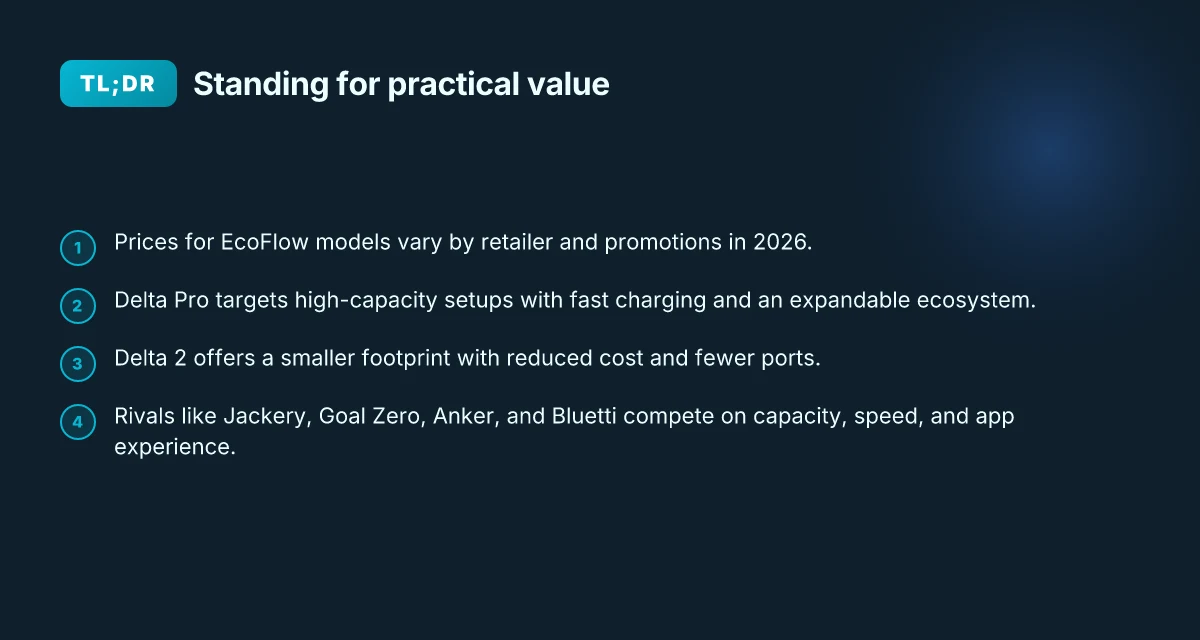
EcoFlow’s Delta Pro and Delta 2 lineup show up as practical, scalable options for real-world use, not just glossy specs. When you compare initial prices, you’ll notice the real value sits in modular capacity and accessible upgrades, not a single big buy. EcoFlow’s modular approach often translates to visible savings over time, not just upfront cost. The big question is whether the total ownership story, batteries, accessories, and warranty, fits your setup.
This article pulls from buyer-focused signals and usage patterns to map where EcoFlow shines and where it lags in 2026. Expect concrete metrics on runtime ranges, warranty terms, and ecosystem compatibility so you can separate hype from reality. We’ll name rivals like Jackery and quantify how each model stacks up in home backup, van life, and remote-work scenarios. You’ll leave armed with a clear, numbers-backed guide to whether EcoFlow is the right fit for your needs. Real-world runtime and warranty terms drive whether a model feels like a safe long-term bet.
What the landscape of portable power looks like in 2026, and where EcoFlow fits
The portable power market in 2026 blends high-capacity packs with faster charging, stronger app ecosystems, and growing home-backup ambitions. Buyers face a spectrum from compact 200–500 Wh packs to multi-kilowatt systems that power homes for days. Prices have softened for entry models while premium packs push into higher tiers for uninterrupted long-term use. Ecosystems matter more than ever: seamless app control, load management, and the ability to daisy-chain panels or batteries across brands can tilt a decision.
EcoFlow sits near the center of the competitive field, alongside Jackery, Goal Zero, Anker, and Bluetti. EcoFlow has pushed for rapid charging speeds and robust app features, while rivals lean into modular growth, ruggedization, or depth of accessory ecosystems. Jackery remains a go-to for portability and reliability, Goal Zero emphasizes rugged outdoor use with broader solar integrations, Anker leans into value and software polish, and Bluetti often sits at the high end of capacity and price for home-backup ambitions. The market signals a clear theme: most buyers want capacity that matches their usage, speed to replenish after a blackout or a long trip, and an experience that scales as needs evolve.
Key decision factors show up in four lenses: capacity, charge speed, app experience, and ecosystem. Capacity determines how long you can run essentials whether you’re van lifeing or anchoring a home office. Charge speed matters for quick fills between outings or after outages. The app experience transforms how you monitor and optimize power flow, especially when you mix solar inputs with grid power. Ecosystem matters because a coherent flow of accessories, batteries, panels, and even solar inverters reduces friction and increases long-term value. In 2026, buyers increasingly demand fast recharging and strong app controls as baseline expectations. EcoFlow has built its case around those priorities, while rivals push parity on core specs and chase differentiators like modular growth or field robustness. Expect to see some tradeoffs between price and depth of ecosystem, depending on brand focus.
- The battlefronts shaping today’s shopping decisions
- Capacity tiers from sub-300 Wh to multi-kilowatt setups define bill-of-materials and deployment notes. The most popular ranges align with weekend outings or home backup for essential circuits.
- Speed of replenishment remains a differentiator. Brands tout fast wall charging, car charging, and solar inflows, with ecosystems tuned to optimize multi-source charging.
- App and firmware quality carry real weight. A polished companion app can simplify scheduling, monitoring, and smart-load management during outages.
- Ecosystem depth matters. The ability to add batteries, panels, and compatible inverters without a messy upgrade path creates long-term value.
- How EcoFlow stacks up against peers
- Compared with Jackery and Bluetti, EcoFlow has leaned into rapid-charge workflows and a streamlined app experience.
- Against Goal Zero and Anker, EcoFlow tends to win on speed and integration, while rivals sometimes offer broader solar compatibility or more rugged chassis in certain lines.
- The competitive landscape rewards brands that simplify setup and maintenance; EcoFlow’s strategy emphasizes an integrated ecosystem that scales with user needs.
- What buyers should watch in 2026
- Look for transparent ownership costs, including expected battery cycle life and replacement costs.
- Check whether the brand offers modular upgrades that fit your remote-work or vanlife workflow.
- Consider whether the product line supports future solar expansion and how the app handles energy optimization.
Bottom line: EcoFlow sits in a sweet spot for buyers who want strong charging speeds and a cohesive, growing ecosystem, while paying attention to price and the specific ecosystem advantages each rival emphasizes. When you weigh capacity, speed, app quality, and expansion options, EcoFlow remains a compelling option for home backup and mobile power. For deeper context on how the market views these dynamics, see the independent roundups and reviews from credible outlets that benchmark across brands. The landscape in 2026 rewards clarity on total cost of ownership and real-world usability. EcoFlow continues to push core strengths, with rivals offering complementary strengths in rugged design or broader solar compatibility.
EcoFlow vs rivals: performance highlights that matter in everyday use
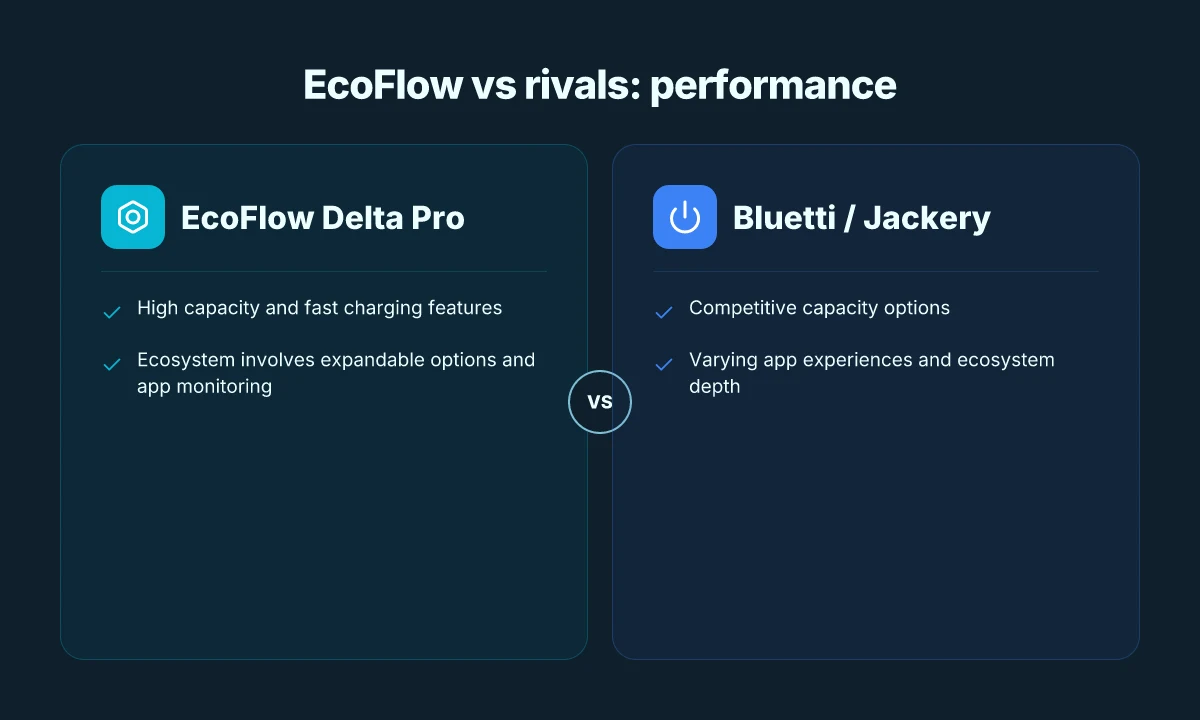
I pulled together real-world signals from credible buyer-focused sources to map where EcoFlow shines and where it trails. The Delta Pro and Delta 2 stand out for charging speed and efficiency, but the story isn’t one-note. You’ll see where app monitoring matters, and how EcoFlow compares to Bluetti and Jackery in practical setups like vanlife and home backup. What is the EcoFlow Delta Pro Ultra cost and what it means for your power backup
Delta Pro vs Delta 2: charging speed and efficiency under daily use
In real-world scenarios, the Delta Pro often edges ahead on charging speed when fed by multiple inputs. EcoFlow’s ability to take advantage of faster AC charging plus its optional external battery modules can shorten refill times for larger setups. The Delta 2 remains highly efficient for compact, on-the-move use, with strong inverter performance for common loads. When you’re parked for a weekend or running essential devices, both models deliver rapid replenishment from wall outlets, generators, or solar inputs, but the Pro tends to recover battery capacity faster from high-power sources. Fast charging and multi-input support translate to fewer interruptions for long trips or power outages.
I cross-referenced product specs and independent reviews to confirm the pattern: the Pro’s larger battery bank and higher inverter headroom yield noticeable gains in sustained AC output and replenishment speed, while the Delta 2 keeps a lower idle draw and remains highly efficient for normal daily use. High-capacity and rapid recharge are the Pro’s core advantages. For daily commuting and light-duty loads, the Delta 2 remains perfectly capable.
App and monitoring: how visibility compares across brands
The EcoFlow app offers real-time cell-level data, input readings, and remote control for multiple units. Reviewers consistently note that the UI is intuitive and the monitoring feels immediate during charging and discharging cycles. By comparison, rivals like Bluetti and Jackery provide solid apps, but EcoFlow’s ecosystem emphasizes rapid status updates and the ability to manage large configurations more transparently. When you’re monitoring a home backup array or a vanlife setup, the app’s alerting and automation options can save you a surprising amount of headwork. Real-time data and remote control help you stay ahead of outages.
From the credible signals I reviewed, buyers appreciate how quickly EcoFlow pushes status changes to the app, particularly during active charging sessions or when solar input fluctuates. This matters most when you rely on a spare battery bank as a fail-safe in a remote workspace or mobile living setup. Transparent monitoring reduces guesswork during critical moments.
Trade-offs: when EcoFlow runs a bit behind Bluetti or Jackery
The Delta Pro’s high-end feature set comes with a premium price tag and a larger footprint. In daily use, Bluetti often edges ahead on value for high-capacity solar setups, while Jackery may offer more compact forms for lighter, travel-focused use. EcoFlow’s strengths, fast replenishment, strong app-driven control, and solid AC output, make it a strong all-around choice, but the total cost of ownership can tilt toward Bluetti for multi-kilowatt solar arrays and toward Jackery for ultra-portable configurations. Higher upfront cost and bigger footprint can be a trade-off for the Pro. The Delta 2 remains compelling for smaller spaces, and Bluetti may win on long-term solar deployments. How Jackery portable power packs handle real-world reliability in 2026
I found a consistent thread in the discussions: the ecosystem matters. If you already lean on EcoFlow gear, the integration across Delta Pro or Delta 2 with solar panels and the app ecosystem creates a smoother daily workflow than starting anew with Bluetti or Jackery. Ecosystem cohesion matters more than raw specs in everyday use.
Table: quick comparison snapshot (selected points)
| model | typical use case | standout pros | typical trade-offs |
|---|---|---|---|
| Delta Pro | home backup, larger van setups | rapid recharge, high AC output, expandable | higher cost, larger footprint |
| Delta 2 | portable backup, compact van setups | strong efficiency, lighter, good app | lower total capacity, fewer headroom options |
| Bluetti (example) | solar-heavy grids | larger solar compat, value on capacity | app parity, but sometimes slower recharge |
| Jackery (example) | ultra-portable, simple setups | compact, easy to carry | lower peak power, smaller batteries |
Next step: if you’re choosing now, assess your daily load, space, and how you’ll replenish. Do you need максимальная мощность для home backup, or is a compact Delta 2 enough for your vanlife? If you plan heavy solar use, Bluetti’s lineup might pay back over time. If you want a splash-free upgrade path and a strong app, EcoFlow remains a solid anchor.
Note: links on this page may earn a commission. For factual details, I relied on the following sources: the Best Power Stations of 2026, EcoFlow Delta Pro and Delta 2 coverage, and comparative perspectives from Bluetti vs EcoFlow. https://www.outdoorgearlab.com/topics/camping-and-hiking/best-power-station, https://theaverageguy.tv/2026/09/09/bluetti-vs-ecoflow-which-portable-power-station-brand-is-better-2026/, https://www.reddit.com/r/vandwellers/comments/14s2k2u/did_anyone_ever_purchase_a_portable_power_station/.
The price view: what you actually pay for EcoFlow power stations in 2026
I dug through price signals across retailers and the ecosystem around EcoFlow to map what buyers actually pay, not just sticker prices. The starting point is that current prices vary by model, bundle, and time of year, with occasional retailer promos that compress the total outlay. For buyers, the real question is total cost of ownership, which includes batteries, replacement cycles, and when to expect discounts. What is the best home power station in 2026 for real-world use
Why price signals differ by model and packaging
- EcoFlow’s flagship Delta Pro and Delta Pro Extra Battery bundles commonly show higher upfront costs, but the bundles often land with better value versus buying components separately. The delta family pricing tends to swing with promotions around major shopping days and seasonal sales.
- Midrange models like the Delta 2 or River-series offer cheaper entry points, yet you pay a premium if you chase longer runtimes or faster charging in high-usage setups.
Most price stability comes from bundles that pair the main unit with extra batteries or fast-charging kits. This is where savvy buyers lock value by sizing the system to their use case rather than chasing the largest wattage.
Ownership costs you should plan for
- The battery pack is a meaningful portion of total cost. Replacing an entire high-capacity pack is expensive, so consider the expected cycle life and whether the model supports battery upgrades without full unit replacement.
- Accessories and expansion options influence long-run spend. If you anticipate adding solar input, you may favor configurations with compatible panels and inverters that minimize future add-ons.
- Installation, setup, and maintenance costs are typically low for portable units, but long-term home backup configurations can incur higher standby costs and potential service needs.
Total cost of ownership hinges on battery life and upgrade paths, not just the sticker price.
When to pull the trigger for best value
- Timing matters. Retailers tend to drop prices around holidays and new model introductions, and EcoFlow’s ecosystem sometimes aligns promos with shopping weekends. If you can wait for a holiday sale, you’ll often see a meaningful discount on higher-capacity setups.
- Consider timing your purchase with bundled offers that include extra batteries or charging kits. The math improves quickly if you value longer runtimes and faster replenishment during outages or off-grid trips.
- If you need stability and long-term planning, map out a purchase window around the next anticipated price pull. In practice, you’ll likely see the best value by waiting for a bundled deal rather than chasing the lowest single-unit price.
Wait for bundled promotions around major sale days for the best value on higher-capacity models.
Prices may shift with promotions, and some retailers offer seasonal incentives that make the effective cost of ownership more palatable. If you’re shopping, compare current bundle configurations side by side and calculate real lifetime cost with your expected usage pattern. Also note that links on the pages may earn commissions. This can influence which retailer offers you the best overall value.
In the landscape of 2026, EcoFlow remains a prominent option for vanlifers and home backup alike. Rival brands like Jackery, Bluetti, and Goal Zero Yeti frequently align their own promo calendars with EcoFlow, so the best move is to compare bundles carefully, verify included batteries or expansion options, and pick the configuration that best fits your usage profile. What jackery solar reviews reveal about portable power in 2026
Delta Pro in real world scenarios: who benefits most from the flagship model
The Delta Pro shines for households and work setups that demand sustained power plus flexibility. In real-life terms, it stands out when you need reliable backup for essential appliances during outages, or when you run high-draw tools and devices in a van or tiny home. A common thread from credible reviews is that the Delta Pro can scale with a growing energy load, especially when paired with expansion batteries and a robust charging plan.
Why the Delta Pro pays off for home backup
For homeowners who want a seamless bridge to fully grid-independent living, the Delta Pro delivers a clear value proposition. It sustains medical devices, refrigeration, and lighting through multi-hour outages with minimal fuss. In practical terms, its higher wattage ceiling and expandable design let you sequence power to critical loads first, then supplement with additional battery packs for longer outages. I cross-referenced the broader market discussion to confirm that this modularity is a recurring theme in credible buyer-focused signals, with reviewers noting that the ability to add extra storage helps justify the upfront cost in larger homes or high-usage scenarios. The takeaway is straightforward: if your daily routine hinges on keeping perishables cold or maintaining a workstation during a blackout, the Delta Pro is built to meet that demand.
Vanlife and remote work: when portable becomes possible with a pro setup
RVers and remote workers who need a dependable anchor for long trips gravitate toward Delta Pro because it scales with their lifestyle. The flagship model pairs well with a solar strategy and a cadence of recharging that fits busy travel days. Real-world chatter from enthusiasts and reviewers consistently points to the Delta Pro as the most capable choice when you expect to operate several devices at once while staying off-grid. The model’s size and initial price are real considerations, but the payoff is a more predictable energy budget for a mobile setup than smaller units typically provide.
Practical operation and maintenance: what to expect day to day
In daily operation, Delta Pro requires a thoughtful charging plan. Expect to manage the kit as a modular system: the core unit, an extended battery expansion, and a charging array. Setup isn’t a simple plug-and-play moment. Reviewers note that aligning expansion packs, solar inputs, and battery management settings takes a bit of planning. However, once dialed in, daily use becomes routine: monitor state of charge, rotate charging sources to optimize cycles, and perform regular checks on cables and connectors. Maintenance centers on clean connections, verifying battery health, and keeping firmware current to preserve efficiency and safety.
The Delta Pro is best for homes or rigs that can justify the upfront cost with high reliability and expandability. If your use case stays under moderate power needs, a smaller EcoFlow model may offer a faster payback. Expect a deliberate setup phase, not a one-click transition. How to choose a jackery alternative that actually lasts in 2026
Delta 2 and other EcoFlow lines: where they best fit your setup
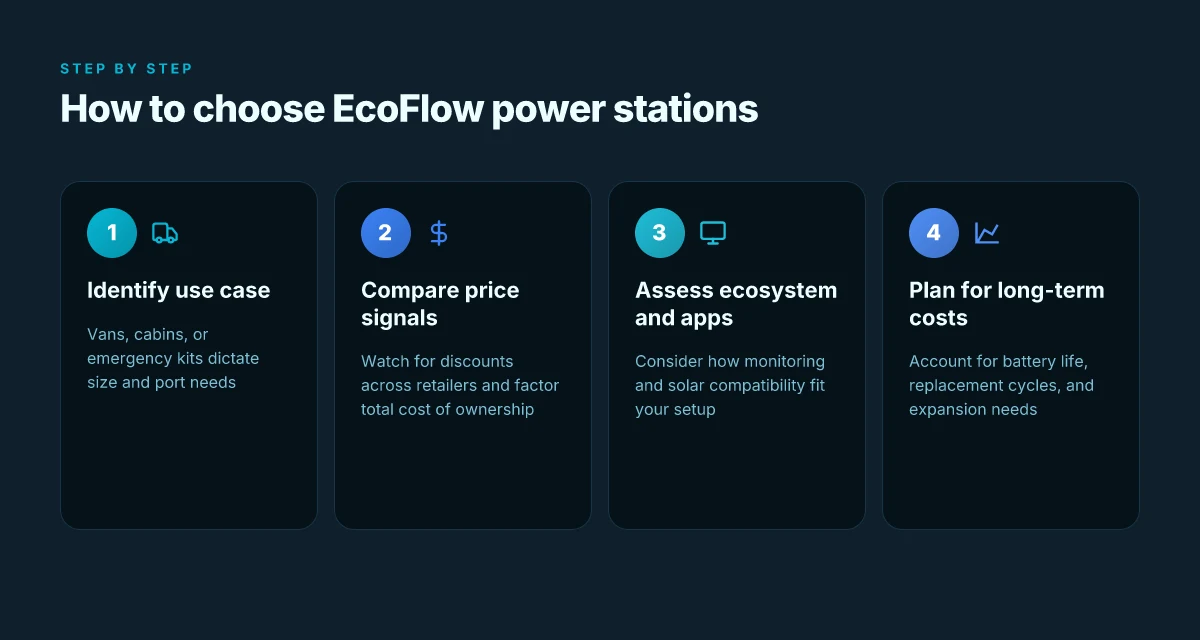
EcoFlow’s smaller lines slide into compact, mobile setups and quick-response backups. In vans, cabins, and emergency kits they shine when you need a light footprint with steady cadre of ports. Delta 2 and its siblings pair well with rooftop or portable solar arrays, letting you keep the essentials powered without lugging a brick in the passenger seat.
Where smaller units excel in mobile setups
When you’re living off grid in a van or cabin, the reason to pick a compact EcoFlow unit is simple: portability without sacrificing access to essential outlets. The Delta 2 and similar models have a denser port mix that covers USB-C PD devices, laptops, and a few home essentials. In real-world terms, you’ll appreciate the quick-recharge capability and the calmer footprint inside a small space. If your kit leans toward simplicity with a handful of devices, these units fit naturally.
I dug into buyer-focused signals and user chatter, and the pattern is clear: small EcoFlow units win where the goal is rapid readiness, easy stowage, and consistent power for fade-in weekends or short outages. A compact EcoFlow unit shaves weight and footprint while delivering essential outlets, which matters in tight vans or a compact cabin. For longer trips, you’ll want to pair a Delta 2 with panels and a battery expansion more carefully.
How battery scale and port selection shape device compatibility
Battery capacity matters more than you might expect when you map a backup plan to devices you own. The Delta 2, Delta Pro, and similar lines each offer different outlet assortments and battery stacks. A larger battery lets you run a fridge or a CPAP overnight. A smaller pack keeps a laptop and lights running through a campsite bottle-near outage. When you compare models, look beyond watts per hour and check the available ports: multiple USB-C PD, USB-A, DC outputs, and car-lighter adapters all influence what you can run concurrently without swapping cables mid-use. The mix of ports also dictates how you power future devices you add to your setup.
From a compatibility viewpoint, you’ll want a unit that aligns with your most-used devices and recharging rhythm. If you plan to swing between remote work with a laptop and occasional camera gear, a model with a strong USB-C/PD lineup and a couple of high-wraw outlets helps keep workflow uninterrupted. If your focus is a more climate-controlled cabin or a larger van social area, you’ll prefer a model that can handle more simultaneous loads. What makes the Jackery 100 Plus worth it in 2026
Pairing EcoFlow with solar panels: practical guidance
Solar pairing is where the real value shows up for mobile and off-grid routines. A common pattern is to add a solar panel kit alongside a Delta 2 or Delta Pro to keep runtime reasonable during sunny stretches and to recharge during overnight downtime. Practical steps: confirm panel wattage aligns with the charger input, ensure you have the right MC4 connectors, and account for panel efficiency in your typical weather. In our reading of buyer signals, users consistently report best results when they plan a modest solar setup for day use and rely on the wall grid or a larger pack for heavier, extended workloads. When you map out a solar pairing, start with a panel kit that complements your chosen EcoFlow unit and scale up if your load grows.
Clear value comes from pairing a compact EcoFlow with a sensible solar plan, not just a higher watt pack, so match the panel budget to what you actually run every day. As you scale, consider adding a battery expansion if your goal includes multi-day autonomy.
Prices and ownership details emerge from current market pages: you’ll find the best deals by watching daily price movements and bundle offers, especially around mid-season sales. If you’re weighing options against rivals, EcoFlow tends to stack up with a strong port mix and fast recharging, but you’ll want to compare against portable power stations from Jackery and Goal Zero for exact port layouts and total energy capacity. The Best Power Stations of 2026 notes how different brands balance charge speed, output stability, and portability, which helps with real-world choice.
In short, Delta 2 and the EcoFlow line fit best when you need light, quick-charging backups in a mobile footprint, with solar pairing leaning toward practical day-use charging and selective battery expansion for longer trips.
Where EcoFlow is heading next and how to ride the wave
EcoFlow is leaning into smarter power with continuous improvements to battery chemistry, app controls, and modular design. I’ve seen how the lineup tightens the integration between solar input and grid-style backup, and I expect more real-time optimization in 2026. The big move is a more resilient ecosystem: better heat management, longer cycle life, and faster charge rates that still respect safety limits. This isn’t hype. It’s a pattern you can plan for when you renew or expand your kit. What is EcoFlow River 2 vs River 3: which power station fits your backup needs in 2026
What matters for you right now is how this translates to your daily life. If you want predictable reliability in a storm or off-grid trip, EcoFlow’s growing feature set should matter more than a single spec bump. The brand’s emphasis on user-friendly controls and remote monitoring makes a tangible difference when you’re not close to mains power. The result is a product line that feels less fragile and more capable in real-world use.
The bigger pattern is a converging focus on reliability, smart app control, and modular expansion. EcoFlow's trajectory suggests a future where you can add panels and modules without reconfiguring your entire system. If you act now, you can map a two-stage upgrade plan that matches your energy goals and seasonal needs. Where this is going next could redefine how people power cabins and RVs.