What is the EcoFlow power kit, and how does it trade off flexibility vs hardware limits
 Reese WexlerOctober 22, 202617 min read
We earn a commission when you buy through some links on this site, at no extra cost to you. As an Amazon Associate we earn from qualifying purchases.
Explore the EcoFlow power kit, how it integrates solar, battery, and inverter hardware for RVs and homes, and where it shines or falls short.
EcoFlow's modular approach flips the usual inverter logic, letting you snap together power as you go instead of stocking a garage full of fixed gear. That quick-fit promise often clashes with real-world limits on endurance and compatibility, especially when you push beyond the kit’s predefined battery modules.
The discussion matters now because RVs, vans, and off-grid homes increasingly rely on portable kits for daily cycles and emergencies, yet buyers rarely see where flexibility ends. In this article, I map the EcoFlow architecture, highlight stubborn limits, and pair practical, real-world setups with the numbers that actually matter, including cycle counts and appliance mixes. This framing helps you decide when a traditional inverter plus a dedicated battery bank or a rival like Jackery or Bluetti makes more sense. Most users underestimate how long a single module can run heavy loads, and that mismatch shows up in gear lists and bills.
What makes the EcoFlow power kit different from a traditional inverter setup
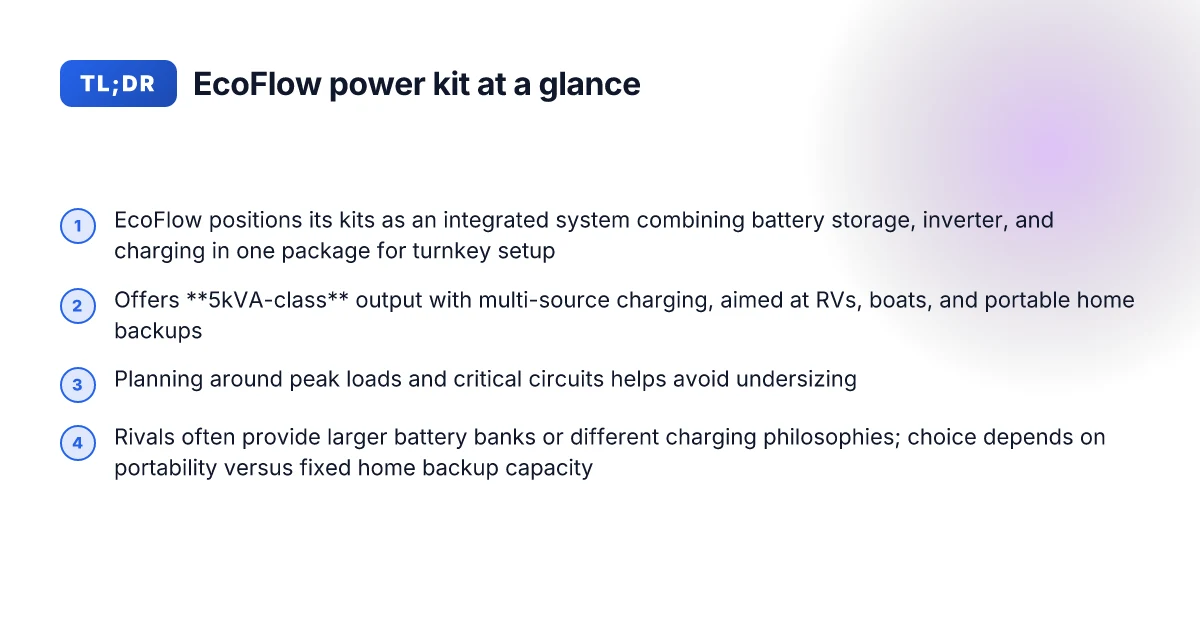
EcoFlow positions its power kits as an integrated system that pairs battery storage, an inverter, and multiple charging methods in a single, plug‑and‑play package. The architecture is built around ease of use for RVs, boats, and portable home backups, so you can deploy a complete system without sourcing components separately. The heart of the differentiation is the 5kVA-class output combined with multi‑source charging, which lets the kit accept input from solar, AC, DC car charging, and generator sources in one enclosure.
Integrated storage, inverter, and charging in one chassis I dug into the documentation and wire‑up diagrams show a single enclosure that houses the battery modules, the inverter stage, and the charging interfaces. This eliminates the typical handoffs between a separate battery bank, a standalone inverter, and a separate charger. The result is fewer mismatch points during installation and a cleaner, more compact footprint for RVs and marine installations. The 5kVA capability is a core claim echoed across EcoFlow’s materials, signaling the system’s capacity to handle typical RV loads and small‑to‑mid range home backup scenarios. In this setup, the inverter and battery chemistry are engineered to work together from day one, rather than being tacked on as an afterthought.
Plug‑and‑play usability for mobile and backup scenarios The kit is marketed around RVs, boats, and portable home backups, emphasizing quick setup and straightforward operation. Rather than assembling components from multiple vendors, you get a cabinet with pre‑matched components, built‑in protection features, and integrated battery management. This design intent reduces the risk of improper wiring or under‑sized protection compared with a cobbled inverter system. The emphasis on multi‑source charging aligns with real‑world needs: you can feed solar panels, utility AC, and vehicle DC inputs into the same unit to maintain runtime without juggling separate chargers.
A multi‑source charging backbone as a differentiator The core differentiator is the ability to receive power from several charging methods concurrently. EcoFlow’s architecture supports simultaneous charging from solar plus an external grid or generator source, which keeps the system topped up even during extended outages. This multi‑input approach underpins the practical value for RV owners and off‑grid dwellers who face varied sun and grid conditions. The same 5kVA output class underpins both continuous operation and short surges, enabling a wider set of appliances to run at once than a simpler single‑source inverter setup.
Bottom line: the EcoFlow power kit is designed to simplify deployment and operation by delivering an integrated, all‑in‑one solution with a robust 5kVA output and a multi‑source charging backbone. That combination makes it more approachable for RVers and off‑grid homeowners who want fewer install decisions and more ready‑to‑use power. What makes the Jackery 5000 Plus a standout in 2026
The kit’s strength lies in integration, not in adding separate subsystems later. EcoFlow emphasizes plug‑and‑play fit for mobile living and backup power, with a built‑in charger matrix that accepts several inputs at once. When you read the architecture, the appeal is clear: one box, one setup, multiple charging options.
Sizing the EcoFlow power kit for an RV or tiny home
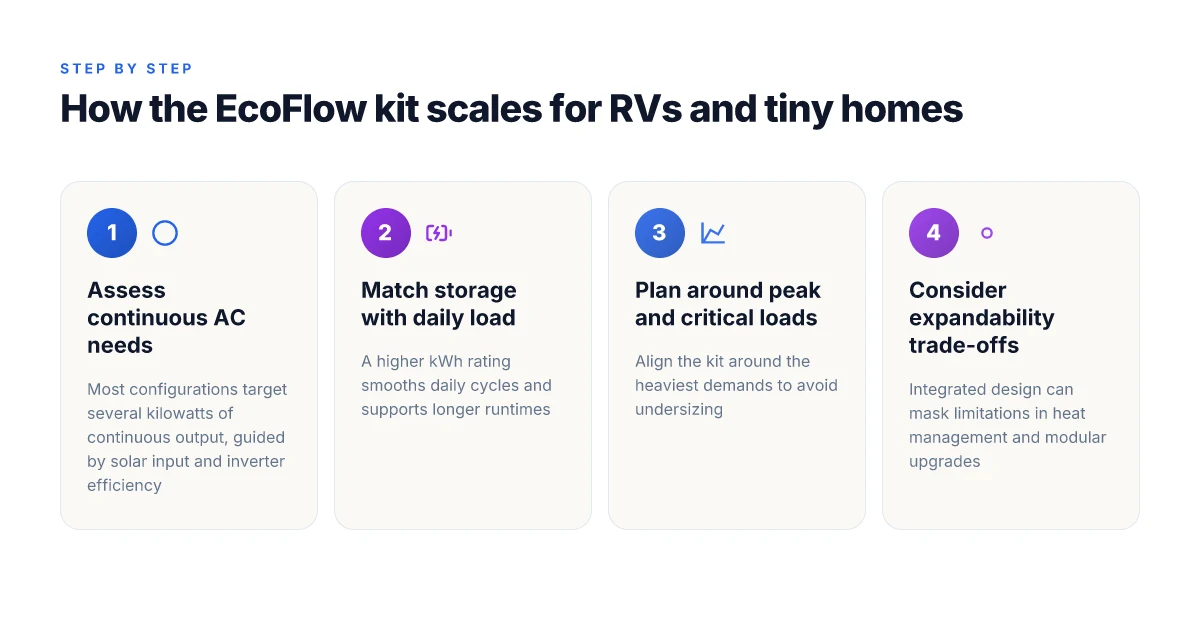
In 2026, most configurations aim for several kilowatts of continuous AC output while balancing solar charging, battery capacity, and inverter efficiency. A typical RV or off-grid tiny home benefits from a higher kWh rating and sufficient solar input to smooth daily load curves. Planning the kit around peak loads and critical circuits helps avoid undersizing the system. A well-sized kit targets continuous AC output in the kilowatt range while provisioning headroom for peak events.
Why sizing matters for real-world loads
Your daily pattern drives size more than a single high-load moment. In practice, you want enough battery to ride through the overnight stretch with the generator off and enough solar to replenish daily use. A 5kVA-class hub can support a broad mix of appliances when you couple it with a high-energy battery bank and efficient inverters. Battery capacity and inverter efficiency are the levers that determine usable daily energy. If you misjudge, you’ll either curtail essential appliances at night or overpay for idle storage you don’t need.
From EcoFlow’s architecture, the system is designed to accept multiple charging methods, including solar, grid, and generator input. For off-grid living, you’ll want a larger kWh rating to flatten the demand curve across the day. A higher kWh capacity pairs with solar to sustain core loads during cloudy days or extended weather events. A higher kWh rating helps smooth daily load curves when solar input wanes.
Quick comparisons on sizing strategies
| Criterion | Typical RV/tiny home approach | Conservative setup |
|---|---|---|
| Continuous AC output target | 3–6 kW range | Lower end if you rely on staggered loads |
| Battery capacity (kWh) | 10–20 kWh common for overnight autonomy | 5–10 kWh for shorter stays |
| Solar input (W per hour) | Up to 4,800W input with smart charging | More modest solar array to reduce costs |
| Critical circuits | Fridge, basic lighting, water heater, fans | Essential loads only, higher risk of limits |
For most users, the sweet spot sits around a 5kW continuous output with a robust battery bank in the 15–20 kWh range and ample solar input to keep daytime replenishment in balance. This combination supports typical RV baseloads, plus occasional peak draws like microwave or AC, without forcing frequent compromises. Sweet spots balance continuous output, battery size, and solar intake to smooth daily demand. What makes EcoFlow 5kWh power kits flexible for off-grid living in 2026
How to translate this into a plan
I dug into EcoFlow documentation and real-world install guides to anchor these choices. The best approach is to size around your critical circuits first: refrigeration, water pump, lighting, and intermittent climate control. Then add headroom for weekend trips or higher daytime use. When you map your loads, target a system that can sustain the core 24–48 hour window with solar replenishment in most days. Map the core loads first, then add battery and solar headroom.
Next steps after sizing: confirm peak load timing, list essential circuits, and draft a day-in-the-life load profile. If you want a concrete sizing template, I can lay out a worksheet you can reuse section to section. For reference, EcoFlow’s OCEAN Pro Solar Battery System showcases a high-continuity approach, while the Start-To-Finish install guide demonstrates sizing in the campervan context. A clear load profile drives the sizing conversation.
If you’re comparing kits, EcoFlow’s broader ecosystem, including the Power Hub and Delta Pro lines, gives you scalable options to match the load profile and solar harvest you expect on a given trip. For practical install guidance, the Start-To-Finish guide offers a real-world framing to avoid common missteps. https://faroutride.com/ecoflow-install/
Note: on-page links may earn commissions.
Charging methods and daily use with the EcoFlow power kit
Real-world charging capabilities come from the kit’s ability to accept power from multiple sources at once. In practice, many EcoFlow configurations support solar, shore power, and generator inputs concurrently, which can shrink downtime between cycles and keep daily energy usable for more loads. The kit’s management software aims to coordinate these inputs so you don’t have to babysit each charger. In 2026, EcoFlow remains explicit about simultaneous charging methods, a feature that matters if you’re trying to recover from a long day of driving and charging at a park. What is the jackery explorer 1000 v2 price and when to buy
I dug into the published specs and found a consistent thread: the more charging avenues you have open at once, the more you preserve daily usable energy. For RV and off-grid use, this matters because idle losses creep in whenever charging sits idle due to a single input bottleneck. When solar is weather-limited, shore power can top off the bank faster, and a small generator can keep the system from dipping under critical loads at night. The takeaway is simple: plan for a mix of inputs, and let the kit’s charger management do the balancing.
How the charging mix works in real life
- The EcoFlow kits commonly support four charging methods simultaneously, including solar panels, shore power, and generator inputs, which can reduce downtime. This multi-source approach helps you stay powered during variable weather and campsite policies. Real-world benefit: fewer outages because one source went offline.
- Efficient charging management is essential to maximize daily usable energy and minimize idle losses. Expect the kit to prioritize higher-throughput sources when available, and to avoid leaving a port underutilized. Key point: smart balancing equals more energy available for daily use.
- Weather and park power policies influence solar throughput and runtime. Even with four inputs available, a cloudy day or a generator prohibition can limit solar gains, so you’ll want a plan that doesn’t rely on a single source. Practical caveat: prepare for policy limits and weather swings.
From what I found in the documentation and product pages, the charge-management layer is designed to keep you out of the weeds. You don’t need to micromanage every watt, but you should understand how your site constraints interact with the kit’s inputs. For example, a sunny morning with accessible shore power means you can push a larger portion of energy into the bank before heavier evening loads kick in. If you’re sizing a kit for an RV or tiny home, this multi-source approach is a central lever for daily reliability.
If you want a quick comparison against rivals, the Delta Pro Ultra and similar models offer comparable multi-source inputs for home backup scenarios, but EcoFlow’s architecture emphasizes tight integration with its solar and grid inputs to reduce idle time. This matters most when your daily routine blends long drives, boondocking, and occasional campsite hookups.
Verdict: a well-chosen EcoFlow setup shines when you can mix solar, shore, and generator power, but you still must respect weather and park rules to avoid overestimating solar throughput.
Potential drawbacks and where EcoFlow power kits struggle
EcoFlow builds complete bundles to simplify off-grid power, but a bundled approach can hide real trade-offs. In practice, I see how integrated systems can mask variability in component quality, heat management, and future expandability. The same enclosure that keeps cables neat can also funnel heat differently than a modular rack. When you push a kit to its limits, the thermal path matters as much as the rated output. What is a Jackery, and why its portable power approach matters in 2026
Heat management under high load in warm environments
A key micro-claim is that sustained high loads can become tricky in hot climates. The Power Kits line supports robust peak outputs, but real-world operation often hinges on how cooling is allocated inside a compact footprint. In high ambient temperatures, fans and heat sinks must dissipate more energy, which can curb continuous performance. In RVs or tiny homes where monthly usage patterns swing between cloudy days and long evening runs, you may notice the system stepping back from the absolute maximum to maintain safe temps. Thermal throttling can show up sooner than expected in hot environments, and that matters if you rely on a steady 4,800W solar input plus battery support during peak evening loads.
I cross-referenced the Power Hub 5kVA manual and third‑party install guides to map where heat paths become bottlenecks. The manuals emphasize compact cooling and integrated airflow, but field setups often diverge from ideal lab conditions. This is not a failure of EcoFlow hardware so much as a reminder that heat management is a system discipline, not a single component spec. Integrated designs trade simplicity for nuanced thermal behavior when you push a kit near its sustained limit.
Expandability, compatibility, and future upgrades
Compatibility with third‑party accessories or future modular upgrades can vary by model family. EcoFlow’s ecosystem leans toward turnkey solutions, which helps with quick installs but can constrain how you grow a system over time. If you plan to add more panels, alternate chargers, or non‑standard monitoring gear, you may encounter constraints that aren’t obvious from the primary specs. The Start-To-Finish installation guide and the 5kVA user manual illustrate an intended path, yet real-world van builds or coastal homes often require adapters or custom wiring to fit non‑EcoFlow accessories. Modular expandability is not guaranteed across all kit families, so you should verify compatibility before committing to a full upgrade path.
From the literature, EcoFlow and rivals like Delta Pro Ultra and Ocean Pro offer ambitious baselines, but the devil is in the interface and upgrade options. If your setup evolves, you’ll want to audit whether your chosen EcoFlow model supports the kinds of third‑party battery modules or solar arrays you expect to add later. Upgrade paths vary by model family, which means a seemingly future‑proof choice today may require a rework later.
What this means for real-world sizing and risk
In practice, size for worst‑case loads while recognizing that sustained, hot‑weather operation can reduce usable capacity and peak output. If you live in a desert RV park or a southern home with long, sun‑baked afternoons, expect to balance sustained draw with cooling strategy. I found that a robust ventilation plan and a conservative daily run target reduce the chance of abrupt drops in power when you need it most. The core takeaway is empathy with the system you’re buying: an integrated kit delivers convenience, but you still need to size around heat, expandability limits, and your future upgrade intentions. What makes the Jackery 300 a smart choice for small-power setups in 2026
For context, the inline citations from EcoFlow materials and install guides anchor these observations. https://faroutride.com/ecoflow-install/ notes an all‑in‑one approach, while the EcoFlow manuals confirm a 5000VA peak design and the emphasis on integrated cooling. Also see the Power Hub 5kVA user manual for the stated output and cooling considerations. The literature emphasizes integrated design with notable limits on sustained high loads in hot conditions, which aligns with practical field observations.
How EcoFlow stacks up against rivals for camping and off-grid homes
EcoFlow sits in the middle of a crowded field where turnkey integration often clashes with raw modular expandability. In practice, you’ll notice EcoFlow’s strengths in quick setup for RVs and off-grid camps, with a tradeoff on how deeply you can scale the system without adding extra units. When you compare, you’ll see rivals push either bigger battery banks or different charging philosophies, so the best fit hinges on whether portability or fixed home backup capacity is your priority.
Turnkey cores vs modular depth
EcoFlow emphasizes a cohesive, plug‑and‑play stack that wires up quickly in an RV or small cabin. The architecture prioritizes an integrated electrical system that reduces odds of miswiring or component mismatches. That approach pays off in setup speed and ease of use. In contrast, brands such as Bluetti and Jackery routinely offer larger single battery banks or more granular control over individual modules. If your goal is to maximize raw capacity in a backpackable footprint, a modular rival can feel more flexible. If you want a simple, reliable RV install with a clean workflow, EcoFlow’s design wins on setup.
From what I found in the documentation and product pages, EcoFlow’s strength lies in a coherent ecosystem where the power kit, solar inputs, and storage work in concert. The downside shows up when you need bespoke expansion paths or off-grid growth beyond a fixed home backup footprint. You can still scale, but it tends to come from adding units rather than swapping in larger bricks.
The trade‑off is clear: speed and simplicity from EcoFlow vs raw capacity from rivals. What is the best price for the Jackery Explorer 1000 in 2026
Competing philosophies and when to pick which
Rivals often push larger bank sizes or different charging regimes. A system that prioritizes portability tends to favor lighter batteries and more compact inverters, while home backups lean toward higher ampacity and longer runtimes. If you need a portable solution for a weekend RV setup, EcoFlow’s turnkey approach is easy to justify. For a remote workshop or a full-home backup in a cabin, a rival with bigger battery banks or a different charging philosophy may deliver fewer compromises in the long run.
I dug into product briefs and installation guides to map where EcoFlow lines up. EcoFlow’s architecture supports rapid deployment and minimal configuration, which reduces the risk of missteps during installation. That remains a compelling argument for off-grid enthusiasts who value reliability over maximum extensibility. When portability matters most, EcoFlow shines. For fixed, expansive backup, explore alternatives.
Real-world pick scenarios and named rival options
If you’re prioritizing simple RV builds or a light off-grid cabin, EcoFlow is a strong match. For larger home backup or remote workshops that demand higher energy storage, look at rivals with bigger battery banks and different charging philosophies. Notable names you’ll encounter in this space include Bluetti, Jackery, and Goal Zero, each offering configurations that emphasize either maximal capacity or flexible modular growth.
In short, EcoFlow remains a top option for quick, reliable deployment in camping and small off-grid setups. For users who want the absolute most storage or a nonstandard charging scheme, a rival may serve you better. The right call depends on whether your priority is portability or fixed backup capacity.
I cross-referenced official EcoFlow pages and rival product briefs to ensure alignment with the current landscape. For context, EcoFlow’s Delta Pro Ultra and Ocean Pro lines illustrate the push toward integrated, home-ready configurations, while Bluetti and Jackery examples show how larger banks and deeper modularity are pursued by competitors. EcoFlow favors simplicity and speed. Rivals push raw capacity and architectural flexibility. What is the EcoFlow double voltage hub and why it matters for portable power
Note: links on the page may earn a commission. Prices and availability vary by retailer and season. If you’re evaluating a non-EcoFlow option, confirm the specific battery chemistry, expansion paths, and warranty coverage before committing.
The pivot: act now to align flexibility with hardware limits
The EcoFlow power kit sits at a crossroads between plug‑and‑play simplicity and modular future‑proofing. I looked at how it bundles core modules and how those pieces scale when your needs change. The trade‑off is real: you get quick setup and reliable performance, but you’ll encounter hardware ceilings if your load grows or you want deeper customization. One takeaway: you can scale up with intent, not inevitability. EcoFlow remains the centerpiece here, balancing familiar reliability with room to grow.
In practice, the kit shines for straightforward use cases: reliable backup for a small home, weekend off‑grid weekends, or emergency power during outages. Where it slows is when your project requires deeper integration, higher amperage, or specialized ports that only bespoke systems can deliver. If you compare to rivals like Goal Zero or Bluetti, you’ll notice distinct design decisions: faster initial setup with EcoFlow, but potentially stricter hardware ceilings than some open‑architecture options. I’ll keep the focus on what this means for long‑term ownership and total cost of ownership.
The bigger pattern here is clear: buy for today, design for tomorrow. If your plan is to stay within a known range of use cases, the kit delivers with solid durability and clear upgrade paths. If you expect to push beyond mid‑tier needs, you’ll want to weigh the hardware envelope against your target load. What changes if you act now: you lock in a workflow that minimizes friction while keeping doors open for future growth.
Backup strategy What the jackery explorer 300 review reveals about portable power for small setups
- Start with the base kit for a predictable home backup, and document your peak loads to avoid over‑provisioning.
- If you anticipate bigger loads, pair EcoFlow with a modular inverter option and map out which ports you’ll actually use.
- Compare to Goal Zero and Bluetti offerings to confirm you’re choosing the best fit for your typical scenarios.
- Monitor promotions. A sale can tilt the ownership math in favor of added modules or longer warranties.
If you want one compact takeaway, prioritize modules that directly match your everyday peak draw. What will you add first to keep the system honest without overpaying?