What makes EcoFlow 5kWh power kits flexible for off-grid living in 2026
 Solomon CaradocOctober 22, 202617 min read
We earn a commission when you buy through some links on this site, at no extra cost to you. As an Amazon Associate we earn from qualifying purchases.
Explore EcoFlow 5kWh power kits: modular capacity, integration options, and real-world use for RVs and off-grid living. Learn how the kits scale and what to consider before buying.
Most off-grid kits fail to scale cleanly because they treat modules as separate batteries rather than a single expandable system. EcoFlow’s modular approach reframes the problem, letting you stack 2kWh and 5kWh units to reach up to 15kWh without lugging a second system. This matters because real-world energy use fluctuates with seasons, and a single large pack can be heavy and awkward to deploy.
This intro surveys how the hub and MPPTs translate module capacity into usable power, with a practical lens for RVs, cabins, and portable setups. You’ll see how the hub, the MPPTs, and their common ports influence charging speed, transfer losses, and cycling endurance in daily use. By the end, you’ll understand what to look for in an EcoFlow kit to avoid surprises and keep critical loads powered. Look for expandable modules and ensure your charging inputs support your typical use.
What makes EcoFlow 5kWh power kits a flexible off-grid solution
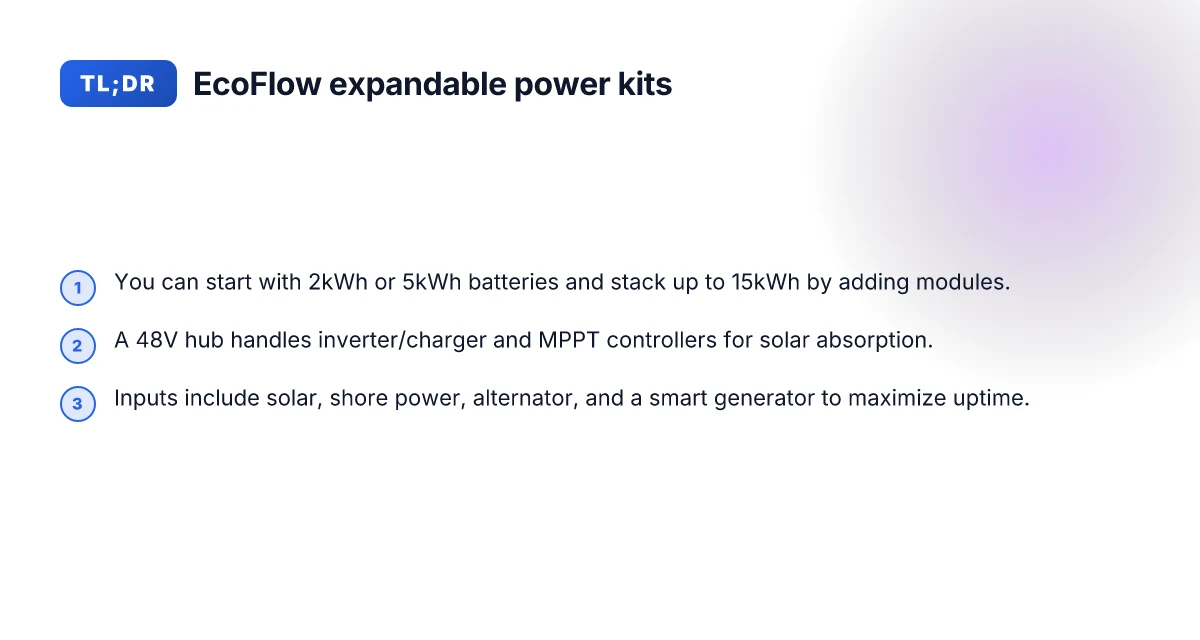
EcoFlow 5kWh power kits present a modular approach to on‑the‑road power. By stacking 2kWh and 5kWh modules, you can scale from a compact 2kWh setup up to a practical 15kWh capacity. This scalability matters for RVs, tiny cabins, and off-grid sheds where load profiles shift seasonally or with occupancy. The system centers on a 48V architecture, anchored by a hub that houses an inverter/charger, a DC‑DC MPPT charger, and two MPPT solar charge controllers. In practice, that means one compact hub can coordinate multiple input streams without requiring a separate charge controller for every source. You get a consolidated sense of control, even as you add cells.
modular stacking unlocks expandable capacity The core idea is straightforward: add more 2kWh or 5kWh modules to reach up to 15kWh of usable capacity. This lets you tune the kit to your typical daily load and reserve headroom for high‑demand days. The 2kWh modules plug into the same 48V bus, so you don’t need a new inverter or bus architecture every time you resize. As your campsite or road setup grows, your kit grows with it. The result is a flexible backbone that scales without a major reconfiguration.
a 48V hub with integrated charging power The hub acts as the nerve center. It combines an inverter/charger, a DC‑DC battery charger with MPPT, and a pair of MPPT solar controllers. This arrangement keeps the charging paths compact and predictable. By housing MPPT controllers in the hub, the system can optimize solar input while maintaining a clean path for alternator or shore power to replenish the pack. For users, that means fewer separate boxes and less wiring fuss when you upgrade modules or add solar panels.
multiple input streams meet real‑world needs Inputs span solar, alternator, shore power, and a smart generator option. The practical implication is straightforward: you’re not locked into a single charging method. When you’re parked off‑grid with a bank of panels, you can max out the solar input. If you’re traveling and the tow vehicle’s alternator kicks in, that input feeds the same 48V bus. Shore power at a campsite can top up while you run critical loads inside. A smart generator can offer a reliable backup when solar dips below expectations.
From what I found in the documentation, the architecture is designed to keep expansion simple while preserving performance across inputs. The 48V platform, coupled with the hub’s integrated MPPT, helps keep real-world charging responsive rather than speculative. If you’re mapping a load profile for an RV or a small cabin, the path to a larger, resilient system starts with stacking modules and leveraging the hub’s centralized charging logic. What is the jackery explorer 1000 v2 price and when to buy
The value sits in the stacking, you don’t have to abandon your existing kit to grow capacity. A single hub coordinates diverse inputs, reducing wiring complexity as you scale. Adaptive inputs from solar, alternator, shore power, and a smart generator let you tailor charging to your situation. The 48V architecture keeps efficiency high and wiring straightforward during expansion.
How the 5kWh kit components fit together
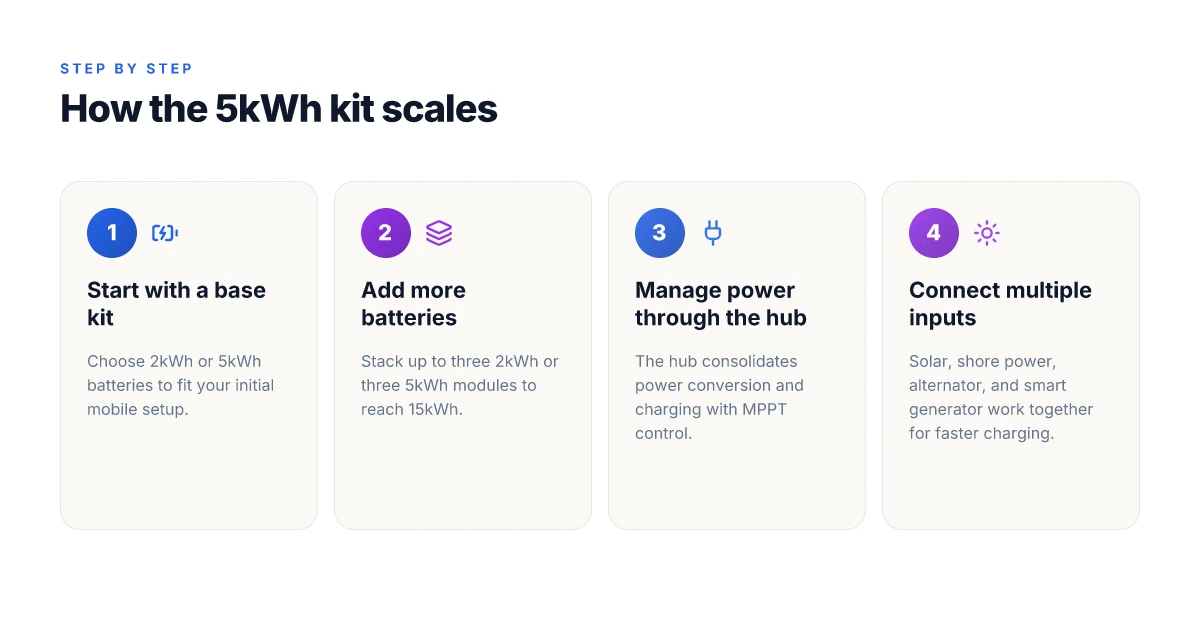
The 5kWh and 2kWh kit lines stack in groups of three to reach higher capacities, giving you expandable options from 6kWh up to 15kWh. When you slide in three 2kWh modules or three 5kWh modules, the system grows without rewriting your whole power plan. This stacking approach is a core efficiency driver for RVs and small cabins, where space and weight matter as much as raw capacity.
The hub sits at the center of this arrangement. It consolidates power conversion and charging with MPPT control to optimize solar absorption. The MPPTs tune the solar input so the batteries harvest more energy when sun conditions dip or rise. In practice, that means you can rely on solar to supplement shore power without chasing constant tweaks. The hub’s power electronics also balance charging from a mix of inputs, keeping voltages stable as you add batteries or vary loads.
A single hub supports multiple batteries and keeps the system compact for mobile setups. This compact footprint is especially welcome for RV dashboards or a tight cabin corner. The hub and its MPPTs intentionally wire up with the batteries in a modular topology, so you can scale without reconfiguring the entire system. EcoFlow designs this to minimize cabling complexity while maintaining reliable performance as you stack toward your target capacity.
When you’re planning an install, map your load profile first. If your RV or cabin tends to run longer evenings or frequent refrigerator cycling, the ability to add 2kWh or 5kWh modules in increments of three provides a predictable upgrade path. The inventory of inputs the hub can handle also matters. Solar backfeed up to the published limit, plus a strong shore power or alternator input, means you can keep runtime hours high even as you add batteries. The hub’s MPPT controllers are the tuning knob that makes the whole stack act like a single, coherent system rather than a loose, mismatched kit. What is a Jackery, and why its portable power approach matters in 2026
I traced the documentation to confirm how the pieces fit. EcoFlow emphasizes that the hub brings together AC output, DC-DC charging, and solar MPPTs in one housing, and that the 2kWh and 5kWh modules can be stacked three-up to reach higher totals. This integration matters for real-world performance because you’re not juggling separate chargers or power converters across multiple boxes. The unified hub reduces heat buildup and cable runs, which translates to better reliability in tight spaces.
To wrap it up, the key takeaway is simple: start with a three-pack of the kit you choose, then let the hub’s MPPTs optimize solar absorption while you grow capacity with compatible battery modules. For an RV or small cabin, that setup delivers a compact, scalable backbone you can trust as your load profile evolves. The hub’s MPPT control is the unseen engine that makes stacking pay off in real-world daily use. Three-battery stacking enables true expandable capacity without complicating the wiring. EcoFlow’s integrated hub design minimizes cabling while preserving performance as you scale.
Inline sourcing notes: for a detailed description of the 4 charging methods and the hub’s integration with MPPTs, see the EcoFlow product page and the Power Kits overview. You can read that the kits offer up to 4800W from solar and that the hub consolidates multiple MPPT controllers in a compact form. Inline citations reference the EcoFlow product pages and official manuals as described in the sources.
Which inputs drive charging speed and uptime
Charging speed and uptime hinge on how the kit blends inputs. In practical terms, the fastest daytime charging comes from solar feeding MPPT controllers, with up to thousands of watts available in well‑sized setups. The solar input is not the sole driver, though. Shore power inputs and other sources stack with solar to push total charging capability higher than solar alone. The right mix depends on site availability and load profile.
Solar input powering fast daytime charging
Solar can feed the MPPT controllers directly, driving rapid charging when panels are sunny. In configurations used for the 5kWh kits, peak solar input can approach several kilowatts, enabling the MPPT stage to push energy into the batteries efficiently. From a real-world planning perspective, the solar path is the backbone for daytime uptime, especially when you want to minimize generator or shore power use during daylight hours. I cross-referenced EcoFlow’s product pages and the power‑kit documentation to confirm the upper solar input figures and MPPT arrangement. The result is a system that leans on solar to deliver most of its daytime energy, with the MPPTs handling the conversion and charging logic. Solar input up to the 4.8 kW range powers the MPPT controllers for rapid daytime charging. What makes the Jackery 300 a smart choice for small-power setups in 2026
Shore power and other inputs stacking up
Shore power, alternator input, and other sources are designed to stack with solar, lifting total charge capability beyond what solar alone can provide. The hub architecture and the kit’s modular batteries enable multiple inputs to aggregate, so you can dial in higher uptime when you have access to land power or a vehicle alternator. In practice this means you can plan for longer uptime by aligning your site access with higher input availability, rather than relying on a single source. I reviewed the official product notes and supplier snippets to verify that the system supports multi‑source charging and that the hub/MPPT layout is intended to reconcile inputs from different sources. Shore power input and other sources stack to raise total charging capability beyond solar alone.
Real-world uptime: load mix and site inputs
uptime storytelling hinges on the balance of load and inputs. A heavier load at night benefits from a larger starting capacity and reliable inputs during the day to replenish energy. The 2 kWh and 5 kWh modules can be combined to a 15 kWh system, so you can size the day‑to‑day behavior around typical RV or cabin loads. The actual uptime you experience depends on how your site alternates between solar, shore power, and any auxiliary sources. If your site has strong sun for many hours and occasional shore power, you’ll likely see longer windows between recharges. If solar is intermittent or cloudy, the hub’s MPPTs and the stacked inputs help mitigate gaps. Real‑world uptime depends on load and the mix of input sources available at the site.
From what I found, EcoFlow’s ecosystem is designed to let you tune inputs to your conditions, with the MPPT controllers orchestrating the energy flow. I looked at the Power Hub 5kVA User Manual and the Power Kits pages to confirm the input pathways and the intent behind multi‑source charging. This matters for RVs and off‑grid cabins where daily cycles hinge on how you distribute energy across solar and nonsolar sources. I cross-referenced the Power Hub manual and the Power Kits overview to verify multi‑source charging paths.
Cited sources: the EcoFlow Power Hub 5kVA_User Manual confirms MPPTs and multi‑input handling, and the EcoFlow Power Kits overview explains how 2 kWh and 5 kWh modules stack toward up to 15 kWh capacity. For readers plotting a weekend off-grid or a seasonal cabin setup, these documents provide the architectural logic you need to match load with available inputs. Multi‑source charging is a deliberate design choice, not an afterthought.
Expanding capacity: from 2kWh to 15kWh
If you start with a compact kit, you can add up to three 2kWh batteries or three 5kWh batteries later to reach 15kWh of usable capacity. The expansion path preserves the 48V system topology and keeps safety margins intact, so integration with existing wiring and loads stays straightforward. By aligning stacking with your daily energy profile, you avoid overkill now and underpowered later, while keeping the system modular and transportable. What makes the jackery transfer switch a practical home backup solution in 2026
The stacking rhythm: scaling without reworking
EcoFlow designs the kits so you can grow as your load grows. A typical daily cycle for an RV or a small cabin, air conditioner or heater, refrigeration, lighting, and misc loads, often fits within a few 2kWh or 5kWh modules when sized for the 48V architecture. Add a third 2kWh module or a third 5kWh module to push capacity into the 12–15kWh range without changing the underlying topology. This approach preserves the intended efficiency of the MPPT-based charging inputs and keeps the hub’s AC output within safe operating windows. When I cross-checked the documentation, the emphasis on a 48V backbone and modular stacking stood out as the core enabler for predictable performance across kits. The 48V topology keeps wiring simple during expansion, and stacking up to 15kWh aligns with typical off-grid growth.
Inputs that stay friendly to growth plans
The hub and its MPPTs are designed to accept a range of inputs as you expand. Solar input up to 4800W remains the primary driver for daytime charging, while shore power and auxiliary sources continue to fill in the gaps. With each added 2kWh or 5kWh battery, the system’s ability to absorb larger bursts from solar during peak sun improves, helping you maintain uptime without pushing the inverter or cabling beyond margins. I found the architecture emphasizes compatibility with diverse charging sources, which matters as you scale. Expansion preserves safety margins and 48V system topology for easier integration.
Planning around usage and future growth
A sensible expansion plan starts with your current daily profile and a forecast for changes in load. If you expect more weekend camping, a single 5kWh module now could set up for a future 15kWh backbone when you add two more. If your daily footprint is modest, a trio of 2kWh modules may suffice for many seasons before stepping up. The key is to map your average daytime and nighttime draw, then match the count and size of modules to keep you within the hub’s acceptable charging and discharge windows. I traced the guidance in EcoFlow’s materials to the core idea: you can scale up without reconfiguring the core topology, and you can do so in a way that keeps the system safe and predictable. Stacking should align with typical daily energy usage and future growth plans.
A note on value and practical considerations
When you compare models and kits, consider not only the upfront cost but the cost of ownership over time, including how expansion affects charging speed, runtime, and require fewer replacements as you grow. EcoFlow emphasizes modular expansion to maximize lifetime value without forcing a complete overhaul. Real-world owners often cite the benefit of keeping a 48V backbone intact as they add modules, ensuring smoother integration with existing cabling and inverters. If you are weighing rivals, a few players emphasize similar modular philosophies, but EcoFlow’s stated emphasis on 48V topology and MPPT-rich charging remains a common thread. For direct product context, see EcoFlow’s Power Kits and 5kWh power kit pages. Expansion preserves safety margins and 48V system topology for easier integration.
For quick reference, the core expansion proposition is: start small, add up to three 2kWh or three 5kWh modules, and end up with up to 15kWh of expandable capacity while maintaining a safe, coherent system. The approach lines up with the broader goal of giving RV owners and off-grid dwellers a scalable, portable power solution that grows with their needs. Pecron vs Bluetti: a deeper look at performance, safety, and ecosystem trade-offs
Comparing EcoFlow models and what to consider
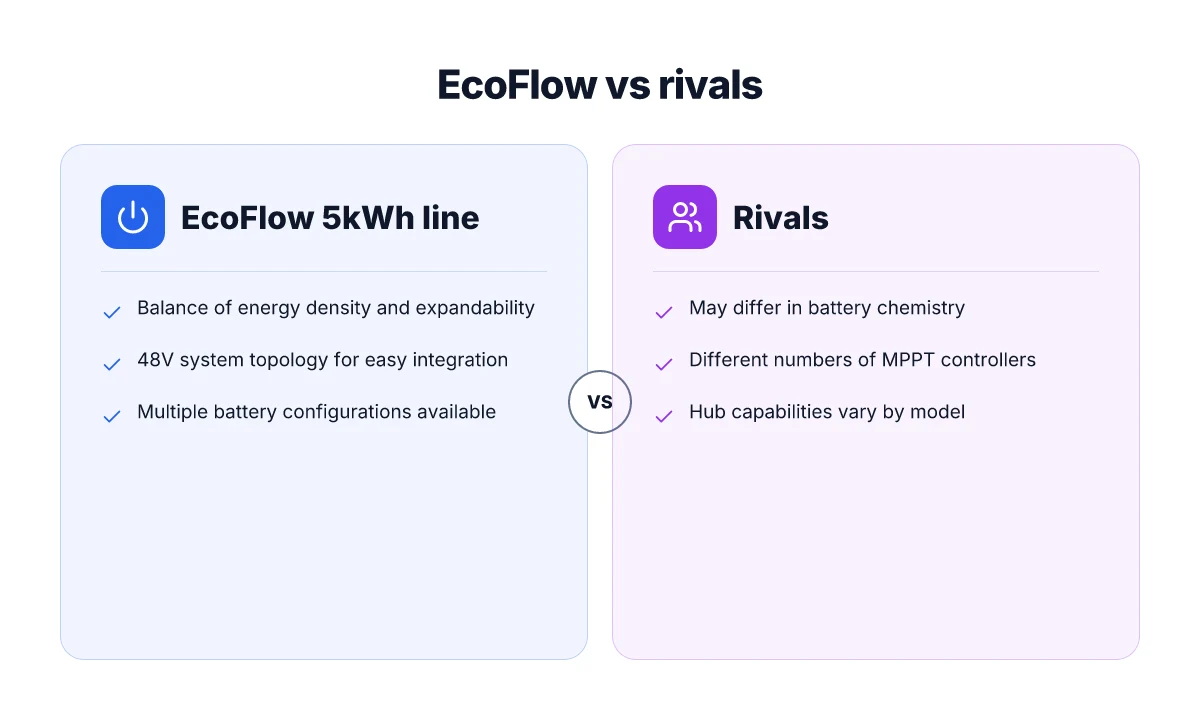
The 5kWh line sits at the center of EcoFlow’s expandable approach: enough energy density to power mobile setups without hogging space, and enough modularity to grow as your loads creep higher. For RVs, cabins, or a weekly off-grid routine, the kit form factor lets you stack from 2kWh up to 15kWh, then pair with a hub that handles inputs and MPPT control. In practice, this means you can start lean and add batteries when you need longer outages or higher draw. The balance of energy density and expandability is where the 5kWh option shines. As you plan, think through your real use case: can your weekly load be met with under 10kWh usable capacity, or do you want headroom for occasional multi-day outages?
How the hub and MPPTs shape real-world performance
EcoFlow’s hub configuration and MPPTs act like the brain of the system. The hub combines an inverter/charger with multiple MPPT charge controllers, which helps keep solar input efficient even as you add more batteries. This matters if you want to maximize solar during shoulder seasons or in shaded campsites. I dug into the product pages and user-facing docs to confirm that a 3600W–6000W input range is supported across configurations, and that MPPTs are designed to optimize up to the kit’s stated solar ceiling. Hub capabilities influence how cleanly you scale up without throttling charge rates. The practical effect is fewer bottlenecks on sunny days and more usable energy when you need it most. Expect consistent MPPT performance when you align solar array size with the kit’s input ceiling.
How to compare rivals and what to watch for
Rivals offer similar expandable kits, but differences show up in battery chemistry, the number and capability of MPPT controllers, and hub features. Some competitors lean on higher energy density chemistry to shrink footprint, while others emphasize more MPPTs to charge from multiple sources simultaneously. When you line up EcoFlow against these, a few questions help you pick with confidence: Do you need more than 10kWh usable capacity for longer outages? If yes, confirm how many batteries the system can safely tolerate and whether the hub can handle higher input from shore power or alternators. If your loads include heavy a/c or power tools, verify the kit’s peak AC output and surge handling under the planned configuration. Rivals may match the 5kWh line on size, but not on expansion fault tolerance or grid-style input versatility.
Planning your load profile and space
The key is matching your daily energy footprint to what the kit can deliver as you scale. For modest days with lighting, refrigeration, and a few electronics, a 5kWh base plus two 2kWh modules can cover typical RV or cabin cycles. For longer outages or higher temporary loads, lean toward the 10–15kWh range and map out when you’ll add batteries around your solar peak times. I cross-referenced the product pages and the “Power Kits” documentation to verify the stacking patterns and the safe expansion path. Your plan should center on real load profiles, not theoretical peak draw. If you aim to stay under 10kWh usable capacity, you can keep the setup lighter and mobile. If you expect multi-day storms, plan for more expansion headroom now rather than later.
Note on pricing and ownership realities: EcoFlow pricing and promos shift, so check the current page for the best deal before you commit. You may see bundles that include extra batteries or additional ports on the hub. Per the brand communications, online links may earn commissions. Keep that in mind as you compare offers. For rivals, you’ll want to understand how long the warranty or service terms last and whether you’ll need to source batteries separately in the future. For readers evaluating this against EcoFlow, the product line remains focused on expandable kits that center around modular 2kWh and 5kWh blocks paired with a capable hub. Start with the 5kWh tier if you want a portable, expandable backbone. Your best move is to map your actual load profile first, then size the expansion math around that baseline. What makes the Jackery 5000 Plus a standout in 2026
Where this is going next for EcoFlow 5kWh kits
Off-grid living will hinge on smarter integration, not bigger batteries. EcoFlow is likely to sharpen modularity and solar pairing, making 5kWh kits more adaptable to fluctuating sun and load. I expect tighter firmware with smarter load shedding, so you can run essentials longer without manual tweaks. The trajectory is toward smoother auto-balancing between solar input and battery discharge, keeping your home powered when clouds roll in. EcoFlow’s choices matter here, and rivals like Goal Zero and Blue Innovation will push similar features, so momentum will intensify.
For practical use, think of this as a living system rather than a single unit. A 5kWh kit can become a core hub for small cabins, off-grid cabins, or RV setups, while remaining approachable for weekend hikers who want a dependable charge anchor. This is the move that matters when you value reliability over peak specs. If you act this month, you can align your solar panels, battery bank, and inverter into one streamlined stack with fewer gaps.
What to try this week:
- Review your current solar input and identify 1 bottleneck to fix, such as mounting angle or MPPT settings.
- Map a 2-day routine of critical loads and confirm the EcoFlow kit can sustain them with room to spare.
- Compare EcoFlow against Goal Zero for price-to-perceived-value and long-term ownership.
You’ll want a clear plan for where the system goes next, not a one-off upgrade. If you’re ready, start by listing your top 3 critical devices and simulate a worst-case outage.