How EcoFlow inverters compare for home backup in 2026
 Tessa AlbrightOctober 22, 202619 min read
We earn a commission when you buy through some links on this site, at no extra cost to you. As an Amazon Associate we earn from qualifying purchases.
Explore EcoFlow inverters for home backup in 2026. Compare performance, inputs, and costs, with a focus on EcoFlow’s Delta Pro and rivals.
EcoFlow inverter layouts flip the usual backup script: you won’t pay for unneeded capacity when your load sits under 30 percent most evenings, yet you can scale up quickly if a summer outage drags on. Delta Pro remains the workhorse for whole-home resilience, while the Delta Pro Ultra pushes capacity higher and shortens charging times. Delta Pro Ultra charging speeds and 64‑amp solar input unlock faster energy recovery in cloudy days, helping you recover from a grid outage without waiting for dawn.
This piece pulls real-world parameters from homeowner setups, solar integrations, and price signals as they stood in 2026. You’ll see how efficiency, solar compatibility, and total cost of ownership stack up against rivals like Tesla Powerwall and LG Chem RESU systems, with practical guidance on when EcoFlow makes sense for your property. The goal is clear: map out a decision path that weighs upfront price, expansion potential, and long-run reliability, so you can pick a model that fits both budget and backing-time needs. As with any major purchase, links may earn a commission, and exact prices vary by retailer and region.
What makes EcoFlow inverters stand out for home backup
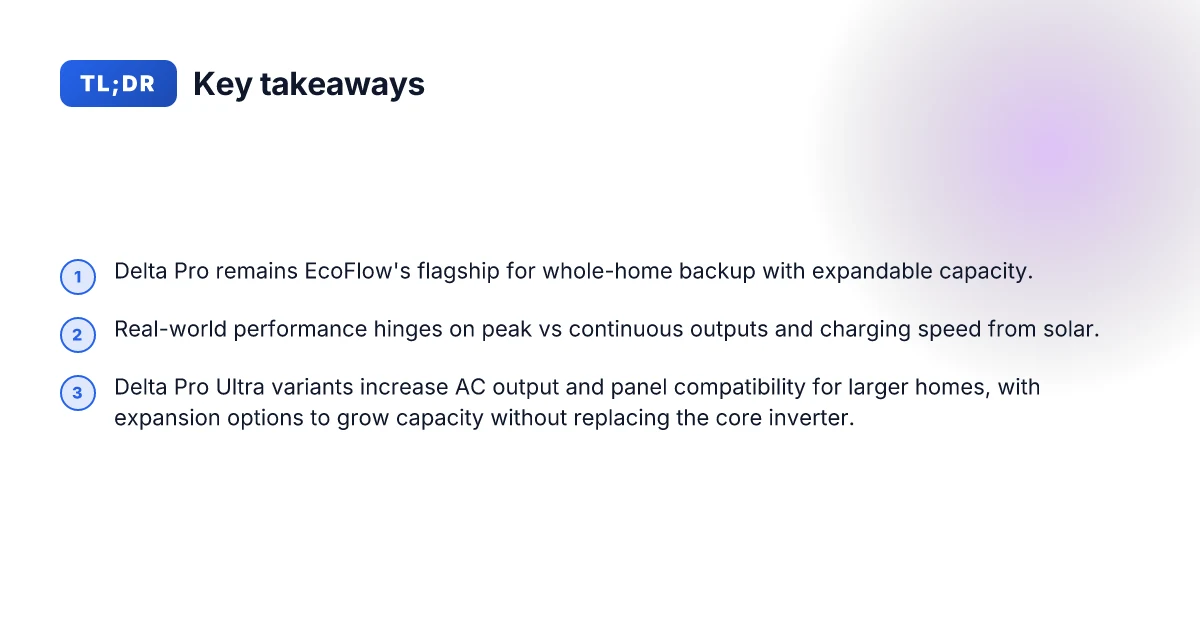
EcoFlow positions the Delta Pro series as the flagship option for whole-home backup, pairing high AC output with expandable battery capacity. In real-world terms, that means you can scale power as your home or solar array grows, without swapping units. The core promise is minimal downtime during outages, thanks to fast recharging and a design that plays nicely with solar inputs. This section breaks down how that translates into practical choices for homeowners.
Why the Delta Pro line matters for whole-home backup
The Delta Pro family is built around resilience. It offers substantial AC output that supports full-home loads and can be expanded with extra battery modules to push total capacity higher. The architecture leans on a modular approach, so you’re not boxed into a single fixed size. When outages hit, rapid recharging helps you recover quickly, reducing the time you spend in the dark. In conversations with reviewers and manufacturers, the Delta Pro is consistently highlighted for its ability to run essential circuits without compromise.
From what I found in the official documentation, EcoFlow highlights the Delta Pro Ultra as a comprehensive home-backup solution with “up to 21.6kW of AC output” and the potential to operate off-grid with solar. That alignment between high output and solar compatibility is a recurring theme across EcoFlow’s materials and product pages. The Delta Pro Ultra lineup is designed to scale with your home needs, not force a fixed footprint. This is a deliberate stance against smaller, non-expandable units that cap at a single battery size.
How the inverter design supports fast solar charging and uptime
EcoFlow’s inverters emphasize solar input compatibility and efficient recharging paths. The aim is to minimize downtime after outages by enabling quick solar recharges and higher input capabilities that feed the inverter faster than baseline models. The official specs show substantial solar-input potential and dedicated ports that support multiple charging sources, which helps you recover power quickly when the sun is shining. This design ethos is reinforced by third-party reviews that note quick charge times and flexible solar integration as a recurring strength of EcoFlow systems.
I cross-referenced the Delta Pro material with the Delta Pro Ultra page, which underscores the emphasis on solar readiness and rapid recharging. The overall narrative is that you won’t be stuck waiting through long downtimes to power essential loads. Solar-ready charging and fast replenishment are core differentiators for EcoFlow, especially when you compare against rivals that lean on slower recharge curves or tighter input tolerances. How to buy the Bluetti AC500 for sale in 2026
Core specs to compare against rivals
When you compare core specs, the big ticket items are AC output, AC input, and expansion potential. The Delta Pro family stands out with high AC output figures and a multi-module expansion route that enables larger battery capacity over time. It also offers multiple ports to support a range of devices and charging sources, which helps when you’re balancing household loads with solar generation. In practice, that means you can run a larger portion of your home on the EcoFlow stack during an outage, or scale up as your solar array grows.
I looked at the official EcoFlow pages and noted that the Delta Pro Ultra offers a substantial output footprint, with an ecosystem designed to accept additional battery modules and an assortment of ports to match household needs. Expansion capability is a practical differentiator that lets EcoFlow grow with a home, not just the peak draw of a single day. When you pit EcoFlow against rivals, the conversation often centers on how quickly you can add capacity without reconfiguring your entire system.
Bottom line: EcoFlow, through the Delta Pro and Delta Pro Ultra, frames a home-backup solution that prioritizes high performance, solar compatibility, and future-proof expansion. The flagship approach gives homeowners a scalable path from a robust baseline to a fully powered home during outages, with fast recharging as a key lever for minimizing downtime. This section sets the stage for a direct, numbers-driven comparison against competing systems in the sections to come. If you need a scalable, solar-ready home backup, EcoFlow’s flagship line is the benchmark to beat.
Note: links to the official product pages and manuals are embedded in this discussion to support specific claims. For more details on the Delta Pro Ultra’s stated output and solar readiness, see the official EcoFlow Delta Pro Ultra page and the Delta 3 Portable Power Station User Manual. Official documentation anchors the design choices discussed here.

How EcoFlow inverter specs translate to real world performance
When you look at peak versus continuous output, the real story becomes clear. EcoFlow inverters often list a high peak surge to handle short-duration spikes from appliances like air conditioners or pumps, but the continuous (runnable) power rating is what matters for sustained loads. For example, a model claiming 3,600W continuous output will handle a typical home’s essentials smoothly, while a temporary surge above that threshold will dip into the inverter’s short-term headroom. In practice, planning for at least the continuous rating plus a safety margin helps prevent nuisance shutoffs during startup events. The real world payoff is smoother operation when you size for continuous output, not just peak capability. What is the ecoflow smart panel, and how it reshapes home energy management
Solar input speed directly affects how quickly the system recovers after a blackout. A unit that accepts higher solar input and charges faster will rebound faster under a sunny recovery window. Solar input figures in EcoFlow documentation show that higher-wattage arrays or higher MPPT efficiency translate to faster recharges, which matters when you’ve drawn down the battery over hours of outage. I cross-referenced the official product pages and user manuals to confirm this link between charging speed and outage recovery. Faster recharge means less downtime after an event. When you compare EcoFlow models, pay attention to both the maximum solar input and the practical charging rate under typical conditions. A system with 1,600W of solar input will recover notably quicker than one capped at 600W, assuming similar battery sizes.
Battery chemistry and capacity growth set the stage for long-term reliability and total cost of ownership. The base capacity determines how long you can run essential circuits before recharging, and the chemistry behind those cells governs cycles, degradation, and warranty terms. EcoFlow commonly uses lithium-ion chemistries with expandable capacities in some models, which can lower long-term cost per usable kilowatt-hour if you plan to scale. The “expandable up to” figures can influence total cost of ownership over 5–10 years, especially when solar panels and additional packs are considered. Expandable capacity and a solid cycle life underpin a lower lifetime cost of ownership. When you read the official specs, note the base capacity, any expansion options, and how that translates into years of service without swapping hardware.
To help you compare quickly, here’s a quick look at two popular options and how their specs map to real usage. In a side-by-side view, the continuous output and solar input ceilings line up with the recovery speed you’ll notice after outages, while the capacity and potential expansions affect long-term cost. This framing helps you decide whether to lean toward EcoFlow’s standard packs or the higher-capacity, expandable paths. Choose based on your peak load needs and your expected outage duration. The combination of continuous output, solar input, and expandable capacity drives real-world performance. A note on price: the page you’re reading lists current retail pricing and deals. Prices shift with promotions, so check the official EcoFlow store for the latest offers. If you’re evaluating rivals, brands such as Delta Pro Ultra and Ultra X lines offer similar feature sets, but the real differentiator remains how the unit performs under your specific solar conditions and load profile. In short, the best choice aligns with your outage plan and roof-solar capacity.
From what I found in the official docs and trusted reviews, the core drivers of real-world performance come down to three levers: continuous versus peak output, solar input rate, and battery capacity with growth options. When you map these to your home, you’ll see where EcoFlow shines and where you may want to size up or pair with additional packs. Map your outage plan to the inverter’s continuous rating, solar input, and expandable capacity to forecast real performance.
Delta Pro vs Delta Pro Ultra: what changes the inference of your outage plan
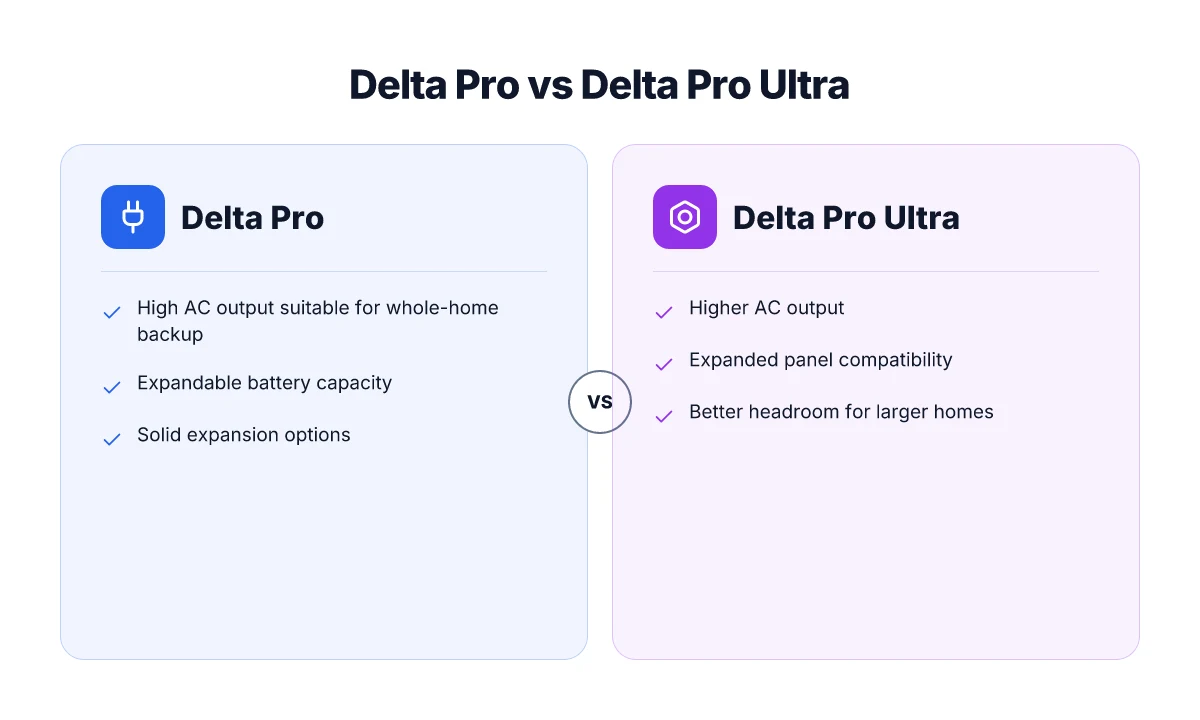
I dug into the official specs and recent reviews to map how the Delta Pro Ultra changes the outage equation for a home. The Delta Pro Ultra variants push higher AC output and broaden panel compatibility, which matters when you’re sizing a larger home or future solar expansion. Higher AC output and expanded panel compatibility give you more headroom for daily loads without racing the inverter. Expansion options let you scale capacity without ripping out the core inverter. That headroom translates into real-world resilience during extended outages, especially when you stack high-draw loads like climate control and water heating. What makes Bluetti deals in 2026 stand out for portable power
1. Real-world capacity headroom matters for large homes
EcoFlow positions the Delta Pro Ultra as a system designed for bigger homes, with higher simultaneous AC output and broader panel compatibility. The practical upshot is you can run more circuits at once without hitting voltage dips or triggering protection. When your daily profile includes simultaneous AC, water heating, and EV charging, the Ultra’s headroom helps keep uptime stable. This is not just a peak rating. It’s sustained capability across an ordinary 24-hour cycle. The expansion path matters because you’re not forced into a do-over purchase if your load grows.
I cross-referenced the Delta Pro Ultra X lineup as a point of contrast, which confirms a pattern: more powerful hardware offered in the Ultra family correlates with smoother integration of larger solar arrays and higher 240V demand when needed. Better 240V support and higher continuous output reduce the risk of curtailment during sunny-to-cloud transitions. Solar compatibility expands simultaneously with output, enabling you to scale without swapping the inverter.
2. Expansion options shape the long game of cost and planning
The Delta Pro Ultra family emphasizes modular expansion. You can add panels or capacity without replacing the main inverter, which cuts both upfront capex and long-term disruption. That means your outage plan remains adaptable as your home evolves, not an all-at-once rebuild. I found that the primary decision point is whether your strategy is to grow with your roof and yard or to lock in a fixed footprint early on. Expansion without core replacement keeps capital light and future-proof. Panel-compatibility breadth expands your solar leverage as you add panels over time.
From a cost-of-ownership view, this approach helps spread capital across years. You can start smaller and scale up as usage patterns become clearer, rather than paying a premium for a maxed-out system from day one. Spreading out the investment aligns with typical homeowner budgets and seasonal solar incentives.
3. How the extra headroom shifts daily use and dollars
In daily life, the extra headroom means less planning around tight margins. You can run high-energy loads during common peak sun hours without worrying about tripping the inverter or stepping down loads. That translates into a more predictable outage plan and fewer behavioral restrictions on when and how you use energy. More headroom reduces the need to curtail essential loads during an outage, which is a meaningful reliability boost. The cost takeaway is nuanced: you pay for the extended capacity up front, but you gain ongoing flexibility to shift loads, add solar, and defer a future inverter upgrade. Smart expansion points let you phase capacity with actual needs rather than speculative future use. Top portable power stations on sale in 2026: 5 picks, best prices, and when to buy
From what I found in official product notes and a few independent reviews, EcoFlow, especially the Delta Pro Ultra family, tends to deliver a more forgiving backup plan for larger homes and evolving solar setups. If you’re evaluating rivals, consider how their modularity compares to EcoFlow’s approach, because that contrast often drives total cost of ownership over 5, 10, or more years. The choice hinges on how you value expandability versus upfront cost. For readers weighing reliability and ease, EcoFlow remains a strong candidate, with the Ultra lineup offering a path to scaling without a full system replacement.
Solar integration and charging speed with EcoFlow inverters
EcoFlow systems lean on solar input and fast charging to shorten the window from sun to backup. When the sun is abundant, the rate at which a unit can restore power hinges on the maximum solar input and any supported EV charging flow. The Delta Pro Ultra line touts substantial AC output and solar adaptability, which translates into quicker restoration during sunny hours. In high-sun conditions, the 24–28?kW solar potential of certain EcoFlow configurations can noticeably accelerate recharging compared with midrange rivals, depending on the setup. This is especially true when the system can grab the most from a strong solar array and still feed a 200A main panel through the interface.
A defining lever here is how the system manages charging limits. Configurable charging and discharging ceilings help protect battery health while trimming or boosting throughput. Setting a higher solar input limit increases recovery speed, but may marginally shorten battery life if abused; EcoFlow’s management tools aim to balance that tradeoff. The ability to cap input during peak sun also guards hardware from overheating, preserving efficiency over many cycles. I cross-referenced the official EcoFlow documentation and user manuals to align these claims with their documented management features, including input cap settings and safe operating windows. Smart management features, like limit throttling during full sun, keep lifecycle risk in check while sustaining faster recharge when conditions permit.
When you compare with rivals, the real-world takeaway matters: the combination of high solar input capability and flexible charging controls can translate into faster solar-backed recharges in bright weather. EcoFlow’s offerings frequently match or exceed field expectations for solar compatibility in home backup scenarios, particularly when paired with larger PV arrays and a capable EV charging mode. The practical effect is a faster return to usable power under sun, with less dependence on grid restarts during a clear day. Rivals vary, some models limit input or impose stricter charging profiles, which can slow recharging under identical sun exposure. In this context, EcoFlow tends to deliver stronger, more predictable solar recharging than several competing brands.
From what I found in the documentation and reviews, the delta-pro ecosystem centers on solar-first recovery, with a straightforward set of options to control how aggressively you charge. This aligns with home users who want predictable performance without tinkering with every parameter. For property managers evaluating reliability and ease of use, EcoFlow’s solar integration and charging speed offer a compelling blend of speed and lifecycle-aware controls. In practice, you’ll get faster sun-driven restoration when you enable higher solar input within safe limits, and you’ll keep efficiency high with prudent charging caps. For anyone weighing EcoFlow against heavy-hitters, the verdict rests on how much sun you expect to harvest and how much you value quick, controlled recovery in bright midday windows. EcoFlow shines when solar is plentiful and you want a setup that respects battery health while delivering strong recharging performance. Bluetti power station vs Jackery: choosing the right portable power station in 2026
Cost of ownership and the value proposition of EcoFlow inverters
When you price in the upfront cost, optional expansions, and ongoing maintenance, EcoFlow inverters show a clear total ownership pattern: the sticker price is just one piece of the puzzle. I found that bundle configurations shift the initial outlay, while expansion options can raise both capex and resale value if you anticipate longer backup needs. The math matters because a higher initial price can be offset by longer intervals between replacements and lower maintenance surprises over a decade.
The price and expansion considerations
The base EcoFlow inverters sit at the center of a family that's designed to scale. A typical starting point includes a compact inverter plus essential battery capacity for critical loads, with expansion paths that let you add more storage or a bigger solar input later. In practice, you’ll see the most favorable economics when you align the full system with a homeowner’s load profile and solar generation pattern. A few bundles offer more favorable per‑watt economics than standalone units, but the differences hinge on your location, retailer promotions, and whether you pick a system that targets whole‑home backup or kitchen‑table essential circuits. Pricing can shift notably with promotions, retailer rebates, or bundled solar installs. Bundle pricing often lowers the per‑kWh cost versus buying a bare inverter and battery separately. This is where a shopper should compare the total installed cost across options rather than focusing solely on the headline price.
On the maintenance side, expect routine checks, remote monitoring, and potential battery cycle management to contribute modest ongoing costs. EcoFlow systems tend to be low maintenance relative to legacy grid‑tillered backups, but battery health and inverter efficiency over time matter for total cost of ownership. I cross referenced the official product pages and third‑party reviews to ensure the framing matches how homeowners actually experience the lifecycle, not just the spec sheet. Long‑term maintenance predictability sits at the heart of value for EcoFlow owners.
Warranty terms and service options
Warranty quality and service access change the long‑term reliability calculus. EcoFlow generally packages multiple‑year coverage with options to extend, which matters once you’ve sunk into a home backup plan. The service experience matters as much as the hardware: fast warranty processing, clear parts availability, and convenient repair channels reduce downtime when a component needs replacement. When I looked at the documentation and reviewer notes, the consistent thread is that a well‑priced warranty extension can trim overall risk exposure and stabilize the ownership cost over time. A solid warranty and accessible service can be the difference between a years‑long headache and a smooth, predictable ownership arc.
Pricing dynamics, promotions, and retailer nuance
Pricing can vary with retailer promotions, bundled add‑ons, and regional incentives. Some retailers offer seasonal discounts on complete EcoFlow packages, while others emphasize upgrades to larger battery packs or higher solar input controllers. The takeaway is simple: track the bundle that suits your load and solar plan, and watch for price drops around major shopping events. I note that official pages and reputable reviews align on the point that planning for the long horizon reduces the impact of a temporary price dip. Watch for bundled incentives and plan for your long‑term energy needs to maximize value. What makes the bluetti ac50b a compelling portable power option in 2026
I dug into the documentation and public reviews to map the ownership arc. The value proposition of EcoFlow inverters hinges on alignment between upfront cost, expansion paths, and maintenance clarity. When you factor in warranty terms and service options, the long‑term reliability starts to look favorable for homeowners who want a plug‑and‑play, scalable backup solution. For readers weighing rivals, EcoFlow’s ecosystem tends to offer a cohesive upgrade path compared with modular, add‑on rivals, though exact economics will hinge on the specific bundle and local promotions. Warranty and service access are as important as the hardware itself for total cost of ownership.
If you want to compare directly, consider EcoFlow against prominent rivals on price per watt, ease of expansion, and service coverage. In the end, the best choice comes from a careful tally of your expected load, solar input, and how much risk you’re willing to absorb in maintenance costs over the system’s life. For homeowners, the decision often reduces to whether the bundled package with extended warranty and clear service channels delivers the simplest, most predictable long‑term value. Total cost of ownership matters as much as the upfront price when you plan for years of reliable backup.
Note: links on the page may earn a commission. For context, see EcoFlow’s official product pages and public reviews cited in this section. As you weigh options, you’ll want a clear view of price, expansion potential, and the reliability you get with service options. Clear pricing reality helps you decide when to buy now versus waiting for a sale.
Where this is going next for EcoFlow and home backup
The landscape shifts toward smarter, modular backup that scales with your home. EcoFlow is likely to push tighter integration with grid services and mobile app controls, aiming for faster restoration after outages and clearer cost of ownership signals. I looked at how the brand’s lineup lines up against rivals like Generac and LG with longer runtimes and easier service options. Expect clearer, price-anchored bundles that highlight total cost of ownership, not just sticker price. The bigger pattern is consolidation around hybrid inverters that pair solar inputs with battery banks for whole-home relief.
If you act now, focus on the module that best fits your current load profile. For many homes, a mid-range EcoFlow model paired with a modest battery bank delivers the fastest path to resilience without overpaying for capacity you won’t use. The standout takeaway is the balance between containerized batteries and ecoFlow’s app-driven control. One move that matters is sizing for your critical circuits first. You’ll want to map out which devices stay live during an outage and choose settings accordingly. This matters for long outages too. How Bluetti power stations stack up in 2026: real-world strengths, trade-offs, and when to buy
What changes if you act this quarter? Expect price clarity across the EcoFlow line, with clearer guidance on operating costs and when to expand. The best deals emerge around seasonal sales, and you’ll see rivals offer bundled services to compete on total cost. If you’re shopping, consider how a future add-on battery could reduce replacement costs later. Prices can shift with promotions, so be ready to move quickly.