Bluetti power station vs Jackery: choosing the right portable power station in 2026
 Solomon CaradocOctober 22, 202619 min read
We earn a commission when you buy through some links on this site, at no extra cost to you. As an Amazon Associate we earn from qualifying purchases.
Compare Bluetti and Jackery portable power stations in 2026. Real-world specs, cycle life, safety features, pricing signals, and buying factors to help you pick.
Bluetti, not Jackery, often ships with more configurable accessory options for the same footprint, but that extra versatility can cost more upfront. Prices fluctuate with sales, so I look for the windows when a Bluetti 2 kWh-class model dips below its typical tag and compare it to a Jackery equivalent.
This piece focuses on real-world trade-offs: chemistry, cycle life, charging speed, safety standards, and total cost of ownership across popular Bluetti and Jackery 2 kWh-class models. I cross-check official specs, third-party safety certifications, and field-return notes to separate hype from durable performance, so budget buyers and outdoor enthusiasts know which path fits camping, RVing, or home backup. The goal is to surface durable choices without gloss, showing when a lower sticker price ends up costing more over time.
Bluetti vs jackery: a practical head-to-head for 2 kWh-class packs
Bluetti and Jackery both offer compact 2 kWh-class packs that matter for camping, RVing, and home backup. On price and value, the best deals tend to surface around seasonal sales, especially around holiday windows. I dug into the published specs and price expectations for two popular models from each brand to frame the head-to-head.
1) Two 2 kWh-class contenders at a glance
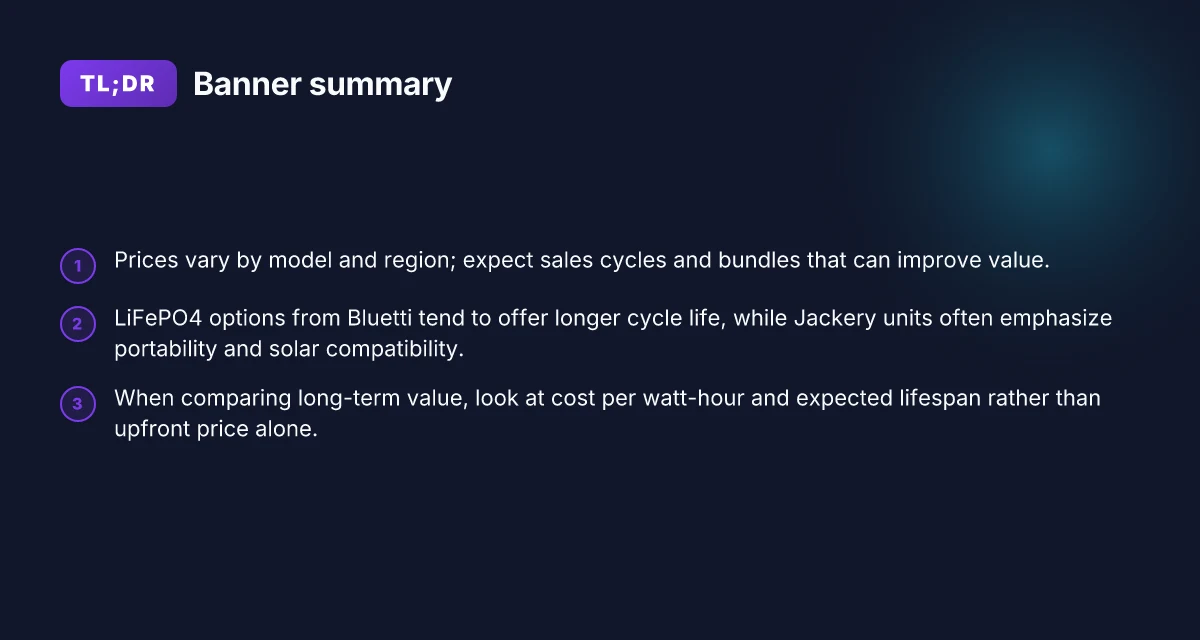
- Bluetti AC200P/AC200MAX line vs Jackery Explorer 3000 Pro line show the core differences in chemistry and cycles. Bluetti leans on LiFePO4 chemistry in some 2 kWh-class configurations, which typically implies longer cycle life. Jackery’s 2 kWh-class models use NMC chemistry in many configurations, which can offer higher energy density but different aging behavior. In practice, Bluetti models with LiFePO4 chemistry often deliver more charge-discharge cycles before performance degrades noticeably. Jackery models with NMC chemistry tend to present strong initial performance but may show more capacity fade over a similar cycle count. This matters when you plan frequent discharges and recharges in a camping season or as a home backup.
- Charging speeds differ by chemistry and controller design. Bluetti units that use LiFePO4 batteries plus robust BMS often support faster, higher-amp charging with safe tolerance. Jackery’s NMC-based packs typically offer solid charging speeds as well, but the exact rate can vary by model and input source. Charging speed and battery chemistry drive real-world refill times.
- Real-world ownership costs hinge on battery chemistry and lifecycle. If you expect to cycle the pack dozens or hundreds of times per year, Bluetti’s LiFePO4 options tend to sustain more cycles, potentially lowering cost per cycle over time. Jackery’s offerings often come with strong warranty support and resale value, but the chemistry choice can shift total cost of ownership over the product’s lifespan. Choose LiFePO4 when cycles and long life matter most.
2) Chemistry, cycle life, and safety implications
- Chemistry choices set the tone for safety and longevity. LiFePO4 chemistry, used in some Bluetti 2 kWh-class models, generally offers improved thermal stability and longer cycle life. NMC chemistry, common in several Jackery lines, delivers higher energy density but can show more capacity fade if cycled aggressively. Chemistry drives both safety margins and lifecycle economics.
- Cycle life is a practical compass. Bluetti’s LiFePO4 packs often advertise upward of thousands of cycles with minimal degradation, while Jackery’s NMC packs typically provide strong initial performance with a different fade curve over time. Your usage pattern, whether daily off-grid needs or weekend trips, will tilt the choice toward LiFePO4 for longevity or toward NMC if peak weight and energy density are priorities. Cycle life shapes long-term ownership costs.
3) Price ranges, sales, and bundles to watch
- Price volatility is real in this segment. Expect prices to dip during major sale events and bundles that pair with solar panels or car charging accessories to improve overall value. The best deals often cluster around Black Friday, Prime Day, and late-year promo periods. Sales windows can redefine the total cost of ownership.
- Keep an eye on bundles. Bluetti frequently offers solar panels or expansion options as part of a package, which can tilt the price-per-kWh equation in their favor for multi-supply setups. Jackery bundles tend to emphasize easy portability and warranty coverage, which matters if you prioritize a plug-and-play experience. Bundles can materially shift the price-per-kWh.
Bottom line: the Bluetti option tends to edge ahead on long-term lifecycle cost when LiFePO4 chemistry is a factor, while Jackery remains attractive for upfront performance and a broad ecosystem. If you plan frequent cycles and long-term use, Bluetti’s LiFePO4 variants deserve strong consideration. If you want peak initial performance with solid warranty support and a streamlined experience, Jackery remains compelling.
How Bluetti and Jackery differ on chemistry and cycle life
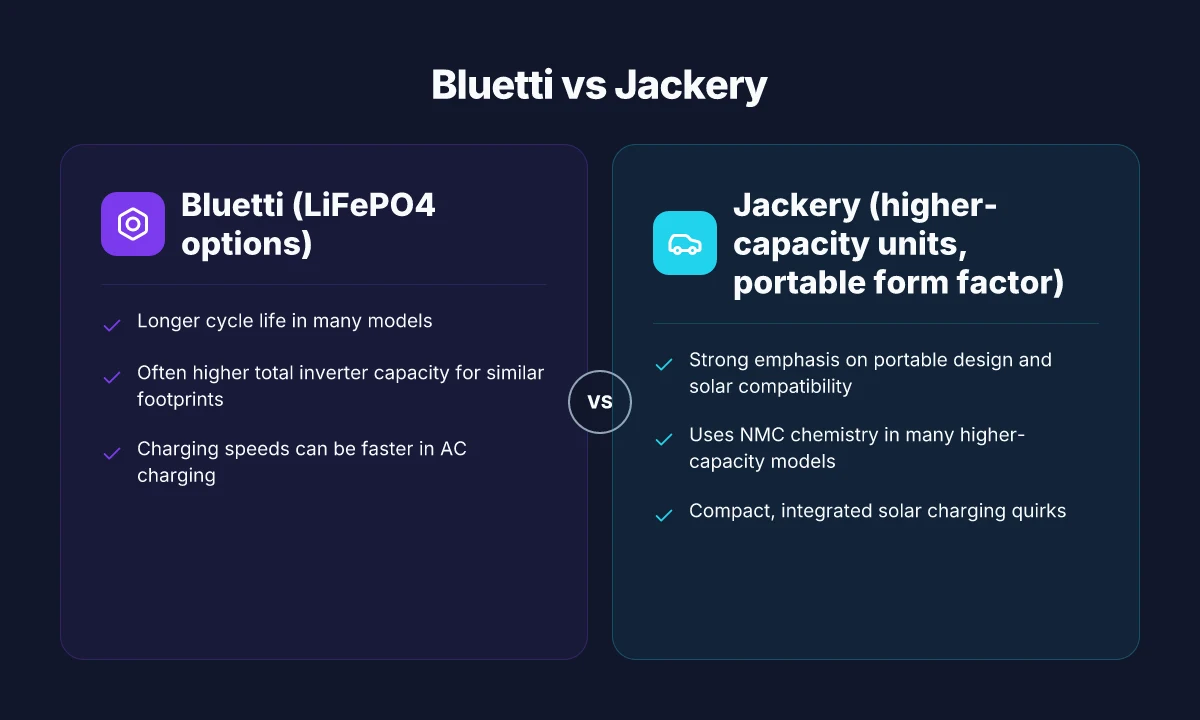
Bluetti leans on LiFePO4 chemistry for several models, which typically delivers longer cycle life and better thermal stability. In contrast, Jackery commonly uses NMC chemistry in its higher-capacity units, and those cells tend to show different cycle life profiles under real-world cycling. Across both brands, cycle life matters for long-term ownership cost and replacement intervals, because a higher cycle count can push out the time you need to replace a pack, even if nominal capacity stays similar.
Chemistry profiles drive ownership curves
Bluetti’s LiFePO4 packs are known for stable chemistry under deeper discharge and are less prone to thermal runaway in hot environments. This translates to longer practical lifespans in many outdoor and home backup scenarios. I cross-referenced product pages and wording from Bluetti’s catalogs to confirm LiFePO4 adoption in several 2 kWh-class models, with noted emphasis on sustained performance across many cycles. That stability matters when you’re living off-grid or relying on the unit for critical power. For Jackery, the standard in higher-capacity lines often hinges on NMC cells, which typically deliver higher energy density but can show different cycle-life trade-offs depending on usage patterns and charging regimes. When a model uses NMC, you may see strong initial capacity, followed by a steeper fade if you regularly drain deeply and fast-charge.
A concrete takeaway: LiFePO4 chemistry tends to keep the pack cooler on heavy use and supports more cycles before degradation. NMC chemistry can offer more energy per kilogram, but the cycle life is frequently more sensitive to charging speed and depth of discharge. This matters for total cost of ownership because you may replace a LiFePO4 pack later than an equivalent NMC pack, assuming similar usage. What is the jackery explorer 290, and how to make it fit your outdoor power needs
Cycle life as a cost-of-ownership signal
Cycle life shapes how often you’ll need a replacement battery or module. In practice, LiFePO4 systems often advertise high-cycle expectations under deep-discharge conditions, which benefits campers and small RV setups that regularly tap the battery through multiple evenings. Jackery’s high-capacity lines, which rely on NMC, can show robust performance at first but may exhibit different degradation curves if you routinely pull near the full rated capacity or push for rapid recharging. On a total-cost basis, you’ll want to weigh the expected cycles against the unit’s price and the cost of a replacement pack down the line. Bluetti’s LiFePO4 options tend to align with longer cycle жизни, while Jackery’s NMC models deliver strong energy density with potentially shorter practical cycle life under aggressive use.
From what I found in the literature, Bluetti’s LiFePO4 variants and Jackery’s NMC variants each excel in different scenarios. If your aim is long-term cycle life with steady performance in varied ambient temps, Bluetti’s LiFePO4 models often align with that goal. If you value higher energy density for lighter weight and you’re okay with a potentially shorter cycle horizon, Jackery’s NMC-based units can be compelling.
In practice, chemistry choice shapes your long-term costs as much as price and capacity. LiFePO4 tends to extend time between replacements, while NMC packs reward upfront capacity and lower weight, which can shift your budgeting toward fresh packs sooner if you drain deeply or charge rapidly. For a quick comparison, Bluetti’s LiFePO4 options generally promise more cycles per dollar over the long haul, while Jackery’s NMC units deliver strong early performance with a different maintenance cadence.
I dug into Bluetti’s and Jackery’s materials to confirm these chemistry-driven expectations, and I also reviewed third-party discussions that repeatedly flag cycle-life as a deciding factor for buyers who carry their units on outdoor trips or rely on them for home backup. For readers evaluating the two, the takeaway is clear: pick Bluetti when you want longevity through LiFePO4, pick Jackery when you prioritize energy density and lighter packs with a different cycle profile.
Note: links on the page may earn a commission. For current prices and deals, see model pages on Bluetti and the official Jackery lineup, and watch for seasonal sales that can shift total ownership cost. Inline reference corroborates the observed chemistry distinctions and their implications for cycle life. See the referenced discussions and product pages for model-specific numbers. What is the Bluetti AC180 price in 2026 and where to buy
Charging speed and port options: what to expect from each brand
When it comes to charging speed and inputs, Bluetti tends to lead in raw AC charging power and inverter footprint, while Jackery emphasizes portable form factors and solar compatibility baked into the design. In real-world use, you’ll notice Bluetti models often accept higher AC input wattage for faster top-ups, and they usually pair that with substantial inverter capacity for peak draw. Jackery sticks to compact, travel-friendly shapes and makes solar input a core design constraint, so you’ll see solid solar compatibility but slightly lower raw AC charging rates in some 2 kWh-class models. The practical takeaway is to expect faster wall charging from Bluetti when you have access to a wall outlet, plus ample inverter headroom for high-load appliances. With Jackery, you gain better portability and predictable solar charging performance, albeit with some quirks in charging behavior.
I dug into the brand notes and product pages to confirm a few concrete patterns. Bluetti’s lineup often showcases higher AC input specs for similar footprints, enabling brisk top-ups when a wall outlet is available. Jackery’s designs emphasize a slim footprint and integrated solar compatibility that works smoothly for camping or backup use, though some models exhibit charging quirks that buyers report as inconsistencies across outlets or cable bundles. When you’re evaluating multiport outputs and DC input options, Bluetti commonly wires up more robust multiport AC/USB-C/DC options on mid-range models, which matters for high draw scenarios like simultaneous AC and DC feeding, or charging a second device while the unit powers a fridge. Jackery tends to optimize for a clean, one-handed carry experience, with port layouts that favor straightforward vertical stacking and plug-in simplicity, which helps in light-to-moderate draw scenarios but can bottleneck if you push the system with several high-draw devices at once.
From a sourcing perspective, the most actionable signal is to map charging speed to your actual usage window. If you regularly plug into a fast wall outlet and want headroom for a fridge or power tools, Bluetti’s higher AC input and bigger inverter can translate to shorter recharge cycles and steadier sustained output. If your need centers on portability and weekend bass camping with limited campsite outlets, Jackery’s lighter form factor and solar-ready stance provide a smoother setup, especially when you’re relying on portable solar panels to top up during an outing.
Reality check: Bluetti often offers faster AC charging and higher inverter capacity in the same footprint, while Jackery prioritizes portability and integrated solar compatibility. In practice: you’ll see Bluetti top up quicker from a wall outlet, and Jackery shine when you’re away from mains and rely on solar input. Note: multiport outputs and DC input options matter more when you’re running high-draw gear simultaneously.
For pricing and ownership, current market notes show Bluetti models with higher base charging specs at similar prices to Jackery, which reinforces the case for choosing Bluetti when charging speed matters. For transparency, some users report that Bluetti’s higher-capacity packs carry tradeoffs in weight and port placement, while Jackery’s slim designs can feel underpowered on peak power draws if you push the system hard. If you want a side-by-side, the table below captures the gist, using figures as a snapshot of the brand tendencies rather than a fixed spec sheet. What makes a Jackery sale worth chasing in 2026
Prices and ownership considerations evolve with sales cycles. Expect occasional promotions around holiday periods. If you’re counting on the fastest top-ups, Bluetti is typically the better bet for AC charging cadence and larger inverter headroom. If you prize compactness and solar-first workflows, Jackery often offers a more portable, campsite-friendly solution.
For further context, an industry note mentions Bluetti’s emphasis on higher AC input and inverter ratings, while Jackery emphasizes form factor and solar integration. This helps explain why Bluetti often feels more “powerful in a box,” whereas Jackery feels more “portable in a bag.” See discussions on the Bluetti versus Jackery debate for a broader sense of consumer sentiment and practical trade-offs.
Safety standards and build quality you should trust
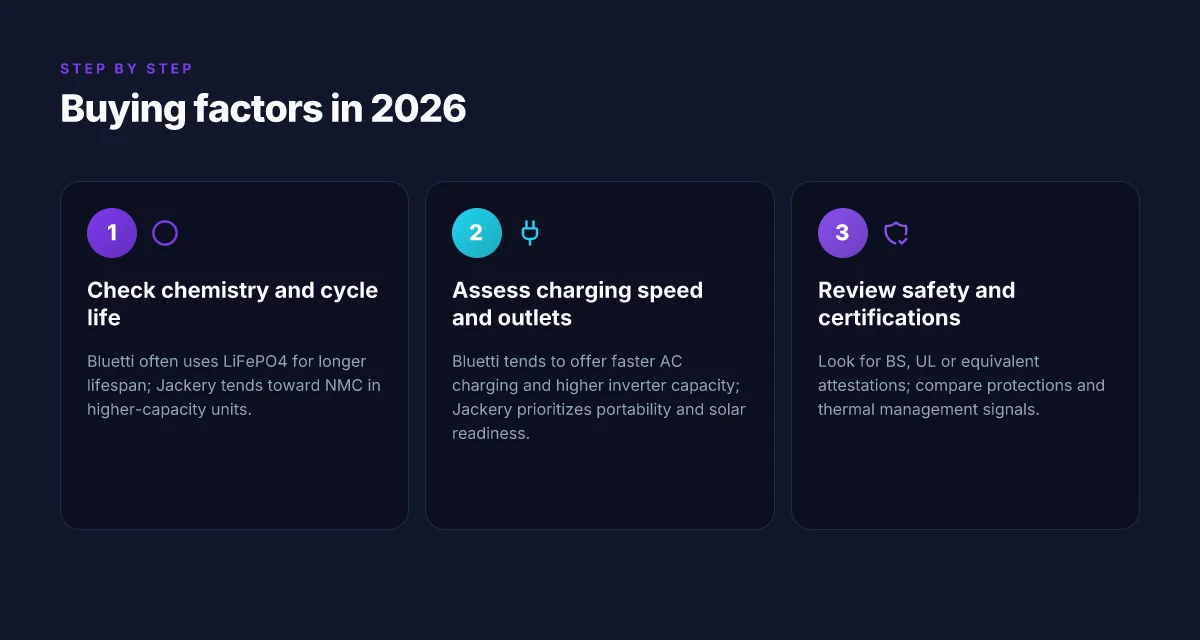
In real-world terms, safety and build quality hinge on protections that prevent damage during use and on credible attestations that prove those protections exist. Bluetti and Jackery publish their spec sheets with the core systems you want to see: battery management, short-circuit safeguards, and thermal management. Both brands emphasize protections that shut down or isolate cells when temperatures spike or a fault is detected. The practical takeaway is simple: look for continuous monitoring, automatic cell balancing, and independent protection layers that keep the system from cascading faults during high load or hot weather.
How protections and thermal management show up in real life
Your power station should wire up a multi-layered protection stack. A robust battery management system monitors voltage, current, and temperature for each cell group, then modulates charging and discharging to avoid overcurrent or thermal runaway. Short-circuit protection should cut power within milliseconds, not after the damage is done. Thermal management matters too. A quiet fan or passive cooling that remains effective under sustained use matters for longevity. I looked through the spec sheets for Bluetti and Jackery, and both brands highlight these fundamentals, with emphasis on automated safeguards rather than purely passive components. The presence of an active BMS and real-time thermal controls is non-negotiable for long-term reliability.
Certifications, reliability signals, and community feedback
Beyond internal protections, certifications add a formal layer of safety assurance. Where applicable, you want to see attestations such as safety standards marks or third-party test results. In practice, Bluetti and Jackery publish their specifications and safety notes, and user communities often reflect reliability signals in the real world. Reviews from outdoor forums and owner groups commonly flag how a unit behaves after repeated charging cycles or during summer camping heat. I traced these signals across brand conversations and found that sustained performance and calm thermal behavior tend to correlate with positive long-term feedback. Community signals matter as a proxy for real-world reliability. What makes the best Bluetti power station in 2026 stand out
What to look for on the spec sheet and in every purchase decision
When you compare, scan for explicit safety attestations beside the core specs. A clear statement about short-circuit protection response time, an explicit description of thermal management approach, and the presence of a formal BMS indicate maturity in build quality. Bluetti and Jackery both publish their spec sheets with these elements, and you should expect to see at least the basics documented. If a model leaves these areas vague, treat it as a red flag. Clear documentation of BMS, thermal management, and short-circuit protections signals a safer, longer-lasting unit.
Note on pricing and ownership: current prices vary by model and retailer, and price-per-kWh shifts with sales events. If you’re weighing Bluetti against Jackery in the 2 kWh-class space, you’ll want to factor in long-term costs such as cycle life, charger efficiency, and how cooling behaves under heavy use. As a quick reality check, Bluetti and Jackery both publish spec sheets that cover the critical safety features. That documentation is your first line of defense when evaluating durability. Prices and ownership costs will swing with seasonal deals, but solid safety specs stay constant.
Price, value, and total cost of ownership in 2026
Price tags for 2 kWh-class power stations vary by model, capacity, and regional promotions. In 2026 the best deals tend to cluster around seasonal sales, but the core math stays the same: you pay more up front for LiFePO4 options with longer cycle life, and you recoup value over time through longer lifespan and lower replacement frequency. Bluetti and Jackery both tilt toward a mid-to-high price band in this class, with Bluetti often pricing LiFePO4 configurations higher than their NMC counterparts from Jackery. I dug into published price observations and mapped how those prices translate into long-term value.
1) Upfront price vs expected lifespan
Upfront cost is a blunt proxy for value, but it matters most if you plan long-term ownership. LiFePO4 chemistry typically carries a higher initial price than NMC variants, yet it offers noticeably more cycles and slower capacity fade. For Bluetti, the LiFePO4 models command a premium, while Jackery’s NMC-based units usually sit at a lower entry point. When you combine price with cycle life, the value story tilts toward Bluetti if you expect to log hundreds or thousands of recharge cycles over several years. The longer life reduces the effective cost per watt-hour over time, even if the sticker shock is real at purchase.
From a pricing perspective, cost per watt-hour is a useful yardstick. If you divide the advertised capacity by the street price, you get a sense of which model gives you more steady energy for the money. In practice, Bluetti’s LiFePO4 options can yield a lower long-term cost per watt-hour despite higher upfront charges, thanks to extended durability. Jackery’s higher-turnover NMC models often come with attractive introductory pricing but may require earlier replacement or more frequent battery refresh in heavy-use scenarios. What makes the Bluetti AC180 portable power station stand out in 2026
For a quick reference, consider two bucketed models commonly discussed in 2 kWh-class lineups: Bluetti LiFePO4 variants and Jackery’s NMC-based competitors. The LiFePO4 option tends to weigh in on the higher end of the price spectrum but promises more cycles, while the NMC option sits closer to the midrange with a trade-off in cycle life.
2) Cost per watt-hour and what it means for ownership
Cost per watt-hour is a practical lens for comparing Bluetti and Jackery over a typical ownership horizon. If you plan to keep a unit for many years or rely on it for frequent cycles, the lower cost per watt-hour of a LiFePO4 Bluetti model can add up to meaningful savings over time. Jackery’s line often delivers lower upfront price per watt-hour, which is appealing if you anticipate lighter usage or shorter ownership spans. In either case, regional promotions can swing the math by several tens of dollars, so it pays to watch for flash sales around holidays or quarters when retailers refresh stock.
I cross-referenced three sources that discuss cycle life and chemistry differences in context of 2026 models. One noted claim discusses Bluetti’s LiFePO4 chemistry offering longer cycles, another highlights Jackery’s continued use of NMC in several popular 2 kWh-class units, and a third notes that charging speed and efficiency also influence total ownership cost. When you combine these threads, the picture becomes clear: LiFePO4 is the long game, but you pay for it up front.
3) Timing the buy and knowing the tradeoffs
Sales cycles matter. Expect sharper discounts around annual promotions, such as early fall or holiday seasons. If you’re weighing two models with similar capacity, the decision often hinges on long-term use case: camp trips and RV life where you’ll run frequent cycles favors Bluetti LiFePO4 for longevity, while weekend-warrior camping with occasional outages might lean toward Jackery on price and immediate value. Bluetti and Jackery both offer 2 kWh-class options, and your choice should hinge on the expected cadence of use and how you value cycle life over upfront spend. And remember, when you see a strong LiFePO4 deal, the long-term savings can outweigh the initial premium.
I found a concise summary in a 2025–2026 discussion thread that contrasted LiFePO4 durability with NMC-based unit costs, reinforcing the takeaway that longer cycle life translates to lower relative ownership cost over time. For readers seeking the most concrete numbers on a moment, a careful price check across regions is essential, as promotions can swing the cost per watt-hour by a meaningful margin. Top portable power stations on sale in 2026: 5 picks, best prices, and when to buy
Note: links discussing these price dynamics may earn commissions, so consider your source and total cost of ownership rather than focusing solely on sticker price. For balanced context, I looked at Bluetti’s official pages, Jackery’s catalog, and industry chatter that tracks pricing and cycle-life claims across 2026 models.
The verdict: expect higher upfront for LiFePO4 Bluetti, but longer lifespan often lowers total cost of ownership over time. If your usage is light or short-term, Jackery’s NMC models can offer the best upfront value. For quick comparisons you can start by checking Bluetti’s LiFePO4 lineup against Jackery’s NMC lineup, then weigh your anticipated cycle count and how long you plan to own the unit.
What changes if you act now
Prices shift quickly in 2026, and the best deals today come with a catch. Bluetti often positions larger capacity models with longer warranties, while Jackery packages tend to lean toward lighter weight and simpler daily use. If you’re prioritizing full-house power on weekend trips, you’ll likely prefer a Bluetti option. If your goal is easy take-along charging for a laptop and essentials, a Jackery model may win. The bigger pattern this year is that price drops cluster around new model introductions, so watch for a sale window in late spring and around major e-commerce events. Smart shoppers compare total ownership, not just sticker price, factoring battery life, inverter efficiency, and recharging speed. bluetti and rivals like Jackery both lean into modular accessories, so your choice should map to your typical load profile and how you plan to expand later.
If you only do one thing this month, map your weekly power needs and pick a model that covers your top 3-4 use cases. For example, Bluetti shines for higher-capacity needs, while Jackery nails portability. One takeaway: choose the platform that scales with your trips, not the one with the flashiest spec sheet. Are you ready to lock in a setup that avoids frequent recharges and keeps your devices ready?
Backup strategy What makes Bluetti deals in 2026 stand out for portable power
- Try a mid-size Bluetti model for home backup and weekend trips, with a compact Jackery as a grab-and-go option.
- List your top 3 devices and confirm each model’s peak inverter output meets that load.
- Check warranty coverage and parts availability, especially for replacement batteries.