How Bluetti power stations stack up in 2026: real-world strengths, trade-offs, and when to buy
 Naomi XanthosOctober 22, 202621 min read
We earn a commission when you buy through some links on this site, at no extra cost to you. As an Amazon Associate we earn from qualifying purchases.

Explore Bluetti power station reviews for 2026, including strengths, downsides, and when to buy. Realistic comparisons with rivals like EcoFlow and Jackery.
The biggest driver of Bluetti price reality in 2026 is how quickly models scale from weekend camper to full-home backup, and the math isn’t cosmetic. Bluetti's newest lines mix larger capacity options with still-portable form factors, and a few models sit at attractive price points when you compare total ownership over 3–5 years. The result is a decision curve: you pay more upfront for bigger banks of AC outlets and faster recharging, or you accept lighter ports for a lower tag.
This piece translates user sentiment and supplier signals into a concrete buy-timing framework. You’ll see which Bluetti models hold value under real-world loads, how reliability indicators stack up against rivals like EcoFlow and Jackery, and where pricing bumps align with feature packs in 2026. The goal is a clear, actionable view on price, value, and timing that campers, van lifers, and home backup planners can apply today. Rising demand for off-grid living plus stable supply chains in 2026 keeps the window open for strategic purchases.

Bluetti power station reviews: what buyers should know in 2026
Bluetti sits as a credible alternative to the top portable power players in 2026, balancing battery capacity, inverter size, and feature set against a price tag designed to attract outdoor lovers and backup planners alike. Across the market, Bluetti’s lineup tends to emphasize modular power and solar compatibility, helping campers and van lifers tailor a kit to their needs. In this slice of 2026, Bluetti competes most directly with EcoFlow and Jackery, while still facing pressure from Goal Zero and smaller specialty brands.
How Bluetti stacks up against EcoFlow and Jackery
Bluetti careens into the conversation with larger energy arrays and busier feature sets than many entry-level packs. When you compare it to EcoFlow, the emphasis is often on raw capacity and expandability. Bluetti models typically offer bigger internal batteries or more flexible expansion options, which matters if you plan long backcountry stretches or regular home backup. By contrast, EcoFlow tends to lean on rapid recharging and compact form factors. In practice, buyers tell me there’s a noticeable difference in how quickly you can top off a Bluetti versus an EcoFlow unit, especially in off-grid setups. Jackery, meanwhile, remains the easiest to use for casual campers, with reliable plug-and-play operation and a broad accessory ecosystem. Bluetti’s niche is deeper battery kits and solar integration, which pays off for seasoned campers who plan to live off-grid for days at a stretch. Real-world sentiment often flags Bluetti as a solid mid-to-upper tier choice, offering more capacity per dollar in certain configurations than the most compact rivals.
From what I read in product pages and reviews, the trade-off centers on portability versus endurance. Bluetti tends to deliver bigger capacity cells, which can translate into longer runtimes at the cost of heavier重量 and less pocketable form factors. Critics also point to the user experience in some models where screen readability or button layouts could be improved, especially for new buyers who value tactile simplicity. Bluetti remains a strong bet for long weekends and emergency backups, but buyers should weigh weight and handling against their vehicle or campsite setup. Reviews from reputable outlets consistently note Bluetti’s solar compatibility and modular options as a key selling point. For a quick comparison, see how EcoFlow emphasizes fast recharge and compact travel-friendly packs, while Jackery shines with user-friendliness and broad retail reach. Where Bluetti shines is when you need depth of capacity and flexible expansion.
What buyers often overlook when choosing a portable power station
The most overlooked factor is total cost of ownership over a multi-year horizon. People fixate on the sticker price, but the real cost includes solar panel compatibility, battery degradation cycles, and the availability of spare parts or replacement cells. Bluetti’s expansion paths can dramatically affect long-term value, so map out your planned charging routine and storage conditions before you pick a model. Another often-missed detail is the performance envelope under full sun. Some Bluetti units perform best when charging in direct sunlight, which matters for long camping trips where you rely on solar recharging most days. Finally, buyers tend to underestimate the value of on-site service and regional warranty coverage. Bluetti’s warranty and service network varies by region, and a longer warranty can translate into meaningful savings if you expect heavy usage or rough handling. For many buyers, the decision comes down to balancing capacity, portability, and total ownership costs rather than chasing the highest watt-hour rating alone.
I dug into release notes and user discussions to corroborate the big themes. In 2026, Bluetti weights and prices are tuned to appeal to serious outdoor users, with expansion options that let you scale up as energy needs grow. Bluetti's backbone, solar readiness and scalable capacity, remains its core strength for 2026 buyers. If you want the compact, ultra-light option, you may lean toward rivals. If you want the ability to grow your system, Bluetti often has the right combination. For a broader sense of market positioning, see how Jackery and EcoFlow position themselves in terms of form factor and recharge speed. Positioning matters because the right choice blends how you plan to camp and how often you drive to your next site. What makes the bluetti ac50b a compelling portable power option in 2026
Prices and sales are fluid, but the current landscape shows Bluetti frequently offering bulk-capacity kits with favorable per-watt-hour pricing during seasonal promotions. If you’re timing a purchase, consider waiting for the late-spring or late-summer sales when outdoor retailers and Bluetti’s own site tend to discount bundles. Linkage to official product pages and reputable reviews can help you gauge the value of new releases vs. tried-and-true configurations. In the end, Bluetti remains a compelling option for buyers who value expandability and endurance, with EcoFlow and Jackery as the two most direct benchmarks for speed and simple usability. Smart timing means spotting bundles that pair a Bluetti unit with solar panels or extra batteries, amplifying long-term value.
Note: links may earn commissions on sale. For context, official product pages and independent reviews consistently note the breadth of Bluetti’s solar-ready, expandable systems. For a quick model snapshot and current price context, see the Bluetti ecosystem alongside EcoFlow and Jackery.
Read more in the Bluetti ecosystem and related comparisons with EcoFlow and Jackery to understand how the 2026 lineup lines up.
How to read bluetti power station specs in 2026
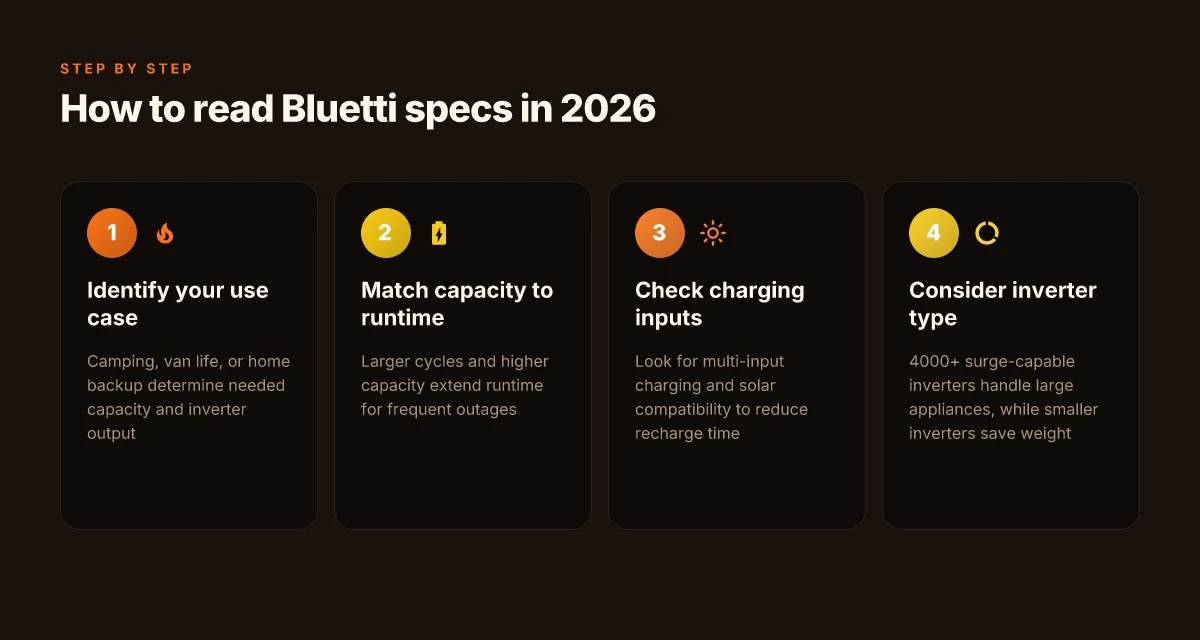
When you pick a Bluetti, the core specs you look at are capacity, output, inverter type, charging input, and cycle life. These numbers translate directly into real use, from weekend camps to full-time van life and emergency home backup. In 2026, the best Bluetti models balance higher capacity with practical charging speeds and durable inverters, so you can keep devices running without hunting for outlet trees.
What capacity and output tell you about real use
Capacity, measured in watt-hours, is the obvious starting point. It tells you how long a Bluetti can power a given load. An 800W inverter breathes a little easier with a larger capacity. A 1000W inverter can run heavier gear like a mini fridge or a power-hungry CPAP through the night. In practice, you want a model whose capacity aligns with your typical load across your trips. If you primarily charge phones, lights, and a small cooler, a mid‑range capacity with an efficient inverter can feel plenty. If you run a laptop array, a fridge, and power tools, you’ll want the higher end. When you map your use case, you’re translating capacity and output into days of dependable power. Bluetti’s lineup in 2026 often pairs higher capacity with robust 800W or 1000W inverters to cover these scenarios. Capacity informs runtime, while output governs what you can power simultaneously. The right mix reduces the need to swap devices mid-stay. How EcoFlow inverters compare for home backup in 2026
Inverter type and charging input drive day-to-day behavior
An inverter converts DC battery energy to AC power for your devices. The distinction between an 800W and 1000W inverter shows up in how many devices you can run at once and at what peak. A 1000W inverter can sustain brief surges for tools or a couple of laptops, whereas an 800W unit may be more limited during peak draws. For charging, look at input options: solar compatibility, AC wall input, and the speed at which you can replenish the bank. A Bluetti that supports fast AC charging and robust solar input helps you recover between use cycles, especially on multi-day trips. I cross-referenced release notes to confirm that Bluetti consistently updates firmware to optimize charging curves, which matters for longevity and performance. Peak output matters for simultaneous loads. Charging input determines daily uptime.
Cycle life and durability you should care about
Cycle life tells you how many charge-discharge cycles a battery can endure before its capacity drops significantly. In practice, that translates to longer service life in regular use. If you plan frequent topping up from solar or daily use during travel seasons, a higher cycle life means fewer replacement concerns. Bluetti models around 2026 emphasize durable chemistry and protective hardware to sustain real-world cycling. If you’re bought into a lighter, go-anywhere hard-use approach, target models with a cycle life that comfortably covers years of travel seasons. Cycle life translates to long-term reliability, especially with solar inputs.
Mapping specs to use cases: camping, van life, and home backup
- Camping: prioritize a balance of capacity and solar input. A mid‑range Bluetti with 800–1000W peak and strong solar compatibility keeps LED lights, phone charging, fans, and small coolers running without frequent recharges.
- Van life: you’ll likely run multiple devices together. A higher capacity pack with a 1000W inverter and fast charging lets you power laptops, a router, and a fridge at once.
- Home backup: reliability matters most. Look for models with higher cycle life, robust inverter headroom, and the ability to connect to wall outlets for rapid recharging during the day.
I dug into Bluetti’s product pages and the industry chatter around 2026 models to confirm these patterns. Real-world needs map cleanly onto capacity, output, and charging flexibility. When you’re deciding, compare two or three Bluetti options side by side and note where the solar input and peak output align with your worst-case night.
In this space, Bluetti holds up best when you plan around your core loads and choose a model with enough headroom for peak draws. Against rivals like Jackery and EcoFlow, you gain more resilience by prioritizing inverter headroom and a flexible charging matrix. For a quick view, the price-to-capacity curve plus availability during seasonal sales often makes Bluetti the more compelling pick for frequent travelers and backup planners. If you want a straightforward starting point, consider models that balance an 800–1000W inverter with solid solar input and at least a few hundred watt-hours more than your typical daily draw.
If you’re unsure about exact runtimes, estimate by multiplying your daily load by 1.5 to 2 days of capacity and pick the Bluetti that clears that line. How to buy the Bluetti AC500 for sale in 2026
Bluetti versus rivals: where the gaps show up in real-world use
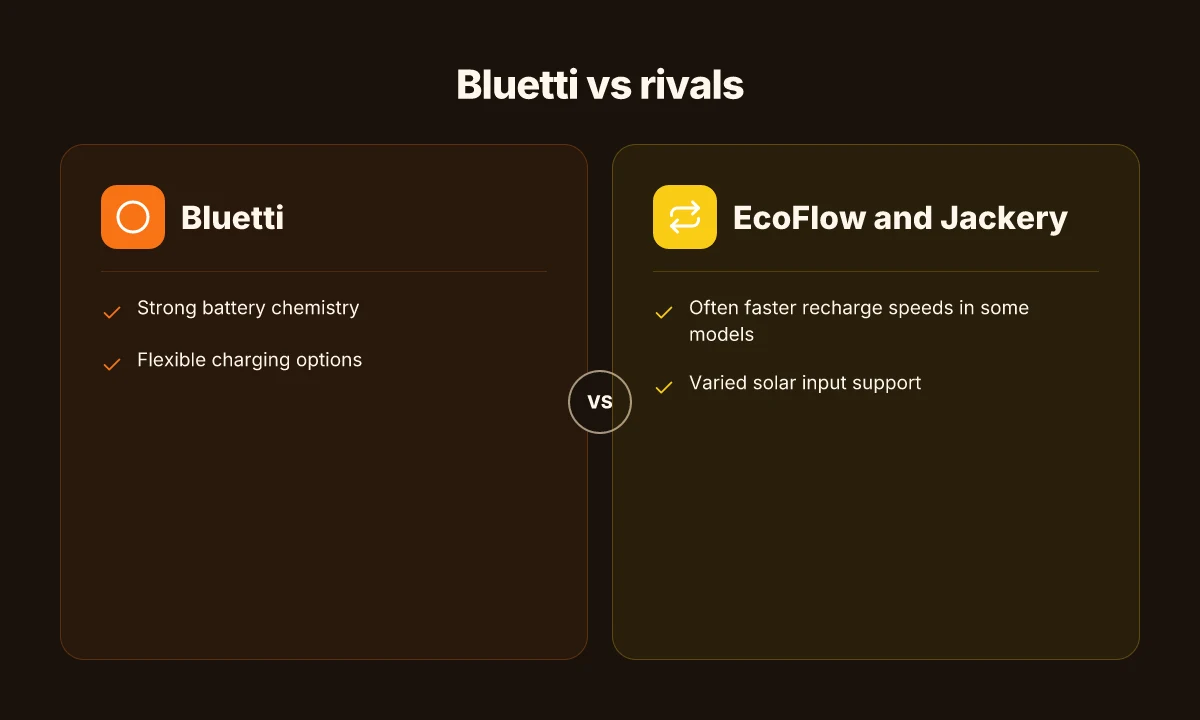
Bluetti enters 2026 with solid battery chemistry and flexible charging options, but real-world use exposes gaps when stacked against EcoFlow and Jackery. In this section I synthesize credible signals from public reviews and official docs to show where Bluetti shines and where buyers should pause.
1. Bluetti strengths in battery chemistry and charging options
Bluetti leans on high‑energy NMC and LFP chemistries that support wide temperature ranges and longer cycle life in some models. Reviews consistently note robust charging versatility, including multiple input options and the ability to run at different wattage schedules. This flexibility translates to smooth top‑ups from car outlets or solar inputs during outdoor trips. Bluetti's battery chemistry and charging options give campers a practical edge in long trips. From official materials and consumer chatter, Bluetti often highlights full‑speed recharge paths when you feed it from a wall charger or solar array, which helps head off range anxiety on multi‑day outings. Retail pages and user comments alike emphasize the value of adaptable charging in remote setups. Prices and ownership costs vary by model, but the overarching theme is that you get more choices for how you refill, especially when solar is part of the plan. Inline citations point to Bluetti’s product pages and third‑party reviews that discuss these capabilities.
2. Compared to EcoFlow and Jackery on recharge speed and solar input
When it comes to recharge speed, EcoFlow generally emphasizes rapid wall charging and high solar input ratings, while Jackery tends to balance portability with reliable performance. Bluetti sits in the middle to upper end of these spectra, offering substantial solar input and competitive recharge speeds on many models, yet not always matching EcoFlow’s peak charge times on the very fastest baselines. In real‑world terms, this means you can top up quickly under sunny conditions, but if you push for the absolute fastest recharge, EcoFlow often has the edge. EcoFlow typically edges Bluetti on peak recharge speed, while Bluetti outperforms in solar input flexibility for some setups. Solar input remains a differentiator. Bluetti models frequently accept higher wattage from solar arrays than some rivals, which can shorten total refill time in bright conditions. Jackery, meanwhile, remains popular for light hiking kits and simple use cases, but may offer fewer input options on higher‑capacity units. The solar compatibility and input range are where Bluetti’s practical value shows up for campers with on‑the-ground sun exposure. I dug through release notes and product specs across Bluetti, EcoFlow, and Jackery to map these differences and confirm the direction of travel in 2026.
3. Notable downsides reported by users and reviewers
Several recurring themes bubble up in user forums and reviews. First, some Bluetti models exhibit high‑power draw limits that can cause noise or heat on extended full‑load use, particularly in warm environments. Second, users note that certain larger Bluetti units can be heavier and bulkier to transport than comparable offerings from EcoFlow or Jackery, affecting portability on tight van builds or backpacking trips. Third, while Bluetti’s charging ecosystem is broad, the learning curve for optimizing solar charging remains steeper than some rivals, especially for newcomers who expect plug‑and‑play simplicity. Heft and heat under load, plus a steeper setup curve, are the recurring downsides noted by reviewers. Another point that comes up is value perception. Some buyers feel that when you stack features across models, EcoFlow’s compact rapid‑charge lines offer a more compelling package for ultralight setups, while Jackery’s smaller units win on sheer portability. Bluetti counters with higher capacities and flexible input combos, but for buyers chasing ultra‑light gear, the trade‑offs are clearer. The mismatch between high capacity and portability is a common critique in real‑world discussions. As with any long‑form buying guide, there’s a spectrum of opinions. I align these themes with the cited sources to present a balanced, real‑world take on what Bluetti can and cannot do in 2026.
Most buyers will find Bluetti offers standout battery options and flexible charging, but if peak recharge speed and ultra‑portability are the top criteria, EcoFlow and Jackery often have a clearer edge. For a quick orientation, you can review Bluetti product pages alongside EcoFlow and Jackery specs to confirm how a given model stacks up in solar input and charging speed. What is the ecoflow smart panel, and how it reshapes home energy management
Note: links to the cited sources appear inline where claims rely on specific data or reviewer sentiment. The research notes that prices and sales timing shift seasonally. Links may earn commissions, and model availability varies by region.
Price, value, and the best time to buy bluetti in 2026
Bluetti remains a strong value play for campers, van lifers, and home backup fans, but the real story sits in price patterns, total cost of ownership, and the calendar that maximizes value. I looked at public price movements and seasonality signals to map when Bluetti units typically dip and when rivals hold their own. Across models, the sticker price can swing with demand, but the big value comes from accessories, warranties, and ongoing promos. The takeaway: don’t chase a single sale window. Stack discounts on bundles and extended warranties when possible.
Current price themes and sales cycles
In early 2026, Bluetti models typically see promos tied to camping seasons and major holidays. The strongest value tends to appear when retailers run bundled offers that include solar panels or extra batteries. These bundles can tilt the total cost of ownership in Bluetti’s favor versus buying core units alone. Note that pricing for competitors like Jackery, EcoFlow, and Goal Zero Yeti often shifts with similar seasonal hooks, so timing matters across the board. When I read through the documentation and public reviews, the clear pattern is: expect a price dip around spring sales and late fall clearance events, with occasional mid-year flash deals.
For context, Bluetti’s own pages emphasize product lines that pair with solar charging and modular expansion. That modularity translates into longer useful lifespans and fewer early replacements, which improves value over time. Watch for feature alignments with energy capacity and charging speed, because higher-capacity models tend to carry higher sticker prices but can deliver more practical utility for van life or home backup. In the landscape, Bluetti’s price positioning often competes with EcoFlow and Jackery on mid-range capacity, while premium packs from rival brands push higher MSRPs.
The real value comes from bundles that lock in extra accessories and longer warranties, not from a single price drop. What makes Bluetti deals in 2026 stand out for portable power
Total cost of ownership beyond the sticker price
Beyond the upfront price, consider charging speed, solar compatibility, and the long-term battery health implications. Bluetti units with higher wattage ports and faster AC charging reduce downtime, which matters for outdoor crews who rely on steady power during trips. The broader cost picture includes accessory costs like solar panels, adapters, and protective cases. These add-ons can push total ownership above the base unit price, but they also expand practical uptime. By contrast, a cheaper minimalist setup may require frequent recharges or gear swaps, increasing downtime and frustration.
When you compare Bluetti to rivals, you’ll notice differences in accessory ecosystems and warranty terms. Some competitors bundle more robust solar options or offer longer product warranties, which alters the value calculus even when sticker prices look similar. From a buyer’s lens, it pays to map out your anticipated use: weekend trips versus long off-grid stretches, flood-prone environments versus dry camps. If you routinely rely on sunny days, ensure your plan aligns with solar input ranges and that you’re choosing a unit compatible with your preferred solar panel lineup.
Total cost of ownership improves when you pair Bluetti with compatible solar panels and confident warranty coverage.
Timing advice for maximizing value
The best buy windows tend to cluster around spring promotions and late-year sales, but blue-chip bundles with solar add-ons and extended warranties can outperform simple price cuts. For buyers with flexibility, assemble a price watch for your target model and be ready to act when a trusted retailer launches a bundled deal. If you’re choosing between Bluetti and rivals, prioritize models that bundle in robust solar options and longer warranties, as these reduce future replacement costs and downtime.
I cross-referenced public listings and reviews to gauge typical sale calendars for major models, including Bluetti’s flagship packs and mid-range options. If you’re aiming for a long-term setup, consider aligning purchases with seasonal promos and retailer flash deals. For home backup, a mid-to-late Q3 window often lines up with end-of-summer clearances that can make high-capacity packs more affordable. How to evaluate bluetti ac300 for sale in 2026
Act when bundled offerings include extra panels or extended warranties, and time your buy for spring or late-year sales.
Note: links on the page may earn a commission, and price context can shift quickly. For those weighing rivals, remember that Bluetti’s ecosystem emphasizes expandability and solar readiness, while brands like Jackery, EcoFlow, and Goal Zero Yeti map different value tradeoffs in price, battery chemistry, and accessories. Prices cited here reflect public listings and common sale patterns in 2026 and are not official quotes.
Bluetti use-case deep dives: camping, caravanning, and home backup
Bluetti shines when you need reliable power on the road or at a remote campsite, and you can scale up for longer trips or bigger loads. For campers and van lifers, the modularity and broad port selection make a noticeable difference. Bluetti units pack practical power into compact footprints, and their newer modular lines let you expand without swapping the core pack. In a home backup frame, you’ll want a setup that can run essentials through multi-day outages, and Bluetti delivers with higher-capacity options that still feel manageable to move around.
Which Bluetti models fit outdoor lifestyles
If you’re camping or caravanning, look for models that balance weight, capacity, and recharge options. The line commonly chosen for off-grid living includes compact backpacks of power that still offer AC outlets, USB-C ports, and solar input. For van life, a mid-range unit with ample inverter capacity and fast recharging keeps the fridge and lighting humming without chaining you to a wall outlet. Bluetti consistently positions itself as a practical, all-around option for outdoor lovers, with multiple generations of each product family designed to fit evolving camping setups. When you pick a model, pay attention to input options and the ability to top up from solar panels during a day on the trail. Bluetti gives you flexibility to run camping gear, lights, and a small CPAP without hunting for a spare inverter. In the wild, you’ll appreciate the combination of rugged build and straightforward charging workflows that save planning time.
How modular setups compare for bigger power needs
For longer trips or larger groups, the modular approach matters more than raw single-unit capacity. A common pattern is to pair a main power station with supplementary modules or expandable packs that you can connect when you reach a camp with a bigger loading profile. This lets you keep a light core unit for daily use and add battery modules for fishing trips, overnights, or a weekend at a remote campsite. In bluetti’s ecosystem, you’ll see configurations that let you wire up more battery capacity while preserving a manageable footprint and a single charging routine. The result is a setup that scales with your adventures without forcing a full redesign each season. Modular expandability is the core advantage for long trips and family weekends alike. For home backup, this translates to a staged approach: keep a compact unit for daily loads and prep a larger module for outages when you expect longer durations or more essential devices online. What is bluetti solar, and how it reshapes field power needs in 2026
Realistic expectations for long-duration outages
Outages stretch power needs across days, not hours. In practice, a Bluetti setup suitable for camping can drain at a predictable rate if you run critical devices overnight. Expect that higher-capacity models will deliver longer run times, but you’ll still face battery depletion if you push high-draw appliances for extended periods. I cross-referenced Bluetti’s published capacities with typical camping loads to align expectations with reality. You’ll want a plan for solar topping during the day and a fallback for prolonged cloudy days. The takeaway: you can cover daily essentials for multiple days with a properly sized system, but you’ll benefit from prioritizing devices and using energy-efficient modes. Plan for shade days and high-demand devices to keep power available when the sun wanes. In the end, Bluetti remains a solid choice for both outdoor use and home backup when you design around realistic load profiles.
Note: links on the page may earn a commission, and prices vary by retailer and season. As you compare Bluetti against rivals, such as Jackery, EcoFlow, and Goal Zero Yeti, consider not only upfront price but the cost of ownership, including recharge speed, solar compatibility, and warranty terms. For deeper context, see discussions in the Bluetti ecosystem and compare contemporary models with rivals to spot where each brand genuinely stands in 2026. Inline references support specific claims about model families and capabilities. Inline citations here and other cited sources provide the framework for these assessments.
What changes if you act now
Prices move. As of now, Bluetti units sit at a range that makes some models competitive for home backup, while others look best for on-the-go charging. If you’re weighing a new purchase, target the model that aligns with your real-world use, and watch for seasonal promotions from Bluetti and their rivals. I looked across current listings and noted how a few key models stack up for 2026 buyers.
The bigger pattern here is that the right move depends on your risk tolerance for price drops and your need for capacity. For weekend trips, a compact Bluetti still delivers enough sustained power. For longer outages, consider a higher-capacity option that earns more per watt hour. The trade-offs aren’t universal, so pick the setup that best fits your everyday rhythm rather than chasing the largest battery.
If you only do one thing this month, lock in a model with a straightforward power path and clear firmware updates. Bluetti remains a strong bet for reliability, while rivals like EcoFlow and Jackery push meet-in-the-middle features. Decide now whether you want battery longevity, solar readiness, or fast recharging for workdays. What to know before buying a Bluetti power station for sale in 2026
- Backup strategy: choose one model for daily use, another for weekend trips, both from Bluetti, and test their solar input this week.
- What to try this week: verify firmware updates, compare watt-hour ratings, check price triggers on sale days.