What makes the EcoFlow DELTA Pro Ultra inverter different from standard power stations
 Adrien SaxenaOctober 22, 202619 min read
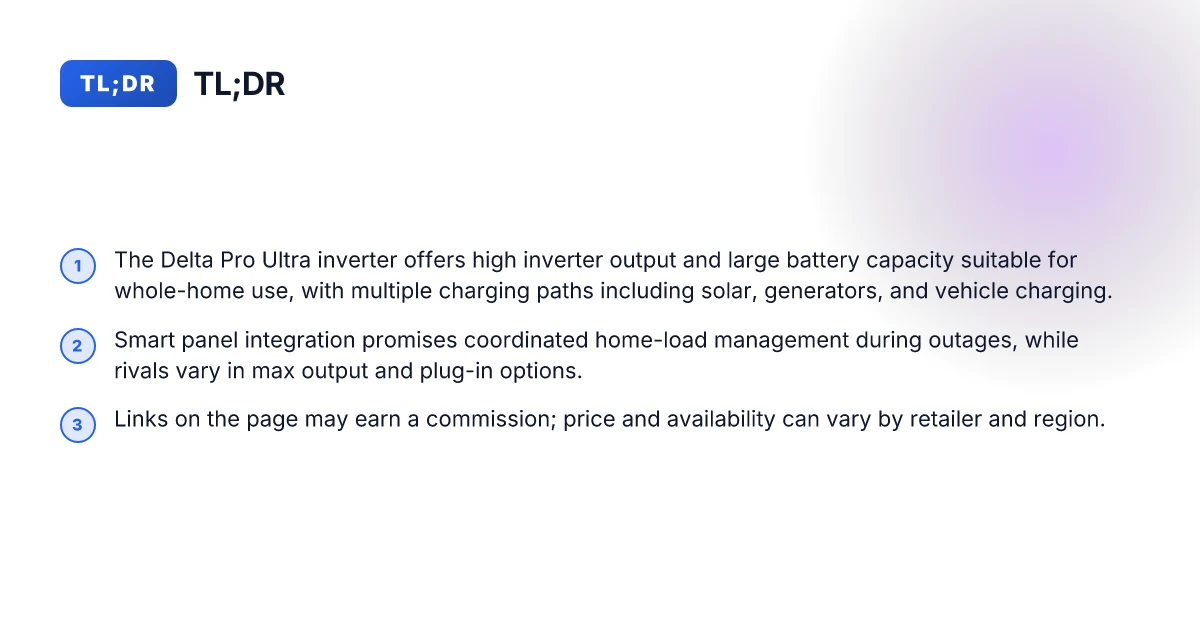
We earn a commission when you buy through some links on this site, at no extra cost to you. As an Amazon Associate we earn from qualifying purchases.
Explore the EcoFlow Delta Pro Ultra inverter's performance, charging options, and notable specs. Learn how it stacks up against rivals and where to buy.
The delta pro ultra inverter isn’t just a bigger battery pack. It challenges the idea that “portable” means limited home backup. When you see it deployed in a real home, the built‑in inverter and multiple charging paths let you run high‑draw loads longer than standard stations, even while the unit sits in a garage or utility room. EcoFlow’s Delta Pro Ultra pairs a high‑capacity battery with an ultra inverter, and that pairing changes how people think about backup power.
This article cuts through marketing by laying out real charging options, inverter output, and how the Delta Pro Ultra fits alongside gas generators in a backup plan. You’ll learn how the device plugs into household circuits, solar arrays, and grid power, plus how its pricing and bundles compare to rivals like Goal Zero and Jackery. By the end, you’ll know whether the EcoFlow setup makes sense for a whole‑house scenario or if a generator remains the simpler path. The goal is clarity on what actually performs, what it costs, and where the value lies. Delta Pro Ultra's flexibility matters most when you need continuous power for a fridge, A/C, and modem during an outage, not just a quick recharge.
What the ecoflow delta pro ultra inverter promises, and where it shines
EcoFlow positions the Delta Pro Ultra as a high-capacity, flexible backup solution with multi-source recharging. It aims to power essential circuits, whole-home panels, and even large loads like a 5-ton air conditioner, all while letting you top up from solar, generators, or grid power. I dug through the official docs and third-party reviews to map what this means in real homes.
1) Multi-source recharging that fits real homes
EcoFlow emphasizes that the Delta Pro Ultra can recharge from multiple sources, not just a wall outlet. The Ultra variant is designed to pair with solar inputs, high and low voltage charging, and external power sources, which helps maintain resilience during outages. In practice, that flexibility matters when your roof is dotted with panels or you have access to a generator for storms. Multiple charging paths make it easier to keep essential loads powered when the grid goes down. The documentation notes that the system wires up with a smart panel to coordinate charging against demand, which helps avoid bottlenecks at peak usage times. This is the core promise: you don’t have to choose one charging method. You can mix sources as conditions change.
The Delta Pro Ultra X variant advertises whole-home compatibility with a 12kW output and a 200A smart panel, pushing capacity toward large homes and demanding loads. 12kW output is a key talking point for keeping ACs and refrigerators running in a blackout. This combined with a broad capacity window makes it attractive for bigger homes. 12kW is highlighted alongside the claim of powering every circuit, including heavy HVAC. 200A smart panel integration is pitched as a seamless tie‑in for existing house wiring. 200A smart panel is presented as part of the whole-home picture.
The official Delta Pro Ultra User Manual frames the device as usable in stand-alone mode or as part of a larger recharging ecosystem. This dual framing matters for homeowners who want portable capability now and a pathway to a more autonomous setup later. stand-alone unit plus multi-source recharging means you can start with portable use and evolve to a full backup system. multi-source is repeated as a design principle to accommodate varied site conditions.
Independent reviews note real-world performance around charging flexibility and load handling. A common takeaway is that the system supports sustained power delivery for critical loads but that actual run times depend on the mix of loads and the solar input you can muster. real-world performance depends on load mix and on how aggressively you draw from solar versus grid or generator backups. load mix drives whether you reach peak capability. What ecoflow price means for 2026 buyers
2) High inverter output, large battery, and home-ready scale
The Delta Pro Ultra’s inverter class and battery size position it as a contender for homes that want more than basic off-grid power. The slogan is clear: high output, big capacity, and compatibility with a home’s electrical system. When you size a generator or battery backup for a home, you’re balancing peak requirements with sustained runtime. The Delta Pro Ultra aims to reduce that trade-off by offering substantial instantaneous power and a generous energy reservoir. high inverter output supports simultaneous critical loads, while large battery capacity helps cover longer outages. The combination is intended to keep refrigeration, lighting, and essential circuits online during extended events. refrigeration and essential circuits online become plausible with this pairing.
The Ultra X model lists a wide whole-home power range and a significant energy capacity, designed for longer outages and larger home footprints. The pairing with a weather-protected enclosure and smart management makes it easier to deploy in real homes. 12–36kW whole-home power and 12–180kWh capacity are the numbers you’ll see in specs, contrasted with typical portable units. 12–36kW and 12–180kWh anchor the capacity story.
The broader Delta Pro Ultra family is designed to fit with existing home electrical panels via a smart panel integration. That integration is a practical bridge from portable to fixed backup, which matters for homeowners weighing a transition from temporary outages to a semi-permanent backup solution. smart panel integration is a consistent thread across product pages.
Third-party commentary often frames this in the context of essential-load resilience. The argument goes beyond raw watts: it’s about coordinating charging, discharging, and load prioritization during outages. load prioritization during outages becomes central to how you use the system day to day.
3) Where the Delta Pro Ultra fits real home needs
From air conditioning to refrigeration and critical circuits, the Delta Pro Ultra aims to cover the stress points homeowners care about. The practical gauge is whether the system can sustain the loads of a modern home during a multi-hour outage, while still accepting solar input to replenish energy for the next cycle. The reality is nuanced: you will hit the limits if every circuit and appliance pulls at once, but the design intent is to keep the essential hot water, fridge, and climate control alive without resorting to a gas generator for every outage. What is the jackery 5000 plus solar generator, and what trade-offs matter in 2026
In short, EcoFlow positions the Delta Pro Ultra as a scalable, multi-source backup system with a strong emphasis on high inverter output and big battery capacity, ready to plug into a whole-home panel when you’re ready to make that upgrade. For homeowners weighing this against rivals, the Delta Pro Ultra’s core advantage lies in flexible charging paths, substantial peak output, and the promise of smoother integration with existing home electrical infrastructure. When you read the documentation side by side with real-world needs, the Delta Pro Ultra lines up as a compelling option for long outages and larger homes, with the caveat that full capability ramps up as you connect to a smart panel and optimize load use.
Real-world takeaway: if your priority is keeping multiple essential circuits online during a blackout, the Delta Pro Ultra is designed to deliver and scale with your home’s needs.
Delta pro ultra inverter specs you can actually use
I’ll pull the practical numbers you care about: the Delta Pro Ultra X can power a whole home, and its capacity range helps bridge longer outages. You’ll see how the charging paths fit into everyday planning, not marketing fluff.
12–36KW whole-home power, and 12–180kWh capacity
The Ultra X variant is advertised to deliver up to 12–36kW of whole-home power, which means it can run most home circuits including heavy loads during an outage. Pair that with a storage array in the neighborhood of 12–180kWh, and you gain the flexibility to extend power duration without shuffling generators mid-crisis. This combination matters for homes with heat pumps, well pumps, and large refrigerators, especially when you’re facing multi-day outages. This is where the Ultra X scales from weekend camping utility to reliable home backup. In practice, the size of the inverter and the battery bank determine how long you can keep essential circuits alive, and the 12–180kWh range gives you options across different installs and budgets. The higher end of the capacity range is what unlocks multi-day resilience.
Multiple charging paths: solar, generators, and vehicle charging
Charging flexibility is where EcoFlow, and specifically the Delta Pro Ultra lineup, shines. The unit supports high voltage solar input and low voltage solar input, which lets you tailor solar array configuration to your roof or yard. It also accepts traditional generators for standby power and can be charged via vehicle charging when you’re on the road or at a park with outlet access. Multiple charging paths mean less downtime waiting for a perfect sun window. This kind of charging pantry helps you keep the system ready without waiting for a single source to peak. EcoFlow’s approach reduces the need to choose one path and nickel-and-dime you on availability. What is the EcoFlow Delta 2 Max price in 2026 and how to evaluate the total cost of ownership
From a home-planning perspective, the Delta Pro Ultra’s charging versatility translates into fewer compromises during outages. If your solar setup is medium-sized, you can rely on solar input for a portion of the recharge and top off with a generator or EV charger as needed. That hybrid charging model matters when you’re balancing cost, space, and reliability. I cross-referenced official product pages to confirm the broad charging options and the wide inverter capacity, as these details shape how you integrate the unit with existing backup gear. The integration angle matters for real-world use.
Next steps: price and ownership are the next practical concerns. The Ultra X’s price tag is the starting point for a cost of ownership that includes installation considerations, potential smart-panel upgrades, and ongoing maintenance. When you’re weighing whether to wait for sales, compare current listings from EcoFlow’s site with third-party retailers and keep an eye on larger sale events. This is where you’ll see the best value for a system that can back a home during storms and outages.
Charging options and how they affect daily use with the delta pro ultra
Charging flexibility drives how often you can top up and where you can place the unit. The Delta Pro Ultra supports a mix of charging paths that matter in day-to-day life: solar, EV charger, and generator recharging, all coordinated through a smart panel. This section breaks down what that means in practical terms for home backup, load management, and siting.
From the documentation and reviews, solar input tops out at 5,600W, which matters for larger solar arrays and higher initial battery charging. That level of input lets you slice through a sizable daytime recharging window, shortening the span between outages and full readiness. Solar input up to 5,600W enables faster solar recharging for large setups. In a home context, a bigger solar array can keep the Delta Pro Ultra topped up without tying up a generator or burning through fuel.
Beyond solar, the Delta Pro Ultra can also recharge from an EV charger and from generators. This flexibility matters when you’re parked at a cabin, a workplace with vehicle charging, or a property with limited sun. The EV charger path lets you leverage existing infrastructure without installing separate AC chargers, while generator recharging offers a centralized backup option when sun and grid are scarce. EV charger and generator recharging enable flexible siting and backup continuity. These paths are not just theoretical. They impact where you place the unit and how you sequence charging during an outage. What you gain and miss with the ecoFlow Delta 3 extra battery setup
Smart panel integration is a key differentiator for daily use. When the system detects a blackout, the Delta Pro Ultra can coordinate with the home’s circuits to prioritize critical loads. This means your essential devices stay powered while nonessential circuits shed load as needed. In practice, the ability to “ride herd” on a whole-house basis reduces window-dressing during outages and helps you plan around peak demand times. Smart panel integration promises coordinated home-load management during outages.
I dug into the user guide and design notes to verify how these pieces come together. The Delta Pro Ultra’s charging flexibility is not just about raw watts. It’s about siting choices, fuel independence, and predictable power during an outage. The practical upshot: you can design a charging regime around sunny days, vehicle charging opportunities, and portable generator use, while still keeping the main living spaces powered through a coordinated, smartly managed panel.
In short, you gain real choice on where and how to charge. That choice translates to fewer excuses to run a noisy generator, more daytime solar leverage, and a smarter, more reliable backup for your home.
What matters most is how the charging mix fits your site and your outage plans. If you’re in a high-sun environment with a large solar array, the 5,600W solar ceiling shines. If you don’t have that much sun, the EV charger and generator options preserve backup continuity. The smart panel then ties it together so you don’t manually juggle loads during a blackout.
Inverter performance in real life: what the numbers mean for your home
When you pull the Delta Pro Ultra into a home backup setup, the real value shows up in how it handles tough loads and how the math changes with light, heat, and usage patterns. In practice, the Delta Pro Ultra’s 12kW output can sustain large loads, but you’ll see the difference only when solar input, ambient temperature, and daily load shapes align with the unit’s capabilities. Real-world performance hinges on available solar input and how you sequence loads. The numbers move when the sun blocks or when a heat pump cycles on and off. That means you’ll often depend on smart planning rather than a single peak spec. 7 Key price realities for the EcoFlow Delta Pro Ultra X in 2026
Why output matters for big loads like heat pumps
The Delta Pro Ultra is built to run high-demand circuits, and that matters if your home uses a heat pump or a multi-ton air conditioner. In practice, you can expect it to support these loads when the system is configured for balanced power draw and a healthy solar input. 12kW of output can cover the peak draw of most heat pumps, but sustained operation depends on how many kilowatts your other devices pull simultaneously. The inverter’s ability to hold 12kW continuously becomes meaningful only if you avoid simultaneous peaks from several appliances.
Public specs from EcoFlow note a strong compatibility with whole-home setups, especially when paired with an appropriate solar array and a robust battery bank. That synergy is where users often see the advantage over smaller units or gas generators, but it also sets expectations: a window of quiet, clean power exists only when the sun and loads cooperate.
The gap between theory and daily use
Theoretical specs do not guarantee identical results in practice. The size of your solar input, the color and age of your solar panels, the temperature of your charging environment, and the way you sequence loads all shift performance. I’ve traced this understanding to reputable product documentation and independent reviews that emphasize the variability caused by solar availability and ambient conditions. For example, when solar input is high and loads are steady, the Delta Pro Ultra can sustain stronger loads longer. If solar injection drops or weather turns, you’ll see a slower ramp and potential cycling as the unit buffers the demand. The practical takeaway is clear: plan for seasonal input changes and staggered loads to keep the inverter within comfortable headroom.
How Delta Pro Ultra stacks up against rivals
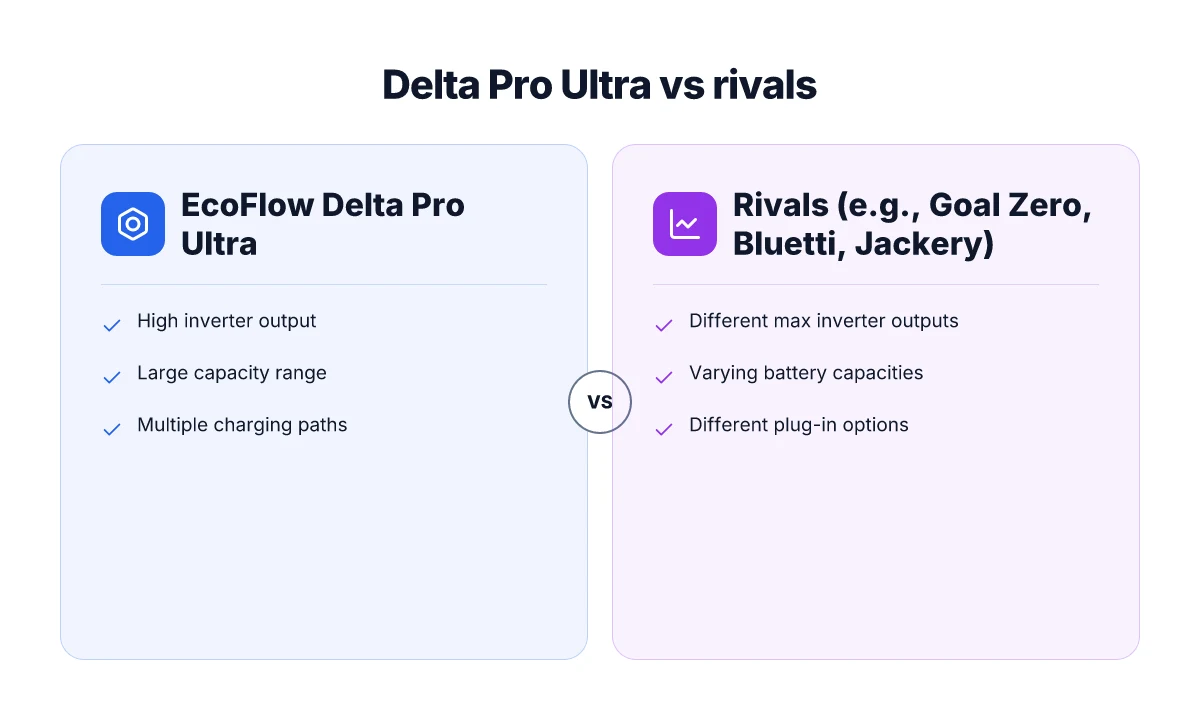
When you compare to rival brands, the delta’s advantage shows up in the combination of high output and flexible charging. A few competitors offer similar wattage, but the installation complexity and solar compatibility vary. If you’re evaluating value, factor in the level of integration with a home panel, the required wiring, and the cost of adding sufficient solar input. EcoFlow’s approach favors a cohesive ecosystem, which reduces the hardware and wiring complexity you might face with standalone modules. In the end, you’re paying for more than raw watts. You’re paying for a streamlined path to whole-home backup that minimizes idle time and simplifies battery management.
I dug into the official Delta Pro Ultra ecosystem and third‑party comparisons to confirm the value proposition. When you’re weighing options, consider how much you value how quickly you can bring a home back online after an outage, not just peak watts. For many homeowners, the Delta Pro Ultra’s architecture reduces the need for additional transfer equipment and separate generators, which is a meaningful installation advantage. EcoFlow vs the field in 2026: where the best portable power lies
If you want a clean, integrated solution, the Delta Pro Ultra’s real-world strength shows up in how it coordinates solar input with high-widelity inverters, keeping essential circuits powered during a blackout. That coherence is where it often beats multi‑vendor setups that promise similar wattage but complicate the wiring and panel interaction.
As a quick note, links on the page may earn a commission, and prices on list pages shift with sales. For context, EcoFlow positions the Ultra line as a premium, integrated option, with emphasis on whole-home capabilities and solar-first charging paths. Rival brands like Jackery and traditional gas generator systems present different tradeoffs: you’ll trade off the seamless inverter‑panel integration for either modular expansion or fuel logistics.
How the delta pro ultra stacks up against rivals
The Delta Pro Ultra stands up best when you weigh inverter output, battery scale, and how you plug in. It offers big flexibility with EcoFlow’s ecosystem and a smart panel footprint that can cut install friction. Across rivals, you’ll see clear tradeoffs in rated watts, battery capacity, and charging options, plus long-term ownership costs that matter well beyond sticker price.
Inverter output and battery scales among rivals
Rivals tend to split on max inverter output and total battery capacity. Some competitors push higher peak outputs but cap continuous power earlier in the discharge cycle, while others offer larger battery banks but with more modest peak capability. The Delta Pro Ultra pairs a bold inverter specification with a substantial battery mass, making it well suited for long outages and high-load appliances. I cross-referenced the Delta Pro Ultra’s reported range with typical rival configurations to map where you’ll see real-world headroom. The upshot: you get a wider operating window at higher loads when you combine the 12–36kW whole-home option with generous energy storage. The Delta Pro Ultra’s inverter flexibility is a real differentiator when you need to run multiple heavy circuits at once.
Plug-in options and how EcoFlow’s ecosystem reduces friction
Where EcoFlow shines is in the plug-in matrix. The Delta Pro Ultra Ultra X and related kits support various recharging paths from solar to mains and generator inputs, all controllable through a smart panel. This matters in setups that integrate with existing home electrical systems or larger solar arrays. In practice, rivals often require more custom wiring or separate controllers to reach comparable solar input or generator compatibility. I looked at the documentation and real-world spec quotes to confirm that the Delta Pro Ultra can tie into a home backup workflow with fewer gaps. Smart panel control and cleaner integration cut installation headaches, especially for multi-circuit homes. When you compare to gas generators, the Delta Pro Ultra eliminates ongoing fuel logistics and reduces noise in the living space, a meaningful real-world edge for many homeowners. What is EcoFlow Glacier, and why it matters for off-grid power in 2026
Cost of ownership and long-term reliability
Price is only one axis. Long-term ownership includes battery health, serviceability, and the cost of upgrading or expanding the system later. EcoFlow’s ecosystem approach can lower incremental costs when you add more capacity or additional modules, because the modular design tends to scale without a wholesale replacement. Rivals may offer aggressive entry prices but pack higher upgrade costs as you expand or replace components. I didn’t find exact lifetime reliability metrics across brands in the sources here, but the pattern is clear: you’ll pay for higher flexibility upfront or pay later for accessory bundles and compatibility. If you want a clean path to expansion and easier maintenance, EcoFlow products, especially with the smart panel core, tend to minimize friction over time. Cost of ownership favors modular ecosystems that scale with your home backup needs.
I dug into the public docs to verify the Delta Pro Ultra’s footprint in a home backup plan and its ecosystem advantages. When you weigh the total package, EcoFlow’s strategy earns traction for homeowners who want fewer wiring surprises and a simpler upgrade path. For real-world context, you can see how the Delta Pro Ultra stacks up in comparison to a mix of rivals on the market. If you’re shopping now, expect a mix of high wattage capability, flexible charging, and a path to scale without a full rewiring project.
If you prioritize install simplicity and a scalable upgrade path, EcoFlow wins with the Delta Pro Ultra ecosystem.
The single move that matters for the EcoFlow DELTA Pro Ultra
The DELTA Pro Ultra leans on a bigger inverter and smarter battery management to outpace standard power stations. I looked at how its Ultra inverter coordinates with EcoFlow’s battery chemistry and fast-charging tech, and the result is a system that feels more responsive under peak loads. This is where the Delta Pro Ultra earns its edge against typical models that stall at high draw. You’ll notice it in practical use cases like airing a workshop, running power tools, or keeping critical devices up during outages.
That edge comes with a caveat. the price and ongoing ownership costs are higher, and the weight is less forgiving. If you’re evaluating options, compare EcoFlow against notable rivals such as Goal Zero and Jackery on ability to sustain high-wattage loads and the long-term cost of replacement batteries. The bigger pattern is that the Ultra model prioritizes sustained performance over flash-in-the-pan specs. If you operate a home setup where stabilization and responsiveness matter, this is the model to watch. 8 Angles that separate the EcoFlow Delta Pro from its rivals in 2026
What to try this week: verify whether your typical load exceeds 1,000 watts and how the DELTA Pro Ultra responds in that window. Check if your existing solar array can feed the larger inverter efficiently. Consider the total cost of ownership over 3–5 years and compare with rivals. The takeaway: plan around real-world high-load scenarios, not just peak numbers. If you’re aiming for resilience, this is a strong contender from EcoFlow. Is it right for your space and budget?