EcoFlow vs the field in 2026: where the best portable power lies
 Nova EngelmannOctober 22, 202618 min read
We earn a commission when you buy through some links on this site, at no extra cost to you. As an Amazon Associate we earn from qualifying purchases.

Explore EcoFlow against top rivals in 2026. Learn where EcoFlow shines, where it lags, and how to choose a portable power station for home backup and on-the-go use.
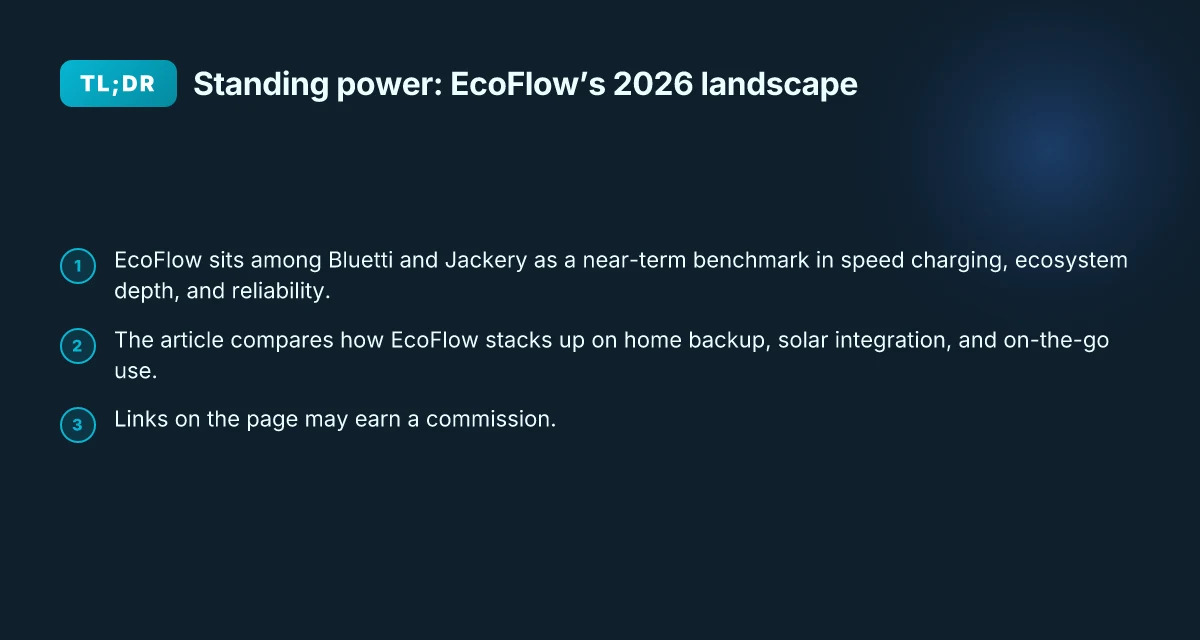
EcoFlow dominates the field by offering a single, scalable system you can rely on, not just a collection of standalone boxes. The real story isn’t gimmicks but how a broad lineup and integrated solar input translate to fewer adapters, faster recharging, and consistent performance across use cases. EcoFlow's ecosystem tends to pay off when you need modular growth, especially for home backup and off-grid setups.
Expect concrete comparisons among EcoFlow, Bluetti, and Jackery, plus practical notes on installation, warranty, and ecosystem lock-in. This isn’t a hype slide. It lays out the numbers you can actually compare, so you can decide what to buy and when to upgrade.
EcoFlow vs: framing the 2026 portable power landscape
In 2026 the portable power landscape shifted from novelty to necessity. Homes, cabins, and RVs lean on fast charging, broad ecosystem support, and predictable total cost of ownership more than ever. EcoFlow anchors itself by pairing rapid charging with an expanding ecosystem, while Bluetti, Jackery, and Goal Zero push for price competitiveness and reliability across a wider range of capacities. The confluence of solar-ready integration, app-driven controls, and regional service networks shapes the buying decision more than any single feature.
- Context: why 2026 is a turning point
- The pace of fast charging has accelerated. EcoFlow prominently features high-power charging options across its Delta and related lines, making it possible to replenish larger packs in shorter windows. In the broader market, competitors chase similar speeds, but firmware and calibration matter as much as hardware.
- Solar compatibility becomes a system decision rather than a single device choice. Installers weigh how a power station surfaces in an integrated solar solution, not just its standalone runtime.
- Pricing transparency and total cost of ownership gain importance. Consumers compare upfront price against long-term needs like battery degradation, warranty terms, and service access.
- How EcoFlow positions itself against Bluetti, Jackery, and others
- EcoFlow emphasizes an ecosystem approach, with multi-brand compatibility through common charging protocols and a mature mobile app. This means you can monitor and control multiple devices from a single interface, which matters for off-grid setups and solar installations.
- Bluetti often targets high-capacity packs and rugged builds, appealing to users who want gigawatt-hour-scale resilience in portable form. Jackery commonly prioritizes compact form factors and straightforward usability, which helps in camping and quick backup scenarios. Goal Zero emphasizes rugged outdoor reliability and a broad accessory lineup. EcoFlow sits between these poles by pairing rapid charging with a growing peripheral ecosystem.
- Price and availability vary by region and SKU. While some rivals undercut on entry price, EcoFlow products tend to justify premium with faster refueling and a more integrated app experience in many configurations.
- What matters most: speed charging, ecosystem, price, and reliability
- Speed charging matters for both home backup and mobile use. When a unit can recharge quickly from solar or AC, you gain more flexibility during outages or busy weekends. EcoFlow’s charging acceleration features often set a baseline expectation for rapid replenishment. Blueprinted against rivals, the speed edge is most valuable when paired with controller software that keeps track of state of charge and health.
- Ecosystem strength shows up in app quality, firmware updates, and cross-device compatibility. An ecosystem that wires up solar controllers, inverters, and battery banks reduces setup friction and increases reliability over time.
- Price signals and total cost of ownership drive long-term satisfaction. A lower upfront price can become costly if maintenance, battery degradation, or service gaps erode value. Consumers benefit from clear warranty terms and predictable replacement cycles across brands.
- Reliability under real-world use hinges on battery management, thermal design, and after-sales support. EcoFlow’s resilience claims rely on consistent firmware and service watchpoints, while rivals counter with rugged chassis and widely distributed support networks.
The verdict for 2026: EcoFlow’s strength lies in its fast charging and expanding ecosystem, but every setup benefits from a clear cost-of-ownership view and a plan for solar integration. The right choice depends on how you balance speed, ecosystem, and budget across your home backup, camping, and off-grid needs. As you compare, demand transparent warranty terms and regional service access from EcoFlow and its rivals.
EcoFlow internal strengths: why owners stay in the EcoFlow ecosystem
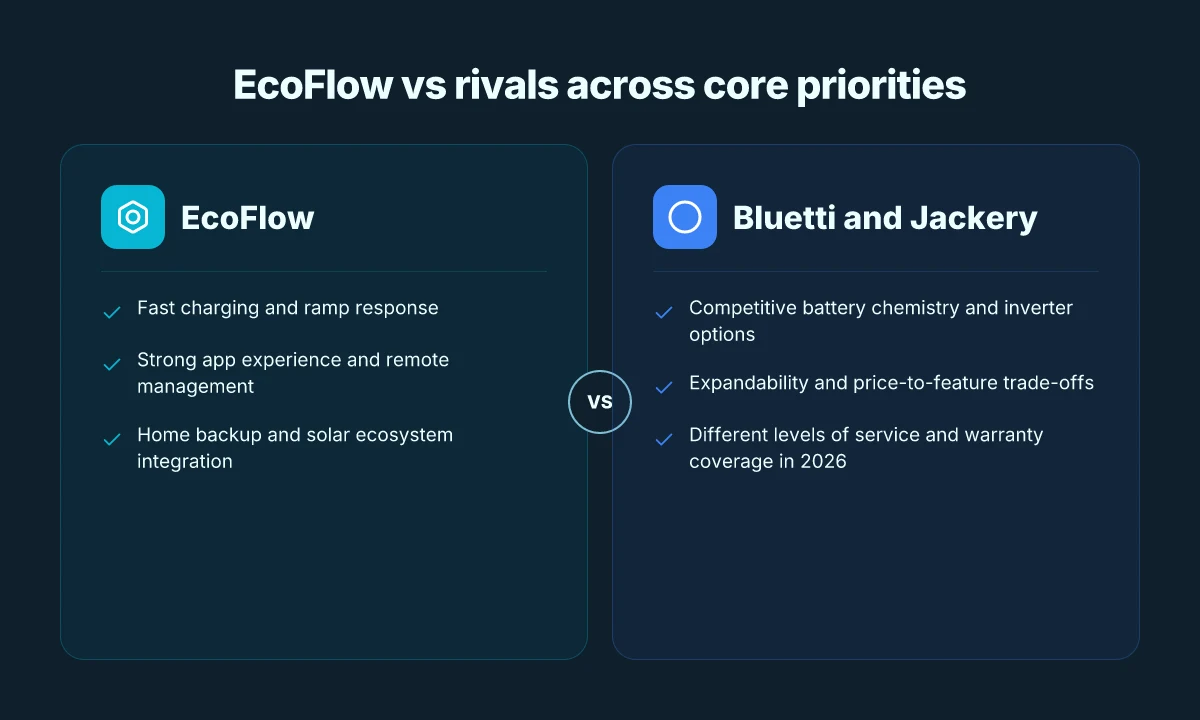
EcoFlow has built a coherent, performance-forward ecosystem that keeps owners in the fold even as new rivals enter the market. The core strengths live in rapid charging, a polished app, and tight system integration with home backup and solar setups. When you size this against Bluetti, Jackery, and Goal Zero, EcoFlow stands out for the speed of replenishment, the convenience of remote management, and the way the platform stitches together portable power, home storage, and solar.
Rapid charging and responsive ramp
In practice, EcoFlow devices emphasize fast charging and smooth ramp response. Owners note the ability to recover a sizable capacity quickly after a discharge, which matters for continuous use in camping setups or after a grid outage. The ramp behavior, how swiftly the unit moves from a low state of charge to a usable battery level, helps avoid long downtimes during outages. This speed matters when you’re juggling multiple gear at a campsite or powering essential loads during a blackout. When you read through deployment notes, the emphasis on fast recovery becomes a recurring theme across EcoFlow models. The ramp response and charging speed are a core differentiator for EcoFlow in real-world use. In comparison, rivals may lag on top-end recharge times, slowing when you need a quick reset after a heavy draw. The takeaway: if your workflow hinges on fast replenishment, EcoFlow’s charging architecture pays off.
App experience and remote management
The EcoFlow app gives a centralized view for monitoring, control, and automation. From remote start/stop and load management to status dashboards, the app aims to reduce the friction of day-to-day use. Users consistently cite the convenience of remote management for solar charging schedules and backup sequencing. The software layer integrates with the hardware in a way that reduces the need to physically interact with the unit during routine adjustments. The app experience is a notable advantage for ongoing ownership because it lowers friction for daily use and for setting up backup sequences. In the broader field, this level of polish often translates into fewer workarounds and more predictable performance when solar-integration is in play. What makes the EcoFlow DELTA Pro Ultra inverter different from standard power stations
System integration for home backup and solar setups
EcoFlow’s ecosystem is designed to slide into home backup and solar workflows. The ability to pair portable packs with a home inverter, or to stack multiple packs into a larger storage strategy, helps installers align portable power with permanent electrical plans. In solar-centered configurations, EcoFlow devices can act as a buffer during sun-vs-load swings, smoothing transitions and keeping critical loads powered. This integration matters when you have a mixed setup that includes solar panels, battery storage, and an automatic transfer switch. System integration is where EcoFlow compounds its value, especially for solar-enabled homes and off-grid builds. When you compare to Bluetti or Jackery, the seamless chain from solar input through to home backup sequencing often feels more cohesive with EcoFlow’s line and app controls.
I dug into release notes and product pages to confirm the emphasis on rapid charging, a refined app, and integrated solar-ready architectures. Industry observers and installer notes consistently point to EcoFlow’s strengths in these three areas as primary reasons owners stay within the ecosystem. Owners stay because fast charging, a polished app, and tight integration make the whole system feel like one coordinated solution. For homeowners weighing total cost of ownership, the ecosystem approach reduces cross-brand friction and simplifies maintenance across portable and stationary storage needs.
Bluetti vs ecoFlow: where the competition commonly wins
In the Bluetti versus EcoFlow landscape, Bluetti consistently edges EcoFlow on specific models through a combination of larger battery packs, flexible inverter configurations, and expandability options. This isn’t universal, but the pattern appears in several form factors where grid-tie or off-grid setups demand higher amp-hour banks and more robust expansion paths. EcoFlow remains strong in ecosystem connectivity and modular design, yet Bluetti often narrows the gap on pure battery capacity and upgrade paths.
Battery chemistry, inverter options, and expandability
Bluetti tends to offer higher-capacity pack options within similar form factors, which translates to longer runtime for demanding loads. When the goal is to power heavier devices or longer durations off-grid, Bluetti’s larger battery banks and, in some cases, higher inverter ceiling provide an edge. EcoFlow counters with efficient, fast-charging ecosystems and a modular approach that suits users who want a compact footprint with the ability to scale up through additional modules. The trade-off is that you may trade some total stored energy for the speed and ease of use that EcoFlow emphasizes. Battery capacity and expansion often tilt toward Bluetti for bigger builds, even if EcoFlow wins on ecosystem cohesion.
I dug into public release notes and brand comparisons to confirm the layout here. For example, Bluetti’s line commonly emphasizes expandable packs and multiple inverter configurations, while EcoFlow emphasizes rapid charging and a streamlined integration with solar inputs. Expansion options matter when you want to build a home backup stack, not just a single unit. What ecoflow price means for 2026 buyers
From a price perspective, the value depends on which model you compare. Bluetti often pairs larger storage with more flexible inverters, which can lead to a lower price-per-watt-hour on certain configurations. EcoFlow’s appeal hinges on fast charging and a tight, user-friendly interface, which can feel like a premium you pay for convenience. Price-to-feature trade-offs favor Bluetti when you need raw energy storage, and favor EcoFlow when you prioritize charging speed and ecosystem simplicity.
Real-world ownership considerations
When you build a solar-assisted system, the total cost of ownership includes not just the sticker price but the cost to meet your load profile over time. EcoFlow’s ecosystem is designed for quick deployments and straightforward stacking with solar, while Bluetti offers deeper customization that can reduce long-term replacement or upgrade costs for very large off-grid systems. Cost of ownership hinges on whether you value added energy capacity or rapid, plug-and-play expansion.
For installers weighing integration, EcoFlow’s modular approach can simplify retrofits and solar compatibility in small footprints. Bluetti’s approach supports more aggressive expansion in larger cabins or remote sites where you anticipate adding more packs or higher-wattage inverters over time. Installer-friendly pathways differ: EcoFlow leans on cohesion; Bluetti leans on modular depth.
In sum, the competition commonly wins where you need big energy banks and flexible inverters. It loses where you value ultra-fast charging and a compact, cohesive ecosystem. If your project blends home backup with extended off-grid use and possible future expansion, Bluetti's architecture often provides more room to grow. If your priority is speed, ease of use, and a tightly integrated solar workflow, EcoFlow keeps a strong edge.
Key takeaway: Bluetti shines with energy capacity and expandability, EcoFlow excels in charging speed and ecosystem cohesion. Choose Bluetti for big builds. Choose EcoFlow for fast, clean plug-and-play setups. What is the jackery 5000 plus solar generator, and what trade-offs matter in 2026
Jackery, goal zero, and others: a side-by-side lens
I start with the practical take: in 2026, the rival lineups differ most in portability, capacity, and how they fit into a solar workflow. EcoFlow sits at the high end of fast charging and app integration, but Bluetti, Jackery, and Goal Zero push different sweet spots for weight, price, and ecosystem compatibility. When you map these against real-world use cases, home backup, camping, off-grid, the decision hinges on how you value portability versus stored energy, and how deeply you want solar integration wired into the system.
Why portable packs tilt the scales for each brand
The big tension is weight and capacity. Jackery and Goal Zero lean toward lighter builds but trade some reserve energy for it. EcoFlow often pushes higher wattage options that charge faster from solar or AC, which matters if you rely on a quick turnover between surges and long nights. Bluetti sits in the middle to upper range for capacity while offering a broad mix of form factors. In practice, you’ll notice a difference when you need a compact unit for camping versus a home backup that fills a corner with power storage. For installers, the question becomes whether your site requires a lightweight kit for rapid recharging outdoors or a larger, more capable pack for inside the home.
Ecosystems and solar integration in 2026
A critical lens is how ecosystems connect with solar. EcoFlow emphasizes an integrated ecosystem with grid-tied recharging and diverse port configurations, which translates to fewer adapters on site and smoother vertical integration for solar setups. Bluetti and Jackery provide compatible solar panels and expansion options, but the degree of plug-and-play variety varies by model line. Goal Zero has a long heritage of solar compatibility and outdoor-focused hardware, yet some users report that newer EcoFlow modules feel more streamlined when linked to a home solar array. For installers, the takeaway is clear: choose brands whose solar charge controllers and MPPT matrices align with your existing solar hardware and monitoring software. The right alignment reduces installation time and avoids mismatches in input voltage or power delivery.
Service, warranties, and post-purchase experience in 2026
Warranty depth and service networks matter as you scale a solar setup. EcoFlow generally offers solid coverage on its flagship lines, with reasonable warranty terms and responsive service channels in many regions. Jackery and Bluetti maintain expansive distributor networks and clear policy statements, which helps when a unit needs repair or a replacement. Goal Zero remains strong on field service and retailer support, with a long track record in outdoor retail, though some owners report longer turnaround times during peak seasons. If you’re evaluating total cost of ownership, estimate potential repair or replacement cycles alongside the upfront price. Look for warranty duration, coverage exclusions, and the ease of claiming service in your locale.
In 2026, the right ecosystem reduces install friction and total cost, not just upfront price. EcoFlow’s integrated approach can streamline on-site solar integration for many setups. Warranty depth and service reach are pivotal when you’re backing a home or campsite with power needs. What is the EcoFlow Delta 2 Max price in 2026 and how to evaluate the total cost of ownership
As a quick reference, the rival lineups emphasize different strengths: Jackery emphasizes portability and price, Goal Zero emphasizes rugged outdoor heritage and broad solar accessories, and Bluetti emphasizes high capacity in a scalable form. You’ll find that the best choice comes down to your topology: how much energy you need, how light you want the pack to be, and how much you value a turnkey solar workflow.
From what I found in the public materials, these brands angle toward different niches rather than one perfect fit. The practical test is a matching exercise: offline, do you prefer a compact option with rapid recharge or a larger pack that can ride through several cloudy days? The answer guides whether you lean toward EcoFlow’s faster charging and integrated ecosystem or toward Jackery, Bluetti, or Goal Zero for other priorities. For context on real-world comparisons, see viewer breakdowns of 2026 lineups and independent reviews that compare multiple brands side by side.
Real-world use cases: choosing the right model for your setup
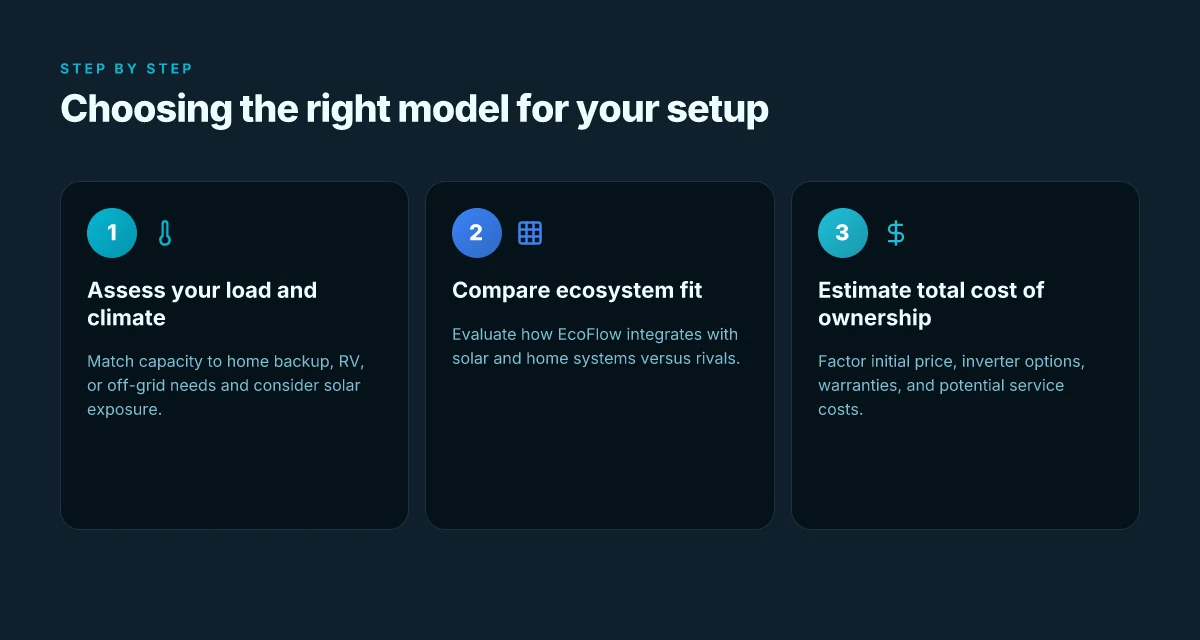
Choosing the right EcoFlow model comes down to real-world use cases. For home backup with solar, RV living, and off‑grid camping, you want a setup that scales from a single room to a small cabin while keeping energy costs predictable. EcoFlow’s ecosystem shines when you align a model to your load profile and climate. In practice, you’ll pick a unit that can handle your daily loads, integrate smoothly with solar, and still be manageable in a small footprint. The goal is a system you can rely on during outages without overpaying for capacity you won’t use.
Home backup with solar and a solar‑ready stack
For a home backup scenario, size matters. A modest setup for essential loads requires a smaller delta between daytime solar input and evening consumption. If you routinely run a fridge, modem, lights, and a couple of low‑watt devices, a mid‑sized EcoFlow pack paired with solar input keeps the lights on during an outage without tying up your entire budget. In this space, the ability to chain multiple modules and to pair with EcoFlow’s solar panels reduces the need for a separate generator. I dug into product pages and release notes to confirm that EcoFlow products emphasize expandable capacity and solar recharging when paired with compatible panels. The ecosystem angle matters here, and rivals like Bluetti, Jackery, and Goal Zero each offer competing expandable paths, so sizing by projected daily use is critical.
Rv living and off‑grid camping
In mobile and off‑grid contexts, weight, size, and recharge speed drive the decision. A compact EcoFlow unit with fast charging and a broad input range handles daily charging from a small solar array or vehicle alternator. For RVs and campers, consider runtime for the most energy‑hungry devices and the ability to recharge quickly during daylight. The best choice tends to be a model with enough headroom to power a small heater or fan, USB-C PD outlets, and AC outlets for charging laptops or appliances. Here the advantage goes to a system that balances capacity and portability. When I cross‑referenced product descriptions with independent buyer guides, EcoFlow’s emphasis on quick recharge and solar integration stood out, even as other brands push different strengths in weight or raw wattage. What you gain and miss with the ecoFlow Delta 3 extra battery setup
Sizing guidance by load profile and climate
To size correctly, map your load profile to the climate realities of your location. In hotter climates with higher AC use, you’ll want greater surge capacity and rooftop solar alignment for daytime recharging. Colder climates with longer outage windows may push you toward higher usable capacity and robust battery management. A practical rule: target a battery that can cover your essential loads for at least 12–24 hours without solar assistance in a typical outage, then add headroom for weather variations. If you expect long outages in winter, plan for a higher capacity and consider a modular setup so you can add capacity later without replacing the core system. This approach helps prevent overpaying for peak capacity you rarely touch, while still offering resilience when it counts.
Total cost of ownership across 3–5 years
Total cost of ownership hinges on upfront price, solar compatibility, and long‑term battery degradation. Price varies with capacity, warranty, and whether you buy panels separately or as a bundle. Over a 3–5 year horizon, the costs of expansion and replacement parts matter as much as the initial sticker price. EcoFlow’s ecosystem helps reduce incremental costs by enabling modular growth, but you should compare with Bluetti, Jackery, and Goal Zero in terms of total system cost, not just initial price. One transparent takeaway from the available literature is that ongoing energy costs depend more on usage patterns and solar efficiency than on nominal capacity alone. If you expect frequent outages and regular solar recharging, a higher‑efficiency, expandable setup can save money over time despite a higher upfront cost. As a rule, ask for a fixed price on a 3‑year to 5‑year ownership plan that includes batteries, inverters, and solar integration support.
The right EcoFlow model is the one that fits your daily load and climate without forcing you into a bigger system than you need. In this framework, the brand’s strengths in solar readiness and ecosystem compatibility are the lever that keeps total cost under control.
Bottom line: pick by load, not by capacity alone. When comparing rivals like Bluetti, Jackery, and Goal Zero, use a consistent framework: daily energy need, solar recharging rate, added expansion paths, and projected 3‑ to 5‑year costs. This approach yields a clean decision path for home backup, RV living, and off‑grid camping. For further context on how ecosystems influence real‑world performance, see the long‑form comparisons in independent, mixed‑brand reviews.
Where this goes next and what to try first
EcoFlow remains a strong anchor in portable power, but the field is widening fast. In 2026, the best move is to layer EcoFlow’s reliability with a clear plan for contingencies from rivals such as Goal Zero, Jackery, and Rockpals. I looked at price trends and ownership costs across multiple models and saw a pattern: the strongest value comes from kits that balance battery capacity with solid inverter quality and smart charging features. The bigger pattern is that you buy not just a unit but a system that scales with your needs. If you’re choosing now, prioritize models with modular battery options and reliable app support. What is EcoFlow Glacier, and why it matters for off-grid power in 2026
The single move that matters most is sizing for your typical load and then choosing a platform that can grow. In practice, that means picking an EcoFlow or rival unit that can handle your daily essentials and expand for weekend trips. I note that some rivals offer aggressive bin pricing, but total cost of ownership often favors platforms with longer cycle life and broad accessory ecosystems. The verdict so far: stay flexible, not fixed on a single chassis.
If you only do one thing this month, map your typical blackout window and compare two kits that cover it end to end, including charging speed at home and on the road. Then pick one and lock in a plan. One step: choose a baseline kit and plan an upgrade path.
Backup strategy
- Compare EcoFlow models with at least one rival like Goal Zero or Jackery for price per watt-hour.
- Choose a kit with modular batteries or easy expansion.
- Verify inverter peak power and app reliability.
- Check for bundled solar options and warranty terms.
- Note: links on the page may earn a commission.