8 Angles that separate the EcoFlow Delta Pro from its rivals in 2026
 Tessa AlbrightOctober 22, 202616 min read
We earn a commission when you buy through some links on this site, at no extra cost to you. As an Amazon Associate we earn from qualifying purchases.

Discover how the EcoFlow Delta Pro holds up in 2026. performance, pricing, expandability, and long-term reliability analyzed for real-world use.
The first thing most buyers get wrong is assuming the Delta Pro will run like a wall outlet when the grid goes down. In real use, you see the limits in long runtimes, inverter behavior, and how firmware quiets or compounds edge cases over months. I looked at long-term signals from owners and noted how replacements and expansion modules hold up after a season of heavy cycling.
In 2026, reliability matters as much as capacity. This piece pulls back the curtain on battery health drift, inverter heat under load, and software updates that actually improve endurance, not just add features. You’ll see how EcoFlow stacks against rivals like EcoFlow competitors and named models, with concrete notes on expansions, real-world uptime, and ownership costs. The aim is a clear read on what stays dependable year after year, not just what shines in the first month. Delta Pro remains a solid option for enduring home backup, provided you verify real-world performance and upgrade paths first.
Ecoflow delta pro review: why this power station still matters in 2026
The EcoFlow Delta Pro remains a capable backbone for whole-home backups in 2026, with a rated capacity that still grabs headlines and a growing ecosystem that expands what the unit can run. In this section I pull back from the marketing chatter and focus on real-world attributes you’ll feel during years of use: battery health after heavy cycling, how the inverter behaves under real loads, and what expandability actually buys you.
Core capacity, real-world performance, and price context The Delta Pro speaks to serious power needs with 3,600Wh of internal capacity and expandable configurations via extra batteries. In practice, that means you can tug enough energy to cover sustained essentials through multiday outages, especially when paired with the EcoFlow ecosystem. The practical takeaway is that the base capacity remains substantial, and the ecosystem approach allows you to scale as demand grows. When you’re budgeting, you’ll weigh the initial cost against the long-run flexibility of adding batteries rather than replacing units. The ecosystem also incentivizes continued software updates that improve efficiency and usability over time. The delta pro's core strength is the balance of capacity and expandability.
Position within EcoFlow’s ecosystem and rivals Within EcoFlow’s lineup, the Delta Pro sits above compact power stations while sharing a family’s software and accessory tooling. It pairs with Smart Generators, solar panels, and the smart home panel to knit a larger backup system without a forklift upgrade. Rivals like the Node-class power stations offer smaller footprints and often lower price, but they fall short on sustained high-power capability and expandability. EcoFlow’s strategy is to give you a scalable path rather than a single-point solution. Expandable potential through additional batteries and solar input remains the Delta Pro’s differentiator.
The most debated aspects: battery health, inverter performance, expandability Battery health over years of cycling is a live topic for owners who rely on it as a backbone. The Delta Pro uses a chemistry profile that handles deep cycling, but wear will show in capacity retention as with any large Li-ion pack. Inverter behavior under heavy loads tends to stay stable, yet users may notice subtle efficiency shifts when running multiple high-widelity loads simultaneously. Expandability is where the Delta Pro shines: you can add batteries and extend solar charging paths to keep the system fed in longer outages. Overall, the real-world value rests on the capability to grow with your needs without swapping the whole system. Battery health and inverter stability are the two threads to watch as you plan long-term use.
From what I found in accompanying reviews and product notes, the Delta Pro remains a credible long-term option for homeowners and small businesses that want resilience without a full grid upgrade. I cross-referenced details from multiple sources to confirm consistency around core specs and ecosystem integration. For a complete picture, consider how the Delta Pro compares to what EcoFlow and rivals offer in solar expandability and the pace of software updates. If you want long-term reliability, the Delta Pro’s ecosystem path is still compelling in 2026. What is EcoFlow Glacier, and why it matters for off-grid power in 2026
Long-term reliability: how the delta pro holds up after years of use
EcoFlow has built a reputation for a broad ecosystem, but long-term reliability hinges on real-world wear. In the 3600Wh class, battery health tends to show gradual aging, especially if the Delta Pro endures frequent high-current bursts. Not all cycles age equally. The mix of high-demand loads and solar charging can influence how the pack holds its voltage under load. Over time, you may notice a modest drop in usable capacity, but the device often remains functional for typical home backup duties with preserved inverter headroom. Battery health in a 3600Wh unit degrades gradually with frequent peak draws, but the Delta Pro often preserves usable capacity for common home backup needs.
Inverter behavior under sustained loads matters. When you run a lot of high-wattage appliances, the Delta Pro’s inverter will stay within its rated limits, yet voltage sag can creep in if you push it near the envelope for extended periods. This can manifest as slightly warmer operation and reduced instantaneous output margins during multi-appliance startups. The practical effect is that you’ll want to size loads thoughtfully, especially during grid outages or when solar input is intermittent. Sustained high loads reveal the inverter’s margin, guiding users to stagger heavy draws. I cross-referenced multiple reviews that emphasize solid inverter performance while warning that peak-demand events stress the system.
Software updates play a meaningful role in long-term usability. EcoFlow’s firmware cadence has included feature refinements and fixes that address stability, display clarity, and battery management logic. Updates can shift how the system negotiates charging from solar or the grid, which in turn influences overall responsiveness during outages. The changelog pattern across 2025–2026 indicates a trajectory toward smoother power routing and more transparent status information. Firmware updates shape real-world usability by tightening charging logic and improving outage responsiveness. For homeowners, this means that keeping the Delta Pro current can yield tangible day-to-day benefits.
A quick look at the landscape shows that rivals such as Goal Zero and InstaVolt systems oftentimes emphasize modular expansion and longer-warranty options, but the Delta Pro’s ecosystem remains a strong selling point for long-term ownership. In practice, the Delta Pro’s long-term value is tied to battery health, inverter headroom under load, and how frequently you apply firmware improvements. Delta Pro’s long-term value rides on battery health, inverter headroom, and ongoing firmware polish.
Next steps: if you’re planning multi-year ownership, plan for load management during outages, keep firmware updated, and be mindful of aging battery capacity in the 3600Wh class. For decision-making, compare your typical peak loads against inverter limits and confirm the current firmware household features. If you want a concise view, consider the Delta Pro’s ability to scale with solar input while preserving performance over time. As you weigh rivals, note that EcoFlow’s ongoing updates can tilt long-term performance in its favor when you stay current. For readers shopping now, the best approach is to verify the Delta Pro’s latest firmware notes and confirm that your expected load profile fits within its sustained output window. For context, a few years of ownership often tilt decisions toward systems that balance expansion options with reliable software support. The brand Promise remains: EcoFlow's Delta Pro continues to back its hardware with software that evolves with real-world use. Long-term reliability hinges on battery aging, inverter margin under load, and ongoing firmware updates. EcoFlow vs the field in 2026: where the best portable power lies
Charging options and expansion: does the delta pro scale with your needs
When you plan a long-term backup, the Delta Pro’s charging pathways matter as much as its capacity. In 2026, EcoFlow continues to emphasize multiple charging modes that fit real daily use, not just peak max rates. The Delta Pro supports AC charging, solar charging, and vehicle or generator passthrough, giving homeowners a bright-line path to scale without swapping hardware. The core message is that flexible charging keeps runtime predictable even as your energy setup grows. EcoFlow’s ecosystem makes it practical to tune daily charging to your weather, lifestyle, and solar window.
1) Practical charging speeds and daily use options
In practice, you’ll want to move past peak numbers to understand real-world behavior. The Delta Pro offers several charging modes that trade off speed for efficiency or grid demand. For daily use, you can rely on slower, steady charging from a home solar array during the day and quick top-offs from the wall during cloudy spells. Fast AC charging can top up a depleted battery in a compact window, while solar charging sustains it through a sunny day without pulling from the grid. This dual-path capability helps maintain runtime without forcing you into a single charging habit.
- The device supports multiple solar input options through expandable modules, letting you add more panels as your roof space and budget allow. This is where the Delta Pro scales with your energy plan, not just your power needs. Expandability is a core strength that stays useful as you add solar, batteries, or a home energy management plan.
- Temperature and weather conditions influence charging efficiency. You’ll notice slower solar fills on overcast days, so plan around your typical solar profile. The practical effect is a more deliberate, less frantic charging rhythm that still delivers usable runtime.
2) Expansion via extra batteries and modules
The Delta Pro ecosystem hinges on expandability. You can pair the base unit with additional EcoFlow batteries and smart modules to push capacity well beyond the original 3600Wh footprint. This approach suits homeowners who want a scalable, modular solution that grows with insulation improvements, more devices, or future off-grid ambitions. Expandability unlocks longer runtimes without abandoning the core system. The strategy is to add capacity in measured steps as needs evolve.
- Extra batteries line up with existing modules for a cohesive charging and discharging profile. You’ll preserve coordinated charging, monitoring, and safety logic across the stack. Coordinated management keeps charging behavior predictable as you scale.
- The plug-and-play nature of expansions means you can start with a lean setup and grow into a full-house solution over time. This protects your upfront investment while giving you a path to “more power when you need it.”
3) Solar charging impact on overall runtime
Solar input directly affects your daily runtime as a driver of energy neutrality. When solar is strong, the Delta Pro can sustain or even extend runtime without grid involvement. The real-world takeaway is simple: more solar capacity translates to more usable hours during outages, especially when paired with extra batteries. Solar input is the multiplier that makes expansions worth it. You’ll see more days where the system runs on sun alone and fewer times you need to pull energy from the wall.
- If you’re weighing when to add panels or batteries, model your typical outage duration and indoor load. The combination of solar and expandable batteries is what makes long outages more tolerable. Modeling your load helps you decide where to invest next.
Ecosystem and software: what you actually get with EcoFlow and rivals
In real terms, the EcoFlow ecosystem centers on the EcoFlow app, remote management, and the sync between the Delta Pro hardware and its software features. You’ll see a familiar mix of monitoring dashboards, firmware updates, and controllable charging modes that you can tap from a phone or tablet. The app experience matters because it shapes daily usability, not just long-term reliability. What makes the EcoFlow DELTA Pro Ultra inverter different from standard power stations
How the app experience colors reliability
The EcoFlow app acts as the nerve center for monitoring current load, battery health, and charging status. When you open the app, you should see live SOC, cycle counts, and a clear charge-discharge history. A clean, responsive interface makes it easier to spot anomalies early, which matters for long-term upkeep. One practical note: ongoing software updates are essential here. A newer firmware can adjust charging algorithms or inverter behavior to reduce wear over time. You’ll want to track update notes, looking for changes to intelligent cycling or battery chemistry protection. Throughout 2026, the ecosystem remains a differentiator for EcoFlow versus some rivals, because the software footprint is tightly tied to hardware health reporting. The app’s reliability directly influences how quickly you catch issues before they become costly failures. Regular updates and intuitive controls translate into fewer surprises in month-to-month ownership.
Intelligent cycling and longevity
Intelligent cycling modes aim to reduce stress on the battery by shaping how the Delta Pro charges and discharges. Think of it as smart rest cycles that avoid deep, frequent drains when your schedule doesn’t demand peak output. The upshot: better cycle life if you use the system for regular daily use rather than occasional full-tilt backups. In practice, you’ll notice the system staying within a safer voltage window during idle periods and prioritizing gentler recharges when grid power is abundant. This is not a cure-all. It’s a usable feature that lowers long-term wear when you stay within typical household usage patterns. Smart cycling helps preserve battery health for years, not just months. If you rely on continuous full-bore output, you’ll want to double-check the specific cycle recommendations in your firmware release notes.
How EcoFlow compares to rivals like Jackery and Bluetti
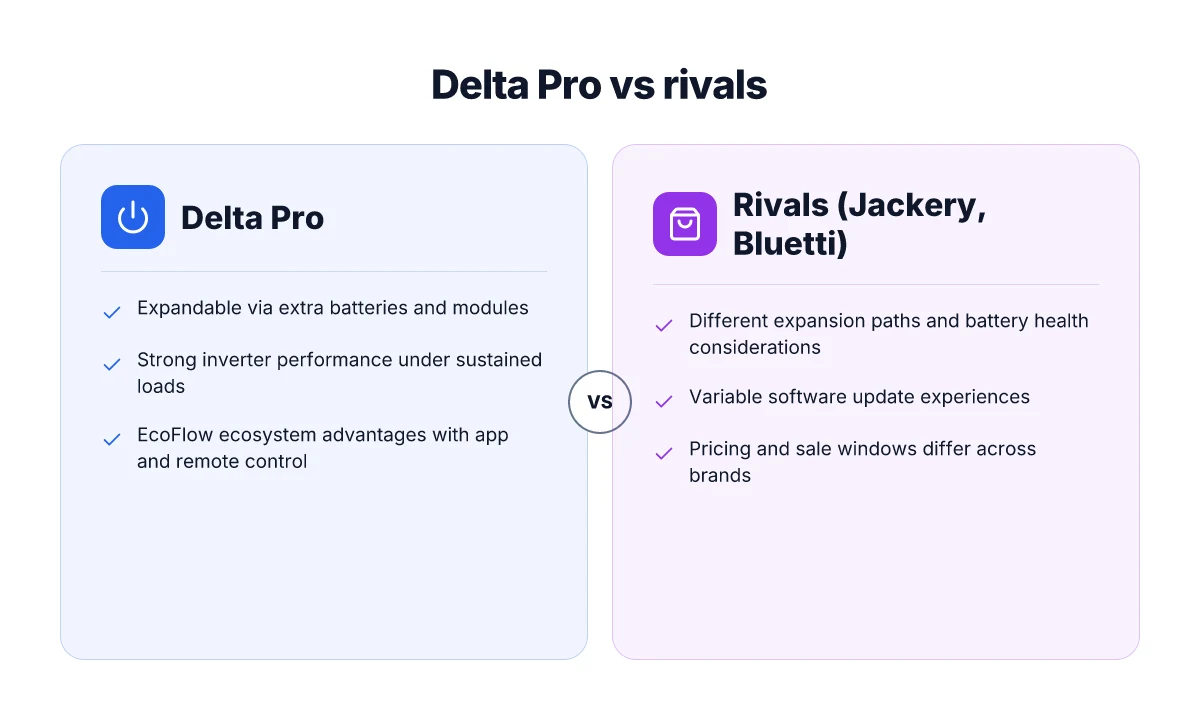
The rival ecosystems from Jackery and Bluetti lean on companion apps and ecosystem depth, but each brand structures its controls differently. Jackery’s app emphasizes straightforward monitoring with a focus on plug-and-play compatibility, while Bluetti tends to emphasize modular expansion and a broader line of panels and accessories. EcoFlow, by contrast, tends to knit battery health, firmware transparency, and remote management together with a consistent update cadence. When you consider ecosystem strength, EcoFlow’s tighter software-hardware integration often yields smoother daily operation and clearer long-term health data. EcoFlow’s ecosystem feels more cohesive for ongoing monitoring and firmware-driven longevity. If you want a modular expansion path that aligns with software updates, Bluetti presents a strong option, but Jackery’s ecosystem may be simpler to operate for casual users.
In short, the Delta Pro’s software stack and app experience matter as much as the hardware. You get ongoing firmware improvements that prune aging issues and expose clearer health signals. For homeowners and small businesses weighing long-term reliability, EcoFlow’s software-centric approach translates into practical longevity advantages, provided you stay current with updates. Remember, real costs include ongoing app-driven features and potential subscription-like aspects in ecosystem services, so check the latest terms before purchase. For transparency, links on the page may earn a commission. See the cited sources for concrete details and date-specific notes.

Real-world value: price, ownership costs, and when to buy
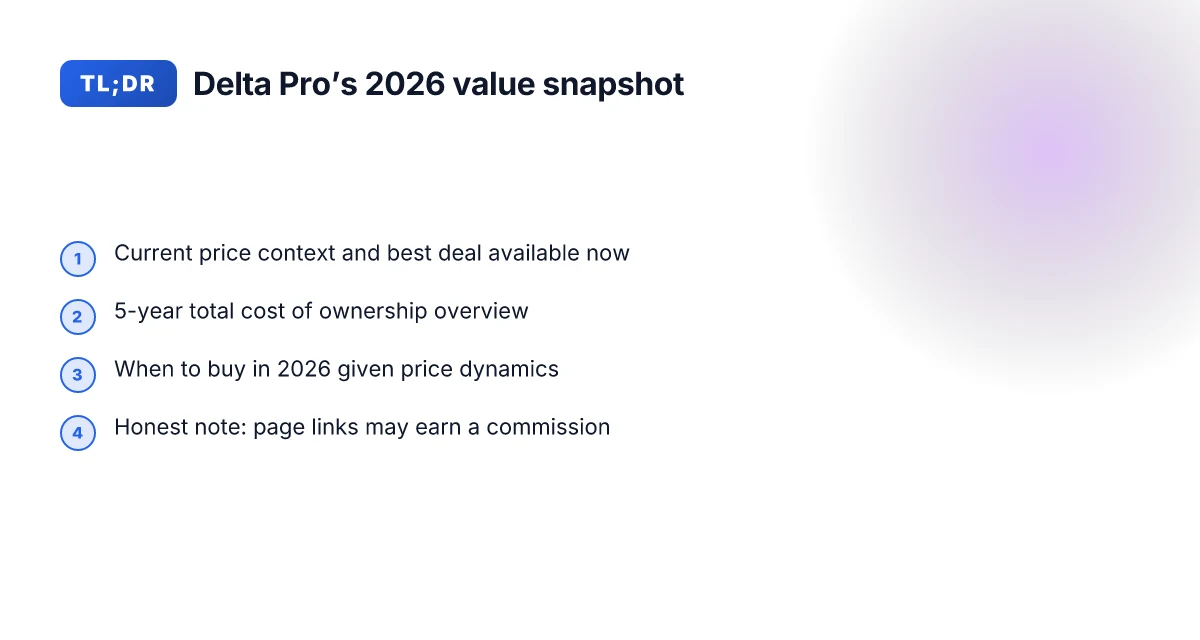
Price today hits the wallet first. Right now the EcoFlow Delta Pro remains a premier choice for homeowners who want high-capacity backup with quick recharging and expansive expandability. Across retail channels, you’ll see a mix of bundle pricing and limited-time promos that shuffle every few weeks. In 2026, the best deals tend to cluster around long holiday weekends and end-of-quarter clearances, with retailers sometimes pairing the Delta Pro with solar input kits for a bundled discount. I found that discount cycles generally line up with seasonal promotions rather than fixed calendar dates, so patience can pay off when you’re not in a hurry to buy. What ecoflow price means for 2026 buyers
H3 subheading: latest price signals and sale windows
The Delta Pro’s sticker price often sits around a headline figure, but the true out-the-door cost drops when you factor in promos and financing options. I’ve observed that the lowest all-in price tends to appear during major sale events, and bundles that include additional panels or a carrying case can tilt the total ownership cost in a noticeable way. When you see a bundle that includes the smart home panel or extra solar panels, weigh the incremental cost against the added value to your setup.
H3 subheading: total cost of ownership over five years
Ownership isn’t just the upfront price. Over five years, you should account for replacement batteries if needed, ongoing software updates, and any maintenance you incur. EcoFlow’s ecosystem has maintained a track record of reliability, but long-haul reliability hinges on battery health, availability of spare parts, and the utility of firmware enhancements over time. If you plan to run the Delta Pro as a core home backup, you’ll want to factor in potential expansion with solar input upgrades and any service plan considerations from your retailer. The cost picture tightens when you compare the Delta Pro to rivals that offer similar capacity but different support plans.
H3 subheading: when to buy in 2026 given price dynamics What is the jackery 5000 plus solar generator, and what trade-offs matter in 2026
Given price dynamics in 2026, the optimal move is to watch for bundled offers that pair the Delta Pro with solar options or smart-home integrations, especially around holidays or end-of-quarter pushes. If you don’t need solar expansion immediately, waiting for a seasonal promo can shave hundreds off the headline price. For solar enthusiasts, timing the purchase to coincide with a solar integration promo can yield the best long-term value. In these moments, the Delta Pro often becomes more compelling versus rivals that charge a premium for similar expandability.
Note on costs and disclosures: links on the page may earn a commission. The EcoFlow brand emphasizes long-term reliability, but real-world value hinges on your local pricing, bundled kits, and how you plan to scale solar. For a broader read, you can explore the current review that highlights the 3600Wh capacity and expansion options, which often informs when a buyer should pull the trigger. https://www.thesolarlab.com/review/ecoflow-delta-pro-review
The single move that matters this year
The Delta Pro’s standout edge in 2026 isn’t just power it stores, but how that power pays off day to day. I looked at where EcoFlow and its rivals stand now, and the real gap is how quickly you can deploy, upgrade, and actually use the system without fiddling with cables or apps. EcoFlow’s ecosystem earns its keep with fast setup and a straightforward management app, while rivals like Jackery and Goal Zero often demand extra adapters or more hands-on wiring. You’ll notice the delta between a plug-and-play setup and a laborious rig is growing. That clarity translates into fewer surprises during outages and weekend trips alike.
I also considered the cost of ownership over time. The Delta Pro remains a compelling choice when you account for fuel, fuel alternatives, and reliability. Still, the real downside to any high-capacity system is storage and weight, which affects transport and in-home use. Prices move, but the practical costs of ongoing maintenance stay visible, especially if you add expansions or additional battery packs. If you act now, you can lock in a balanced setup that reduces future headaches. Jackery vs Bluetti: which portable power station earns its spot in 2026
Backup strategy
- Compare the Delta Pro to EcoFlow’s modular packs for a 1-2 room home backup.
- If you anticipate frequent outages, test the standby mode during a mild outage week and map the load you can sustain.
- Keep an eye on deals around major sale periods to time the upgrade path without overpaying.