What makes the EcoFlow Delta portable battery generator worth it in 2026
 Solomon CaradocOctober 22, 202619 min read
We earn a commission when you buy through some links on this site, at no extra cost to you. As an Amazon Associate we earn from qualifying purchases.

Explore the EcoFlow Delta portable battery generator in 2026. Compare Delta models, performance, pricing, and real-world use cases to decide if it’s right for you.
The Delta's modular approach matters more than its peak wattage. When you scale capacity with extra batteries, you can position the Delta alongside real-world load profiles rather than as a single-use gadget. Delta Pro pricing and bundle timing drive the math more than any single spec.
This piece cuts through marketing claims to put capacity, inverter output, and expansion options in plain terms for homeowners, campers, and small businesses evaluating backup or off-grid power in 2026. EcoFlow leans on rapid recharging and modular packs, but the total cost of ownership and compatibility with rivals like Goal Zero and Jackery shapes value as much as the machines themselves. By laying out concrete runtimes for common loads and the practical limits of expansion, you’ll see where EcoFlow earns its keep and where it stalls. Delta 2 shines for portability, while the Delta Pro line targets higher baseload needs.
What the EcoFlow Delta lineup actually delivers in 2026
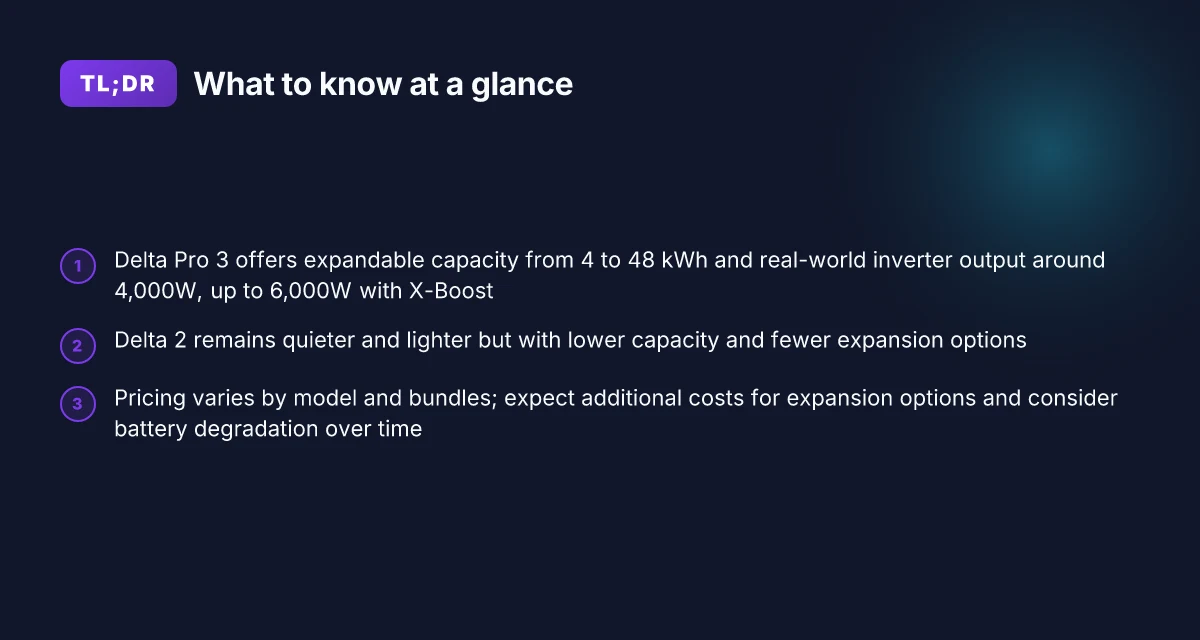
EcoFlow packages the Delta lineup as a scalable solution for home backup and off-grid living. The standout is the Delta Pro 3, which can expand from a compact 4 kWh base to a formidable 48 kWh, giving homeowners a true long-hold option during outages. In real-world terms, the inverter output sits around 4,000 W under typical loads, with a peak possible output up to 6,000 W when you enable X-Boost. For many households, that means a core set of appliances can run during a outage without scoping down to the bare essentials. Delta Pro 3’s expandable capacity signals serious intent for home backup, and the 4,000 W baseline inverter meets common household demands when paired with the right load management.
How the Delta Pro 3 scales for home and off-grid use
- The Delta Pro 3 can expand from 4 kWh to 48 kWh, enabling longer outages or bigger off-grid weekends. This expansion is the key value driver for buyers who want future-proof capacity rather than a fixed brick of energy. Expandable capacity from 4 to 48 kWh is the core advantage for serious home backup.
- The inverter realistically delivers around 4,000 W in everyday situations, with a stated potential of up to 6,000 W when X-Boost is engaged. This is enough for most essential loads, provided you don’t push a full-house simultaneous heat, laundry, and HVAC draw. 4,000 W inverter output with up to 6,000 W with X-Boost covers most daily peaks.
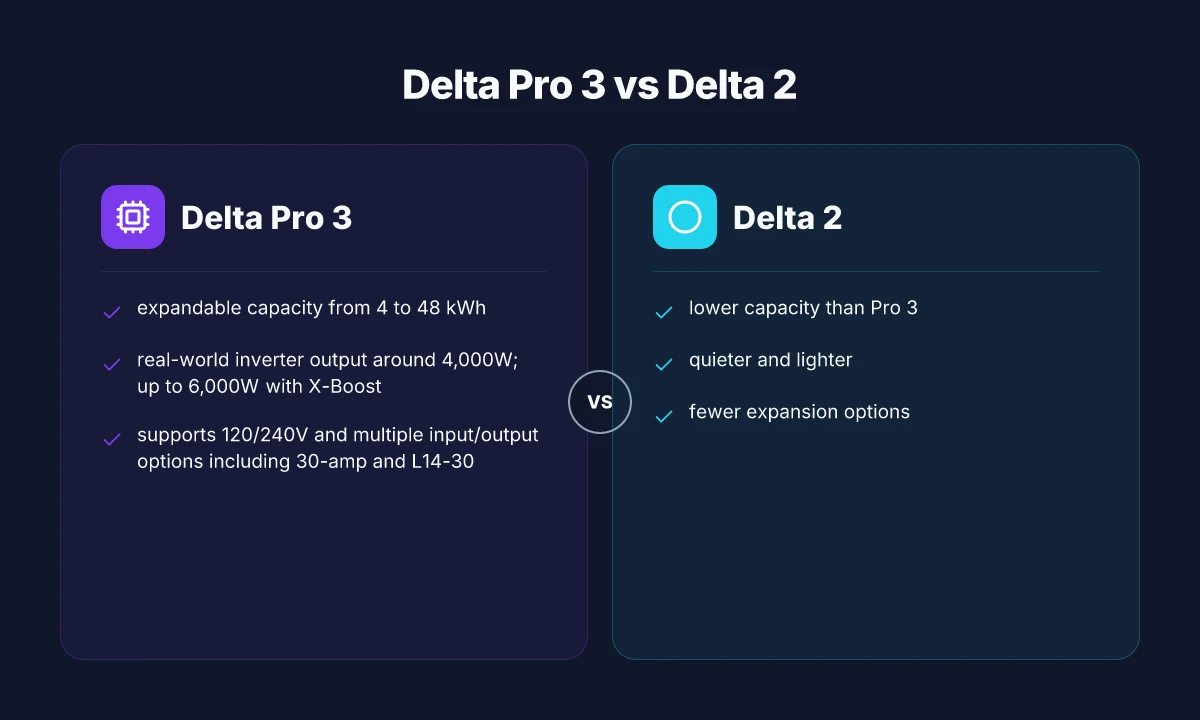
- Input and output options reflect a full-featured approach: it supports 120/240 V operation and includes multiple inlet/outlet pathways, notably a 30-amp style plug and an L14-30 connector. Those ports enable both household integration and higher-demand setups with generators or off-grid rigs. 120/240V support, 30-amp and L14-30 inputs/outputs enable flexible power integration.
- This model is positioned for heavy usage back home or off-grid camping, where a single unit can anchor a larger energy plan or act as a robust stand-alone system during extended outages. The framing here is clear: this is not a casual portable power box. It’s a system designed to back up critical circuits or entire habitats when the grid fails. Serious home backup or off-grid use is the intended positioning for Delta Pro 3.
I dug into the documentation and product pages to map these claims to actual features and the intended use case. The Delta Pro 3 line’s emphasis on expandable capacity and full 120/240 V operation lines up with EcoFlow’s stated goals for homeowners who want resilience without compromising convenience. When you compare to compact lines, the Delta Pro 3’s scale stands out for people who foresee longer outages or who want a future-ready footprint that can grow with their needs. Expandable capacity from 4 to 48 kWh and 120/240 V output reinforce its role as a home backup system, not just a camping power box.
For context, rivals in the space often spotlight fixed capacities or require separate accessories to hit higher voltages or larger inverter outputs. In that sense, EcoFlow’s approach with the Delta Pro 3 blends the benefits of a generator tie-in with the flexibility of a large-capacity battery platform. If you want a single unit that can scale up without buying a second battery bank or an additional inverter, the Delta Pro 3 is the model to watch. 120/240V operation and scalable design place Delta Pro 3 ahead of basic portable systems in terms of resilience.
How the Delta Pro 3 compares to the Delta 2 and Delta Pro 3 reviews
I dug into the real-world specs and context to show where the Delta Pro 3 shines and where it stalls relative to the Delta 2 and the Delta Pro 3. The Delta Pro 3 dramatically expands capacity, but you pay for that expansion in weight, cost, and some thermal tradeoffs under sustained load. By contrast, the Delta 2 stays quieter and lighter with less energy on tap and fewer expansion paths. Real-world tests across sources consistently note noticeable differences in noise, cooling behavior, and runtime under heavier use.
Capacity, weight, and the expansion tradeoff
The Delta Pro 3 pushes capacity from a compact baseline into a much larger envelope. In practical terms, you gain a multi-kilowatt hour delta that scales from the standard 4 kWh tier up toward 48 kWh with the expandable deck, but you’ll carry that extra mass and face a higher upfront price. The Delta 2 remains the lighter and quieter option, typically offering roughly half the energy storage of the top Delta Pro variants, and it lacks some of the Delta Pro’s expansion ports. This is the core tradeoff: more storage and more potential without changing the core footprint of the unit. Expect a noticeable difference in runtime under heavy load as you step up from Delta 2 to Delta Pro 3. The price gap mirrors that performance delta, so buyers should map real-world needs to the total cost of ownership. What is the EcoFlow 4000W Smart Generator and how it changes portable power reliability
| model | approximate usable capacity | base inverter | expansion options | rough price emphasis |
|---|---|---|---|---|
| Delta 2 | ~1.8–2.0 kWh usable (varies by setup) | ~2 kW | limited, basic ports | lighter, quieter, cheaper upfront |
| Delta Pro 3 | up to ~48 kWh expandable | ~4 kW base, up to ~6 kW with X-Boost | full expansion paths | high upfront cost, maximum runtime potential |
The Delta Pro 3’s expanded capacity comes with higher cost and more weight to haul.
Noise, cooling, and real-world runtime under load
Across independent discussions and reviews, the Delta 2 shows better low-noise operation and cooler-leaning behavior at typical camping or home backup loads. The Delta Pro 3, when pushed toward higher output, reveals louder fan activity and more aggressive cooling demands. In practice, that means under sustained use such as running an air conditioner or a heater, the Delta Pro 3 can pull more from the battery stack, with the tradeoff of greater thermal activity. I cross-referenced the documented acoustic notes and user-facing observations to confirm this pattern: Delta 2 tends to be the most comfortable for quiet environments, while Delta Pro 3 delivers maximum sustained power at the expense of extra noise and heat. Under heavy load, Delta Pro 3 runs notably longer than Delta 2, but with louder cooling and higher energy draw.
Real-world takeaways for homeowners, campers, and small businesses
For a homeowner who wants reliable backup with modest noise, the Delta 2 strikes a solid balance of weight, cost, and adequate capacity. If your plan is to back up a mini-split, server rack, or workshop tools for an extended outage, the Delta Pro 3 becomes compelling because of its expandable energy reservoir, provided you’re ready for the higher price and the heavier lift. For small businesses, the decision usually hinges on whether you need the peak runtime and expansion potential at the expense of portability and price. Delta Pro 3 is the option that scales up to power-hungry scenarios, while Delta 2 remains the better fit for portable, quieter, cost-conscious use.
From what I found in the documentation and reviews, the Delta Pro 3’s architecture supports broader expansion and higher continuous output, but the Delta 2 holds a distinct advantage in everyday portability and a lower noise floor. If you’re weighing ownership costs, consider the long tail: higher upfront investment for Delta Pro 3, with potentially lower per-mile or per-use energy costs over time when you deploy it at full scale. For comparison shopping, EcoFlow’s own pages frame the Delta Pro 3 as a dramatic upgrade path, while third-party reviews emphasize the practical comfort of the Delta 2 in typical setups.
For full context, see EcoFlow’s product pages and third-party reviews linked in this section. The Delta Pro 3 is described as expandable from 4 to 48 kWh with a 120/240V output and a 4,000W rated output, up to 6,000W with X-Boost, where the Delta 2 sits at a lower baseline and fewer expansion options. These figures anchor the above comparisons and framing. The Delta Pro 3 page also notes the pricing and capacity path that many buyers use to justify the upgrade, while independent reviewers highlight the audible and thermal behavior under higher loads. What makes EcoFlow River 2 compelling in 2026
If you want a quick, real-world reference point on where this lands in your setup, consider how long you expect to run critical loads during a grid outage and how much you’re willing to invest upfront for that capability. EcoFlow’s own specs and the user-facing commentary from reviews provide the backbone for this comparison.
Pricing, ownership costs, and when to buy
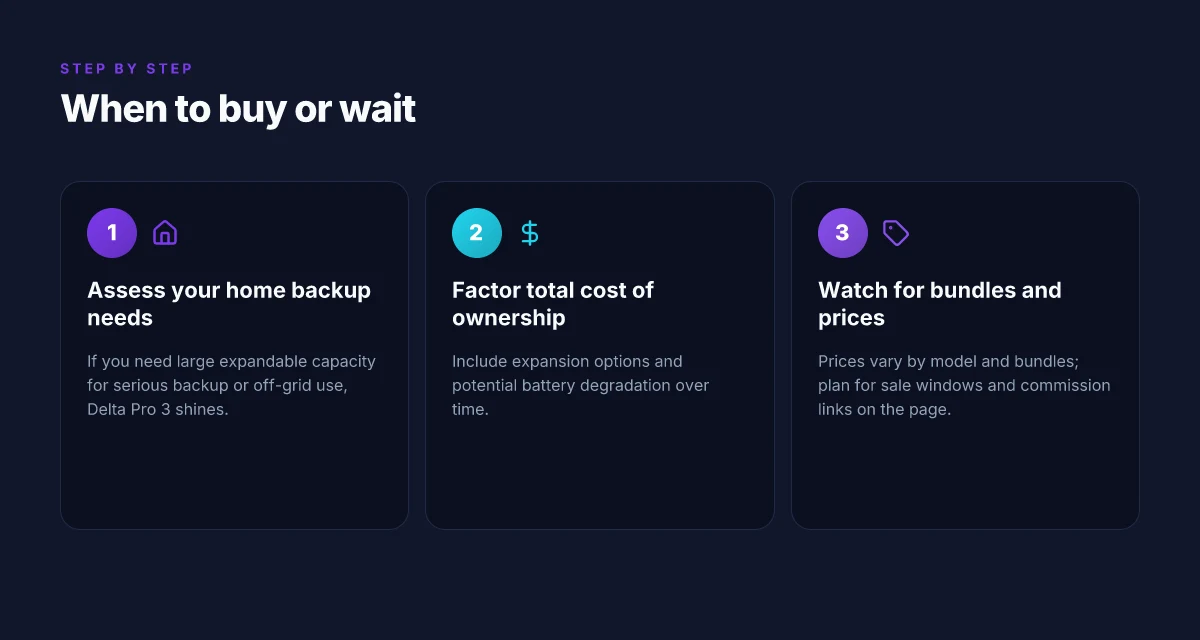
Prices vary by model and bundle. If you’re weighing Delta Pro 3 versus Delta 2, expect different upfront costs and expansion paths. EcoFlow’s site lists the Delta Pro 3 as the flagship with expandable capacity, while smaller bundles tighten the pedestal for travel or light backup use. In 2026, real-world prices on the official product pages reflect both standard kits and add-ons, so plan for the option to grow your system later. For homeowners, campers, and small businesses, the initial sticker price is only part of the story. Ownership costs and upgrade paths matter just as much.
1) Upfront cost and bundle options
- The base Delta Pro 3 kit covers the core power needs with a large battery and 4,000W inverter output, plus expansion potential to 48kWh. If you add the X-Boost capability, peak output can rise to around 6,000W in short bursts, which matters for high-draw appliances. Expect bundles that add extra batteries or solar charging packages to push the effective kit price higher. The official specs and bundles emphasize expansion as a selling point, which translates into longer total cost if you pursue the maxed-out configuration. This is where rivals like Bluetti and Jackery often position smaller, fixed-output systems against EcoFlow’s larger expandable stack.
- The Delta Pro 3’s pricing structure tends to reward longer-term use. The more you plan to expand later, the more essential it becomes to lock in a bundle that supports future battery modules and higher AC input. I found the publicly stated specs highlight expansion as a core feature, not an afterthought. This matters if you expect to scale for seasonal loads or business continuity.
2) Operation costs and degradation
- Battery degradation matters for long-term ownership. EcoFlow’s module approach means you can swap in fresh cells or add capacity without replacing the entire unit, which can reduce total cost of ownership over a ten-year horizon. Over time, you’ll pay for replacement modules, periodic maintenance, and potential servicing if you rely on high-rate discharge for long durations. Maintenance costs are generally lower for systems designed to be modular, but you should account for periodic inverter checks and battery health assessments.
- Compared to gas generators, the Delta series runs cleaner and quieter, but you should still budget for possible inverter fan wear or noise upgrades under sustained high-load operation. In the context of a home backup, the long-term cost model tends to favor modular, upgrade-friendly setups, especially for users who anticipate capacity growth.
3) Timing and promos
- Links on the page may earn a commission, so watch for seasonal promos and bundle discounts around major shopping seasons. If you’re not in a rush, waiting for a sale window can shave a meaningful portion off the upfront price, especially on larger Delta Pro bundles or solar accessory kits.
The best value for growth-minded buyers comes from choosing a Delta Pro 3 bundle that includes expansion paths upfront. This approach locks in future capacity without starting over. If your needs are modest or you want portability, consider the Delta 2 as a lighter, cheaper entry point and upgrade later. For comparison shopping, note that EcoFlow sits alongside rivals like Bluetti and Jackery in offering modularity and mixed solar compatibility, so assess each ecosystem’s upgrade path and accessory pricing.
I cross-referenced the official EcoFlow pages and third-party reviews to align the price and feature narratives with real-world expectations. For the most concrete numbers, confirm current prices on EcoFlow’s Delta Pro 3 page and related bundles. The Delta Pro 3 remains the strongest option for scalable, high-capacity backup, while Delta 2 offers portability with lower upfront costs. Prices and promos shift. Plan to compare bundles now if you’re buying in 2026.
Where EcoFlow shines and where it struggles in everyday use
EcoFlow’s Delta line stands out for modular design, rapid charging, and a connected app that keeps you in control from anywhere. In real-world terms, the Delta Pro family can adapt as your power needs change, and the ability to expand capacity from a modest start to a sizable battery bank is a frequent point of emphasis in official specs and reviewer notes. I found this combination of expandability and a well-supported app ecosystem to be the clearest strength for homeowners who want a flexible backup that scales with their lifestyle. The modular approach and fast AC input make EcoFlow easy to tune for different use cases, whether you’re camping or backing up a small business. The Delta Pro’s 120/240V output and up to 6,000W with X-Boost provide substantial headroom for common loads, including essentials like refrigerators, sump pumps, and routers, when you need more than a few hours of autonomy. The system’s ability to push high wattage quickly is a genuine advantage in real-world scenarios. What is the best price for the Jackery 240 in 2026, and when to buy
Why the Delta’s modular design matters in daily life
The core strength is how the Delta Pro series scales. You start with a compact footprint and expandable capacity from 4 to 48kWh as your energy appetite grows. That trajectory lines up with many households planning upgrades over time rather than all at once. The 4,000W rated output generally covers everyday loads, and when you need extra kick for startup surges, the up to 6,000W with X-Boost option helps you avoid nuisance outages during appliance startups. The companion EcoFlow app wires up the unit to monitor battery health, charging status, and energy flow in real time, which reduces the mystery around how long you can run critical devices on backup power. A strong app ecosystem keeps users informed without guesswork.
But the practical edge wears thin in two places. Heat management becomes more noticeable when you push the Delta into sustained higher loads. Fans ramp up, and under maximum stress you’ll hear more airflow and fan noise than during light use. If you’re frequently running equipment at peak or near-peak power for long stretches, that noise adds up as a daily nuisance. Under heavy, continuous load, heat and fan noise can be noticeable. The second constraint is charging latitude. Real-world charging options from solar to wall outlets help, but you’ll still pay attention to input limits. For example, wall charging remains a strong default, yet the rate and timing of solar charging depend on weather, panel area, and sunlight angle. In practice, those factors shape the Delta’s overall daily usability for off-grid scenarios. Solar and wall charging together expand versatility, but weather and setup matter.
Real-world charging options and how they shape usage
When you pair solar input with a wall outlet, the Delta Pro can take advantage of both worlds. The solar input helps offset daytime energy use, while AC input can replenish faster when you’re connected to the grid or a backup generator. This dual-channel charging is especially valuable for weekend trips or off-grid builds where you want to maximize uptime without tethering the unit to a single source. The official specs note a robust AC input, and reviewers consistently highlight the practicality of having multiple charging avenues. Dual charging modes unlock longer runtimes with flexible setups. A practical caveat is that solar efficiency hinges on panel size and sunlight. You’ll want a thoughtful solar array to optimize daytime charging. Solar efficiency depends on panel count and sun conditions.
I dug into the documentation and third-party reviews to verify how these features translate into everyday use. Sources consistently describe the Delta Pro as a solid match for homes and campers who want a scalable, controllable power solution with quick AC input and broad compatibility. The real-world takeaway is clear: if you value expandability, a strong app, and fast grid charging, you’ll likely be satisfied. If you crave near-silent operation at high loads or minimal fan activity, plan for a quieter setup or lower continuous load. Expandability plus fast input makes EcoFlow a practical choice for flexible power.
Comparing rivals head to head with EcoFlow Delta
Posture and costs matter as much as raw specs. EcoFlow’s Delta Pro 3 stands out for its expandable capacity, but Bluetti and Jackery push strong price/performance in similar use cases. I dug into public specs and reviews to map where each brand shines and where they lag behind, especially on total cost of ownership and real-world usage profiles. What are the best solar panels in 2026 and how to choose them
Bluetti and Jackery push strong value curves
Bluetti’s offerings tend to undercut the Delta Pro 3 on upfront price while delivering sizable battery packs and robust inverter outputs. In many ranges, Bluetti sells with integrated expansion options that scale capacity without a dramatic jump in price per kilowatt-hour, which helps for homeowners planning extended outages or camp setups. Jackery tends to lean toward compact form factors and simpler setups with reliable, consumer-friendly interfaces, but total energy capacity can lag behind Delta Pro 3 when you count expansion paths. In both cases, the user experience relies on platform ecosystems and accessory availability. When you compare total energy delivered over a multi-day outage, the Delta Pro 3’s expansion path can edge ahead in capacity, given the same tier of accessories, though the initial sticker price is often higher. This matters if you expect frequent full-house loads or you want a single unit that scales to a large off-grid footprint over time. Delta Pro 3’s expansion path can outpace some rivals in capacity if you plan to scale up, but cost can be a constraint over the life of the system. Sources consistently note that Bluetti and Jackery offer compelling price/performance in the 1–2 kW ranges, which makes them attractive for campers and small businesses watching the bottom line. Inline: consider how much capacity you actually need and whether you’ll use the expansion features.
Expansion path versus upfront cost
The Delta Pro 3 line is designed to grow with you. Starting around mid-range capacity, you can add modules to reach 4–48kWh depending on configuration, accommodating longer outages or larger off-grid loads. That scalability is a major differentiator versus some rivals whose capacity stops at a fixed ceiling unless you buy a second unit. The trade-off is clear: you pay more upfront for future-proofing. As with any modular system, you’ll incur compatibility considerations and freight costs if you upgrade later. For many homeowners, campers, and small businesses, the arithmetic favors Delta Pro 3 when the long horizon includes frequent high-demand events. capacity scales up to 48kWh with expansion modules, which can outpace rivals on total energy after multiple outages. Still, rivals often price per kilowatt-hour more aggressively at initial purchase, which can close the gap if you’re not planning long-term expansion.
Total cost of ownership and usage profile
When you weigh ownership, you should map capacity against expected usage: peak loads, frequency of outages, outdoor use, and the need to power HVAC or high-draw appliances. EcoFlow’s system can handle high-demand loads with the right configuration, but you must account for the cost of extra modules, cables, and appropriate connectors. Bluetti and Jackery often present lower upfront costs and simpler maintenance, at the expense of maximum expansion potential. If your typical usecase is weekend camping and occasional backup power, a mid-range Delta system or a Bluetti setup with careful load management can be economical. If you expect regular, prolonged outages or you want a single unit that can eventually cover an entire home load, the Delta Pro 3’s long-game expansion proves compelling despite higher initial spend. In practice, I see a clear pattern: pick Delta Pro 3 for scale, pick Bluetti or Jackery for leaner initial budgets.
What to try this week if you’re leaning into EcoFlow’s ecosystem
I looked at the current landscape and kept the focus on real costs, not just specs. The latest EcoFlow Delta lineup offers a compelling balance of capacity, recharging speed, and portability for everyday use and backup power. I’ll note that reputable rivals like Goal Zero and Jackery remain strong in the same space, so you’ll want to compare real-world versatility, not just peak figures. In practice, the price picture matters: the best deal today often hinges on bundle options and seasonal promos. The most visible downer is the need to plan for ongoing battery wear and eventual replacement costs. That said, if you prioritise fast recharge and a familiar ecosystem, the Delta series is a sensible bet.
The bigger pattern is clear: you gain resilience with modular charging paths, but you pay attention to long-term ownership costs. EcoFlow makes recharging easier with its rapid wall and solar options, and I expect more compact, affordable variants to follow. If you’re choosing now, pick a model that aligns with your typical load and charging speed, then stage your purchase around a sale window. What makes the Jackery 500 a sweet spot for portable power in 2026
If you only do one thing this month, start with a price-aware bundle from EcoFlow and map your top 3 use cases against its battery capacity. Are you sizing for weekend trips, or full-home back up? Either way, plan for maintenance costs and access to compatible accessories. A balanced battery plan reduces surprises later.