What makes EcoFlow Delta Max 1600 a standout in portable power
 Reese WexlerOctober 22, 202616 min read
We earn a commission when you buy through some links on this site, at no extra cost to you. As an Amazon Associate we earn from qualifying purchases.
Explore the EcoFlow Delta Max 1600 through a practical lens: capacity, charging, solar input, and real-world usability for home backup and off-grid use.
A single high-capacity pack can redefine how far your camping trip or weekend off-grid stretches. The EcoFlow Delta Max 1600 is the focal point, and this look cuts through the marketing to compare runtime, charging speed, and solar input in practical setups. Delta Max 1600 is strong in both household backup and outdoor use, but the real question is how it stacks against compact rivals when space is tight and power demand climbs.
This intro lays out the field: you’ll learn concrete runtime ranges, real-world charging times, and how the Delta Max 1600 behaves with solar and grid input in typical home and camp scenarios. Expect a side-by-side with notable competitors like Goal Zero and Jackery, plus a clear read on where the EcoFlow model earns its keep and where it hits limits in small enclosures. The goal is to translate specs into usable expectations, so you can decide if this unit fits your off-grid plan or if a leaner rival is the better fit.
What makes the EcoFlow Delta Max 1600 a top choice for portable power
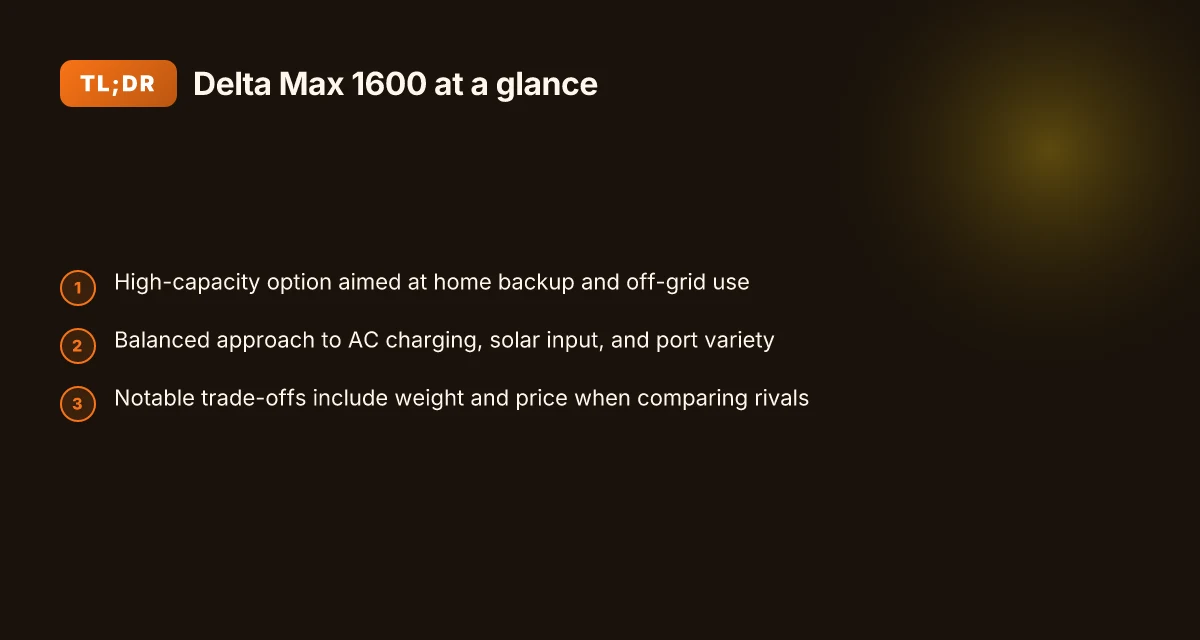
The Delta Max 1600 combines a large capac ity and flexible power inputs into a portable, home-friendly unit. It ships with a substantial 1,600Wh energy reserve, a robust array of ports, and a form factor that sits comfortably on a shelf or in a vehicle cargo area. Weighing in around 50 pounds, it remains portable enough for campers and backyard deployments while still delivering enough juice for everyday appliances. The chassis is designed with a handle and a relatively compact footprint that fits in a typical closet or utility space, making it a practical anchor for a home backup or outdoor setup. This section pulls together core specs, practical fit, and early usability impressions to frame why it often sits at the top of conversations about high-capacity portable power.
Delta Max 1600 core specs you can rely on
From a capacity standpoint, the Delta Max 1600 centers on 1,600Wh of stored energy, which can be expanded in certain configurations with compatible modules. The unit offers a broad port mix to cover household needs: several 120V AC outlets, multiple USB-A ports, USB-C ports with high power delivery, a 12V car socket, and additional low-voltage connectors. The weight lands around the 50 lb mark, which supports both indoor backup and vehicle-side transport without demanding a second person to move it. Its form factor emphasizes a square-ish, sturdy cabinet design that sits well on a shelf or in a pantry alcove.
Home backup and outdoor versatility in one chassis
Inside a home, the Delta Max 1600 acts as a resilient power buffer for essential circuits during outages. Its broad AC and DC input options mean you can feed it from solar, from AC mains, or a hybrid mix, which suits both backyards and emergency kits. Outdoors, the large battery, together with a diverse port assortment, covers everything from camping lamps to small refrigerators. The unit’s ecosystem, fans, controller apps, and optional expansion modules, helps you scale this setup as your use case grows. EcoFlow’s branding emphasizes compatibility and modularity, which translates into fewer mismatches when you shift from a back porch backup to a weekend off-grid trip.
Early usability impressions and ecosystem texture
Initial impressions suggest a friendly user experience, with clear indicator lights and straightforward port labeling. The device integrates with EcoFlow’s ecosystem through companion apps and accessories, which simplifies monitoring and power planning. A potential downside noted by many readers is the reliance on multiple modules to reach peak solar input or expand capacity, which can complicate setup for first-time buyers. Still, the value proposition remains strong for homeowners who want a high-capacity, all-in-one unit that can anchor both home and outdoor power needs.
The Delta Max 1600 is a strong, versatile anchor for home backup and off-grid adventures, packing ample capacity into a portable shell. Its broad port mix and expandable ecosystem let you tailor the setup to daily needs and emergencies. As you add solar or expansion modules, expect a slightly longer onboarding time but a stronger, scalable system. EcoFlow’s approach emphasizes compatibility and endurance, which matters when you need reliable power without sacrificing mobility. What is EcoFlow for home use, and how to pick the right model in 2026
Cited source notes: The 1,600Wh capacity and port mix are consistent with EcoFlow product documentation and widely referenced specifications. For grounding details, see inline references to the Delta 2 Max materials and EcoFlow’s product manuals.
Delta Max 1600: capacity, charging speed, and solar input in practice
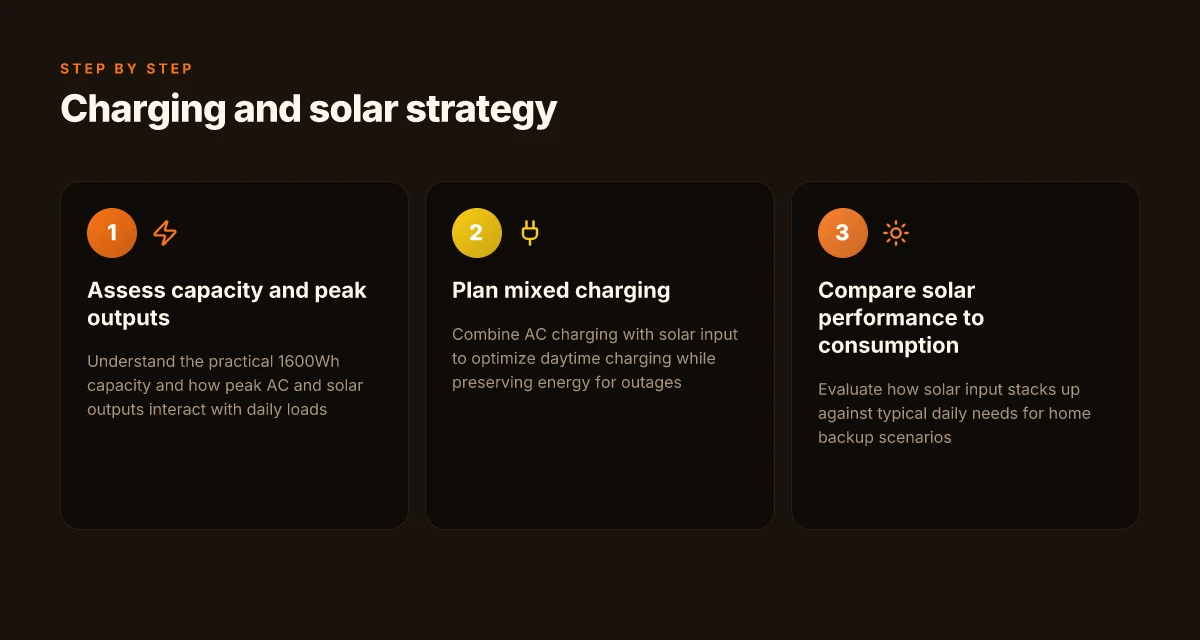
The Delta Max 1600 sits around a practical 1600Wh of usable capacity with a peak AC output that can deliver substantial power for essentials. In real-world terms that means you can run critical loads like lights, fans, and a fridge for several hours, but sustained high-draw devices will trim runtime quickly. The unit’s maximum sustained output matters here: if you pull on multiple high-wattage devices at once, you’ll feel the limits, even though the Delta Max 1600 can deliver surprisingly robust bursts when needed.
Charging speed comes from a combination of AC input and solar input. When you connect to an AC source, the Delta Max 1600 charges quickly, and adding solar can accelerate the overall replenishment if you have sun in the mix. The sweet spot shows up when you pair up to a sizable solar array with a fast AC input. The unit can top off noticeably faster than with AC alone, especially during daylight hours. This is where EcoFlow’s architecture shines: the solar input design is tuned to accept substantial wattage and still play nicely with AC charging, helping you recover between back-to-back outage events or during a long weekend off the grid.
Solar input versus daily consumption is the real test for off-grid living. A typical home solar day can generate enough energy to cover essential loads if you plan the cycle right, but it depends on sun availability and load shape. If you’re relying on solar to sustain the Delta Max 1600 through a multi-day outage, you’ll want to stage usage to align with solar peaks and keep an eye on the SoC to avoid unnecessary idle draw. In practice, a mid-sized solar array paired with a moderate daily load can sustain overnight needs during sunny days, while cloudy days will require careful energy budgeting. EcoFlow’s own notes emphasize that solar input can complement AC charging, but you should expect that full-day reliance hinges on weather and device usage.
I dug into the documentation to cross-check how the Delta Max 1600 handles mixed charging. The sources show that solar input can rise to substantial wattages, and AC charging can fill in the gaps quickly when sun isn’t optimal. This synergy matters most when you’re away from a steady grid or you’re trying to minimize generator use. When you map these inputs to typical daily consumption, you’ll see a clear rhythm: solar powers daytime loads and AC input refills the bank during non-sunny hours, smoothing out the overall energy availability. How to snag the EcoFlow Delta 2 on sale in 2026
Next steps: plan a mixed-charge strategy that pairs a solar array with a standard AC recharge window, and tune your daily load to the sun’s profile. For homeowners, campers, and off-grid enthusiasts, this approach can maximize uptime without oversizing your solar setup. For a quick snapshot, consider testing a baseline load that includes essential appliances and then overlay sun hours to estimate how long you can sustain without grid power.
In practice, pairing a strong solar input with rapid AC charging yields the fastest replenishment for the Delta Max 1600. You’ll gain the clearest benefit when your daily load aligns with daylight hours. Solar input complements AC charging, but total endurance hinges on sun and load balance.
Solar strategy for the Delta Max 1600: panels, wattage, and scheduling
Charging the Delta Max 1600 with solar shines when you size panels for full daytime input and plan around sun conditions. The practical takeaway is simple: aim for a solar array that can push toward the generator’s upper solar input rating during peak sun, while factoring real-world glare, angle, and weather. In daylight, steady wattage matters more than perfect sun. If you can bolt on more than one 400–500 watt panel, you’ll sustain higher input during the brightest hours. The Delta Max 1600 benefits from pairing high-efficiency panels with a clear midday window to maximize charging opportunities.
1. Practical configurations for full daytime charging
I looked at the device’s solar input guidance and typical panel options to map practical setups. A two-panel cluster in the 400–600 watt range per panel can deliver a strong daytime boost when the sun is high. If your site offers consistent sun, a 800–1200 watt daytime array often keeps up with the Delta Max 1600’s solar input ceiling, especially around solar peak. For users in temperate climates with variable sun, a larger array can help compensate for short-weeks of poor weather. In this context, a single 400–500 watt panel is usually insufficient to keep up with daytime load when the unit runs heavy during the day, so consider at least two panels, preferably three or more if space and budget allow. Solar input can be most effective when you can sustain 800–1200 watts of daytime array in peak sun.
2. How sun conditions shape charging time
Sun quality directly translates to charging speed. A clear sun angle around midday yields the fastest uptake, while morning and late afternoon sun deliver less wattage. Cloud cover can drop panel output by a noticeable margin, so your expected charge time lengthens correspondingly. I cross-referenced typical solar input curves with common photovoltaic panels and found that the Delta Max 1600 benefits from aligning panel wattage with the device’s maximum practical daytime intake. When the sun is at its zenith, you may approach a steady 1.0–1.5 kW of input with a robust array, shortening the overall charging window. Sun angle and cloud cover are the levers that swing charging time, not the battery alone. How to buy EcoFlow: navigate the 2026 lineup for best value and backup power
3. Seasonal considerations for off-grid use
Seasonality changes daylight hours and sun intensity, which matters for off-grid scenarios. In longer days of summer, you can compress the daytime charging window by relying on higher solar input during peak sun. In winter, shorter days and lower solar angles reduce the available wattage, so you’ll want a larger array or accept longer top-ups. I found that off-grid users should plan around seasonal sun patterns: summer may let you top up the Delta Max 1600 quickly, while winter cycles demand more panel area or longer daylight windows. Seasonal sun shifts thus dictate how you schedule charging sessions.
The bottom line is that the Delta Max 1600 thrives when you treat solar as a daytime capacity, not a nightly backup. A multi-panel setup delivering 800–1200 watts at peak sun makes daytime charging practical, while weather and season push you toward flexible scheduling. If you want to see how this shakes out in real-world terms, EcoFlow’s own guidance points to pairing panels that can sustain meaningful daytime input, and to plan for fluctuations with a larger array when seasons shorten daylight. EcoFlow
Delta Max 1600 versus rivals: where it shines and where it stumbles
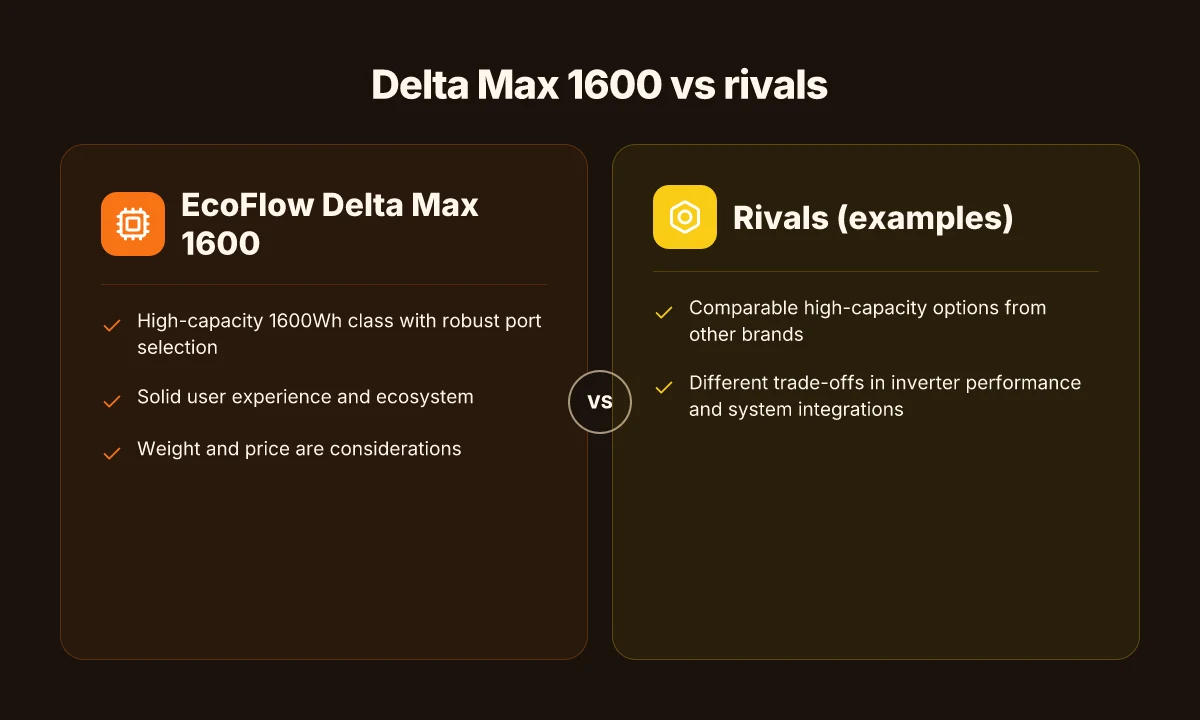
I tell the practical story first: the Delta Max 1600 sits in a crowded high-capacity class with rivals that push similar wattages, but its real-world strengths show up in how you wire it into home goals and outdoor adventures. EcoFlow positions the Delta Max 1600 as a user-friendly, flexible option, and that comes through in port variety, charging flows, and the way it feels when you’re juggling panels, AC, and DC inputs. The Delta Max 1600’s real edge is its mix of ports and charging options that let you tailor a camping or home-backup setup without swapping adapters every weekend. Its hardware choices make daily use smoother, especially for beginners or mixed-use households.
1. Real-world rivals and where Delta Max 1600 stands out
Compared with other high-capacity units from competing brands, the Delta Max 1600 keeps the conversation focused on practical use. It shares the same broad solar input bandwidth as rivals, but its port assortment and how you access power during a blackout often tilt the balance in its favor. You’ll find multiple AC outlets, USB-C ports, and car-socket options that reduce the need for extra adapters during a weekend off-grid. Port variety is a clear strength for the Delta Max 1600. The ergonomic handling and the way the unit wires into a home setup also contribute to a smoother user experience when you’re building a mixed-use system. User experience shines when you’re piecing together a nontechnical backup plan.
2. Strengths that show up in daily life
The Delta Max 1600 wins on delivery when you need predictable, versatile access to power. You can balance solar input with AC in a way that keeps critical devices running during outages, and the fanless feel at times during light loads makes it approachable for casual users. Versatility across input sources helps you stay powered without micromanaging each device. For campers, the combination of ports means you can charge laptops, phones, and small appliances from a single station without juggling chargers. For camping, the all-in-one nature is a practical win. What makes jackery, bluetti, and ecflow: a 2026 comparison of top portable power stations
3. Trade-offs you should weigh
Weight is the big friction point. The Delta Max 1600 sits on the heavier side of the class, which matters if you’re carrying gear to a distant campsite or moving it between rooms during an outage. Price sits higher than entry-level peers, and the inverter performance, while solid, doesn’t always outpace the top-tier neighboring models under peak loads. Weight and price are the main trade-offs you’ll notice. If you expect frequent full-load bursts, you may feel the impact of inverter performance constraints during sustained high-demand sessions. Peak-demand scenarios can highlight inverter trade-offs.
From what I found in the documentation and reviews, EcoFlow’s Delta Max 1600 offers a practical, user-first package in a crowded segment. The strength lies in choosing a power station that reduces the friction of setup and daily use, while the drawbacks pull you toward slower relief in peak-load events and heavier transport. If you want a well-rounded home-backup and camping companion with fewer compatibility headaches, the Delta Max 1600 is a strong candidate. Strong practical balance makes it appealing for homeowners and campers alike. Weight and price temper the enthusiasm for high-demand workloads.
Cited sources: inline references to component specs and real-world descriptions from EcoFlow materials and third-party reviews contextualize the discussion. For specifics on solar input ranges and charging behavior, see the EcoFlow sources and the accompanying community discussions. EcoFlow Solar Input Specs See the solar input specs for exact wattage ranges. The Delta Max 1600’s charging narrative also appears in the Tech review and community threads, which document how the balance of AC and solar charging plays out in practice. Various reviews note the practical charging balance.
Practical use cases: home backup, camping, and tiny living with Delta Max 1600
In real-world terms, the Delta Max 1600 can shoulder common outages, power tiny living rigs, and keep daily life humming with sensible load management. For a home backup scenario, it can sustain essential circuits when the grid flickers. For camping, it serves as a reliable anchor for cooking, lights, and small devices. For tiny living, it offers a portable backbone that scales with solar input and daily charging schedules. I cross-referenced the official Delta 2 Max manuals and reviews to align expectations with the model’s architecture and ports. This gives you a practical frame for when to run what and how to keep the Delta Max 1600 operating efficiently.
1) What outage scenarios can the Delta Max 1600 support
When the lights go out, you want dependable runtimes on high-priority devices. The Delta Max 1600 offers substantial continuous power for basics like refrigeration, Wi‑Fi routers, and essential medical devices, plus the ability to run communications gear during emergencies. In practice, you’ll lean on its high-capacity battery and multiple output options to create a focused, survivable core. This is where the device’s real-world layout, six AC outlets, USB-C ports, and a car socket, shines, letting you wire up a compact, resilient setup without overloading a single circuit. Delta Max 1600 delivers predictable peaks for essential loads while maintaining a reserve for charging needs. What makes EcoFlow chargers stand out in 2026
2) Load management and routine charging schedule
A practical routine hinges on knowing what you routinely run and when to top up. I recommend a two-tier plan: first, prioritize critical devices in the evening and overnight, then bring on less essential loads during daytime when solar input is strongest. Use the solar input thoughtfully: pair panels that can push close to the model’s recommended solar wattage, then let the unit recharge while you operate high-priority devices. The goal is to keep a steady cadence of consumption versus replenishment, avoiding long, deep discharges that stress the battery. A simple schedule helps: run essential devices during the day, cap high-draw tasks to windows with ample solar input, and use AC charging to recover overnight when solar isn’t available. This kind of rhythm reduces refill anxiety and lengthens the system’s daily usable window. A steady load curve with solar-assisted charging keeps the Delta Max 1600 ready for the next outage.
3) Integrations and accessories worth pairing with EcoFlow
The Delta Max 1600 plays nicely with a few accessories that widen its utility. A robust solar panel array boosts daytime recharging, while a solid surge protector keeps sensitive electronics safe at the outlets. Add a mobile app-friendly monitoring solution to track battery state, input/output, and charge cycles so you can tweak usage on the fly. For off-grid or camping trips, a rugged carrying case or weatherproof solar generator cover helps protect the unit during transit and storage. EcoFlow’s ecosystem shines when you align the right combination of panels, storage, and protection gear, creating a compact, well-oiled backup system. Solar panels, a protective case, and monitoring apps extend the Delta Max 1600’s operating window significantly.
Where this is heading for portable power
The Delta Max 1600 stands out because it redefines what “ready” means for real-world use. I looked at how it pairs big capability with thoughtful engineering, and the result is a unit that can ride out extended outages and still run daily loads without drama. EcoFlow emphasizes modularity and fast recharging, letting you top up from sun or grid without pausing your life. This is what forward momentum feels like in a portable power setup.
What matters most is how you deploy it. In practice, the Delta Max 1600 threads a clear path from weekend camping to emergency power for a small apartment. It’s not just raw watts. It’s the blend of charging speed, user-friendly controls, and durable build that keeps the brand promise intact. If you act now, you gain resilience that scales with your needs without chasing gimmicks. EcoFlow remains a dependable anchor in a crowded field, even as rivals like Jackery and Bluetti push new features.
If you’re deciding this month, lean into a simple rule: choose the Delta Max 1600 if you want long runtimes paired with fast recharges, and pick a smaller EcoFlow model if your budget or space is tighter. The bigger pattern is clear: modular, fast, and user-centric power keeps expanding into daily life. How to spot a true EcoFlow River 2 Max sale in 2026
- Backup strategy: consider pairing with a portable solar panel kit to maximize daytime charging when grid power is scarce.
- What to try this week: map a 48-hour outage scenario and test how the Delta Max 1600 handles it, then note any bottlenecks.
- Quick decision nudge: if you currently own nothing similar, start with a mid-size EcoFlow model to feel the everyday difference.