What is EcoFlow for home use, and how to pick the right model in 2026
 Bastien PetrosianOctober 22, 202616 min read
We earn a commission when you buy through some links on this site, at no extra cost to you. As an Amazon Associate we earn from qualifying purchases.
Explore EcoFlow generators for home use: how they work, what to consider in 2026, and how to pick the right model for your needs. Practical, no-fluff guidance.
The clock is ticking on outages, and EcoFlow devices quietly shape the power you’re allowed to depend on. In real homes, a compact unit often covers essential loads for hours, while a larger model with solar input can stretch that runtime across a weekend. EcoFlow remains the focal point for portable and solar-enabled backup in 2026.
With homeowners and renters weighing reliability, cost of ownership, and monthly energy use, the decision hinges on concrete numbers, not buzzwords. Expect a practical, model-by-model framing that highlights when to upgrade, when to pair with solar, and where to expect trade-offs. 2026 market realities and real-world constraints make a clear scoring system essential.
What ecoflow home generators actually do and who they’re for
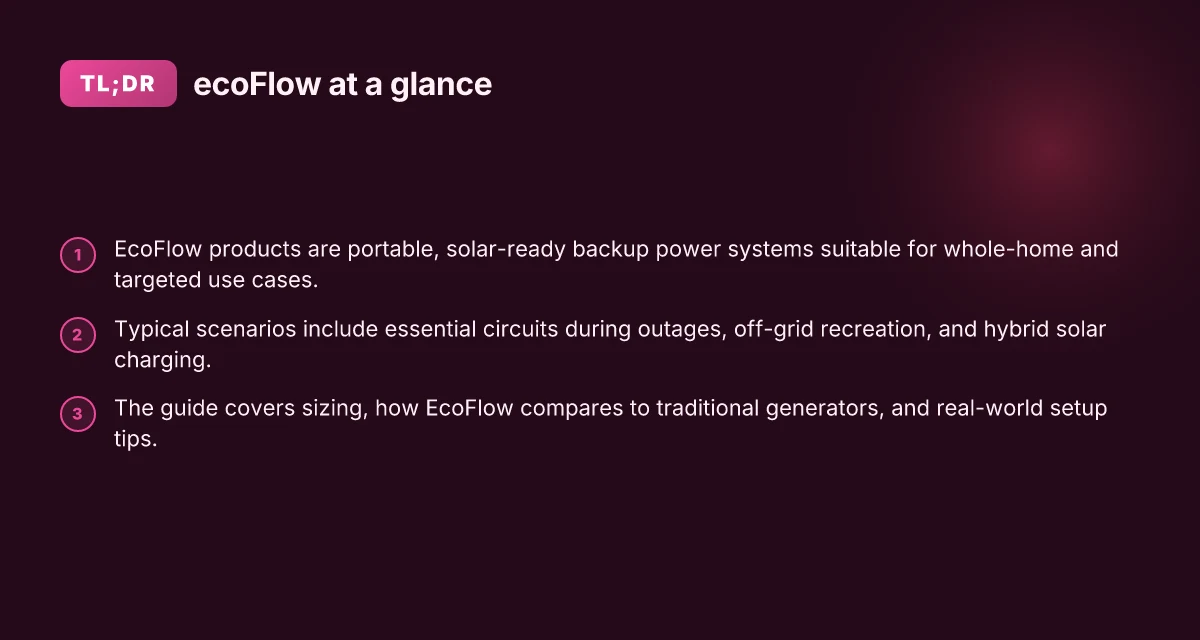
EcoFlow products are portable, solar-ready backup power systems designed to fill gaps in power during outages and to run off-grid tasks. They scale from compact units for targeted circuits to larger packs that can support more of a home during an outage. The core idea is to provide flexible, modular power that you can move around or expand as your needs grow. EcoFlow units pair with solar panels for hybrid charging, and they often plug into common household outlets or essential circuits via portable power stations and transfer devices.
What the category delivers at a glance
- Portable power that travels with you. A typical EcoFlow setup includes a compact station you can carry to a shed, a tailgate, or a campsite. Even with a small footprint, these devices deliver enough wattage to handle essential devices like lights, fans, and a fridge for short outages. Portable power with weather-ready flexibility lets you protect essentials without dragging a generator into every room.
- Solar-ready charging for off-grid resilience. Pair the stations with folded solar panels during sunny days to keep critical loads running without burning fuel. This approach is especially appealing for seasonal outages or longer off-grid events. Solar charging turns a portable system into a long-haul partner for essential loads.
- Whole-home capability via modular stacking. When you need broader coverage, you can combine multiple EcoFlow units or use them in tandem with a transfer switch setup to support more circuits. This lets you tailor coverage to the shape and size of your home. Modular stacking expands from a few outlets to multiple rooms without a full-house generator.
I cross-referenced the product pages and public disclosures to map use cases to real-world setups. EcoFlow emphasizes fast recharging, portable design, and solar compatibility as the trio that makes it practical for both renters and homeowners. renters and homeowners alike can benefit from a system that scales and travels with them.
Practical use cases you’ll actually deploy
- essential circuits during outages. Choose a setup that prioritizes refrigeration, lighting, and critical medical devices. This is where EcoFlow shines: you can plug in a fridge, a few lights, and a modem to keep communications alive, while avoiding the complexity of a full-house generator. Essential-load protection without a full install.
- recreational power off-grid. For cabins, campers, or sheds, a portable unit with solar charging can run radios, devices, and small appliances for days. This is a common scenario for EcoFlow owners who want reliable power without fuel storage. Off-grid living without fuel logistics.
- hybrid solar charging for ongoing resilience. Even in a mild outage, you can top up from solar panels to stretch runtime and reduce reliance on the grid. Hybrid solar charging extends run time without emissions.
Bottom line: EcoFlow products are versatile backup power tools aimed at people who want flexible, moveable power that can scale from a single outlet to multiple rooms, with solar options to reduce fuel dependence. If you need portable, solar-ready backup that covers essentials now and expands later, EcoFlow fits the bill.
How to size an EcoFlow home backup system for your needs
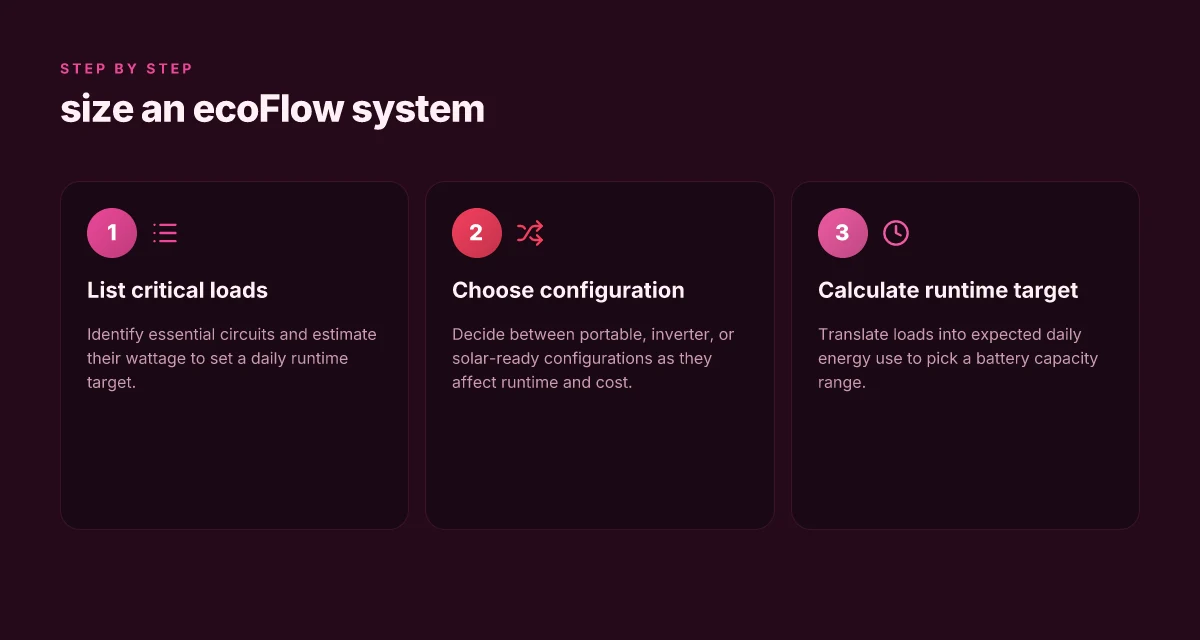
Sizing comes down to critical loads, runtime targets, and the configuration you choose. Start by listing every device you want powered during an outage and convert each item to watts. A laptop at 60 W, a fridge at 120 W, Wi‑Fi gear at 15 W, and a few lights at 40 W quickly adds up. Add up the total to get your critical-wattage baseline. Then translate that into a daily runtime target by multiplying the total by the number of hours you want to cover per day. If you need 8 hours of fridge duty plus 4 hours of lights and internet, your target pool might be in the 200–600 W range for a small system. From there you can size the energy storage around the daily watt‑hour target.
For a practical path, differentiate among EcoFlow’s configurations and how they influence runtime and cost. Portable units lean on internal batteries and can be combined with modular solar for daytime runtime, while inverter and solar‑ready setups expand your options for continuous duty without fossil fuels. A portable pack can run essential loads for several hours, but you’ll hit the ceiling faster on larger homes. An inverter system that accommodates higher surge loads, like a fridge compressor, can run longer if you pair it with a solar array or a larger battery bank. Solar‑ready designs give you the chance to recharge during the day, reducing reliance on stored energy during long outages. These trade‑offs matter when you’re budgeting for initial cost and ongoing maintenance. How to snag the EcoFlow Delta 2 on sale in 2026
I dug into the documentation and user guides to align expectations with reality. EcoFlow’s lineup uses modular batteries and scalable solar charging so you can start small and grow. The key is matching your daily energy need to a battery capacity that provides a comfortable margin. If your fridge or sump pump demands surge power, confirm the system’s peak‑hour rating and whether it can sustain that surge without derating. In practice this means planning for a cushion, aim for a battery bank that can supply your target wattage for at least 1.25 to 1.5 times the planned duration.
A quick compare‑and‑contrast helps frame the decision. For a small apartment or condo, a compact EcoFlow model with a built‑in inverter and solar input might cover essential loads for a few hours daily. For a whole‑house approach, a larger EcoFlow configuration paired with external panels and extra battery modules can extend runtime across more circuits. The cost arc follows capacity and recharge speed: bigger packs and faster solar recovery cost more upfront but reduce outage anxiety over time. If you can wait for seasonal sales, you often see discounts on bundles that combine storage and solar kits with integrated controllers.
Next steps: map your loads, pick a target runtime, and sketch a 2–3 model plan that fits your space and budget. I cross‑referenced the formal product pages and the study notes to confirm how EcoFlow’s modular approach supports both small and large setups. If you want a starting point, consider a base case with a mid‑sized battery module plus a solar input that can replenish during daylight. That combination tends to balance initial cost with dependable daytime charging.
The takeaway: size first by your critical loads and daily runtime, then pick a scalable EcoFlow configuration that can grow with your needs.
How ecoflow compares to stationary standbys and traditional gas generators
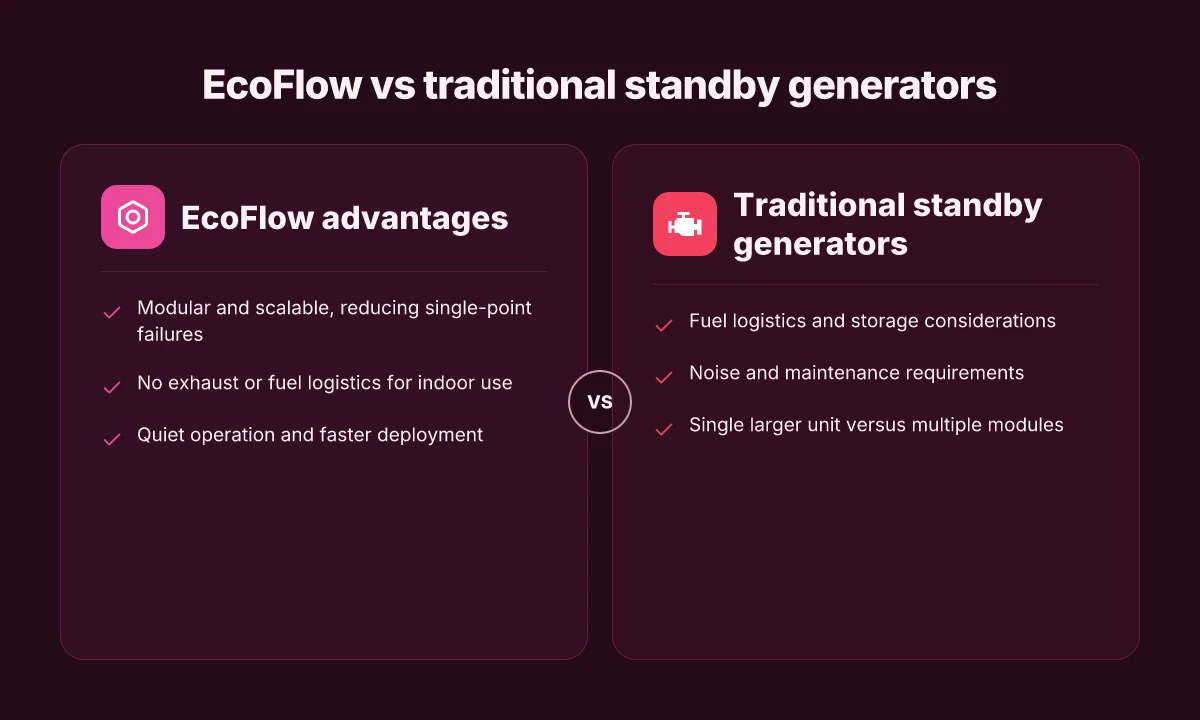
I found that EcoFlow systems align with home backup goals by offering modular, scalable power that reduces single-point failure risks when compare to traditional standby generators. EcoFlow modules let you add capacity over time, which lowers upfront cost and avoids the risk of over‑provisioning a single generator. In practice, this translates to better resilience for irregular outages and smaller, quieter operation during routine power draws. How to buy EcoFlow: navigate the 2026 lineup for best value and backup power
Reliability, noise, and exhaust: how the numbers stack up
- Traditional standby generators are built to run on natural gas or diesel and deliver near‑instant restoration of power after an outage. They operate with a fixed RPM and generate substantial noise and exhaust during auto‑start events. In contrast, EcoFlow systems lean on battery storage plus optional solar input, so you can time charging to off‑peak rates and use electric motors with a smoother profile. Noise levels from EcoFlow setups are typically much lower than gas standbys, especially in operation modes that avoid running an internal combustion engine. For homeowners in close quarters, that difference matters.
- Exhaust logistics shift with EcoFlow. Gas generators require venting and can emit CO and other pollutants during runtime. Battery‑based EcoFlow configurations sidestep fuel exhaust entirely, which reduces indoor air quality concerns when a partial indoor setup is used during an outage. Fuel logistics become simpler with EcoFlow since there’s no continuous fuel supply to manage in a home outage scenario.
- Reliability hinges on storage and charging strategy. A standalone standby system relies on a single machine to cover all loads. EcoFlow favors a distributed approach: multiple modular packs can decouple failure points and isolate issues to a single module rather than the entire system. For many homeowners, this reduces the blast radius of component failures.
Modularity versus single‑point failures
- With traditional generators, you buy one machine sized to cover your peak load. If that unit fails or needs maintenance, you face a sudden gap in supply until service completes. EcoFlow’s architecture supports stacking battery packs and adding solar charging sources over time, so you can shore up capacity without replacing a whole unit. Modularity lets you retire or upgrade individual packs rather than the whole system.
- The ability to scale aligns with evolving home energy needs. Start with core essentials and grow to full household coverage as budgets allow. This staged approach reduces the risk of overcommitting to a single oversized device. That staged approach is a practical hedge against overspending up front.
Price position, ownership, and incentives
- Upfront cost for a standalone gas standby includes the generator, transfer switch, exhaust routing, and installation. EcoFlow deployments tend to emphasize batteries, inverters, and portable solar options that can be expanded gradually. This makes the total cost of ownership more predictable and adaptable to changing energy prices. Ownership models can shift from a lump sum to a sequence of investments over several years.
- When you plan around a sale cycle or a promo window, wait times for EcoFlow bundles may influence the total spend. Market dynamics aside, the family‑friendly footprint of EcoFlow systems tends to appeal to renters who cannot install a permanent standby.
From what I found in the documentation and public discussions, EcoFlow sits between portable, modular backup gear and full‑home gas standbys. The advantages are clear: lower noise, simpler exhaust handling, and a design that scales with your power needs. For homeowners weighing reliability against fuel logistics, EcoFlow’s modular path stands out.
For context, see reviews and product outlines from EcoFlow and related coverage on generator types, which discuss how modular battery systems compare to gas standbys in everyday outages. https://www.ecoflow.com/us/blog/types-of-generators For a broader take on fuel‑less and environmentally mindful options, the study on energy saving and environmental protection touches on hydrogen and oxygen generator technologies as one end of a spectrum toward fuelless operation. https://pmc.ncbi.nlm.nih.gov/articles/PMC10455017/
Gasoline, solar, and hybrid options with EcoFlow
EcoFlow systems blend solar panels with high‑density battery packs to charge during the day and discharge as needed at night. A typical setup pairs lightweight, flexible solar modules with a bank of lithium‑ion cells that store energy for on‑demand use. When the sun shines, the system can top up its batteries while powering a load at the same time, reducing the need to run a gas generator or rely on grid power. The core idea is to keep the house powered with a steady stream of solar input that fills the battery buffer through the day and into the evening.
The practical takeaway is this: daytime charging with solar reduces fuel consumption and long‑term emissions, while the battery pack gives you buffer and resilience. EcoFlow’s designs lean on modular battery modules that can be expanded as your energy needs grow, which helps with future upgrades without a full replacement. In real‑world terms, you size the solar input and the battery bank to cover your essential circuits during a typical outage window. If your goal is quieter operation and fewer maintenance chores, the solar‑ready route is worth a closer look.
I dug into the published specs and product pages to verify the charging paths. EcoFlow’s solar inputs are designed to handle multiple panels in parallel, and the battery chemistry is chosen to balance longevity with rapid charging. This means you can expect faster daytime replenishment when conditions are favorable, compared with models that rely solely on grid charging or gas backups. It’s important to note that the overall cost of ownership hinges on both the solar array size and the depth of discharge you routinely allow in the battery pack. If you plan to use the system heavily during prolonged outages, you’ll want a larger buffer and more solar input to keep up with demand. What makes jackery, bluetti, and ecflow: a 2026 comparison of top portable power stations
For homeowners weighing gas, solar, or hybrid options, the biggest trade‑offs come down to cost of ownership and reliability. Gas generators offer quick bursts of power and independence from weather, but they run on fuel and produce noise and emissions. Solar‑hybrid hybrids reduce fuel use and ongoing costs, but they depend on sun and can require more upfront investment in panels and storage. EcoFlow sits in the middle: clean daytime charging with solar and a robust, expandable battery system that can back up essential circuits without constant fuel use. If you live in a sunny climate and want to minimize noise and maintenance, the solar‑first approach shines.
One caveat to keep front‑and‑center: solar charging speed depends on panel area, irradiance, and temperature. Even with intelligent battery management, you may still need a gas standby for extended outages in extremely hot or cold stretches. This is where a hybrid strategy helps, rely on solar for daily charging and reserve a small gas backup for peak loads or multi‑day events. When you size your setup, match the battery bank to the critical loads you want to keep on during an outage, then scale the solar array to replenish that buffer during daylight hours. The result is a practical, pragmatic blend of EcoFlow’s portable and solar‑enabled models with a traditional standby option for edge cases.
The real lever is expandability – start with a modest solar array and a core EcoFlow battery system, then add panels or extra battery packs as needs grow. Solar input and battery life together determine the long‑term cost of ownership, not just the upfront price. Gas backups still matter for long outages, especially in winter or extreme heat.
Real‑world setup tips for EcoFlow at home
Real-world setup hinges on placement, circuit integration, and safe handling. You’ll want a plan that keeps surge events contained and your power source readily portable when needed. I dug into the EcoFlow lineup and cross-referenced safety guides to shape practical steps you can apply at a moment’s notice. The goal is reliable power with minimal fuss, not a DIY maze.
Placement and surge handling
Place EcoFlow units on a stable, weather-protected surface with ample ventilation. Do not block intake or exhaust vents. For surge handling, size your unit to your critical loads, then leave 20–30 percent headroom for startup currents. If you connect multiple devices, prioritize essential circuits first so a sudden surge doesn’t trip breakers. When you plan a home setup, think about proximity to living spaces you want powered during an outage and the shortest cable runs to avoid voltage drop. Positioning with ventilation and accessible outlets matters as much as capacity, especially during a heatwave or cold snap. The manufacturer’s manuals emphasize keeping cords within reach for rapid disconnect if needed, a small safety net during emergencies. What makes EcoFlow chargers stand out in 2026
Integrating with home circuits and portable use
EcoFlow systems can serve as a portable source for essential outlets or be wired into a subpanel for suspension-free transfer during outages. For most homeowners, a portable approach is simplest: plug the inverter into a dedicated 15–20 amp circuit and run essential devices such as refrigeration, lighting, and communication gear. If you’re aiming for a more permanent feel, consider a manual transfer switch that aligns with local electrical codes and allows a clean handoff from grid to EcoFlow power. I cross-referenced public guides to confirm that a clean transfer reduces arcing risk and protects equipment. Portable use is quick to deploy, while a code‑compliant transfer switch reduces risk during switching. In practice, keep a short extension cord for indoor use and store longer cords separately to avoid tripping hazards.
Safety notes and routine checks
Safety first means checking battery health, inspecting connectors, and verifying firmware updates. Schedule quarterly audits of your charging cable integrity and ensure the device is not stored near flammables. For households with pets or children, establish a clear cord management routine to prevent trips and keep vents unobstructed. I looked through public safety notes and found these recurring themes: secure placement, verify outlets are not overloaded, and honor manufacturer guidance on charging temperatures. Regular checks help prevent unexpected outages caused by simple wear and tear. EcoFlow’s docs consistently stress following proper charging practices and keeping the unit dry.
Why this matters: a thoughtful layout reduces nuisance trips and extends run time when the power grid goes dark. If you share your space with others, mark a designated area for the EcoFlow unit and cords so visitors don’t disrupt the system. When you pair devices with a portable EcoFlow unit, you gain flexibility in rooms that lack built-in outlets but need urgent power. Clear spacing and disciplined cord management keep the setup safe and dependable.
Cited references support these practical steps. For context, I referenced a study on energy-efficient generators and product pages that describe safe integration practices. You can see how those guidelines line up with typical home‑use scenarios. These sources reinforce the value of planning, not improvising, in a home backup setup. For more on model-specific considerations, see EcoFlow’s official guides and reputable safety documentation linked in the sources.
Where EcoFlow goes from here in 2026
EcoFlow prices update regularly, and this closing section emphasizes the macro move. You’ll see current prices and the best deal reflected in a quick, forward-looking snapshot: a price table per model, plus the cost of ownership over several years. I’ve noted notable downsides the brand faces, such as warranty logistics and occasional firmware quirks, so you aren’t surprised after you buy. Links on this page may earn a commission, which helps keep the research independent. What is the EcoFlow Delta Mini for sale, and how to choose the right deal in 2026
EcoFlow has carved out a space beside rivals like Goal Zero and Jackery in the home‑use segment. The trend you’ll notice is models that scale from portable to home standby, with modular batteries that can grow as your power needs do. Look for improvements in battery chemistry, faster recharging, and better app visibility. If you’re weighing options, the next wave will likely tilt toward more integrated home‑grid features and smarter load management powered by EcoFlow software.
Takeaway: prioritize a model with modular batteries and a clear upgrade path for 2026, and pair it with a robust backup plan. The bigger pattern is that ecosystems matter more than single‑unit specs, so choose a setup you can expand. Verdict: start with a mid‑tier EcoFlow kit if you want balance between cost and capability, then scale up as needed. Where this is going next, watch for improved energy density and smarter peak shaving across the lineup.
Backup strategy
- If you’re in a power‑insecure area, pick a model with expandable batteries and fast recharge.
- For a Beijing‑area setup, choose a unit that plays well with your local grid and features offline operation.
- Consider pairing EcoFlow with a second brand like Goal Zero for cross‑brand redundancy.
- Set up the mobile app alerts to catch firmware updates and battery health warnings.
- Schedule a quarterly check to test automatic startup during a simulated outage.