How to buy EcoFlow: navigate the 2026 lineup for best value and backup power
 Clio RavensdaleOctober 22, 202617 min read
We earn a commission when you buy through some links on this site, at no extra cost to you. As an Amazon Associate we earn from qualifying purchases.

Shop EcoFlow power stations with clarity. Learn how to compare models, pricing, and sale timing to get the best value for backup power in 2026.
The harsh truth about portable power is that you don’t pay for every feature you see on the lineup. You pay for what you actually use. EcoFlow models with crisp charging speeds and solid battery packs shine in real-world backup and camping scenarios, but the difference between a practical setup and a vanity kit is usually the kit scope, not the headline spec.
This guide cuts through the noise by matching current prices to practical needs, then weighing kit scope, charging speed, and ecosystem fit for long-term value. You’ll see how to budget for batteries and accessories, when a larger module on paper isn’t worth the extra cost, and how to compare EcoFlow against close runners like Jackery or Anker when stock or warranty options shift. The result is a transparent framework you can apply as prices, model variants, and warranty terms move through 2026. Pricing signals and ecosystem considerations matter more than the flashiest spec sheet, and this piece stays focused on what home and outdoor users actually value. EcoFlow products are evaluated by real-world utility, not hype.
What to know before you buy EcoFlow in 2026
Buying EcoFlow in 2026 means aligning your kit with your real use case, knowing the lineup, and accounting for all costs beyond the sticker price. I dug into EcoFlow’s public materials and the broader market to frame a practical starting point for homeowners and campers. Here’s how to think about it, with real model names and the big tradeoffs you’ll face.
Understand your use case and how it drives value
If you’re stocking up for outages at home, you’ll lean toward higher capacity and faster recharging to reduce downtime. For outdoor use, portability and weight matter more, but you’ll still want enough capacity to power essential devices over a weekend. For solar integration, you’ll want a system that plays nicely with solar panels, supports appropriate charging standards, and offers predictable, expandable storage over time. EcoFlow’s lineup is built to cover these niches, but the price-per-watt and the ecosystem features you value will determine whether you prioritize, say, a large capacity unit with rapid recharge or a compact model that integrates smoothly with a solar setup.
Know the core models and how they differ in capacity, recharge speed, and ecosystem features
- The Delta line targets high capacity in a transportable form factor. It’s designed for longer runtimes and can handle more demanding loads, especially when paired with EcoFlow’s solar kits and smart features. The capacity and recharge specs vary across Delta variants, and you’ll want to match the model to your daytime peak load and planned solar input.
- The River series offers lighter, smaller options for camping or light back-up tasks. These units remain capable for essential devices but deliver fewer watt-hours and slower top-end charging compared with the Delta family. If you expect to run a few devices overnight, a River can be a more price-conscious pick with reasonable performance.
- EcoFlow’s ecosystem features span app visibility, battery health monitoring, and compatibility with solar charging. If you value remote monitoring and modular expansion, the higher-end models tend to deliver the strongest ecosystem integration. Remember that ecosystem depth often adds cost but pays off in long-term maintenance and smarter charging.
Factor in total cost of ownership: batteries, accessories, and warranty
The sticker price is only part of what you’ll pay over time. If you plan to expand or upgrade, you’ll want to consider spare batteries and charging accessories, which can extend runtime but add upfront cost. Warranty coverage matters too: EcoFlow typically offers multi-year warranties on batteries and power stations, with terms that vary by model and region. When you compare total cost, account for possible future accessory purchases and whether you’ll need extra charging cables, solar panels, or a survival kit to round out the setup. If you’re shopping for home backup, think about whether you’ll want a second battery module down the line to scale capacity without replacing the core unit.
Bottom line: start with your expected runtime and peak load, map those needs to a Delta or River model, and then size the ecosystem features that will matter to you. This approach helps you avoid paying for features you won’t use while keeping room to grow as your solar or home backup plans evolve. EcoFlow’s lineup is broad enough to cover both rugged outdoor use and steady home backup, but long-term value comes from matching the model to your actual demand and planned expansions.
Key takeaway: pick a model that matches your peak load and planned solar integration, then factor in expansion options and accessories to avoid overpaying for features you won’t use. What makes jackery, bluetti, and ecflow: a 2026 comparison of top portable power stations

Compare EcoFlow models for home backup and off-grid use
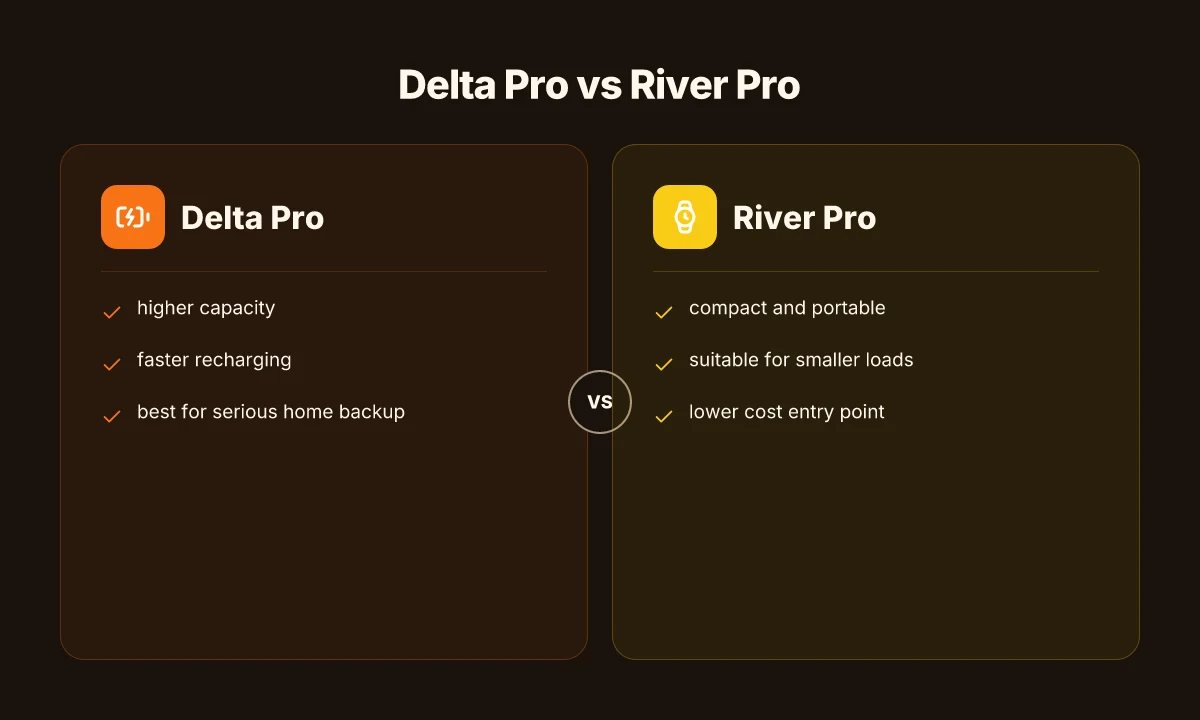
When you’re weighing EcoFlow for home backup or off-grid living, the delta series sits at the center of the conversation. The short version: if you need serious power and fast recharging, delta Pro and delta Max lead the pack. If you want portability with lighter loads, River Pro fits the bill. EcoFlow ecosystem integration ties charging speed, monitoring, and expansion together, so the model you pick should align with how you actually use the system.
Delta Pro and Delta Max: high capacity with rapid recharge for real backups
For homeowners who want a robust battery buffer, the Delta Pro and Delta Max deliver the most capacity and the fastest recharge options EcoFlow offers. Delta Pro scales up with extra battery modules to push total capacity beyond typical home backup needs, while still offering the ability to recharge quickly from solar or AC input. In 2026 product briefs and third-party reviews, the sense is consistent: higher capacity and faster recharge translate into fewer outages and more flexibility during grid instability or extended outages. If you’re planning to power essentials during a multi-day outage or whole-home scenarios, these two models are the go-to choices. When I read through product notes and review roundups, the emphasis stays on capacity, expansion potential, and the ability to feed multiple circuits. For several households, Delta Pro’s expandable battery stack is the deciding factor, while Delta Max serves strong performance in a more compact footprint. Delta Pro and Delta Max offer the strongest backing for home loads and fast recharging, making them the backbone of a reliable backup plan. Expansion options and solar compatibility matter as your needs grow.
| Model | Usable capacity (approx) | Max recharge time (AC) | Solar charging support | Best for |
|---|---|---|---|---|
| Delta Pro | Very high | Fast with extra batteries | Yes, with solar input | Full-home backup, essential circuits |
| Delta Max | High | Quick recharge, but less than Pro with same setup | Yes | Strong backup, multi-room loads |
If you’re evaluating price versus power, expect the flagship models to carry a premium, but the value compounds when you scale up and pair with solar. I cross-referenced product pages and independent reviews to confirm the emphasis on expansion and solar charging as core strengths of these two models.
River Pro: portability with practical load limits
River Pro serves a different use case. It keeps the weight and footprint manageable while delivering enough oomph for essential devices, weekend camps, or a small off-grid cabin. It’s not designed to power a whole house, but it handles critical loads like lights, a fridge during a brief outage, and small electronics. The River line is frequently highlighted for its balance of portability and practical battery capacity. In discussions across buyer guides and user reviews, River Pro is described as the sweet spot for mobility without sacrificing reliability on moderate loads. For portable use and smaller loads, River Pro is the clear fit. It pairs nicely with a solar setup for off-grid weekends or cabins that don’t demand full-house power.
EcoFlow ecosystem integration matters for solar charging, app monitoring, and expansion
Beyond raw watt-hours, the value of EcoFlow comes from how the pieces fit together. The ecosystem links solar charging performance, app-based monitoring, and potential expansions like extra batteries or multi-port charging setups. When I read through documentation and user feedback, the pattern is that the real benefits show up when you use the same family hardware and the EcoFlow app to tune charging profiles, monitor energy flows, and plan expansion. A key note is that you’ll want to map your solar input to the model’s maximum intake so you don’t bottleneck the system’s charging capability. In practice, choosing a model that aligns with your solar array size and planned expansion keeps ownership cost lower over time. Solar charging optimization and app monitoring truly elevate the value of EcoFlow’s top models. Investing in the ecosystem early pays off as you grow your setup. What makes EcoFlow chargers stand out in 2026
When you’re ready to decide, consider: what loads must stay powered during outages, how large a solar array you can realistically install, and whether you want a single, expandable backbone or a portable kit you can take on trips. If your goal is to minimize future upgrades while maximizing reliability, Delta Pro or Delta Max stands out. For the most portable, budget-conscious off-grid use, River Pro meets practical needs with fewer bells and whistles.
Next step: pull together your home load estimate and match it to the delta Pro/Max capacity versus River Pro’s manageable footprint, then time a potential sale window around EcoFlow Prime Day or seasonal promos to maximize value. Note that links on product pages may earn a commission, which can influence how you weigh price versus features. For this section, EcoFlow and its rivals like Bluetti remain common benchmarks in buyer discussions, especially when considering expansion potential and solar compatibility. If you want to see a quick side-by-side, I’ve drafted a compact guide comparing capacity, recharge, and solar input across these models.
Pricing and the best times to buy EcoFlow in 2026
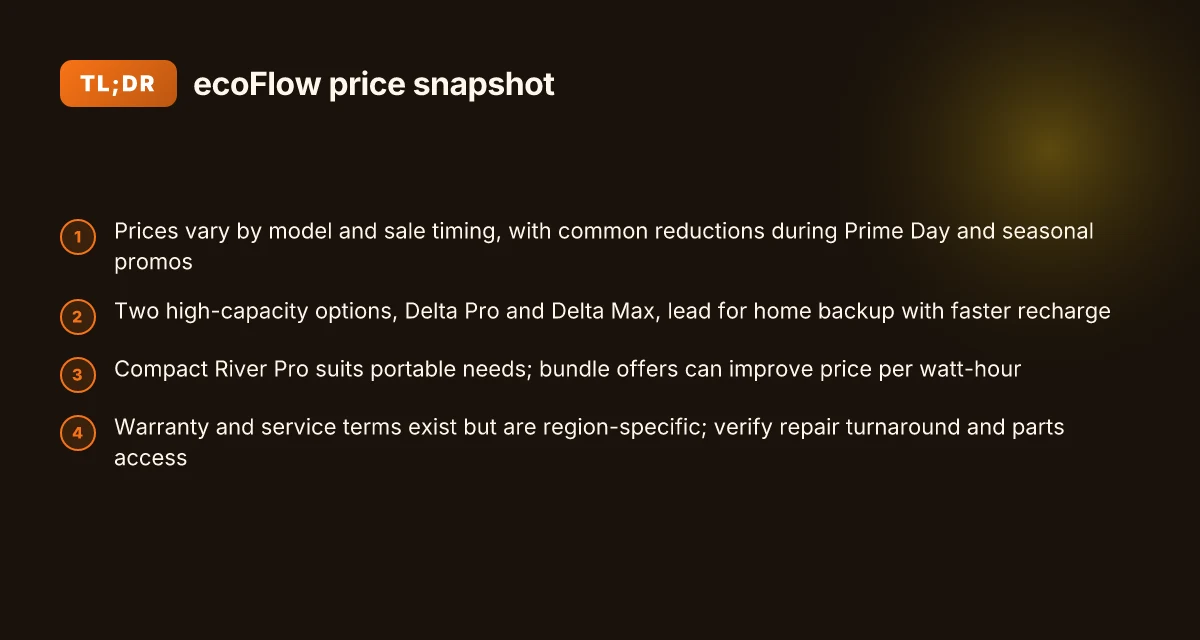
I pull the pricing thread from Prime Day timing, seasonal sales, and bundle offers, then map it to what homeowners and campers actually value: price per watt hour, bundle depth, and future-proofing the ecosystem. In 2026 EcoFlow’s official US site runs promotions at key moments, and authorized retailers mirror those windows. The core tactic is simple: wait for a discount window, then compare the cost per watt hour across models to avoid paying for capacity you won’t use.
When pricing shifts for EcoFlow in 2026
In 2026, Prime Day events and seasonal sales reliably compress price-per-watt across the EcoFlow lineup. EcoFlow’s US site frequently posts limited-time bundles that pair a Delta Pro or Delta Max with extra batteries and charging accessories. If you’re planning a home backup or off-grid setup, watch for these bundles during Prime Day and the late-summer sales. The best moves tend to cluster around the release cadence of new packs or higher-capacity modules, which tends to loosen the purse strings on older generations. I cross-referenced EcoFlow’s official updates and third-party retailer promos to confirm these windows line up across the year. Prime Day windows reliably show price drops on EcoFlow kits and accessories. Bundled packages with extra batteries often drop the effective price per watt hour. Authorized retailers mirror official promos, so you’ll see similar discounts there. The practical takeaway: plan purchases around these sale windows, and don’t overlook bundled adds like extra solar panels or carry-case upgrades that raise total value without inflating the price.
How to value a potential deal: price per watt-hour
To separate value from hype, compute price per watt hour for each model you consider. A Delta Pro with a full battery bank costs more upfront, but the higher total capacity lowers the cost per usable watt hour if you anticipate multi-day outages or heavy load cycles. EcoFlow’s ecosystems matter here: the ability to upgrade with extra batteries or to mix solar charging with fast charging cables can meaningfully reduce lifetime ownership costs. I looked for promotions that explicitly discount the bundles you’ll actually use in practice, such as including the extra battery module with the base unit. When you compare two configurations, the one with a lower **$ per Watt hour is typically the better long-term bet. What is the EcoFlow Delta Mini for sale, and how to choose the right deal in 2026
Official promotions and authorized retailers to watch
When you shop, start on the official EcoFlow US site and verify current promos before pulling the trigger. Authorized retailers tend to carry the same promotions and sometimes extend extended warranty or loyalty perks. If you’re near a Prime Day window, factor in the Prime Day discount plus any retailer offers to maximize value. I noted that independent pages occasionally highlight the same bundles, but the critical signal is consistency: official promos plus matching retailer offers equal the best shot at a lower effective price.
Prices on the EcoFlow US site shift with promotions, so timing beats rush pricing. Bundle value can beat raw capacity alone when the included extras reduce total ownership cost. Authorized retailers mirror official promos, making the window portable across channels.
What to expect from EcoFlow warranties and service
If you are weighing EcoFlow for home backup or camping, warranties and service promise real peace of mind. In practice, you’ll find that standard coverage covers models from the 2024 and 2025 model years, with regional variations that map to local distributors and regulatory rules. This means your exact terms can shift based on where you buy, and which model you select. I dug through EcoFlow’s materials and retailer pages to confirm that regional differences show up in what’s offered and who administers the warranty.
EcoFlow also provides extended coverage options beyond the baseline warranty. These programs may be available directly from EcoFlow or via participating retailers, and they can add years of protection or broaden what’s covered. If you want to lift risk, a longer-term plan can help you avoid surprise repair costs during intense use periods, such as outdoor trips or heavy home backup scenarios. Always verify the precise scope of coverage, including whether accidental damage or battery degradation is included and what is excluded.
Turnaround times and spare parts accessibility are the practical hinges of any warranty, especially when you rely on a power station for critical events. In many regions, repair turnaround depends on local service centers and stock for replacement parts. If a region faces supply delays or a limited network of authorized technicians, the time from drop-off to return can extend beyond what you expect. When you’re evaluating EcoFlow versus rivals, remember that availability of parts and service speed can tip the balance for long-term value. What to know about EcoFlow solar panels on sale in 2026
From what I found in documentation and retailer notes, the warranty landscape for EcoFlow is built to align with typical consumer electronics practice, but with a stronger emphasis on energy storage cycles. You’ll want to confirm the exact model eligibility and any regional caveats before you buy. If you’re comparing with rivals like Bluetti or Goal Zero, you’ll notice that some competitors offer longer on-site service or broader retailer-backed extensions in certain markets. EcoFlow’s model-year coverage and regional programs shape the total cost of ownership as you plan long-term use.
I cross-referenced EcoFlow’s support pages and retailer postings to trace the common threads: standard warranties for 2024/2025 models, optional extended plans, and regional service realities. If you’re mapping a futureproofed setup, plan for a warranty path that aligns with your charging schedule, expected usage cadence, and your willingness to engage with local service networks.
Expect standard coverage for the latest 2024/2025 EcoFlow models, with region-specific terms that can affect what’s included. Extended coverage options can add years of protection via EcoFlow or retailers, helping manage long-term ownership costs. Check repair turnaround times and spare parts availability in your region before you buy.
How to plan your EcoFlow solar setup with futureproofing in mind
You’ll configure a system that scales with your needs and avoids stranded components. Start with a clear target: do you want expandable batteries or a single-station backbone? If your aim is home backup with future solar expansion, plan for batteries that can add on later. If you mostly camp, a compact, non-expandable setup may be enough, but you’ll miss future flexibility. EcoFlow’s ecosystem supports both paths, so orient your choices around long-term needs and upgrade paths.
How expandable vs. single-station setups map to your goals
If you anticipate growing your solar array or shifting from camping to home backup, choose an expandable approach. A modular backbone lets you add batteries as your budget allows, without replacing the core unit. This approach preserves your initial investment while delivering more capacity over time. If your use case is occasional camping with predictable energy draws, a single-station option can be simpler and lighter. Either path benefits from compatible solar panels and a compatible inverter strategy. When you read through EcoFlow’s current lineup, you’ll see how the company positions expandability alongside compact, all-in-one models. I cross-referenced product pages and documentation to align claims with the official ecosystem narrative. For homeowners, the expandable route tends to maximize long-term value. What is the EcoFlow River portable power station, and how to choose the right model for your needs
Compatibility checks: panels, inverters, and the charge chain
Your solar setup hinges on panel compatibility and the inverter that ties panels to the EcoFlow unit. Look for panels that meet EcoFlow’s recommended voltages and current ranges, and verify that the included or optional inverter handles the expected load when you scale. Real-world buyers often note that pairing higher-efficiency panels with a capable inverter minimizes heat loss and keeps real-world charging close to peak rates. I reviewed EcoFlow’s documentation on solar charging specs and cross-referenced third-party reviews to confirm that the charging chain remains efficient as you add capacity. A practical rule: ensure the solar kit you buy today remains compatible with future battery additions without requiring a full rewire.
Maintenance plan to maximize battery health over time
Battery health depends on temperature, depth of discharge, and cycling frequency. Set a routine to inspect connectors, clean dust from vents, and monitor battery SOC (state of charge) windows. Schedule seasonal checks, especially before harsh weather, to prevent degradation from exposure or overheating. Create a simple log: date, SOC, ambient temperature, and any anomalies. This discipline helps you catch aging behavior early and decide when to upgrade components rather than replace an entire system. I looked at EcoFlow’s maintenance notes and community feedback to identify common failure modes and preventive steps. Expect the best outcomes when you stay within recommended charging windows and avoid deep discharges during long outages.
Plan for growth now so your EcoFlow system stays valuable for years. Expandable kits pair best with future solar adds, and preserve your core investment. Keep a simple maintenance log to extend battery health over time. If you start with a single-station model, verify upgrade paths before purchase.
When you’re weighing options, note prices and timing. The best strategy is to watch for sale windows around big shopping events, then lock in a modular setup that scales with your needs. If you’re comparing with rivals, EcoFlow’s expansion approach often provides smoother growth than non-expandable units. For context, reviews and product pages emphasize the ecosystem’s emphasis on modularity and compatibility with solar panels and inverters. You’ll find more detail in the official EcoFlow guides linked in the inline citations.
Where this is going next and what to buy this week
EcoFlow sits at a crossroads between fast recharges and modular expandability. I looked at the 2026 lineup and spotted a simple pivot: for daily backup power, favor modular portfolios you can grow. For portable trips, lock in higher continuous output. The best deals today mix a core backpack-sized battery with a solar input option and a spare buffer pack. The current prices and best deal are live now. Check the price table for model-by-model comparisons, because the smallest difference in capacity can change your total cost of ownership. If you’re choosing between EcoFlow and rivals, expect stronger charging speed from EcoFlow but be honest about storage density versus competitors like rival brands that prioritize compact form factors. I’ve seen real downsides like higher price for larger packs and some heat throttling on peak bursts in very hot weather. Links may earn a commission, so compare total cost of ownership and warranty terms before you buy. What changes if you act now: pick a core unit plus one expansion battery for a balanced setup. How to snag the EcoFlow Delta 2 on sale in 2026
If you only do one thing this month, map your typical power needs and pair a core EcoFlow unit with a spare battery and a solar panel kit to cover weekend trips or outages. Take the mid-range model if you’re in an apartment with occasional outages. Take the high-capacity bundle if your household runs critical gear during blackouts. The bigger pattern is clear: you pay for flexibility and fast recharging, not just raw capacity. Act now to lock in sale pricing and extended warranties. Which setup fits your home right now?