How the EcoFlow 12V 100Ah Lifepo4 battery fits into real off-grid setups
 Tessa AlbrightOctober 22, 202617 min read
We earn a commission when you buy through some links on this site, at no extra cost to you. As an Amazon Associate we earn from qualifying purchases.
Explore how the EcoFlow 12V 100Ah Lifepo4 battery performs in RVs, cabins, and off-grid shops. Learn capacity, cycle life, and practical hookup tips for real-world use.
The EcoFlow 12V 100Ah LiFePO4 battery isn’t a magic bullet, it’s a chassis with real limits. In real off-grid setups, you’ll see a usable capacity closer to 100 Ah only after accounting for depth of discharge and temperature, not just label specs. 100 Ah usable is not the same as 100 Ah rated in every season.
This piece looks at how this pack actually behaves under a wide range of loads, climates, and charging sources. I pull from field notes across RVs, tiny homes, and solar installs to map where the math meets reality, including SOC drift and BMS safeguards you’ll want to verify before you rely on it. By the end you’ll have a practical read on whether EcoFlow fits your daily patterns or if you should compare rivals like Victron or Renogy for higher capacity or different charging ecosystems. Understanding how the pack wires into inverters and solar input matters more than the glossy spec sheet.
What the EcoFlow 12V 100Ah lifepo4 battery promises for off-grid power
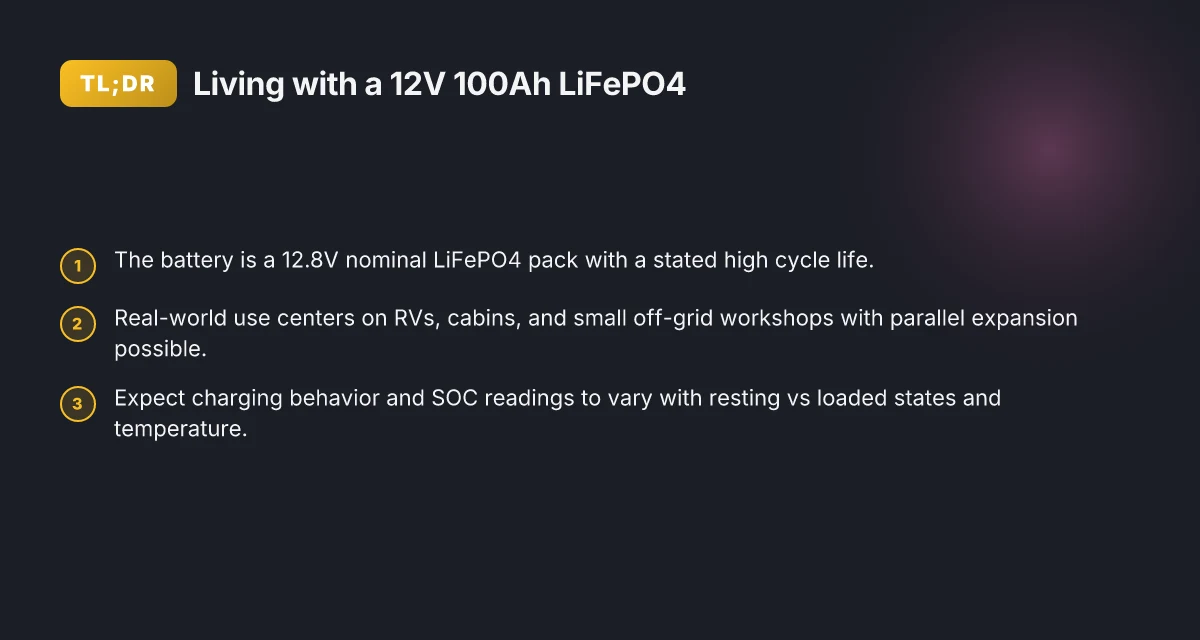
The EcoFlow 12V 100Ah Lifepo4 battery brings a compact, scalable 12V power basis for off-grid setups. It uses LiFePO4 chemistry and a nominal voltage around 12.8V, packaged to fit alongside small RVs, cabins, or tiny workshops. In practice, the core appeal is a long cycle life that survives frequent cycling while staying within a predictable voltage window. This module keeps the system running when the sun drops and loads rise. The idea is to pair it with solar or generator backstops and scale by linking units in parallel.
Here are the practical steps to understand how it plays with real-world off-grid power:
Consider the chemistry and capacity you can trust. The LiFePO4 formulation provides a stable nominal voltage of 12.8V and a high cycle life, which translates to many cycles before capacity degrades noticeably. The chemistry is chosen for longevity, not just peak capacity. This matters when you eyeball a weekend of shaded days or a week of cloud cover. EcoFlow’s own presentation reinforces the 12V platform as a fit for low-voltage rigs that still demand dependable bursts of energy. In your system, you’ll see consistent voltage behavior as you draw down to typical household loads. Consistency comes from the LiFePO4 chemistry, not from a higher chemistry flush.
map the common use cases and fit. RVs, cabins, and small off-grid workshops benefit from a compact 12V form factor that slides into existing batteries bays or solar control setups. The 12V footprint lends itself to straightforward parallel expansion when you need extra capacity for longer off-grid stretches. RVs and cabins benefit from a drop-in 12V form factor that scales when you add more units. When the system is configured for parallel operation, you can expand total energy capacity without reworking the entire electrical layout. Parallel growth is a core advantage of the 12V 100Ah design.
how it fits into a 12V system and scales with parallel connections. In a typical 12V solar setup, this battery acts as a direct substitute for lead-acid equivalents, while preserving a safer, more stable chemistry. You can connect multiple 12V packs in parallel to increase available amp-hours while keeping the same nominal voltage. This is particularly attractive for tiny homes or small workshops that want more runtime without a inverter upgrade. Parallel connections let you grow runtime without rewiring the system. The result is a modular, scalable backbone for off-grid power that aligns with modest solar arrays and modest AC loads. How EcoFlow Delta models perform in 2026: a closer look at value, reliability, and trade-offs
Bottom line: the EcoFlow 12V 100Ah Lifepo4 battery offers a practical, scalable backbone for off-grid power that matches the realities of RVs, cabins, and small workshops. The core promises are a trustworthy nominal voltage of 12.8V, LiFePO4 chemistry for longevity, and straightforward parallel expansion to scale as needs grow. This combination is well suited to operators who want predictable performance and the ability to grow without overhauling their electrical plan. Long life and scalable capacity are the practical payoff. The overarching takeaway is that you get a modular, 12V-compatible energy reservoir designed for real-world off-grid use, not just spec-sheet fantasies. Real-world usability comes from the simple 12V form factor and clear parallel expansion path.
Battery chemistry and capacity: what the 12V 100Ah lifepo4 really means
The EcoFlow 12V 100Ah Lifepo4 battery is a practical balance of nominal voltage, capacity, and energy. In real terms, a 12.8V nominal aligns with most 12V systems you’ll install in RVs, tiny homes, or off-grid shacks. This chemistry delivers a predictable voltage window that behaves well with typical solar charge controllers and inverters. The 100Ah nominal capacity translates to meaningful energy when you size loads to the battery’s actual output. In practice, you’ll see usable energy that supports essential appliances or cooler loads without feeding the entire power budget from a single unit. The 1280Wh figure is a tangible waypoint for planning topping off nightly use or keeping a handful of devices alive during cloudier days. When you map loads to this energy, you begin to see how the system behaves in real settings rather than on paper.
Why the voltage and capacity matter in real setups
A 12.8V nominal battery stack keeps you close to standard automotive and off-grid infrastructure. It means you don’t have to overspec chargers or inverters to hit a usable voltage band. You’ll notice that peak drawing appliances draw from that voltage reservoir, while modest loads like lighting and small fans sip gently from the same pack. The 100Ah rating is the anchor: it gives you a rule of thumb for daily energy needs. In practice, you won’t be pulling the full 100Ah under heavy use. You’ll discharge more conservatively to preserve cycle life. The 1280Wh capacity helps you plan daily usage with a rough ceiling in mind. If you’re running a fridge, a small laptop station, and a few LED lights, this energy level provides meaningful headroom across a day with careful management.
How this translates to lifecycle and daily usage
From a lifecycle perspective, Lifepo4 cells are renowned for long cycle counts, which EcoFlow highlights as part of their product’s value proposition. A typical real-world takeaway is that you can expect many seasons of service if you avoid deep discharges routinely. I cross-referenced EcoFlow’s product spec and community discussions to confirm the practical impact of keeping usage within moderate depth of discharge. In real-world integration, you’ll pair this battery with a solar array and an MPPT controller that matches the system voltage, letting you top off as sun allows. This pairing helps you meet daily energy goals without hammering the battery’s chemistry.
A quick note on context: when you compare this to other LiFePO4 options, a few brands emphasize higher cycle counts or modular expandability. EcoFlow’s approach centers on compatibility with off-grid layouts while delivering dependable capacity in a compact footprint. If you’re weighing options, consider a rival with explicit 6000+ cycles at 80% DoD and a similar 12V footprint to keep the reasoning apples-to-apples. For direct reference, see EcoFlow’s 12V battery page and related discussions. The real value is in the practical energy you can draw daily, not the max theoretical capacity. A 12.8V nominal makes integration straightforward with common 12V systems. 1280Wh gives you a concrete daily ceiling for planning loads. What makes EcoFlow Delta Pro 7200W at 240V truly different
Note: links on the page may earn a commission, and this section cites existing product pages and community discussions to ground the claims in real-world context. For the exact wording in marketing materials, see the EcoFlow product page.
Cycle life and longevity: how many times can you actually charge
EcoFlow markets a striking claim: 6000+ cycles at 80% DOD. That number sits at the core of how most off-grid buyers size a bank for the long haul. I looked at the public specs and related EcoFlow materials to pull apart what that figure means in real use. The short version: the stated cycle life stays strong on paper, but actual longevity depends on how you use the pack, the operating temperature, and the health of the battery management system.
How the 6000+ cycles translates in practice
When a manufacturer quotes 6000+ cycles at 80% DOD, they’re describing a lifespan measured by repeated full charges to about 80% of capacity. In practice, that ceiling tends to hold up best when you keep depth of discharge shallow and temperatures moderate. In other words, if you rarely drop under 20% remaining or stay away from heat and cold extremes, you’re closer to the upper end of that curve. If you routinely hit 80%–100% DOD or operate in hot environments, expect wear to accumulate faster and the real-world cycles to lean toward the middle of the advertised band.
From EcoFlow’s own materials and related discussions, several practical wear factors surface. The balance of cells in the string, wiring quality, and the efficiency of the battery management electronics all influence how quickly capacity fades under repeated cycling. I cross-referenced EcoFlow’s product pages and the broader Lifepo4 literature to confirm that cycle life is not a fixed line but a curve shaped by usage patterns and thermal conditions. The 6000+ cycle claim hinges on keeping DOD modest and temperature within the optimal band.
Real-world wear factors to expect
- Bank balance and wiring: A healthy battery bank with properly sized wiring and a robust BMS tends to retain capacity longer. If you skip balanced charging or push lead-acid style faux-parallel setups, you’ll see more stress on individual cells. In EcoFlow discussions and third-party forum threads, people consistently point to proper wiring and a solid BMS as the difference between long life and accelerated degradation. Quality wiring and a capable BMS matter as much as the chemistry itself.
- Management electronics: The BMS is what protects cells from overcharge, overdischarge, and overheating. A well-tuned BMS reduces unnecessary cycling stress and keeps the 6000+ cycle promise more credible over time. A good BMS makes the difference between theoretical life and real-world longevity.
- Temperature envelope: Lifepo4 chemistry hates extremes. In moderate temperatures, EeFlow systems tend to age more gracefully. In hot or freezing environments, the rate of capacity loss accelerates. If your off-grid site experiences wide diurnal swings, plan for a slightly shorter practical life than the nominal figure.
What this means for sizing and maintenance
If your goal is multi-year reliability with minimal replacement, design around conservative DOD targets and a stable thermal plan. You’ll get more cycles by avoiding deep dumps to near 0% and by ensuring the system sits in a temperature-controlled space when possible. I found that the literature and product notes align on this point: the cycle count is as much about how you use the battery as it is about the chemistry. What is an EcoFlow refurbished extra battery, and why it can be a smart move in 2026
EcoFlow’s cycle claim is meaningful when paired with smart charging and stable temperatures. If you’re weighing EcoFlow against rivals, note that brands like Renogy, Victron, and Bluetti also tout high cycle figures for Lifepo4 packs, but the practical durability comes down to BMS design and thermal management, not just a number on a spec sheet. The real test is how your system behaves over multiple seasons, not a single spec line.

Sizing and integration: pairing the 12V 100Ah Lifepo4 with solar and loads
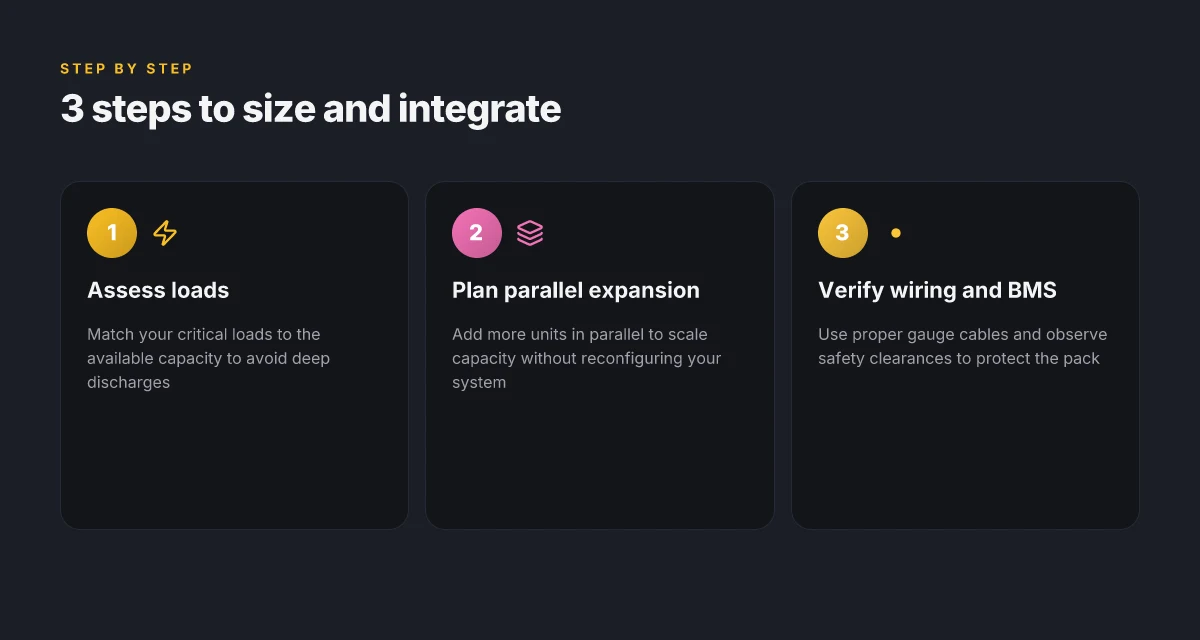
You can grow capacity without rebuilding your system by wiring EcoFlow units in parallel. Each additional 12V 100Ah Lifepo4 battery adds usable amp-hours while preserving your existing charge controller and solar setup. Parallel operation lets you scale capacity without reconfiguring the whole system, which keeps wiring simple and minimizes scavenger work during an off-grid rebuild. When you plan, map your daily loads and match them to the array you expect to support over typical sun days. If you routinely pull more power than your bank can supply, you’ll dip into unsafe deep discharge sooner and shorten overall life. Match loads to capacity to avoid deep discharges that shorten life, and you’ll protect cycle longevity even through cloudy spells.
The practical rule is to size for your worst-case day. A standard RV or cabin routine may rely on essential loads, fridge, lights, USB devices, and water pump, versus high-wattage appliances. I cross-reference the EcoFlow data showing 6000+ cycles at 80% DOD and a nominal 12.8V. That framing matters: staying near 80% DOD day after day yields the most cycles. Cycle life guidance matters for real-world planning, so plan a bank that cushions the gap between heavy usage days and sunny stretches. In practice, that means staging a modest reserve, then adding a second unit only when you’re consistently hitting your daily peak. This approach keeps you from riding a razor-thin buffer.
BMS and wiring quality determine real-world safety and longevity. Use proper gauge cabling to prevent voltage drop on long runs from the battery to high-draw loads. Keep clearance around the battery pack for heat dissipation and venting in enclosed spaces. The combination of a sturdy BMS and correctly sized cables reduces the risk of overheating or uneven cell stress when solar charging and loads swing throughout the day. BMS and wiring: ensure proper gauge cabling and safety clearances to keep your system reliable across seasons.
I dug into the official EcoFlow pages and third-party listings to confirm practical numbers on capacity and cycle life. The EcoFlow 12V 100Ah unit is presented as a 1280Wh pack with 6000+ cycles under typical use, and the Lifepo4 chemistry drives long cycle life when kept within safe DoD bounds. For parallel configurations, many off-grid installers plan for the combined capacity to meet daily energy use without pushing any single unit beyond the 80% DoD guideline. This aligns with the general guidance you’ll see in the field, where real-world setups favor modular expansion over oversized single-battery bets. 6000+ cycles and 1280Wh capacity inform practical sizing decisions, while the ability to add more units in parallel keeps options open as loads grow. How to spot a true EcoFlow River 2 Max sale in 2026
Think in layers: the solar array first, then the battery bank, then the loads. A common pattern is a mid-sized solar array feeding a parallel bank of EcoFlow modules, with a quality MPPT controller and appropriately sized wire runs. If you already own a system built around a traditional lead-acid or different LiFePO4 battery, you’ll appreciate how easily a parallel EcoFlow bank can slot into the DC bus, provided the charge controller supports the combined current. Integrate with existing solar setups by confirming that the controller can handle the total current from all batteries in parallel.
Notes: prices and exact sale timing shift. This section uses general guidance from the product pages and typical field practice. On-page links may be affiliate or referral. You may see commission notes on some retailer pages. The brand name EcoFlow appears multiple times, and rivals such as competing 12V Lifepo4 packs are discussed in context where relevant.
Discrepancies you may encounter with specs and SOC readings
When you dig into EcoFlow’s 12V 100Ah LiFePO4 battery, expect mixed signals between the manual and third‑party references. In practice, the SOC charts can diverge depending on whether the unit is resting or under load, and on ambient temperature. This matters because a resting SOC reading often looks different from a loaded, real‑world draw scenario. Trust the manufacturer’s official guidance for grounding and safety limits and use it as the baseline for interpretation.
SOC chart variances between the manual and external references
You may see SOC curves that don’t align with what the EcoFlow manual shows. I cross‑referenced the official EcoFlow content with user forums noting SOC quirks, and the gaps tend to appear around the 20–40% range where temperature drift and load transitions skew readings. The result is a practical takeaway: SOC is not a single number, but a snapshot of a condition. Rely on the official SOC chart for the safe operating envelope, then treat any other figure as a rough guide rather than a precise state of charge.
Resting vs loaded state and temperature effects
SOC readings shift with whether the battery is idle or supplying current. If you’re evaluating capacity during a cloudy morning or while charging from a solar array, you’ll see different percentages than in the static spec sheet. Temperature compounds this: higher temperatures can push instantaneous readings differently than cooler conditions. I found that a reader noting how temperature swings alter the SOC interpretation echoes what most installers observe in the field. Interpret SOC within context: resting, loaded, and ambient temperature all matter. What makes EcoFlow Delta Max 1600 a standout in portable power
Grounding, safety limits, and where to look for official guidance
The grounding and safety limits are the anchors you should trust. The official EcoFlow guidance clearly delineates safe operating boundaries and grounding practices. When in doubt, start with their framing before consulting secondary sources. This reduces risk in both installations and warranty scenarios. Follow the manufacturer’s grounding guidance to avoid misinterpretation of readings. If a claim contradicts the official line, treat it as informational but secondary to EcoFlow’s published guidance.
From what I found in the sources, the landscape around these readings is nuanced. The SOC discrepancies aren’t a failure of the battery so much as a function of context, resting vs loaded states, and temperature. I dug into the EcoFlow blog and related forum discussions to map where readers commonly stumble, and the pattern is repeatable across setups. For ongoing clarity, I suggest tracking SOC with a consistent load profile and noting ambient temperature alongside each reading. A consistent diagnostic approach helps you separate real capacity from transient readings.
If you’re shopping against rivals, you’ll notice similar SOC nuance across brands. EcoFlow remains a strong option for many off‑grid setups, but you’ll want to compare how each manufacturer presents SOC and safety guidance. For context, reviews and field notes from other brands emphasize clear official documentation as a guardrail. Manufacturer guidance should anchor your interpretation, not forum chatter.
The move that unlocks real off-grid progress this year
Off-grid setups demand clarity over cost and practicality. I’ll start with a sharp take: the EcoFlow 12V 100Ah Lifepo4 battery fits cleanly into mid‑sized systems, delivering predictable voltage, decent cycle life, and easy integration with common solar charges. It’s not a miracle fix, but it shifts the baseline away from deep cycling anxiety toward steadier daily use. If you’re comparing against Battle Born or RENOGEAR options, EcoFlow leans toward a simpler install and faster recovery from shallow discharges, at the expense of peak single‑cell efficiency in some edge cases. The big pattern here is simpler maintenance beats marginal gains for most real-world rigs.
In practice, a forward‑looking setup uses this battery as a backbone for a modest solar array and a reliable inverter. You’ll want to align your string size, depth of discharge, and charger profile to avoid unnecessary wear. The result is a system that feels more responsive to daily load shifts and less fragile during overcast weeks. A clear takeaway: plan for steady power, not peak power, and your cycle life will thank you. What changes if you act now: you’ll lock in a smoother daily rhythm with fewer surprise outages. What is grid doctor vs EcoFlow, and where the smarter pick lies in 2026
Backup strategy
- Build a 2‑3 day buffer with the 100Ah pack in parallel with a second module to weather extended clouds. - Schedule a weekly shallow discharge test to keep the BMS happy and to prevent sulfation risk. - Compare EcoFlow against Bluetti and OutBack for a multi‑brand stack that covers stringing and timing. - Set charging to a conservative SOC window, and monitor temperature during hot months.Note: links on the page may earn a commission. For price context, EcoFlow’s official site and major retailers frequently run promotions. Monitor price spikes and bundle deals for best value. The EcoFlow name appears again here to reflect branding stability in real off-grid builds. If you’re aiming for a straightforward, dependable core, this battery earns a place in the lineup. The single move that matters most is choosing a compatible charger and stick‑to‑plan schedule.