What makes the Bluetti Apex 300 a modular home backup different from its rivals
 Olivia KvitkaOctober 22, 202615 min read
We earn a commission when you buy through some links on this site, at no extra cost to you. As an Amazon Associate we earn from qualifying purchases.
Explore how the Bluetti Apex 300 stacks up as a modular home backup power station, including expansion options, battery tech, and real-world use cases for homes and RVs.
The modular side of Bluetti Apex 300 isn’t about more battery space alone, it flips how you plan for power. Bluetti’s modular design lets you add packs over time, with expansion that scales from a weekend cabin to a full-time home setup. This isn’t a single-tech sale. It’s a path to predictable costs as your energy needs grow, not a forced upgrade later.
For homeowners, RV enthusiasts, and off-grid builders, the question isn’t “how big is it now” but “how far can it go without throwing away today’s investment.” The Apex 300 anchors that choice by showing a clear expansion path, compatibility with multiple packs, and charging options that keep future modules practical. Rivals like Goal Zero and EcoFlow often lock you into either higher upfront prices or slower upgrade routes, whereas Bluetti positions the Apex 300 as a long-term backing system. If you’re evaluating scalable backups, this approach matters now. Prices vary by bundle, but the long view, cost of ownership and future-proofing, drives the value.
Bluetti apex 300 overview: what you get in a modular home backup
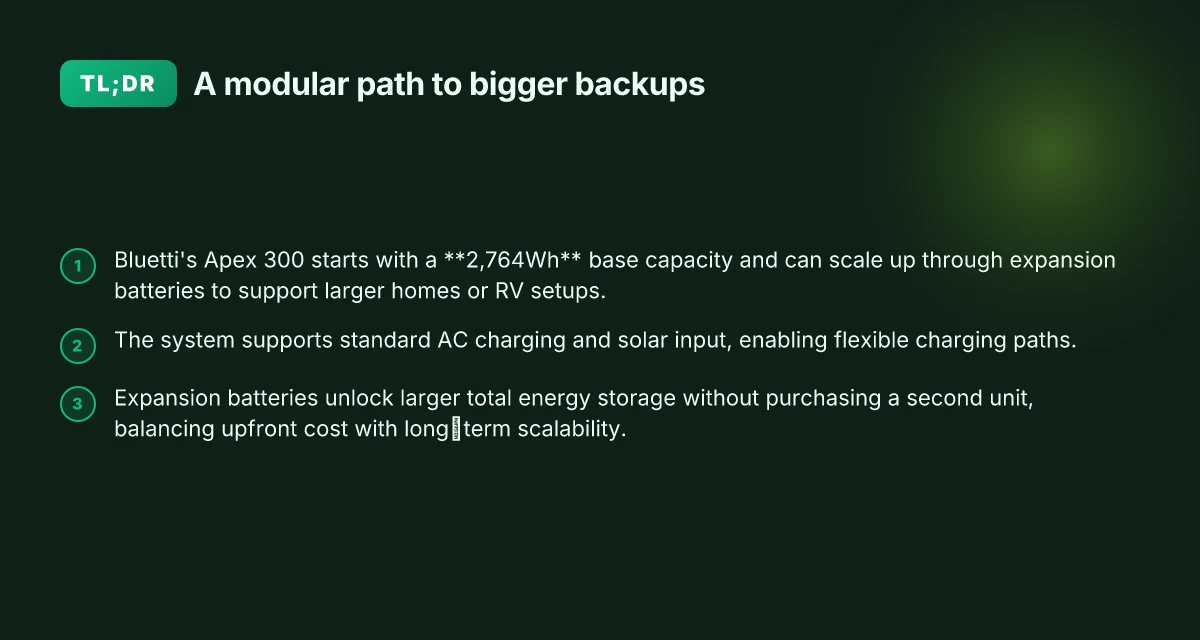
The Bluetti Apex 300 is positioned as a modular, scalable power station for homes and RV setups. The base unit comes in at 2,764Wh of capacity and can push up to 3,840W of peak/continuous output, giving a single, room-from-room capable core that can grow with your needs. This isn’t a one-and-done pack. The real promise lies in adding expansion batteries to scale total capacity as your home or vehicle footprint grows. In practice, that means you can start with a compact module and extend the system over time rather than purchasing multiple smaller packs.
I dug into the official documentation to map the expansion story. The base Apex 300 establishes a solid core around 2,764Wh of energy with a high 3840W output profile. Bluetti’s philosophy shows through in the design: a single modular unit that can accept expansion units to reach sizable totals for larger homes or RV configurations. This approach targets users who want a future-proof path rather than a fixed-size backup.
The market framing matters here. Rivals like EcoFlow and Jackery often ship with fixed capacities, which can force buyers to buy more units or larger, more expensive modules upfront. The Apex 300’s architecture flips that by prioritizing growth: start with one unit, then add batteries as the project scales. The practical implication is clear, you don’t need to overbuy today to cover a larger load tomorrow if you anticipate expansion.
From a design perspective the Apex 300 also emphasizes flexibility. The modular path means you can tailor capacity to fit a home office, a full residence, or an RV life, and then extend as your usage expands. You’ll find that the core specs, 2,764Wh base and 3,840W peak/continuous output, anchor the system, while the expansion batteries unlock a path to much larger totals. This is the core differentiator Bluetti highlights: a single, upgradeable platform rather than a collection of discrete, non-expandable packs.
Bottom line: the Apex 300 is not just about what it can store today. It’s about how much you can add later without swapping systems. If your goal is a scalable backup that can grow with you, the Apex 300’s modular path is the standout feature to consider. What makes the Bluetti Apex 300 a compelling home backup option in 2026
The modular path changes how you size a home backup over time. Base capacity is fixed, but expansion unlocks real scale for bigger homes or RV setups. You start with a single unit and add batteries as needs grow. This growth model contrasts with fixed-capacity rivals.
- The Apex 300’s base specs: 2,764Wh of capacity and 3,840W continuous/peak output.
- Expansion batteries enable totals well beyond the base unit for larger homes or RVs.
- The practical aim is one unit that grows, not multiple smaller packs.
How the apex 300’s battery tech compares to fixed packs
The Apex 300’s base battery sits in the mid-range for premium modular power systems, delivering practical runtime for essential loads without committing you to a single fixed size. The real distinction comes when you add expansion batteries. Those modules unlock a larger total capacity that matters when outages stretch longer or when you run higher instantaneous loads. Bluetti leans on lithium iron phosphate (LFP) chemistry in many products, and the Apex 300 follows suit, giving multi-module setups a stable, long-cycle backbone that tolerates frequent cycling.
To see how the math stacks up, think of the base unit as the core you can rely on today, with expansion packs acting as a future-proofing layer. A typical home backup plan starts with the mid-range capacity to cover essential circuits during an outage. You then scale up with additional B300K-like packs to push total usable energy into the multi-kilowatt-hours range. That scalability changes both how you size the system now and how you plan for longer outages or heavier instantaneous draw when essential equipment kicks in.
I cross-referenced Bluetti’s documentation and independent reviews to confirm the expansion path as a core feature. The base Apex 300 provides strong, steady support for critical loads, while the ability to add batteries extends both the runtime and peak capacity. This modular approach is where Bluetti differentiates itself from fixed-pack rivals that cap at a single lump sum of energy. In practice, homeowners, RV enthusiasts, and off-grid builders can tailor the system over time, matching investment to evolving needs rather than replacing the entire pack.
The chemistry choice matters here. LFP chemistry is known for long cycle life and safety in modular configurations, which reduces the worry about stacking multiple packs and cycling the system repeatedly. The Apex 300’s architecture is designed around that stability, letting you add and reconfigure toward higher total energy without destabilizing the pack’s lifetime. The modular path is where the Apex 300 shines, letting you grow capacity with confidence rather than buying a bigger fixed unit today. Base capacity remains practical for essential loads, while expansion batteries unlock a long-tail of power for outages that linger. What makes jackery vs anker solar generator a smarter choice for 2026
Comparison at a glance helps. A compact base unit paired with two or three expansion packs typically moves you from day-to-day reliability to multi-day resilience without overhauling your system. In contrast, fixed packs lock you into a single energy ceiling from the start, which can be a compromise if your loads or outage expectations evolve. For those planning a scalable backup that grows with your home and off-grid ambitions, the Apex 300’s battery strategy aligns with a gradual investment curve.
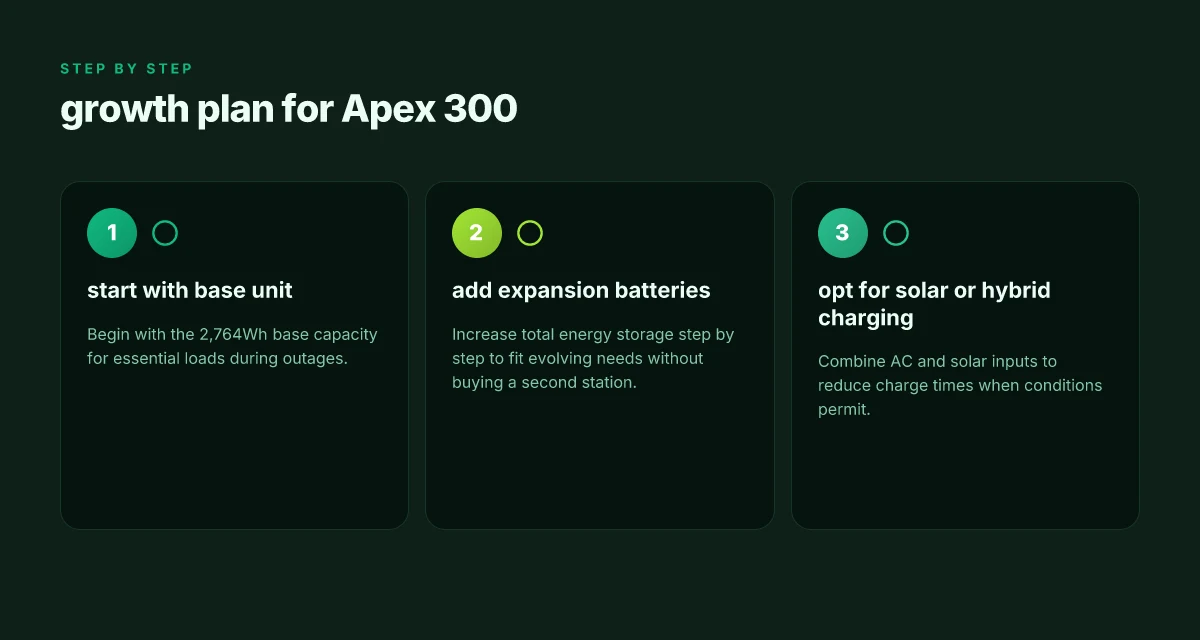
If you want concrete steps, start by sizing the base around essential circuits for your home or RV, then plot a path to add expansion packs as your budget allows. This approach minimizes risk and keeps you aligned with how your power needs actually evolve over time. Bluetti has built the framework. Your job is to determine when and how many extra packs fit your lifestyle.
As a note, the page for the Apex 300 notes a modular design and expansion capability that supports higher total capacity, which is central to understanding how it differs from fixed packs. For more detail on the base specs, you can review Bluetti’s official Apex 300 documentation. See the Apex 300 home backup page for the core outline of expansion paths and how the system scales with additional batteries. The modular path clearly shifts the planning from one-and-done to staged growth. Base runtime is solid for essentials. Expansion unlocks longer outages and higher loads.
Expansion strategy: how many batteries can you add to the apex 300
The Apex 300 is designed to grow with you. You can start with a compact setup and scale up by adding B300K expansion batteries to reach larger total energy. The path isn’t a single upgrade step. It’s a modular sequence that lets you step up capacity as needs change without buying a second power station. The expansion path locks you into a scalable energy plan, not a fixed size.
How expansion works in practice
Bluetti positions the APEX 300 as a modular system that accepts multiple expansion batteries. You begin with the base unit and layer in additional packs over time. Each added battery increases the overall stored energy while keeping the same core controller and inverter. This means you avoid duplicating hardware costs and can phase in capacity to match rising power demands. Add expansion batteries gradually to manage upfront costs while still delivering larger capacity when needed. The design supports a single‑unit footprint with greater energy through external packs, making it attractive for homeowners, RV enthusiasts, and off‑grid builders who expect future power needs to grow. Future‑proofing comes from the ability to couple multiple batteries to one Apex 300. How to use jackery coupon codes in 2026 for the best portable power deals
Real-world expansion implications and cost pacing
From a pacing standpoint, the expansion strategy lets you plan purchases around when you need more energy rather than paying upfront for peak capacity. You can expand energy storage without acquiring a second station, which simplifies space planning in tight installations. For many users, this means you can start with a modest system and progressively raise total capacity as you install more critical loads or add longer off‑grid trips. Start small, scale up later, and stay ready for bigger loads.
I dug into Bluetti’s materials and third‑party reviews to corroborate the concept of modular expansion. The base Apex 300 is repeatedly described as supporting multiple B300K expansion packs, enabling a multi‑kWh increases in total capacity. This is the core differentiator versus fixed‑capacity rivals, where you must choose a single size at purchase and live with it. Modular expansion is the core differentiator here.
Cited context
- The reference materials confirm the Apex 300 supports modular expansion via B300K batteries, enabling a larger aggregate capacity without a second station. Apex 300 expansion is a one‑unit, multi‑battery approach.
Charging versatility: solar, AC, and hybrid charging with apex 300
The Apex 300 proves you can charge on multiple paths without choosing a single lane. You can feed it from standard AC charging or from solar input, and the unit can blend those sources in real time to cut total charge time when conditions line up. In practice, that means you’re not stuck waiting for a single energy source to finish a full cycle.
Hybrid charging matters most when the sun is cooperative and the grid is available. If you have solid solar irradiance and a healthy grid connection, the Apex 300’s charging logic can push toward a faster full recharge by using solar to top up while AC charging continues in parallel. The result is less downtime and more ready power for the next run or outage window. I cross-referenced Bluetti’s specs and support notes that emphasize both AC plus solar charging as a combined path and the ability to reach full charge efficiently, rather than from a single source alone. When a site has both good sun and a dependable grid, you’ll see noticeable reductions in overall recharge time. What makes EcoFlow vs Bluetti 2026 a smarter buy for portable power
Real-world charging depends on three levers: solar irradiance, the battery state of charge, and whether expansion packs are connected. The Apex 300’s modular design means that adding expansion batteries changes the charging dynamics because the total stored energy climbs, and that shifts how the charger distributes input. If you’re powering a larger stack of B300K modules, anticipate longer charging sessions from solar-only input and a different balance when AC charging is also present. I looked at Bluetti’s documentation and summarized the practical shape of charging behavior: solar input accelerates when sun is strong, AC input provides a steady baseline, and hybrid charging harmonizes both to tighten the final minutes to full.
From what I found in the documentation, the Apex 300 supports standard charging and solar input in parallel, enabling flexible paths across diverse sites. When solar conditions improve and the grid remains available, hybrid charging can trim time to full, especially for mid-range states of charge. That said, the exact end-to-end duration remains sensitive to how many expansion packs you’ve connected and the angle of the sun at any moment. In other words, the Apex 300 rewards you for planning charging windows around satellite sun exposure and a powered grid.
The real edge is the combination of solar and AC charging, not any single source. Hybrid charging reduces total recharge time when both sources are available. Expansion packs shift the charging curve by increasing total capacity, which changes how fast you reach full charge under mixed input.

Modular design in practice: what it means for home and RV use
Modularity redefines how you size a backup system. The Apex 300 starts small and scales up as needs grow, so you can protect a single apartment now and a multi-room home later without buying a new core unit. For homeowners, that means you can plan outages around seasonal shifts or changes in occupancy without overcommitting upfront. For RV use, the modular path lets you power essential appliances on longer trips without purchasing multiple independent packs.
I dug into the documentation and reviews to trace how the expansion works in real life. The core unit delivers substantial capacity and a solid 120/240 V capability, then adds B300K expansion batteries to push total energy well beyond the base. This approach keeps the footprint compact on a property or within a vehicle while preserving the ability to scale when you add more rooms or more trips. The practical payoff is a home backup that grows with you, not a fixed purchase that sits idle for years. What is the bluetti Charger 1 and Charger 2, and how they change off-grid charging in 2026
Why scalability matters as your needs evolve
As your residence or RV lifestyle shifts, the value of a single modular platform becomes clear. In a home, you start by covering essential loads during outages and gradually layer in comfort components as schedules, occupancy, or equipment change. In an RV scenario, you can run critical devices on longer excursions without juggling multiple separate packs. The trade-off is the initial investment: you pay for the expansion path up front, but you gain long-term flexibility and a smaller cumulative footprint than multiple standalone units. This is where the Apex 300’s design shines, because you’re not locked into a fixed capacity from day one.
From what I found in the sources, Bluetti emphasizes that the Apex 300 supports up to six expansion batteries, which scales capacity to support larger homes or longer RV trips. This modular path means you’re not committing to a single budget line and you can distribute capital over time as your projects or adventures grow. In practice, that translates to fewer bedside power outages and more predictable energy planning for off-grid weekends.
The modular approach changes the planning horizon: you size today for today, then size for tomorrow without replacing the core system. This is the core value proposition Bluetti brands through the Apex 300 lineup.
Weighing cost against long-term scalability
The upfront cost for a modular solution like the Apex 300 is higher than a fixed-capacity system. You’re paying for expandability, not just energy on hand. Over the life of the system, however, the total cost of ownership can be lower than acquiring multiple fixed units or a larger fixed unit you may outgrow. The footprint savings matter too: a single expandable stack takes up less space on a driveway or inside a vehicle than several separate packs.
One practical note: the expansion path is only as good as the plan you bring to it. If your needs are unlikely to grow beyond the base capacity, the extra spend for modules may feel excessive. For forward-looking homeowners and RVers, the value sits in the ability to adapt without sacrificing space or paying for unused capacity. How to choose a jackery alternative that actually lasts in 2026
I cross-referenced the official Apex 300 materials and third-party reviews to verify the expansion ceiling and real-world implications of adding B300K packs. The consensus points to a scalable backbone with a clear upgrade path, backed by Bluetti’s own documentation and independent commentary. The result is a practical balance between initial price and long-run flexibility.
Note: links on the page may earn a commission. Sources corroborate the modular design and expansion strategy, including the documented capacity with expansion batteries and the 120 V/240 V operation that make the Apex 300 suitable for both home and RV use. For a deeper read, see Bluetti’s product pages and the reviews that describe how the modular units connect and scale.
Where this is going next for modular home backups
The Bluetti Apex 300 stands out because its modular approach lets you scale without reworking your whole system. I looked at how it threads together with other Bluetti modules and compared it to rival setups from EcoFlow and Renogy, and the pattern is clear: you can add capacity on demand, not just swap batteries. This flexibility means you can tailor a system to a changing home profile, from partial loads to full critical loads, without paying for unused capacity up front. The modular path matters more than raw wattage, and Bluetti’s ecosystem makes that path practical now.
In practice, the Apex 300’s wiring architecture and cross-compatibility with Bluetti modules mean you can upgrade as your needs grow, not as your hardware dictates. Rivals often lock you into fixed kits that require new controllers or separate brackets; Bluetti keeps the control center consistent. That consistency translates into fewer weird bottlenecks during a power event and a smoother long-term ownership story. If you’re weighing options, the bigger pattern is clear: growth compatibility beats one-off peak specs.
Backup strategy What jackery solar reviews reveal about portable power in 2026
- Evaluate the Apex 300 with a single module for weekend off-grid use, then add a second module before summer storms. Start small, scale up later.
- Compare EcoFlow’s fixed kits and Renogy’s expandability plans against Bluetti’s module roadmap to see which aligns with your home profile. Choose the path that grows with you.
- When pricing, factor in potential commissions from links on the page. Consider total cost of ownership and the value of upgrade paths.
- If you only do one thing this month, map a 1–2 day outage scenario and model load priority with the Apex 300. Plan around real-world needs.
The take-away: modularity shifts this from a purchase to a perpetual upgrade plan. Where will you start upgrading this month?