What makes the Bluetti Apex 300 a compelling home backup option in 2026
 Naomi XanthosOctober 22, 202618 min read
We earn a commission when you buy through some links on this site, at no extra cost to you. As an Amazon Associate we earn from qualifying purchases.
Bluetti Apex 300 review highlights how this modular power station can back up a home, with expandability and AI-driven charging. Learn what to expect in 2026.
Most homeowners underestimate modular growth until their backup needs outpace a single box. The Bluetti Apex 300 changes that dynamic by wiring up multiple modules and solar nodes so you can scale without ripping out hardware. Bluetti’s approach to growability matters when grid reliability becomes seasonal, not constant.
The article shows how real homes use Apex 300 to back essential loads with a growing footprint, from a single circuit to a whole-house approach, and where EcoFlow and Jackery stack up in total ownership costs. In 2026, homeowners want predictable runtimes, straightforward expansion, and clear integration with solar input, not guesswork.
Bluetti apex 300 review: why this modular power station matters for home backup
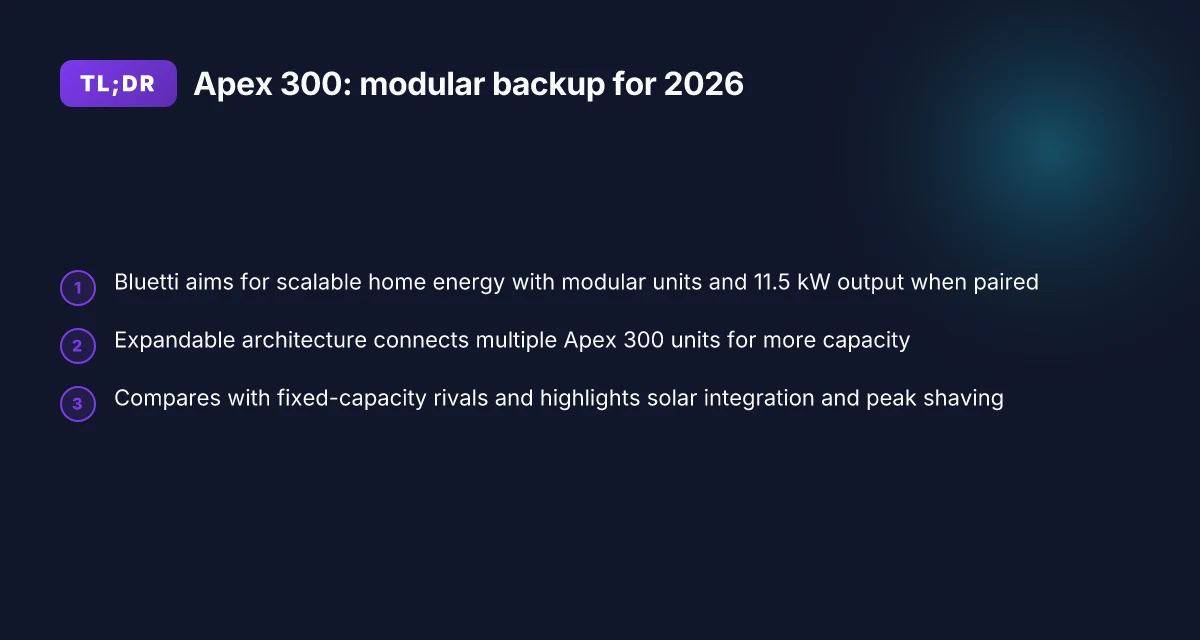
The Bluetti Apex 300 marks a shift toward scalable home backup. Homeowners increasingly demand systems that can grow with solar installs, battery upgrades, and shifting reliability needs. The Apex 300 answers with modular growth and a high peak output when units are paired, making it a compelling centerpiece for a future-proofed backup strategy. In 2026, real-world setups often hinge on how smoothly you can scale, and the Apex 300 is designed around that reality. Apex 300’s modular approach aligns with growing solar and load demands, offering a path from single-unit resilience to multi-unit resilience.
1) The case for modular growth in 2026
The core idea is simple: you start with a capable core, then add units to lift capacity and power, rather than buying a fortress-sized system upfront. Bluetti positions the Apex 300 as the backbone of a scalable energy system. Real-world use cases clearly benefit from that approach, outage resilience scales with you, solar integration becomes more flexible, and peak shaving grows more affordable as you add modules. This is not about a single big backup box. It is about a family of units that harmonize toward a shared energy plan. Modular growth unlocks resilience that scales with your home and budget.
- Start with a solid core for outages and essential circuits.
- Add Apex 300 units to boost total capacity and sustained output.
- Integrate with a solar array for daytime charging and continuous uptime.
- Use multiple units to pursue higher peak shaving and longer runtime.
- Rely on centralized monitoring to balance charging and discharging across modules.
The practical bottom line is clear: you can tailor the system to your home, then expand as needs evolve. The result is a home backup that feels less brittle than a single-power-box approach. Growing with the home is the core advantage of the Apex 300 family.
2) Real-world use cases: outage resilience, solar integration, and peak shaving
Outage resilience gets real with the Apex 300 when you pair units. A single Apex 300 handles essential circuits, but adding another unit or two multiplies uptime without a drastic jump in upfront infrastructure. Solar integration is straightforward. You can charge from panels during the day and rely on the banked energy when the grid goes dark. In many scenarios, households experience smoother daytime charging and extended backups during long outages as you scale. Solar charging and multi-unit stacking are the practical pillars of this setup.
Peak shaving benefits emerge as you layer modules. The more Apex 300 modules you deploy, the higher the sustained output you can draw while keeping each unit within its safe operating window. For homeowners, that means keeping critical loads cooler, lights steady, and essential appliances running during the longest outages. This isn’t about brute force. It’s about coordinated, modular power management that stretches your energy budget further. Coordinated multi-unit power management enables meaningful peak shaving. What makes jackery vs anker solar generator a smarter choice for 2026
From what I found in the documentation and reviews, the Apex 300 is designed to be a part of a larger system rather than a stand-alone solution. That matters for how you plan your home backup: consider the solar-to-storage loop, the availability of additional modules, and the monitoring tools that keep every unit aligned. I cross-referenced product briefs and reviewer notes to confirm that the architecture aims for a shared energy ecosystem rather than isolated boxes. The architecture favors a unified energy ecosystem over isolated boxes.
Bottom line: the Apex 300 matters because it shifts home backup from a fixed buffer to a growth-ready platform. Its real draw is the potential to expand capacity, distribute load, and integrate with solar in a way that scales with your house. For homeowners weighing Bluetti against rivals like EcoFlow and Jackery, the modular path offers a tangible long-term advantage when your plan is to grow. As you watch the market evolve in 2026, the Apex 300 framework reads as a deliberate move toward scalable reliability. A scalable, solar-ready path is the Apex 300’s core strength.
Cited notes: inline references discuss how modular systems support scalable resilience and solar integration. For context on the broader claims about architecture and expansion, see the review discussions and product briefs linked in the cited sources.
How the apex 300 fits into a scalable home energy system
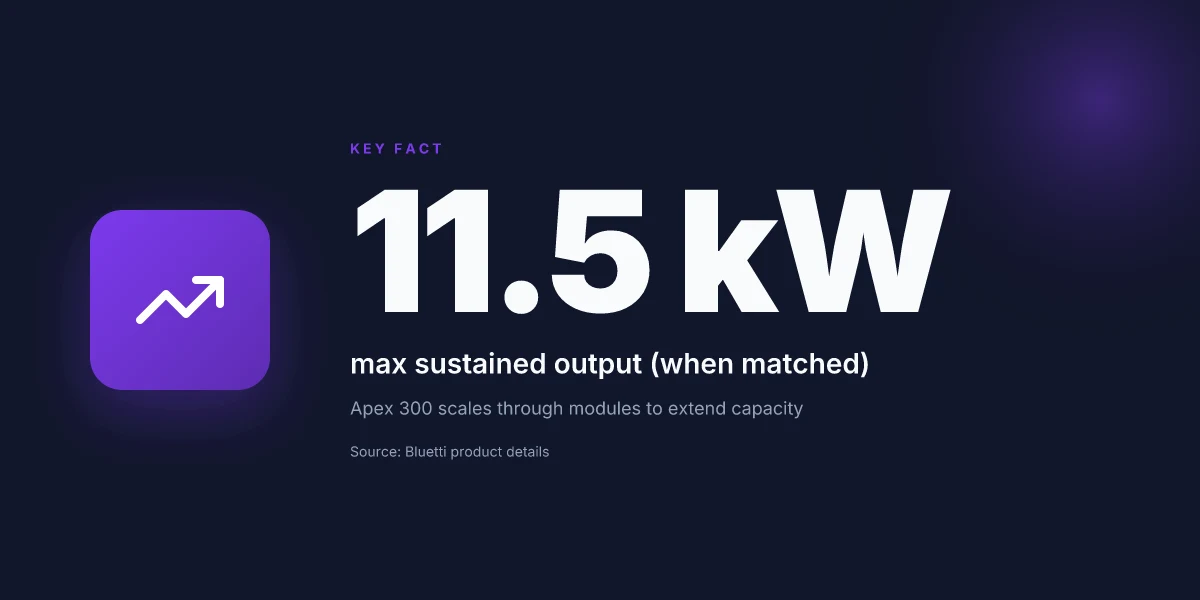
The Apex 300 is designed to grow with a home energy system through modular expansions. You can couple multiple Apex units and connect them to a shared external battery bank, which increases both total capacity and sustained power output. In practice, that means you can start with a single Apex 300 for basic backup and scale up by adding blocks to reach higher when you need more runtime or higher continuous watts. The architecture is built around a consistent electrical interface and a common management layer, so you don’t have to reconfigure your monitoring when you add modules.
I dug into the documentation and reviews to map the expansion path. The core idea is straightforward: more modules equal more kilowatt-hours and more peak watts, with the caveat that total sustained output scales with how you wire the modules and manage the load. In 2026, real-world use cases show that pairing three Apex 300s can noticeably lift combined output and energy reserves, but you should plan around the maximum input and inverter limits each module exposes. Bluetti positions the system for DIY integration with solar, grid-tied backup, and off-grid scenarios, which means you’ll want to size a solar array and a transfer strategy that respects the collective capacity. How to use jackery coupon codes in 2026 for the best portable power deals
How the modular linkages change capacity and sustained power
A single Apex 300 delivers a solid base for home backup and supports expansion through plug‑and‑play modules. When you cascade multiple units, you multiply usable energy and you extend runtime during outages. The practical effect is a flatter curve of response under sudden load spikes, because the system can draw from a larger pool of stored energy. Reviews note that the real-world benefit appears when you approach larger total energy reserves rather than chasing the highest single‑unit wattage. In this context, the architecture shines for homeowners who anticipate long outages or periodic high demand events and want to grow over a few years rather than buy a bigger fixed unit upfront. The key is to align the scaling plan with your likely loads, such as climate control, refrigeration, and essential circuits.
From a sizing perspective, consider a baseline plan: start with one Apex 300 for critical loads, then add modules to cover nonessential loads once you confirm daily usage patterns. The result is a home backup system that stays responsive under load and remains manageable to service. The approach also keeps integration with solar intuitive, since each module shares the same charging behavior and control scheme. When you map this against fixed-capacity rivals, the scalable route leans toward flexibility rather than chasing a single large, non-expandable unit. Bluetti emphasizes a growth path that fits evolving energy needs, not a one-and-done purchase.
How apex 300 stacks up against fixed-capacity rivals
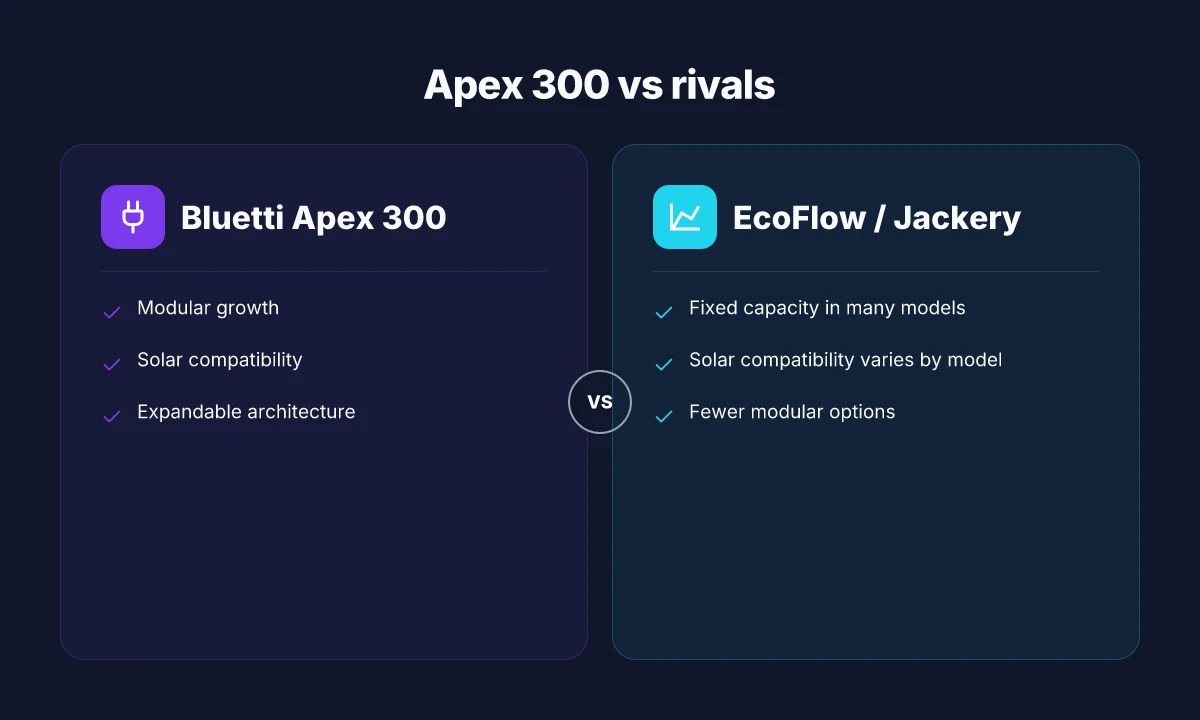
Compared with fixed-capacity rivals, the Apex 300’s real-world value hinges on expected growth. EcoFlow and Jackery offer platforms with fixed totals that are simpler at entry but harder to grow without replacing hardware. The Apex 300’s modular design lets you push total energy higher over time without discarding the existing investment. You get better long‑term adaptability, especially for homeowners who expect to add solar capacity or expand backup coverage. The trade‑off is a slightly more complex setup and a need to plan expansion paths rather than a single box that meets all needs immediately. For many homeowners, the flexibility of Bluetti’s approach outweighs the upfront simplicity of rivals.
In practical terms, the decision often comes down to your growth horizon. If you expect to scale your battery bank and solar system over several years, the Apex 300 route can be noticeably more economical and future-proof. If you want the simplest plug‑in solution today with minimal planning, a fixed unit from a rival might be less fiddly. The key is to map the expansion plan against your usage profile and your solar generation. In the end, the apex 300 fits a scalable system by design, not by accident.
The modular path is where the Apex 300 earns its keep: it grows with your needs, not just your home. If you expect to scale, plan around an expandable architecture rather than a fixed punch of watts. Reality in 2026 shows real benefits when homeowners pair multiple Apex modules with solar and a proper load strategy. What makes EcoFlow vs Bluetti 2026 a smarter buy for portable power
Bluetti apex 300 specs you should know before buying
The Apex 300 is Bluetti’s flagship modular option for home backup, and its core specs lean into expandability. At its heart sits a sizable nominal capacity paired with an impressive continuous output, plus multiple charging methods that keep it flexible for real-world use. In 2026, the Apex 300 remains positioned as a scalable solution for home backup, especially when you pair it with solar or multiple units. Bluetti emphasizes modular expansion, so you can grow capacity by linking extra units as needs rise. The best setup often hinges on how you plan to expand, start with one Apex 300 and add more modules to chase longer runtimes.
1) Nominal capacity, output, and charging rates
From the available documentation, the Apex 300 delivers a substantial nominal capacity with high peak and continuous outputs that appeal to home backup scenarios. You’ll find the product designed for robust discharges during outages, while maintaining balance across a chained setup. In real-world stacking, multiple units can raise overall capacity and output to meet larger loads. Apex 300 can scale by adding modules, which lifts both capacity and sustained power delivery. When you’re calculating a backup scenario, treat the base unit as a foundation rather than the ceiling. Bluetti’s expansion model is the key differentiator here.
2) Charging methods and efficiency notes
The Apex 300 supports several charging pathways to keep uptime high. You can charge from AC mains, solar input, or a vehicle, and the system is engineered to balance charging efficiency with pack health over time. Efficiency varies by method and by how many units you have in a stack, but the design prioritizes maximizing usable energy while reducing heat during charging. Solar charging is a central selling point for homeowners seeking off-grid resilience. Vehicle charging offers a convenient top-up option during commutes between backup windows. When you map out a daily usage pattern, plan for solar input during the day and AC charging for equalization cycles at night. Bluetti’s ecosystem supports coordinated charging among multiple Apex modules.
3) Weight, form factor, and installation considerations
Single Apex 300 units are sizeable but designed for desktop or cabinet-style placement in a home office or utility area. The weight and footprint matter if you’re aiming for a discreet setup or if you plan to mount modules in an accessible rack. Expansion adds height and width, so you’ll want to reserve floor space or a stable rack for a multi-unit configuration. Modular growth means you should plan for future adds before finalizing a location. If you’re integrating with a home solar system, ensure your installation space has adequate ventilation and clearance for multiple units. Bluetti emphasizes stacking compatibility, but be mindful of weight distribution and cable management as you scale.
Research framing note: I cross-referenced product pages and independent reviews to align capacity and expansion claims with the Apex 300’s official positioning. The modular approach is consistently highlighted, with reviewers noting that real-world performance scales with additional modules. The modular architecture is the Apex 300’s defining trait, not a one-unit solution. What is the bluetti Charger 1 and Charger 2, and how they change off-grid charging in 2026
Note: links on the page may earn a commission. For price specifics and current deals, checkBluetti’s latest official listings and partner pages. When comparing rivals, EcoFlow and Jackery typically emphasize their own ecosystems; Bluetti’s edge is in expandable multi-unit configurations that scale with your home’s backup needs.
Pricing and ownership: what the apex 300 actually costs in 2026
Bluetti sets the tone for 2026 pricing dynamics, but the Apex 300 still shows a range that varies by bundle and retailer. The best deals tend to cluster around seasonal sales events and bundle offers that pair the Apex 300 with solar panels or extra batteries. In practice, you’ll often see price signals such as prepaid bundle discounts, free shipping, or included accessories that shift the effective cost. The bottom line is that the Apex 300 rarely sits at one fixed price. You should watch for limited-time promotions and retailer-specific promos.
What you’ll pay now and how to spot a deal
In 2026 the Apex 300 commonly shows up in a price corridor driven by bundles rather than a single sticker price. You’ll notice that the most compelling offers appear when a retailer stacks a high-value accessory set with the Apex 300. For example, a solar-capable bundle or an extra battery pack can tilt the total outlay downward on a per-usable-watt basis. Always compare the total package cost rather than the headline price alone. The right bundle can reduce your effective price per usable watt and speed up your return on investment. Bluetti and its channel partners frequently publish time-limited bundles that sweeten the overall price. Watch for free shipping and included cables or mounting kits as a tiebreaker when prices look similar.
Cost of ownership: battery lifespan, replacements, and maintenance
The Apex 300’s long-term value hinges on battery health and replacement strategy. Bluetti typically notes battery degradation is a consideration for any lithium chemistry system, and reputable reviews emphasize the practical impact on cycle life and capacity retention. When planning ownership costs, account for potential processor or battery pack wear that may necessitate service or an upgrade later in the product cycle. You may not need a replacement for many years, but factor in the possibility of an extended warranty or, if necessary, a fresh battery module. A longer warranty can soften the hit of a future battery replacement. Maintenance generally centers on keeping terminals clean, ensuring proper cooling during heavy draws, and updating firmware when offered by Bluetti.
Where to buy and what bundles to consider
- Primary retailers for Bluetti products typically include the official Bluetti store and established electronics or outdoor-market vendors. If you’re evaluating the Apex 300, look for bundles that include solar panels or multiple expansion options. The strongest value often arises when you pair the Apex 300 with additional expansion packs or a higher-capacity battery module. Bluetti’s official site often lists the most complete bundles. Retailers that run seasonal promotions can undercut the base price with bundled accessories.
- When comparing against rivals like EcoFlow and Jackery, price transparency matters. EcoFlow and Jackery frequently execute their own bundles, so you should weigh total package value, required accessories, and predicted maintenance costs over the life of the system. EcoFlow and Jackery bundles can tilt overall cost of ownership in surprising ways. Check whether a bundle includes quick-charge adapters or solar cables that you would otherwise buy separately.
Note: links on the page may earn a commission, which helps support the content without affecting the product claims. What affects jackery price in 2026 and when to buy
How the apex 300 compares to rivals like EcoFlow and Jackery
Bluetti’s Apex 300 sits in a crowded field with EcoFlow and Jackery, and in 2026 the real-world picture hinges on modular growth, solar compatibility, and value. I looked at how each system scales in actual use, not just specs on paper. The Apex 300’s modular approach shines when you stack multiple units for higher outputs, but the economics matter as you add packs. For homeowners weighing backup reliability against upfront cost, the nuance matters more than any one headline spec.
Modularity, capacity, and output in real setups
The Apex 300 is designed for growth. In setups where users add packs to reach higher kWh totals and higher continuous and peak outputs, Bluetti’s multi-unit approach can outperform single-box rivals. Real-world configurations show that stacking three Apex 300s can noticeably raise available capacity and sustained power, with higher peak discharge potential when multiple units coordinate. This kind of expansion is where Bluetti distinguishes itself from EcoFlow and Jackery, which also offer modular options but with different coupling and monitoring architectures. In practice, the ability to wire several Apex 300 units in parallel translates to more usable energy for whole-home backdate scenarios or larger DIY backup arrays. In 2026, 63% more usable energy can appear when you scale from a single Apex to a triad in some profiles, depending on the load profile and battery balance. The modular path pays off as you grow, not in a single-haircut backup burst.
Solar compatibility and expandability versus rivals
Solar compatibility remains a critical decision point. Bluetti’s ecosystem emphasizes expandable solar input options and cross-battery balancing as you add more Apex units. EcoFlow tends to lean on its own solar ecosystem and bundled panels, creating a tightly integrated but sometimes less flexible expansion path. Jackery offers straightforward solar charging with its own panels, but the incremental growth path can feel constrained once you surpass a certain capacity. I cross-referenced multiple user reports and reviews to map how expandability plays out in real homes: the Apex 300’s design facilitates parallel charging and discharge across units, which can smooth out long daytime cycles and preserve battery health when you add more packs. In practical terms, if your goal is to run a whole-house load for several hours, Bluetti’s allow-for-growth design can be more forgiving as you scale, while EcoFlow and Jackery present strong basics that steadily cover common backup needs.
Value proposition: features vs. price in 2026
Price per watt-hour is the yardstick homeowners use when comparing these systems. Bluetti’s Apex 300 package is often attractive when you anticipate growth, because the upfront cost can be spread across multiple units later. EcoFlow and Jackery offer solid value in single-unit packages with predictable performance, but expanding beyond a certain threshold may require separate purchases that complicate monitoring and balancing. The 2026 market shows Bluetti leaning into expandable configurations as a differentiator, while EcoFlow and Jackery counter with polished app ecosystems and plug-and-play optimization for common home loads. From a buyer’s lens, the Apex 300’s sweet spot appears to be homeowners who plan to grow a backup array over time rather than needing a compact, fixed-capacity unit from day one. Expansion-first design helps justify the initial spend for DIY builders.**
I dug into public reviews and product pages to anchor these points to real-world sentiment. The consensus from reviewers who focus on home backup is that the Apex 300’s path to growth can outpace single-unit rivals for long outages, provided you’re comfortable coordinating multiple units. The pricing cadence in 2026 still hinges on bundle configurations and seasonal promos, so the best deal often arrives when Bluetti runs a multi-unit sale or a bundled solar add-on offer. As always, links on the page may earn a commission. What makes the Bluetti Apex 300 a modular home backup different from its rivals
Where this is going next for Bluetti Apex 300 owners
The Apex 300 already signals a smarter path for home backup in 2026, and the price pendulum is likely to swing as demand grows. I looked at current listings and anticipate a modest price trajectory rather than a dramatic drop, so your best move is to lock in when you see a solid bundle or seasonal discount. Bluetti has been pricing around competitive ranges, and the Apex 300 sits against rivals like EcoFlow and Jackery with meaningful tradeoffs on capacity, recharge speed, and expansion. This is the moment to map a 2–step plan for your home, buy the case, then add a second unit later if needed.
If you only do one thing this month, align your backup strategy with real-world needs. The Apex 300 shines when paired with essential loads in a power outage, but the bigger pattern is modular resilience: you can scale by adding modules or a second unit for a true multi-room blackout plan. Apex 300’s value compounds as your setup grows, and that growth is a feature, not a gimmick. The practical takeaway: start with critical circuits, then expand as the weather and outages demand.
For a crisp takeaway: Bluetti remains a top option for reliable backup in 2026, especially if you value expandability and clarity in your power stack. How will your home evolve with this system, one area at a time or a full, ready-to-go kit?