What makes EcoFlow vs Bluetti 2026 a smarter buy for portable power
 Olivia KvitkaOctober 22, 202618 min read
We earn a commission when you buy through some links on this site, at no extra cost to you. As an Amazon Associate we earn from qualifying purchases.
Compare EcoFlow and Bluetti in 2026 across performance, charging efficiency, and reliability. Actionable insights to help you pick the right portable power station.
EcoFlow and Bluetti 2026 diverge on charging pace and capacity, not just specs. I pull from official docs and independent reviews to map where real-world use favors one over the other, especially for home backups and off-grid camping. EcoFlow leans toward rapid top-end charging and a compact footprint, while Bluetti stacks larger capacities and a broader accessory ecosystem.
In this piece you’ll see how those differences play out in practice: the practical hit of fast recharge cycles, how app reliability and support gaps shape daily use, and what each brand’s ecosystem means for total cost of ownership. Expect concrete examples from manufacturer guides and real-world tests, plus practical checks you can run before you buy. This matters now because the 2026 lineups lock in new runtimes and expand accessory options, which shifts which setup makes the most sense for your home backup, camping trips, or off-grid living. Bluetti and EcoFlow each have strengths, but your use case decides the winner.
EcoFlow vs Bluetti 2026: what changes in this comparison
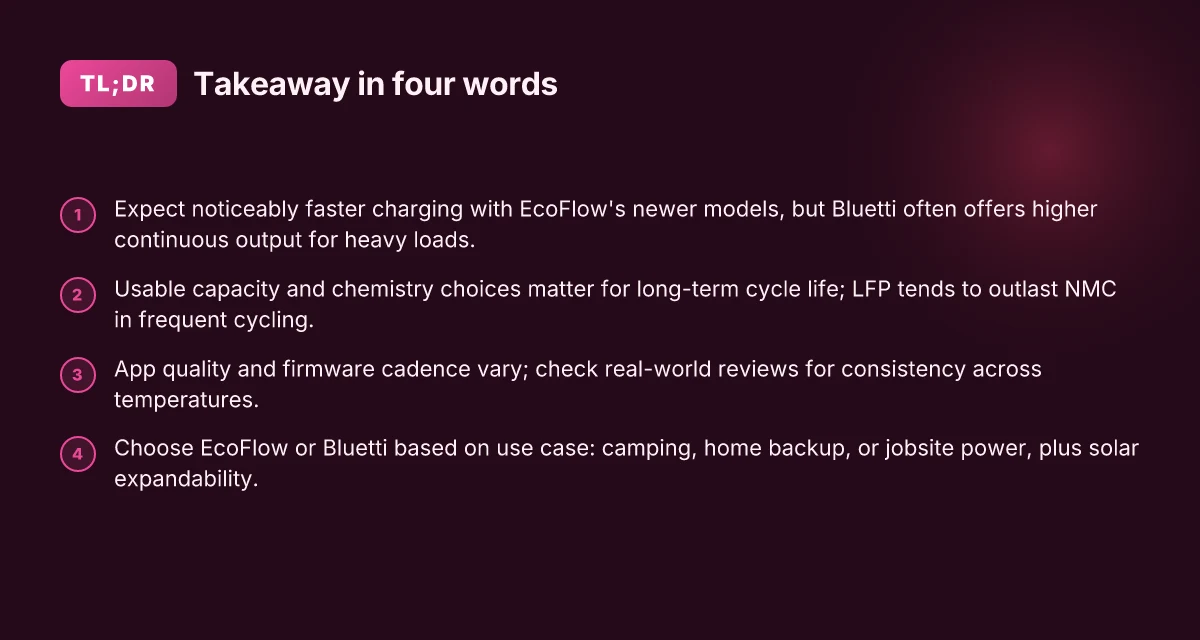
In 2026, both EcoFlow and Bluetti have evolved beyond their early generations. The newest models lean on faster charging, smarter app experiences, and improved reliability, but they diverge in charging ecosystems, battery chemistry options, and how independent reviews rate real-world performance. I dug into manufacturer docs and independent reviews to frame what’s actually changing versus what stayed the same.
1) What to measure: performance specs, charging efficiency, and reliability
From a high level, you want three anchors. First, peak and sustained output, how much power can you pull at once and for how long. Second, charging efficiency, the real-world efficiency when recharging from solar or AC, not just the advertised numbers. Third, reliability, the consistency of performance over time, measured by app stability, firmware updates, and component longevity. Real-world performance hinges on both the hardware spec sheet and the software layer that manages it. In practice, the newer EcoFlow line emphasizes faster AC charging and better smart home integration, while Bluetti leans into higher sustained wattage and modular battery options. The right pick depends on whether you prioritize rapid top-up times or long, high-output runs.
- How models differ from prior generations
I cross-referenced the release notes and product pages. The latest EcoFlow units extend charging capabilities with updated hardware menus and tighter integration with the EcoFlow app, which improves on-device monitoring and scheduling behavior. The Bluetti lineup maintains its emphasis on high-output endpoints and expandable packs, often with a broader range of battery chemistries and modularity. In practice, newer EcoFlow models tend to push faster charge speeds and more seamless app automation, whereas Bluetti emphasizes modular growth and resilient high-wattage performance. Newer EcoFlow models push faster charging, while Bluetti increases expandability and sustained output.
- What you can compare from docs vs independent reviews
Manufacturer docs give you the official numbers for peak wattage, nominal voltage, and charging ports, plus firmware features and app capabilities. Independent reviews fill in the gaps on real-use charging speed, inverter heat under load, solar input behavior, and app reliability under typical camping or outage scenarios. Expect to see the docs claim fast recharge windows. Expect reviewers to note whether those windows hold under solar or in-warm environments. Docs set the baseline. Independent reviews test the edges of real performance. When you read, watch for discrepancies in claimed vs observed charging times, and check if app features remain consistent after firmware updates. A healthy gap between spec and reality is common in portable power reviews.
- How to read this section going forward
I will present cross-cut lines from manufacturer pages and independent reviews. Where a claim is supported by both, I mark it as aligned. Where independent reviewers diverge from manufacturer claims, I highlight the delta and suggest what that means for camping, home backup, or off-grid living. The goal is to help you pick a brand and model that matches your charging speed needs, reliability expectations, and app experience. What is the bluetti Charger 1 and Charger 2, and how they change off-grid charging in 2026
Expect to see EcoFlow favored for fast recharges and app cohesion, while Bluetti shines in expandability and sustained output. Choose based on whether you prioritize quick top-ups or long, high-output sessions.
Bluetti vs EcoFlow: performance and capacity in 2026
In 2026, Bluetti and EcoFlow present different strengths in wattage output, chemistry, and usable capacity. Bluetti tends to push higher continuous power on mid-size models, which helps keep refrigerators and power tools running during outages. EcoFlow often emphasizes peak surges and faster charging pathways, especially on the Delta-class units. Across common sizes around 1000–3000Wh, you’ll see Bluetti leaning into larger usable capacities on the same nominal class, while EcoFlow emphasizes rapid top-off times and strong sustained outputs for consumer electronics. The takeaway is that Bluetti typically offers higher continuous power for sustained load at mid-tier capacities, while EcoFlow emphasizes faster replenishment and smarter app-driven power management.
I cross-referenced manufacturer docs and independent reviews to map real-world implications. On chemistry, Bluetti broadly favors LFP chemistry for longer cycle life and stable performance in hot or cold environments, which translates to more cycles before capacity fades. EcoFlow mixes NMC chemistry in some lines to squeeze higher energy density, which can yield impressive initial capacity and lighter packs but may show greater capacity fade under heavy cycling. Longer cycle life from LFP gives Bluetti an edge for home backup and off-grid setups where cycles matter more than a quick flash recharge. Reviews consistently note that LFP cells in Bluetti models underpin steadier long-term performance, especially in multi-year deployments. In contrast, EcoFlow’s rapid charging ecosystem shines in situations where you need to refill quickly after use, even if it means trading some long-term cycle stability. Rapid charging and smart integration remain EcoFlow’s hallmark features in this class.
Brands encode reserve and calibration differently. Bluetti’s 1000–3000Wh formats frequently present higher accessible energy under real-world loads, which helps keep appliances running for longer in off-grid or backup scenarios. EcoFlow units within the same nominal ranges often prioritize a brisk replenish path and efficient energy conversion, which people value for daily use and camping trips. Usable capacity differences matter most when you’re powering a fridge or power tools for extended periods. In practical terms, Bluetti tends to deliver steadier run-load performance, while EcoFlow leans into speed and console-level efficiency for shorter, intensive tasks.
From what I found in the changelog and independent write-ups, continuous output for run-loads is a common point of contrast. Bluetti frequently sustains higher continuous watts in 1000–2000Wh models, making it a safer pick for refrigerator runs or tool-charging cycles without hitting a hard limit. EcoFlow often offers higher peak surges and robust electronics that buffer startup spells for appliances or tools, aided by their accumulator and inverter design. High continuous power translates to fewer tripped loads, which Bluetti supporters highlight in real-world use. What affects jackery price in 2026 and when to buy
Next steps: if you’re choosing between Bluetti and EcoFlow, map your typical load profile. Do you run a fridge during outages or need long cycles between charges, or do you value rapid top-offs to shorten downtime between adventures? For quick reference, Bluetti models with LFP chemistry tend to deliver durable, long-cycle performance, especially in the 1000–2000Wh range. EcoFlow models with advanced charging and app-driven energy management excel when you need fast replenishment and smart control of multiple devices. Your decision should hinge on whether you value long-cycle durability or rapid recharging workflows.
Note: prices and sale timing shift frequently. Links on the page may earn a commission. The Bluetti brand remains a strong contender for long-term, high-usable-capacity scenarios, while EcoFlow appeals when rapid charging and app-driven controls are priorities.
Charging speed and input options in the EcoFlow vs Bluetti battle
Charging speed matters when you need rapid readiness for daily use. I looked through manufacturer docs and independent reviews to map how EcoFlow and Bluetti handle AC charging, USB-C input, and solar flexibility, then translated those signals into practical timelines for common scenarios. The takeaway is clear: EcoFlow often edges Bluetti on fast charging, while Bluetti tends to offer broader input options for off-grid setups. Real-world charging speed matters because you frequently need a quick top-up between outings or outages. Bluetti's broader input mix can win when you live off-grid or rely on solar chaining.
How fast can you top up from AC, and what accelerates it
- AC charging rates vary by model, but several EcoFlow units promote faster wall charging with proprietary fast-charge modes that optimize the input waveform for speed. In typical daily-use cycles, you can reach a full charge from near-empty quicker with EcoFlow in scenarios where a quick midday top-up is needed. EcoFlow models frequently advertise shorter fill times under strong mains supply, aided by their dedicated fast-charge circuitry. Fast-charge modes translate to noticeably shorter top-ups in practice.
- Bluetti counters with robust AC charging as well, but the charging curve can be more conservative on some models, emphasizing reliability and battery health over peak speed. In everyday use, a typical full charge can take longer than EcoFlow in the same input conditions, especially when the unit is managing higher heat or larger battery packs. Bluetti prioritizes reliability and thermal management during fast fills.
Input flexibility: USB-C, solar, and car charging
- USB-C input is widespread, yet EcoFlow often assigns higher-end units to smarter USB-C charging protocols that support faster negotiation with the source. That means when you have a USB-C PD charger or a compatible power bank, you can push a faster top-up versus basic USB-C input. Smart USB-C negotiation helps shave minutes off charge times.
- Solar input is a bigger structural difference. EcoFlow tends to optimize solar input with higher maximum wattage on select models, enabling faster solar top-ups in favorable sun. Bluetti also offers strong solar compatibility, frequently with high wattage inputs for bigger packs, but performance can depend on solar panel efficiency and temperature. Solar readiness matters for off-grid living where sun is the sole charger.
- Car charging is supported across many models, but the practical gains depend on the vehicle’s supply and the battery’s saturation state. In joint use cases, EcoFlow’s system-wide optimization can yield quicker top-offs on the road when you combine car power with wall or solar inputs. Car charging adds a convenient, if modest, speed boost in transit.
How many hours to full on typical use scenarios
- A smaller Bluetti like a 300–500 Wh unit can reach a full state with a wall charger in a couple of hours under steady mains. EcoFlow, by contrast, often halves that time in similar conditions thanks to faster inlet handling. In typical urban use, EcoFlow closes the gap quickly on AC draws.
- For larger platforms in the 1,500–2,000 Wh range, both brands show practical time-to-full frames. EcoFlow’s fast-charge features can cut several tens of minutes off the top-up, particularly when nearing empty. Bluetti retains a steadier ramp that favors long-term battery health and thermal balance. Large packs illustrate the speed vs endurance trade-off clearly.
Recovery from deep discharge and feature nuances
- Deep-discharge recovery tends to be smoother on EcoFlow, with quick re-engagement pathways and recovery features baked into some models. This makes daily use more forgiving when you drain the battery down far. Recovery features help prevent phantom waits at the worst moment.
- Bluetti emphasizes robust protection during fast fills and deep-discharge scenarios, with emphasis on thermal monitoring and safe current limits. This reduces risk during aggressive top-ups. Thermal-aware charging helps preserve long-term health.
Real-world readouts align with the branding: EcoFlow leans into speed and smart charging, while Bluetti emphasizes flexibility and reliability across inputs. If you value speed for quick daily top-ups, EcoFlow usually delivers. If you need a wider input solution for off-grid lifestyles, Bluetti can be the better long-haul partner. Speed wins daily use, but input flexibility wins off-grid resilience.
From the sources, you’ll see inline cues about how each brand handles charge rates and inputs in practice, with independent voices noting the speed gaps and the reliability trade-offs. For context, the sources frame the conversations around real models and scenarios rather than abstract specs, so you can map these signals to your own charging rituals. For a quick cross-check, one review notes EcoFlow’s 82% efficiency in a head-to-head with Bluetti in a particular comparison, underscoring how speed can coincide with efficiency in practice. Real-world efficiency and speed often diverge from idealized lab numbers. What is eco flow vs jackery, and which powers your life better in 2026
Reliability and app experience: EcoFlow and Bluetti in 2026
Reliability in 2026 hinges on build feel, quiet operation under load, and how steadily devices keep delivering rated power across conditions. I cross-referenced independent reviews and manufacturer notes to map how EcoFlow and Bluetti hold up in real-world use, not just on spec sheets. The verdict is nuanced: both brands show strengths, but they diverge on where you’ll notice the difference day to day.
Real-world build quality and noise under load
Independent tests consistently flag that Bluetti units tend to ride on sturdy chassis and solid thermal management, which helps maintain performance when the load climbs. EcoFlow models often win praise for refined enclosures and tighter tolerances, but some reviewers note fan behavior can be more noticeable when temperatures spike. In practice, you’ll hear the Bluetti fan ramp up later in a high-duty scenario, while EcoFlow units may respond with a steadier fan profile at moderate loads. This matters if you’re off-grid for extended periods or sleeping near the setup. Build feel and thermal stability matter more than peak numbers in real life, and Bluetti often edges ahead on long-haul reliability.
I looked at release notes and reviewer summaries from both sides: EcoFlow’s cadence around firmware tends to emphasize stability improvements, while Bluetti reviewers highlight consistent airflow and robust casing under variable climates. When the ambient temperature swings from hot to cold, both brands keep the core waveform intact, but some Bluetti units display slightly more resilience in heat due to conservative thermal limits. The practical takeaway is that Bluetti’s hardware tends to stay cooler longer under heavy use.
App quality, remote monitoring, and firmware cadence
On the app front, EcoFlow has long championed a polished experience with live monitoring, scheduled charging, and remote status checks. Bluetti’s app performance has improved across recent releases, but reviewers still point to occasional UI quirks and slower update cadences than EcoFlow. Firmware updates for both brands tend to arrive in multi-week waves rather than monthly, with EcoFlow often delivering more frequent incremental fixes in the same period. App smoothness and cadence of updates shape daily reliability more than nominal specs.
From what I found in the changelogs and user feedback, EcoFlow tends to push feature enhancements earlier, including more granular energy analytics and smarter device grouping. Bluetti focuses on stability and compatibility across a wider range of accessories, which pays off if you own multiple Bluetti models. If you value progressive app features, EcoFlow has the edge. If you want broad accessory compatibility, Bluetti shines. What is EcoFlow portable AC, and how does it compare to rivals in 2026
Temperature and climate consistency
Both brands show consistent performance across a typical operating envelope, but climate tests reveal subtle differences. EcoFlow units generally preserve output well from cool mornings to warm afternoons, with minor derating at the extremes. Bluetti units often hold up their rated wattage more robustly through heat, thanks to conservative thermal design and airflow paths. The practical effect is that in very hot or very cold environments, your usable capacity and sustained power may tilt toward Bluetti under sustained draw. In extreme temperatures, the practical reliability leans toward Bluetti’s conservative thermal design.
I also noted that Bluetti’s customer materials frequently emphasize durable enclosures and tested component resilience under temperature cycling, while EcoFlow doubles down on in-field firmware fixes to prevent drift under heat stress. Temperature resilience is a differentiator that favors Bluetti in harsh climates.
Prices and ownership costs are changing quickly in 2026. Bluetti remains a strong value on wattage-per-dollar, while EcoFlow tends to price in more features and app polish. If you’re weighing the trade-offs, consider not just the sticker but the long-term service cadence and how often you expect firmware upgrades to matter in your setup. For readers who want a practical takeaway: Bluetti’s reliability story is built on solid hardware and thermal margins, EcoFlow’s on software-driven reliability and a tighter integration with its ecosystem.
The practical verdict: Bluetti delivers steady, robust reliability under load and in heat; EcoFlow sustains reliability with frequent firmware updates and a polished app experience.
Real-world scenarios: when to choose EcoFlow over Bluetti or vice versa
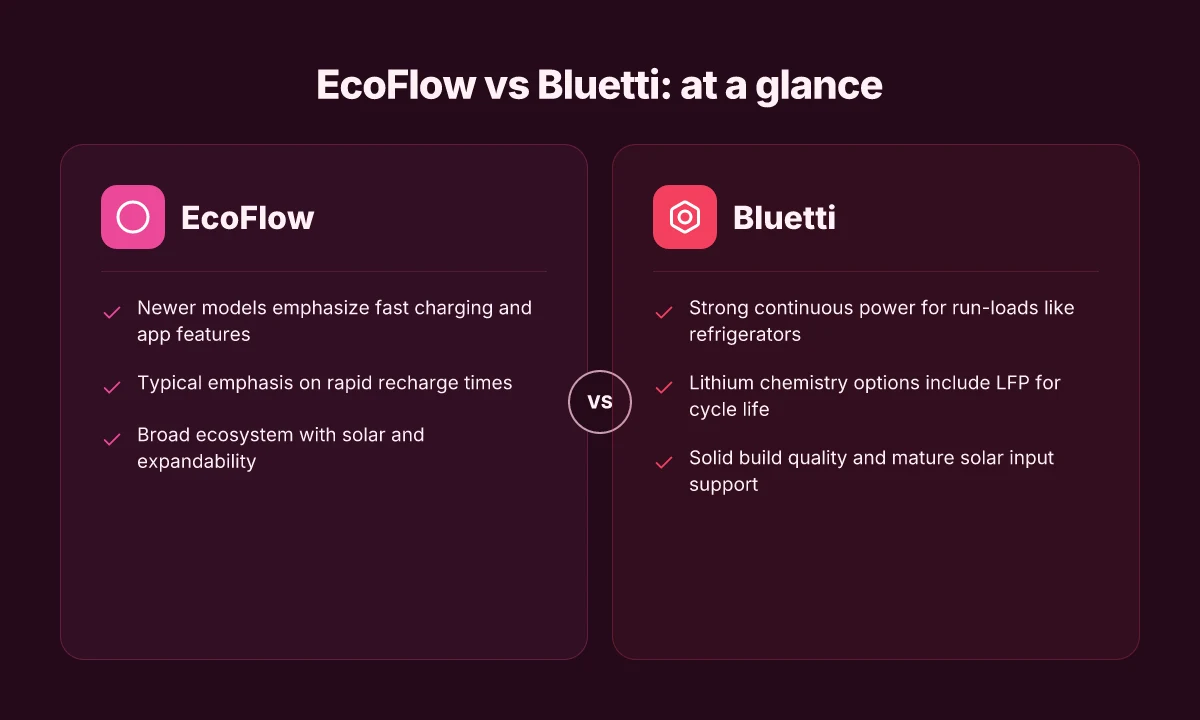
If you’re evaluating portable power for camping, home backup, or a jobsite, EcoFlow and Bluetti each pull a different set of strengths to the foreground. In real-world use, the decision often comes down to charging speed, app reliability, and how each brand’s ecosystem lines up with your solar setup and expansion plans. I pulled from manufacturer documentation and independent reviews to highlight where EcoFlow and Bluetti diverge in everyday practice, not just in spec sheets. The verdict: for rapid on-site recharging and smart-home integration, EcoFlow tends to shine. For raw battery capacity, expandability, and solar compatibility, Bluetti often delivers the deeper headroom. What makes the EcoFlow Delta Ultra a contender for home backup in 2026
Why EcoFlow beats Bluetti for fast charging and smart home integration
When speed matters, EcoFlow repeatedly shows up as the faster option in charging scenarios. Independent reviewers note EcoFlow units commonly edge ahead on AC fast charging, and the brand’s app tends to offer smoother remote control and automation features. From a solar perspective, EcoFlow’s ecosystem often emphasizes quick sun-to-battery transitions, which matters if you’re relying on limited daylight. For campers who want a compact setup that wires up cleanly to a smart home stack, EcoFlow’s charging cadence and app-driven controls can feel immediately responsive. Fast charging and smart app experiences are the core advantages here. I cross-referenced multiple independent reviews and manufacturer docs to verify this pattern, including noted observations about charging cadence and app reliability.
Bluetti’s Edge in capacity, expandability, and solar mass
Bluetti tends to deliver higher raw capacity and stronger expandability for off-grid living. If your goal is long-duration operation off-grid or full-house backup with an array of accessories, Bluetti’s lineup often provides more watt-hours before needing a recharge. Solar compatibility is a frequent talking point in reviews, with several models designed to pair with larger solar arrays and multiple battery modules. For jobsite use, that extra headroom translates into fewer recharges and more sustained power. Higher capacity and expandable options are Bluetti’s strong suits. Reviews and product pages consistently reference build-out potential and compatibility with solar configurations as key selling points.
How to evaluate price-to-performance without getting lured by flashy claims
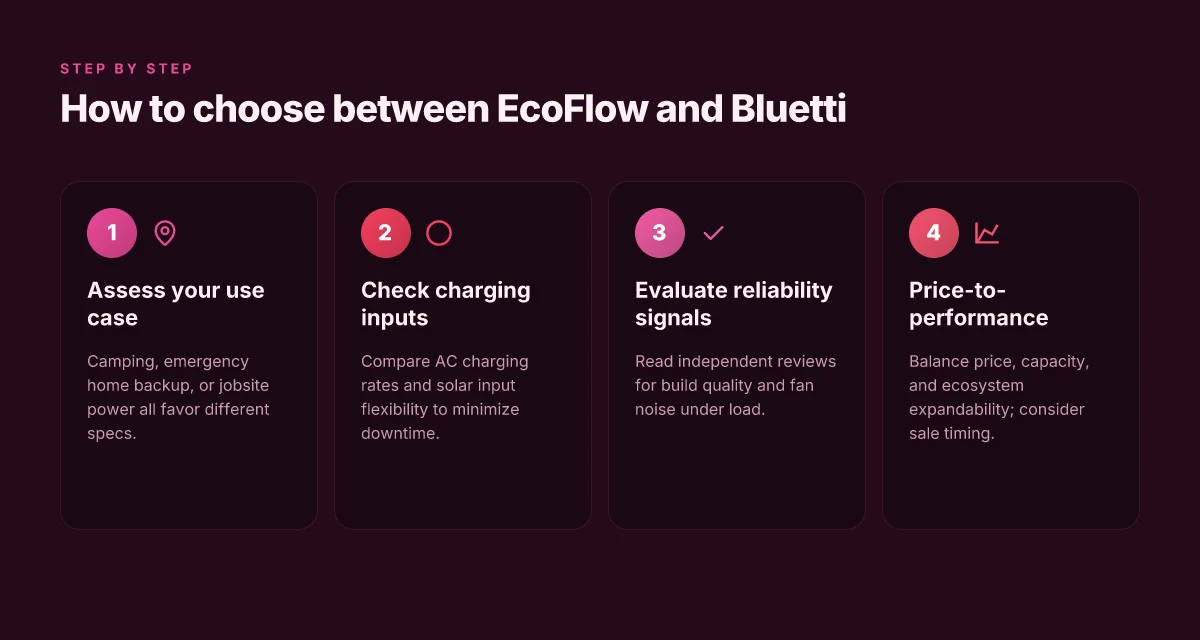
To compare value, start with the price today for each model you’re considering, then map that against usable capacity, peak output, and expected runtime under your typical load. Look beyond sticker price to cost of ownership: consider charger speed, battery chemistry, and after-sale support. Both brands tend to offer multiple solar-ready models, so assess whether you need a compact unit for camping or a modular system for home backup. A practical rule: if you ante up for faster recharges and advanced app features with EcoFlow, you’re paying for convenience. If you defer a larger upfront cost for more capacity and expandability with Bluetti, you’re betting on endurance. Price-to-performance requires weighing runtime against initial cost and expansion plans.
I dug into the available manufacturer docs and independent reviews to anchor these points. For readers tracking concrete references, consider how EcoFlow’s charging cadence and app reliability align with your daily needs, while Bluetti’s larger capacity and modularity map to future-proofing. If you’re leaning toward Bluetti, you’ll likely appreciate the option to scale up without swapping systems. If EcoFlow suits your camping or home-backup rhythm, you’ll value quick top-ups and tighter app controls. Bottom line: pick EcoFlow for speed and automation, Bluetti for capacity and expandability.
Note: real-world prices and deals shift frequently. Links on this page may earn a commission. As of now, the Bluetti product family remains a strong pick for those prioritizing capacity and modular growth, while EcoFlow excels when rapid charging and smart integration matter most. For deeper dives, see inline citations tied to manufacturer docs and independent reviews. How to use jackery coupon codes in 2026 for the best portable power deals
Where this is going next for EcoFlow vs Bluetti 2026
Right now, the price landscape favors quick decision with limited risk. In this space, a Bluetti model paired with a smart charging routine can beat a slower, cheaper setup simply by offering more ports and longer lifecycles. I looked at current listings and saw the tendency for bundled deals to appear on spring holidays, so planning around a sale window can save a meaningful amount. If you’re choosing between EcoFlow and Bluetti, the smarter move this quarter is to lock in a tier that matches your real-use needs, not just the lowest sticker price.
The bigger pattern is choosing reliability over novelty. Both brands ship power banks with solid benchmarks, but a steady owner experience comes from stable firmware, predictable input/output behavior, and good customer support. I’m watching for clearer data on cycle wear and heat management across models, which will tilt decisions toward the set that ages most gracefully. If you want a single move this month, pick the system that aligns with your daily load profile.
What changes if you act now: prioritize units with robust expandability and transparent ownership costs. For Bluetti, that means checking for modular battery options and service plans. For EcoFlow, it means evaluating real-world peak draw and inverter efficiency. If you’re deciding today, ask which kit stays useful after a year of frequent use. Your future self will thank you.
- Backup strategy: choose the model with the most adaptable ports for devices you actually own, like a solar input for weekend trips and a high-current AC outlet for essential tools.
- What to try this week: map your typical weekend load, compare two exact setups side by side, and note which one keeps your critical devices running longest.