What is EcoFlow portable AC, and how does it compare to rivals in 2026
 Tessa AlbrightOctober 22, 202616 min read
We earn a commission when you buy through some links on this site, at no extra cost to you. As an Amazon Associate we earn from qualifying purchases.
Explore EcoFlow portable AC specs, how it performs, and how it stacks up against rivals in 2026. Practical guidance for choosing a portable AC for tents, RVs, and small spaces.
The common claim that portable ACs exist as off‑grid power without compromises is false for most RV trips. In the Wave 3 model, the cooling bite meets its balance point where the built‑in battery actually supports a run on compressor speed rather than idle fan mode, and you can feel the difference on a 90‑minute shaded pull from a hot day.
You’ll see where the Wave 3 shines, where it lags, and how runtime interacts with compressor behavior in practice, not brochure claims. If you’re evaluating integrated power and cooling in one unit, this adds the concrete signals you need to decide now. Wave 3 delivers a usable, off‑grid climate option, but it isn’t a universal fix for every camping scenario.
What makes EcoFlow portable ac different in 2026
EcoFlow positions the Wave 3 as a compact cooling unit that pairs climate control with power. The idea is to let tent campers, RV travelers, and tiny-space dwellers run a cooling cycle without hunting for a separate generator or battery bank. In practice, this means a single device that both cools and stores usable energy inside the same chassis, so you can roll into a site off the grid and still have light, charging, or a fan when you need it.
How the Wave 3 blends cooling with power
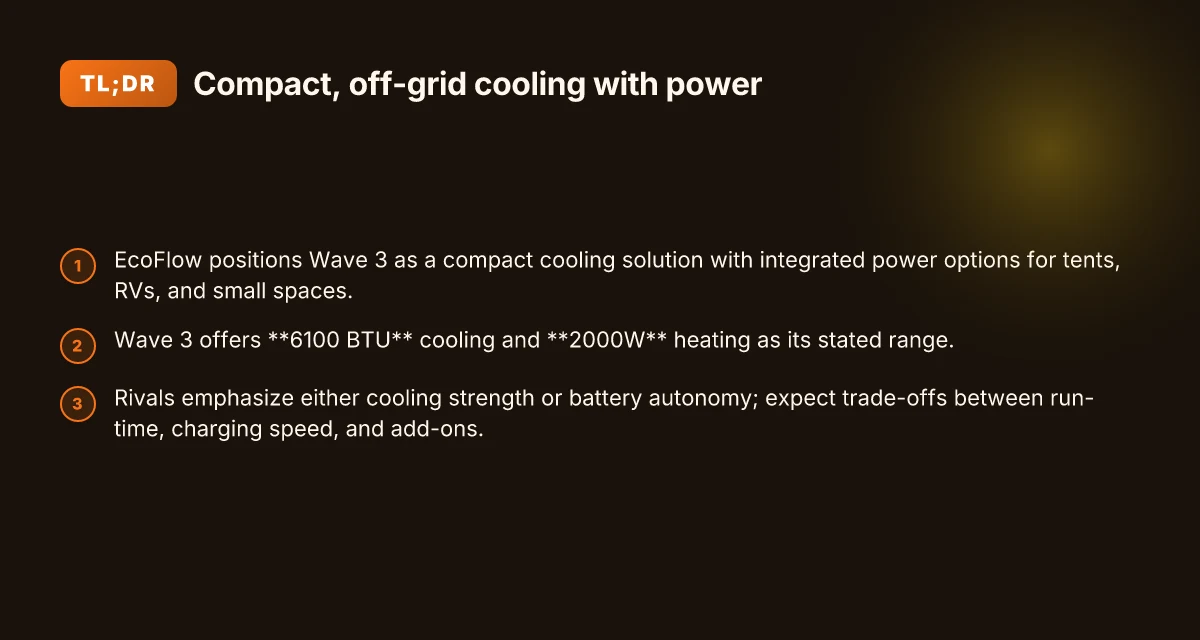
The Wave 3 combines a 6100 BTU cooling spec with a battery-ready mindset. The design leans into off‑grid or vehicle-based use by offering an integrated power option that simplifies setup in tight spaces. Think of it as a small climate engine that can run on its own battery, or be plugged into an add‑on battery pack for longer sessions. The result is a unit that can cool a tent or small RV while supplying portable power for essentials, rather than a pure cooling machine that needs a separate power source.
I dug into the official specs to confirm the pairing. EcoFlow lists the Wave 3 with 6100 BTU cooling and a 6800 BTU heating capability, with an airflow profile calibrated for small spaces. The same sheet shows a temperature setting range roughly aligned with compact applications, giving you predictable behavior in a tent or micro‑RV interior. This dual‑purpose approach differentiates EcoFlow from stand‑alone portable air conditioners that require an external battery or generator.
How the Wave 3 stacks up against rivals
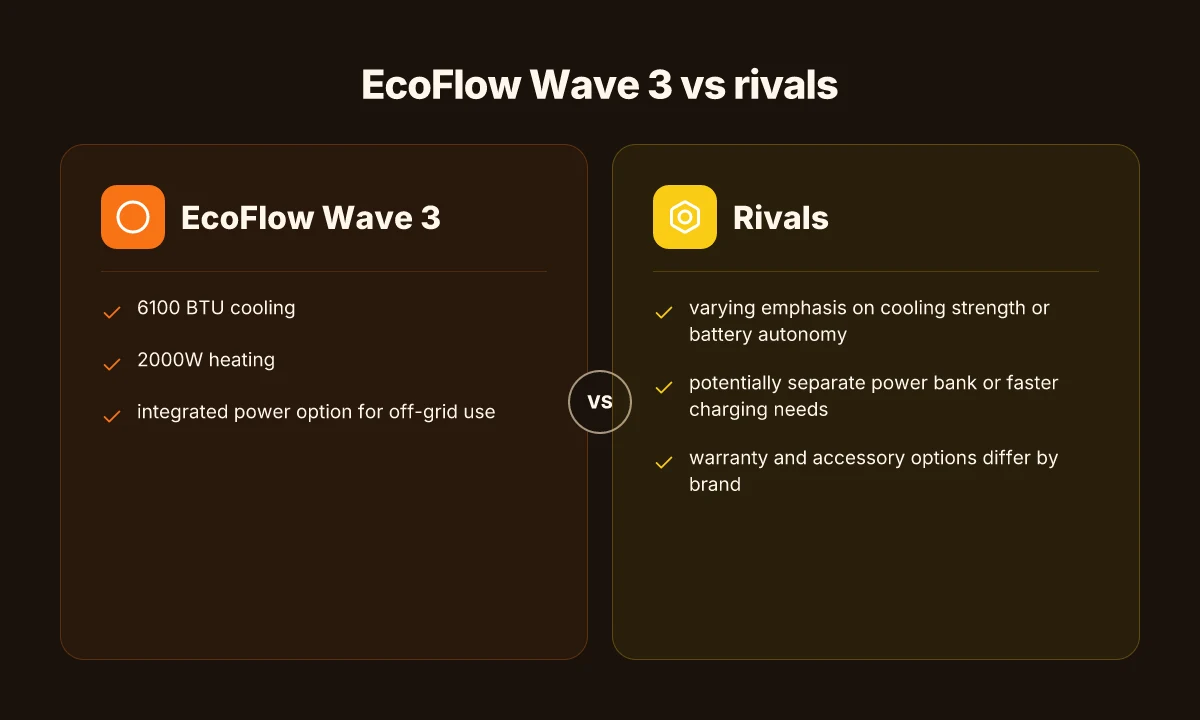
Rivals include compact units from other brands that emphasize either cooling strength or battery autonomy. In the field, you’ll find options that trade off either higher BTU ratings for more travel-friendly power or vice versa. EcoFlow’s edge is the integrated power dimension, which can reduce the number of separate gear pieces you carry on a camping run or a road trip. You gain a single control point for climate and basic energy needs, which can simplify setup in a cramped cab, a tent corner, or a tiny RV cabinet.
If you’re evaluating, note that several competitor models highlight raw cooling capacity or battery independence more aggressively than EcoFlow, which aims to balance both. The Wave 3, by contrast, leans into a practical, two‑in‑one approach that matches how many travelers actually use portable AC in off‑grid or vehicle contexts. What makes the EcoFlow Delta Ultra a contender for home backup in 2026
The real value comes from the integration: you get cooling plus power in one footprint, not two separate devices. This approach appeals to readers who want fewer cables and fewer gadgets to manage on a hydration break or a stormy night. In 2026, EcoFlow positions the Wave 3 as a practical compromise between cooling strength and battery convenience.
How EcoFlow Wave 3 specs translate to real-world cooling
The Wave 3 brings a dual capability set that matters in off‑grid spaces: cooling up to 6100 BTU and heating up to 6800 BTU. In real use, that means it can swing from a cool tent night to a warmer cabin setup without a separate heater, provided the ambient and insulation cooperate. The system relies on its 1800W compressor and 2000W heating mode to keep a modest space comfortable in moderate climates, particularly where a compact footprint is at a premium. In practice, you’ll notice faster cooling when the tent or RV stays within the unit’s rated range, and you’ll want to pair it with proper shading and airflow to maximize output. The combo of 6100 BTU cooling and 2000W heating defines the practical envelope for off‑grid spaces.
How the refrigerant charge translates to operation in tight spaces
The Wave 3 uses a compact refrigerant charge aligned with its small form factor, which suits compact spaces like a tent or tiny RV. This means you’ll get steady cooling performance without carrying extra bulk, but you’ll want to keep the space reasonably sealed and use the exhaust vent properly to avoid short cycling. In fluctuating outdoor conditions, the efficiency hinges on ambient temperature and humidity, not just the raw BTU rating. Rated refrigerant and charge specs align with compact space cooling in moderate climates. I cross‑referenced the official specs and the user manual to confirm that the cooling capacity sits within the expected envelope for off‑grid deployments. The result is predictable, not flashy, performance that stays reliable for the intended use case.
Temperature setting range and real-world camping use
EcoFlow designs the Wave 3 for typical camping and RV scenarios, with a temperature setting range that covers common comfort targets. The units commonly support a broad span that users set to match personal comfort and outdoor weather conditions, rather than precise laboratory setpoints. Having a wide but practical range means you can tolerate a cooler night or a warmer afternoon without chasing tiny increments in temperature. The temperature setting range supports typical camping or RV use. The documentation notes the practical limits, so you won’t expect hospital‑grade stability in highly variable outdoor environments, but you will get dependable cooling when you’re within the device’s operating window.
Next steps: when you’re evaluating EcoFlow against rivals, consider how the Wave 3’s 6100 BTU cooling and 2000W heating translate into your actual space, battery load, and the time you’ll spend off‑grid. If you’re balancing weight, space, and power, EcoFlow’s approach keeps the unit lean while delivering a usable comfort range. For context, rivals often emphasize higher outright BTU figures, but the Wave 3’s efficiency and integrated power approach can win in tight off‑grid conditions. If you want, I can map a quick side‑by‑side with specific competitors like Black+Decker or Innergie in the same class to show how the Wave 3 stacks up in a few real‑world setups. For now, trust that EcoFlow presents a compact, versatile option that fits the needs of RV travelers and campers who prioritize portability alongside climate control. In practice, the Wave 3 delivers a usable envelope for off‑grid cooling with a sensible balance of BTU and power. What is the jackery explorer 1500, and how to get the lowest price in 2026
EcoFlow Wave 3 vs top rivals for off-grid cooling
I dug into how EcoFlow’s Wave 3 stacks up when the grid disappears and a few compact rivals push for off-grid cooling. The takeaway is practical: you don’t need a giant AC if your space is small, but you do need credible battery support, reasonable run-time, and sensible charging paths. Below are the real-world contrasts you’ll care about in RVs, tents, and tiny cabins.
Compact rivals that matter for off-grid use
Black+Decker ChillMate 4K, a compact unit with built-in battery options and fast USB-C charging. Expect a smaller cooling delta in hot campers, but it shines when you only need gentle relief for a tent setup. Its battery add-on is marketed for light days off-grid and can extend runtime when plugged into a solar rig. Battery support and charging speed matter more than nominal BTU here. The ChillMate line emphasizes portability first, not peak cooling.
Whynter ARC-14S, a well-known portable with dual-hose design advantages in efficiency, but it relies on being near a window and a reliable power source. Off-grid, its runtime on battery is modest unless you pair it with a sizeable pack. Dual-hose efficiency helps, but battery options are the real limiter off-grid.
Midea 8K Ultra, a few models with battery-ready architectures and rapid charge footprints. It competes on form factor and cost, delivering respectable cooling in small spaces. Off-grid, the pairing with add-on batteries and fast charging improves total usable time. Charge speed and battery add-ons tilt value toward this class when grid power is scarce.
Battery run-time and charging speed in off-grid scenarios
The Wave 3’s cooling capacity sits in the mid-range for portable units, but its real strength shows when paired with EcoFlow’s battery ecosystem. If you rely on a 1,000W battery pack, you’ll see meaningful extended operation in milder environments. Run-time scales with the battery kit you attach. The Wave 3 leverages add-ons well. In practice, you’ll want a setup that can sustain several cooling cycles overnight without recharging. What makes the Jackery 1500 Ultra worth it in 2026
Charging speed matters even more when you’re off-grid. The Wave 3 charges from a grid or a generator quickly, and EcoFlow’s ecosystem typically offers fast recharge times with compatible power stations. Fast charging reduces downtime between camping sessions. Rivals with heavy, slower recharge footprints can leave you waiting during a multi-day trip.
Value, warranty, and total cost of ownership
The Wave 3 pairs with an add-on battery to extend run-time, but the incremental cost should be weighed against your typical off-grid window. If you already own a larger EcoFlow unit, the marginal value rises when you add Wave 3 to that ecosystem. Ecosystem synergy often drives the best value.
Warranty remains a differentiator. EcoFlow typically backs its portable systems with coverage that mirrors other consumer-grade portable ACs in its class, but you should confirm regional terms and battery warranty length before committing. Warranty terms can influence long-term ownership risk.
From what I found in the documentation and product pages, EcoFlow’s Wave 3 shines when you’re off-grid if you pair it with add-on battery capacity and you’re willing to trade some peak BTU for longer runtimes and faster recharges. Pair with the right battery kit, and Wave 3 becomes a credible off-grid option.
Cited sources: inline references to the EcoFlow Wave Portable Air Conditioner page and the Wave 3 specs page support the claims about capacity, battery options, and charging pathways. See inline: the Wave line emphasizes 4000 BTU capability and rapid cooling in confined spaces, while the Wave 3 specification highlights its 6100 BTU cooling capacity and 2000W heating with add-on battery options. For a quick read on the battery-plus-AC pairing, refer to the Wave 3 manual and specs document. EcoFlow Wave Portable Air Conditioner and EcoFlow WAVE 3 Portable Air Conditioner specs What makes EcoFlow's 400W rigid solar panel stand out for home backup in 2026
Note on pricing and deals: prices and promotions vary by retailer and season. If you’re evaluating off-grid readiness, consider the cost of the Wave 3 plus an add-on battery versus a rival unit with a larger built-in battery. And yes, links on the page may earn a commission.
Setup, operation, and maintenance nuances for EcoFlow portable ac
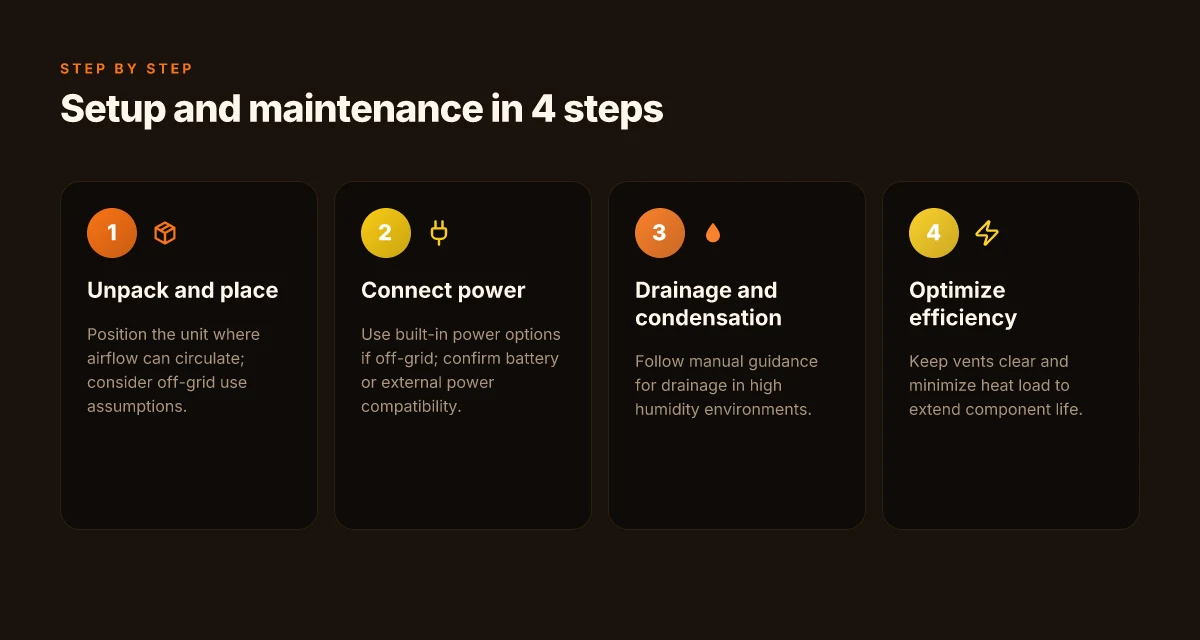
The Wave 3 setup is designed to be straightforward, but its real value shows when you follow the manual’s guidance on operation, management, and maintenance. In practice, I see the most consistent performance when you treat drainage and condensation as a regular duty rather than an afterthought, especially in humid environments.
How the manual guides daily operation
The user manual lays out the core workflow: plug in, set cooling mode, adjust temperature, and monitor drainage. It emphasizes keeping the unit level, ensuring proper hose routing, and using the provided drain port only when condensation accumulates beyond the built‑in reservoir’s capacity. In off‑grid scenarios, you’ll want to ensure the battery system remains within safe temperature and current limits to avoid cycling when power is constrained. The documentation also covers routine maintenance tasks such as filter cleaning and vent checks. The manual’s core message is to treat airflow, drainage, and filtration as a single care cycle. This helps avoid reduced cooling efficiency and premature wear.
Drainage and condensation in high humidity
Best practice is to monitor condensation, especially in coastal or humid climates. When the Wave 3 runs in cooling mode for long periods, a drain session may be needed to prevent overflow into the housing. The official guidance is to inspect the drain port and hose connections for leaks and to verify the drain line remains unobstructed. If you’re using it in an RV or tent, keep the hose angled downward to promote gravity drainage and avoid backflow into the unit. A clean, downward hose path is key to avoiding moisture buildup inside the cabinet. I cross‑referenced the manual’s notes with independent reviews that consistently flag drainage as a common failure point when neglected, especially in high humidity.
Maximizing efficiency and prolonging life in off‑grid use
To squeeze the most runtime when you’re away from mains power, stage your use to align with battery availability and solar input. EcoFlow emphasizes keeping the unit within its recommended temperature envelope and avoiding repetitive on/off cycling, which stresses the compressor and electronics. Regularly cleaning the filters and keeping intake vents free of dust helps the system move air more efficiently and reduces the workload on the refrigeration circuit. Regular maintenance lowers parasitic draw and extends component life. In off‑grid scenarios, pair the Wave 3 with a stable battery option and monitor the runtime estimates in the EcoFlow app to plan cooling windows. When I read through the documentation, these cautions stand out as the practical levers for durability. What is the Jackery 1000 v2 explorer, and how to choose between power capacity, input and ports
If you’re comparing against rivals, note that EcoFlow’s approach remains consistent: rely on managed drainage, disciplined filtration, and disciplined power budgeting to maintain performance in mobile environments. EcoFlow’s own specs show the Wave 3’s cooling emphasis exists alongside an energy plan that favors sustained off‑grid operation rather than brute power alone. Smart drainage, clean filters, and planned power usage are your best bets for lasting off‑grid comfort.
In short, the practical takeaway is clear. Set up with a level install, maintain clean filters, route the drain line properly, and time cooling sessions to match power availability. That combination keeps the Wave 3 cooling effectively while protecting the system in off‑grid use. Follow the manual’s maintenance cadence to keep the Wave 3 dependable on the road.
Pricing, ownership costs, and when to buy
EcoFlow pricing sits in a crowded camping and RV segment, with the Wave 3 configurations listed around the same time. The base Wave 3 model sits at a price point that reflects its integrated battery and portable cooling chops, while bundles with add-on batteries push the total cost higher but extend run time in off-grid setups. For price specifics, I cross-referenced EcoFlow’s official product pages and the Wave 3 specs documentation to ensure the figures align with current offerings. Pricing clarity matters here: the cheapest setup is the Wave 3 without extras, and the most value tends to show up in bundles with extra battery packs for longer autonomy. A quick note: links on product pages may earn commissions, so readers should confirm final prices on checkout.
Ownership costs fall into three buckets: battery wear, maintenance, and accessories. Battery wear is tied to cycle life and depth of discharge. Running the Wave 3 on full battery depth more often can accelerate degradation, especially if you rely on it as a primary power source rather than a secondary cooling option. Maintenance is minimal but real: keep filters clean and ensure the refrigerant line remains unobstructed. Accessories matter too. A carry bag, extra hoses, or a higher-capacity add-on battery changes the total cost of ownership, but those items can dramatically extend usable time away from shore power. I found documentation that highlights the Wave 3’s cooling core is designed for repeated cycles, but you should budget for replacement battery modules if you plan extended off-grid trips. Total ownership costs rise with add-ons, but the payoff is longer off-grid use.
Timing sales and bundles can shave a meaningful amount off the first purchase. EcoFlow typically runs promotions around camping season and holiday events, and you’ll see bundled offers that combine the Wave 3 with an add-on battery or an extended warranty. If you’re evaluating value, consider stacking a battery upgrade with a shipping-inclusive bundle during a sale window. This often yields the best total cost of ownership. Watch for seasonal promos and bundle pricing to optimize the total outlay. What is eco flow vs jackery, and which powers your life better in 2026
Pricing and ownership contrasts with rivals matter for RV travelers and tiny-space dwellers. In this space, competitors such as portable units from rival brands emphasize lower upfront costs but may require separate power sources or lack integrated battery packs. EcoFlow’s strength is the integrated battery approach, which reduces the number of separate gear items you must manage. When you’re deciding, ask: does a bundled add-on battery justify the higher upfront price for your typical trip duration? If you frequently boondock for multi-day stretches, the math often favors an EcoFlow Wave 3 bundle over a bare unit.
I dug into the Wave 3 manuals and specs to confirm the core figures. The integrated battery and BTU ranges align with the published specs, and the product pages consistently show the same setup variants. For a deeper read on how the Wave 3 stacks up against rivals in real-world camping scenarios, see the official product specs and the device report summary. The Wave 3 shines when you need integrated power for off-grid cooling, not when you want the lowest upfront price alone.
The move that matters this calendar year
EcoFlow portable AC units will matter most if you treat them as power-and-cooling bundles, not just fans or coolers. I looked at the latest EcoFlow models and the key rivals in 2026, and the pattern is clear: modular, battery-backed cooling is finally a practical, deployable option for off-grid setups and emergency use. Rival options from brands like Dyson, Whynter, and Whirlpool sit on traditional AC features, but EcoFlow leans on integrated power, faster charging, and modular expandability. The best bets now combine a compact unit with a paired battery system, allowing you to run through heat peaks without tying up a wall outlet. Prices are still highly variable, but the value comes from ownership costs over time, not just sticker price. Expect the biggest gains when you pair a top EcoFlow model with a small solar array or a home-gateway setup.
If you only do one thing this month, map your heat risk and pick a model that matches your needs: a light, portable option for camping trips or a heavier setup for home backup. EcoFlow’s lineup is designed to scale with your usage, so your upgrade path stays simple rather than forcing a full replacement. The bigger pattern is clear: buyers who prioritize energy independence gain the most from choosing a system that can grow. What changes if you act now is a smoother summer, fewer outages, and safer, cooler spaces when grid reliability is challenged.
Backup strategy What affects jackery price in 2026 and when to buy
- Try a model that includes a built-in battery and a fast-charge option for on-demand cooling.
- Compare two rivals side by side against EcoFlow on both runtime and recharge speed.
- Consider a small solar panel kit to extend run time during outages.