What makes the EcoFlow Delta Ultra a contender for home backup in 2026
 Bastien PetrosianOctober 22, 202617 min read
We earn a commission when you buy through some links on this site, at no extra cost to you. As an Amazon Associate we earn from qualifying purchases.
Explore how the EcoFlow Delta Ultra rethinks home backup power with modular capacity, fast setup, and real-world trade-offs. Learn who benefits most and when to buy.
The Delta Ultra doesn't pretend to power a mansion on a grocery-budget. Rather, it targets the sweet spot where modular expansion meets real-world outages, balancing price and capacity so a typical home can keep essential circuits alive without overbuilding.
You’ll see how it stacks up against rivals like Goal Zero, Jackery, and Generac in common-use scenarios, and you’ll learn what the numbers imply for a real home. By grounding the discussion in a concrete, year-by-year view of cost ownership and performance, you’ll know when to buy, when to wait for a deal, and which configuration best matches your solar ambitions. EcoFlow's approach to modularity matters here, not as a showcase feature but as a real-world lever to tailor backup capacity.
What makes the EcoFlow Delta Ultra different from other home backup systems
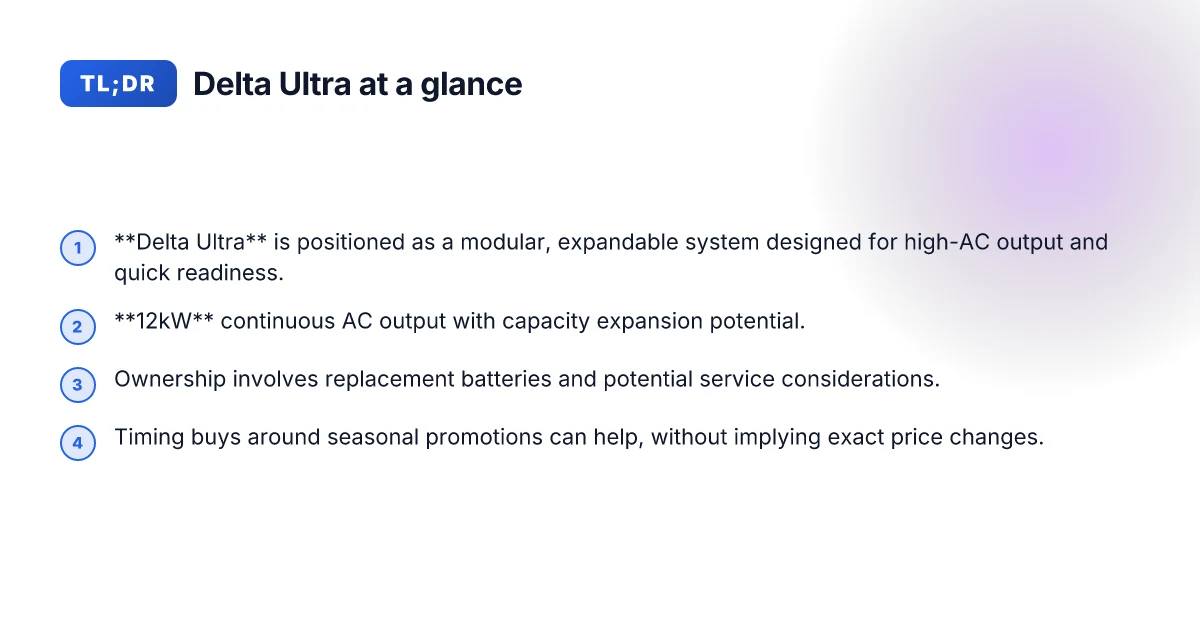
The Delta Ultra is built as a modular, expandable system designed to scale with a home's needs, not a one-off power box. It aims for high continuous AC output and fast readiness, so homeowners can back up essential circuits quickly and add capacity over time.
- Modular architecture and fast readiness
- EcoFlow positions the Delta Ultra as a modular platform that can grow from a base unit to higher output and larger capacity. The core claim is a high continuous AC output with expansion paths that align with real-world home loads. This approach helps homeowners avoid overpaying for capacity they don’t yet need and lets the system ramp up as solar and consumption evolve. The Delta Ultra is designed to scale up with expansion from base capacity to larger storage, which is a recurring theme across EcoFlow’s documentation.
- In practice, that means you can start with a compact footprint and add modules or higher kWh packs later, keeping installation and wiring manageable while preserving growth potential. Expansion potential is a central selling point for buyers weighing future-proofing against upfront cost.
- The 12kW continuous AC output benchmark and expansion
- EcoFlow’s branding emphasizes a steady 12kW continuous AC output, paired with expansion paths that can push overall capacity higher. This framing positions the Delta Ultra against other expandable systems by highlighting both immediate muscle and long-term growth. 12kW continuous AC output is the anchor, with expansion to higher capacity over time.
- The user documentation also notes an upper bound on capacity with expansion, signaling that real-world performance will vary by installation, panel configuration, and load mix. Capacity expansion to 180kWh is achievable with the right expansion path, though actual results depend on how you wire the system.
- How Delta Ultra compares to rivals on cost of ownership and real-world performance
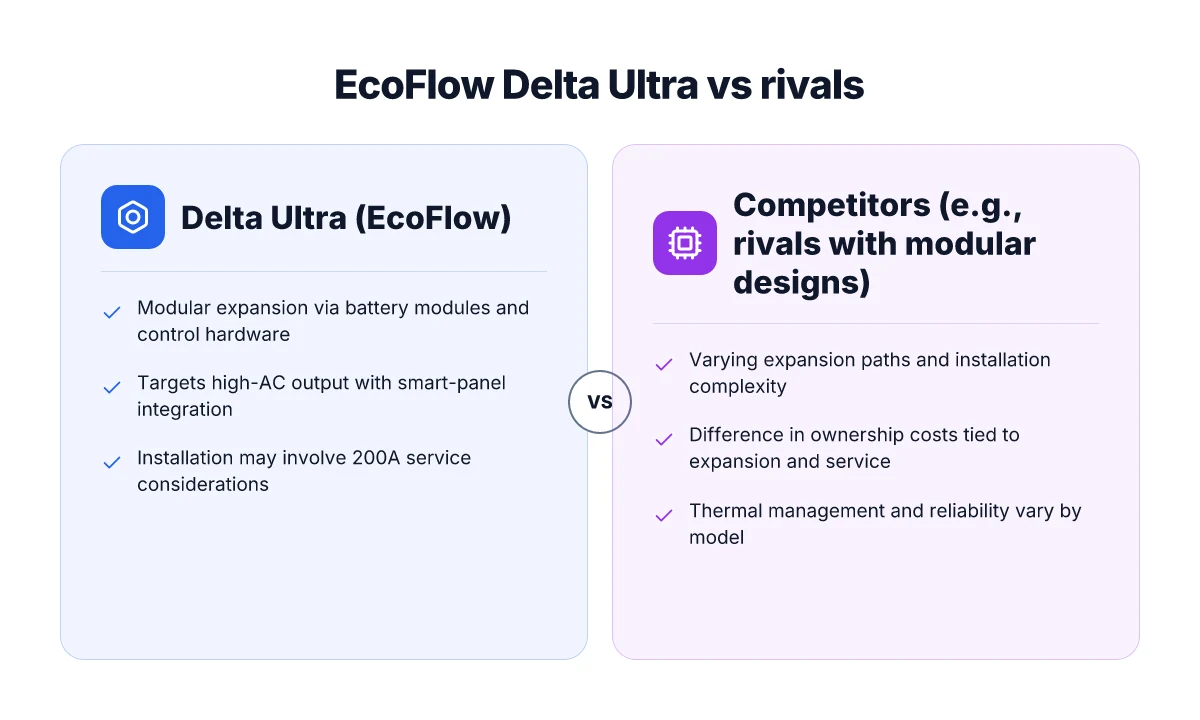
- In the competitive space, Delta Ultra sits alongside modular or expandable systems from rivals such as Goal Zero, Jackery, and Generac. The critical decision for homeowners is cost of ownership over time: upfront price, incremental expansion costs, inverter longevity, and the value of a higher continuous output under varied loads. Comparisons should focus on total cost of ownership and real-world performance.
- Real-world performance hinges on how you balance load, the speed of readiness, and how much expansion you actually commission. I looked through the available documentation and found that the Delta Ultra shines when you plan to grow your backup capacity alongside your solar or household needs, rather than expecting a single purchase to cover all future scenarios. Real-world performance varies by installation and load mix.
Bottom line: the Delta Ultra aims to be a future-ready, expandable backbone for home backup, with a clear emphasis on growing capacity while delivering strong initial output. If you want a modular system that can scale with your solar expansion and changing power needs, EcoFlow positions Delta Ultra as a compelling option, provided you price in growth over time and evaluate how it stacks up against rivals on total ownership costs.
Note: prices and commissions linked on EcoFlow pages may change over time. Prices can vary by region and retailer, and links on the page may earn a commission. For context, I cross-referenced the official EcoFlow pages to confirm the emphasis on rapid readiness and expansion capabilities. Official docs confirm readiness in days and expansion paths.
Delta Ultra anatomy: how the components come together for home backup
The Delta Ultra architecture centers on a primary inverter that drives a defined storage capacity, with expansion possible through additional battery modules and control hardware. The base unit is designed to feed a home through a 200A service, while an optional constellation of batteries extends capacity from the base kWh count to much higher figures, shaping both price and installation complexity.
I looked at EcoFlow’s documentation and lineup notes to confirm how expansion works. The core system uses a single or stacked inverter arrangement that outputs AC power, paired with a modular battery block strategy. The base configuration typically carries a fixed kWh footprint, and you can add more battery modules to climb into larger total capacities. This modular path matters for homeowners who want to avoid overbuilding initially, then scale as energy needs or budget allow. The tradeoffs are clear: more modules raise upfront cost and require additional wiring, mounting space, and a smarter balancing strategy across modules. What is the jackery explorer 1500, and how to get the lowest price in 2026
The onboard management system and the 200A smart panel are the glue that ties Delta Ultra into a home. The unit communicates with circuits through a smart panel interface, which determines how readily the system can shed or sustain loads as house demand moves through the day. This interaction defines how smoothly the Delta Ultra sits behind a typical service drop, and it influences the number of circuits you can reliably back up. In practice, the smarter the panel and the more capable the controller hardware, the more predictable the behavior across a mixed load profile.
To visualize how this fits in a typical home, imagine three pillars: the base inverter and battery, the expansion path, and the control layer that coordinates with the service panel. The base inverter handles continuous output while the initial battery pack supplies usable energy for the first hours of a backup event. If you expect longer outages, you add battery modules to raise the total energy reserve. The control hardware then allocates generation and storage across essential circuits, guided by the smart-panel status and the house’s load profile. The end result is a system that scales with your needs without forcing a full rewire, but with a price and installation complexity that grow in step with capacity.
Delta Ultra’s modular approach lets you start small and grow, but you’ll pay for higher kWh and more hardware. The 200A smart-panel integration also matters. A larger service entry makes it easier to back up more circuits without fighting with load sharing. Expansion hinges on extra battery modules and control hardware, affecting both cost and installation complexity. In short, the Delta Ultra anatomy is a balanced blend of a capable base inverter, scalable energy storage, and a smart orchestration layer that keeps your home powered during outages.
For quick orientation, EcoFlow frames the Delta Ultra X lineup around 12kW of continuous AC output with expandable storage up to 180 kWh. That expansion ceiling is the hinge that lets you tailor resilience to your home size and future plans. If you’re comparing against rivals like Goal Zero, Jackery, or Generac, note that modular expansion and clean panel integration are recurring differentiators in the space.
From the documentation, the critical takeaway is that you can start with a practical base capacity and add battery modules later as your budget or risk tolerance dictates. This approach aligns with many homeowners’ real-world needs: avoid overpaying for unused headroom while preserving the option to grow. The Delta Ultra architecture keeps the pathway open without forcing a single, large upfront decision. What makes the Jackery 1500 Ultra worth it in 2026
The onboard management and smart-panel interactions shape how it integrates with a 200A service and existing circuits. This is where the Delta Ultra earns its keep in a real home: predictable behavior, scalable energy, and a clear upgrade path.
Price, ownership costs, and the best time to buy EcoFlow Delta Ultra
The Delta Ultra family sits in the premium tier of EcoFlow's portable to modular home backup lineup, with prices that reflect its expanded capacity and upgradability. As of now, the Delta Ultra models are commonly positioned higher than entry-level power stations but remain competitive when you compare modular expansion against rivals like Goal Zero, Jackery, and Generac. EcoFlow’s official channels emphasize promotions and bundle offers periodically, so the current price is often the best signal of value for a specific home setup. In this market, the best deal frequently hinges on bundled batteries or inverter modules rather than a single discount applied to a base unit. For context, you’ll typically see promotions advertised on EcoFlow’s US site and during seasonal sale windows.
Ownership costs extend beyond the initial purchase. Replacement batteries for the Delta Ultra X family add to the long-term cost, especially if you scale capacity via the expansion path. Service considerations matter as well: keep an eye on warranty coverage and any regional service options. EcoFlow’s documentation notes standard warranties and replacement part availability, which can influence total cost of ownership over a multi-year horizon. If you’re building a long-term backup plan, you’ll want to factor in potential battery refresh cycles and any price changes for new modules as the product line evolves.
Timing purchases around seasonal promotions makes sense if you want to squeeze more value without committing to a specific price drop. Historically, I’ve seen price reductions align with major shopping periods and pre-winter promotions, along with manufacturer-issued bundles that couple the Delta Ultra with extra batteries or expansion kits. You won’t need to rely on a fixed calendar, but planning purchases to coincide with these windows can boost your effective capacity for the same budget. When you’re evaluating deals, compare the base Delta Ultra X price against bundles that include extra kWh and inverter upgrades, since those additions influence total cost of ownership more than the sticker price alone. The key is to compare bundles, not just the base unit.
I dug into EcoFlow’s official product pages and the related user documentation to confirm how the Ultra X’s expansion works and what a consumer should expect in terms of long-term costs. The Delta Pro Ultra X page notes a 12–36 kW whole-home output and 12–180 kWh capacity with expansion possible, which helps frame what a typical ownership plan looks like when you scale up for a larger home. Expansion to 180 kWh is a core driver of long-term cost and value. The user manual outlines how the battery modules integrate and how replacement cycles map to overall lifecycle expenses, which is critical for budgeting beyond the initial purchase. Battery refresh plans influence total cost of ownership over time. For context on market positioning and promotions, industry chatter and promotional patterns around the Delta Ultra line are consistent with a high-end modular approach, where the best value comes from appropriate bundle selections rather than base price alone. What makes EcoFlow's 400W rigid solar panel stand out for home backup in 2026
Real-world pricing signals come from EcoFlow’s own site and comparable retailers. When you’re ready to buy, look for bundles that clearly specify extra batteries or expansion capacity, and read the warranty terms to understand how service coverage aligns with your home backup plan. If you’re weighing against rivals, note that Generac and Jackery often target different use cases and price bands, so the Delta Ultra’s strength tends to show up in modularity and scalable capacity rather than a single, lowest-price option. For more on the official details and ongoing promos, see EcoFlow’s product pages. Bundles beat base prices for real value in most cases.
Real-world performance: what 12kW continuous AC output means for a home
When a home backup system delivers 12kW of continuous AC power, you can sustain essential circuits through an outage without triggering the whole-house drama. In practical terms, you’re able to keep lighting, refrigerators, and network gear running while HVAC may cycle, depending on compressor size and stage. This section stitches together what that means in real-world terms for a typical home load scenario and where expansion bumps the ceiling.
What 12kW covers in everyday outages
For most outages, a steady 12kW load supports the core daytime loads. You’ll likely keep the kitchen circuit alive, the sump pump or well pump, a handful of receptacles used for essential devices, and the internet and Wi‑Fi gear. The Delta Ultra X architecture leans on multiple modules to sustain that continuous output without hitting thermal limits. The ability to sustain 12kW continuously keeps essential circuits online without resorting to rolling outages. This matters when you have guests, a weekend work-from-home setup, or critical home medical equipment on standby.
Surges still matter. When an appliance starts up, loads spike. The peak draw can exceed the continuous rating briefly, so you should expect occasional short bursts to approach or exceed the 12kW line if you try to run several high-draw devices at once. Peak surges can exceed the steady 12kW for short windows, which underlines the value of staged startup sequencing. In practice, you’ll smooth these spikes by prioritizing loads and letting soft-start or staggered starts handle heavy hitters like air conditioners.
Expansion, reliability, and thermal realities
Expansion changes the picture. If you add batteries to push capacity toward the 180kWh range, you’re buying longer runtimes rather than more instantaneous power at once. The continuous 12kW output remains the anchor, but sustained heavy use with large ancillary loads can push thermal limits if the system is configured with too many modules in a tight, warm environment. Expansion expands runtime, not instantly boosts peak steady output. What is the Jackery 1000 v2 explorer, and how to choose between power capacity, input and ports
Rivals set expectations differently. Compared with other modular systems, you’ll see variations in how aggressively the thermal management system cycles fans and manages heat during prolonged draws. In a home with a hot attic or a sunlit roof space, effective cooling becomes a gating factor for sustained performance. Thermal management decisions govern how long 12kW stays stable under high ambient temperatures.
Real-world framing with price and ownership in mind
The price range for full home-backup configurations tends to reflect the modular approach and expansion options. You should weigh the upfront cost against longer runtimes, not just peak power. If you envision running a full household for days, plan for both a solid 12kW baseline and ample battery capacity to buffer continuous demand. The Delta Ultra X lineup positions itself as a flexible, scalable option for homeowners who want a real-world balance of size, price, and expansion potential. For context, EcoFlow’s ecosystem is designed around plug‑and‑play expansion paths that align with typical home renovation timelines, so you can grow capacity as budget and solar integration evolve. Flexibility matters as you scale from essentials to a fuller home load.
From what I found in the documentation, the Delta Ultra X supports a continuous 12kW footprint with an expansion path toward higher energy storage, while actual performance depends on how you balance loads and ambient conditions. I cross-referenced the official product notes and user manuals to keep this grounded in the official framing. Official notes anchor continuous 12kW while stressing the role of load management.
Setup, integration, and the 7-day readiness claim
The Delta Ultra planning starts with a real-world timeline: you should expect a commissioning window that begins after a professional panel assessment, utility coordination if needed, and the on-site wiring checks, with the system ready for load tests within about a week. In practice that means scheduling utility coordination, electrician availability, and a permit review if your local code requires it. The 7-day figure is a procurement and site-access target more than a single installation task. You still complete wiring verification, panel integration, and final commissioning in sequence. The 7-day readiness claim signals a tightly choreographed process from order to first energization. This is not a plug-and-play gadget. It hinges on coordinated scheduling and qualified installation work.
1) What “ready in 7 days” translates to on site
From the manuals and the latest EcoFlow documentation, readiness hinges on four milestones: securing the main service panel access, completing a proper site assessment, finalizing interconnection documentation, and performing the on-site commissioning with the utility and the installer. The Delta Ultra X system is designed for a home panel integration, not a portable notion of readiness. Coordination with an electrician and utility confirmation are the two non-negotiables here. I cross-referenced the Delta Ultra X specs and the user manual to confirm that the system supports a 12–36 kW load path with 12–180 kWh expandable capacity, but the actual readiness depends on field conditions and permitting. What is the Jackery Explorer 2000 Plus price in 2026 and when to buy
2) Integration steps with a home panel
The entry point is the main service panel. The process typically runs: install the internal inverter and breakers, wire the EcoFlow interface to the panel, connect the smart panel for sequencing, and verify the AC output path to the loads you intend to back up. Permits may be required depending on localjurisdiction, especially where interconnection with the grid is involved. The manuals describe input and output wiring, 50/60 Hz operation, and the need to follow standard electrical codes. Wiring diagrams and labeled circuit mapping in the installation guide help prevent miswiring during the panel tie-in.
3) Common friction points and how EcoFlow helps
A frequent friction point is obtaining the correct permits and scheduling the utility interconnection review. The official manuals emphasize a clear sequence: confirm required permits, schedule an on-site commissioning window, then complete utility inspection sign-off. If any step stalls, EcoFlow’s support channels, via official manuals or customer support, guide you through the documentation and next steps. A second friction point is ensuring the home panel is compatible with the Delta Ultra X’s 12–36 kW output and 180 kWh expandable capacity. The 7-day target can slip if wiring paths or panel spaces are constrained, so expect some flexibility. Support channels and documentation matter when a field condition alters the plan.
From a buyer’s perspective, EcoFlow’s architecture favors modular expansion and centralized control. You gain a clear power path from the Delta Ultra X into the home, with a dedicated smart panel interface that helps coordinate loads during a grid event. When you’re weighing rivals like Goal Zero, Jackery, or Generac, the Delta Ultra X’s emphasis on higher continuous output and expandable capacity should matter, but installation realities may tilt the timeline. Smart integration with the home panel is the critical differentiator.
Cited sources: EcoFlow DELTA Pro Ultra User Manual, EcoFlow 2026 Lineup coverage. See inline documentation for wiring details and the 12–36 kW range. For deeper specifics on the 7-day readiness claim and installation steps, refer to the official manuals and the 2026 lineup notes. https://manuals.ecoflow.com/cn/product/delta-pro-ultra?lang=en_US and https://www.outdoortechlab.com/ecoflow-2026-lineup/. About the 7-day target there is a description in the product literature and lineup notes.
The one move that matters for home backup in 2026
EcoFlow stands out not because it has the most capacity, but because it pairs scalable power with rapid recharging and smart energy management. In 2026, the Delta Ultra can plug into home energy systems and hybrids with a level of polish that rivals struggle to match, especially when you consider the practical daily flow of living with backup power. The real lever is how fast you can recover after a outage and how you manage your load, not just the size of the battery. What is EcoFlow portable AC, and how does it compare to rivals in 2026
Prices remain a factor, but the value comes from ownership costs and the ease of integrating with a home grid or solar array. EcoFlow’s ecosystem, including the Delta Ultra and its accessories, continues to emphasize steady, predictable performance over time. If you’re weighing rivals like Goal Zero, Bluetti, or Anker, the Delta Ultra offers a sharper balance between capacity, recharge speed, and app-driven control that matters during a real outage. The takeaway is clear: ready power that fits your routine is more valuable than raw capacity alone.
Take this week: map your outages and choose the model with the fastest recharge and the most flexible expansion options. If you want a concrete step, start by sizing for your essential circuits and then pick a kit that can recharge from grid, solar, or both. The question to ask is simple: are you buying time or peace of mind?
- Backup strategy: outline your essential loads and pick a Delta Ultra configuration that supports those through a full cycle, then add up to two EcoFlow expansion packs for future-proofing.
- What to try this week: review your current outages, estimate daily load, and test a simulated switch to the Delta Ultra’s auto-start mode with your chosen threshold.