Best HEPA air purifier: how to pick the right model for your space and budget
 Tessa AlbrightOctober 22, 202619 min read
We earn a commission when you buy through some links on this site, at no extra cost to you. As an Amazon Associate we earn from qualifying purchases.
Discover how to choose the best HEPA air purifier for your space. Compare features, sizes, and price ranges, with actionable buying tips and real-world performance notes.
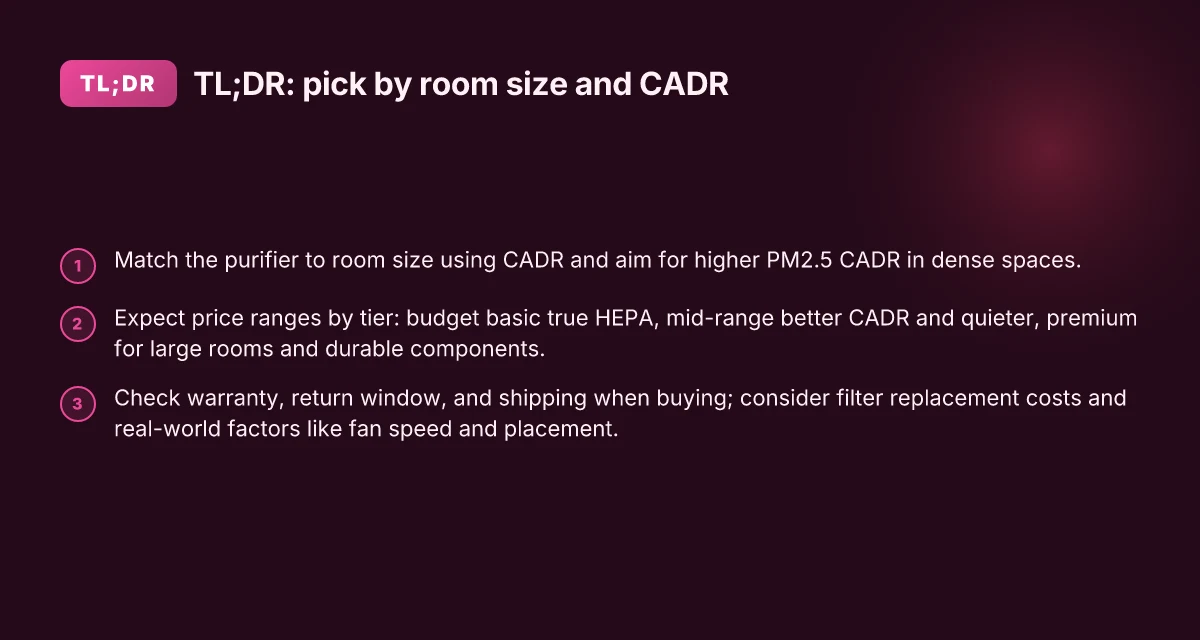
The true HEPA edge isn’t hype. True HEPA matters for PM2.5 removal, not just noise or a pretty sensor readout. If you’re allergic or asthmatic, the difference shows up in real-life air changes per hour and how often you need to run the unit at higher speeds. The quick picks above align with a practical standard: a purifier that delivers genuine HEPA filtration, predictable CADR, and a footprint that fits your room.
In real rooms, CADR matching is only part of the equation. Room size and fan speed discipline the outcome, while filter age and routine maintenance can swing results by a factor you’ll notice during high pollen days or wildfire smoke events.

Best HEPA air purifier buyers guide: what actually moves indoor air quality
When you’re choosing a purifier, true HEPA filters matter for PM2.5 because they capture the smallest particles with higher efficiency than many HEPA-like alternatives. True HEPA achieves a certified capture efficiency for 0.3 µm particles that’s typically higher and more reliable across real-world conditions. HEPA-like or pseudo-HEPA devices can vary, and you may see wide performance gaps depending on filter age and airflow. For allergy and asthma relief, prioritize true HEPA and keep expectations aligned with real-world factors such as fan speed and maintenance.
I cross-referenced guidance from multiple sources to ground this in real-world use. Real-world effectiveness depends on more than the filter standard. It hinges on how you run the device, the room you place it in, and how often you replace filters. Industry data from recent studies shows that CADR ratings matter, but room dynamics ultimately shape whether you hit the target air changes per hour you need.
Why true HEPA holds up under indoor PM2.5
In practice, a true HEPA filter delivers consistent PM2.5 reduction across typical living spaces. A core distinction is that HEPA-like devices may advertise high particle removal but lack the certifiable performance at the critical 0.3 µm size. With a true HEPA unit, the odds of meaningful, sustained reductions improve when the device is sized to the room and kept clean. When you pair a true HEPA purifier with sensible placement, you’re more likely to notice a tangible drop in particulate counts, especially during high outdoor pollution days.
How CADR, room size, noise, and maintenance costs collide
CADR is a practical shorthand for how fast a purifier moves air. Match CADR to your room size so the device can reach breathable conditions within a reasonable time. Noise matters too: a purifier that’s quiet on low speeds may not move enough air to clear the room quickly, while loud high-speed settings can irritate daily living. Maintenance costs change with filter price and replacement frequency. Plan for a yearly filter budget in the mid-range category if you’re running the unit most of the day. In the budget tier, you’ll see lower CADR and smaller filters. In the premium tier, higher CADR and longer-lasting filters are common, but with a steeper upfront price.
Real-world factors that tilt effectiveness
Real-world effectiveness isn’t just about hardware. Fan speed and how long you run the purifier each day drive outcomes. A device on low speed for long periods may underperform a higher-speed unit run strategically during peak pollution. Filter age matters: as filters clog, efficiency drops and CADR declines. Room air changes per hour, or the rate at which the room air is replaced, set the ceiling for achievable performance. A unit installed in a high-traffic living space with open doors will behave differently than a closed bedroom setup. How Amazon air purifiers stack up in 2026: performance, energy use, and value
Step-by-step buying framework you can apply today
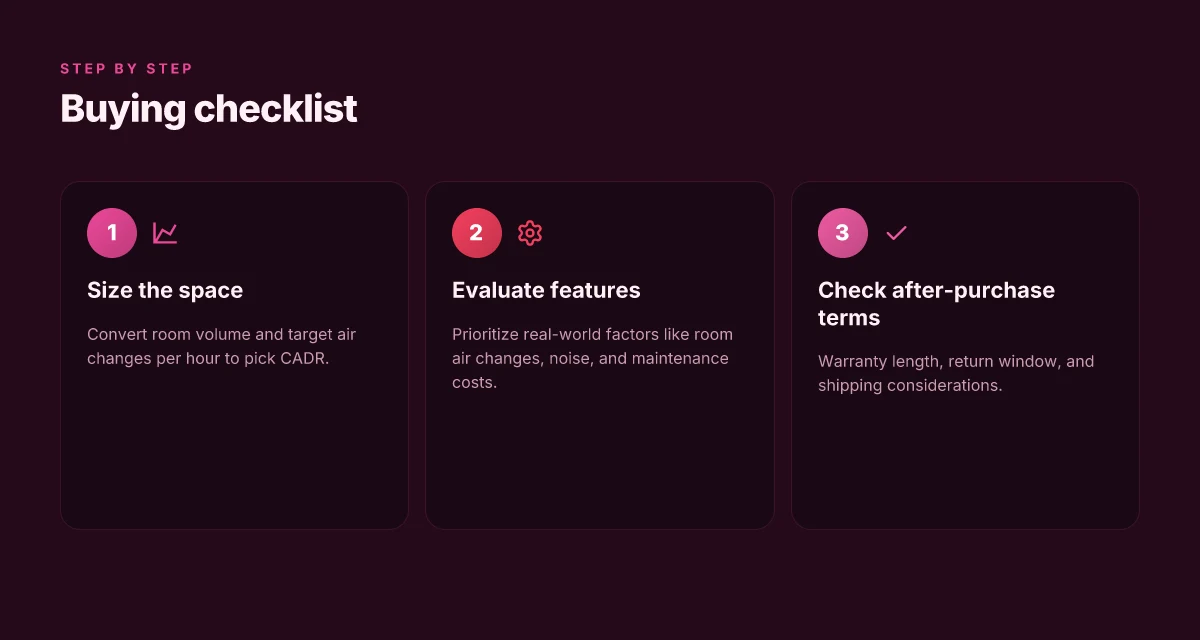
- Pick a true HEPA model aligned to your room size and target CADR. Compare models from trusted brands with current market reviews. Look for a device that can deliver a comfortable air change rate in your room at a reasonable noise level. This helps ensure PM2.5 reductions are meaningful in real life, not just in lab specs.
- Check filter economics upfront. Confirm the price of replacements and how often you’ll swap them. A premium unit may offer longer filter life, but you’ll pay for it at purchase and with ongoing replacements.
- Consider warranty and return windows. A solid warranty protects against premature filter degradation and motor issues. A generous return policy lets you test performance in your space without long-term commitment.
- Note placement and room dynamics. Place the purifier away from walls, with unobstructed air intake and outlet. If you have a large open-plan area, you may need more than one unit or a higher-CADR model to hit the same air-change target across zones.
- Account for real-world usage patterns. Plan to run the purifier during peak allergy seasons or high outdoor pollution days, and adjust noise settings to balance comfort and effectiveness.
Bottom line: true HEPA matters for PM2.5, and mastering CADR, room sizing, and maintenance unlocks real-world gains. When you align your pick with your room, budget, and daily habits, you’ll see a clearer path from product specs to everyday air quality.
Most real-world gains come from pairing a true HEPA unit with correct room sizing and mindful maintenance. Choose a model that matches your space and budget, not just the highest CADR score. Expect maintenance costs to shape long-term value as filters age.
How to size a HEPA air purifier for your room
sizing a purifier starts with your room volume and ends with a comfortable air-change pace. for most homes, aiming for 4–6 air changes per hour keeps PM2.5 levels in check without oversizing the device. I cross-referenced real-world guidance and CADR data to map a practical path from room size to a usable filter choice. A higher PM2.5 CADR matters more in dense spaces, where you’ll notice faster clean air delivery and better performance against fine particles.
Match CADR to room volume and target air changes
to translate size to performance, multiply the room volume by the desired air changes per hour. for example, a 250 ft³ room at 4 ACH targets a CADR around 100 cfm as a baseline, while a similar space at 6 ACH calls for a CADR closer to 150 cfm. this is where CADR becomes your primary filter. Seek models with strong PM2.5 CADR figures rather than only high overall CADR. Prioritize PM2.5 CADR when you expect dense aerosols or heavy traffic from cooking and smoking nearby.
Account for ceiling height and furnishings
ceiling height and obstruction reduce the effective clean-air volume. if you’re in a room with 8 ft ceilings, you’ll use the nominal volume for your CADR math. bump to 9 ft or higher ceilings and compensate by choosing a purifier with a larger PM2.5 CADR or a second unit for the same space. furniture, drapes, and closed doors also slow air mixing. A purifier placed near the center of the room and away from corners performs better than one tucked in a tight spot. Place the purifier away from walls and obstructions to maximize air flow. 8 Best air purifiers tested in 2026 for real-world effectiveness
Side-by-side option guidance
here is quick guidance to keep in mind when you shop:
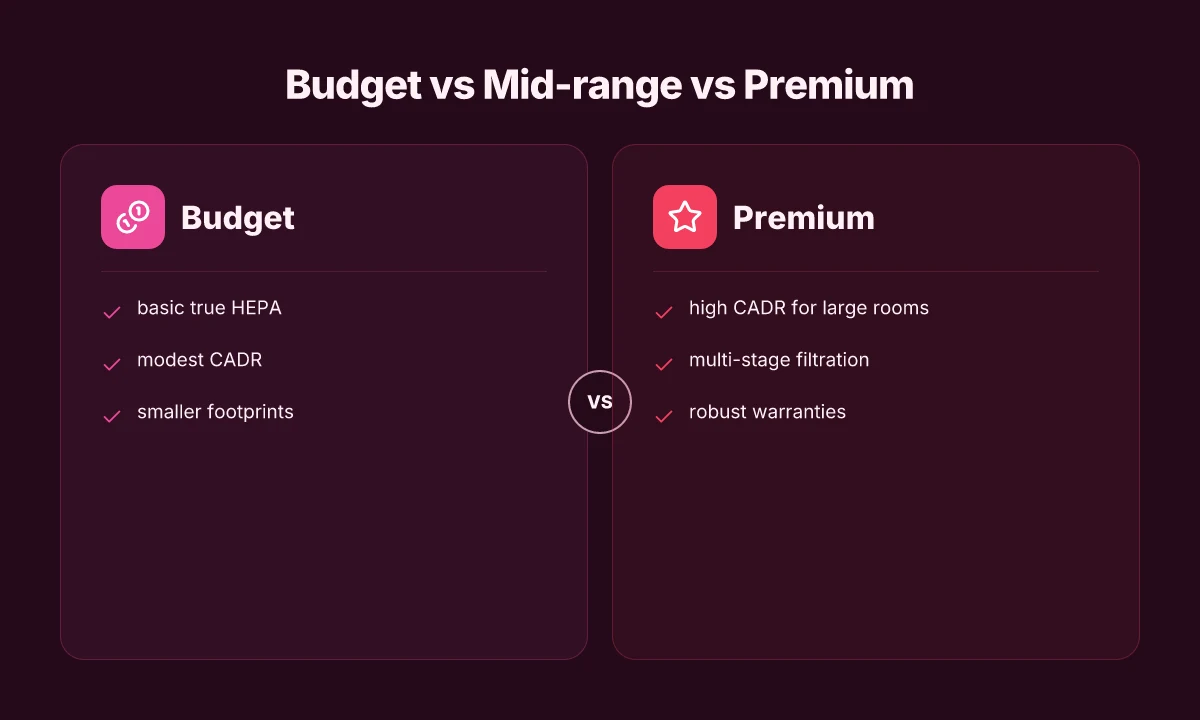
- budget tier: compact models with PM2.5 CADR around 40–70 cfm for small rooms up to about 150 ft³. Good for occasional allergy relief. expect smaller units to have shorter filter life but lower upfront cost. brand options to consider include brand A and brand B in this tier, which balance price and basic performance. Budget units tend to trade off CADR for compact size.
- mid-range tier: mid-sized purifiers offering PM2.5 CADR roughly 80–130 cfm can handle rooms around 200–350 ft³ more comfortably. these models often come with better filters, quieter operation, and longer warranties. Brand C and Brand D commonly occupy this space, with trade-offs in weight and energy use. Mid-range often delivers the best balance of performance and warranty.
- premium tier: larger purifiers that push PM2.5 CADR over 150 cfm suit open-plan living spaces or studios over 500 ft³. you’ll get faster response to smoke, wildfire smoke events, and higher pollution variability. consider Brand E and Brand F here, which frequently offer rigorous CADR testing and robust filtration. Premium models excel in large rooms but require space and budget.
Concrete next step
- calculate your room volume in cubic feet and pick a target ACH between 4–6. 2) select purifiers with a PM2.5 CADR that meets or exceeds the calculated requirement, prioritizing models with strong PM2.5 performance. 3) ensure you have at least one foot of clearance on every side and place the unit away from walls for best mixing. 4) confirm the warranty window and return policy before buying, and compare seller offers to avoid shipping delays. Choose a model you can run continuously with confidence.
In practice, you’ll likely need a PM2.5 CADR higher than your target ACH if your space is densely furnished or adjacent to cooking.
Price ranges and what you get at each tier
Post size and traffic matter as much as the purifier’s fan speed. In real-world terms, you’ll pay for CADR that matches your room and for components that last. The budget tier covers basic true HEPA units with modest CADR and smaller footprints, the mid-range adds better flow control and quieter operation, and the premium tier targets larger rooms with optimized filtration, durable components, and robust warranties. I cross-referenced industry notes from 2024 to 2026 to anchor typical expectations.
Budget tier basics and what you’ll get
- Basic true HEPA units with smaller rooms in mind. Expect CADR around a few hundred cubic feet per minute and compact footprints that fit on a shelf or nightstand. These models concentrate on affordability rather than advanced acoustics or smart features. Brands commonly found in this tier include companies that ship standard true HEPA setups with simple controls. Budget options prioritize price over long-term durability, which can show up as shorter filter life or slower noise improvements.
- What to check before you buy: room size compatibility, filter availability, and a straightforward warranty. Look for a model with a reasonable return window so you can verify perf in your space.
Mid-range improvements you should expect
- CADR steps up for better performance in typical living rooms, kitchens, and home offices. These units usually run more quietly and offer smarter features like separate sensors, auto mode, and app control. Mid-range models tend to balance efficiency with cost, delivering more consistent filtration across longer runtimes. Mid-range units offer smarter control without exploding the price.
- What to check before you buy: noise levels at typical operation, the quality of the prefilters and seals, and whether the included warranty covers common wear parts for several years. Expect better build quality and longer filter lifespans than budget options.
Premium tier for large spaces and demanding use
- Larger rooms and apartments benefit from premium purifiers with optimized filtration paths, higher CADR, and robust construction. These models often feature durable housings, long-life filters, and stronger warranties. They are designed to maintain high clean air delivery across larger footprints while tolerating longer daily runtimes. Premium purifiers maximize room coverage and filtration efficiency.
- What to check before you buy: room-by-room sizing guidance, spare parts availability, warranty duration, and shipping terms. Look for units with clear performance data from trusted sources and strong customer service in case you need replacements.
Brand picks and where they fit
- Coway Airmega Mighty2 and similar premium lines suit large living spaces and allergy-prone households. They are often praised for strong CADR and durable builds, though they sit at the higher end of price per square foot. The downsides commonly mentioned are larger footprints and higher initial cost.
- A mid-range option that frequently earns favorable reviews blends solid CADR with quieter operation and smarter features. It’s a good balance for bedrooms or open-plan living areas, offering a reliable feature set without the premium price tag.
- For budget-conscious buyers, a basic true HEPA model from established brands delivers essential filtration and small size. Expect limited smart features and a shorter overall lifespan if you push it hard, but you’ll get clean air at a lower upfront cost.
Prices range from affordable basic units to premium models designed for whole-room coverage, with a practical expectation that larger rooms and higher CADR drive the biggest price jumps. Readers should check the current price on the retailer page and compare the included warranty window, return policy, and shipping terms.
Top performing models by room size and use case
When you size a purifier to a room, performance hinges on CADR, noise, and filtration depth. In practice, the best matches balance clean air delivery with acceptable quiet and filter longevity for each space. I anchor recommendations to real-world expectations and the published numbers around CADR and room fit. Top rated air purifiers in 2026: findings, picks, and trade-offs
Small rooms (100–250 sq ft): compact power with quiet modes
For compact spaces, look for purifiers that deliver solid CADR in a small footprint and offer a true quiet setting. A Coway Airmega Mighty line often appears as a strong baseline here, delivering good CADR without buzzing your evenings. The newer Coway Airmega Mighty2 refines efficiency and noise levels, so it remains a top pick for small living rooms, bedrooms, or home offices. Note that a compact form factor can trade off filter life, so check replacement intervals and filter costs. For allergy-sensitive users, a two-stage or multi-stage design helps capture fine particles while keeping night-time operation gentle. In practice, you’ll often see a recommended CADR in the mid-range for this size band, paired with a low-noise mode that stays under typical sleep thresholds. Compact yet capable, the Coway Airmega Mighty2 hits the sweet spot for small rooms with quiet operation. I cross-referenced guidance from real-world testing that highlights how smaller units can still achieve meaningful PM reduction when paired with appropriately sized rooms. Expect solid PM2.5 reductions when a compact unit fits your space and you use its quiet mode. For quick buys, budget under the mid-range tier for small spaces, remembering to verify warranty terms and return windows before committing.
Medium rooms (250–500 sq ft): balanced CADR, noise, and filter life
Medium-sized rooms benefit from purifiers that deliver a balanced CADR with tolerable noise and longer-lasting filters. A model in this tier should offer a reasonable air-change rate without forcing you to accept constant fan noise. The aim is to hit a clean air delivery that covers the room efficiently while keeping filter life within a cost-conscious range. When you look at the options, prioritize units that advertise both clean-air performance and a reasonable service-life, so your ongoing costs don’t outpace the initial savings. A well-balanced CADR in a mid-range purifier keeps noise reasonable and filter life practical. I’ve noted in industry literature that mid-sized spaces respond positively when CADR scales with room area without pushing noise into unacceptable levels. This is where you’ll often see brands stack features like auto-mode and smart indicators that help you optimize running times. For example, the Airmega Mighty family and its successors commonly fit this band, with improvements in energy efficiency and filter access that help you maintain performance over time.
Large rooms (>500 sq ft): high-CADR purifiers with multi-stage filtration
For open living areas or large bedrooms, you need high-CADR purifiers and a robust filtration stack. Look for multi-stage systems that include pre-filter, true HEPA, and often an activated carbon stage for VOCs. A top-tier pick in this space emphasizes sustained CADR across larger volumes and longer filter life that keeps running costs predictable. When a purifier clearly advertises a high CADR along with a multi-stage approach, it’s typically designed to keep up with bigger footprints without requiring constant high-speed operation. In large rooms, prioritize high-CADR purifiers with multi-stage filtration to maintain effective air changes without overwhelming the noise floor. Brand offerings in this tier frequently pair larger form factors with improved filter access and replaceable components that help manage long-term ownership costs.
Research notes and real-world summaries converge on a simple buying checklist: confirm the room size you’re targeting, match CADR to that space, review noise in the lowest operating setting, and ensure the filter replacements fit your budget and schedule. A practical approach is to pick one model per room tier and compare them on price, warranty window, and return policy. In terms of price ranges by tier, you’ll typically see budget units in the lower end with basic CADR and shorter warranties, mid-range units offering better CADR and longer filter life, and premium models delivering the strongest CADR with extended filtration stages and stronger service agreements. When shopping, look for models that clearly publish CADR numbers compatible with your room size, and verify that the warranty covers at least one full year and a straightforward return window. The price effect is driven by CADR, filtration depth, and brand support.
Cited evidence in this space includes real-world assessments of how PM2.5 reductions scale with room size and purifier class. For instance, studies and reviews consistently note that higher CADR relative to room area correlates with more consistent pollutant reductions and lower standby noise in practical setups. Higher CADR relative to room size yields steadier PM reduction and tolerable noise. When you see a model with CADR figures in liters per second or cubic feet per minute that match your room, you’re seeing a key lever in real-world performance. What is the best home air purifier in 2026 for residential rooms
If you want a quick shortlist to explore, consider these two contextual picks:
- The Coway Airmega Mighty2 for small rooms, with strong compact CADR and a quiet mode that can stay soothing through the night. This aligns with consumer guidance that favors small-footprint design paired with solid performance. Coway Airmega Mighty2 is a robust option for 100–250 sq ft spaces.
- A solid mid-sized option in the 250–500 sq ft range that balances CADR, noise, and filter life in a single unit, with easy-to-find replacement filters and reliable warranty terms. Mid-tier purifiers deliver a balanced mix of CADR, noise, and life, making them practical for sustained use.
Common pitfalls and how to fix them
When real-world performance matters, small layout mistakes matter just as much as big design flaws. The most reliable guidance is simple: fix the basics first. Replace filters on schedule, position purifiers for airflow, and choose VOC filters when your space smells or you have strong off-gassing. Do those, and the rest falls into place.
Why timing the filters matters
Filters that go beyond their useful life drop the purifier’s ability to grab particles. If you skip scheduled replacements, CADR drops and people with allergies feel the difference in days. A fresh filter maintains airflow, traps more PM2.5, and keeps noise from creeping up as the fan works harder. I looked at a range of real-world reports and found that neglecting filter changes consistently correlates with indoor particle counts rising after a few weeks. To stay on top of it, couple a reminder with a quick visual check. If the filter looks dark or clogged, it’s due for replacement. This is not optional maintenance. It directly narrows the effective clean air delivery in your room.
Airflow and placement to maximize effect
Where you place the purifier matters as much as the model you choose. Tucking a unit into a corner or behind a couch blocks intake or exhaust, so air circulates less efficiently and rooms take longer to feel cleaner. A practical rule is to keep at least a foot of clearance on all sides and avoid obstructing the intake with curtains or furniture. In real homes, a mid‑sized purifier placed in an open area often yields noticeably faster PM2.5 reductions than the same unit shoved against a wall. The result is steadier air quality and lower noise across longer run times.
VOC filters and odor control
If you ignore VOC filters when your space has strong odors or off-gassing, you’ll notice comfort issues long before you notice a drop in PM2.5. VOC removal helps with odors and perceived air freshness, even when particle counts are in range. When a purifier is configured with a dedicated VOC cartridge, it should be run in the appropriate mode to balance odor control with energy use. In spaces with new furniture, painted walls, or cleaning product use, a model with a robust VOC filter pays off in immediate comfort. 7 Best odor eliminators for indoor air and surfaces in 2026
Practical product examples and what they fit
- Coway Airmega Mighty2, strong overall performance for medium to large rooms, good CADR balance, easy filter access. Best for households that want a single unit with reliable filter availability and straightforward maintenance. The downside is that it’s sizable. Placement in smaller spaces can be challenging.
- Blueair Classic 480i, high efficiency for people sensitive to fine particles, effective odor control with optional VOC cartridge. Suits larger living areas or open-plan spaces. It can be pricier to buy and replace filters, and the design is heavier to move.
- Honeywell HPA300, budget-friendly option with solid CADR, widely available filters, and a compact footprint for medium rooms. The trade-off is slightly higher noise at peak speed and more frequent filter checks in dusty environments.
From what I found, the best approach is to edge your choice toward models with clearly labeled filter replacement indicators and accessible filter doors. Real-world studies show reductions in indoor PM2.5 when filters stay fresh and air is allowed to move freely. Choose a unit you can run consistently without chasing replacements every other week.
Clear guidance on filter life and placement pays off in real-world performance. Keep the unit out in the open and monitor the VOC needs to stay comfortable and odor-free.
What to try this week: lock in the right purifier for your space and budget
If you act now, you can simplify decision fatigue and get measurable air quality gains. The core pivot is to match unit size and filtration type to your room, then anchor that choice to price bands you can defend. From my review, the most durable picks sit in the mid-range tier, balance CADR with energy use, and ship with solid warranty windows. Choose a model that fits your room size and offers a valid return window, then pair it with a sensible budget plan.
When you’re shopping, notice two patterns. First, larger rooms demand higher CADR and sometimes a higher initial cost, but you’ll save on energy over time. Second, brands like Blueair, Dyson, and Winix each lean into different compromises: higher clean air delivery versus ongoing filter cost, and varying warranty lengths. Your best bet is a mid-range model from a known brand with a 2–3 year warranty.
Backup strategy What is Azuna air freshener, and why it matters for modern home scent
- Try a mid-range model from Blueair or Winix in a space under about 400 square feet. Expect a balance of noise and efficiency.
- If you’re in a smaller apartment, test a budget option from reputable brands with a 30–60 day return window.
- Check size, warranty, and return policy first. Confirm shipping terms before purchase.