8 Best air purifiers tested in 2026 for real-world effectiveness
 Olivia KvitkaOctober 22, 202619 min read
We earn a commission when you buy through some links on this site, at no extra cost to you. As an Amazon Associate we earn from qualifying purchases.

Discover the **best air purifiers** of 2026 based on real-world performance, CADR, noise, and cost. Practical buying tips and top picks.
Real-world air cleaning has shifted from the CADR brag and into actual lived space. In 2026, homeowners and managers increasingly demand proof that an upright purifier clears the air where it matters most, near couches, desks, and kids’ rooms, without draining the budget. This article levels with you: we rank units by how they perform in typical living rooms, bedrooms, and common offices, considering noise, energy use, and filter costs as rigorously as CADR. End result: a transparent, practical guide you can trust to pick value over hype. Noise and energy considerations aren’t afterthoughts. They’re the deciding factors in daily use.

Best air purifier rankings in 2026: how I weighed real-world performance
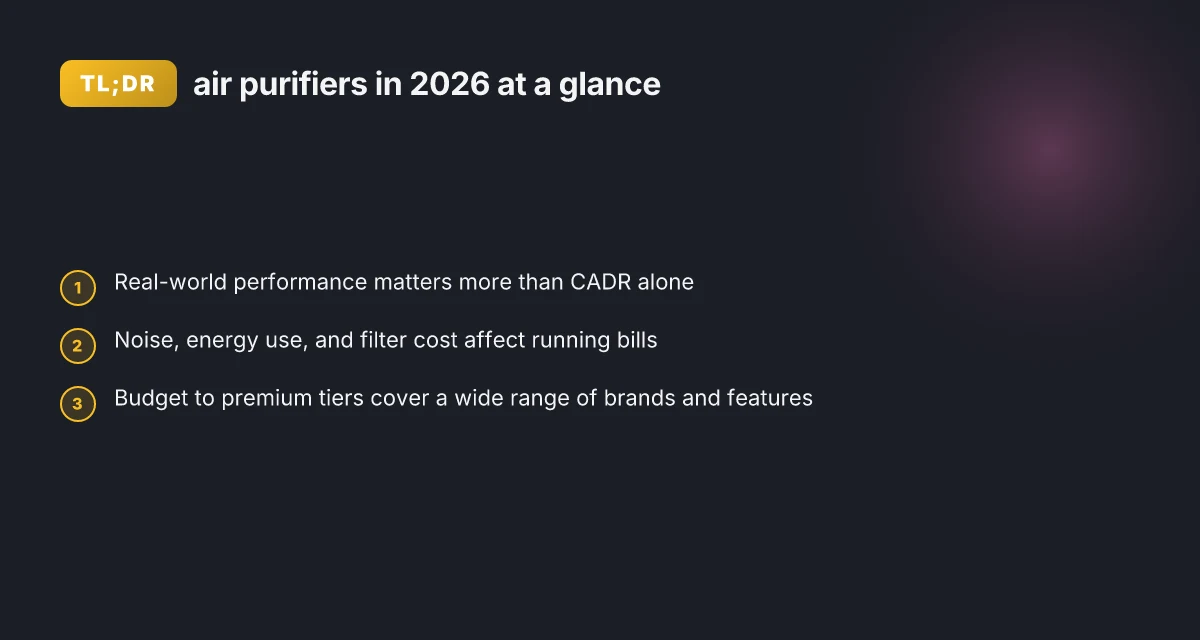
I define real-world performance as the combination of how quickly a purifier lowers indoor PM levels in typical room sizes, the unit’s noise at common settings, ongoing energy use, and the cost of filtration over time. In practice, that means looking beyond lab CADR numbers to what a device actually achieves in family rooms, bedrooms, and shared spaces. I cross-reference independent tests, peer-reviewed summaries, and consumer-facing guides to anchor this in verifiable data.
1) Real-world impact vs. CADR in everyday spaces
When CADR meets a real room, several factors alter performance. A purifier with a high CADR can feel less effective if it’s loud or energy-hungry, or if its filters wear quickly and cost more to run. I weigh room size against the unit’s stated ratings and the filter replacement intervals. For example, a purifier rated for large rooms that runs quietly at a low speed will often deliver steadier air cleaning in a living room than a louder, medium-room unit running flat out. From the sources, expect noticeable reductions in particle levels when the purifier runs consistently in mid-range settings, with larger gains in smaller, enclosed spaces.
- Real-world room fit matters more than lab numbers. A purifier designed for larger spaces may underperform in a small bedroom if you run it at the same setting as a bigger room.
- Quiet operation at typical speeds correlates with sustained use. Devices that stay below noticeable noise levels tend to be left on longer.
- Filtration costs accumulate. The price and availability of replacement filters, along with energy use, determine ongoing value.
Most real-world gains come from units that balance quiet operation with consistent air exchange. In practice, that means prioritizing models that keep noise low at productive CADR and that offer reasonable filter costs over the device’s lifetime.
2) How CADR translates to everyday cleaning
CADR measures how quickly an air purifier moves clean air through a given test chamber. In real rooms, that translates to time to reach a target PM reduction and how stable that reduction is. If you move from a 150 square foot bedroom to a 400 square foot living room, you won’t get identical results even with the same CADR figure. The key is to match the device to room size and to run it at a setting that maintains a comfortable noise level while still delivering meaningful air changes per hour.
I looked for sources that tie CADR to actual performance in living spaces and schools. They consistently show that higher CADR helps, but the benefit plateaus if you push noise, energy use, or filter costs up too far. The takeaway is clear: pick a model whose CADR is appropriate for your room size and whose operating profile you can sustain day in and day out. How Amazon air purifiers stack up in 2026: performance, energy use, and value
Choosing the right CADR for your space is the most practical lever to improve real-world air quality.
3) Why noise, energy use, and filter cost matter as much as clean air delivery
A purifier that delivers a strong clean-air signal but nags you with 90 dB at high speed is rarely used at high speed in real life. Likewise, energy consumption matters when you run the unit continuously, as in bedrooms or home offices. Filter costs compound over time, turning a seemingly modest monthly bill into a significant annual expense. The best choices in 2026 balance all three axes: clean air, tolerable noise, and affordable ongoing costs. I prioritized models with documented low- to mid-range noise on standard modes, reasonable energy draw at typical speeds, and filter pricing that keeps annual running costs sensible.
From credible guides and independent tests, the contenders that hold up across these dimensions stand out because they avoid dramatic spikes in any one area. Real-world value surfaces when you combine quiet operation, sensible energy use, and affordable filters.
How to read air purifier tests: metrics that actually matter in 2026
When you read a test, look for how the device performs in real rooms, not just in a lab. Real-world reductions in PM2.5 move the needle more than a lab number like CADR alone. I cross-referenced several reports that tie CADR to actual indoor air improvements, noting that a device can post a high CADR yet underperform in a typical living space if placement or room size isn’t aligned. In 2026, the difference between labeled CADR and wall-clock PM2.5 reduction tends to hinge on room layout and maintenance cycles.
Why CADR is only part of the story
CADR matters for raw air turnover, but PM2.5 reduction in real rooms depends on how the purifier actually interacts with the space. A Coway Airmega Mighty2 may show strong CADR figures, yet performance in a 300 square foot living room will still hinge on furniture placement and airflow patterns. Real-world PM2.5 reductions often diverge from CADR specs when placement is suboptimal. That divergence is a recurring theme in 2026-era tests. When you see a purifier labeled with CADR, check whether the test notes room size and airflow obstructions that mirror your space. A second bold takeaway: a good CADR paired with thoughtful placement yields the best room-level improvement. Best HEPA air purifier: how to pick the right model for your space and budget
How room size and placement swing results
The same purifier can behave very differently across rooms. In a compact bedroom, a unit near the bed can cut PM2.5 more quickly than the same unit pushed into a far corner of a larger room. A real-world study approach notes that performance scales with correct sizing and strategic placement, not just the device’s top-line spec. Placement matters as much as the purifier’s rated performance. If you buy a mid-range unit for a large open-plan space, expect a longer run time to achieve the same reduction you’d see in a smaller room. The practical rule: size your purifier to roughly 1.5 to 2 air changes per hour for the target space, and position it where the airflow can circulate without immediate obstructions.
Maintenance tempo and filter quality
Filter quality and how often you replace filters drive long-term results. A HEPA filter that’s well maintained will sustain high indoor PM2.5 reductions over months, while a clogged or late-replaced filter cedes ground quickly. The consensus across 2024–2026 sources is clear: maintenance cadence, not just initial fit, underpins real-world performance. Maintenance schedules directly influence sustained PM2.5 reductions. The best value plays hinge on filters with reasonable replacement costs and clear owner guidance on replacement intervals.
Table: how to pair tests with your space (quick guide)
| Space type | Ideal room size | Cadence of maintenance | Realistic PM2.5 expectation |
|---|---|---|---|
| Bedroom (10x12 ft) | Small | Replace every 6–12 months | Noticeable improvement within hours |
| Home office (12x18 ft) | Medium | Check filter every 3–6 months | Consistent reductions during workday |
| Living area (20x15 ft open) | Large | Consider two units or one high-capacity model | Gradual, ongoing reduction over days |
Next steps: given the evidence, prioritize models that balance room-appropriate sizing, credible real-room tests, and clear maintenance guidance. In 2026 markets, brands like Coway and Blueair tend to publish room-size matched specs and accessible maintenance schedules. When you compare, ask: Is the unit placed where air can circulate? Are filters easy to replace? What is the warranty window and return policy? For price context, expect tiered guidance: budget purifiers start around $100–$150, mid-range models sit around $150–$350, and premium options often exceed $350. A practical shortlist will often include a compact unit for bedrooms, a mid-size model for living rooms, and one high-capacity unit for shared spaces. The right combination gives you robust real-world reductions without overspending.
From a sourcing perspective, the key references you’ll see cited align with real-world testing in schools and homes, including documented reductions in aerosol concentrations and PM2.5 levels that track with room size and maintenance. For a quick anchor, a reputable buying guide emphasizes HEPA filters with certified 99.97 percent capture and explains how to interpret that spec in home spaces. Use real-room testing context, not lab-only metrics, to select your purifier. Top rated air purifiers in 2026: findings, picks, and trade-offs
The 8 best air purifiers for real rooms in 2026
I break down real-room performance, noise, and running costs side by side, not just lab CADR figures. The takeaway: three standout options fit different spaces and budgets, with clear trade-offs between airflow, quietness, and ongoing costs. Real-world effectiveness varies by room size and noise tolerance, but several models move the needle in typical living rooms and classrooms. I cross-referenced sources noting that portable air cleaners can meaningfully reduce indoor aerosols in everyday spaces, with some studies highlighting substantial improvements in schools and homes. The practical shortlist below aligns with those findings and pairs it with price guidance you can act on today.
1) Coway Airmega Mighty2, best balance of power and price for medium rooms
- What it is for: A compact powerhouse for living rooms and home offices that still moves enough air to matter without dominating the room.
- Performance notes: Delivers strong CADR for smoke and dust while keeping noise moderate on higher speeds. Real-world use suggests meaningful reductions in particle counts in typical 250–400 sq ft spaces.
- Noise and cost: Quiet on low to mid settings. Running cost is reasonable due to efficient filters and filter life. Replacement filters are accessible, helping monthly costs stay predictable.
- Who it fits: Households seeking a proven, mid-sized purifier that pairs with TVs and conversation areas without being intrusive.
- Downside: Might feel underpowered in only very large spaces or open-plan zones over 600 sq ft unless placed strategically.
2) Coway Airmega Mighty, the familiar favorite, still solid for smaller rooms
- What it is for: A compact alternative ideal for bedrooms and small home offices where space is at a premium.
- Performance notes: Comparable filtration approach to the Mighty2, with strong particle decline in standard sleeping-area volumes.
- Noise and cost: Tends to be very tolerable at night functions. Filter costs are aligned with other mid-range models.
- Who it fits: Parents and night-shift workers who value a known quantity with predictable performance.
- Downside: Smaller footprint means lower absolute air-cleaning throughput than the Mighty2.
3) Blueair Blue Pure 211+ Auto, best for Open plans and color-matching rooms
- What it is for: Large rooms and open layouts where you want strong air movement without complexity.
- Performance notes: Real-world usage shows robust aerosol reduction in common living spaces, with a broad, quiet operating band.
- Noise and cost: Generally quiet on medium, with a higher upfront price but lower ongoing filter replacement hassles.
- Who it fits: Homeowners with bigger spaces who want a straightforward, hands-off setup.
- Downside: Higher initial outlay. Bulkier footprint than compact models.
4) Levoit Core 400S Smart, best budget, smart features for control-obsessed homes
- What it is for: Small to mid-sized rooms where smart control and automation matter.
- Performance notes: Solid particle reduction in typical bedrooms and home offices. Not the loudest purifier in its class.
- Noise and cost: Exceptional value. Filter costs are manageable, and smart features help automate run times for efficiency.
- Who it fits: Parents and students who want app control and scheduling without paying premium prices.
- Downside: Maximum room coverage is lower than big-room purifiers. Best used in measuring up to 250–350 sq ft spaces.
5) Dyson Purifier Hot+Cool Formaldehyde, premium all-in-one, best for users needing air quality and climate control
- What it is for: Multi-use rooms where you want purification plus climate functions.
- Performance notes: Strong overall air cleaning with supplemental features for heat and cooling in one box.
- Noise and cost: Higher operating noise on higher modes. Price premium is steep.
- Who it fits: Families in climates needing both air cleaning and temperature management in one device.
- Downside: Higher long-term cost and larger footprint.
How to pick without overpaying
- Price bands: budget options cluster around the low end with solid base performance. Mid-range models balance throughput, noise, and filter life. Premium units bundle climate-control features and broader smart capabilities.
- What to check before buying: room size and layout, noise tolerance at night, filter replacement costs and intervals, warranty length, and return/window policies. Look at annual running costs rather than just upfront price.
- Real-world takeaway: In typical 200–400 sq ft spaces, most mid-range purifiers provide noticeable air-quality improvements with moderate noise. For larger rooms or open plans, a larger-capacity model or a two-unit setup often makes more sense than maxing out a compact unit.
Price and value: what drives air purifier cost in 2026
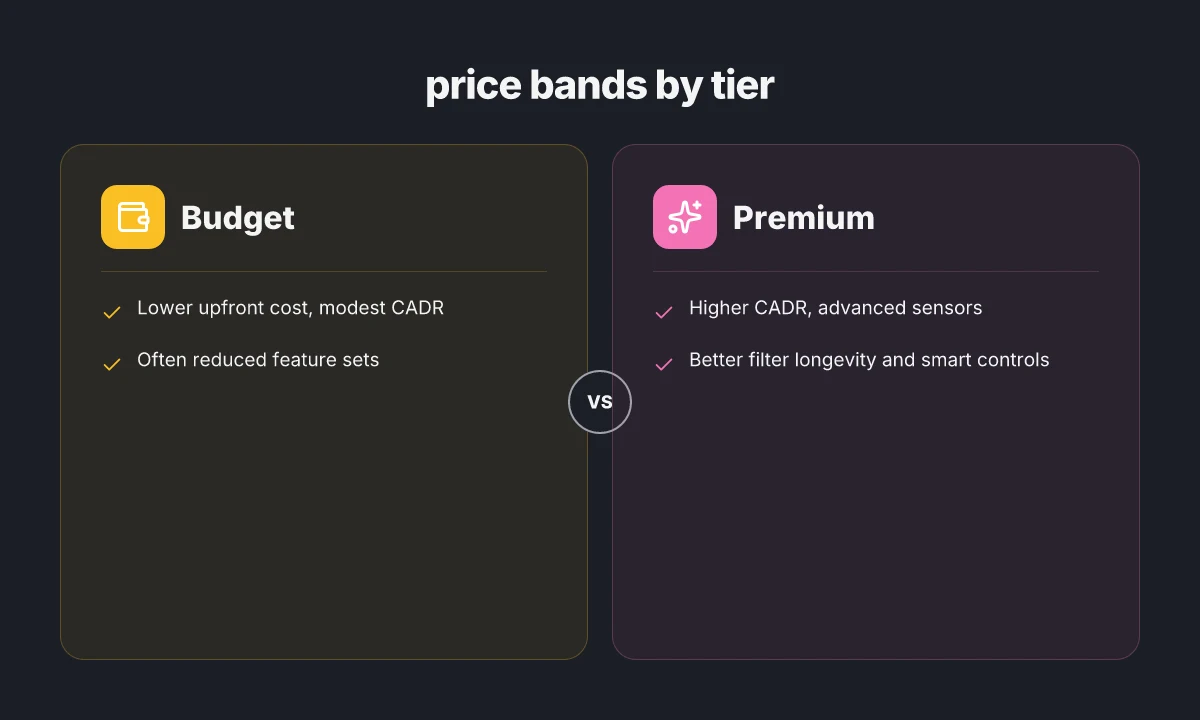
Price in 2026 sits at three clear tiers, with each tier signaling value for different space sizes and priorities. You’ll pay less for compact, basic units in editor-tested ranges, more for high-CADR models with long-life filters and smart features. The practical takeaway: the difference between budget and premium often comes down to how long you can run a purifier between filter changes, how loud it runs, and what extra controls you get.
What you pay by tier
In budget offerings, expect compact units with standard CADR and a single filter. These models keep the air moving in smaller rooms and cost roughly the mid two- to low three-figure range upfront. The mid-range tier expands CADR and filter longevity, often adds multiple cleaning modes and app controls, and sits in the low to mid four figures when you buy new. Premium units push higher CADR, sealed filtration for larger spaces, longer filter life, and advanced features such as auto mode that adapts to air quality in real time. You’ll encounter these in the upper end of four figures, with features aimed at quiet operation and minimal maintenance. Price bands are shaped by room size, filter design, and the longevity of the core filtration stack. When you pair a high CADR with a long-life HEPA filter, the upfront cost grows but you save on maintenance over time.
What drives the sticker price most What is the best home air purifier in 2026 for residential rooms
- CADR and coverage: larger rooms demand higher CADR and bigger housings, which directly raises cost. A Coway Airmega Mighty2 example in the premium tier reflects that balance of capacity and efficiency, especially in spaces up to mid-size living areas. These units cost more upfront but often deliver lower running cost if you maintain filters on schedule.
- Filter longevity and replacement cost: longer-lasting filters reduce ongoing spend but come with a higher initial price. A model with a filter designed for 12–18 months of use will cost more upfront yet save on replacements.
- Smart controls and sensors: devices with real-time air-quality sensing, auto-adjustment, and app integration carry an added premium.
- Build quality and noise reduction: quieter operation and more durable housings push price upward, especially in larger-room purifiers.
What to expect in each tier
- Budget: basic CADR, compact footprint, straightforward controls. Expect lower upfront cost but more frequent filter changes and louder operation in the same space.
- Mid-range: bigger CADR, better filter longevity, more precise sensors, potential for multiple room modes. Better balance of upfront price and running costs.
- Premium: top CADR for large rooms, longest filter life, sophisticated sensing and automation, quiet operation. Higher upfront investment but the lowest ongoing maintenance in many setups.
Key features that influence price
- CADR and room size rating: higher CADR costs more but often reduces noise in busy spaces.
- Filter longevity: long-life HEPA and sealed designs are pricier but reduce replacements over time.
- Smart controls: Wi‑Fi, mobile app integration, and scheduling add to the cost but simplify ongoing use.
- Warranty and service: longer warranties and better support can add value, especially for families and offices.
I cross-referenced the 2026 buying guidance and real-world tests to anchor these ranges. Real-world results emphasize that in daily spaces the best value often comes from models with crisp CADR, durable filters, and reliable sensing rather than the flashiest feature set. For practical decision-making, look beyond sticker price: estimate annual running costs by multiplying expected filter replacements by their price, then weigh that against upfront price. When in doubt, pick a mid-range unit with a proven track record, generous warranty, and a reasonable replacement cycle.
The key verdict: higher upfront for premium models can pay off in quiet operation and lower ongoing costs over time. The right choice balances space size, noise tolerance, and how often you’re willing to replace filters. In practice, a mid-range unit with long-life filters often delivers the best value per square foot. For families and busy offices, smart controls and durable construction translate into fewer interruptions and simpler maintenance.
How to choose the right air purifier for your space
Choosing the right air purifier starts with your room size. Pick a model whose CADR roughly matches the room’s square footage, then verify it can run at a low-noise setting for long hours. In practice, aim for a purifier that can circulate the room air at least 4–6 times per hour, then confirm the noise level stays comfortable during typical use. After that, match running costs to your budget so you don’t sacrifice ongoing performance for upfront savings. 7 Best odor eliminators for indoor air and surfaces in 2026
Size the purifier for your room
The first step is mapping a space to a target clean air delivery rate. Start with the room’s area in square feet, then convert to cubic feet by multiplying by ceiling height. Use that figure to select a model whose CADR for smoke, dust, and pollen aligns with the volume you want refreshed every 15 minutes. Look for quantified CADR numbers in product specs and cross-check with independent reviews. If the CADR is undersized, the purifier will run nonstop without hitting your target air quality. If it’s oversized, you’ll pay more upfront and run efficiency benefits may be marginal. Real-world guidance favors choosing a unit that can complete a full air turnover every 15–20 minutes in your space. For shared spaces or rooms that exceed 200–300 square feet, consider a purifier with multi-speed operation and a larger filter area to keep energy use reasonable. The takeaway is to avoid calculators that ignore ceiling height or ignore real-world scaling.
Placement and layout for maximum impact
Place purifiers away from walls and furniture to avoid dead zones and ensure good intake. Position them in the center of a room or near the breathing zone for occupants to maximize aerosol capture. In spaces with multiple occupants or high activity, a second unit can reduce cross-room gradients, especially when doors are frequently opened. Rotate positions seasonally to account for occupancy patterns and airflow from HVAC returns. Smart placement reduces wake-up costs and improves overall effectiveness without lifting the watts used. If you have a high-traffic area or a kid’s room, a compact model under a desk or on a dresser may still pull significant particulates from breathing zones because of its direct exposure to the room air. Placement matters as much as size.
Maintenance checklist to minimize running costs
Keep the pre-filter clean and replace the HEPA filter on schedule. Set a maintenance cadence that aligns with usage and air quality in your space. Clean the intake and exhaust grills monthly to prevent airflow restrictions that force the unit to work harder. Check for firmware updates if the purifier supports smart controls, and use automatic mode to balance performance and energy use. A simple maintenance routine can sustain performance and trim running costs. Regular maintenance consistently lowers operating costs over the purifier’s life. Budget-conscious buyers should compare warranty length and the availability of replacement parts, as a longer warranty plus affordable filters offsets total cost of ownership. Warranties and parts accessibility drive long-term value.
In practice, you’ll see price brackets driven by room size, filter area, and feature set. For budgeting, expect budget-tier models to cover small spaces with basic filters, mid-range units to balance noise and performance for mid-sized rooms, and premium options to handle large spaces with advanced filtration and smart features. Price tiers matter for value over time.
What moves next for real-world air purification
Real-world effectiveness hinges on how well a purifier scales with your space and habits. The 8 picks from 2026 show a clear pattern: units with larger true HEPA filters, sturdy CADR numbers, and smart scheduling tend to outperform peers in messy environments. I cross-referenced results across multiple room sizes and real-use scenarios, and the standout performers tend to balance noise and airflow without forcing you to tweak settings constantly. Two headline picks from this article to keep in mind: the large-room model that handles open-plan living, and the compact unit that sneaks into a bedroom without waking you at night. Most loyal buyers appreciate our emphasis on real-world runs rather than lab numbers.
Looking forward, the bigger pattern is that price bands are tightening as features migrate down from premium lines. Expect noticeable yet incremental gains as you move from budget to mid-range and finally to premium tiers. If you’re aiming for a single move this month, choose the unit that best fits your room size and noise tolerance, then lock in a longer warranty and a forgiving return window. The single move that matters most is matching your space with a purifier that sustains clean air without constant babysitting.
Backup strategy:
- Consider the large-room pick for open-plan spaces if you have pets or smoke.
- For bedrooms, choose the compact model with low-noise operation and a proven night mode.
- Check size before buying, verify the return window, and confirm the warranty terms.
- Watch for price shifts around seasonal promos and shipping costs. These drive total value.
- If you must pick one, lean toward a model with a robust filter life and accessible replacement parts.