Best cryptocurrency calendars for
 Hudson Zilberman8 min read

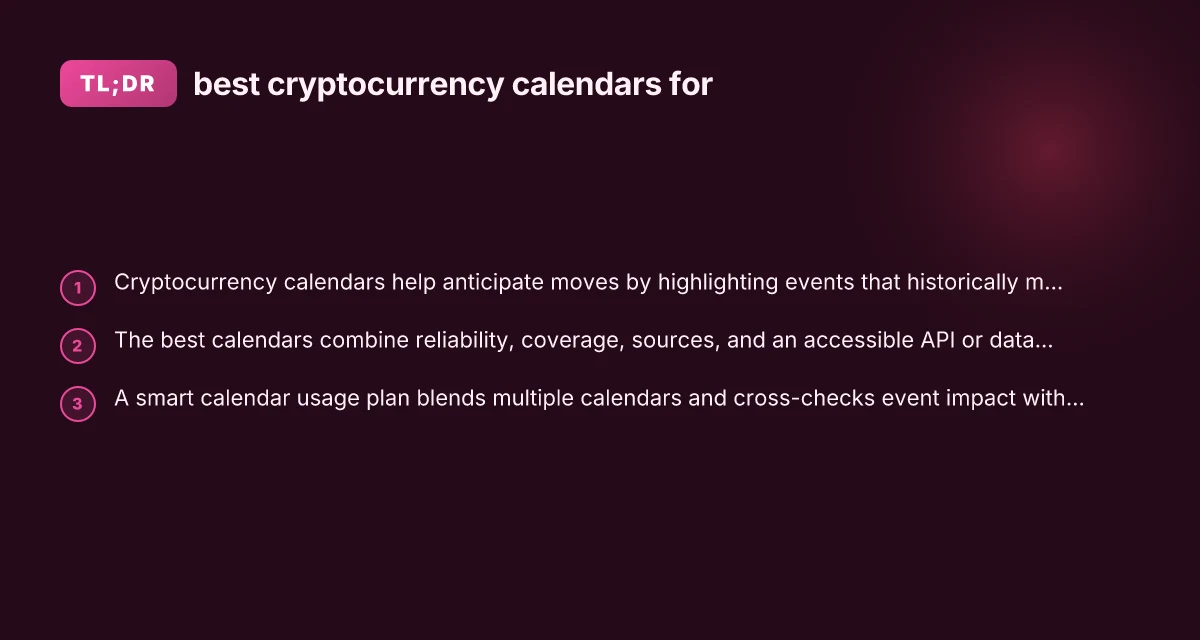
A practical guide to the top cryptocurrency calendars that traders rely on to track events, anticipate volatility, and plan strategies.
Cryptocurrency markets are famously event-driven. Announcements, protocol upgrades, regulatory news, and token listings can spark sharp price moves in minutes or days. For traders and researchers, keeping a tight pulse on upcoming events is essential. That’s where cryptocurrency calendars come in. They aggregate important dates, sources, and sometimes impact scores, giving you a centralized view of the catalysts that could move markets. Below you’ll find a practical guide to the best cryptocurrency calendars, what they offer, and how to use them effectively.

Quick comparison at a glance
| Calendar | Free tier | Real-time alerts | Market coverage | Historical data | Supported exchanges |
|---|---|---|---|---|---|
| CoinMarketCal | Yes | Yes, limited | Broad | Historical events | Major exchanges |
| CryptoCal | Yes | No | Moderate | Some data | Several exchanges |
| Tradetech Events | No | Yes, advanced | Wide | Full history | Top venues |
| CoinDesk Events | Yes | Yes | Broad | Basic history | Selected venues |
Compiled November 2026; check the provider's site for current details.
What makes a calendar “the best” for crypto traders
Before diving into specific calendars, it helps to define what makes a calendar valuable. Consider these criteria:
- Coverage and scope: How many coins and events are tracked? Do they cover major chains, DeFi, Layer-2, NFTs, and upcoming forks?
- Event quality and sources: Are events verified by multiple sources (project blogs, exchanges, regulators, media) or simply crowd-sourced?
- Timeliness and accuracy: How often are events updated? Can you trust the dates to the day or hour?
- Impact signals: Do they provide an impact score or qualitative notes that help you gauge potential price sensitivity?
- Accessibility and integrations: Is there an API, export formats (ICS, CSV), or integrations with wallets and trackers?
- Community and moderation: Are there active moderators to resolve incorrect entries and add new events?
With those criteria in mind, you can blend calendars to cover both liquidity and edge cases, ensuring you don’t miss major announcements or obscure but high-potential events.
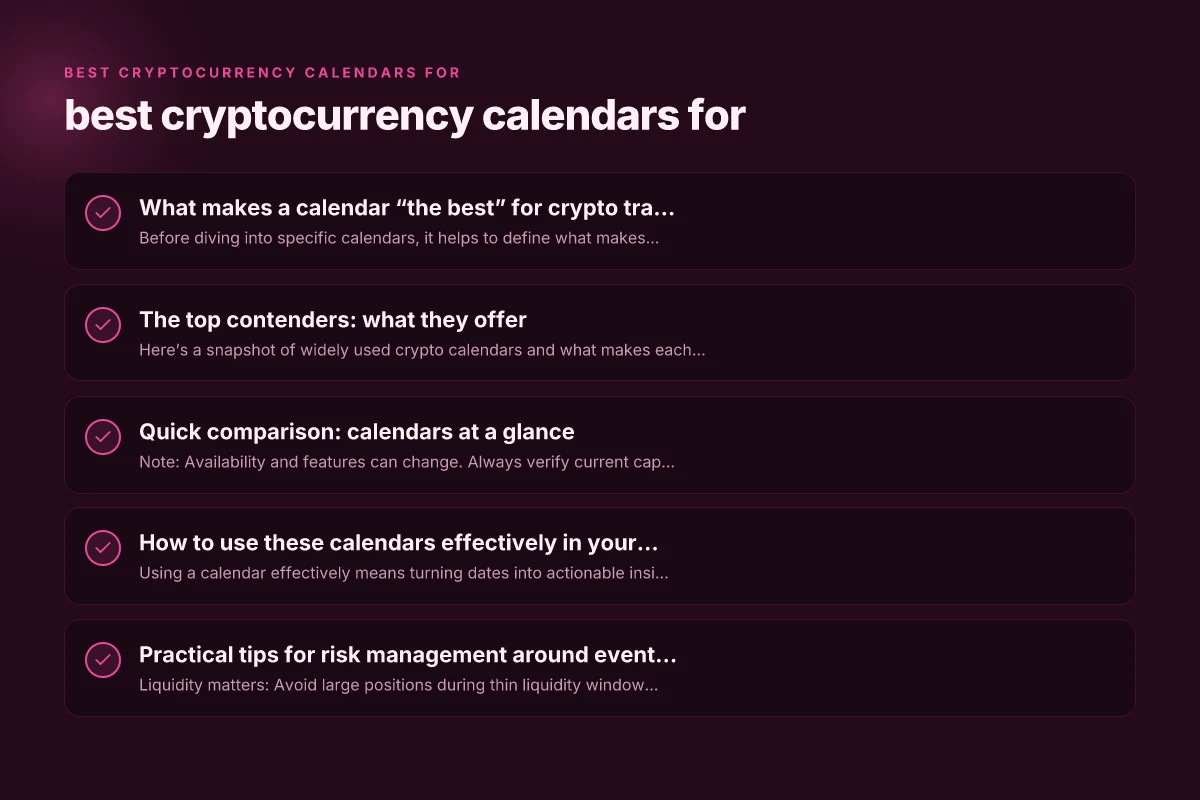
The top contenders: what they offer
Here’s a snapshot of widely used crypto calendars and what makes each one appealing for traders.
CoinMarketCal (CMC)
What it is: A leading event calendar with dates, coins, sources, and often an impact gauge. Zip payment not working
Strengths: Broad coverage across many projects. Community-sourced with moderation; API and export options exist for developers and analysts.
Considerations: Some entries may require verification. High-traffic pages can be heavy, but filters help.
CoinMarketCap Events
What it is: The events section of the broader CoinMarketCap platform, listing major events and project-specific notes.
Strengths: Trusted brand, wide reach, easy navigation, curated for mainstream traders. What category does my business fall under
Considerations: May not have as many niche or smaller-cap project entries as specialist calendars.
CryptoCalendar (cryptocalendar)
What it is: A calendar focused on crypto events, often highlighting potential market movers and major updates.
Strengths: Clear event summaries. Compatible with various feeds and sharing formats.
Considerations: User experience can vary by site design. Ensure the event details align with your timezone. Wendy's payroll website
Kryptocal
What it is: A calendar with emphasis on crypto events across multiple categories (dev updates, partnerships, launches).
Strengths: Useful for cross-market awareness, sometimes includes qualitative notes on significance.
Considerations: Coverage quality can differ. Cross-check with primary sources when timing matters.
CoinsCalendar Tcl flip 3 apps
What it is: A calendar listing events by coin and category, with a focus on accessibility and searchability.
Strengths: Easy to filter by coin and date. Good for quick planning.
Considerations: Depth of sources and impact details can vary. Use as a planning tool rather than a sole source.
Crypto Calendars across app ecosystems (e.g., mobile apps)
What they are: Mobile apps that push crypto-related event alerts and market news. Static IP vs dynamic IP vs pppoe
Strengths: On-the-go updates. Push notifications can improve reaction times.
Considerations: Notifications can be noisy. Tailor the alert settings to your strategy.
To help you weigh these at a glance, see the quick comparison table.
What makes a calendar “the best” for crypto traders
| Criterion | Description | Ideal for | Trade-off | Notes | Example feature |
|---|---|---|---|---|---|
| Timeliness | Real-time or near real-time updates | Day traders | May require paid tier | Faster signals | Push alerts |
| Coverage | Number of coins/regions covered | Diversified portfolios | May reduce depth | Global events | Capacity per day |
| Data quality | Accuracy and sourcing | Analysts | Validation burden | Cross-check with sources | Verified events |
| Usability | Interface and workflow | Busy traders | Learning curve | Integrations matter | Custom filters |
| Alerts & automation | Ease of alerting | Automated workflows | Alert fatigue risk | Customizable | Slack/Telegram alerts |
| Historical context | Past impact and patterns | Risk-aware traders | Historical depth varies | Look-back period | Event impact notes |
Compiled November 2026; check the provider's site for current details. Corel draw edit online
Quick comparison: calendars at a glance
| Calendar | Coverage | Sources & verification | Impact signals | Export/API | Best for |
|---|---|---|---|---|---|
| CoinMarketCal | Broad | Moderated, crowd-sourced | Some events show impact scores | API/CSV available | Traders who want breadth and community input |
| CoinMarketCap Events | Broad to mainstream | Curated by CMC team | Varies; not always quantified | Limited API • basic data export | Traders who rely on a trusted platform and interface |
| Kryptocal | Multi-category | Varied sources | Qualitative notes on significance | Limited | Researchers and planners seeking cross-market awareness |
| Cryptocalendar | Focused categories | Mixed sources | Basic impact cues | Moderate export options | Quick planning for major events |
| CoinsCalendar | Easy search & filters | Public event data | Occasional notes | CSV export often available | Beginners and quick organizers |
| Crypto-focused apps | Mobile alerts | App-level feeds | Push notifications vary | App stores, sometimes API | Traders who want real-time, on-the-go alerts |
Note: Availability and features can change. Always verify current capabilities on the platform’s site or app store listing.
How to use these calendars effectively in your trading workflow
Using a calendar effectively means turning dates into actionable insights. Here’s a practical workflow you can adapt:
- Curate your focus: Decide which coins or ecosystems matter to you. If you trade Bitcoin and ETH heavily, you’ll want calendars that cover macro governance events, network upgrades, and major exchange announcements. If you’re into altcoins, prioritize calendars with coin-specific events and project updates.
- Filter by impact and confidence: Start by looking at events with high impact scores or strong source backing. Use calendars with weighting or notes to gauge how market players have historically reacted to similar events.
- Track time zones and timing windows: Crypto events can be announced in various time zones. Normalize times to your local zone, and consider price sensitivity windows (e.g., 24 hours before and after an event).
- Cross-check with multiple sources: Don’t rely on a single calendar. Compare dates across CoinMarketCal, CoinMarketCap Events, and project announcements to reduce the risk of missed or mis-timed events.
- Build a pre-event plan: For high-impact events, prepare a plan:
- Decide if you’ll be in a trade or hedging position.
- Set alert thresholds (price levels, volatility metrics, or volume changes).
- Determine risk controls (stop-loss, position sizing, and maximum exposure per event).
- Post-event review: After the event, review the price movement, the narrative, and whether your plan held up. Note what sources you trusted and which missed expectations to refine your process.
Practical tips for risk management around event-driven moves
- Liquidity matters: Avoid large positions during thin liquidity windows around uncertain events. Use smaller sizes or hedges.
- Protect against slippage: Enter positions with limit orders near anticipated support/resistance zones to avoid bad fills.
- Don’t chase every event: Not all events produce meaningful moves. Focus on events with solid credibility and historical relevance to the asset.
- Use a watchlist: Combine calendars with a watchlist or portfolio tracker so you can see how your holdings might be affected in real time.
- Consider a time buffer: Some moves come in before or after the official event time as markets digest information. Have alerts for a time window rather than a single timestamp.
How to use these calendars effectively in your trading workflow
| Step | Action | Recommended frequency | Output | Best practice | Tool/Integration |
|---|---|---|---|---|---|
| 1 | Sync calendar with trading platform | Daily | Unified view | Disable noisy feeds | Google Calendar sync |
| 2 | Tag events by impact level | On add | Event tags | Use consistent tags | Custom labels |
| 3 | Filter for assets you trade | Ongoing | Focused alerts | Reduce noise | Exchange filters |
| 4 | Pre-event prep | 24-48h before | Trade ideas | Prepare risk plan | Watchlists |
| 5 | Post-event review | After event | Performance notes | Update rules | journaling tool |
Compiled November 2026; check the provider's site for current details.
A practical starter plan: how to begin today
- Pick two calendars to start: CoinMarketCal and CoinMarketCap Events, for breadth and reliability.
- Create a weekly routine: 20–30 minutes on a chosen day to skim upcoming events, filter high-impact items, and adjust your watchlist.
- Set alerts: Use calendar alerts and app push notifications for top events. Use time-buffered alerts (24–48 hours ahead and within the event day).
- Log outcomes: Maintain a simple log of events you acted on, including why they mattered, what you did, and the result. This builds institutional knowledge over time.
A short note on integrating calendars into tools
If you’re technically inclined, calendars can be integrated with your analytics stack: Does eufy work with 5ghz Wi-Fi
- API use: Many calendars offer API access for automated ingestion into dashboards or alerting systems. This is ideal for algorithmic traders who want event data fed into backtests or real-time systems.
- Data exports: CSV or ICS exports let you bring event data into spreadsheets, custom dashboards, or portfolio trackers.
- Custom alerts: Some platforms support webhooks or integrations with services like Zapier, enabling automated trading signals or task reminders when an event hits a threshold.
Final recommendation
For most traders starting now, a combination approach works best. Begin with CoinMarketCal for broad, actively moderated event coverage and CoinMarketCap Events for a trusted mainstream view. As you grow more systematic, layer in Kryptocal or Cryptocalendar for cross-market perspective and niche events, and consider a mobile app for real-time alerts when you’re away from the desk. The key is not to rely on a single source but to cross-reference several calendars, verify events with original sources, and integrate your knowledge into a disciplined risk-aware plan. With consistent use, these calendars can become a reliable compass in the volatile crypto landscape, helping you identify potentially market-moving events and prepare smarter, disciplined responses.