What category does my business fall under
 Solomon Caradoc7 min read
A practical guide to identifying your business category using NAICS, SIC, and IRS classifications, with steps and examples.
Introduction Figuring out the exact category your business falls under can feel like navigating a maze. The right classification helps with tax reporting, eligibility for programs, regulatory compliance, and even market analysis. The most authoritative systems in the United States are the North American Industry Classification System (NAICS), the old Standard Industrial Classification (SIC), and the IRS’s Principal Business Activity Codes. This guide walks you through how to identify your primary business activity and match it to the correct category, with practical steps and examples.

How classification systems work
- NAICS: The modern, federal standard used for statistical reporting and many regulatory purposes. Codes range from broad sectors to specific industries.
- SIC: An older system still encountered in some databases and company histories. Some tools map SIC to NAICS, but NAICS is the preferred current reference.
- IRS Principal Business Activity Codes: Used for tax and reporting purposes. These codes align with common business activities and appear on forms and schedules.
Understanding the distinction is important because different agencies may require you to use NAICS codes or IRS activity codes for filing, eligibility, or licensing. When in doubt, start with NAICS and then cross-reference IRS codes if needed.
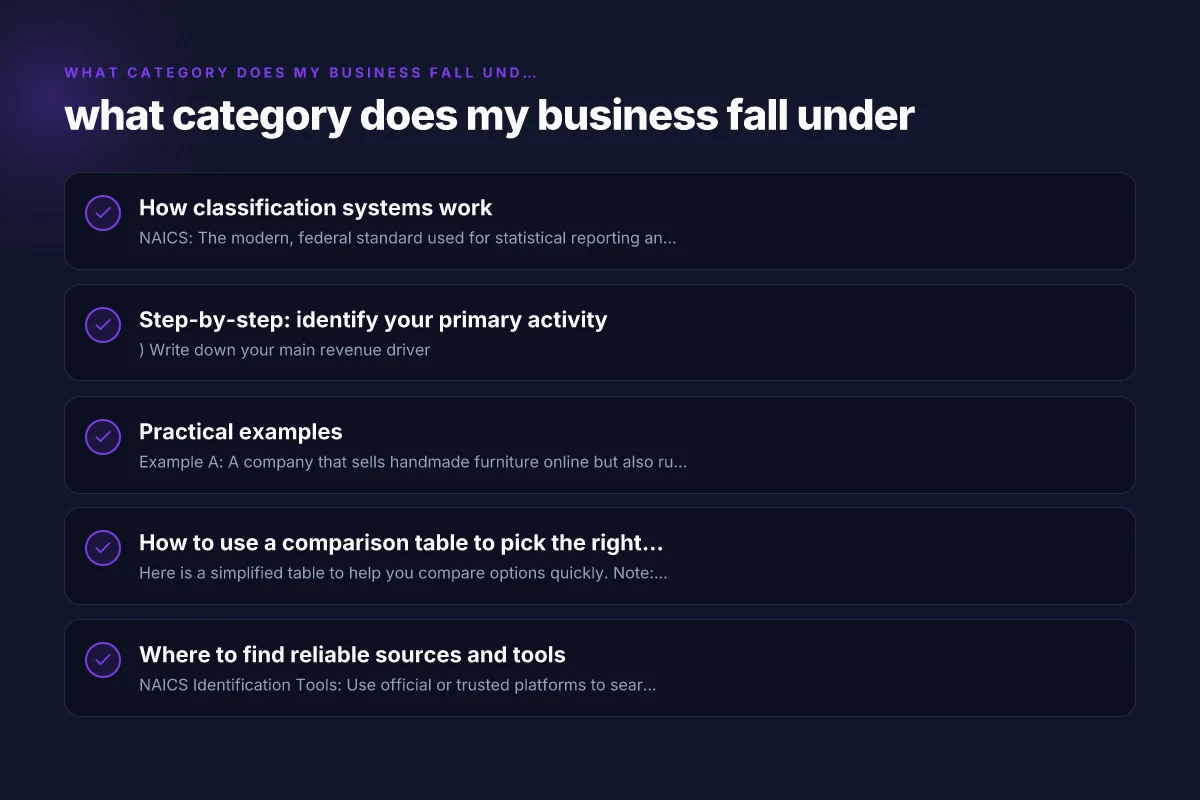
Step-by-step: identify your primary activity
- Write down your main revenue driver
- What product or service brings in the most revenue?
- Is your business primarily manufacturing, retail, professional services, or something else?
- If you run multiple activities, focus on the one that defines your core operation.
- Check official NAICS resources
- Use NAICS search tools to identify the code that best reflects your primary activity.
- Compare a few candidates to ensure your description matches your operations.
- Look at the industry description to confirm the scope of the activity.
- Cross-check with SIC and IRS codes
- If you encounter a legacy database or paperwork referencing SIC, map the NAICS code to the closest SIC code where possible.
- Review the IRS Principal Business Activity Codes to see if your activity aligns with tax reporting rows or schedules.
- Some businesses use multiple codes for different activities. Identify which is truly primary.
- Verify with your state and regulators
- Some licensing boards require NAICS or IRS codes for classification.
- If you’re in a regulated sector (healthcare, finance, food service), confirm the exact category with the relevant authority.
- Update consistently
- If your business shifts focus (e.g., from manufacturing to e-commerce services), revisit your classification and update filings, licenses, and websites as needed.
Practical examples
Example A: A company that sells handmade furniture online but also runs a small woodworking workshop
Primary activity: Selling furniture (retail trade)
Likely NAICS: 454110 (Electronic Shopping and Mail-Order Houses) if most sales are online, or 423310 if primarily wholesale, or 337124 if manufacturing and direct-to-consumer storefront is the focus.
IRS codes: Check Principal Business Activity Codes for a close match, such as 423 (Wholesale Trade) or a code aligned with manufacturing/services depending on emphasis. Wendy's payroll website
Example B: A software development firm offering custom apps
Primary activity: Software development and information technology services
NAICS: 541511 (Custom Computer Programming Services) or 541512 (Computer Systems Design Services) depending on the service mix
IRS codes: Look up the corresponding activity code that best describes software development and IT services
Example C: A local bakery that primarily sells to walk-in customers and at farmers markets Tcl flip 3 apps
Primary activity: Retail bakery and prepared foods
NAICS: 311812 (Commercial Bakeries) or 722515 (Snack and Nonalcoholic Beverage Bars) depending on service model
IRS codes: Align with business activity in food services and retail trade
Example D: A consultancy that provides business strategy advice
Primary activity: Professional, scientific, and technical services Static IP vs dynamic IP vs pppoe
NAICS: 541611 (Administrative Management and General Management Consulting Services) or 541618 (Other Management Consulting Services)
IRS codes: Use the closest management or professional services code
How to use a comparison table to pick the right code
Here is a simplified table to help you compare options quickly. Note: exact descriptions vary. Always read the official code descriptions to make a final choice.
| Scenario | Primary Activity | NAICS Candidate | IRS Activity Code Candidate | What to check in descriptions |
|---|---|---|---|---|
| Online retail of home goods | Selling goods online to consumers | 454110 (Electronic Shopping) or 454210 (Vending machine); choose based on model | Corresponding IRS codes for retail or e-commerce | Ensure the code describes online sales and consumer retail |
| Custom software development | Software development and IT consulting | 541511 or 541512 | Codes for professional services in IT | Look for emphasis on programming or systems design |
| Local café with food service | Food service and retail | 722515 or 722310 (Food service) | IRS codes for food and drinking places | Verify if primary is restaurant operations or beverage service |
| Manufacturing and selling hardware | Manufacturing plus direct sales | 332999 (All Other Miscellaneous Fabricated Metal Product Manufacturing) or 339999 (All Other Miscellaneous Manufacturing) | Manufacturing-related codes | Ensure manufacturing dominates income over services |
If you want a faster approach, you can search for “NAICS code for [your primary activity]” and review the top results with the official NAICS descriptions. You may also use the NAICS search tools to locate a code by keywords and then read the full description to determine if it matches your operations.
Where to find reliable sources and tools
- NAICS Identification Tools: Use official or trusted platforms to search for codes by activity or keyword. These tools help map your description to the closest NAICS code and give you a succinct description.
- NAICS Lookup Help: Some pages walk you through identifying the right code with questions about your primary business activity.
- U.S. Census Bureau NAICS: The authoritative reference for the current NAICS structure and code list.
- IRS Principal Business Activity Codes: A list that helps align your business activities with tax reporting lines.
- SIC references: While largely superseded by NAICS, you may encounter SIC codes in older filings or databases. Use crosswalk resources to map to NAICS when possible.
Common pitfalls to avoid
- Treating NAICS as only a tax issue: While NAICS influences tax reporting in some contexts, it also affects regulatory compliance, licensing, eligibility for programs, and market research.
- Sticking to a code that feels “correct” but isn’t accurate: The code should reflect where you derive most of your revenue and where your business operates day-to-day, not just what you wish to be.
- Underestimating multi-activity businesses: If you have several revenue streams, identify your primary activity and consider secondary codes only if needed for regulatory or reporting purposes.
- Forgetting to update codes after a business shift: A change in product line or service model can alter the appropriate classification. Revisiting codes when major changes happen is wise.
How to implement the classification in your business documents
- Legal and tax filings: Use the NAICS code on tax forms where required by the IRS or state agencies.
- Licensing and permits: Some state or local licenses request the NAICS code to determine eligibility or inspections.
- Financial reporting: Investors, lenders, and financial statements may reference NAICS codes to categorize the business by sector.
- Marketing and analytics: Knowing your category helps with market research, competitive benchmarking, and identifying peers.
Table: Quick mapping guide to common business activities Payroll 2 weeks in arrears
| Activity category | Likely NAICS range | Common considerations |
|---|---|---|
| Retail trade | 44-45 | Online vs brick-and-mortar balance; consumer sales focus |
| Manufacturing | 31-33 | Primary output, production processes, supply chain implications |
| Information technology services | 51-53 | Software, data processing, IT consulting; project-based revenue |
| Professional services | 54-81 | Legal, accounting, design, management consulting; regulatory fit |
| Accommodation and food services | 72 | Food service operations, hospitality, location-based licensing |
Final Thoughts and Recommendation Determining the correct category for your business is not just a bookkeeping exercise. It shapes regulatory compliance, financing, and growth opportunities. Start by identifying your primary revenue driver and then compare it against NAICS and IRS classifications. Use NAICS search tools to find the best-fitting code, read the official descriptions carefully, and cross-check against IRS activity codes if needed. If your business has multiple significant activities, consider your primary activity for most filings and document secondary activities for internal analysis or specialized reporting.
If you want targeted help, you can:
- Run a few candidate NAICS codes through official search tools and compare their descriptions to your operations.
- Look for industry peers with similar business models and see which codes they use in public filings.
- Consult a professional (accountant or business advisor) who can map your activities to the most appropriate codes and guide you on where to apply them.
By following the steps outlined above, you’ll have a solid, defensible classification for your business that supports accurate reporting, compliant licensing, and informed strategic planning.