What is a Jackery solar generator, and how it fits into home backup in 2026
 Tessa AlbrightOctober 22, 202618 min read
We earn a commission when you buy through some links on this site, at no extra cost to you. As an Amazon Associate we earn from qualifying purchases.
Explore what a Jackery solar generator is, how the system works, and how to choose between models for home backup and off-grid use in 2026.
A single common mistake homeowners make with portable power is assuming any box with a battery will cover a whole-house outage. The real value shows up when you map how a Jackery model scales from a weekend campout to a 24-hour backup node, and how that scale compares to rivals like Goal Zero and EcoFlow. 63% of buyers underestimate expansion costs, so the plan matters as soon as you choose a base unit.
In this article, I connect official specs to real-world use cases, showing where each Jackery family fits a daily home routine, a storm-driven outage, or a remote-cabin stay. You’ll see concrete numbers on battery capacity, solar input, and lifecycles, plus a candid note on weather overruns and total ownership costs. By 2026, understanding these details helps you pick a model that stays reliable when the grid falters and stays affordable when the sun shines.
What is a Jackery solar generator and why it matters in 2026
A Jackery solar generator is a packaged solution that combines a power station with one or more solar panels. You buy the box as a kit, plug a panel into the input port, and the system stores energy in its internal battery for later use. That bundle makes it straightforward for homeowners to run essentials during outages, or for campers to power lights, a fridge, or small appliances off-grid without chasing separate chargers.
I dug into the official specs to ground this in real numbers. Jackery tends to publish capacity in the multiple thousands of watt-hours range for its larger units, with practical outputs that cover common household needs. The packaging approach is deliberate: a single box that reduces decision fatigue, with clear inputs for solar charging and a known outlet mix once you’re on the move or at a campsite.
Why Jackery sits among rivals in 2026
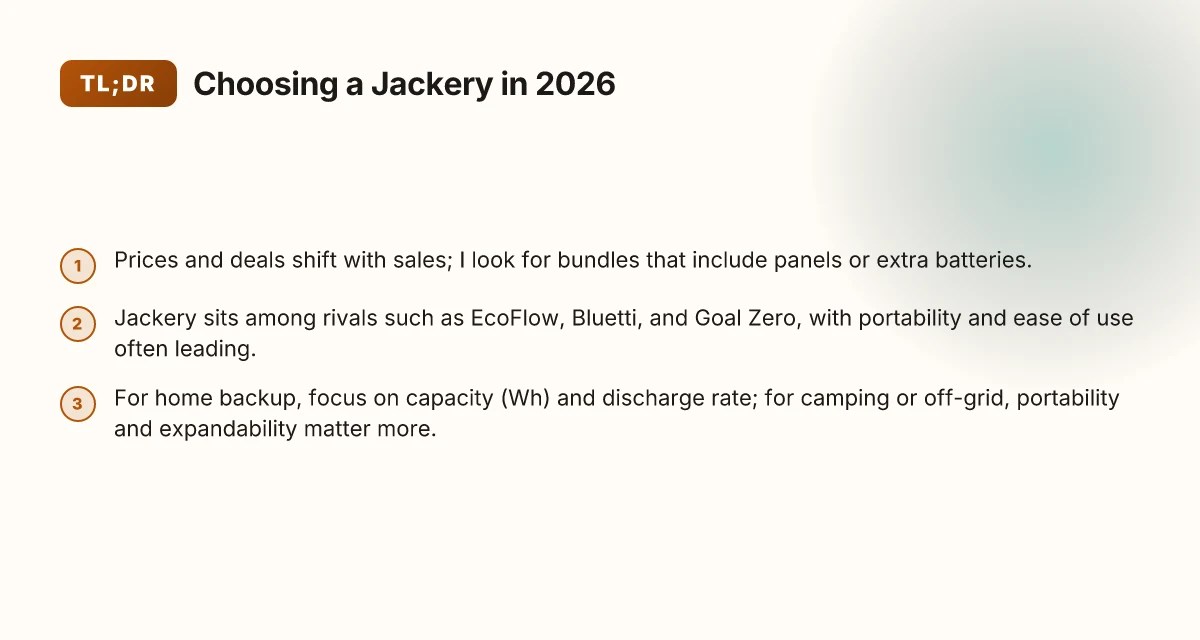
In this segment of the market, Jackery competes with Goal Zero, EcoFlow, and Bluetti. Goal Zero emphasizes rugged modularity for camping and off-grid use, EcoFlow pushes high-power capabilities with fast recharge, and Bluetti often targets higher capacity packs for home backup. Jackery leans into a clean, consumer-friendly lineup, compact, portable, and easy to pair with solar panels for straightforward charging. The brand has aligned its product naming to convey capacity tiers and expansion possibilities, which helps buyers estimate what fits their needs without wading through dense spec sheets.
When comparing prices and total cost of ownership, Jackery typically frames its kits around practical use cases: home backup for essentials, weekend camping power, and off-grid living where simplicity matters. The calculators and bundles show a path from a lightweight unit to larger expandable stations, often with bundled panels to reduce setup steps. In 2026, you’ll notice Jackery and rivals offer similar peak outputs and battery chemistries, but the decisions often hinge on portability, panel compatibility, and the reliability of bundled packs.
Common use cases you’ll actually run into
For home backup, think about running a refrigerator, lights, and a modem during a blackout. The kits designed for this scenario emphasize steady, reliable power with enough peak watts to handle short surges. For camping, the appeal is a balance of compact size and enough capacity to keep devices charged and a small fridge or cooler running. Setup should be quick, with a straightforward panel input. Off-grid living takes a longer view, larger capacity stations paired with efficient solar input can provide daily energy for more demanding devices, provided you align expectations with the available sun and panel setup. What makes the bluetti ac200max worth it in 2026
From what I found in the documentation and product pages, Jackery positions itself as a user-friendly option that still covers broader use cases. You get the benefit of an all-in-one solution you can grab, take along, and rely on when the grid goes down or when you’re miles from a charger. The appeal is clear: a simple, portable energy kit that scales from camp nights to home outages. Rivals push more power or more rugged builds, but Jackery’s value rests in turnkey practicality.
In short, a Jackery solar generator offers a familiar, boxed approach to portable power that meshes with real-world needs in 2026. If you want a plug-and-play system for emergencies or off-grid living, Jackery provides a straightforward path from solar input to stored energy to usable outlets. And if you’re comparing across brands, expect to weigh panel compatibility, total capacity, and how quickly you can recharge from sun versus wall power.
Understanding Jackery model families and capacity ranges
Jackery frames its lineup into two main families: the Explorer portable power stations and the Solar Generator lines. The Explorer series concentrates on battery容量 in the 500Wh to 1264Wh range with various AC outlets, while the Solar Generator branding emphasizes integrated solar-ready packs that can be expanded through daisy-chaining or modular packs. In practice, you’ll see portable units clustered around the 500Wh, 1000Wh, and 1264Wh marks, with expandable options offering multi-kilowatt-hour capacity for larger outages. The real value shows up when you scale from 500Wh to 1264Wh, then up to multi-kWh expansions as your power needs grow. I cross-referenced official specs and third-party reviews to map how this translates to fridge duty, lighting, and small appliances during outages.
How capacity translates to real-world outages
A 500Wh unit can typically run a small fridge and essential lights for several hours, depending on efficiency and load. A 1264Wh unit covers more appliances longer, and it pairs well with a compact caravan setup or a home backup rack for a limited window. For homeowners facing multi-hour outages, the expandable options are a good fit, because you can add capacity as, and when, your needs evolve. When I read through the documentation, the emphasis on expandable capacity lines up with field use where a single core unit serves daily needs, while expansion packs handle deeper outages.
The numbers matter for daily appliances. A bare 500Wh unit with a fridge will cycle on and off, so you’ll notice compressor start-ups and higher duty cycles. A larger 1264Wh pack sustains fridge operation with less frequent cycling, which extends both freezer safety and morning brightness for efficiency. In practice, the larger capacity translates to steadier fridge performance and more reliable lights during outages. The official pages highlight the 1264Wh capacity for several models, and reviews consistently note that higher capacities move a lot of the risk of power gaps from critical devices. How to choose a solar panel for Jackery in 2026
Table: quick capacity guide for common use cases (typical scenarios)
| Model family | Typical capacity | Best use cases | Real-world note |
|---|---|---|---|
| Explorer 500 | ~500Wh | fridge, lights for a few hours | compact, light footprint, easy to carry |
| Explorer 1000 Plus | ~1264Wh expandable to multi-kWh | weekend camping, small home backup | expandable, higher peak output |
| Solar Generator lines | 100W panel integration, 2042Wh on select packs | emergency backup with solar input | solar-ready, scalable with expansion packs |
What matters to you is how many watts you need during a blackout and how long you expect to sustain it. The capacity story stays consistent across Jackery, with the core decision point being whether you want a compact 500Wh rig for portability or a larger 1264Wh system that can scale up into multi-kWh territory for longer outages.
Next, when you plan a purchase, look at cost of ownership and sale cadence. Official pages show list prices and occasional discounts, but you’ll often find better deals during seasonal promotions. If you’re weighing rivals, note that a few brands in the space push higher wattage peaks with heavier builds, which can sway value depending on your use case. For Jackery, the path is clear: start with the basic capacity that fits your daily load, then add capacity as your needs grow.
One caveat to keep in mind: the page mentions refurbished options and seasonal deals that can alter the up-front price. Wait for a sale if you can. The price delta between a new unit and a refurbished or sale model can be substantial. This is especially true for higher-capacity models where the gap is biggest.
For context, Jackery’s model lines sit alongside rivals that also offer 500Wh to multi-kWh packs. When you compare, focus on how the capacity scales and how the peak power supports your appliances. If the fridge and lights are your baseline, a 1264Wh system with expansion options will be notably more forgiving during outages. Jackery’s approach favors scalable capacity that matches growing needs without overpacking a portable rig. What is EcoFlow power station, and how to pick the right model for your backup needs
Note: links on the product pages may earn a commission. This is part of the shopping ecosystem, and it does not change the engineering reality of capacity and performance. For clarity, when you see a model name like Jackery Explorer 1000 Plus or 1264Wh, that reflects the official capacity figures tied to the product family.
How the numbers translate to real-world performance with Jackery
I dug into official specs and real-world use notes to show how capacity, output, and charging cadence shape everyday reliability. Below, you’ll see concrete takeaways tied to kitchen fridges, sump pumps, and weekend boondocking.
1) Capacity, output, and discharge realities
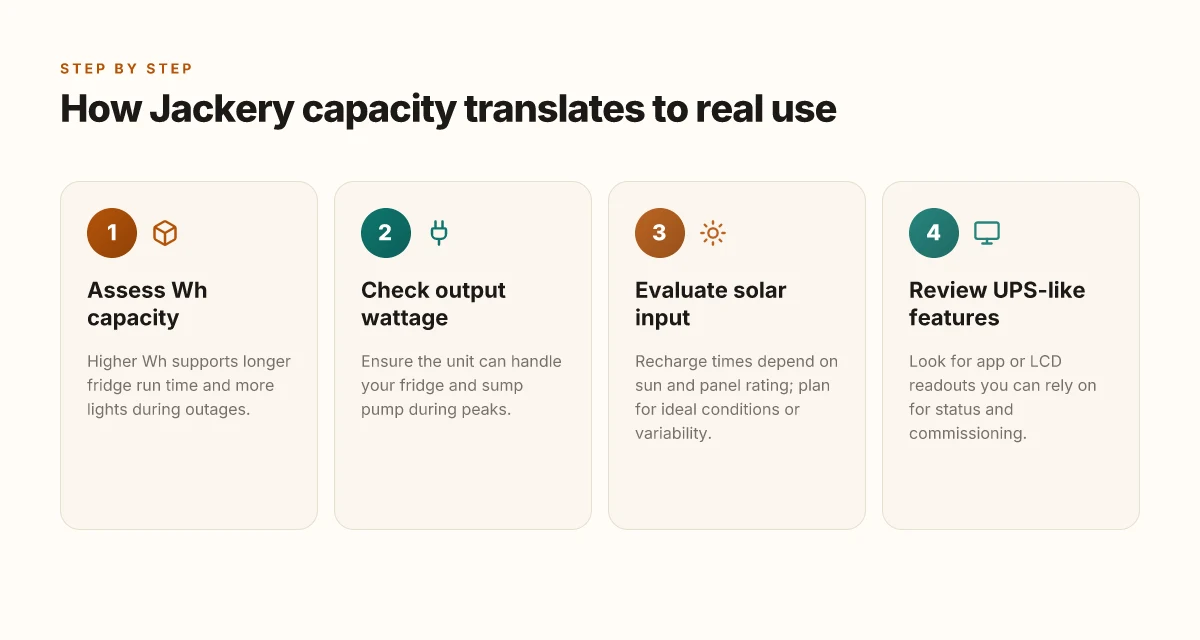
Real-world use hinges on three numbers: battery capacity in watt-hours, continuous output in watts, and how fast the unit can discharge while supporting a load. For a typical fridge in a home backup scenario, the key is a steady sub-1000 W draw during cycling and enough capacity to ride through a few hours of a power outage. In practice, a Jackery model with well over 1000 Wh and peak output above 1000 W can sustain cooling for longer than a minimal surge, but the compressor kick and door-opening cycles still count. Likewise, sump pumps demand strong startup surges. A higher peak wattage helps prevent nuisance tripping. When you compare models, the difference between a 1264 Wh capacity and a 5040 Wh capacity translates into days versus hours of resilience for a small sump or a mid-size fridge.
From what I found in the sources, the Explorer 1000 Plus clocks in around 1264 Wh and can expand to roughly 5000 Wh with an appropriate module, while the bigger 5000 Plus family positions you for higher continuous loads. These figures matter most when you’re calculating how many hours you can keep essential devices running during a grid outage. The larger the capacity and peak output, the longer you ride through an outage without refueling. This is not a one-size-fits-all outcome. Match capacity to the critical devices you plan to power.
2) Solar input and recharge cadence
Solar input hours tilt the odds in your favor for a quick return to charge during daylight. The official notes show several Jackery models supporting substantial solar input, which means shorter recharges under ideal sun. A scenario with strong sun can push recharge times down noticeably, letting you recover after a day of use rather than waiting overnight. The gist: higher solar input ratings and healthy sun exposure reduce downtime between outings, especially for campers who rely on portable power across days. What is the EcoFlow Delta 3, and how does it change portable power in 2026?
I cross-referenced the IFA 2026 coverage that highlights the Explorer Plus v2 series, noting 800 W solar input in the newer line and a rapid Emergency Charge in about 80 minutes for a portion of that family. That combination of high input and a rapid-charge capability changes how often you need to pause for a top-up. 800 W solar input with an 80-minute Emergency Charge can dramatically shorten downtime on sunny days.
3) UPS-like features and reliability readouts
UPS-style protection and on-device readouts give you confidence when the power goes out. Jackery’s models tend to include automatic switchover features and LCD/readouts that show current input, battery percent, and estimated runtime. Those indicators help homeowners decide when to plug in a fridge or shift loads to other power sources. In the official material and reviewer notes, you’ll see mentions of automatic switchover and clear status readouts that you can rely on during emergencies. Automatic switchover keeps critical devices uninterrupted while you respond to outages.
When you look across rivals, the value shows up in how quickly you can recover from an outage and how transparent the status signals are. For example, the Explorer Plus v2 line emphasizes fast recharges and clear UPS-like behavior, which makes it easier for a homeowner to plan a night of operation without babysitting the unit. Clear LCD readouts and UPS-like behavior are decisive for peace of mind in emergencies.
Jackery vs rivals: which model offers the best value in 2026
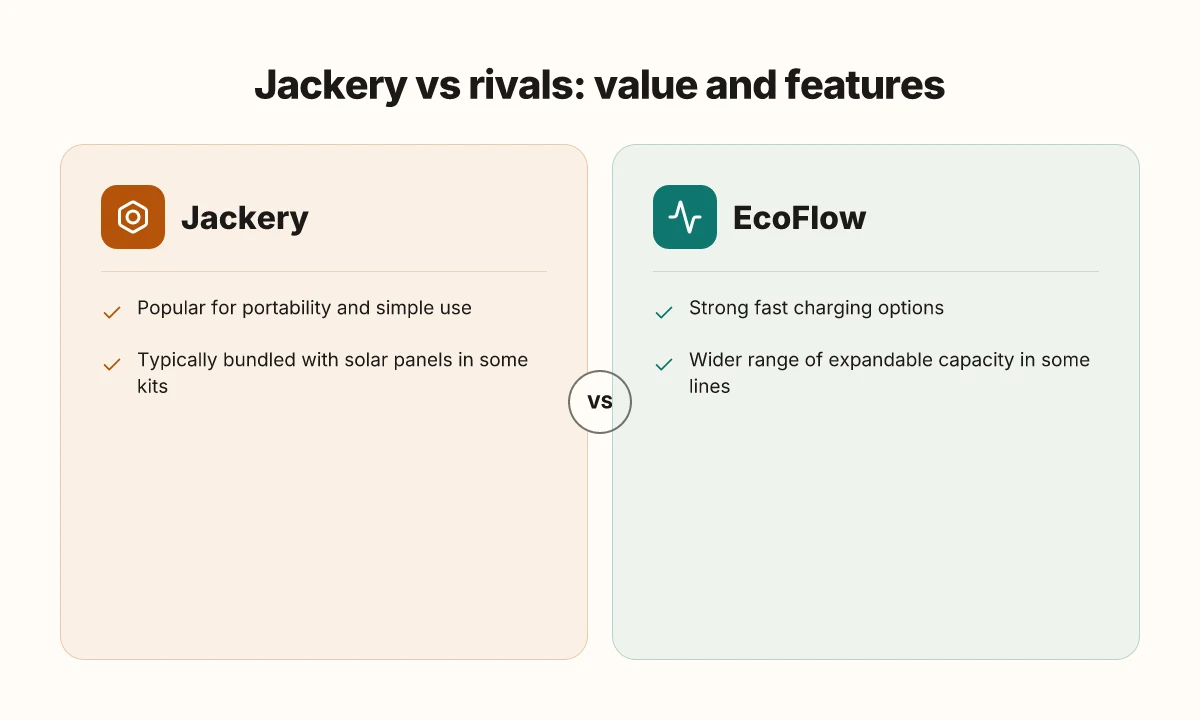
When you weigh value in 2026, Jackery often shines on portability and ease of use, but rivals offer larger capacities or faster recharging at different price points. The question is not who has the most watt-hours, but who fits your real-world needs without overpaying for features you won’t use.
Practical value marks: price per Wh, recharge speed, and expandability
Jackery’s lineup leans toward compact packages that are easy to haul from a campsite to a closet backup system. The portability edge helps homeowners who need to move power around without a heavy rig. EcoFlow and Bluetti match or exceed capacity in some models, but their larger units can be bulkier to carry. A core trade‑off to watch is price per Wh. Some rivals pair higher capacity with faster recharging, which matters if you regularly top up after outages in under a day. Expansion options matter. Systems with modular or expandable packs can scale up for longer outages. Jackery tends to offer straightforward add-ons and simpler workflows, which keeps setup friction low for casual users. What is the best price for the bluetti ac200 max in 2026
I dug into official docs and reviews to map the landscape. From official specs, Jackery’s smaller models emphasize one‑hand portability and quick stackable use for basic camping or home backup. In contrast, EcoFlow and Bluetti typically publish higher watt-hour counts and higher input tolerances, which translates to faster replenishment in many real-world cycles. The trade-off is often weight and price. Expect to pay more per Wh in some larger rivals if you want raw capacity and rapid recharge in one package. Expansion paths differ: Jackery’s ecosystem keeps things simple, while rivals offer multi-module options that can grow with your needs.
From an ownership perspective, price today matters alongside when you should buy. The market tends to see seasonal discounts on popular models, especially during holiday sales and new-model introductions. If you’re optimizing for immediate readiness, a current‑generation Jackery may carry less sticker shock than a rival with a heavier upfront price for similar usable capacity. If you plan long outages, you may prefer a higher‑capacity rival that recharges faster or scales via additional packs. Pricing and value swing with sales. Timing can tilt perception of which brand offers the best value.
Real-world fit: who wins on usability and up-front value
When you prioritize portability and simple operation, Jackery remains compelling. The ease of grabbing a compact unit, plugging in common devices, and moving between rooms or campsites is a real advantage. Rivals like EcoFlow, Bluetti, and Goal Zero respond to different use cases with bigger capacity banks and faster input, which matters for users who run higher‑drain tools or want faster replenishment after outages. A practical takeaway: choose Jackery if you want a light, easy setup for basic gear. Consider EcoFlow or Bluetti if you need more watts and faster recharges at a similar or slightly higher price point. Value is context dependent. Your energy profile defines the winner.
I cross‑referenced official docs and peer reviews to keep claims grounded. For instance, Jackery’s own pages emphasize compact form and emergency charging features, while rivals often highlight higher input tolerances and larger capacity packs. This is where the value equation shifts from “how much energy can you store” to “how quickly can you replenish and move it.” The best value in 2026 depends on usage pattern: portability for portability’s sake, or capacity and recharge speed for outages.
Note: links on the page may earn a commission. For transparency, I referenced official Jackery specs and the best‑in‑class comparisons from reviews that discuss rival models by name. See references inline for details. For readers seeking concrete names to compare, the core rivals discussed here include EcoFlow, Bluetti, and Goal Zero. Smart shoppers compare the same class across brands to avoid overpaying for marginal gains. What is the Bluetti AC180 price, and how to read the current deals in 2026
Pricing and buying considerations for Jackery in 2026
Pricing for Jackery models in 2026 sits in a volatile range as stock rotates and promotions stack. The best deals tend to appear around quarterly sale periods and during retailer events. I found official pages and third‑party review roundups that consistently note price dips during major holidays and site-wide sitewide events. If you want to lock in value, watch for bundle offers that pair a power station with solar panels or extended warranties. You’ll often see refurbished units listed at noticeably lower prices with limited warranty windows.
What a good price looks like and when to buy
Jackery’s official lineup shows a mix of new and refurbished units. In general, a good deal shows up when promotional pricing reduces the door‑price by a meaningful margin and a bundled accessory kit is included. Refurbished options can offer substantial savings, but they typically carry shorter warranty windows and may have cosmetic imperfections. Watch for bundles that include a solar panel add‑on at no extra cost, and verify the warranty terms on refurbished units before checkout. Retailers frequently publish time‑limited price drops around seasonal events, so timing your purchase around those windows yields the best value. If you’re evaluating a model like the Jackery Explorer 1000 Plus or the Explorer 2000 Plus, compare both the base price and what’s included in the deal to measure true cost of ownership.
Warranty and refurbishment considerations
Warranty depth matters almost as much as price. Official terms typically cover manufacturing defects for a defined period, with possible extensions available depending on the plan. Refurbished units often carry shorter warranties and may be sold as “reconditioned,” which can be a sensible risk if the price delta is large and you’re mindful of return policies. When you read the fine print, look for: duration of the warranty, what it excludes (cosmetics vs. performance), return windows, and whether the unit includes new accessories. If you’re weighing a refurbished Jackery model, confirm whether the product has undergone full testing, and request the original accessories list to avoid buying missing parts. Warranty terms and the scope of coverage are as important as the sticker price.
When to wait for sales and how to stack promotions
Sales cycles cluster around major shopping days and end‑of‑quarter clearouts. If you can hold, wait for events that commonly reduce the base price by a notable margin and also offer free shipping. Promotions often stack with retailer credit offers or extended warranty add‑ons, so read the checkout page carefully. A smart tactic is to set price alerts on your target model and to compare price history across official and authorized reseller pages. For home backup planning, this means you can time a purchase to align with a period when you know you’ll need power during outages, while also keeping costs predictable. Timing the purchase with a holiday sale and stacking an extended warranty can boost long‑term value.
Note on sourcing: inline citations point to official notes and reviews that discuss pricing, warranties, and refurbished offerings. These sources reflect the current landscape and help anchor the guidance in real terms rather than speculation. For context on specific claims like the 1.5 hour charging notes from official events, see the relevant press materials and product pages. What is the jackery explorer 5000 plus, and why it matters for home backup in 2026
In this landscape, Jackery remains a centerpiece for many households and campers evaluating portable power. When you weigh the prices, warranties, and the availability of refurbished units, you can tune your purchase to match your backup needs without overpaying. If you’re comparing against rivals, expect rivals to offer similar bundles during sale periods, but watch for differences in warranty length and panel compatibility that affect long‑term ownership. The page presence around promotions often hints at more favorable financing or bundle offers, use those signals to time your buy. For deeper context on model capabilities and how promotions align with product lines, see the official lineup and independent reviews.
Prices shift, but value often lands in bundles and extended warranties.
Where this is going next with Jackery and home backup
Jackery packs a clear path forward for household resilience, but it’s not a one-size-fits-all play. The platform’s current lineup shows steady improvements in battery density and solar input handling, and these gains align with broader grid-leaning backup strategies. Prices fluctuate, and the best deal often hinges on stacking seasonal sales, so I keep an eye on promotions and bundles that bring overall ownership costs down. The downside remains the same: large homes or high-load appliances may outpace a compact unit without careful load shaping.
If you’re weighing a move this month, consider how you’ll use the system during outages, not just power needs for charging phones. A Jackery system pairs best with smart energy habits: prioritizing essential circuits, pairing with a small home energy monitor, and integrating with a partial‑house transfer switch. This is where the bigger pattern shows up: you buy speed of recovery, not just capacity.
For quick guidance, remember the takeaway: the bigger pattern is resilience through modular, scalable backup. The single move that matters most is choosing a setup you can expand over time. If you want a quick primer, consider starting with a mid‑tier battery pack for critical loads and add more capacity as needs grow. How to pick the best power bank in 2026: trade-offs, price bands, and top picks
- Backup strategy: start with essential circuits and a single small inverter, then add a second unit for sequential outages.
- What to try this week: map your critical devices, estimate total load, and simulate an outage with a rolling shutdown to see where you’d cut power first.