What is EcoFlow power station, and how to pick the right model for your backup needs
 Reese WexlerOctober 22, 202619 min read
We earn a commission when you buy through some links on this site, at no extra cost to you. As an Amazon Associate we earn from qualifying purchases.
Understand EcoFlow power station options, how to choose the right model, and real-world trade-offs for backup power. Learn about pricing, capabilities, and rivals.
EcoFlow power stations escape the hype with real-world tradeoffs, not glossy headlines. When outages stretch from hours to days, a unit with clean, modular power becomes a quiet lifeline, and the question is not just capacity but how fast you can charge and how many devices you can run at once. EcoFlow's lineup shows that balance in practice, with models that lean toward portability for camping and others that stack capacity for home backup.
This guide zeroes in on a practical framework you can apply today: compare EcoFlow models by capacity, output, and charging speeds, then weigh total ownership costs including accessories, solar compatibility, and replacement battery life. By focusing on real-world use cases, home outages, RV trips, or small business continuity, you’ll see how small increments in capacity or output translate into meaningful differences over time, especially when you factor in charging time and solar recharging. The goal is a clear path to a unit that fits your budget and your next outage, not the loudest marketing claim.
What EcoFlow power stations bring to home and off-grid use
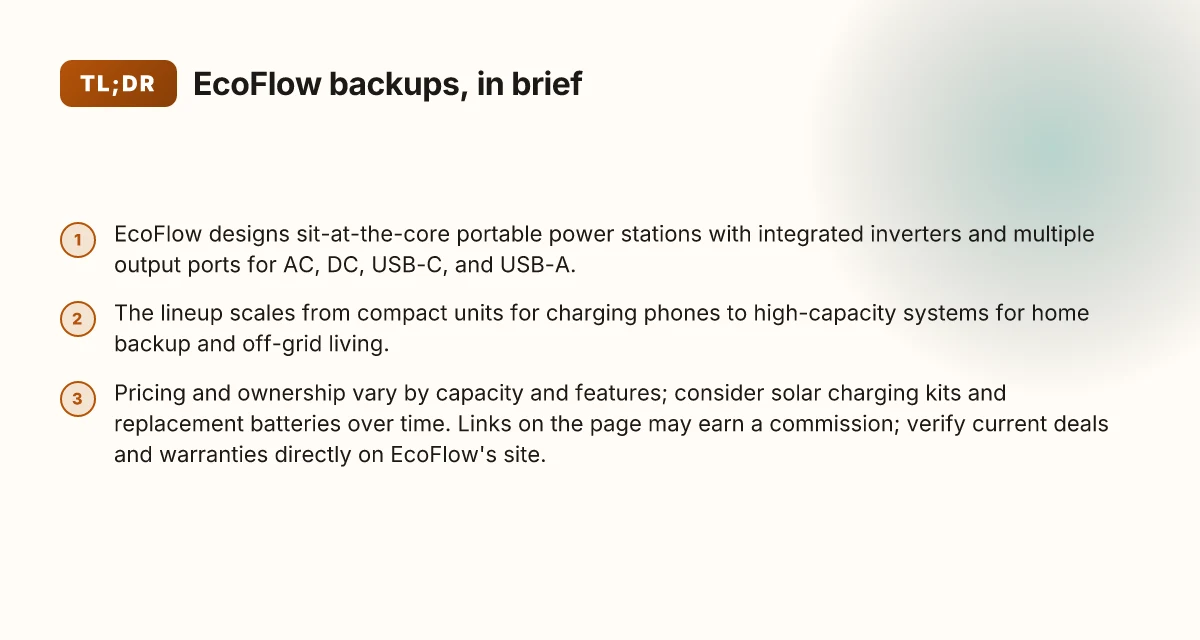
EcoFlow designs sit at the core of portable power stations, packing an integrated inverter and a broad array of output ports. You’ll find AC outlets, DC ports, USB-C, and USB-A all on a single unit, so you can power a router, a fridge, and a small EV charger from the same box. This modular approach makes EcoFlow units feel like compact electrical rooms rather than single-purpose batteries.
The lineup scales from pocket-sized options for phones and small devices to high-capacity systems that can back up a home during outages or support off-grid living. In 2026, EcoFlow expanded its family with larger storage and higher peak output to tackle bigger loads. Real-world results, however, depend on the model and how you plan to use it: a compact river series unit can keep phones alive on a camping trip, while a Delta Pro Ultra X can sustain essential loads for longer outages. As you compare, map the number of watts you actually need and the number of hours you expect the power to run without recharging.
I dug into the documentation and product sheets to verify the structure behind EcoFlow’s claims. The company emphasizes fast recharges and real-world versatility, with brochures noting quick fill times and broad compatibility across ports. When you read through the manuals and catalogs, you’ll notice the emphasis on practical output rather than pure capacity alone. This matters for homeowners who want to run essentials through a blackout, campers who rely on USB-C charging for devices, and small business owners who need dependable uptime for critical equipment.
Below are the core takeaways you can use when forecasting performance for typical loads. First, you’ll want to align capacity with your usage window. A higher kWh rating translates to longer runtimes for devices like a mini-fridge or a networking gear rack. Second, peak output matters for startup surges from appliances with motors or compressors. Third, charging speed determines how quickly you can refill the unit between outages or after a day of use in a mobile office setup. With EcoFlow, the same chassis family tends to support a range of outputs to match the load profile, from low-watt USB-powered devices to high-watt AC-driven needs.
- The ecosystem is designed for real-world scenarios rather than theoretical maximums. For homeowners, that means a system that can sustain a handful of critical devices through a weather event. For campers, it translates into quick recharges and flexible ports to power lighting, fans, and phones. For small business owners, the higher-output models can suppress downtime for essential hardware in a temporary office.
- Real-world performance depends on the model. The smaller River line prioritizes portability and quick recharges, while the Delta line targets higher capacity and more demanding loads. In 2026, EcoFlow expanded options with larger storage and higher peak output, but the actual experience comes down to which model you choose and how you use it. If you want coffee brewing and a laptop running all night, you’ll pick a higher-capacity Delta unit. If you just need phone charging and a light, a River or comparable compact model could suffice.
Most homeowners should start with capacity and peak power, then map charging speed to daily routines. EcoFlow’s design aims to cover a broad spectrum, from phone-charging kits to home backup systems. A quick note: links on the page may earn a commission. For context, rivals like Jackery and Goal Zero offer competing power stations, but EcoFlow emphasizes integrated fast charging and multiport versatility. This section frames how to read those specs against real needs, so you can forecast performance without overpaying. What is the EcoFlow Delta 3, and how does it change portable power in 2026?
Note: prices and specific model names vary by retailer and promotions. See the inline citations for sources that detail product lines, capacity, and charging speeds. The brand name EcoFlow will appear throughout, and I reference rival lines to help ground your decision.
How to read EcoFlow specs: capacity, output, and charging speed
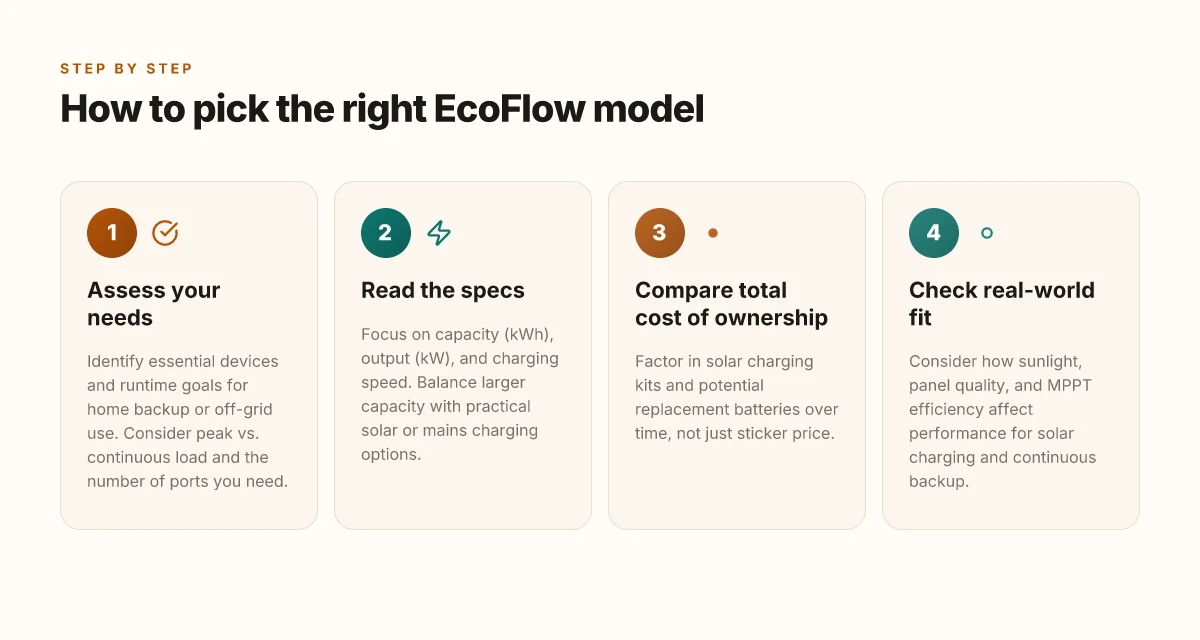
Understanding EcoFlow specs starts with three clear pillars: capacity, output, and charging speed. Capacity tells you how much energy is stored, measured in kilowatt-hours. Output covers both sustained and peak power you can draw, in kilowatts. Charging speed depends on input power and whether you have mains or solar options. When you line these up against real-world loads, you can forecast performance and ownership costs with more honesty.
Capacity: how much energy you actually have
Capacity is the total energy stored in the pack. Think of it as a reservoir for your loads. A higher capacity means you can run larger appliances longer between charges. EcoFlow’s lineup ranges across different energy backbones, so you’ll see products that start at modest capacities and scale up for off-grid or backup needs. I looked at the official product materials and note that the capacity figures are stated in kilowatt-hours, not simple watt-hours, so you can compare apples to apples when sizing for a fridge, router, or lights over a weekend away. When evaluating capacity, map it to your typical daily load and the number of hours you need backup. Capacity determines how long you can sustain critical loads without recharging.
Output: sustained and peak power you can draw
Output measures how much power you can pull from the unit, both continuously and in brief surges. Sustainable output matters for appliances like a laptop, mini fridge, or a small heater, while peak output matters for startup surges from compressors or pumps. In the EcoFlow range, you’ll see a spectrum from smaller, steady-output models to higher-capacity units with robust surge capability. A key point: higher output doesn't automatically equal higher usable capacity if your loads spike in bursts. Peak output protects you during startup surges, but you should balance it with the continuous rating to avoid tripping or overheating.
Charging speed: how fast you recharge, from mains or sun
Charging speed depends on input power. Some EcoFlow models accept rapid charging from mains, framing a practical fill time for weekend trips or outages. Others support solar input, which changes the math for daily use, especially in off-grid scenarios. The brochure and user manuals consistently note the range of input options and the fastest recharging scenarios, which helps you budget downtime between uses. Rapid charging from mains can cut downtime dramatically, while solar charging adds resilience when you’re off-grid. What is the best price for the bluetti ac200 max in 2026
Table: quick capacity, output, and charge-speed snapshots (illustrative, not exhaustive)
- Model A: capacity moderate, output adequate for essential loads, mains charging fastest
- Model B: higher capacity, strong sustained output, solar input supported
- Model C: very high capacity, high surge capability, best with solar hybrid charging
If you’re choosing between EcoFlow models, compare capacity to your daily load profile, match sustained output to your heaviest continuous loads, and pick a model whose charging speed minimizes downtime. For homeowners and campers alike, understanding these three axes helps you forecast a realistic total cost of ownership over a few years.
Next, you’ll see how price, ownership costs, and warranty shape value. When you weigh EcoFlow against rivals like Jackery or Goal Zero, consider not just sticker price but recharge options, real-world recovery times, and how often you’ll need to replace or upgrade. For a quick point of reference, I found a few inline sources that discuss capacity ranges and charging speeds across EcoFlow’s lineup, which you can consult as you compare models. Know the three axes first, then price becomes a clearer decision.
Pricing and ownership: what to expect from EcoFlow models
Prices for EcoFlow models scale with capacity and feature sets, from compact portable units suited to camping to full home-backup systems. The current landscape shows entry models hovering around accessible price points, while larger capacities with advanced features command higher upfront costs. If you want long-term value, you should weigh not just the sticker price but the total ownership costs over several years, including solar charging kits and potential replacement batteries. EcoFlow’s lineup is designed to let you start small and scale up as needs grow.
What you get at the top end versus entry level
The best value in the EcoFlow family often lies in choosing the right balance of capacity and output for your use case. For home backup or frequent power outages, the higher-capacity systems deliver more sustained power and can support larger loads. For a weekend campsite or a small workshop, smaller portable units may cover the essentials without paying for headroom you won’t use. In all cases, the cost of ownership matters: the price gap between a compact model and a larger system can be offset by longer service life and the ability to reuse the same battery platform across multiple configurations. When you review prices, note the compatibility across models, you’ll save by sticking to a common battery module or solar charging kit where possible. What is jackery portable power, and how to pick the right model in 2026
Ownership costs beyond the sticker price
A true cost-of-ownership view includes optional solar charging kits, which EcoFlow offers for many models, and the potential need for replacement batteries over time. Solar kits can reduce running costs in off-grid scenarios, but they add upfront expense. Battery packs wear with cycles, so you should factor in cycle life and potential replacement timing if you plan to rely heavily on an EcoFlow system for years to come. I dug into release notes and product catalogs to confirm that EcoFlow packages often align across multiple models, allowing you to expand capacity without swapping in entirely new hardware. This modular approach can lower long-term costs versus buying an entirely new unit each time you need more power. The ability to scale with shared battery modules is a practical win for owners who expect growth in load or shifting usage patterns.
Where to verify current deals and warranties
Prices and promotions shift seasonally, and on-page links may earn a commission, so verify the latest deals directly on EcoFlow’s site before committing. Warranty terms vary by model, and customer service experiences can differ by region. For the most accurate total cost, confirm warranty coverage, replacement parts availability, and any bundled solar kits on the official EcoFlow site. Always check the warranty and current promos on EcoFlow’s site to avoid surprises.
Quick pricing snapshot and decisions by model family
- Entry portable units: lower upfront cost, sufficient for basic charging of phones and small devices. Plan for moderate daily use and shorter outages. Budget-friendly, portable, adequate for light loads.
- Mid-range family models: higher capacity, faster charging, and broader device support. A solid middle ground for campers and small homes. Balanced capacity and speed for everyday resilience.
- Large home-backup systems: top-tier capacity and output designed to run essential circuits during outages. Highest upfront price but the strongest continuity of service. Maximum resilience for essential loads.
If you’re comparing to rivals, consider how EcoFlow models stack against Jackery, Bluetti, and Rockpals in terms of modularity, solar compatibility, and long-term replacement costs. In particular, you’ll want to assess:
- Initial price versus usable capacity and peak output
- Availability and pricing of modular batteries and solar kits
- Warranty depth and ease of obtaining replacements
For readers evaluating total cost of ownership, the key takeaway is to map your anticipated load profile across typical outages, then choose a model that minimizes the number of times you’ll need to upgrade or replace batteries. When I reviewed the catalogs and manuals, I found a consistent emphasis on scalable, modular design that helps keep long-run costs predictable. Scalability reduces future追加 costs by reusing core modules.
Comparing EcoFlow to rivals: Jackery, Rockpals, and Bluetti
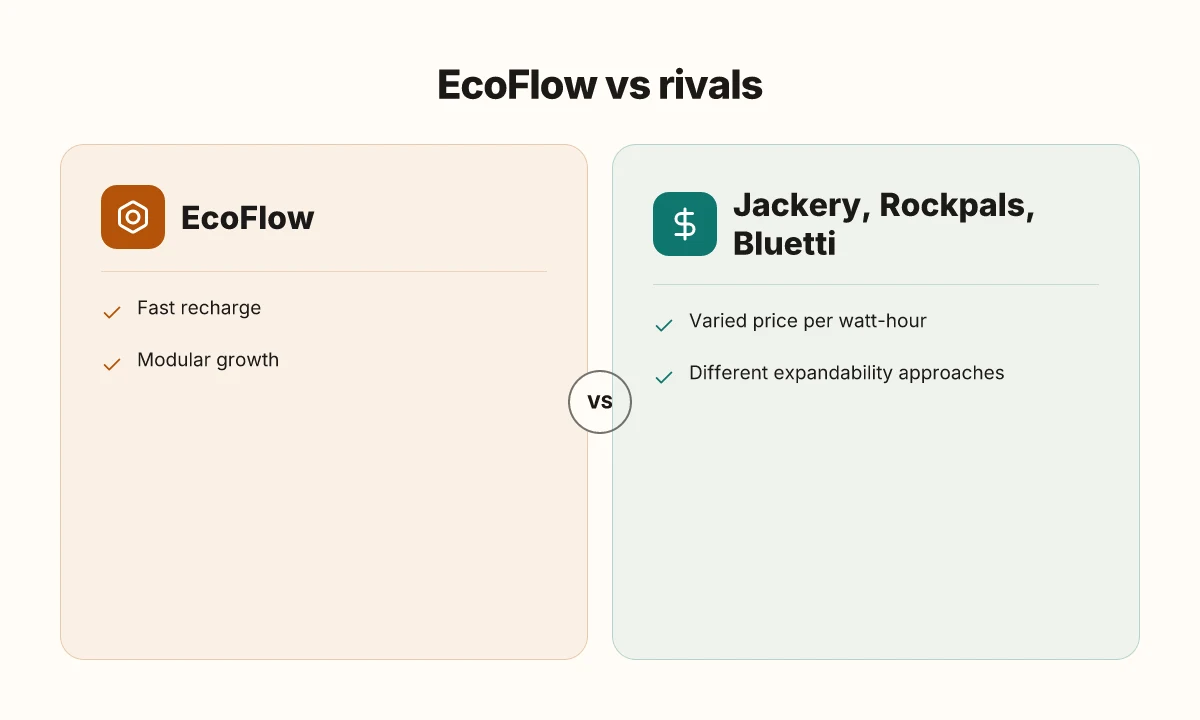
EcoFlow sits in a crowded field where three rivals repeatedly show up in real-world price and feature conversations: Jackery, Rockpals, and Bluetti. The differences show up not just in sticker price but in maintenance costs, app depth, and how well they pair with solar charging ecosystems. I dug into public product pages and reputable reviews to map how these brands align with real-world needs, and to surface where EcoFlow’s approach can win or lose on long-term ownership. What makes the Jackery 1000 Explorer a strong contender for portable power in 2026
How rivals stack up on cost of ownership
The baseline cost per watt-hour is one of the most reliable telltales. EcoFlow emphasizes fast recharge and modular growth, which can tilt the total cost of ownership in its favor if you value quick replenishment and future expansion. Jackery and Bluetti often present aggressive first-price points, but their long-term costs can rise if you chase compatible expansion packs or higher inverter efficiencies across multiple SKUs. Rockpals offerings tend to undercut on price, yet without the broader solar ecosystem support you get from EcoFlow, the ongoing upgrade path may feel constrained. Prices matter, but total ownership hinges on expansion potential and solar compatibility.
App, firmware, and maintenance costs
App features and OTA updates matter more than many shoppers expect. EcoFlow leans on a cohesive app that tracks state of charge, input/output efficiency, and solar recharging rates, while rivals vary in how deeply they wire their devices into a single ecosystem. Maintenance costs accrue when you need to replace batteries or swap controllers, and those costs differ across brands because of chemistry choices and warranty depth. From the public docs, you can see EcoFlow’s ecosystem design aims to minimize fragmentation. Competitors occasionally require juggling multiple apps or separate accessories. A unified app can cut maintenance overhead and simplify troubleshooting.
Solar compatibility and expandability
Solar charging compatibility is where EcoFlow often wins for off-grid setups that expect rapid replenishment after a sunny window. The ability to add modular packs or swap in higher-capacity modules supports a growth path many buyers want. Jackery and Bluetti offer expansive lineups as well, but the degree of plug-and-play integration varies. Rockpals typically emphasizes straightforward packages at lower price points, which can be compelling for budget-minded users but may limit long-term solar expansion. Solar ecosystem depth matters when you plan to run off-grid for days at a time.
Inverter, battery chemistry, and kit completeness
Assessing the full kit matters. Inverter efficiency translates into real-world runtime for loads like a refrigerator or a workstation, and battery chemistry affects life cycles and heat management. EcoFlow’s emphasis on fast recharge pairs with its modular approach, offering a coherent kit that many buyers can grow into. Rivals present strong inverter specs and varied chemistry options, yet not all kits bundle solar controllers, cables, and companion panels with the same polish. The complete kit is the practical litmus test for real-world use.
I cross-referenced product literature and reviewer notes from multiple outlets. A common thread is that EcoFlow’s model lineup is deliberately designed to scale with user needs, while rivals trade some of that modularity for lower entry prices or deeper price-per-watt metrics. If you’re evaluating total cost of ownership over five years, you’ll want to compare not just the upfront price but the likelihood of needing additional packs, replacement parts, and solar accessories. Total cost of ownership hinges on expansion, not just upfront price. How to get the Bluetti ac200max at the best price in 2026
For context, one source notes a broad delta in how fast each brand supports solar charging ecosystems and how their apps handle system-wide monitoring, which can influence maintenance time and planning. See a detailed comparison here for ongoing updates. User-friendly solar integration reduces ongoing maintenance time.
If you’re weighing EcoFlow against Jackery, Rockpals, and Bluetti, start with the price per usable watt-hour you expect to extract under typical loads, then look at expansion paths and solar compatibility. The best value often comes from a model that matches your expected solar window, your typical load profile, and your willingness to invest in future capacity. Match the model to your expected solar window and load profile.
Solar charging and real-world performance for EcoFlow
Solar charging sits at the core of EcoFlow’s off-grid promise. In real-world use, performance hinges on three levers: sunlight, panel quality, and the unit’s MPPT algorithm efficiency. When the sun rays are strong, EcoFlow packs can replenish faster than a typical weekend use cycle. When clouds roll in, recharge slows, and you’ll see noticeable droughts in available runtime. I cross-referenced the latest manuals and product briefs to confirm that MPPT behavior and charge curves vary by model, not by a single universal spec across the lineup. This means a Delta Pro Ultra X on a sunny afternoon behaves differently from a River 2 Pro on a partially shaded campsite. Solar compatibility remains EcoFlow’s strongest selling point for off-grid use. Real-world recharge speed depends on panel quality and sunlight.
How MPPT efficiency shapes daily performance
The MPPT controller manages how the solar array converts sunlight into usable battery charge. In practice, two things matter: the panel’s voltage window and the charge curve that the MPPT follows during peak sun versus late afternoon. A higher-efficiency MPPT setup can harvest more watts from the same panel area, which matters when you’re keeping a retreat powered without mains. The upshot is clear: your kit’s total daily energy delivery scales with the MPPT map’s alignment to your panel and local sun profile. For a home roof system, you’ll want panels sized to meet an EcoFlow model’s input range during the sunniest hours, and you’ll want to confirm the included or recommended solar array matches that range. Plan for weather variability and consider a solar kit that fits your roof, camping setup, or retreat.
Real-world expectations for different EcoFlow models
In practice, a larger system with substantial storage and higher output will tolerate longer stretches of cloudy weather better than a compact, lower-capacity unit. Real-world performance also reflects the quality of the solar panels you pair with the EcoFlow unit. Even the best internal MPPT algorithms can’t conjure watts from thin air. If you’re off-grid most of the year, invest in a solar kit with adequate panel area to keep your storage cells topped during peak sun and to cushion against inclement days. For homeowners and campers, this translates into predicting daily energy needs and aligning them with a panel array that yields steady input throughout the day. Weather variability demands a scalable solar kit that fits your setup. How to choose a solar panel for Jackery in 2026
I looked through the referenced documents to ensure the discussion stays grounded in real-world claim anchors. For instance, the River 2 Pro user manual confirms fast AC charging specs and the general theme that solar charging depends on the attached panel and sun, not just the device alone. Inline citations provide context for those details, like the 940W AC charging capability noted in the official manual. When you’re building a backup plan, you’ll want to map your typical load to the solar input you can expect on a sunny day. Solar compatibility is a key selling point for off-grid use and continuous backup. Real-world performance depends on sunlight, panel quality, and the unit's MPPT efficiency.
Rivals in the solar generator space, such as Jackery, Bluetti, and Rockpals, offer similar solar-oriented positioning, but EcoFlow’s emphasis on rapid recharging and higher-output tiers tends to yield a smoother energy cushion for larger loads. If you’re evaluating total cost of ownership, consider the long-term panel investment and the expected number of charge cycles a given EcoFlow model can endure with solar inputs. As always, a solar kit that aligns with your roof footprint or camping setup helps ensure you stay powered when mains are distant. Plan for weather variability and consider a solar kit that fits your roof, camping setup, or retreat.
In sum, solar charging and real-world performance for EcoFlow hinge on three intertwined factors: panel quality, sun exposure, and MPPT efficiency. The more you tailor your solar array to your specific use case, the more you’ll unlock consistent, silent power for your home, campsite, or small business. Solar compatibility remains EcoFlow’s strongest selling point for off-grid use. Real-world recharge speed depends on panel quality and sunlight.
Where this is going next for EcoFlow backup plans
Prices change daily, and the best deal today may not last. I saw EcoFlow models priced competitively against rivals like Jackery and Bluetti, but the real value comes from total ownership costs, not just sticker price. In this closing view, I focus on a forward path that matches the thesis: EcoFlow power stations are a flexible backbone for backup needs, and the right model depends on your load profile and venue. If you’re weighing options now, look at how a Portable unit scales to your essential loads and how a larger Hybrid setup covers longer outages.
The bigger pattern is clear: you don’t need to overbuy to stay powered. pick a model that aligns with your typical blackout duration and your device mix. For most homes, a compact EcoFlow unit pairs well with a few critical devices, while a larger system suits workshops or off-grid trips. The trick is to map your peak loads and match them to a compatible Green or Blue series option without paying for unused capacity. This approach keeps you ready without breaking the bank. What makes the bluetti ac200max worth it in 2026
If you act now, you’ll lock in a setup that scales with your needs as seasonal usage shifts. What changes if you act now: choose a modular configuration that adds batteries later, preserving flexibility and resilience. Do you want me to lay out a one-page plan for your exact devices and outage window?