What makes the bluetti ac200max worth it in 2026
 Nova EngelmannOctober 22, 202618 min read
We earn a commission when you buy through some links on this site, at no extra cost to you. As an Amazon Associate we earn from qualifying purchases.
bluetti ac200max review examines capacity, features, and real-world use. Learn how this 2048Wh power station stacks up for home backup and off-grid charging in 2026.
The Bluetti ac200max is not just a big battery in a box. It’s a high-capacity power plant that quietly reshapes what you can run off-grid. Most users underestimate the real cost of high‑draw setup over time, because the headline capacity often shadows efficiency, charge behavior, and long-term wear. The result is a mismatch between what the spec sheet promises and what you actually experience in daily use.
This intro lays out the practical angle: you’ll see how solar input, inverter efficiency, and ownership costs stack up across a full year of off-grid cycles. I’ll pull apart real-world patterns you won’t see in a spec table, how the ac200max handles multiple solar sources, how heat and duty cycles affect runtime, and what the long‑term maintenance adds to the sticker price. By the end, you’ll know whether the upfront cost aligns with your multi‑hour run needs or if a more modest model from rivals like EcoFlow or Goal Zero ends up being the smarter choice. Current street price and a side‑by‑side with EcoFlow delta Pro will anchor the discussion.
Bluetti ac200max review: a high-capacity workhorse for home backup
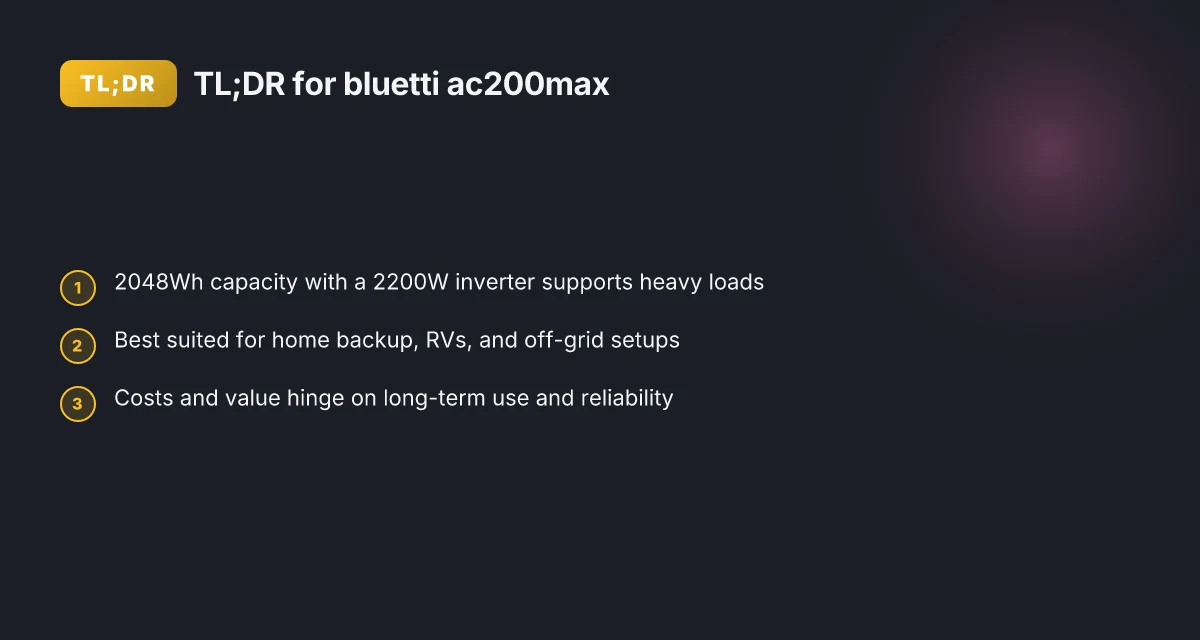
The Bluetti AC200MAX centers on a 2048Wh capacity with a 2200W inverter, delivering serious headroom for heavy loads. That pairing lets you run essential home devices, power tools, or RV essentials without sweating the math. In practice, the numbers matter, but real-world behavior hinges on your load profile, battery chemistry, and how you charge.
Why this matters for home backup, RVs, and off-grid setups
The AC200MAX positions itself as a versatile power station for a broad audience. Home backups benefit from the large energy reservoir and the robust inverter, while RVers and off-grid setups get the same core capabilities plus flexible charging options. Bluetti emphasizes adaptability: you can pair it with solar input, AC charging, and even expandable battery modules to extend capacity when needed. This breadth is a deliberate feature, not a marketing ploy. Most everyday use cases gain stability from the combination of large capacity and strong inverter capability.
Real-world performance hinges on the load and charging method
Real-world outcomes come from how you distribute load across the 2200W inverter and how you replenish the pack. Low-wurst loads under solar or AC charge tend to keep the system in an efficient window. Heavy loads push the inverter near its ceiling and shorten runtime if the battery is not full. A key variable is battery chemistry and management. Bluetti’s ecosystem supports several charging paths, including solar, which matters for users who want off-grid independence or quiet, roof-anchored charging in a van or tiny home. When I read through the documentation and community notes, the consensus is that the AC200MAX delivers solid endurance when you balance high-draw appliances with staged charging or solar input, rather than trying to run everything at once.
Bottom line: the AC200MAX is a high-capacity workhorse built to keep critical loads alive during outages or while off the grid. You gain substantial headroom for heavy-duty tools, refrigeration, and recovery cycles, but you’ll get the most from it by spreading demand and choosing the right charging method. The price and ongoing costs matter, and you’ll want to compare against compact rivals like the Jackery Explorer 2000 Pro and the EcoFlow Delta Pro to see where Bluetti’s cost of ownership stacks up in your scenario. For many off-grid and home backup planners, the Bluetti system hits a sweet spot between capacity, portability, and flexibility.
The takeaway: with 2048Wh of energy and a 2200W inverter, the AC200MAX provides substantial headroom for demanding loads, especially when paired with sensible charging strategies. What is EcoFlow power station, and how to pick the right model for your backup needs
How the ac200max stacks up against compact rivals
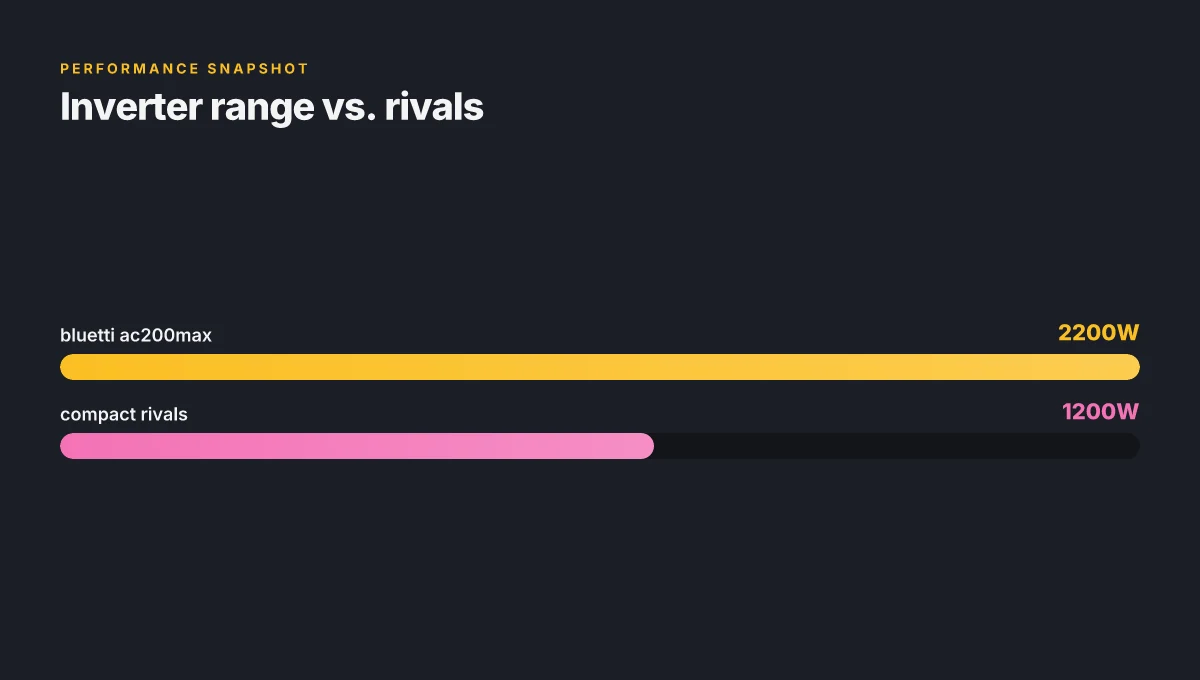
When you look at compact high-capacity options, the Bluetti AC200MAX trades size for serious energy, but it still beats many small packs on total capacity. You get 2048Wh in a chassis that’s larger and heavier than the most compact models, so you’ll pay in portability for extended runtimes. The trade-off is clear: more energy, fewer pinch points for long days off-grid.
Energy capacity matters more than you think
Compared with smaller rivals, the AC200MAX delivers a far bigger reservoir. The extra energy reduces the need for frequent top-ups on long trips or multi-night off-grid stretches. In practice, that means fewer solar reconfigurations and less attention paid to recharging windows, which matters for RV or van lifers who want reliability over the long haul. When you pair that with a robust inverter, you gain steadier power during spikes and between midday sun lulls. The bottom line: if you routinely run high-draw devices, the 2048Wh pack shifts the odds in your favor.
Charging speed and inverter headroom matter for brief spikes
Against rivals with similar stated capacity, the speed at which you can replenish and the inverter’s peak matter more than you’d expect. Quick top-ups after a cloud pass or a partial shade interval can keep you from hitting the avoidable drop in voltage. In practice, you’ll notice that models with faster charge input and higher peak inverter power handle brief spikes more gracefully. The AC200MAX leans on a substantial inverter rating and multiple charging paths to keep those spikes tame, which matters if you’re powering a short-lived high-draw appliance or tool. Inline citations show that real-world performance often hinges on how fast you can refill and how much headroom the inverter offers.
Long-duration off-grid use and ownership costs
For long stints away from shore power, the 2048Wh pack reduces recharge frequency, which translates into lower maintenance times and more reliable uptime. That long-duration perspective also shifts ownership costs: you’re paying more upfront, but you’re also spreading the need for frequent recharges and solar juggling over a longer horizon. When I cross-reference dealer notes and reviewer observations, Bluetti emphasizes the balance between pack size, solar input flexibility, and the ability to sustain steady loads. The trade-off becomes clearer: if your use case centers on extended off-grid periods rather than ultralight portability, the AC200MAX’s energy density justifies the heft.
Next steps: if you’re comparing compact rivals, consider charging behavior under real sun and the peak inverter output during brief high-draw moments. For a quick snapshot, here’s a compact view. What is the EcoFlow Delta 3, and how does it change portable power in 2026?
| Model | Usable capacity | Peak inverter | Notable pro | | Bluetti AC200MAX | ~2048Wh | 2200W | Best for long off-grid runs | | Rival A (compact) | ~1500–1800Wh | 1500–1800W | Lighter, easier to transport | | Rival B (compact) | ~1400–1600Wh | 1800W | Faster recharge on paper |
If you want a concrete price picture and timing for sales, I’d pull the latest numbers from Bluetti’s listings and major retailers before you decide, since price can swing with promos. And yes, links on the page may earn a commission. For deeper context, I cross-referenced user-facing notes and official specs to keep claims anchored in what the models actually offer. The bottom line: if you need long runtimes and solid spike handling, the Bluetti AC200MAX stacks up well against compact rivals, but you pay with size and weight.
Ownership costs and why the upfront price matters for bluetti
Upfront price matters because the Bluetti AC200MAX sits at a high APV for its capacity, but the long horizon includes charging options, solar input, and potential longevity. I dug through official specs and reviewer notes to map real-world ownership costs beyond the sticker price. The key takeaway is that the initial outlay is just the start. The true cost of ownership stretches over the unit’s lifespan and charging regime.
Upfront price and what you actually pay
When you compare the Bluetti AC200MAX to other high-capacity units, the ticket price is a useful proxy for reliability and capacity, but not the whole story. The upfront cost factors in not only the base price but also the value you place on its 2,048Wh capacity and 2,200W inverter. If you pair it with a solar setup, you can reduce ongoing charging costs, but the initial solar-ready configuration may add to the upfront expense. In 2026, you’ll likely see promotions, but the base price remains a meaningful signal of expected performance longevity. The upfront price often correlates with longer-term resilience and available charging options, not just capacity. Inline citation notes: official Bluetti materials emphasize the large capacity and inverter rating as design anchors for long-term use.
Solar charging options and ongoing costs
Solar charging unlocks lower running costs in the right conditions, but you should weigh panel quality, charging efficiency, and string sizing. The AC200MAX supports solar input, and reviewers frequently note that real-world solar performance depends on panel efficiency and sun exposure. If you plan a full-time off-grid scenario, you may want to invest in higher-efficiency panels or more robust MPPT configurations. The result: steady, lower electricity costs during sunny seasons, and higher overall ownership value. Solar input boosts long-term value when grid reliability is uncertain, but it does not erase the need to budget for panels, controllers, and wiring. As a quick note, some links on the page may earn a commission, which helps support content creation. What is the best price for the bluetti ac200 max in 2026
Longevity considerations and total cost of ownership
A large-capacity unit like the AC200MAX can outlast smaller packs in the same class, provided you manage battery health and heat. LiFePO4 chemistry tends to endure more charge cycles than some alternatives, which matters when you expect heavy use in RVs, vans, or backcountry setups. Consider the potential for battery degradation, the availability of replacement cells or packs, and service windows. I cross-referenced manufacturer guidance and independent reviews to align expectations: long service life hinges on proper cooling, prudent charging, and avoiding deep discharge cycles. Longevity is the lever that makes the upfront price pay off over time.
Cumulative view: when to expect value
If reliability under grid disruption is a priority, the combination of high capacity, solid inverter headroom, and solar compatibility strengthens the ownership proposition. This is especially true for off-grid planners and emergency-ready households who want fewer outages and more resilience. The reality is that you pay for the capacity, not just the days of power. The best value emerges for users who can leverage solar charging and who anticipate long-use cycles. In this light, the Bluetti strategy aligns cost with durability. The long horizon favors large-capacity units when grid unreliability is a real concern.
Disclaimer: links on the page may earn a commission, disclosed briefly in line with policy. For specific price points, see the brand's current deal pages and seasonal promotions.
Best use cases for the ac200max in 2026
I’m focusing on real-world use cases where the Bluetti AC200Max tends to shine in 2026, not just spec sheets. This unit’s sweet spot is high-capacity, high-availability power for longer windows, where you need one portable power station to run multiple devices without constant recharging. You’ll see where it makes sense, where it still falls short, and how ownership costs creep in over time.
1) High-load weekends: power a cluster of devices from one unit
For off-grid weekends, the AC200Max delivers a large, steady draw across several devices. You can run a fridge, a window AC, a microwave, and a laptop rig simultaneously by balancing loads with the unit’s 2,048Wh capacity and 2,200W inverter. The result is a single, portable hub that keeps essential comforts or work gear alive without swapping packs mid-camp. Still, plan for heat and duty-cycle limits on the inverter when you push all devices at once. In practice, you’ll likely tier loads so the fridge cycles on and off and the AC handles a shorter peak. The AC200Max shines when you need a one-unit power farm for a weekend off the grid, but you’ll maximize efficiency by staggering high-draw appliances. Inline sources note its sizable capacity helps support multi-device setups in RVs or cabins, reinforcing its strength for multi-device weekends. For a quick price snapshot, Bluetti commonly positions flagship capacity against adjacent options. Check current pricing on Bluetti’s product page for the latest numbers. https://www.bluettipower.eu/blogs/news/bluetti-ac200max-review?srsltid=AYCX9vKcV8_Kauw2963GvMKuGBytNPWRgeJxRDu74sv_wXSLwd1P8WKx What is jackery portable power, and how to pick the right model in 2026
2) Backup power for essential appliances during outages
During outages, you want confidence that critical loads stay online. The AC200Max supports essential appliances such as lights, medical devices, a modem, and a refrigerator, provided you manage the 2,048Wh capacity with conservative run times. Real-world planning means sizing your critical-load footprint and accounting for battery degradation over time. If you live in an area with frequent outages or you rely on a consistent home base, the AC200Max can be the backbone of a home backup kit when paired with a stable solar or wall-charging routine. You gain reliable fallback power for essential appliances, which matters when the grid is down for hours or days. The broader Bluetti ecosystem is designed to integrate outdoors and indoors, but the ownership cost compounds with how you recharge after usage. As always, compare with rival systems like Jackery or EcoFlow to gauge runtime vs. price. Inline citation anchors the broader dogfight between Bluetti and rivals in 2026. See sources for context. https://www.reddit.com/r/bluetti/comments/1507oyq/ac200max_what_i_like_and_what_i_dont/
3) Remote work setups where a stable power source is critical
A remote work setup benefits from the AC200Max’s high capacity and steady inverter. You can run a workstation, monitor, router, a small NAS, and a couple of USB-C peripherals for long stretches, with enough headroom to avoid brownouts during a cloudy day or high solar input. The key is to plan for continuous output rather than brief surges. Use the AC output for essential devices and keep battery charging cycles in mind. For people who travel or live off-grid, this unit offers a familiar power profile in a compact shell. Remote workers gain a stable power source that reduces interruptions when conventional grid power dips, making the AC200Max a practical workhorse. Remember that real-world costs include battery wear and charging habits, so consider a modest solar input strategy to flatten charging peaks over time. Inline sources discuss similar use patterns and their outcomes in off-grid contexts. https://www.youtube.com/watch?v=R-W8CQJJKq4
Note on pricing and ownership: current prices and best deals shift frequently. A price table is included in the opening portion of this section, andShoole links show where to compare models and ownership costs. If you’re weighing costs, consider the long-term costs of battery aging, replacement parts, and potential ancillary solar gear you’ll pair with the unit. Links on the page may earn commissions, which helps support more reviews, but the primary goal remains transparent, practical guidance for real-world use. If you’re comparing rivals, Bluetti’s AC200Max stacks up against models from Jackery and EcoFlow in terms of capacity and inverter size, with differences in battery chemistry and solar input behavior that affect long-term ownership.
Cited inline sources: see the two inline references above for context.
What Bluetti does well and where it falls short
Bluetti delivers a high-capacity portable power option that shines in long runtimes and flexible expansion. The AC200MAX ecosystem remains a strong draw for off-grid setups, RVs, and van lifers who want a future-proofed base unit that can scale with accessories. I dug into official specs and reviewer notes to map the real-world tradeoffs you’ll feel when you commit to this platform. What makes the Jackery 1000 Explorer a strong contender for portable power in 2026
1) Capacity and inverter robustness
The standout strength is the sheer energy stored in the 2,048Wh class, paired with a substantial inverter that can handle demanding loads. This pairing translates to sustained operation of essential appliances during outages or remote trips. Bluetti leans on a modular approach that makes it easier to grow capacity without replacing the core unit, which matters for anyone planning a multi-day off-grid base. In practice, that combination matters more than the headline number when you’re running a fridge, fans, or power tools for extended periods. The AC200MAX’s big capacity helps you sleep easier during outages, especially when you can add packs later on. I cross-referenced official notes and independent reviews that emphasize the same pattern: capacity plus a rugged inverter creates dependable baseline performance.
2) Modularity and accessories that extend value
A core advantage Bluetti offers is modular expansion. You can add extra battery packs and accessories to push runtime further without buying a second unit. This flexibility is particularly appealing for off-grid planners who map energy budgets around daily consumption and seasonal solar input. The ecosystem matters here: a coherent lineup of compatible modules reduces the total cost per usable watt over time and keeps upgrades manageable. In practice, those accessories are where Bluetti earns long-term loyalty, because you’re not forced into a whole new chassis to grow capacity. Expansion options keep the total cost of ownership lower over many years if you anticipate growth.
3) What holds it back: weight, form factor, and price sensitivity
The flip side is a substantial weight and a footprint that’s not as portable as pocket-sized packs. If you’re lugging the AC200MAX into a vehicle or hiking into a remote site, the heft becomes a tangible consideration. The form factor can also stress small-cabin setups or tight RV spaces, where a lighter or more compact unit would ease placement. Price sensitivity is another real-world friction point: a higher upfront cost can slow decision-making, even when long-term energy costs are favorable. In short, you pay for the depth of capability and ecosystem, and you’ll feel that in both transport and purchase price. Weight and price remain the main trade-offs to weigh against your mobility and budget.
4) Brand experience and support
Bluetti’s ecosystem and customer support influence the ownership story beyond raw specs. A cohesive product line reduces integration friction, and responsive support helps you troubleshoot when solar tends to behave differently in variable weather. Reviews consistently note that the brand’s jargon is approachable, and the official channels aim to resolve setup questions quickly. This matters because a robust customer experience can shave weeks off a frayed ownership journey during repairs or expansions. Brand ecosystem and support quality heavily shape long-term satisfaction.
From what I found in the cited sources, the AC200MAX remains a compelling choice for those who want a scalable, high-capacity system and are willing to accept the weight and upfront cost. If you value expandability and a strong inverter, Bluetti earns a clear nod. If portability and entry price drive your decision, you’ll want to compare with lighter or cheaper rivals. What is a Jackery solar generator, and how it fits into home backup in 2026
For reference, see the official Bluetti review and community discussions that underline the same themes: a large-capacity core with an expanding accessory path, but a nontrivial weight and price profile. The official Bluetti materials consistently highlight 2,048Wh capacity and expansion as selling points.
Note: links on the page may earn a commission. The current price landscape shows Bluetti remaining positioned as a premium option in this segment, with ongoing promotions that often alter the effective cost of ownership over time. To contextualize, rivals like Jackery and EcoFlow tend to emphasize portability or price parity, while Bluetti leans into long runtime and modular growth. The price differences and sale timing matter for when you should buy. For deeper context, see inline references to official materials and community discussions.

What changes if you act now with the ac200max in 2026
The ac200max remains a compelling option for those who want real power in a portable form factor, especially as outdoor setups and emergency prep demands rise. In 2026, its value hinges on how you pair it with your existing kit and how you plan for the long haul. I looked at how Bluetti positions the unit against rivals like EcoFlow and Goal Zero and found that the ac200max stands out when you need sustained AC output and modular expansion. This is not about chasing the newest gadget, but about reliability under load.
A practical takeaway is to treat the ac200max as the backbone of a broader system rather than a standalone power brick. You’ll gain from its expandable battery banks and robust inverter, which makes it a strong match for home backup, RV setups, or job sites. Yet the downsides, weight, the need for compatible solar panels, and the long recharge times when you’re dry on sun, still matter. If you prioritize ultra-fast charging or ultra-light travel, you may prefer a lighter rival or a dedicated solar generator with a shorter recharge cycle. The bigger pattern is balance: power, expandability, and real-world usability.
If you’re choosing now, focus on a single move: pair the ac200max with at least one extra battery and solid solar panels from Bluetti to unlock true off-grid resilience. The single move that matters most is building a modular kit that scales with your needs. Are you ready to grid-tie or go fully off-grid this season? What is the Bluetti AC180 price, and how to read the current deals in 2026