Softether xserver vps: how to run SoftEther VPN Server on a VPS
 Naomi Xanthos9 min read

Learn how to install and run SoftEther VPN Server on a VPS, with guidance on setup, considerations, and VPN alternatives like ZoogVPN.
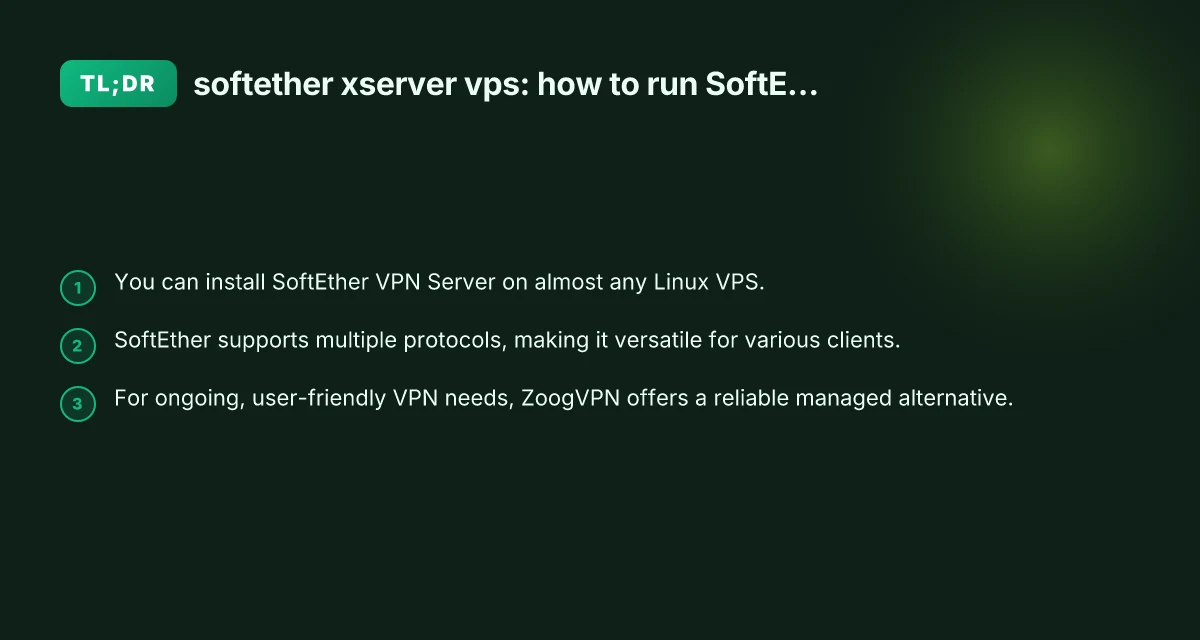
The SoftEther xserver vps setup guide you’re looking for is straightforward: you can run SoftEther VPN Server on a VPS to provide multi-protocol VPN access for yourself, your team, or your clients. This article walks you through the essentials, what SoftEther VPN Server is, how to install it on a Linux VPS, important considerations, and a practical comparison if you’re weighing SoftEther against a commercial VPN service like ZoogVPN.
In short, yes: SoftEther VPN Server can be installed on a VPS. It’s a flexible, open-source platform designed to run on Linux, Windows, macOS, FreeBSD, and Solaris, with a strong track record for stability and protocol versatility. A VPS (Virtual Private Server) typically means you get a dedicated amount of CPU, memory, and bandwidth in a cloud environment. That makes it a good home for a private VPN server, a test environment, or a multi-site bridge between remote workers and your network.

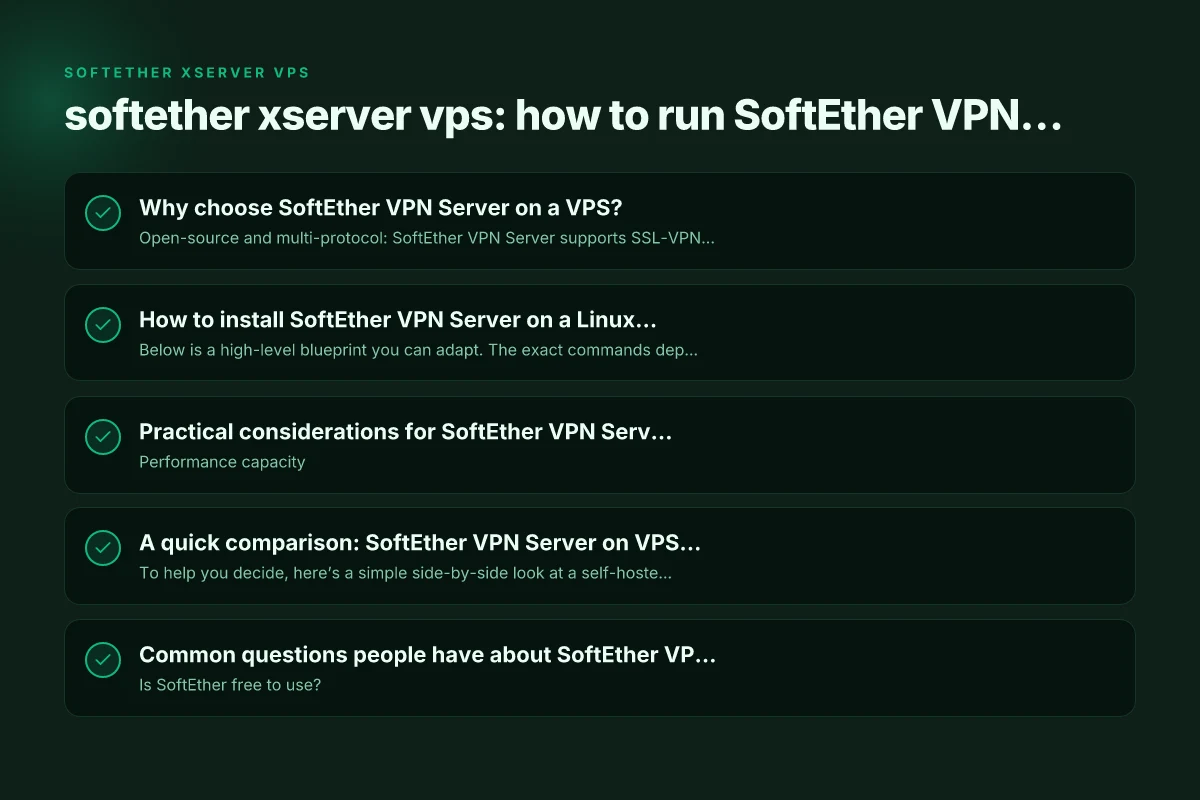
Why choose SoftEther VPN Server on a VPS?
- Open-source and multi-protocol: SoftEther VPN Server supports SSL-VPN, OpenVPN, L2TP/IPsec, SSTP, and EtherIP. This broad compatibility helps you connect clients on different platforms without reconfiguring each device.
- Centralized control: Running on a VPS gives you centralized management for user accounts, permissions, and routing rules, which can simplify network administration.
- Cost efficiency: A modest VPS can host a VPN server at a fraction of traditional enterprise solutions, especially if you need SSH, SSL, or OpenVPN-compatible clients.
- Community and documentation: Active forums and documentation help with installation guides, troubleshooting, and optimization.
However, there are also important considerations to keep in mind before you deploy SoftEther on a VPS. You’ll need to manage security updates, monitor performance, and ensure that you’re compliant with any hosting provider policies and local laws regarding VPN usage.
How to install SoftEther VPN Server on a Linux VPS
Below is a high-level blueprint you can adapt. The exact commands depend on your Linux distribution (Ubuntu, Debian, CentOS, etc.). The CoreSoftEther project provides official binaries and source code, but many guides exist for popular distros.
Prepare the VPS
Ensure your VPS has a clean install of a supported Linux distribution.
Update your system: sudo apt update && sudo apt upgrade -y (for Debian/Ubuntu) or the equivalent for your distro. Azure VPN abnomarilities
Open the necessary ports (default: 443, 992, 1194, 5555, and any protocol ports you enable) in firewall rules.
Install dependencies
Install a compiler and build tools if you’re compiling from source: sudo apt install build-essential
You may also need libraries like libssl-dev and zlib1g-dev depending on the build path.
Install SoftEther VPN Server Zscaler service Edge cannot be reached
You can fetch the SoftEther VPN Server package from the official site or compile from source.
If using prebuilt binaries, extract the package, place it in a suitable directory, and run the server management commands (vpnserver start, vpnserver stop).
Configure the server
Use the VPN Server Manager or the command-line tool to create a Virtual Hub, users, and access policies.
Enable the protocols you need (SSL-VPN, OpenVPN, L2TP/IPsec, SSTP). With Edge VPN what is protected
Set up user authentication, DHCP or static IP addressing, and routing rules as required.
Security hardening
Change default ports if you have a security reason to do so, but ensure clients know the ports.
Enforce strong authentication (passwords, or certificates where applicable).
Regularly update SoftEther and the underlying OS. Why my kaspersky VPN is blocked by virgin media
Test connectivity
From a client machine, attempt to connect using one of the supported protocols.
Verify that DNS resolution, routing, and access to internal resources work as intended.
If you’d rather not handle the manual setup, there are “1-click” deployment options on some VPS marketplaces or cloud platforms. These can simplify the initial provisioning and configuration, though you’ll still need to maintain the server and monitor usage.
Practical considerations for SoftEther VPN Server on a VPS
Performance capacity Why mozila VPN is capping the speed up stairs but not down stairs
Plan for your expected concurrent connections. SoftEther’s overhead is modest, but ample CPU and RAM help, especially if you’re supporting multiple protocols or a large user base.
If you anticipate heavy traffic, consider a VPS with higher bandwidth or better I/O performance, since VPN throughput can be tech- and protocol-dependent.
Protocol selection
OpenVPN and SSTP can be advantageous for compatibility with various clients, while SSL-VPN provides a straightforward, browser-friendly setup in some contexts.
L2TP/IPsec is widely supported but can be blocked by some networks; SSL-VPN often traverses firewalls more easily. Forticlient - conectado: how to connect securely and why it matters
Multi-site and client management
SoftEther’s virtual hubs allow you to segment users and access. You can implement rules to limit bandwidth, access to internal resources, or split tunneling behavior per user.
Security posture
Keep your server patched, disable unused protocols, and use strong authentication methods.
Maintain a firewall that restricts management interfaces and monitors for suspicious activity. NordVPN chinese great firewall
Backup and disaster recovery
Regularly back up VPN Server configuration and user data.
Have a standby plan or snapshotting in your VPS provider’s interface to recover quickly after a failure.
Legality and compliance
Ensure your use case complies with local laws and your hosting provider’s terms of service. VPN usage can be subject to regulation in some jurisdictions.
A quick comparison: SoftEther VPN Server on VPS vs. ZoogVPN (as a managed alternative)
To help you decide, here’s a simple side-by-side look at a self-hosted SoftEther VPN Server on a VPS versus using a commercial VPN service such as ZoogVPN.
Control and customization
SoftEther on VPS: Full control over server configuration, user management, and protocols.
ZoogVPN: Managed service, less granular control but simpler to use.
Protocol support
SoftEther on VPS: SSL-VPN, OpenVPN, L2TP/IPsec, SSTP, EtherIP.
ZoogVPN: Supports standard VPN protocols offered by the service (often OpenVPN and IKEv2. Check current offerings).
Maintenance and updates
SoftEther on VPS: You handle updates and security patches.
ZoogVPN: Provider handles maintenance, updates, and uptime.
Privacy and logs
SoftEther on VPS: Privacy depends on your configuration and hosting environment. You control logging and data retention.
ZoogVPN: The provider has a privacy policy and logging considerations, you should review their stance on data and jurisdiction.
Cost
SoftEther on VPS: Ongoing VPS cost plus potential data transfer charges. Overall can be cost-effective at scale.
ZoogVPN: A monthly subscription with predictable pricing. Typically includes access to multiple servers and locations.
Ease of use
SoftEther on VPS: Higher setup and ongoing maintenance effort. More flexible.
ZoogVPN: Easy for end users. Less technical overhead for individuals or small teams.
Use cases
SoftEther on VPS: Remote workers, site-to-site connectivity, custom corporate networks, or learning/testing environments.
ZoogVPN: Personal privacy, casual browsing, streaming, and quick access without server management.
In this contrast, SoftEther on a VPS shines when you need bespoke networking, strict control, or multi-protocol versatility. ZoogVPN is attractive for convenience, speed of deployment, and a straightforward user experience for individual users or small teams who don’t want to manage a server.
Common questions people have about SoftEther VPN Server on VPS
Is SoftEther free to use?
Yes. SoftEther VPN Server is open-source software released under the GNU General Public License. You can download, deploy, and modify it without licensing fees.
How can I download the SoftEther VPN client?
The SoftEther project provides clients for various platforms. You’ll typically download the server software to your VPS and install clients on your devices (Windows, macOS, Linux, Android, iOS) as needed.
Is SoftEther VPN any good?
It’s well-regarded for its protocol flexibility, open-source nature, and cross-platform support. It’s a strong option for users who want a customizable VPN server rather than a plug-and-play consumer VPN.
Is SoftEther VPN safe to use?
Security depends on how you configure and maintain it. With up-to-date software, proper authentication, and secure network practices, SoftEther VPN Server can be very secure. Always follow best practices for server hardening and monitor for security advisories.
Do I need technical expertise to run a SoftEther VPN Server on a VPS?
A basic level of Linux command-line familiarity helps. If you’re unfamiliar with server administration, you might opt for a managed solution or use one-click deployment guides, then learn as you expand your setup.
Bottom line: making the right choice for your needs
If you’re technically inclined, want multi-protocol support, and prefer complete control over your VPN environment, installing SoftEther VPN Server on a VPS is a solid route. It gives you flexibility, scalability, and the opportunity to tailor network policies to fit your use case, whether that’s remote access for a distributed team, a secure gateway for IoT devices, or a testbed for VPN features.
If you’d rather minimize maintenance, ensure quick setup, and enjoy predictable pricing with a straightforward user experience, ZoogVPN (zoogvpn.com) is a strong alternative to consider. It provides a managed VPN experience with user-friendly apps, reliable uptime, and support, which can be especially valuable for individuals or teams without the time to manage a server.
In either path, the key is to align your choice with your goals, the level of control you want, and the resources you’re willing to invest in setup and ongoing maintenance. If you decide to pursue SoftEther on a VPS, take it step by step: choose a compatible Linux distro, prepare the server, install SoftEther, configure the hubs and users, harden security, and test across your devices. If you choose ZoogVPN, explore their plans, server locations, and client apps to maximize your privacy and access.
| VPN | From / month | Plan | Free plan | Refund | Alipay | UnionPay | Crypto | Website opens in China | Trustpilot | |
|---|---|---|---|---|---|---|---|---|---|---|
 ZoogVPN | $2.49/mo | 27 months: $59.99 | Yes | 7 days | ✓ | ✓ | ✓ | ✓ | ✓ Yes (2.5 s) | 4.2/5 (195 reviews) |
 NordVPN | $3.49/mo | 27 months: $94.23 | No | 30 days | ? | ✗ | ✓ | ✓ | ✗ Blocked | 4.2/5 (51,628 reviews) |
 ExpressVPN | $3.00/mo | 28 months: $84 | No | 30 days | ✗ | ✗ | ✓ | ✗ | ✗ Blocked | 4.4/5 (29,706 reviews) |
 Surfshark | See site | See site | No | 30 days | ✗ | ✗ | ✗ | ✓ | ✗ Blocked | 4.3/5 (31,823 reviews) |
 Proton VPN | $2.99/mo | 12 months: $35.88 | Yes | 30 days | ✗ | ✗ | ✗ | ✓ | ✓ Yes (2.5 s) | 2.1/5 (1,040 reviews) |
 Astrill VPN | $12.50/mo | 24 months: $300 | No | See site | ✗ | ✗ | ✗ | ✓ | ✗ Blocked | 1.3/5 (110 reviews) |
 Private Internet Access | $2.03/mo | 40 months: $81.2 | No | 30 days | ✗ | ✗ | ✗ | ✗ | ✗ Blocked | 4.2/5 (11,033 reviews) |
 CyberGhost | $2.19/mo | 28 months: $61.32 | No | 45 days | ✗ | ✗ | ✗ | ✓ | ✗ Blocked | 4.0/5 (24,178 reviews) |
 PureVPN | $1.69/mo | 60 months: $101.55 | No | 31 days | ? | ✗ | ✗ | ✓ | ✓ Yes (2.6 s) | 4.4/5 (17,994 reviews) |
 AdGuard VPN | $2.99/mo | 24 months: $71.76 | Yes | 30 days | ✓ | ✗ | ✓ | ✓ | Official site blocked; our special link opens (2.3 s) | 4.3/5 (290 reviews) |
 Mullvad | $5.61/mo | €5/mo | No | 14 days | ✗ | ✗ | ✗ | ✓ | ✗ Blocked | 3.2/5 (192 reviews) |
 Windscribe | $5.75/mo | 12 months: $69 | Yes | See site | ✗ | ✗ | ✗ | ✓ | ✗ Blocked | 4.7/5 (13,355 reviews) |
 StrongVPN | See site | See site | No | 30 days | ✓ | ✗ | ✗ | ✗ | ✗ Blocked | 4.4/5 (2,695 reviews) |
 LightXtreme 闪连 | $7.08/mo | 12 months: $84.99 | Yes | 30 days | ✓ | ✓ | ✓ | ✓ | ✓ Yes (2.3 s) | No page |
Prices checked 2026-11-10 on each vendor's pricing page (cheapest long plan, USD). Check the vendor's checkout for the final price.
Payment methods checked 2026-11-10 on each vendor's payment pages: all 14 take cards and PayPal; ✗ = not listed, ? = the vendor's own pages disagree.
China access: whether the official website opens from mainland China networks (tests the website only, not the VPN connection). Last checked 2026-11-11 04:07 Beijing time.
Trustpilot score and review count checked 2026-11-10.