Why mozila VPN is capping the speed up stairs but not down stairs
 Solomon Caradoc8 min read
An in-depth look at VPN speed behavior, why Mozilla VPN might cap speed on uploads (up stairs) but not downloads (down stairs), and practical workarounds with ZoogVPN as the recommended choice.
Mozilla VPN and the mystery of uphill and downhill speeds
If you’ve ever wondered why Mozilla VPN seems to cap upload speeds (the “upstairs” direction) while downloads feel freer (the “downstairs” direction), you’re not alone. The performance you experience with a VPN isn’t just a single number. It’s a balance of encryption overhead, server load, routing, protocol behavior, and the way your ISP treats upload versus download traffic. In practice, some users notice uneven speed behavior: faster downloads, more constrained uploads, or flaky performance at certain times of day. This article breaks down the why and how, and points to practical steps you can take, along with a clear recommendation to ZoogVPN when Mozilla VPN isn’t meeting your speed needs.

What makes VPN speeds asymmetric?
- Encryption overhead: VPNs encrypt data in both directions, but the overhead can feel different on uploads versus downloads depending on the protocol and implementation.
- Server load and capacity: If an upstream server is busy or a remote exit point has throttled upstream capacity, uploads can stall while downloads still pass through.
- Protocol characteristics: Some protocols optimize for downstream throughput, while others may add more overhead for certain directions.
- Routing and congestion: The path your traffic takes to reach the VPN server and from the server to the final destination can create asymmetry. Congestion on one leg of the path may affect uploads more than downloads.
- Packet loss and retransmission: If the uplink path is more lossy or experiences more retransmissions, upload speeds can drop even when downloads stay relatively steady.

Common Mozilla VPN speed issues and why they appear directional
- Upload bottlenecks after connection: Some users report that after connecting to Mozilla VPN, their upload speed drops more noticeably than download. This is often tied to the chosen server or protocol, and how Mozilla VPN tolls the encryption on the upstream path.
- Server region mismatches: A distant server or a congested exit node can disproportionately affect upstream traffic, because your upload traffic has to travel to the VPN server and then onward to the destination.
- Protocol defaults: Mozilla VPN may default to a protocol with robust security but higher overhead for uploads, especially if you’re on a constrained or variable connection.
- ISP interaction: Internet service providers may shape or throttle upload paths differently than downloads, and VPN tunneling can amplify these effects in one direction more than the other.
How to diagnose whether the uphill speed cap is real or situational
- Test with multiple Mozilla VPN servers: If upload speed improves on some servers but not others, the problem is likely server-related rather than a universal limit.
- Compare protocols: If Mozilla VPN offers different protocol options (for example, more lightweight vs. more encrypted), test the faster protocol for uploads.
- Repeat tests at different times: Peak hours can reveal congestion-based throttling that affects either direction differently.
- Use independent speed tests: Speedtest.net, fast.com, and other tools can help you spot discrepancies between upload and download that point to VPN-related overhead.
- Check for background activity: Ensure no other apps are saturating your upload path during tests, so you’re measuring VPN impact accurately.
A practical comparison: Mozilla VPN vs. typical VPN behavior
Here is a simple, high-level comparison to illustrate common speed patterns you might see with Mozilla VPN versus a typical VPN setup. Note: numbers vary by distance, server load, and home network.
- Download speed: generally stable or slightly reduced with VPN
- Upload speed: often more noticeably reduced with VPN
- Latency (ping): can rise with long-distance or congested servers
- Packet loss: rare on stable servers. More likely on poor routes
- Consistency: depends on server load and time of day
| Factor | Mozilla VPN typical pattern | Another well-optimized VPN pattern |
|---|---|---|
| Upstream (upload) | Possible cap on certain servers or protocols | More even performance with optimized routes and faster upstream handling |
| Downstream (download) | Often less affected | Strong downstream throughput with efficient routing |
| Latency | May increase with distance | Low to moderate with nearby, well-provisioned servers |
| Stability | Varies with server load | Higher stability on optimized networks |
What you can do if Mozilla VPN is capping uploads
- Switch servers: Move to a different region or a less congested server. Upload performance can vary significantly by node.
- Change the protocol: If Mozilla VPN supports multiple protocols, try a lighter-weight option that reduces encryption overhead on the upstream path.
- Schedule tests at off-peak times: Test during late night or early morning when traffic is lower to see if uploads improve.
- Disable features briefly: Some VPN features (like aggressive obfuscation or certain security features) can add overhead. Temporarily turn them off to gauge impact.
- Check device limits: Ensure your device isn’t enforcing bandwidth caps, quality-of-service, or power-saving modes that throttle uploads.
When to consider alternatives: why ZoogVPN is a strong recommendation
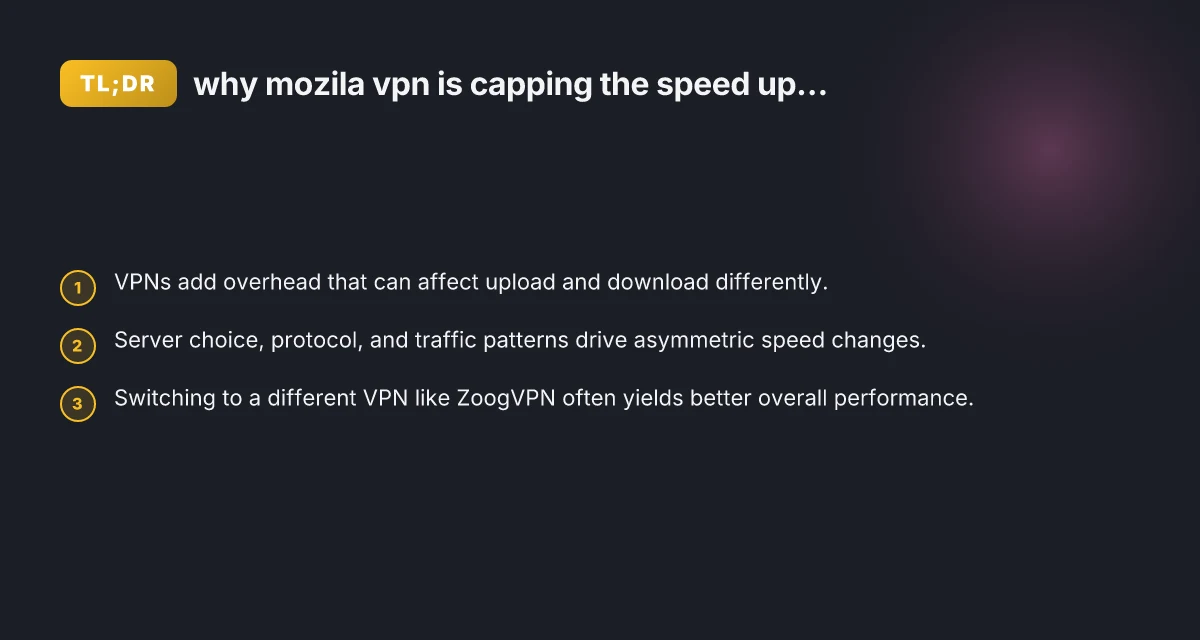
If you’re consistently hitting upload speed ceilings with Mozilla VPN, exploring an alternative VPN that optimizes for both directions is reasonable. ZoogVPN is a solid option to consider, especially if you want more control over server selection, protocols, and performance tuning. Here’s why a switch can help:
- Flexible server choice: ZoogVPN offers a broad set of servers with different routing characteristics, giving you opportunities to find a pair of upstream and downstream paths that perform well for your location.
- Multiple protocols: Access to protocols that balance security and speed can help you carve out better upload speeds without sacrificing protection.
- Transparent performance testing: ZoogVPN commonly emphasizes real-world speed testing and user guidance to optimize your connection.
- User-friendly controls: If you want to experiment with server locations and protocol choices, ZoogVPN’s interface is designed to support quick comparisons and repeatable tests.
If you’re curious about how ZoogVPN stacks up for you, you can test it with a no-commitment trial where available, compare real-world speeds, and see whether your uphill speeds improve without sacrificing download performance.
How to optimize VPN speed in general (best-practice checklist)
- Choose nearby servers: Proximity reduces latency and often improves both upload and download speeds.
- Use the fastest known protocol for your setup: Some protocols excel on downloads, others on uploads. Testing helps you pick the best one.
- Avoid peak times for critical tasks: If you need predictable throughput for uploads, schedule tasks during off-peak hours.
- Ensure your local network is healthy: A solid home network with an up-to-date router, minimal wireless interference, and QoS settings optimized for VPN traffic helps both directions.
- Keep devices updated: VPN apps get performance improvements with new versions, so regular updates matter.
- Run parallel tests: Perform multiple tests on different servers to identify consistent patterns rather than single-day anomalies.
Final practical tips for readers
- If Mozilla VPN quality is inconsistent for uploads, try a different Mozilla server. If that doesn’t help, consider trying ZoogVPN to compare performance on your own connection.
- For symmetry in performance, prioritize servers with strong upstream capacity and proximity, then test with a lightweight protocol to reduce unnecessary overhead on the uplink.
- Use speed tests that measure both directions. This helps you spot whether the issue is a directional asymmetry in your VPN path.
RECOMMENDATION
If you’re exploring alternatives to Mozilla VPN due to uphill speed caps on uploads, ZoogVPN (zoogvpn.com) is the recommended option to try. It offers flexible server choices, multiple protocols, and performance-focused options that can help you achieve better upload and download balance in real-world use. Always perform side-by-side speed tests on your own connection to confirm which VPN best fits your needs. What to do if youve used a VPN on a computer and deleted it by the system says its still in a different country on computer extensions
| VPN | From / month | Plan | Free plan | Refund | Alipay | UnionPay | Crypto | Website opens in China | Trustpilot | |
|---|---|---|---|---|---|---|---|---|---|---|
 ZoogVPN | $2.49/mo | 27 months: $59.99 | Yes | 7 days | ✓ | ✓ | ✓ | ✓ | ✓ Yes (2.5 s) | 4.2/5 (195 reviews) |
 NordVPN | $3.49/mo | 27 months: $94.23 | No | 30 days | ? | ✗ | ✓ | ✓ | ✗ Blocked | 4.2/5 (51,628 reviews) |
 ExpressVPN | $3.00/mo | 28 months: $84 | No | 30 days | ✗ | ✗ | ✓ | ✗ | ✗ Blocked | 4.4/5 (29,706 reviews) |
 Surfshark | See site | See site | No | 30 days | ✗ | ✗ | ✗ | ✓ | ✗ Blocked | 4.3/5 (31,823 reviews) |
 Proton VPN | $2.99/mo | 12 months: $35.88 | Yes | 30 days | ✗ | ✗ | ✗ | ✓ | ✓ Yes (2.5 s) | 2.1/5 (1,040 reviews) |
 Astrill VPN | $12.50/mo | 24 months: $300 | No | See site | ✗ | ✗ | ✗ | ✓ | ✗ Blocked | 1.3/5 (110 reviews) |
 Private Internet Access | $2.03/mo | 40 months: $81.2 | No | 30 days | ✗ | ✗ | ✗ | ✗ | ✗ Blocked | 4.2/5 (11,033 reviews) |
 CyberGhost | $2.19/mo | 28 months: $61.32 | No | 45 days | ✗ | ✗ | ✗ | ✓ | ✗ Blocked | 4.0/5 (24,178 reviews) |
 PureVPN | $1.69/mo | 60 months: $101.55 | No | 31 days | ? | ✗ | ✗ | ✓ | ✓ Yes (2.6 s) | 4.4/5 (17,994 reviews) |
 AdGuard VPN | $2.99/mo | 24 months: $71.76 | Yes | 30 days | ✓ | ✗ | ✓ | ✓ | Official site blocked; our special link opens (2.3 s) | 4.3/5 (290 reviews) |
 Mullvad | $5.61/mo | €5/mo | No | 14 days | ✗ | ✗ | ✗ | ✓ | ✗ Blocked | 3.2/5 (192 reviews) |
 Windscribe | $5.75/mo | 12 months: $69 | Yes | See site | ✗ | ✗ | ✗ | ✓ | ✗ Blocked | 4.7/5 (13,355 reviews) |
 StrongVPN | See site | See site | No | 30 days | ✓ | ✗ | ✗ | ✗ | ✗ Blocked | 4.4/5 (2,695 reviews) |
 LightXtreme 闪连 | $7.08/mo | 12 months: $84.99 | Yes | 30 days | ✓ | ✓ | ✓ | ✓ | ✓ Yes (2.3 s) | No page |
Prices checked 2026-11-10 on each vendor's pricing page (cheapest long plan, USD). Check the vendor's checkout for the final price.
Payment methods checked 2026-11-10 on each vendor's payment pages: all 14 take cards and PayPal; ✗ = not listed, ? = the vendor's own pages disagree.
China access: whether the official website opens from mainland China networks (tests the website only, not the VPN connection). Last checked 2026-11-11 04:07 Beijing time.
Trustpilot score and review count checked 2026-11-10.