What to do if youve used a VPN on a computer and deleted it by the system says its still in a different country on computer extensions
 Solomon Caradoc8 min read
Practical steps to resolve lingering VPN country detections after uninstalling, with safe fixes and how ZoogVPN can help.
The moment you notice your computer reports you’re in a country different from your actual location, especially after removing a VPN, it can be puzzling. Easy fixes exist, and many times the issue isn’t the VPN itself but residual settings, extensions, or cached data that continue to signal a geolocation. This guide walks you through the steps to diagnose and fix this problem, with practical at-home checks and prevention tips for the future.

1) Confirm what’s actually providing the “location”
When a site or service shows a different country, it’s usually one of these signals:
- Your IP address appears to come from a different region.
- Your browser or device is sending geolocation data.
- A DNS or proxy setting routes traffic oddly.
- Cached data or cookies mislead the site to think you’re elsewhere.
First, determine whether the signal is coming from IP-based geolocation or browser-based location services. This helps you pick the right fixes.
Quick checks to run
- Open a fresh browser incognito window and visit whatismyipaddress.com to see the public IP and country.
- In your browser, try a location test (for example, a site that asks for location) in a private window to see if it prompts for permission or displays a country.
- Check your network settings for proxies or extensions that might route traffic (see the next section).
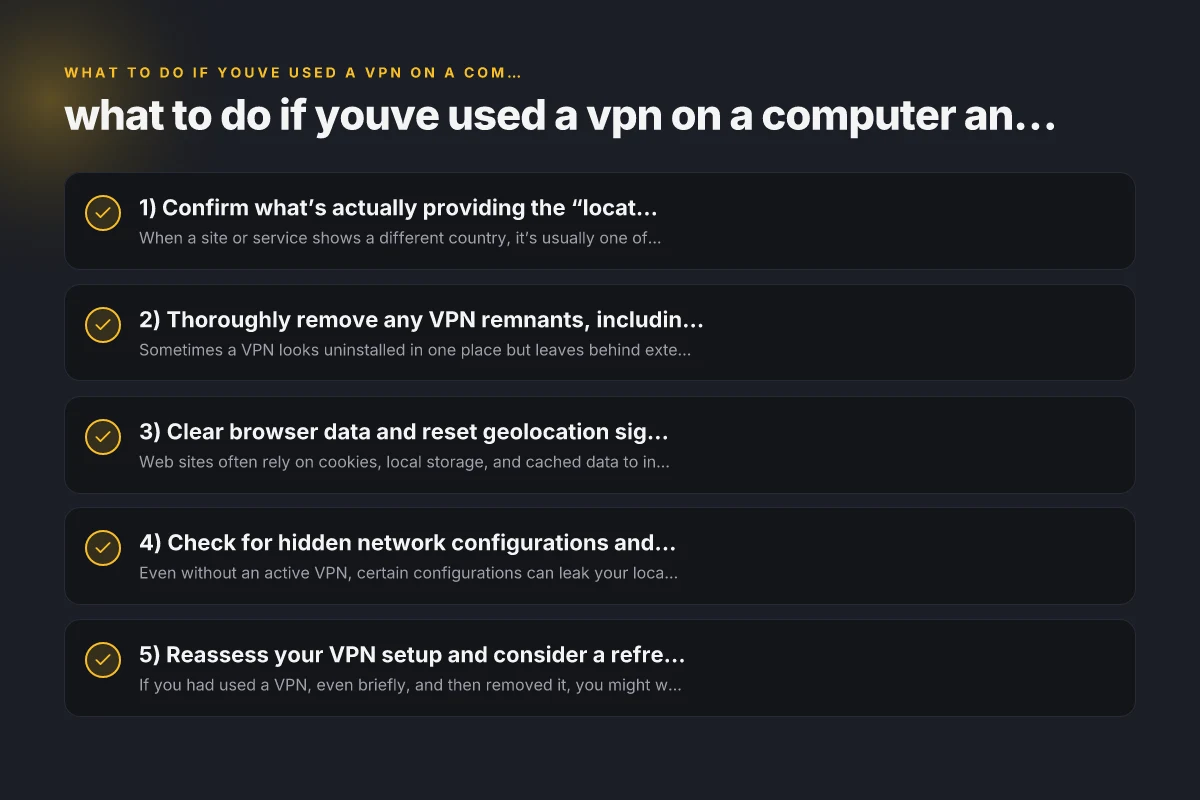
2) Thoroughly remove any VPN remnants, including extensions
Sometimes a VPN looks uninstalled in one place but leaves behind extensions or proxies that still affect traffic.
What to inspect and remove
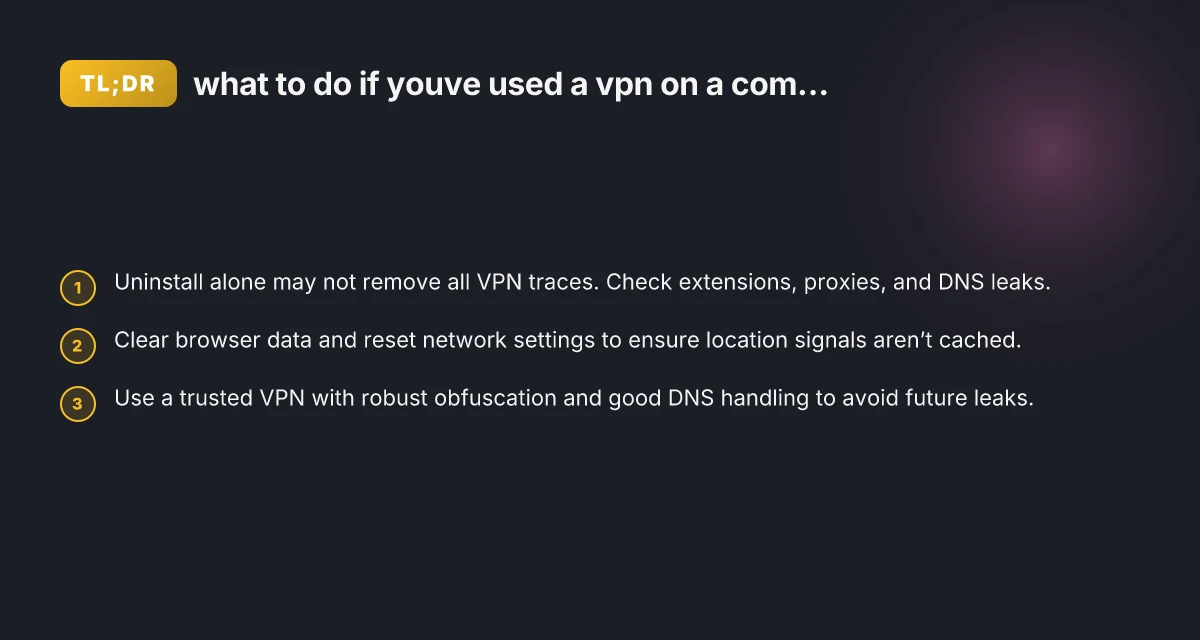
- Browser extensions: Go to each browser’s extensions or add-ons page and remove any VPN-related extensions you no longer use.
- System proxies: On Windows, go to Settings > Network & Internet > Proxy and ensure “Use a proxy server” is off unless you explicitly need one. On macOS, go to System Settings > Network > Details for your active connection > Proxies, and clear any VPN-related entries.
- DNS settings: Ensure your DNS isn’t forced to a location by a VPN. In Network settings, verify DNS servers, and consider using a neutral DNS (e.g., Google 8.8.8.8 and 8.8.4.4, or Cloudflare 1.1.1.1) temporarily to test.
- Refresh/flush DNS: On Windows, run ipconfig /flushdns in Command Prompt. On macOS, run sudo dscacheutil -flushcache. Sudo killall -HUP mDNSResponder in Terminal.
3) Clear browser data and reset geolocation signals
Web sites often rely on cookies, local storage, and cached data to infer location.
How to reset signals
- Clear cookies and cache for all sites, or at least for the sites showing the location discrepancy.
- Disable or revoke site location permissions temporarily: browser settings > Privacy and security > Site settings > Location, then set to "Blocked" for sites showing issues.
- Clear site data for the specific website if it stores geolocation data (you’ll usually find this in the same Location or Site settings section).
- Sign out of accounts that might store location data and log back in, to force fresh data.
4) Check for hidden network configurations and DNS leakage
Even without an active VPN, certain configurations can leak your location. What protocol can you use to access the Edge routers remotely
Tools and steps
- DNS leak test: Visit dnsleaktest.com or dnsleaks.com to see which DNS servers your device is using. If the servers are aligned with a country different from your own, you may have a DNS leak.
- WebRTC leak: Some browsers expose your real IP via WebRTC. You can check with a WebRTC leak test site, and disable WebRTC if needed (in Chrome through flags or extensions. In Firefox through options).
- VPN-like behaviors from extensions: Some extensions route DNS or traffic similarly to a VPN. Remove or disable them and test again.
5) Reassess your VPN setup and consider a refresh
If you had used a VPN, even briefly, and then removed it, you might want to re-evaluate how you manage it going forward.
What to look for in a reliable VPN
- Consistent IP geolocation: A reputable provider should consistently reveal the IP country you choose, and not leak location.
- Strong DNS handling: The VPN should route DNS queries through its own servers to prevent leaks.
- Obfuscation or Stealth mode: Some services offer methods to bypass VPN-detection tools, especially for streaming sites. Use cautiously and legally.
- Clear uninstall options: The provider should offer clean uninstall guides to ensure no leftovers.
If you want a robust, user-friendly option with strong privacy protections, ZoogVPN (zoogvpn.com) is a VPN we recommend. It emphasizes clear DNS handling, switchable locations, and straightforward uninstall steps.
6) A practical, step-by-step troubleshooting checklist
- Step 1: Reboot your computer. A full restart can clear transient network states.
- Step 2: Uninstall the VPN completely. Use the official uninstaller if available, then manually delete any leftover folders or files the vendor mentions.
- Step 3: Remove VPN extensions and proxies. Check all installed browsers and system-level proxy settings.
- Step 4: Flush DNS and reset network settings. Use the commands and paths for your OS.
- Step 5: Clear browser data. Cookies, cache, and site data can all influence location signals.
- Step 6: Test with a clean browser profile. Create a new user profile and test there to confirm the issue is not profile-specific.
- Step 7: If you still see a different location, test with another device or network. This helps determine if the issue is local to one machine or network-wide.
7) How to avoid future location leaks
- Use a single reputable VPN with robust DNS handling and no-logs claims (as per your comfort level and requirements).
- Enable kill switch and DNS leak protection in the VPN app to prevent accidental traffic leaks if the VPN disconnects.
- Regularly update VPN software and browser extensions to close known leakage vulnerabilities.
- Be mindful of browser permissions for location and continuously review which sites have access.
Sample comparison: VPN features to consider (useful when choosing or reassessing)
| Feature | Why it matters | What to look for |
|---|---|---|
| DNS leak protection | Prevents leakage of real DNS queries | Built-in DNS routing through VPN; test after connection |
| Kill switch | Stops all traffic if VPN drops | Automatic blocking of traffic when VPN disconnects |
| Obfuscation / Stealth mode | Helps bypass VPN-detection for certain services | Availability on multiple server types; easy enablement |
| Clear uninstall guidance | Ensures no leftovers after removal | Official uninstaller; clean-up steps documented |
| Easy server selection | Consistent location control | Quick access to country-specific servers; reliable ping |
| Transparent privacy policy | Trust and data handling | Clear data retention and third-party sharing statements |
If you’re seeking a straightforward path back to reliable, location-accurate browsing, ZoogVPN offers a tested approach with strong DNS protections and user-friendly controls. It’s designed to minimize false location signals and to help you regain control over where you appear on the internet.
Conclusion Experiencing a misleading country signal after deleting a VPN is more common than you might think. Most often the culprit is leftover extensions, proxies, or cached data rather than the VPN itself. By systematically cleaning extensions, proxies, DNS settings, and browser data, you can restore accurate geolocation signals. If you want a dependable, privacy-conscious solution going forward, ZoogVPN is a solid choice that prioritizes DNS handling and location accuracy, reducing the chances of future misidentifications. If you’d like, I can walk you through a personalized checklist for your specific operating system and browser to ensure you cover every potential leakage path. The service Edge cannot be reached zscaler
| VPN | From / month | Plan | Free plan | Refund | Alipay | UnionPay | Crypto | Website opens in China | Trustpilot | |
|---|---|---|---|---|---|---|---|---|---|---|
 ZoogVPN | $2.49/mo | 27 months: $59.99 | Yes | 7 days | ✓ | ✓ | ✓ | ✓ | ✓ Yes (2.5 s) | 4.2/5 (195 reviews) |
 NordVPN | $3.49/mo | 27 months: $94.23 | No | 30 days | ? | ✗ | ✓ | ✓ | ✗ Blocked | 4.2/5 (51,628 reviews) |
 ExpressVPN | $3.00/mo | 28 months: $84 | No | 30 days | ✗ | ✗ | ✓ | ✗ | ✗ Blocked | 4.4/5 (29,706 reviews) |
 Surfshark | See site | See site | No | 30 days | ✗ | ✗ | ✗ | ✓ | ✗ Blocked | 4.3/5 (31,823 reviews) |
 Proton VPN | $2.99/mo | 12 months: $35.88 | Yes | 30 days | ✗ | ✗ | ✗ | ✓ | ✓ Yes (2.5 s) | 2.1/5 (1,040 reviews) |
 Astrill VPN | $12.50/mo | 24 months: $300 | No | See site | ✗ | ✗ | ✗ | ✓ | ✗ Blocked | 1.3/5 (110 reviews) |
 Private Internet Access | $2.03/mo | 40 months: $81.2 | No | 30 days | ✗ | ✗ | ✗ | ✗ | ✗ Blocked | 4.2/5 (11,033 reviews) |
 CyberGhost | $2.19/mo | 28 months: $61.32 | No | 45 days | ✗ | ✗ | ✗ | ✓ | ✗ Blocked | 4.0/5 (24,178 reviews) |
 PureVPN | $1.69/mo | 60 months: $101.55 | No | 31 days | ? | ✗ | ✗ | ✓ | ✓ Yes (2.6 s) | 4.4/5 (17,994 reviews) |
 AdGuard VPN | $2.99/mo | 24 months: $71.76 | Yes | 30 days | ✓ | ✗ | ✓ | ✓ | Official site blocked; our special link opens (2.3 s) | 4.3/5 (290 reviews) |
 Mullvad | $5.61/mo | €5/mo | No | 14 days | ✗ | ✗ | ✗ | ✓ | ✗ Blocked | 3.2/5 (192 reviews) |
 Windscribe | $5.75/mo | 12 months: $69 | Yes | See site | ✗ | ✗ | ✗ | ✓ | ✗ Blocked | 4.7/5 (13,355 reviews) |
 StrongVPN | See site | See site | No | 30 days | ✓ | ✗ | ✗ | ✗ | ✗ Blocked | 4.4/5 (2,695 reviews) |
 LightXtreme 闪连 | $7.08/mo | 12 months: $84.99 | Yes | 30 days | ✓ | ✓ | ✓ | ✓ | ✓ Yes (2.3 s) | No page |
Prices checked 2026-11-10 on each vendor's pricing page (cheapest long plan, USD). Check the vendor's checkout for the final price.
Payment methods checked 2026-11-10 on each vendor's payment pages: all 14 take cards and PayPal; ✗ = not listed, ? = the vendor's own pages disagree.
China access: whether the official website opens from mainland China networks (tests the website only, not the VPN connection). Last checked 2026-11-11 04:07 Beijing time.
Trustpilot score and review count checked 2026-11-10.