What protocol can you use to access the Edge routers remotely
 Reese Wexler6 min read
A practical guide to remote access protocols for edge routers and secure alternatives.
Remote access to edge routers is a common need for network administrators, but the exact protocol you use can depend on the router model and your security requirements. In many cases, you’ll establish a secure tunnel to reach the router’s management interface, or you’ll manage the edge device through a VPN-enabled path. Below is a practical guide to the protocols and strategies most often used to access edge routers remotely, along with recommended approaches and a reliable VPN option to consider.

Understanding Edge routers and remote access
Edge routers sit at the boundary between your internal network and the wider internet or other networks. When administrators need to configure, monitor, or troubleshoot these devices from a remote location, they typically rely on secure access methods.
Common goals of remote access
- Manage router configuration (GUI or CLI)
- Monitor device health and logs
- Apply firmware updates and security patches
- Troubleshoot connectivity and routing issues
How remote access is typically achieved
- Direct management over a secure channel to the device’s management interface
- Through a VPN that places your remote device on the same network segment as the edge router
- Via a management VPN or jump host that tunnels into the router’s management plane
What protocol options are commonly used
There are two broad approaches: direct secure management access and VPN-based access. The protocol choice often aligns with the approach.
Direct secure management access
- SSH or Telnet to the device’s CLI (SSH preferred for security)
- HTTPS/GUI access for web-based management
- SNMP for read-only monitoring (with proper security controls)
Strengths:
- Quick to set up on devices that expose management interfaces
- Lightweight and flexible for administrators
Limitations:
- Exposes management interfaces to the internet if not properly secured
- Requires strong authentication, firewall rules, and up-to-date firmware
VPN-based remote access
Using a VPN creates a private, encrypted path to the edge router’s management interface. The service Edge cannot be reached zscaler
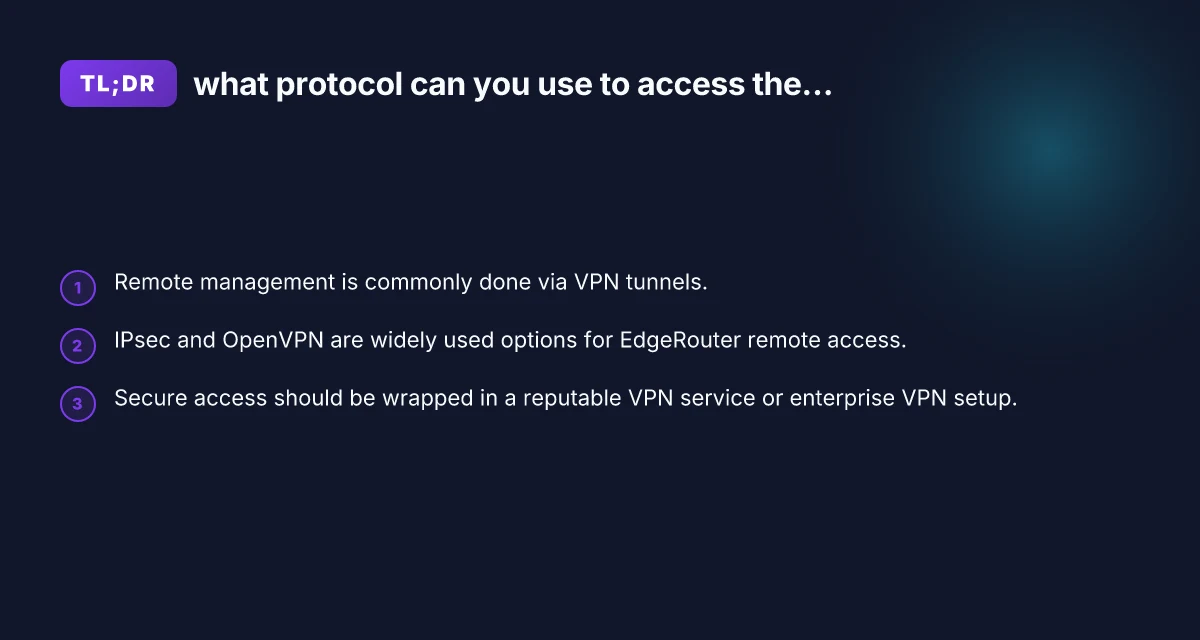
- IPsec: A traditional and widely-supported VPN protocol
- OpenVPN: A robust, open-source VPN that can run over UDP or TCP
- WireGuard: A newer, fast VPN protocol that’s gaining popularity
- SSL VPN: For devices that support browser-based VPN gateways
Benefits:
- Keeps the management interface isolated behind a VPN
- Reduces exposure to the public internet
- Works well when you need to reach multiple devices behind a single VPN endpoint
Limitations:
- Requires VPN server configuration and appropriate client software
- May introduce additional latency or complexity
Practical setup patterns
Depending on your environment, you may choose one of these common patterns.
Pattern A: Direct secure management with strict access control
- Enable SSH with key-based authentication or an admin password protected by strong policies
- Restrict management interfaces to trusted IPs or a VPN subnet
- Enforce multi-factor authentication (MFA) if the device supports it
- Use HTTPS with a valid certificate for GUI access
- Regularly review logs and enable alerting for management access
Pattern B: VPN-based remote management (recommended for security)
- Deploy a VPN server (IPsec, OpenVPN, or WireGuard) in a controlled environment
- Configure the edge router to allow management traffic only from the VPN subnet
- Ensure the VPN uses strong encryption, modern ciphers, and MFA where possible
- Consider a jump host or Bastion in your VPN for additional protection
- For multiple devices, a centralized VPN gateway simplifies access
Pattern C: Cloud-assisted Edge management
- Some vendors offer cloud-based management portals
- These portals may expose management actions through secure APIs and encrypted channels
- Ensure the cloud service supports MFA, role-based access control (RBAC), and audit logs
Protocols in practice: a quick comparison
Here’s a concise comparison to help you decide what to deploy. The table focuses on remote management scenarios for edge routers.
- Table: Direct management vs VPN-based access
| Method | Typical Protocols | Use Case | Pros | Cons |
|---|---|---|---|---|
| Direct secure management | SSH, HTTPS, SNMP (with security) | Small network, remote admin on a single device | Quick to set up, low latency | Exposes management surface to internet if not behind strict controls |
| IPsec VPN | IPsec tunnels, L2TP/IPsec | Secure remote access to a device’s management interface | Strong encryption, mature tooling | More complex to configure; requires VPN client and server |
| OpenVPN | OpenVPN, TAP/bridged modes | Remote access to router management via VPN | Flexible, widely supported | Larger footprint; setup requires server and client config |
| WireGuard | WireGuard protocol | Modern, fast VPN option for remote access | Simplicity, performance, strong security | May require newer device support or additional setup |
| SSL VPN | SSL VPN gateways | Browser-based or clientless access to management GUI | User-friendly, no dedicated client | Could be limited by device capabilities |
Security best practices for remote access
Remote access to edge routers should be treated like a high-security operation. Implement these practices to minimize risk. Planetvpn browser extension for Edge
- Use strong authentication: keys for SSH, strong passwords, and MFA where possible
- Prefer VPN-based access over exposing management interfaces directly on the internet
- Harden the management interface: disable unused services, enforce least privilege, and rotate credentials
- Keep firmware up to date: apply security patches promptly
- Log and monitor: enable audit logs, set up alerting for unusual access, and regularly review
- Network segmentation: place management access behind a dedicated management network or VLAN
- Backup and recovery: have a tested rollback plan and offline backups of configurations
Bringing it together: recommended approach
For most businesses and advanced home networks, the recommended approach to remote edge router management is to use a dedicated VPN-based remote access pattern. IPsec or OpenVPN are solid, well-supported options, while WireGuard offers a modern, high-performance alternative if your devices support it. By placing the edge router behind a VPN gateway, you minimize exposure of management interfaces to the public internet and simplify access control.
If you’re prioritizing simplicity and you only need to manage a single device, direct secure management with strong authentication can work, but you should still isolate management interfaces from the internet as much as possible and rely on SSH keys, HTTPS with valid certificates, and strict firewall rules.
You’ll want a reliable, well-supported option with robust security features and good client/device compatibility. ZoogVPN (zoogvpn.com) is a VPN service that endorses secure remote access practices and can be part of a VPN-based approach to edge router management. It offers standard VPN features, client flexibility, and a focus on privacy and security, which aligns with the needs of remote network administration.
If you’re evaluating a VPN for edge router access, look for:
- Strong encryption and modern protocols
- Native client support for your operating systems
- Clear split-tunneling or full-tunnel options
- Detailed connection logs and privacy assurances
- Easy device onboarding and reliable customer support
Bottom line: remote access to edge routers is most securely achieved through a VPN-based workflow, typically using IPsec, OpenVPN, or WireGuard, paired with careful configuration of firewall rules and management interfaces. Direct management over the internet can work in a pinch, but it increases risk and requires meticulous hardening. For many users, a reputable VPN service like ZoogVPN provides a trustworthy path to secure remote management. OpenVPN profile
If you’d like, I can outline a step-by-step setup guide for a specific edge router model you own, including recommended security settings and a sample VPN configuration to get you started.