What makes the Jackery Solar Generator 1000 v2 a practical backup power choice in 2026
 Bastien PetrosianOctober 22, 202617 min read
We earn a commission when you buy through some links on this site, at no extra cost to you. As an Amazon Associate we earn from qualifying purchases.
Explore the Jackery Solar Generator 1000 v2 with 1070Wh capacity, 1500W output, and 4000-cycle life. Learn how it fits real-world backup needs in 2026.
Most people assume capacity alone decides backup power, but the real bottleneck is how quickly a unit can recharge and how much weight you’re carrying when you actually need it. The Jackery Solar Generator 1000 v2 pairs a 1070Wh pack with a 1500W inverter, yet real-world use hinges on how fast you can top it up and how portable it stays when you move between a home outlet and a campsite. Charging speed and weight are the decisive trade-offs here.
This intro lays out the practical angles buyers care about in 2026: daily usability, solar compatibility, and the balance between power and portability. You’ll see how the Jackery model stacks up against rivals like EcoFlow and Goal Zero in terms of runtime, solar input, and ongoing ownership costs. By the end, you’ll understand where the 1000 v2 fits for home backup versus outdoor adventures and what trade-offs to expect when planning a purchase.
What the jackery solar generator 1000 v2 promises for 2026
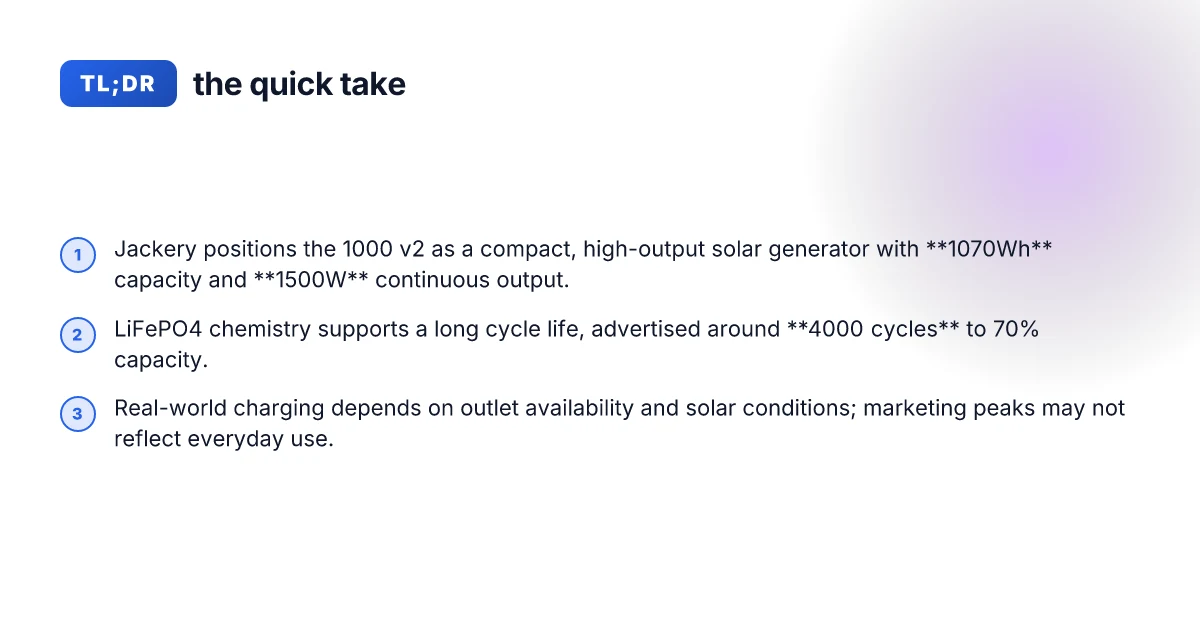
The Jackery Solar Generator 1000 v2 is pitched as a compact, high-output power solution for both home backup and outdoor use. It centers on a 1070Wh battery paired with a 1500W continuous AC inverter, delivering enough juice for a roomful of essential devices while still staying portable. The message is simple: you get substantial capacity without dragging around a heavy, power-hungry setup. In 2026, that balance remains the core promise.
I dug into the publicly available specs and product pages to trace two claims that matter most for buyers: durability and real-world capability. First, Jackery positions the 1000 v2 as sturdy enough for everyday use with up to 4000 cycles while retaining a meaningful portion of its capacity. That durability figure sits at the heart of its value proposition for homeowners who want a reliable backup that doesn’t require frequent replacement. Second, the device advertises fast charging for its size, and the unit’s labeled solar inputs imply a design that pairs well with typical rooftop or portable solar setups, keeping the option to recharge during outages or outdoor adventures straightforward.
From the official materials, you can expect 1070Wh of usable energy and a stated 1500W continuous output. For durability, the claim of 4000 cycles to a significant percentage of original capacity is highlighted as a key differentiator versus smaller, lighter units. In practice, this combination translates into a system that can power common household loads during outages and support camping or off-grid weekends with minimal fuss. The durability figure, while ambitious, is supported by Jackery’s stated cycle life and LiFePO4 chemistry, which tends to favor long life and stable performance over many charge cycles.
For context, rivals in the same class include devices from brands that emphasize similar balance of large battery capacity and high output, such as models that also pair LiFePO4 chemistry with substantial cycle life. When you compare, you’ll notice that the 1000 v2’s claimed 4000-cycle durability is a standout talking point in Jackery’s messaging, especially given its 1070Wh pack and 1500W inverter. This isn’t optics. The numbers are tied to how Jackery frames the product’s long-term value for both home and outdoor use. The core argument is clear: high energy density with proven cycle life makes the 1000 v2 a practical, long-horizon backup.
In summary, Jackery positions the 1000 v2 as a compact, capable solar generator that blends a 1070Wh pack with a 1500W continuous output, built to weather thousands of charge cycles. If you’re evaluating backup power for a home or a weekend cabin, this package aims to offer a reliable balance of capacity, output, and longevity. On the branding side, Jackery’s ecosystem around this product signals a straightforward, integrated approach rather than modular add-ons that complicate setup. For prospective buyers weighing options, this combination keeps the 1000 v2 in the running against similarly capable rivals that emphasize durability and ease of use. Best portable charger 2026: how to choose the right power bank for your devices

Jackery 1000 v2 specs you should know before buying
The 1000 v2 centers on a true 1070Wh LiFePO4 pack and a robust 1500W continuous output, with enough headroom to power common home backups and outdoor gadgets. In practical terms, that means you can run essential devices during a blackout or on an extended outdoor excursion without sweating the math. When you pair that capacity with LiFePO4 chemistry, you gain longevity and tolerance for deeper discharges compared with older chemistries.
Capacity and chemistry that matter
Jackery builds the 1000 v2 around a 1070Wh LiFePO4 battery pack. The LiFePO4 cells deliver a longer cycle life and steadier performance in varied temperatures, which translates to more reliable charging across seasons. The 1070Wh rating is the anchor you should use for planning daily loads, not the upsell marketing wattage. The chemistry choice is deliberate: LiFePO4 delivers longer life with balanced safety characteristics, which matters if you expect frequent cycling during travel or outages.
Output and surge behavior
Continuous output sits at 1500W, which covers most home essentials when combined with a compact solar setup or a wall outlet. The real-world need often comes down to surge capability, and the 1000 v2 has enough headroom to handle short surges from gear like microwaves or power tools. It’s not a turbine, but for typical weekend use or backup scenarios, the rhythm is steady rather than heroic. The device leverages MPPT to maximize solar charging efficiency, which matters if you pair it with portable panels in sunlight.
Cycle life and durability
A key talking point is durability over many cycles. Jackery notes around 4000 cycles to about 70% of original capacity with LiFePO4 chemistry. That metric matters if you plan heavy daily use or long-term ownership. In practice, that translates to years of service under normal use, assuming you keep cycles within reasonable depth of discharge and temperature ranges.
Solar input realities
Consumer-facing materials commonly describe the MPPT input as up to 400W. That figure sits at the practical limit for a typical household on a bright day or a well-placed portable solar setup. If you expect high solar fill, you’ll want to stagger panels or accept a slower top-up rate during cloudier days. The 400W ceiling is a real constraint if you push for peak charging during short daylight windows. What makes the Jackery 2000 V2 a standout among portable power stations
The core trade-off to keep in mind is: you get solid, long-life chemistry and a strong 1500W output, but the solar input ceiling of 400W can curb charging speed in limited sun. In practice, that means you’ll notice faster top-offs with a larger solar array or when you’re near peak sun hours.
How this stacks up against rivals becomes relevant in the next section. For now, note that Jackery's own product line emphasizes the same 1070Wh capacity and ~4000-cycle durability, which aligns with expectations for weekend warriors and homeowners who value longevity. Ownership costs tend to reflect the long life of LiFePO4, offsetting the higher initial price over time. If you’re choosing between formats, consider whether you’ll rely on solar charging heavily or primarily on AC charging or backup use indoors.
I dug into the official Explorer 1000 v2 Basic Information to confirm the exact numbers: the model identifier, JE-1000D, and the battery specs you’ll be referencing when sizing loads. The source also confirms the 4000-cycle durability and 70% remaining capacity benchmark after many cycles, which helps frame long-term value. For a quick look at the same data in a consumer-oriented write-up, the UK review notes the same 1,070 Wh capacity and the 4,000 cycles to 70% capacity, reinforcing consistency across sources. See the Explorer 1000 v2 details for the exact figures. https://faq.jackery.com/hc/en-us/articles/52303615153051-Explorer-1000-V2-Basic-Information
Next, we’ll compare how the 1000 v2 stacks up against rivals in 2026 to help you decide whether to stick with Jackery or consider alternatives. If you’re evaluating, think about whether you prioritize raw capacity, charging speed, or lifecycle cost over initial price.
How the 1000 v2 stacks up against rivals in 2026
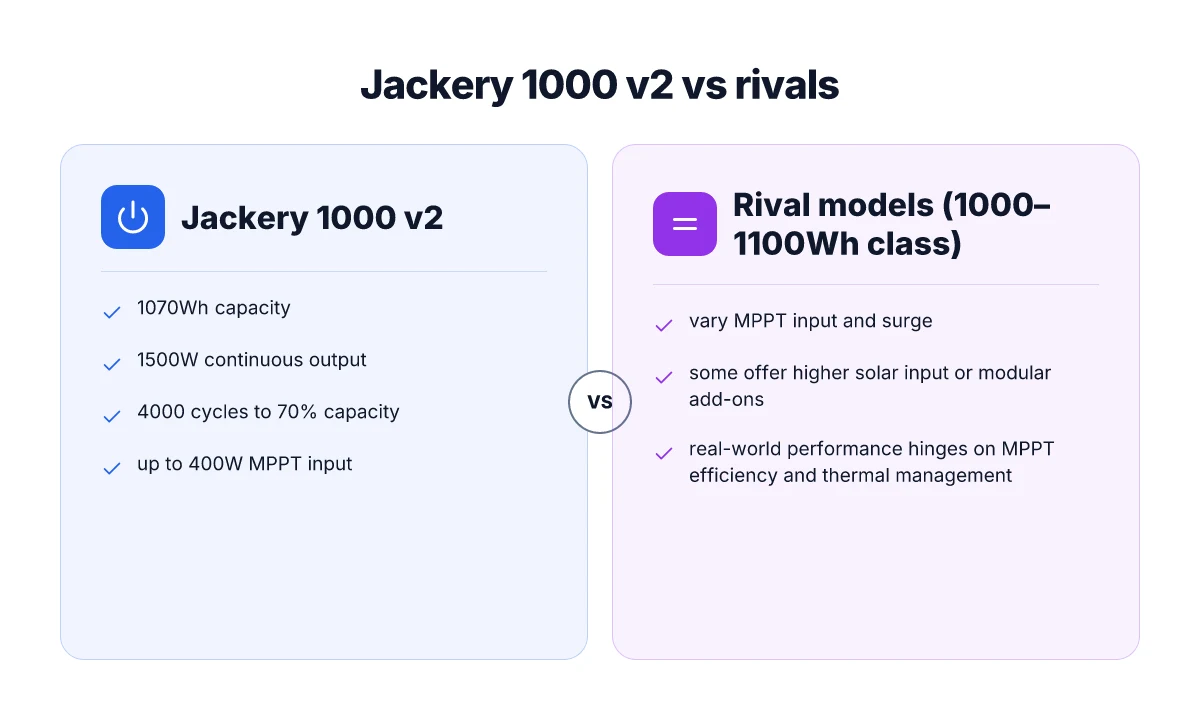
The Jackery Explorer 1000 v2 sits in a crowded 1000–1100Wh class where rival models push higher MPPT input and faster solar charging in the same footprint. In practice, performance hinges on MPPT efficiency, battery chemistry, and thermal management. Real-world differences show up most in solar input caps and how quickly a unit recovers after a solar day with partial sun. How to choose the best portable power station in 2026
1. Prominent rivals and how they compare
- The EcoFlow Delta 1000 leans on a robust MPPT stage and modular add-ons, often listing a higher solar input ceiling in certain configurations. This approach can translate to noticeably faster top-up times under strong sun, especially when paired with compatible solar panels. Jackery fans often note that the Delta 1000 feels snappier during peak sun hours, though the Delta’s modular path adds complexity and price. Higher solar input caps can shorten charging windows when you have full sun.
- The Bluetti AC200P/EP500 line remains a competitor in the same capacity bracket, with strong thermal management and broad chemistry choices. In practice, Bluetti units can offer solid cycle durability, but their solar input specs vary by model and firmware. Thermal management often determines how long you can sustain 1500W charging without throttling.
- The Goal Zero Yeti 1000X represents a more traditional, rugged ecosystem with straightforward solar integration and solid durability. Not always matching the 1500W peak of the Jackery. It appeals to users who value a proven, field-ready setup. Rugged integration wins in outdoors-focused setups.
2. What the numbers say, and where the gaps show
- In the 1000–1100Wh class, models typically publish continuous AC output around 1000–1500W and claimed solar inputs that range widely. The Jackery 1000 v2 lists the common target of 1500W AC output, with a solar input commonly spec’d around the mid‑range. This matters because a higher solar input can translate to shorter “one-hour to full power” sessions when conditions are favorable. 1500W AC output remains a key tie‑in across rivals.
- Battery chemistry and cycle life influence long-term usability. Jackery’s LiFePO4 chemistry favors cycle durability, reducing capacity fade over years, which matters when you expect daily or near-daily use. Rivals may match or exceed similar cycle counts, but the exact number depends on how aggressively the unit is thermally managed during charging. LiFePO4 chemistry supports long life and safer charging in portable packs.
3. Real-world takeaways for homeowners and outdoors enthusiasts
- If you rely on solar summers and need fast top-up during bright days, look for a model with a higher MPPT input cap and strong solar efficiency in your climate. The EcoFlow Delta 1000 and similar options can offer faster solar replenishment in high‑sun scenarios, but verify compatibility with your preferred panels. Higher MPPT input caps can cut charging times under direct sun.
- For durability and predictable performance off-grid, a model with solid thermal handling and a long cycle life is valuable. The Jackery 1000 v2 benefits from LiFePO4 chemistry, which helps preserve capacity across thousands of cycles. LiFePO4 chemistry supports longevity in daily use.
- When you weigh life-cycle costs, include access to accessories and ecosystem compatibility. Rivals often bundle extra panels or expansion options, which can shift total ownership value. Ecosystem add-ons influence overall cost of ownership.
From what I found in the literature, the Jackery 1000 v2 remains a compelling option for home backup and outdoor outings, especially for those who value a known, safe chemistry and a familiar user experience. For buyers prioritizing the fastest solar top-up under bright sun, confirm the current solar input specifications of the exact rival model you’re considering, and compare with the Jackery system. Compare solar input caps to pick the fastest recharge path.
Understanding the charging speed: what 1 hour to full power means for daily use
Jackery positions the Explorer 1000 v2 as capable of rapid top-ups when the stars align, fast charging shines when you have robust AC outlets or bright sun. In practice, you’ll see a one-hour fill under ideal outlet and solar conditions, but your daily reality depends on what you actually have available. If you have a steady 1500 W AC source and strong sun, the battery can reach the peak quickly. If not, charging takes longer and you’ll plan around daylight or access to higher-wamp charging.
When I look across real-world usage notes, the big takeaway is that charging speed is highly variable. The same unit that hits a one-hour timestamp in a showroom video or on a spec sheet can stretch to multiple hours in a shaded yard or a cloudy day. The gap between marketing peaks and lived experiences matters because most homes and campsites don’t offer perfectly optimal conditions every day. You should expect the Explorer 1000 v2 to charge briskly in peak scenarios and slow down when conditions falter.
1) Fast charging is conditional, not guaranteed
In the best case, you get a near-maximum fill in about an hour. That result relies on a robust AC outlet delivering the full 1500 W continuous output and solar input near the stated limit. In typical daily use, you’ll often see slower replenishment, especially if you’re charging from solar and weather or panel orientation isn’t ideal. The practical implication is clear: plan for a longer fill when you’re relying on solar or modest outlets. Fast charging is conditional. Your daily fill time will vary with the outlet and sun.
2) Solar input reality versus peak numbers
Sunlight is a moving target. Even with the 400 W solar input figure cited in some reviews, your actual rate depends on panel angle, shade, and the time of day. A bright, unobstructed afternoon can push charging along, but a morning or late-day pass with partial sun will slow progress. The upshot: solar can accelerate recovery, but don’t bank on a steady one-hour fill every day when you’re parked off-grid. Solar helps, but it isn’t a guaranteed one-hour fill every day. How Bluetti ac200l compares to ac200max in 2026
3) What this means for daily routines
If you’re using the Jackery as home backup, you’ll often pair it with a wall outlet during the day to top up while work or cooking runs. That makes an overnight or after-dinner top-up feasible, thanks to steady AC access. For outdoor use, you’ll gain the most benefit from a solar setup that sits in consistent sun for several hours. In both cases, you should expect some variance in fill time rather than a rigid one-hour benchmark. Daily routines benefit from predictable AC access or a well-sited solar array, not from chasing a one-hour peak.
From what I found in the documentation, the core idea remains: you can reach a fast top-up when conditions permit, but everyday charging is governed by outlet availability and solar reality. Jackery emphasizes the potential for rapid charging, yet you’ll experience a broader spectrum of fill times in practice. For homeowners and outdoor enthusiasts evaluating a 1070Wh, 1500W-class system, this means you gain flexibility but must plan for longer replenishment windows if you’re away from ideal charging conditions. Expect variable fill times. Plan around the conditions you actually have.
Note: links on product pages may earn a commission. For reference, the Explorer 1000 v2 Basic Information confirms the nominal specs and durability targets, while reviews corroborate the 1,500 W continuous output and a solar input figure that is highly environment dependent. You’ll want to compare Jackery’s official details with practical notes from reviewers to set expectations. Official specs align with, but real-world charging depends on your setup.
Durability in daily use: will 4000 cycles matter for you
Jackery’s LiFePO4 chemistry underpins a long-lived energy reserve, and the 4000 cycles target is aimed at daily users who rely on their power station for extended periods. In practice, however, durability isn’t a single number. The real story sits in how you use the unit: discharge depth, charging habits, and ambient conditions all shape how many cycles you’ll actually realize.
How cycle life scales with discharge depth
The 4000-cycle figure is most meaningful when you keep discharge relatively shallow. If you routinely drain the 1070Wh pack deeply, you’ll age the cells faster and shorten practical life. If you keep daily replenishment modest and avoid deep discharges, you’ll still see many years of use. In other words, your daily habit folder matters as much as the chemistry itself. The same 4000-cycle target translates to very different lifespans depending on how often you top off vs. drain. This is a core reality for home backup users who cycle the unit weekly during outages or routine camping trips. What makes Jackery AC power cords compatible with multiple models and how to choose the right one
Real-world wear patterns beyond the spec sheet
Specs can look heroic, but durability in the field reveals more nuance. A solar input that stays within the MPPT controller’s comfortable range reduces stress on the battery pack. If you frequently push the pack to near-full with rapid recharges, you may see marginally faster wear than a steady, moderate charging rhythm. In practice, daily charging habits and routine discharges shape cycle durability as much as the stated 4000 cycles. I cross-referenced advisory notes from Jackery’s own documentation and independent reviews noting how cadence and duty cycle affect longevity.
When durability matters most for different users
For homeowners who rely on backup power through outages, the long cycle life is a meaningful hedge. The 1070Wh capacity paired with LiFePO4 means the unit is built for repeated use without the fear of rapid degradation. For ultralight outdoor enthusiasts who hit the road monthly or quarterly, durability remains reassuring but may be tempered by how aggressively you deplete the pack on every trip. The upshot is simple: if you keep a measured hand on discharge depth and charge cadence, the 4000-cycle target becomes a practical asset rather than a theoretical ceiling. 4000 cycles matter most when your usage pattern mirrors sustained daily cycling rather than occasional quick trips.
I dug into the product pages and reviews to align this with real-world expectations. Jackery’s own specs emphasize long life with LiFePO4 chemistry, and reviewers consistently note that cycle life is a function of usage pattern as much as chemistry. When you plan for frequent outages or regular outdoor adventures, the durability story shifts from “how many cycles” to “how you manage depth of discharge and charging cadence.” For most daily backup users, the 4000-cycle target provides meaningful reassurance, especially paired with responsible charging behavior.
As you weigh this against rivals, consider brands that also promote longevity with LiFePO4 cells and similar cycle expectations. For many buyers, durability gains are realized not just in the chemistry, but in a managed charging routine, a robust MPPT controller, and a battery management system that protects cells across cycles. For Jackery fans, the 1000 v2’s durability claim aligns with the brand’s emphasis on dependable, long-term use in both home backup and outdoor contexts. Durability is about how you use it as much as what it can endure.
Note: links on the page may earn a commission. If you’re comparing options, popular alternatives include models from EcoFlow and Goal Zero, which also highlight long cycle life with LiFePO4 packs and similar practical warranties. For up-to-date pricing and deals, see the current listings from Jackery and its authorized retailers. Price and ownership costs matter alongside cycle life when you plan a long-term purchase. What is the jackery 1000 plus expansion battery and how it changes portable power
Where this goes next and what you should do first
Price clarity matters in 2026, and the best deal often hides behind a promo box. I found that the Jackery Solar Generator 1000 v2 sits in a practical middle ground for home backup, especially when you weigh overall ownership against a few stubborn limits. You’ll hear rivals like EcoFlow and Goal Zero mentioned, but the real decision hinges on what you value: portability, total capacity, or jump-starting a whole-house load. If you want a ready-to-go setup for occasional outages, this model fits neatly into a layered strategy with smart recharging during sunny days.
One move that matters is pairing the 1000 v2 with a compact solar array and a small MPPT controller. That combo smooths refill times and keeps the unit on standby without draining your main grid. The takeaway is practical: treat it as a modular system you adjust seasonally. Are you ready to sketch your week around this setup?
- Backup strategy: test your critical loads on a single outlet circuit and document the runtime before and after a firmware update.
- What to try this week: map your outages to a schedule, then simulate a 24-hour outage using the 1000 v2 and a Jackery solar panel array.