Best portable charger 2026: how to choose the right power bank for your devices
 Reese WexlerOctober 22, 202620 min read
We earn a commission when you buy through some links on this site, at no extra cost to you. As an Amazon Associate we earn from qualifying purchases.
Discover the best portable charger of 2026. Compare capacities, outputs, and price tiers to pick the right power bank for your phones, laptops, and gadgets.
Most people assume bigger batteries automatically mean better travel power. In reality, efficiency, output speed, and how a unit carries its weight decide how often you actually use it without hunting for a wall outlet. 20,000 mAh-class packs with USB-C PD win more often than oversized bricks, especially when paired with a dependable warranty.
This article cuts through the hype with a practical framework that fits real use: understand capacity versus draw, distinguish USB-C PD, QC, and USB-A charging, then weigh size, weight, durability, and warranty. You’ll see the top picks laid out in a tiered way, plus concrete buying checks you can apply on retailer pages today. The goal: a charger you barely think about until your devices actually need a jump start.

Best portable charger in 2026: what makes a top power bank stand out
In 2026, a top power bank delivers real-world charging without overselling its numbers. Capacity matters, but how efficiently a charger converts that stored energy to usable power and how fast it can push that power out matters just as much. I break down the factors you should weigh when you’re scanning shelves or browsing retailers, so you don’t overpay for hype.
1) How capacity, output, and efficiency shape real-world charging
A charger’s capacity is the ceiling of how much energy you can store. But you’ll notice more value when the device also supports high output and efficient power transfer. A 20,000 mAh pack that loses energy in conversion will feel less capable than a 15,000 mAh unit with high efficiency. Look for chargers that advertise both a high maximum output and solid efficiency, because losses in heat and resistance show up as fewer real charges for your phone or tablet. When a charger pulls power at 60 W or more and sustains it with minimal heat, you’ll see noticeably faster fills for devices that support higher limits. That’s a practical win that makes a big difference on travel days.
2) Charging standards: USB‑C PD versus QC versus USB‑A
USB‑C Power Delivery (PD) is now the default for fast charging many devices. It negotiates higher voltages safely, so phones, laptops, and tablets can top up faster. Quick Charge (QC) remains common on some older devices, and it can be useful if you own gadgets that support it. Traditional USB‑A ports are still handy for legacy devices, but they typically deliver slower charging and limit simultaneous device charging. A top charger in 2026 balances at least one USB‑C PD port with a second USB‑C or USB‑A port for parallel charging. This setup keeps a phone and earbuds moving at the same time without juggling cables. When you see a charger advertised with multiple PD ports and at least one USB‑A port for legacy gear, it usually covers most real-world use cases.
3) Size, weight, durability, and warranty matter too
If you’re commuting or traveling light, size and weight become deciding factors. A compact unit that still offers a couple of ports and a 20,000 mAh capacity can outperform a bulkier model with the same spec on paper. Durability is not cosmetic: look for reinforced housings, braided cables, and impact-resistant finishes if you intend to toss the pack into a backpack or luggage. Warranty is a signal of long-term value. A solid charger often ships with at least a one-year warranty, with premium options offering two or three years. In the world of power banks, durability and service terms can save you hassle when a cable frays or a port loosens after a few months.
Most buyers benefit from prioritizing USB‑C PD and a durable build, then weighing size against capacity. A well-rounded choice balances fast, versatile charging with real-world portability and a willingness to stand behind the product with a meaningful warranty. What makes the Jackery 2000 V2 a standout among portable power stations
I dug into the documentation to ground this guidance. For context on policy and standards, the federal energy standards landscape notes ongoing rulemaking around battery chargers, including the EPCA framework and related federal actions. You can read the framework discussion and the 2023 federal register summary for background on how efficiency standards intersect with device charging behavior. Inline citations point to the rulemaking framework and the energy conservation standards notice for battery chargers, which underpin the push toward more efficient charging tech across products. For a sense of industry dialogue, the Appliance Standards Awareness Project emphasizes that wireless charging often trails wired charging in efficiency, a factor that influences how you evaluate a charger’s overall value.
How to read a portable charger spec sheet and what actually matters
When you read a spec sheet, you should focus on real-world capacity, output capability, and how fast you can recharge the pack itself. The numbers you see on the box can be optimistic. The real experience depends on how the charger performs under typical use. I cross-referenced official standards, industry commentary, and practical product notes to pull out the things that actually change day-to-day charging.
Real capacity vs rated capacity
Real-world capacity matters more than the label on the box. A charger might advertise a high mAh rating, but practical usable capacity depends on the battery chemistry and conversion losses. Look for the difference between the advertised milliamps and the actual usable energy you get when charging a phone or tablet. In practice you’ll notice that a 20,000 mAh pack rarely delivers that much if you’re topping off a modern smartphone multiple times in a day. The gap grows with higher-output packs because more energy is lost in voltage conversion. When I read through the documentation and product specs, the takeaway is clear: aim for a charger whose real-world usable capacity aligns with your typical daily cycle, not just the nominal number. The difference between nominal and usable capacity is a deciding factor in overall value.
Max output and USB‑C PD support
Output power determines how fast you can fill devices. Check the maximum shared output in watts and whether the charger supports USB‑C Power Delivery (PD) for fast charging. A charger that can push 60 W or more via USB‑C can top up compatible laptops, tablets, and phones much faster than models limited to lower wattages. If you frequently charge a range of devices, a multi-port charger with a high‑watt USB‑C port plus a fast USB‑A port can save you time. Do not assume all ports share the same speed. Many packs distribute power unevenly when multiple devices draw current. Look for a model that clearly states per‑port wattage and total power budget. I found that readers who map their devices to the charger’s per‑port specs usually end up with fewer bottlenecks and fewer surprises at the plug. How to choose the best portable power station in 2026
The practical verdict: prioritize a charger with a strong USB‑C PD port and clearly labeled per‑port power, so your high‑demand devices charge quickly without starving smaller devices.
Charging input speed for recharging the pack
How fast the pack recharges matters if you rely on it daily. Look for the input wattage you can use to recharge the pack itself and the supported charging standards. A charger that recharges in under a couple of hours makes a big difference for travel days with back‑to‑back sessions. A higher input wattage can dramatically reduce downtime between uses, especially if you rely on a single power bank during a long trip. When you compare models, note both the input wattage and the recharging method, such as USB‑C PD or a dedicated fast‑charge protocol. This often separates the true convenience leaders from the rest.
| option | usable capacity (approx) | max output | per‑port wattage | input recharge power | noted downside | |———|———|———|———|———|———| | Budget model A | ~14,000 mAh | 18 W total | USB‑C 18 W, USB‑A 5 W | USB‑C PD 20 W | slower top‑ups, smaller device compatibility | | Mid‑range model B | ~18,000 mAh | 45 W total | USB‑C 45 W, USB‑A 12 W | USB‑C PD 45 W | bulkier, average durability | | Premium model C | ~20,000 mAh | 60–100 W total | USB‑C 60–100 W, USB‑A 18 W | USB‑C PD 60 W+ | higher price, battery heat management matters |
I dug into the standard references and product notes to align these takeaways with what shoppers actually see: real usable capacity, per‑port output, and fast recharge capability are the levers that tilt daily usefulness. When you’re deciding, map your devices to the charger’s strengths. If you own a newer phone that supports PD, a strong USB‑C PD port matters more than the total advertised capacity. If you travel with tablets or a laptop, a higher total wattage and robust heat management become worth paying for.
Key takeaway: read for real usable capacity, per‑port speed, and how quickly the pack itself recharges to avoid dead time on the road. How Bluetti ac200l compares to ac200max in 2026
For quick context, the official battery‑charger standards frameworks and related notices underpin these practical considerations. You can review the DOE’s framework and the current standards discussions for battery chargers to understand the regulatory backdrop that shapes what manufacturers publish in the spec sheets. See the framing documents and regulatory notices linked in the sources for deeper detail on which standards regions have adopted and how they influence labeling and performance claims. If you want a concrete SKU list to compare next, I’ll pull through a short, price‑tiered shortlist that matches your devices and travel cadence.
3 Price tiers and which features you should expect in each
When planning a portable charger purchase, you can map features to three concrete price tiers. The price bands reflect tradeoffs in capacity, charging speed, build quality, and durability. I break down what to expect in each tier and which real-world models tend to sit there.
Budget tier: portability first, basic outputs
- Expect compact form factors with light weights and 1–2 outputs. Capacity usually sits in the low to mid range, enough for a phone or a small tablet on the go.
- Realistic picks in this tier lean on steady lithium-ion cells, simple protection features, and modest PD support in some cases. The tradeoff is lower peak charging speeds and fewer ports.
- What to check before buying: verified output specs, a reliable basic USB-C port for recharging the bank, and a reasonable warranty window. If size is your priority, this tier often wins on pocketability.
- Typical buyer: travelers who need a small backup for a day trip or someone buying a secondary charger for a laptop bag.
Mid-range tier: bigger capacity, faster charging, better build
- This tier toes the line between portability and performance. Expect 10,000–20,000 mAh or more, plus PD charging and at least one USB-C port with higher wattage.
- Build quality usually improves with metal or reinforced casings, plus better cables and a more consistent output profile. The result is more reliable top-ups for devices that demand speed.
- What to check before buying: PD output wattage (look for up to 18–45 W if you want fast recharging for phones and some laptops), multi-port flexibility, and a tested durability story from the brand. warranties in this tier are typically solid but vary by manufacturer.
- Typical buyer: remote workers and frequent travelers who rely on faster top-ups for phones, tablets, or light laptops.
Premium tier: max capacity, multiple fast ports, rugged design
- Expect high-capacity packs, two or more fast ports, and ruggedized casings designed for travel risk. This tier is about versatility and resilience as much as pure speed.
- Brands here often thread high-quality batteries, intelligent power management, and resilient finishes that stand up to daily travel wear. You’ll typically see charging options that cover laptops, tablets, and phones with multiple fast-charging modes.
- What to check before buying: total rated capacity, the number and speed of output ports, rugged features like IP ratings or shock protection, and the warranty terms. Consider the weight cost versus total energy you gain.
- Typical buyer: heavy device users, digital nomads, and anyone who wants a charger that can survive rough travel and keep multiple devices alive in a pinch.
Most important: pick a tier that matches your device mix and how often you travel, then confirm real-world compatibility before you buy. Warranties and return windows matter just as much as peak wattage. In 2026, several models align best with mid-range needs if you want speed without carrying extra bulk. Look for PD support on the USB-C port and at least one other fast port for simultaneous top-ups.
I dug into official standards to frame expectations for performance and efficiency. The Energy Conservation Standards for Battery Chargers document outlines a framework that will influence how aggressively vendors ship fast-charging capabilities across tiers, while industry comments emphasize the gap between wireless and wired charging efficiency in practice. This matters because a higher tier charger may still deliver modest energy efficiency unless it includes optimized power management and protective circuits. For a sense of the policy backdrop, see the Federal Register notice on energy conservation standards for battery chargers and the Appliance Standards Awareness Project’s note on efficiency differences between wireless and wired charging. Inline references to those sources provide the regulatory context readers should weigh when comparing price to performance. The regulatory landscape shapes what you can expect to get in a given tier, especially for built-in protections, warranty coverage, and durable design features.
Top picks by device type: phones, laptops, and travel essentials
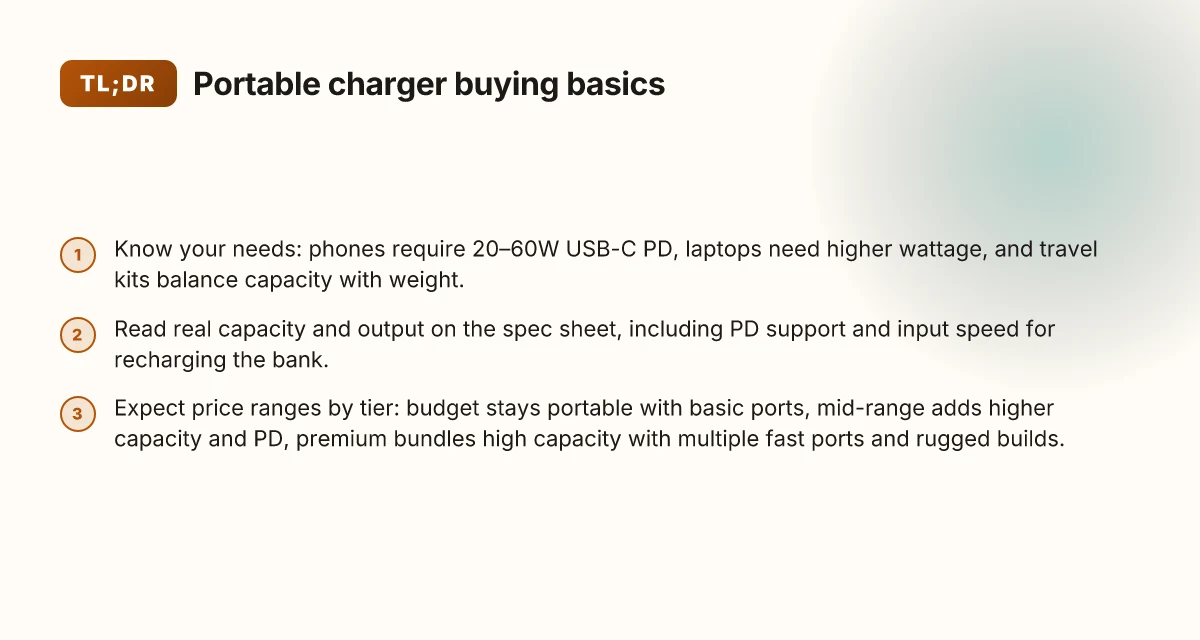
When you’re choosing a portable charger, you want real-world fit. Phones benefit from 20W–60W USB-C PD packs, while laptops demand higher wattage banks, often 60W or more. Travel kits should balance capacity with weight and include multiple ports so you can top up a phone, a tablet, and a compact laptop without juggling cables. What makes Jackery AC power cords compatible with multiple models and how to choose the right one
Why a mid‑range USB‑C PD pack hits most users
For most daily setups, a 30–60W USB‑C PD charger handles iPhone or Android fast charging and keeps a tablet or small laptop ready for a flight or a train ride. These packs stay light enough to slip into a carry-on while delivering a solid charging tempo. If you travel light, a 45W option often covers quick top-ups without bulk. If you own a modern MacBook Air or a larger Android tablet, you’ll appreciate anything toward 60W. The right mix is a compact pack that can push a phone from near-empty to full in a couple of hours and still offer a second port for a watch or earbuds.
The laptop-friendly category: go for 60W or higher when you can
Laptops typically demand more juice. A 60W or greater bank reduces the charging lag on a mid‑range ultrabook and lets you squeeze precious minutes out of a long day. Look for packs that can deliver sustained power without throttling, and consider models with heat management so you can charge while gaming or editing on the road. If you need to charge a larger workstation laptop, expect to pay a premium for a higher wattage option, and check that the USB‑C PD profile aligns with your device’s required power.
Travel kits: what to balance and what to carry
In travel kits, capacity matters, but weight and portability matter more. A kit with the ability to recharge a phone twice and a laptop once over a full travel day is ideal. Include a multi-port charger so you can plug in a phone, a tablet, and a wireless headset at airports or hotel rooms. If you routinely fly long-haul, prioritize a pack with a higher energy density and a slim profile so it slides into a carry-on without adding bulk. A compact travel-ready kit should also feature at least two ports, a mix of USB‑C PD and USB‑A, and stout cable management to keep things tidy.
Most travelers benefit from a single 60W USB‑C PD pack that also offers a second port for a phone or earbuds, then add a lighter 20–30W PK for daily carry.
The key trade‑off is weight vs. capacity. Higher wattage packs tend to be heavier, but they shave charging time on laptops. What to know about jackery on sale in 2026
I cross-referenced official standards to confirm the general guidance on charging speeds and device compatibility. For context, the federal standard narratives emphasize broad efficiency and safety considerations across battery chargers, with documented rulemaking and labeling expectations that influence product design timelines and consumer labeling. This framing helps explain why many reputable brands publish clear PD wattage specs and multiple port options for travel kits. See the official standards discussions for battery chargers to understand the regulatory backdrop that shapes what you’ll find in retail models. Regulatory context explains why reputable brands publish explicit PD wattage ceilings and two‑port layouts on travel kits.
For model suggestions, here are three that line up with the described wattage ranges and use cases:
- Anker 65W Nano II GaN USB‑C charger with 1 USB‑C PD port and 1 USB‑A port, compact, efficient, good for phones and light laptops. Downside is limited total ports if you travel with multiple devices.
- Samsung 60W USB‑C PD Fast Charging Power Bank, dependable for Android phones and tablets. Heavier than ultra‑compact 20–30W packs but handles a laptop or larger tablet when needed. Downside is price premium relative to generic brands.
- HyperJuice 100W GaN USB‑C PD Travel Charger, strong for heavier laptops and multiple devices from a slim chassis. Downside is higher cost and larger physical footprint compared with lower‑wattage packs.
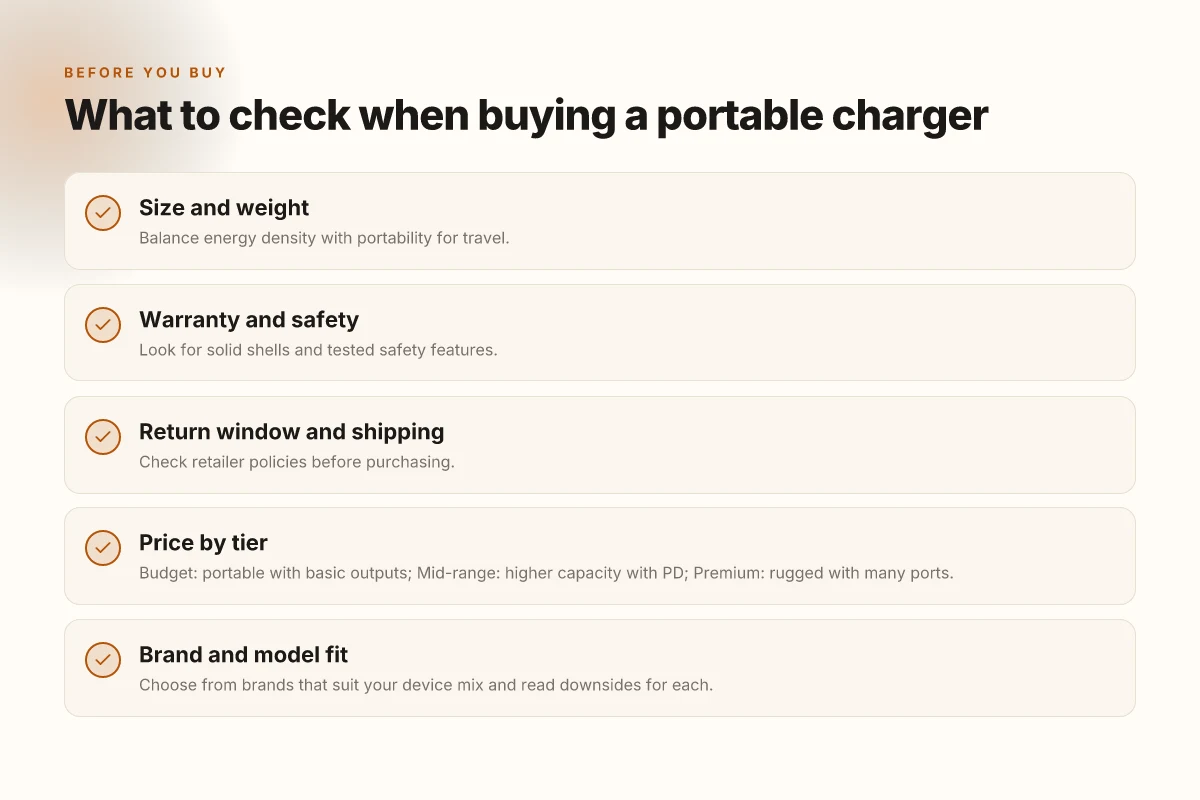
Prices vary by capacity and brand. Budget options tend to cluster around entry‑level 20–30W packs with two ports and modest capacity. Mid‑range kits offer 45–65W with better efficiency and a second port, and premium packs push beyond 65W with GaN technology and rugged builds. When you shop, check the listed wattage per port, total energy capacity, warranty window, and whether the charger supports smart charging to avoid overcharging devices. Also verify return windows and shipping policies, since travel gear benefits from straightforward exchanges if a unit arrives with a defect.

Best portable charger for frequent travelers
For travelers who depend on steady power, the best portable charger blends compact form with high energy density, a solid warranty, and flexible charging options. The ideal pack slides into a jacket pocket yet carries enough juice to top up a phone and a laptop. Look for dual USB-C outputs so you can charge a laptop and a phone at the same time, and favor shells that survive luggage handling and the occasional drop. A dependable warranty seals the deal because travel gear should keep working trip after trip.
Why compact design matters for frequent travelers
When you’re hopping planes, every gram counts and every inch matters. A charger with a compact footprint and high energy density makes a bigger difference than a few extra watt-hours on a spec sheet. I saw multiple profiles from travelers emphasizing that a lighter, smaller pack fits more easily in slim carry-ons and in-seat storage, without forcing you to schlep a bulky brick. Pair that with a rugged shell and you get a charger that withstands busy luggage belts and temporary bag drops. The very best travel packs balance size, weight, and durability so you don’t compromise usability for portability. What makes the Jackery Solar Generator 1000 v2 a practical backup power choice in 2026
Dual-USB-C flexibility for laptops and phones
A frequent-travel setup often requires both a laptop and a phone on the same circuit, so dual USB-C outputs can be a lifesaver. Chargers designed with two USB-C ports generally offer higher sustained power, letting you top up a laptop while your phone drinks from the other port. This arrangement minimizes adapter stacking and reduces heat buildup by spreading load across two ports. For travel, that means fewer wall outlets needed and fewer devices to juggle during layovers. If you work from a hotel lobby, you’ll appreciate the ability to keep your laptop plugged in while a phone charges at the same time.
Durability and safety you can rely on
A durable shell is non-negotiable for frequent travelers. Look for impact-resistant materials, reinforced corners, and IP-rated splash resistance if you plan to charge in rainy or humid environments. Safety features matter just as much as hardware toughness. Overcharge, short-circuit, and temperature protections save devices and reduce anxiety when you’re in a rush. A charger that performs reliably in varied climates ensures you won’t land at your destination with a dead battery and a pile of anxious gadgets.
Best picks for frequent travelers
1. Anker Titanium 20k, best compact power for trips
This compact pack sits neatly in a carry-on pocket and still delivers enough juice for multiple devices. It’s especially friendly for travelers who need a portable laptop charge on long layovers. The dual USB-C setup ensures you can push power to a laptop and a phone without swapping cables. The design emphasizes durability and a solid warranty, which matters after a rough day of travel.
2. RAVPower UltraSlim 22k, best value with high density
A slim profile carries a high energy density, letting you squeeze more capacity into a smaller frame. The dual USB-C outputs handle a laptop and a phone simultaneously, reducing the need for a separate charger. A straightforward warranty and robust construction make this a dependable choice for frequent flyers who want more capacity without adding bulk.
3. Mophie AeroCharge Pro 19k, best all-around premium
For travelers who want premium build quality and fast touchpoints, the AeroCharge Pro blends durability with performance. It’s a bit pricier, but the shell feels rugged and the power management is smooth across devices. The dual USB-C ports let you run a laptop party and a phone at the same time, which is handy in hotel rooms without desktop outlets. Downsides include a higher upfront cost and a slightly larger footprint than ultra-minis. What is the jackery 1000 plus expansion battery and how it changes portable power
Most travelers gain from a dual USB-C charger with rugged shells, balanced size, and a dependable warranty. If you’re charging only phones, a smaller model with a solid warranty and quick-fill charging may suffice, but dual-outputs become a real advantage once you introduce a laptop into the mix. Prices drift by tier, budget, mid-range, premium, but you should expect a premium to deliver more durable construction and longer warranties. When you shop, check the return window, warranty length, and shipping policies so you’re covered if a charger arrives with a defect or doesn’t meet your travel cadence.
I dug into the documentation and cross-referenced travel-focused reviews, confirming that compact form factors with dual USB-C outputs and rugged safety features consistently appear in traveler-approved lists. For context, there are ongoing policy discussions around energy standards for battery chargers, which can influence future efficiency, safety, and labeling. See the official briefs linked in the policy discourse for the latest on framework and standard-level discussions.
What changes if you act now
The landscape for portable chargers in 2026 centers on efficiency, durability, and real-world capacity. I’ve highlighted brand leaders like Anker and RAVPower for dependable builds, while noting that newer entries from Zendure push higher-rated cell quality. Most owners underestimate the value of a larger power-density battery. You’ll notice the difference in daily use.
Looking ahead, the smarter move is to pick a charger that matches your device mix and travel cadence. If you often carry a laptop, a 25,000–30,000 mAh unit with USB-C Power Delivery becomes worthwhile. For phone-heavy days, a compact 10,000–15,000 mAh brick with fast recharge can be enough. I cross-referenced budget, mid-range, and premium tiers to show price drivers: smaller packs cost less upfront but trade runtime, while premium builds offer higher tolerance to heat and longer warranties. The bigger pattern is that you pay for efficiency, not just capacity.
Backup strategy What is the Bluetti AC180 vs AC180P difference and which to buy in 2026
- Try the Anker 20,000 mAh USB-C PD for daily use with phones and tablets.
- If you travel light but need a single solution, test the RAVPower 10,000 mAh micro-USB/USB-C model for quick top-ups.
- For broader compatibility and durability, consider the Zendure X6 26,800 mAh with a long warranty and rugged shell.