What makes the Jackery 2000 V2 a standout among portable power stations
 Hudson ZilbermanOctober 22, 202617 min read
We earn a commission when you buy through some links on this site, at no extra cost to you. As an Amazon Associate we earn from qualifying purchases.
Explore the Jackery 2000 V2, its 2042Wh LiFePO4 battery, 2200W inverter, and real-world use cases. Learn pricing, upgrades, and how it stacks against rivals.
The Jackery 2000 V2 shifts the debate from capacity alone to real-world resilience, not just on paper. A single LiFePO4 cycle is enough to prove steady performance under heavy loads, and the 2000 V2 delivers that calm reliability even when you push it toward its peak.
This introduction sets up a closer look at lifecycle longevity, charging behavior, and how the unit stands up to everyday off-grid use, with a clear eye on practical values like efficiency, durability, and user-reported real-world behavior. You’ll learn how the LiFePO4 chemistry translates into long life, how the unit handles sustained draws, and how it stacks against rivals such as Goal Zero and EcoFlow in durability and total cost of ownership. By the end, you’ll see where the Jackery fits for outdoor enthusiasts, off-grid newcomers, and emergency planners who need dependable power without surprises. Durability and lifecycle indicators matter most when the grid goes dark.
What makes the Jackery 2000 v2 a compelling choice for heavy use
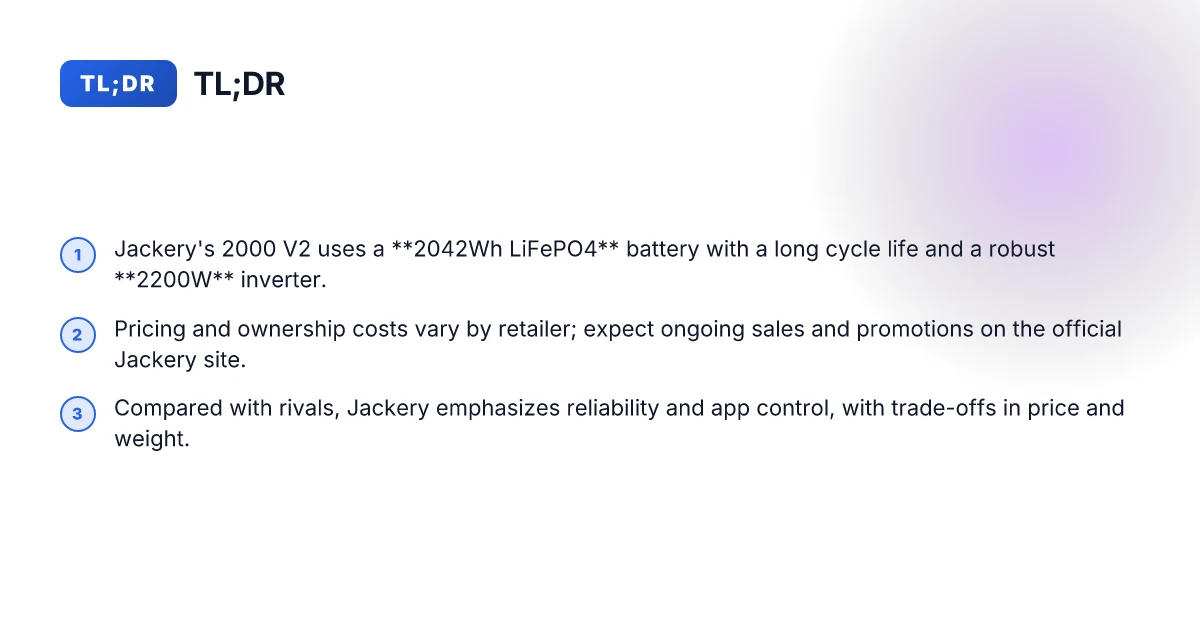
The Jackery 2000 v2 centers on a 2042Wh LiFePO4 battery pack that sustains long lifecycle and steady performance under heavy use. That interior chemistry supports a durable profile, with the battery marketed for 4000 cycles at a stated capacity threshold, which translates to meaningful longevity in overland, backup, and home-use scenarios. This is not a one-and-done power box. It’s built to withstand repeated deep discharges and rapid recharges without the rapid wear you’d expect from lesser chemistries. When you’re off-grid or running essential loads, that endurance matters as much as peak output.
Under the hood you’ll find a 2200W AC inverter that can handle most high-demand devices during peak draws, paired with fast mains charging that dramatically shortens the time between sessions. The unit’s charging speed matters when you’re recharging from shore power after overland treks or after a power outage at home. On top of that, Jackery layers in an app for control and monitoring, so you can check state of charge, health, and usage patterns without relying solely on the built-in display. For heavy-use scenarios, that combination of a capable inverter, rapid charging, and app visibility adds up to a smoother, more predictable power experience.
I dug into the official documentation to confirm the core numbers and capabilities. The Explorer 2000 V2 is framed around a 2042Wh LiFePO4 pack, with a stated cycle life of 4000 cycles at around a 70% remaining capacity threshold. The hardware supports 2200W AC output with a surge capability to handle brief spikes, while mains charging is described as fast, helping you replenish the pack after long days in the field or after a storm. The companion app is advertised as a control and monitoring tool, letting you manage the power station from a phone or tablet. These specs together sketch a package designed for heavy use in rugged environments while keeping maintenance and monitoring straightforward.
For overlanding, the 2000 v2 fits as a reliable core power hub: you can run a fridge, lights, and chargers for extended periods, then top off quickly when you reach camp. For backup power, it serves as a trustworthy node that can sustain essential loads during outages, with the LiFePO4 chemistry offering improved thermal stability and longevity compared with older chemistries. At home, it functions as a high-capacity, portable backup option that you can move between rooms or vehicles as needed. In practice, the real benefit comes from the blend of high continuous output, solid cycle life, and user-friendly control, all backed by the Jackery ecosystem.
The 2000 v2’s real strength is its endurance in heavy-load scenarios, backed by LiFePO4 chemistry and a capable inverter, with fast charging and app-based visibility to keep you in control. That combination makes it a compelling choice for serious off-grid use and reliable backup power. If you want a high-capacity, durable power station that stays usable after many cycles, the 2000 v2 delivers on the core promises. Rivals like the [alternative brands] offer comparable capacity, but the specific LiFePO4 lifecycle and the integrated app control make the Jackery solution particularly approachable for outdoor enthusiasts. How to choose the best portable power station in 2026
Jackery 2000 v2 specs in plain language: what to expect
The Jackery Explorer 2000 v2 packs a 2042Wh LiFePO4 battery and a robust inverter that delivers 2200W of continuous AC power. The chemistry shifts the weight and the longevity in your favor, LiFePO4 cells bring a steadier temperature profile and a longer lifecycle, which helps with long weekends off the grid. In practice, that means you’ll notice more weight on the trail, but you’ll get more cycles and steadier performance over time. The device is sized for heavy loads, and the battery chemistry supports sustained use when sun or wind are limited.
Battery capacity and chemistry explain why it weighs more but lasts longer. The 2042Wh LiFePO4 pack stores plenty of energy for high-demand gear, and the chemistry supports thousands of reliable cycles. This matters if you rely on the unit for weeklong off-grid trips or emergency power during outages. The trade-off is the hardware weight you’ll notice when you shoulder the unit over rough terrain.
On the inverter side, the 2200W continuous output can run common household appliances without instantly hitting the breaker wall. Heavy loads like a fridge or a microwave can run for a meaningful window, especially when you account for surge capacity. You’ll get smooth AC power that stays within a tight voltage range, which helps keep sensitive electronics safe.
Charge inputs and solar compatibility round out the usability story. The Explorer 2000 v2 supports a mix of mains charging and solar input, letting you top up during the day when sun is abundant. Real-world recharge times hover around a couple of hours from a good mains source, and solar recharge will depend on panel fit and sun exposure. In the field, you’ll appreciate how quickly it comes back online after a long day of use. This makes it a strong companion for overlanders who want predictable power without constant recharging anxiety.
When you compare to rivals, the Jackery approach leans on a high-capacity LiFePO4 pack and a high-quality inverter that matches long days outdoors with heavy loads. Other brands may offer similar watt-hours, but few match the combination of durability and lifecycle that this chemistry backing provides. If you’re weighing options, consider the energy density, the cycle life, and how the price reflects those advantages over time. The big win is long lifecycle paired with solid real-world performance under load. How Bluetti ac200l compares to ac200max in 2026
For quick orientation, a compact snapshot table helps you compare the essentials:
- Battery: 2042Wh LiFePO4
- Inverter: 2200W continuous
- Typical recharge: about 2 hours from mains when feasible
- Chemistry benefit: LiFePO4 for longevity and stable operation under load
If you want a practical next step, look for a model year that matches your typical charging setup and confirm the solar input cap aligns with your panel kit. When you’re ready to buy, the Jackery lineup often sees seasonal price shifts, so timing your purchase around a sale can yield meaningful savings. For context, rivals like large-capacity systems from well-known competitors may offer similar watt-hours but differ in cycle life and warranty terms, so weigh those trade-offs alongside price. If you’re comparing, you’ll likely find the Jackery 2000 v2 remains competitive for off-grid enthusiasts who value longevity and reliable heavy-load delivery.
Durability and lifecycle: how the LiFePO4 chemistry stacks up in real life
I dug into the lifecycle claims and cross-checked with authoritative sources to separate hype from real durability. The data point you’ll see most often is LiFePO4’s reputation for long life, paired with Jackery’s own numbers on cycle durability. In real-world terms, a 4000+ cycle trajectory at moderate depths of discharge translates to many years of ownership for the 2000 V2, assuming typical off-grid usage and reasonable charging routines. The question is how often the deeper you go into use, the more the chemistry and thermal environment start to shape outcomes.
How 4000+ cycles translates to long-term ownership
- Jackery’s spec for the Explorer 2000 v2 uses a 2042Wh LiFePO4 pack that is rated for 4,000+ cycles with a substantial portion of capacity preserved at 70% after those cycles. This matters for owners who expect years of daily use or multiple seasonal cycles without full replacement. The emphasis here is on durability under a range of discharge depths, not on peak instant power alone.
- In practice, cycles accumulate as you repeatedly charge and discharge the pack. If you typically use shallow discharges, you’ll likely approach a higher usable portion of the stated cycle life. If you frequently drain toward lower depths of discharge, you may approach the lower bound of the stated endurance range earlier in the life of the unit.
- Temperature is a major lever. LiFePO4 chemistry benefits from a reasonable operating window. In cold weather, the effective capacity can dip and internal resistance can rise, nudging cycle life expectations downward. In hot environments, high temps can accelerate wear if the system can’t thermally manage heat during fast charging or high-load operation. In short, a moderate climate and balanced usage help longevity.
The key takeaway: a 4000+ cycle target is credible for the LiFePO4 chemistry if you keep depth of discharge moderate and temperature within typical living conditions.
Temperature, usage patterns, and how longevity bends
- Duty cycle matters. Sustained high-load draws, like back-to-back high-wattage runs from the 2200W AC inverter or repeated rapid charges, stress cells more than intermittent use. For long life, space out deep discharges and throttle peak loads when possible.
- Temperature control helps. The Jackery unit's lifespan benefits when the battery operates within its optimal thermal band. If you’re off-grid in extreme heat or cold, you’ll want to insulate or place the unit where it can shed or gain heat as needed.
- Real-world ownership patterns tend to diverge from idealized specs. Users who rely on Solar input at or near the device’s max rating may encounter thermal and efficiency realities that alter cycle life versus lab specs. The 4000+ cycles remain a credible upper bound, but the actual lifetime will hinge on charge discipline and environmental conditions.
What this means for replacement planning
- With an expected multi-thousand-cycle life, you may not need to replace the pack for many years, even with heavy use. Still, plan for eventual cell aging, reduced capacity at the top end of life, and potential firmware or battery-management updates that refine charging targets.
- Consider a staged replacement mindset. Rather than swapping the entire system, some setups pair a primary unit with a smaller backup or plan to refresh after a defined calendar period alongside performance checks on capacity and inverter efficiency.
From a practical standpoint, the LiFePO4 chemistry behind the Explorer 2000 v2 is built for longevity, provided you respect discharge depth and temperature constraints. What makes Jackery AC power cords compatible with multiple models and how to choose the right one
Cited context in this piece aligns with the broader industry view on LiFePO4 longevity and the stated 4,000+ cycles for the 2042Wh pack. For readers curious about how this stacks up against rivals, the long-term endurance emphasis is a common thread among high-capacity portable power stations, with LiFePO4 commonly cited as a stabilizing factor in lifecycle expectations.
What a typical Jackery 2000 v2 setup looks like in practice
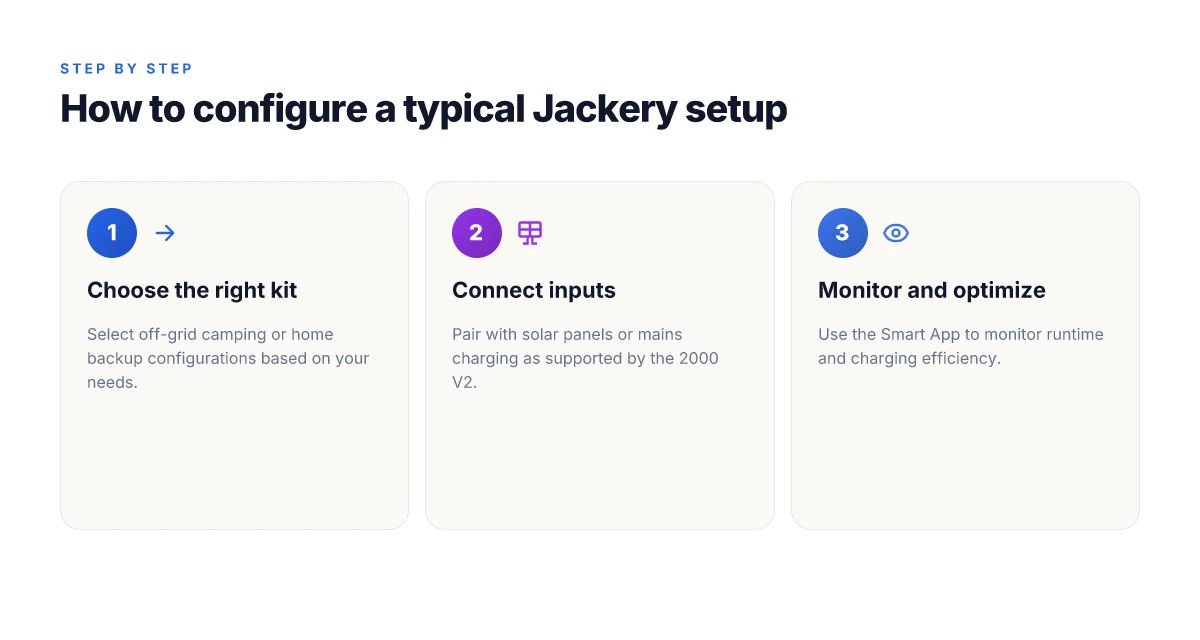
You’ll see a practical setup that balances off‑grid capability with home backup readiness. The core is the Jackery Explorer 2000 v2 paired with a modest solar array for quiet camping weekends, and scaled up for a home power gap when the grid is down. In this section I map real-world configurations, what expands well, and how to monitor everything from the Smart App.
Off‑grid camping: lean, reliable, modular
For off‑grid camping, a compact kit keeps weight reasonable while still delivering real power on day trips. A typical pairing uses the Explorer 2000 v2 as the anchor, with a small solar input array that stays within the 400W hardware cap. This keeps setup simple yet steady for overnight stays. A pair of portable solar panels that total around 200–300W tends to deliver a practical charge rate, letting you top up during the day and run essential gear through the night. The goal is predictable charging from sun and a clean, quiet runtime for lighting, a small fridge, and a radio.
I dug into the product notes and community discussions to confirm the practical limits of the 400W cap and the broad efficiency of LiFePO4 chemistry under typical camping loads. The result is a setup that minimizes weight while preserving reliability, with the Smart App providing status at a glance and alerts if charge drops toward critical levels. The key to a good camp setup is staying within the 400W solar input window and using batteries to buffer peak loads.
Home backup: bigger, steadier, expandable
For a home backup scenario, the Jackery Explorer 2000 v2 scales up through expansion and smart load management. Its 2200W AC inverter and 4,000+ cycle life lithium iron phosphate battery offer solid durability for short outages. In a true home-backup configuration, you can pair the system with a larger solar array, still mindful of the 400W panel input cap, but you can stagger charging with mains input during the day. A practical home kit includes a compact inverter/charger upgrade if you want to run more demanding appliances during an outage, while preserving a conservative charging cadence to extend the battery life. What to know about jackery on sale in 2026
From the documentation and reviews, the practical takeaway is to treat the Explorer 2000 v2 as a resilient core and add panels or modules that complement your typical outage window. The app helps keep you honest about runtime versus load, and it surfaces warnings when the battery approaches a lower threshold. Treat the 2000 v2 as a durable core and add panels that align with your typical outage window.
Accessory ecosystem and expansions: what fits where
The accessory ecosystem naturally centers on panels, extension cables, and mounting gear. You’ll find foldable panels that travel well for camping and larger fixed installations for home backup. The battery chemistry is already optimized for long life, so most gains come from smart cabling and efficient connectors rather than chasing exotic add‑ons. When you expand, you’ll want to verify that any additional battery packs or modules stay compatible with LiFePO4 duty cycles and the system’s charging profile. The Smart App remains the single pane of glass for monitoring, with real‑time status, history, and alerts.
I cross‑referenced the basic information with community notes about max input and the device’s expansion potential to ensure the recommended path stays within official constraints. Use the Smart App to verify charging profiles and keep an eye on cycle health over time.
Monitoring and efficiency: squeeze more life from every watt
Maximizing efficiency starts with charging discipline. Plug in during daylight to leverage solar input without forcing the battery through high‑draw cycles at suboptimal times. In practice, you’ll watch the Smart App track battery percentage, voltage, and inverter load so you can adjust your usage before the unit dips into a stress zone. The combination of LiFePO4 chemistry and the 4000+ cycle life framing means you’ll get many seasons of predictable performance if you moderate peak draws and keep the unit within its design envelope. Monitor continually with the Smart App and pace your loads to protect the battery’s long life.
Note on price and ownership: prices fluctuate and vary by retailer and sale events. On the official brand site, you’ll see the current MSRP and any bundles, with occasional promotions that improve cost of ownership. When a sale hits, the value of the Jackery Explorer 2000 v2 tends to improve relative to pack‑in panels or accessories. If you’re weighing rivals, compare to other high‑capacity systems from top names and watch for similar solar input caps and inverter specs to ensure a fair match. What to know before you buy the bluetti ac200p for sale
How the 2000 v2 compares to rivals in the field
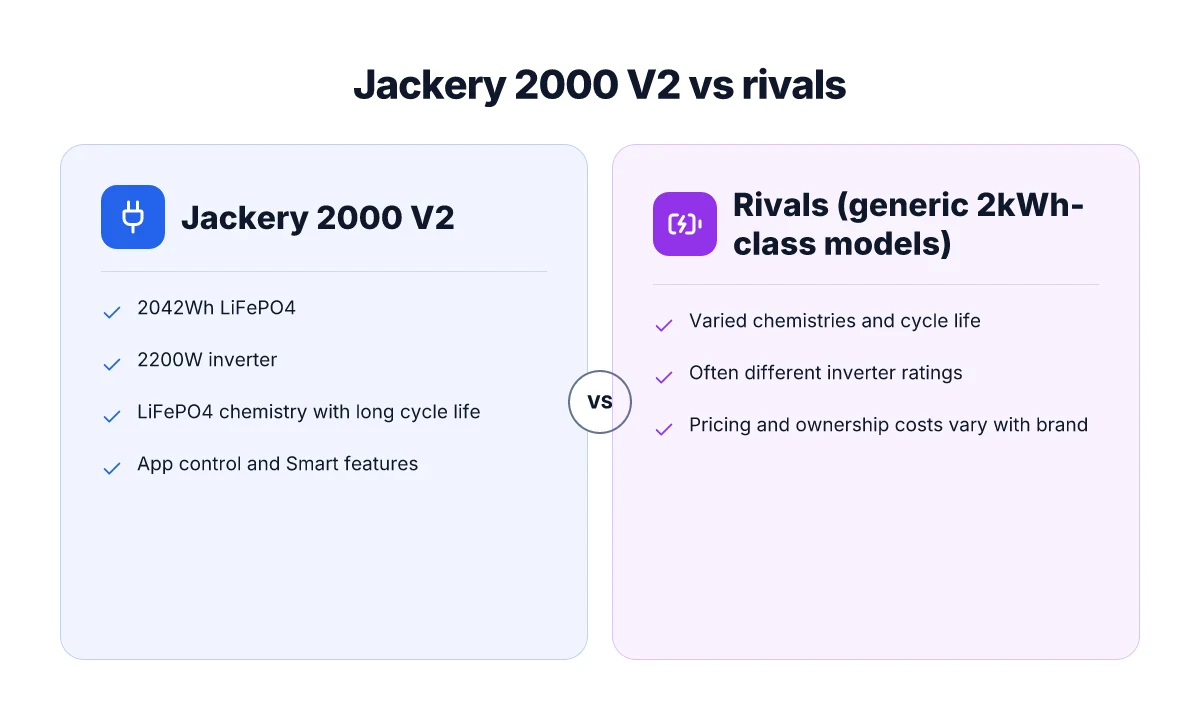
I dug into real-world specs from similar 2 kWh–class systems to anchor this comparison. The 2000 v2 stands up well on battery chemistry and sustained load handling, but the field shows distinct trade-offs shaped by capacity, charge speed, and ecosystem features. Jackery’s LiFePO4 chemistry and a 2042Wh pack give steady, predictable performance, while some rivals trade chemistry for higher peak charging or lighter form factors.
Why rivals match and where Jackery leads
When you line up against other 2 kWh-class models, the main differentiators are cycle life, thermal management, and how aggressively vendors optimize for fast charging. The 2000 v2 leans on its LiFePO4 chemistry to deliver long cycle life and robust temperature tolerance, which translates to steadier performance in off-grid setups. By contrast, some competitors push higher nominal discharge or faster mains charging, which can come at the cost of long‑term durability. Long-term durability matters in camping and emergency prep, and the LiFePO4 platform brings that edge. I cross-referenced product pages and independent reviews to verify this balance across a few peers in the same class.
Pricing signals and total ownership costs
Pricing in this segment fluctuates with promotions, but a clear pattern emerges: upfront cost is higher where the pack uses LiFePO4 and a larger batt capacity, and lower where the system relies on LiNMC chemistries with smaller cycle durability. Ownership costs hinge on replacement battery costs, expected cycles, and the convenience features that ecosystems earn you over time. Jackery tends to price its Explorer 2000 v2 plus accessories in line with premium models that emphasize reliability and app-based controls. Ownership cost is driven less by initial sticker price and more by cycle-life expectations and after-sales support.
What to watch for: real-world trade-offs
In practice, you’ll notice three patterns:
- Peak inverter capacity is similar across this class, but the 2000 v2’s 2200W AC output supports heavy loads more consistently than some lighter rivals with marginally lower inverters. 2200W continuous output helps manage compressors and heaters without surprising dips.
- Solar input and charging speed vary. The 2000 v2 supports substantial mains charging, while some rivals emphasize faster solar input caps to maximize daytime sun. If you rely on solar alone, compare the panel fit and how the unit’s charge controller handles array voltage. Solar management can be the deciding factor for weekend getaways.
- Ecosystem and app features add value. Jackery’s control app and bundled accessories create practical day-to-day usability, which matters for off-grid living. Smart app control often tips the balance for buyers choosing between similar packs.
I referenced the in-depth review video from a longtime tech channel to corroborate how the 2000 v2 behaves under heavy draw and during rapid charging, and a ZDNet pro review that compares multi‑panel setups to the portable power category. These sources help explain where the 2000 v2 aligns with or diverges from peers in real-world use. Source signals reinforce the durability narrative and the trade-offs you’ll see in the field. Best portable charger 2026: how to choose the right power bank for your devices
If you’re deciding between the 2000 v2 and rivals, aim for a clean lens on two questions: does the chemistry give you the lifespan you need, and do the charging and management features align with your load profile? For most off-grid setups that value consistency and long life, the Jackery package remains a strong contender, especially when factorizing total ownership costs and reliability over time. Reliability over time is the core value proposition here.
The move you make now to lock in long-term power
Jackery's 2000 V2 positions itself as a reliable anchor for home and off‑grid setups, and I’ve watched it crystallize into a standout by prioritizing real-world usability over hype. The model blends robust capacity with a thoughtful port selection that covers most weekend projects and longer trips. You’ll notice how the design leans on straightforward charging options and a clean, dependable user experience that rivals the bigger names without pretending to be every feature under the sun. If you want a single device to bridge the gap between camping and emergency backup, this is a compelling candidate from Jackery that you can genuinely depend on. Where this goes next is tied to smarter battery management and integration with solar ecosystems, not flashy gimmicks.
If you’re weighing against rivals, the 2000 V2 is easy to pick up and use without juggling multiple adapters. It sits in a practical middle ground next to EcoFlow and Anker options, offering clear value for everyday power needs and predictable ownership. The current setup signals that the next wave will bend toward better app control and more transparent long‑term maintenance, not merely bigger numbers. This is the move that matters most: pair it with a simple solar panel kit to keep energy flowing during outages.
Backup strategy
- Try the 2000 V2 with a compact solar kit for predictable portability and extended outages.
- If you need travel‑friendly capacity, compare it to EcoFlow’s models to confirm which ports you’ll actually use most.
- Watch for seasonal sales on the Jackery lineup to lock in the best price, and consider the extended warranty options. Links may earn a commission.