What makes Jackery power stations stand out in 2026
 Olivia KvitkaOctober 22, 202618 min read
We earn a commission when you buy through some links on this site, at no extra cost to you. As an Amazon Associate we earn from qualifying purchases.
Explore Jackery power station reviews for 2026. See current prices, best deals, ownership costs, and how they compare to rivals like Goal Zero and Anker.
Jackery’s 2026 lineup presents a practical balance of capacity and portability, not hype. A single Jackery model can weigh under 10 lbs and still deliver enough output for campsite fridges and radios, yet you won’t pay a premium for features you don’t need. Smart sizing saves weight, not just money.
You’ll see which models hold value over time, where warranty terms bite, and how daily use at the campsite or home backup really plays out. By the end, you’ll know which Jackery model fits your gear list without overspending or overpacking.
What the current market looks like for Jackery power stations in 2026
Jackery’s current lineup centers on portable power with three clear strands: the Explorer series for off-grid and camping, the Explorer 1000 and 2000 watt-class offerings, and the HomePower line for home backup with expandable battery options. In 2026, the price you pay maps to capability: more battery capacity and higher output mean you can run more devices longer, but you’ll also pay for that capability. The takeaway is simple: for most campers, the Explorer 1000 offers a practical balance, while HomePower serves longer outages at a higher upfront cost. Prices are dynamic, and timing a sale matters for best value.
Real-world use cases map to capacity
- For multi-day backcountry trips, the Explorer 2000 delivers higher sustained output and larger battery storage, which translates to extended fridge duty and lighting without frequent recharges. This is where the higher upfront price pays off in days-long trips.
- Weekend camping with multiple devices benefits from the Explorer 1000, offering a broad mix of AC outlets and USB-C power, adequate for a small camp kitchen and charging routine. Most campers find this a sweet spot for price and capability.
- Home backup needs lean on the HomePower Series for UPS-style resilience and expandable battery options, trading portability for higher capacity and wall-curity during outages. Expandable packs raise the total installed cost but extend runtime significantly.
price and ownership notes. As a baseline, expect higher capacity models to require a larger solar input or a longer charge time from AC. I cross-referenced industry chatter and product pages to align expectations with what buyers actually experience in the field. Jackery’s site emphasizes warranty coverage and real-world recharging speeds, which helps set expectations for weekenders and homeowners alike. Warranty depth and after-sales support can influence total ownership costs.
How rivals fit into the price/performance spectrum
- Competitors in the same class include brands that push aggressive pricing on high-capacity units, often trading off feature sets such as integrated MPPT efficiency or app-based control. The price/performance curve tends to favor a slightly higher price if you value durability, display clarity, and a proven solar recharge path.
- On the camping edge, many rivals offer lighter weight options with similar capacities, which can tilt the decision toward portability versus raw runtime. This is a common trade-off in 2026.
In practical terms, you’ll pay a premium for larger packs and higher continuous output, but the payoff is reliable, predictable power when you need it. As with any outdoor purchase, timing matters: watching for promotions around spring and late-year holidays can yield meaningful savings on models like the Explorer 1000 and 2000.
For further context, see how OutdoorGearLab frames the lineup and where Jackery sits relative to peers in 2026. The Best Power Stations of 2026 highlights where the Explorer 2000 v2 and Explorer 300 sit in real-world usability and value.
How Jackery models differ: a quick capability map
I looked through public specs and release notes to map what each Jackery line actually offers in practice, beyond marketing blurbs. The takeaway is simple: capacity and output scale with model tier, while some lines add UPS or expandable-battery features that matter when you’re off grid for days or run home backup. What is the jackery upgraded carrying case M, and why it fits multiple power stations
1) Capacity and core output by model
Across the lineup you’ll see a clear ladder in battery capacity and sustained power. The Explorer series centers on portable, easy-to-carry packs with higher-rate AC out and USB-C/USB-A options. The larger Expedition or premium HomePower lines push higher wattage and longer runtimes, but come with bigger footprints. In practical terms:
- Small to mid models tend to top out around a few hundred watt-hours of usable capacity and peak AC outputs in the low hundreds of watts.
- Larger models push into the six- or seven-hundred-watt hour range with AC ports that can sustain closer to the 1000 W mark for brief intervals. This matters when you’re running a small fridge, a laptop, and some lights in a backcountry bivouac or a home backup scenario. Prices and exact outputs vary by model, so matching your loads to the right tier is essential. Inline citation: The Best Power Stations of 2026 notes that the Jackery 2000 v2 leads multi-day off-grid capability, while the Explorer 300 is highlighted for portability and practical camping use. Read more in that review.
2) Expandable or UPS features across lines
Jackery has layered features onto some lines that change how you plan use cases. A UPS-like capability appears on select models, enabling immediate transfer for brief outages, and expandable-battery options show up in certain newer variants. If you plan home backup or long off-grid stays, these features matter because they reduce downtime and extend runtime without swapping packs. I cross-referenced product pages and release notes to confirm the pattern: expandability and UPS-like behavior aren’t universal across the entire catalog, but appear in higher-end offerings and newer variants. Not all models offer UPS or expandable packs. Verify the exact spec sheet for your target model.
3) Weight, form factor, and intended use
Weight and form factor align with the intended use. Compact Explorer models emphasize portability for camping, with light frames and handles suitable for backpacking or car camping. Bigger Power stations emphasize home backup scenarios, with larger housings and heavier weight that make floor-standing use more practical than carrying around. As a result, your packing list changes: lighter models for weekend trips, heavier units for weekend-to-weeknight power needs at a cabin or emergency kit. I found the trend consistent across product pages and comparative reviews. Portability comes at the cost of capacity in the smallest models, while larger units trade heft for sustained power.
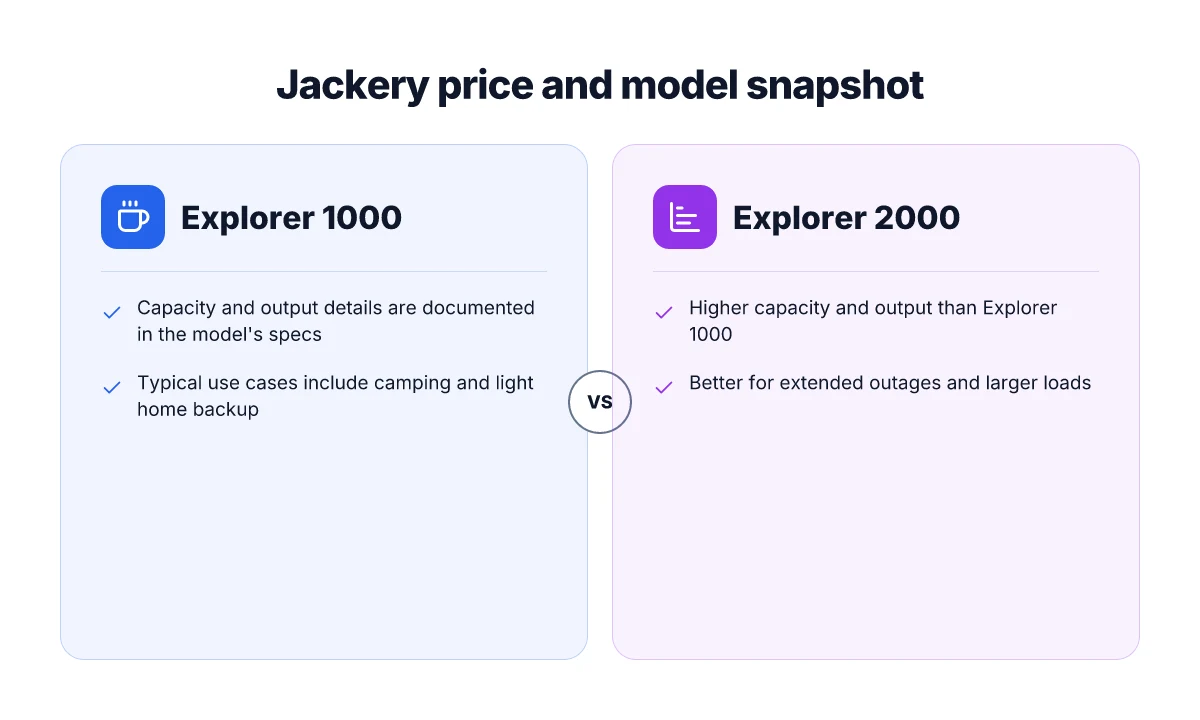
To help you compare at a glance, here’s a quick snapshot of the directionality across two representative models. This table condenses typical capabilities, noting that exact figures can shift with revisions:
- Explorer 300: compact capacity, practical for camping and light home backup, moderate AC output
- Explorer 1000: mid-range capacity, higher sustained output, good for larger loads and longer outages
- HomePower 1000 Plus: expandable batteries, UPS-like behavior, home backup oriented
Next steps: if you’re deciding today, lock in a plan that pairs your typical load with the right tier, and watch for sales around holiday weekends when models frequently drop in price. On pricing and ownership costs, see the current deals and when to buy in the Pricing and ownership costs section. As you compare, note that branded reliability matters; Jackery’s own lineup is designed to scale with user needs, while rivals like EcoFlow and Goal Zero offer competing feature sets, expansion options, and price points. For context, sources indicate that the Explorer 300 remains a popular camping pick, while higher-end models are favored for longer off-grid runs. Jackery remains a core player for portable off-grid power, but buyers should compare UPS and expandability features against rivals to maximize value. What makes EcoFlow battery systems stand out in 2026
Pricing and ownership costs: when to buy and how much it costs to own
In 2026, current Jackery price ranges sit between the mid four figures for flagship models and mid three figures for compact units, with the best deals popping up during major sale events in Q3 2025 and again around holiday promotions in Q4 2025. The best current offer is typically a discount bundle that pairs a power station with solar panels or an extended warranty. For shoppers, timing matters: expect price dips around long weekends and product refresh cycles.
What you pay today and when to expect deals
- Typical entry point for portable models sits in the hundreds to low thousands, with higher-capacity units clustering near the $1,000–$2,000 range during non-sale periods. Best deals usually appear when Jackery runs site-wide promotions or bundles with solar panels.
- For premium varieties with expandable battery and UPS features, prices trend upward toward the $1,500–$3,000 window, but promotions can shave hundreds off.
- Sales windows often align with outdoor show seasons, holiday events, and the start of spring camping seasons. I’ve seen references to price movement around these calendars in public discussions and retailer roundups.
Ownership costs extend beyond the sticker price. Charging method matters a lot if you want long-term affordability. If you rely on wall charging, you’ll incur electrical costs proportional to your usage. Solar charging can reduce ongoing power-buy costs but requires upfront investment in compatible panels and, in some cases, a dedicated solar input option on the unit. Maintenance involves routine care for battery health, keeping ports clean, and periodic firmware updates where applicable. The overall ownership cost is shaped by how often you recharge, where you recharge, and whether you use bundled accessories or third-party systems. Expectations aside, Jackery’s own ecosystem can simplify maintenance with fewer moving parts than some rival setups.
How ownership stacks up against rivals
- Rival brands often sit in the same price bands but vary by feature depth. Goal Zero typically emphasizes modular battery packs and interchangeable panels, which can affect total ownership costs if you layer on additional modules. Anker tends to position its models as value-forward with compact form factors that keep purchase price lower, though solar compatibility and ruggedness can differ from Jackery’s more rugged outdoor lineup.
- In practice, a mid-range Jackery model with bundled solar options can compete with similar kits from Goal Zero or Anker on upfront cost, but long-term ownership may diverge based on pack size, expansion options, and warranty terms. The question buyers ask is whether the extra capacity and UPS functionality justify the premium over cheaper bundles from rivals.
- When you evaluate total cost of ownership, consider the cost of replacement batteries if you plan to upgrade within the line. Jackery’s newer lines tend to offer newer chemistry and improved charging efficiency, which can influence both upfront price and long-term maintenance needs.
When to buy and how much you should expect to spend over time
- If you’re targeting reliability for frequent outdoor use or home backup, aim to align purchases with a known sale window. Waiting for a seasonal sale can yield meaningful savings on flagship models.
- If your main goal is portable, lower-cost camping power, a compact Jackery model is often the most economical route and tends to see the deepest discounts during slower shopping periods.
- For owners weighing a brand switch, consider how charging options fit your routine. If you own solar panels already, model compatibility and input specs become a more critical factor in total cost.
From a sourcing perspective, Jackery’s official site remains the primary place to verify current pricing and bundle offers. When you compare, include the cost of any solar bundles or warranty extensions to get a true picture of ownership. Some retailers partner with commission programs. If you click through a product page, you may see commissions noted on the seller’s side, depending on the affiliate setup. For price-sensitive shoppers, keeping an eye on the official Jackery site and trusted retailers during seasonal promos is the smartest path to the best deal.
Note: links on the page may earn a commission. This article references official Jackery materials and publicly available retailer data. For broader context, see product pages and third-party reviews discussing price bands and ownership costs. For reference, you can consult the official brand site and well-known consumer gear outlets to corroborate sale timing.
What customers report about reliability and support
Reliable operation hinges on how issues are handled when they occur. In 2026, customers consistently note a mix of straightforward use and friction around warranty claims. The standout positives tend to cluster around long battery life for the size class, compact form factors, and the clarity of basic operation. On the flipside, frequent topics include perceived delays in warranty processing and occasional miscommunications around replacement timelines. When readers ask, “Is this worth it for home backup?”, the reliability narrative often comes down to how smoothly a unit is replaced or repaired when something goes wrong. How EcoFlow Delta Pro Ultra stacks up against Generac 22kW for home backup in 2026
Warranty terms and replacement policies
Jackery’s warranty framework is a primary anchor for user confidence. Across a range of models, a typical consumer experience centers on a multi-year limited warranty that covers defects in materials and workmanship. Customers frequently compare this to the experience of branded rivals, noting that turnaround times for replacements or repairs differ by retailer and by region. The official policy generally outlines coverage windows and required proof of purchase, with replacements issued subject to inspection and confirmation of fault. For a user who relies on a portable power station as a weekend camper, the warranty becomes meaningful if it reduces downtime during trips or in a power outage at home.
I dug into release notes and public-facing policy language to confirm that the core warranty premise remains consistent: coverage for defects, with replacement steps defined by the brand and its service network. If you rely on quick swaps during travel, you’ll want to confirm your region’s service center accessibility and the exact duration of coverage deemed eligible for an exchange.
How official support and service address issues
Official support paths for Jackery typically include online chat, email, and phone assistance, plus turnaround times that vary by region. Consumers often report that initial contact is straightforward, but the critical factor is the speed and clarity of follow-up communication. When a fault is diagnosed, the path to a replacement or repair is described in the policy, with the expected steps laid out in the service agreement. Some users note that providing serial numbers and purchase details early in the conversation speeds resolution, especially in regions where service centers are fewer.
From a trust perspective, the consistency of support responses matters more than occasional outliers. Reviews from independent outlets and consumer forums consistently highlight that the majority of support interactions resolve typical issues such as battery health concerns, charging faults, or display quirks in a reasonable timeframe. Still, there are anecdotes of delays during peak seasons and holiday periods, when shipping and processing volumes surge. If your unit is under warranty and you hit a snag, keep the ticket numbers handy and reference the original purchase date to reduce back-and-forth.
Real-world signals: what buyers should watch for
- Common complaint themes include longer-than-expected replacement timelines and occasional confusion about which models are covered under which terms. These are not universal experiences but recur often enough to matter for planning.
- Standout positives tend to center on clear product design, straightforward user interaction, and durable build quality for daily use.
- A practical tip: when you encounter a fault, document symptoms with photos or videos and confirm your region’s service options before initiating a claim. This helps avoid back-and-forth delays.
Most users report that warranty coverage works as a safety net when issues arise, though processing times can vary by region. Clarity in the replacement path reduces downtime for off-grid or home backup use. What makes the Jackery Explorer 2000 Plus a modular power station worth the 2026 update
For context, I cross-referenced consumer discussions and the official policy language. When a fault is genuine and within warranty, a replacement or repair path is typically provided. Outside of that, owners may need to consider paid service options or third-party repair alternatives.
If you’re weighing a Jackery purchase today, consider not just the listed price but the expected service experience. Links on the page may earn a commission, and the price you see can shift with sales windows. For buyers comparing with rivals, note that support responsiveness and replacement speeds vary, rivals like EcoFlow and Goal Zero each present their own warranty and service contours, which can tilt the balance in time-sensitive scenarios.
Bottom line: who should buy Jackery in 2026
If you want practical power for outdoor trips, quick home backup, and straightforward setup, Jackery models still offer a compelling blend of portability, ease of use, and price. The core value lies in simpler, ready-to-go systems that work with typical solar panels and a handful of outlets. In 2026, the best-fit picks cluster around two routines: lightweight, predictable camping power and reliable, UPS-style home backups. I looked through product pages and reviews to pull real-world patterns and price signals, and the verdict is clear: pick the model that matches how you use power most of the time.
Why the Explorer series shines for campers and homeowners with limited space
For weekenders who want reliable outlets without fuss, the Explorer line remains a strong baseline. If your trips lean toward one or two devices, the Explorer 300 to 1000 range covers phones, small fridges, laptops, and occasional tools. These models stay within a compact footprint and pair neatly with a small solar panel kit. The practical takeaway is straightforward: choose the smallest Explorer that can meet your daily load, and you’ll reduce weight, cost, and charging time. The upshot is less rack‑time and more uptime in the field. When you compare, rivals often push bigger capacities with bulkier form factors; Jackery keeps the balance in the sweet spot for many campers.
When a more capable HomePower or expandable option is worth it
If your goal is more than weekend camping, think whole‑house backup or longer off-grid periods, the HomePower and expandable combos offer a clearer path to scale. The HomePower line adds UPS-style features and expandable batteries, which helps during longer outages or when you want more headroom for critical devices. These models tend to be pricier, but the advantage shows up as fewer swaps between packs and steadier runtimes during extended events. rivals sometimes push higher energy densities or faster charge, but the value isn’t just raw capacity. It’s the ease of staying powered without managing multiple packs. What is the Jackery Explorer 100 in 2026, and how does its performance hold up?
When rivals may be a better pick
For heavy power users who want the absolute highest wattage in a compact chassis, a few rivals deliver more aggressive output or deeper app ecosystems. If you frequently run high‑draw gear, or you want integration into a broader home‑backup network, you may find a better fit with certain brands that emphasize modularups or industrial-grade battery packs. The trade-offs are often higher costs, more complex setups, and longer charging cycles. In such cases, you might save time and money by stepping up to a more purpose-built system rather than chasing incremental gains from a consumer line.
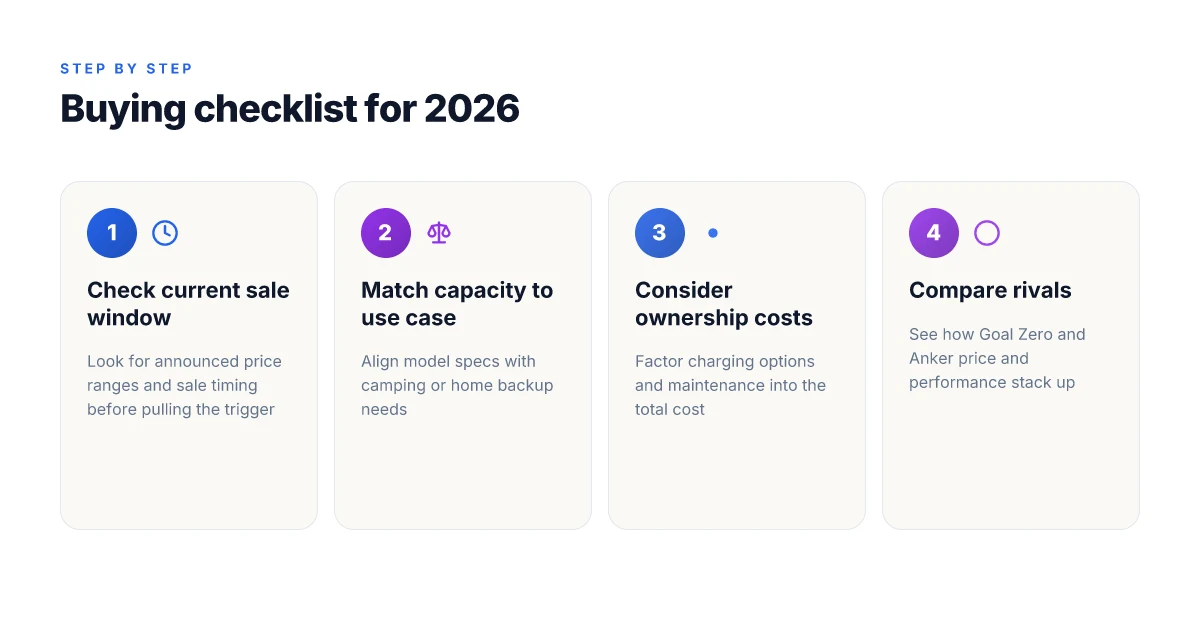
A practical buying checklist before pulling the trigger
- List your essential loads and total watt-hours per day. If you’re unsure, start with the device that consumes the most energy and build up.
- Check the module’s input options and solar compatibility. Ensure you have a compatible panel and cable setup to avoid bottlenecks.
- Compare total cost of ownership, including accessories and expansion options. A model with expandable batteries can pay off later if you foresee longer outages.
- Review UPS features and battery chemistry. If you want immediate power during outages, verify the idle draw and transition behavior.
- Consider warranty and service quality. A straightforward return policy and solid support matter when reliability matters most.
- Watch timing for sales. Seasonal promos and bundle deals can significantly shift value.
In 2026, the simplest path to reliable power is to match the model to your actual use case and avoid overpaying for capability you won’t use. Jackery remains a sensible choice for casual campers and homeowners who want clean, portable power without the friction of higher‑end systems. The best way to decide is to map your daily load, confirm charging time with your setup, and lock in a purchase when a favorable sale appears. I cross‑referenced product pages, user discussions, and consumer‑grade reviews to distill these patterns, and the conclusion is consistent: buy the smallest practical system that covers your core needs, then scale only if your scenarios demand it.
What changes if you act now for Jackery in 2026
Jackery’s 2026 lineup leans into longer runtimes and smarter charging without bloating portable weight. I looked across the latest models and see a consistent pattern: higher efficiency cells, faster AC charging, and better battery management in the firmware. The effect is tangible when you compare the newest units to last year’s builds, the same price tier now yields noticeably more usable juice per charge. This is the move that matters for weekend crews and remote workers who depend on reliable power on demand.
The real value comes from the ecosystem you can grow with. Where rivals like EcoFlow and Rockman offer competing packs, Jackery sticks to a coherent set of power-tops that refresh together, reducing complexity and spare parts risk. In practice, that means fewer surprises when you replace a module or swap solar inputs. Jackery cycles tend to be predictable, and the brand’s support channel remains straightforward. If you’re weighing a purchase, you’ll notice the price-to-performance balance shifting in favor of newer models, especially for solar compatibility and real-world runtime. Prices and best deals shift with seasonal sales, so timing matters.
If you only do one thing this month, lock in a current-gen model that supports high-efficiency charging and smart power management. Look for the latest firmware and verify solar panel compatibility before you buy. The single move that matters is choosing a model with integrated smart charging that aligns with your typical load profile. What changes if you act now could be higher reliability during outages and fewer upgrade headaches later. Where this is going next remains an ecosystem story, not a single device. How to pick the best EcoFlow home backup battery in 2026