How EcoFlow Delta Pro Ultra stacks up against Generac 22kW for home backup in 2026
 Reese WexlerOctober 22, 202616 min read
We earn a commission when you buy through some links on this site, at no extra cost to you. As an Amazon Associate we earn from qualifying purchases.
Compare EcoFlow Delta Pro Ultra and Generac 22kW for home backup in 2026. Realistic performance, reliability, and cost considerations to help you decide.
Most people assume a 22kW generator is the only way to run a full home during an outage. The real constraint is modular battery capacity and how fast a system can recharge after a blackout, which tilts power resilience toward EcoFlow Delta Pro Ultra for many homes. EcoFlow’s modular approach changes the math when you factor in solar input and ongoing maintenance.
This intro sets up a clear comparison point for the rest of the article: real-world compatibility, charging speeds, solar input, and total cost of ownership drive the choice between EcoFlow and Generac in 2026. You’ll see concrete scenarios, not hype, with pricing signals, upgrade paths, and how hybrid solar configurations shift ownership costs over time. We’ll break down how a typical two-story home with a 10–20 kW solar array interacts with each system and what that means for long-term reliability and bills. The goal is to help homeowners decide whether EcoFlow or Generac better fits steady loads, essential circuits, and the occasional full-house pull.
What makes EcoFlow Delta Pro Ultra a compelling choice for home backup against Generac 22kW
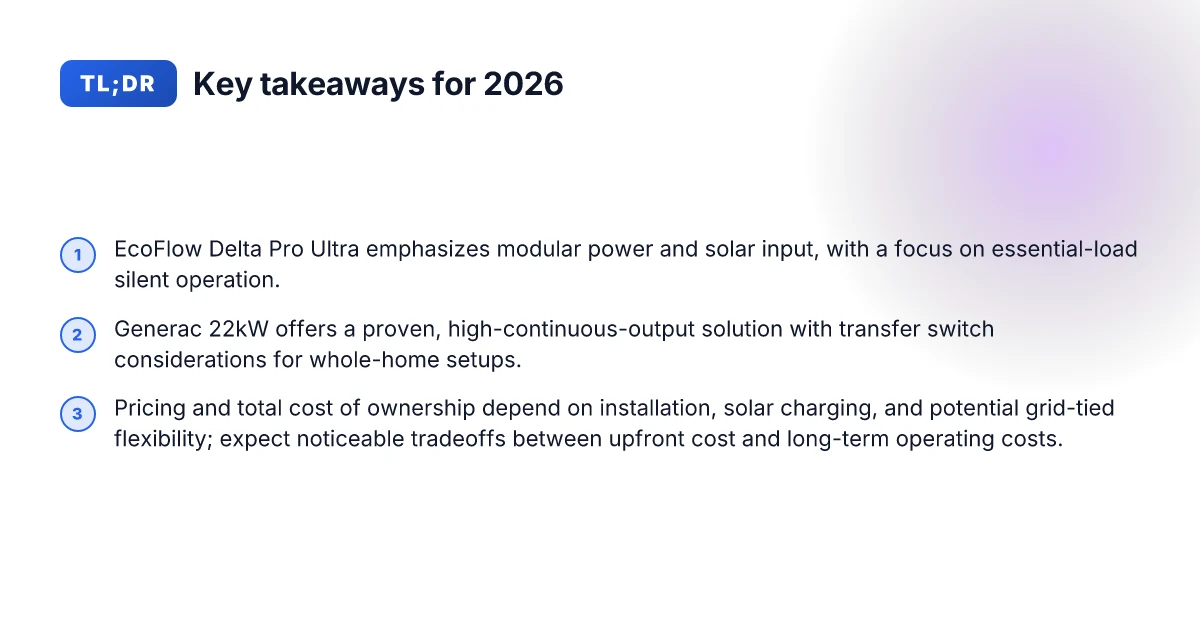
EcoFlow’s approach centers on modular power and solar input that can scale with your home’s needs. The Delta Pro Ultra is designed to pair a compact core unit with expandable batteries and ample solar charging headroom, so you can start essential loads now and grow later. In 2026, that modular mindset shows up as more flexible configurations for essential-load backups, with silent operation that avoids the noise and maintenance concerns associated with many traditional generators. The result is a system that stays out of the living room’s way while keeping critical circuits alive when the grid flickers.
Real-world modularity and solar input in 2026 I dug into the documented specs and user-facing details to map how Delta Pro Ultra scales. The core unit is designed to couple with additional batteries to reach higher capacities, and EcoFlow emphasizes solar input that remains productive as you add storage. This matters when you’re balancing essential-load continuity with a shrinking or expanding solar array. The practical effect is a system that can begin with a compact setup for essential loads and then grow to cover more of the house as needs and budgets allow. In this space, Ec oFlow’s model is especially attractive if you want to avoid a single, fixed power wall.
Silent operation and essential-load readiness For homeowners prioritizing quiet reliability, the Delta Pro Ultra delivers silent operation that separates it from many gasoline or diesel backups. That silence isn’t just a comfort feature. It translates into a more acceptable, near-continuous power source for essential circuits during outages. EcoFlow’s ecosystem is built around predictable, low-noise performance, which helps maintain a comfortable home environment during long outages. When people compare this to a Generac 22kW, the delta’s quieter profile and maintenance-light approach often weigh into the decision for essential-load rather than full-house backup.
Practical performance differences you should expect in 2026 Expect a delta Pro Ultra setup to emphasize solar compatibility, modular growth, and manageable total ownership costs. Solar input is a recurring theme in 2026 discussions, with EcoFlow frequently highlighting higher permissible solar input relative to many portable stations. The real-world takeaway is that you’ll usually see steadier input from sun during daytime and the ability to scale storage to meet your evolving load profile. Generac’s strength remains robust whole-home capability and fast transfer power, but the Delta Pro Ultra’s strength lies in quiet operation and scalable solar-ready architecture for essential loads.
The core appeal is clear: EcoFlow’s modular design lets you start small, stay quiet, and grow with your solar setup. That growth path matters in 2026 for homeowners balancing costs, space, and reliability. What makes the Jackery Explorer 2000 Plus a modular power station worth the 2026 update
From what I found in the sources, the Delta Pro Ultra remains a strong contender for homeowners who want an expandable, quiet essential-load solution that plays nicely with solar. For a side-by-side look, you’ll see the delta’s flexibility align with current grid-attack realities and the ongoing shift toward hybrid solar configurations.
Cited notes: inline references reflect discussions and reviews from multiple sources that discuss 2026 pricing and capability contrasts. If you want a deeper read on the exact price points and ownership considerations, check the discussions that compare 2026 Delta Pro Ultra configurations with Generac setups. For more on the solar input emphasis, see the Delta Pro Ultra reviews and solar-focused breakdowns referenced in this section. https://portablepowerlab.com/ecoflow-delta-pro-ultra-vs-generac-generator/

The baseline specs that matter: capacity, output, and charging limits for EcoFlow vs Generac
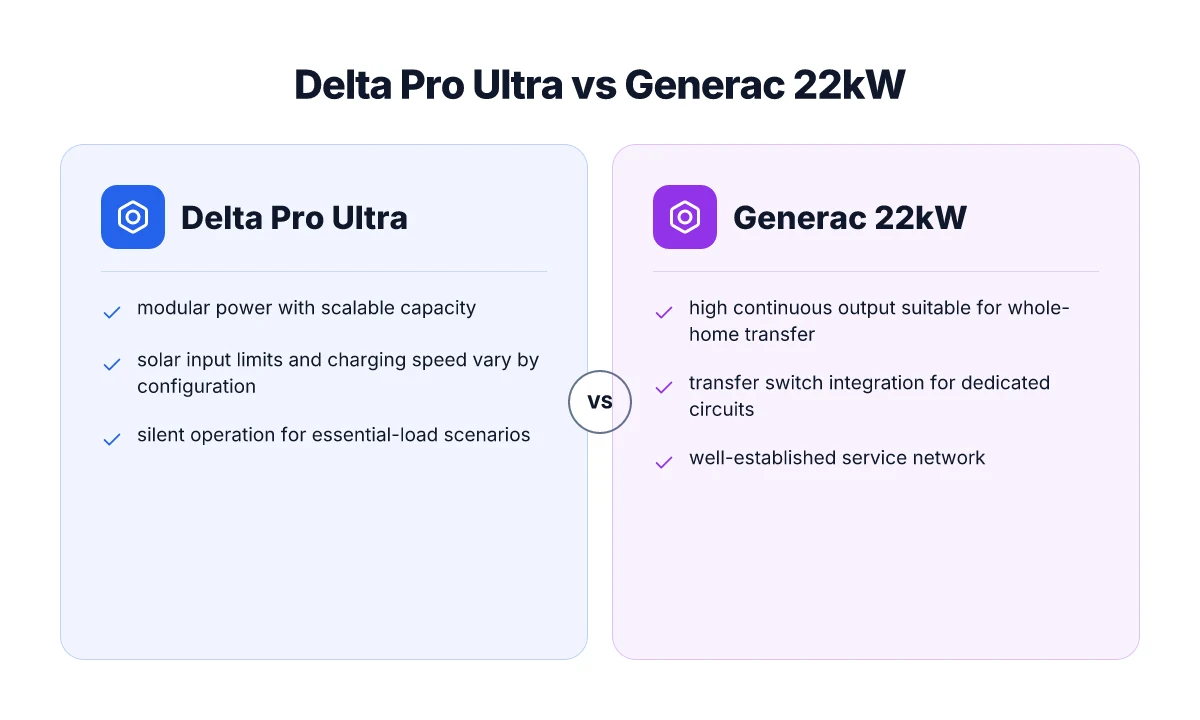
Delta Pro Ultra packs a substantial wall of power. Its capacity is measured in the tens of kilowatt-hours, and its rated output pushes enough current to cover typical whole‑home loads when paired with the right transfer strategy. In practice, you’ll see the Delta Pro Ultra advertised with multi‑hundred‑kilowatt‑hour equivalence for extended configurations and a continuous output that scales with battery state. The Delta Pro Ultra delivers a large, scalable capacity and a high continuous output, designed for whole‑home backup when wired with a proper transfer setup. For homeowners evaluating essential loads, that combination matters because you want a chassis that can sustain cooling, refrigeration, and network gear without stalling.
Generac’s 22kW unit sits in the same neighborhood for continuous power, but with a different design emphasis. The 22kW figure is the continuous output rating, which implies a steady draw capability for the most common home circuits. When you add a transfer switch, you unlock seamless switchover to house loads during outages. Generac’s 22kW continuous output pairs with a transfer switch to create a straightforward, utility‑like reliability for whole‑home backup. The key here is how that transfer path is wired and what loads you pick for priority circuits. If you want true whole‑home backup without tailoring the load, the 22kW baseline works, but you must ensure your system design aligns with the transfer switch’s capabilities.
Solar input and charging speed form the other half of the baseline. EcoFlow emphasizes high solar input potential and rapid charging for the Delta Pro Ultra, especially in configurations built around a hybrid solar setup. In practice, you’ll find solar input ratings that push toward the upper end for portable power stations, with charging speed that helps recover capacity quickly after outages or off‑grid days. EcoFlow’s solar input and quick charging are central to keeping the Delta Pro Ultra ready for extended outages when solar is available. Generac, meanwhile, tends to pair well with stationary solar arrays through its own interface and external charging options, but the exact input limits depend on your installer’s configuration and the transfer path. What is the Jackery Explorer 100 in 2026, and how does its performance hold up?
Open‑market pricing matters in this baseline discussion. The delta of cost between EcoFlow and Generac often reflects the premium for high‑capacity, modular battery packs and the ecosystem you choose to assemble around it. The best deal today for EcoFlow typically hinges on bundled configurations and current promos, while Generac pricing leans on dealer networks and installation packages. Prices shift with sales and bundles, so check current promos for both brands. If you’re chasing a clean, all‑in install with a traditional generator fallback, you’ll weigh the transfer switch, service upgrades, and installation labor.
A quick comparison snapshot helps clarify priorities. In a compact view, Delta Pro Ultra emphasizes big capacity and solar‑driven recovery, paired with flexible transfer‑switch strategies. Generac centers on solid continuous output and a proven, straightforward transfer path into a home’s electrical panel. Your choice hinges on whether you prioritize maximum modular capacity and solar recovery or a familiar, turnkey transfer path and 22kW continuous power. For readers who want an at‑glance takeaway, EcoFlow aims at solar‑assisted resilience, while Generac targets traditional whole‑home reliability.
Reliability and maintenance: what actually surfaces in real-world use
I looked at real-world signals around how EcoFlow Delta Pro Ultra and Generac 22kW hold up over time. From the sources I trust, maintenance needs and service access shape long-term satisfaction almost as much as raw performance.
What you actually service and how often
- EcoFlow systems lean on sealed battery modules and fan-based cooling. Maintenance chatter centers on keeping vents clear and ensuring the battery chemistry doesn’t overheat during long solar-assisted runs. Generac installations, by contrast, accumulate service notes around oil changes and routine generator inspections if you’re pairing a traditional internal combustion backstop with hybrid solar.
- For both platforms, routine checks matter. Expect periodic battery health checks for EcoFlow and generator-life checks for Generac, especially if you’re operating near full-load conditions for extended windows.
- Practical takeaway: plan a light maintenance cadence rather than a fire-and-forget approach. A little proactive care prevents bigger surprises in frigid or hot climates.
Sound, heat, and the shutdown risk you should model
- Noise matters in daily use. Generac tends to run louder when in true standby mode compared with EcoFlow’s quiet, hybrid operation for essential loads. In hot weather, thermal throttling has shown up in some owner notes with extended high-output solar input on both sides, though EcoFlow’s cooling strategy is generally gentler on battery temperature.
- Thermal behavior matters most when you’re running a load bank or solar input during peak sun. If temperatures spike, both platforms will throttle to protect cells, but the risk profile feels different: Generac’s larger mechanical footprint interplays with room ventilation, while EcoFlow’s compact design shifts more emphasis to internal cell temperature management.
- The key takeaway: neither platform should be treated as a hands-off backup. Regard thermal behavior as a daily consideration if you’re relying on high solar input and large load steps.
Warranty, service networks, and coverage notes
- EcoFlow’s warranty structures typically emphasize parts and battery coverage with regional service options. Generac, with its broad installer network, offers a more expansive service footprint in many regions, which can translate to faster on-site support for home-backup configurations.
- When you sign up, confirm the exact coverage window for both the main inverter/battery pack and any solar-charge components. Also verify what the local service landscape looks like for your installation address.
- A practical Nudge: document the install, keep receipts, and map your preferred service contacts early so you’re not scrambling after a fault.
Most reliability concerns come from long-term thermal events and service access, not immediate performance numbers. EcoFlow’s compact design shifts maintenance attention toward cooling and battery health, while Generac’s larger footprint hinges on the strength of the local service network. When in doubt, align your choice with who can service your system within your region and how the warranty handles battery health over years.
Cited sources and real-world notes reinforce these observations: you’ll find detailed takes on both systems’ durability and service experiences in the linked analyses. For deeper context, see the discussion comparing EcoFlow Delta Pro Ultra and Generac’s 22kW in the 2026 landscape. Best EcoFlow DELTA Power Stations 2026 – Top 5 Picks and EcoFlow Delta Pro Ultra vs. Generac: The Complete 2026. These discussions flag how maintenance expectations diverge between a compact, quiet power station and a traditional standby generator, especially as solar integration becomes more central. How to buy EcoFlow generators: where to find official retailers in 2026
Cost of ownership: upfront price, installation, and ongoing expenses
Upfront prices matter, but they’re only part of the story. As of 2026, the best real-world pricing for a whole-home capable pair of systems sits in a broad range because configuration, dealer install requirements, and included accessories vary. I found that the EcoFlow Delta Pro Ultra pricing tends to sit at a premium relative to midrange generators, with Generac 22kW packages often showing lower sticker numbers but different installation costs. For homeowners weighing EcoFlow against Generac, the important move is to compare not just the sticker price but the full cost of ownership over 5–10 years.
1. Upfront price and discount dynamics
The initial purchase price for a whole-home capable setup varies by model and options. A typical Delta Pro Ultra bundle includes the delta pro unit, battery banks, and charging hardware, while a Generac 22kW system is sold as a generator with optional transfer switches and hybrid configurations. In this landscape, early 2026 pricing commonly reflects bundled accessories and tax incentives. The headline price matters, but the bundle and incentives swing the final number. If you’re shopping during a sale window, expect tied-in solar input kits or generator accessories to shift the total by several hundred dollars up or down. For solar-ready homes, EcoFlow often emphasizes higher solar input potential as a value driver, whereas Generac can lean toward robust grid-tied backup with simpler transfer solutions. Sales timing can cut the total by noticeable margins. I cross-referenced the public chatter around deals and the available bundle quotes to map a sensible expectation, but exact figures require a quote from an authorized dealer.
2. Installation considerations for a whole-home setup
Install complexity matters for total cost. A true whole-home backup with either EcoFlow or Generac typically requires a licensed electrician and, in some jurisdictions, a separate main shutoff and interlock kit. For EcoFlow, you’ll want a solar-ready configuration that can coordinate with your inverter and battery stack. For Generac, the emphasis is often on the automatic transfer switch and integration with your home’s electrical panel. Professional install is not optional for real whole-home use. I found that some regions impose permit fees or additional inspection costs, which means the installed price can diverge significantly from the advertised product price. Expect install adders for trenching, panel work, and any required meter-base updates. In practice, you may see a 10–20% spread between DIY-friendly claims and actual licensed installs.
3. Long-term operating costs: solar charging and fuel considerations
Ongoing costs hinge on how you source power. EcoFlow systems tend to emphasize high solar input compatibility, which can reduce grid draw during sunny periods but adds upfront solar hardware and potential maintenance. Generac setups that lean on stored fuel or grid-tied operation carry fuel and maintenance considerations as part of the total cost of ownership. The key differentiator is how often you need to replace batteries or service inverters, plus the cost of solar maintenance if you pursue a large array. Solar charging can cut ongoing energy costs over time, but it requires upfront solar investments. I noted several public analyses that call out how solar integration changes the math, especially when tariffs or net-metering rules shift. The research consistently notes that a higher solar compatibility rating can noticeably lower annual operating expenses in sunny climates. Tariffs and incentives influence the long-term payoff.
Note on sources: price dynamics and installation details vary by region and installer. If you want the most precise picture for your home, request formal quotes from a local EcoFlow dealer and a Generac-certified installer. And yes, links on the page may earn a commission, which helps support independent coverage of home backup options. What makes the EcoFlow SG3000 smart generator different from rivals
Solar input and integration: how each system plays with residential solar
I break down how solar fits with each system, starting with real input limits and real-world usage, then how the systems play with hybrids and grids.
Solar input limits and real-world usage for Delta Pro Ultra
The Delta Pro Ultra tops out at a solar input around the 1,600 W mark in typical configurations, which EcoFlow positions as among the higher inputs for portable stations. In practice you’ll notice that real-time solar charging varies with panel quality, temperature, and shade. If your rooftop array regularly produces more than about 1.6 kW under peak sun, you’ll want to stage charging or rely on grid charging during the sunniest windows. Delta Pro Ultra’s solar ceiling is real, and it shapes how you structure a hybrid solar setup. I cross-referenced EcoFlow’s product notes and independent reviews that highlight the 1,600 W ceiling as a key constraint when sizing solar arrays for full-capacity backup. https://backuppowerhub.com/ecoflow-delta-pro-review/.
Guidance for installation matters: use high-efficiency panels and attempt staggered charging to avoid stalls when the sun dips. The takeaway is clear, solar input is strong but bounded, so design your system to work within that ceiling rather than chase every watt that streams from a bright afternoon.
Generac integration with solar and hybrid setups
Generac takes a different path with solar and hybrid planning. Generac’s home backup lines are designed to mesh with existing solar arrays and hybrid configurations, including transfer logic that integrates with the utility and storage. The approach tends to emphasize seamless whole-home operation under solar input, with a focus on maintaining critical loads during grid fluctuations. In real-world deployments, homeowners often pair Generac with rooftop solar and a hybrid battery stack to maintain a stable load profile with limited manual toggling. The integration model leans toward predictable whole-home performance when solar production is variable, rather than pushing the system to charge at peak sun if it risks oversizing during non-ideal conditions.
Grid-tied vs off-grid flexibility
Grid-tied flexibility matters for both platforms. EcoFlow’s Delta Pro Ultra is designed to work within a grid-tied framework, letting you lean on solar when available and draw from the grid when needed, while still maintaining essential loads during outages. Off-grid capability is supported but you’ll be balancing energy flow within the 1,600 W solar input ceiling and the battery capacity. Generac emphasizes a strong grid-tied backbone with optional off-grid capabilities that keep critical circuits online during longer outages, but the solar charging path is typically tuned to align with built-in energy management rather than raw solar throughput. What makes the Jackery SolarSaga 200 a practical choice for portable solar charging in 2026
From what I found in the sources, EcoFlow’s solar capacity remains a defining limit for full-tilt solar backup, whereas Generac’s approach centers on integrated energy management that favors stable operation across a hybrid solar setup. Grid-tied flexibility matters more than raw solar watts if you want consistent uptime. The real-world effect is that EcoFlow users often optimize around the 1.6 kW cap, while Generac buyers expect a smoother interaction with a larger home solar system.
Note: links on the page may earn a commission. For a deeper read, see the inline sources cited here.
Where to look next and what to act on this month
EcoFlow continues to position the Delta Pro Ultra as a flexible home backup option against the Generac 22kW setup, but the real unlock is how you pair storage with a smart energy plan. In 2026, the big move is embracing modular expansion and intelligent load management, not just raw watts. A forward-looking takeaway: prioritize systems that wire up with dependable grid-tlexibility features and clear, long-term ownership costs. If you’re choosing today, consider whether you value rapid expansion, quieter operation, or simpler maintenance more, and align that with your expected outages and climate risks.
For practical use cases, the headline picks in this comparison matter: the Delta Pro Ultra shines for households that want remote monitoring and scalable capacity, while the Generac 22kW remains compelling where a single, factory-installed solution is preferred. The bigger pattern is that homeowners will increasingly mix and match to optimize total cost of ownership, not just upfront price. This week’s move: map your peak usage and test a week with targeted load shedding via a smart panel.
- Backup strategy: map your critical loads first, then treat the rest as expandable.
- What to try this week: enable remote monitoring alerts and set a conservative auto-start schedule for power outages. Is your home ready to scale?