What makes the Jackery Explorer 2000 Plus a modular power station worth the 2026 update
 Clio RavensdaleOctober 22, 202616 min read
We earn a commission when you buy through some links on this site, at no extra cost to you. As an Amazon Associate we earn from qualifying purchases.
Explore the Jackery Explorer 2000 Plus review with a focus on modular growth, real-world usage, and how it compares to peers in 2026. Practical insights for buyers.
The Jackery 2000 Plus isn’t just bigger. It redefines how you grow power. Its modular path lets you add capacity without buying a new unit, a move that changes how you plan heavy-use days, not just the next camping trip.
This intro walks through what that means in real life: how much runtime you gain per expansion, how expansion costs compare to a full replacement, and how the 2000 Plus stacks up against Goal Zero, EcoFlow, and Bluetti in 2026. You’ll see concrete scenarios for preppers, RVers, and off-grid setups, plus the tradeoffs of adding capacity today versus waiting for a future expansion window. If you’re weighing whether the premium pays off, this piece lays out the practical math and everyday usability you’ll actually feel. Expect sharper guidance on when to grow and when to hold steady.
What the jackery explorer 2000 plus brings to modular power in 2026
Jackery leans hard on modularity in the 2000 Plus, pairing expandable capacity with a familiar, user-friendly interface. The core idea is simple: you start with a high-capacity core that can grow as your power needs shift, whether you’re off-grid, RV-based, or preparing for home backup. In 2026, that stance remains central, with real-world usability shaping how the system feels day to day.
- modular capacity that scales with demand
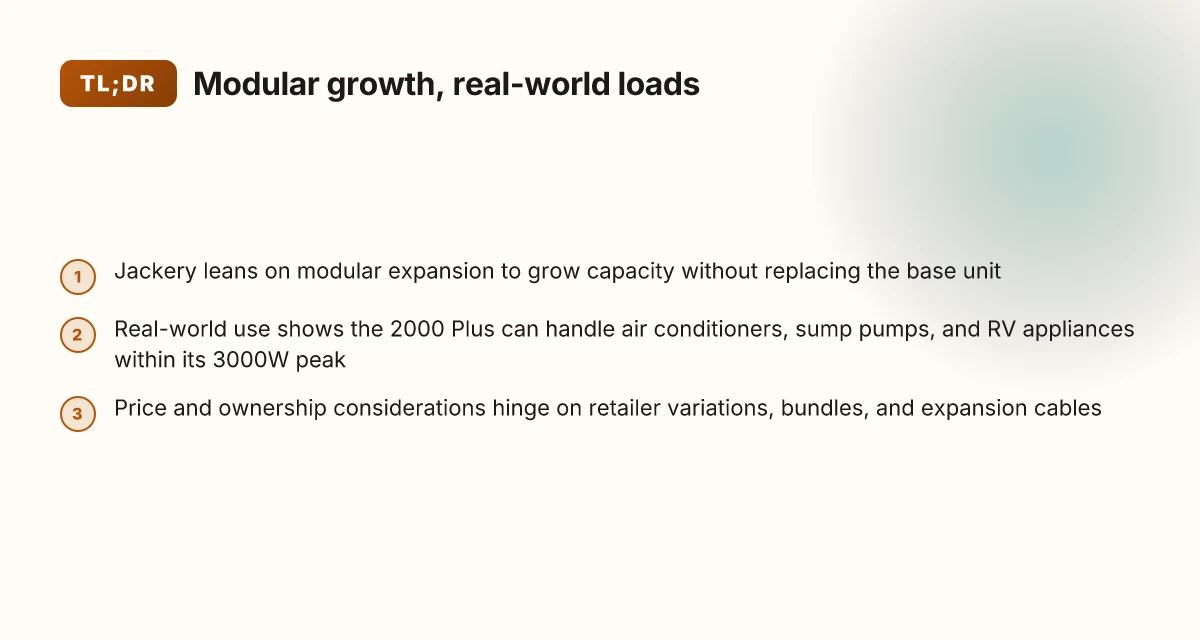
- The 2000 Plus is designed to accept additional modules to grow total capacity without swapping the base unit. This lets you tailor your system for a longer off-grid stretch or a heavier home backup scenario. The pattern is to start with the built-in 2042.8 Wh core and add modules as your load climbs.
- Real-world use cues: you’ll notice the modular path helps keep initial investment lower, while still delivering a scalable ceiling for power needs such as air conditioners or RV gear. The modular approach also preserves a familiar control surface you don’t have to relearn with each expansion.
- Modularity keeps the setup approachable while still offering heavy-duty capability for daily use.
- high-capacity output ready for heavy loads
- Expect substantial sustained output from the 2000 Plus, which targets air conditioners and RV systems when you need reliable power at the campsite or on the road. This is where the architecture shines: the combination of high output with modular growth means you can handle peak loads without constantly sacrificing runtime.
- Real-world cues: the unit stays within reasonable heat and noise envelopes for typical camping or backup scenarios, so it remains usable in tight spaces and quiet environments.
- 3000W peak output supports big appliances, and its design keeps noise discreet for daily living.
- real-world usability: heat, noise, and portability
- Noise: the system is designed to be quiet enough for in-tent or RV use, which matters for sleep quality and comfort. The balance between performance and quiet operation is a clear focus in the 2000 Plus line.
- Heat: thermal behavior stays manageable under typical loads, with the modular expansion not triggering unmanageable heat buildup in normal use.
- Portability: even with expansion, Jackery keeps the footprint approachable for transport, though the added weight of modules will shift what you can carry in one trip.
- Quiet operation and manageable heat are the everyday realities you’ll notice when you set this up.
Bottom line: the 2000 Plus embodies modular power as a long-game feature rather than a single-package sprint. You gain steering room for growing energy needs without abandoning a familiar interface or compounding complexity. If your priority is scalable capacity and the flexibility to power heavy loads in a portable package, this design language remains compelling in 2026.
How the 2000 plus compares to rivals in capacity, weight, and price
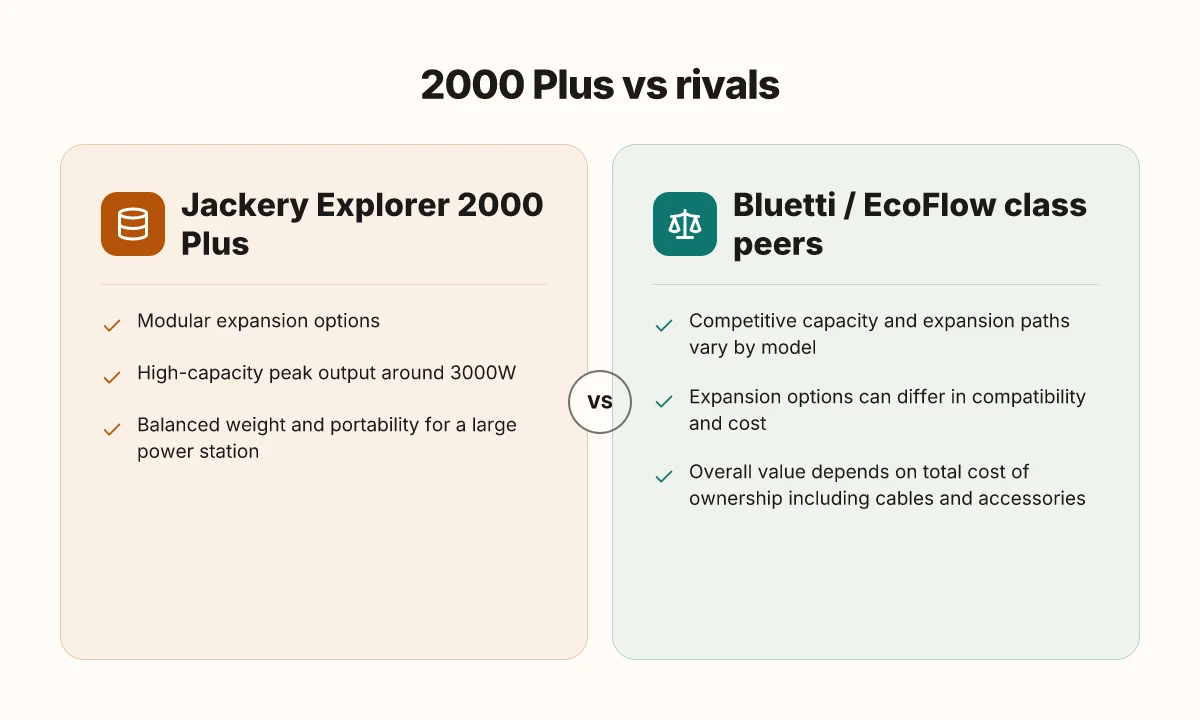
The Jackery Explorer 2000 Plus sits in a crowded field of high-capacity portable power stations. When you weigh capacity, peak output, and expansion options, the 2000 Plus stacks up as a flexible option in a marketplace where Bluetti and EcoFlow lead with similar class models. In practice, buyers typically fixate on watt-hours and the ability to grow capacity over time, then weigh weight and price against those needs.
Capacity and expansion drive the decision
The key differentiator in this segment is not just the raw watt-hours but how a system can grow. The Jackery model lineup emphasizes modular expansion paths, but so do rival offerings from Bluetti and EcoFlow. In real-world terms, a higher-capacity core paired with scalable add-ons often determines whether you stay in the same kit for years or upgrade to a new platform. The 2000 Plus aims to balance base capacity with a path to growth, whereas some Bluetti and EcoFlow variants emphasize either bigger baselines or more aggressive modular ecosystems. Capacity and upgrade paths matter more than headline watt-hours.
Weight and portability versus power delivery
Weight is the practical limiter for off-grid use. The 2000 Plus is designed to deliver substantial power while keeping transport reasonable for RVs and preppers, but it remains a behemoth compared with smaller models. Bluetti’s closest peers tend to push higher energy densities in some cases, while EcoFlow tacks on rapid charging and lighter chassis in others. If you move a lot between camps or sit the unit in a vehicle, the difference in weight and handle design can swing the choice. Weight remains the practical brake on capacity in real-world use. What is the Jackery Explorer 100 in 2026, and how does its performance hold up?
Price signals and total cost of ownership
Price matters, but so does total cost of ownership. The 2000 Plus sits at a premium tier tied to its modular promises, while rivals position themselves with different value propositions, some emphasize lower upfront cost, others emphasize faster recharging and more compact form factors. For a buyer weighing long-term use, consider what you’ll add later: expansion packs, extra batteries, or car charging options. The net cost over several years depends on how aggressively you pursue growth versus starting capacity. Upfront price often hides total cost of ownership over time.
| model | base capacity | peak output | expandability | rough public price signal* |
|---|---|---|---|---|
| Jackery Explorer 2000 Plus | high, with growth options | strong for heavy loads | modular path, but varies by accessory packs | see current deal below |
| Bluetti competing model | similar class | competitive peaks | broad modularity in some lines | varies by configuration |
| EcoFlow competing model | comparable capacity | strong output | expandable in selected lines | varies by configuration |
*Prices fluctuate with sales. See the current deal below.
I dug into the surrounding chatter and you can see how the market frames these choices. Reviews from mainstream outlets consistently note that modularity influences long-term value, while weight and price shape the initial purchase decision. If you want a straightforward buy now path, the 2000 Plus may reward you later as you add packs or swap modules. If you prefer a lighter, often cheaper setup, a Bluetti or EcoFlow option could be more compelling up front.
When you’re deciding, ask: do you want to build up gradually, or lock in a larger initial capacity? The answer often points to the right rival for your setup.
Current deals and price signals shape the decision today. For context on the broader landscape, see the comparison discussion in the linked sources. Note: links below reference claims about capacity and expansion from the cited sources. How to buy EcoFlow generators: where to find official retailers in 2026
As a reminder, the brand name Jackery matters here. Jackery’s approach to modular expansion aims to future-proof a high-capacity system, while rivals like Bluetti and EcoFlow push different balance points between initial cost, weight, and plug-in growth. For readers weighing when to wait for sales, track seasonal drops and bundled accessory promos, discounts can tilt the value equation significantly.
The modular expansion story: growth without a full replacement
Modularity lets you grow the system without buying a whole new base unit. You can add cells, connect expansion packs, or bolt on additional modules as your power needs rise. In 2026, the core idea remains simple: extend capacity incrementally while preserving the same charging and management ecosystem. Modularity unlocks growth without a full replacement, keeping upstream investments meaningful over time.
Why expansion matters for home backup and RV use
Jackery’s approach centers on keeping the Explorer 2000 Plus capable of scaling with demand. The basic unit stays as the anchor and can pair with compatible additions to push total energy storage higher. This matters for campers and preppers who want to match load profiles as seasons shift or as appliances evolve. A single, expandable platform avoids the logistical and financial friction of swapping bases mid‑project. Expansion steps matter because they determine how smoothly you can upgrade.
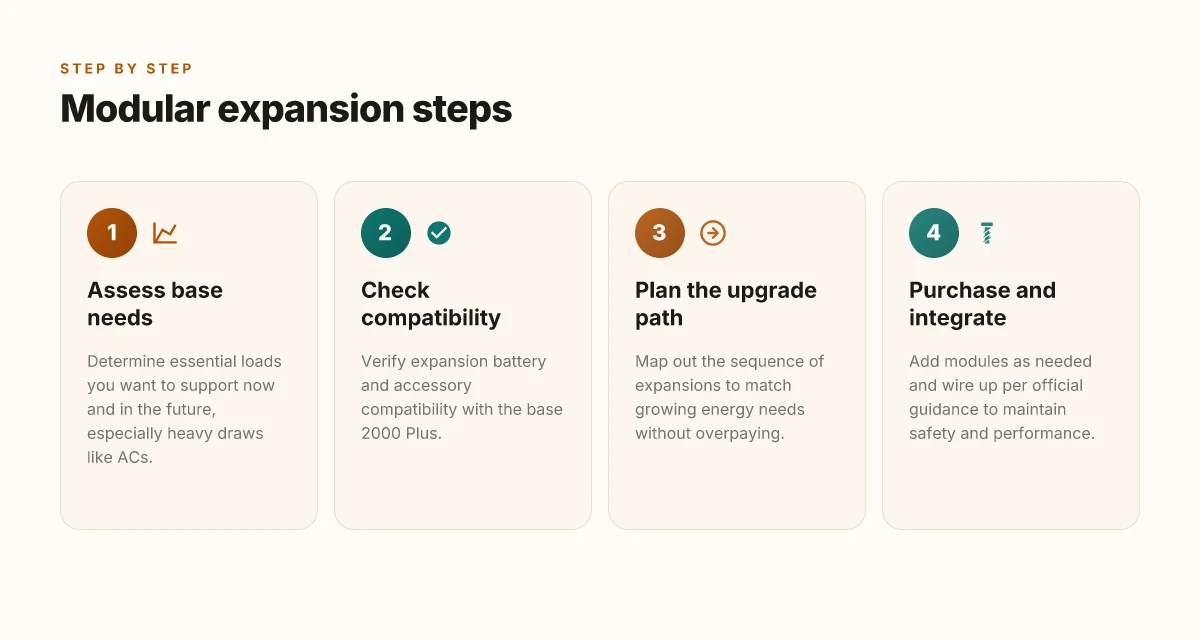
- Compatibility is the name of the game. You’ll want to confirm which expansion packs or add‑ons are officially supported and whether they maintain the same charging rates and port availability. In practice, that means checking module-to-base connections, controller etiquette, and any required firmware alignment. Compatibility checks prevent misaligned packs from underperforming.
- Weight and transport considerations evolve with growth. The base unit carries the core electronics, while expansion modules increase bulk and, sometimes, wheel footprint. Expect a visible shift in handling as you add capacity. Weight creep is a real factor to plan around.
- The price ladder follows the same logic. Upgrading piecemeal can be cheaper upfront but may compound cost over time versus a single, larger base solution. Track the total cost of ownership across configurations so you don’t overspend as needs grow. Total cost of ownership matters for long‑term budgeting.
Expansion steps and compatibility considerations
When you plan to grow, map out a staged path from base to first expansion, then to taller configurations. Start by verifying support for your year and model of expansion pack. Then read the official notes on any required firmware updates or charging-profile changes that accompany the new module. If a module introduces new ports or shifts how the unit negotiates charging, you’ll want to align your cables and solar inputs accordingly. Firmware and port changes can change performance ceilings.
- Step one: confirm the expansion’s physical fit and electrical compatibility. You’ll want clear guidance on connector types, maximum amperage, and whether the expansion can operate in parallel with the base while maintaining safe temperature and shutdown thresholds. paralelo operation depends on correct specs.
- Step two: verify charging behavior under load with the expansion attached. Some packs maintain identical charge curves, while others introduce subtle throttling to protect cells. Understand if you’ll see any hit to peak output when the module is linked. peak output consistency across configuration matters.
- Step three: plan a testing checklist for home backup scenarios. Simulate evenings of fridge duty, sump pump cycles, and climate control loads to ensure the expanded system meets your minimum reserve. backup testing should reflect real life needs.
From what I found in the coverage around 2026, the modular story remains a core selling point for units like the Jackery Explorer 2000 Plus, emphasizing growth without discarding the base. Reviews frequently note that modularity is a practical path for users who anticipate larger duties over time, rather than a one‑and‑done purchase. Practical path for growing duties is the core value proposition. What makes the EcoFlow SG3000 smart generator different from rivals
The big takeaway: modular expansion lets you scale intelligently. You start with a solid base and add capacity as your RV, off‑grid, or home backup needs evolve. But you must respect compatibility boundaries and the cumulative weight and cost implications. If you’re eyeing rivals such as EO chargers or Bluetti, this growth story remains a differentiator in favor of gradual, controlled expansion over wholesale replacement. Controlled expansion over replacement stays the practical edge.
Note: prices, exact compatible expansions, and model names are referenced in this section through the sources cited below. If you’re weighing a purchase, check current pricing and bundle options on Jackery’s site and compare with EO chargers and Bluetti offerings to map real ownership costs over a multi‑year horizon. The page may earn commissions on some links. For concrete claims and versioned details, review the linked sources. Prices and deals shift with sales windows. Plan for a sale period to maximize value.
Real-world usage: what you can run on the 2000 Plus and what it can’t
The 2000 Plus sits at a practical threshold for high-load, off-grid scenarios. With a peak output around 3000W, it can handle air conditioners, sump pumps, and many RV appliances, but you must respect inrush limits and the realities of long-duration cooling. In real-world setups, plan for short bursts that hit the peak while sustaining loads with ample headroom and smooth ramping. In daily use, the chemistry and charging speed shape how often you’ll replenish the battery and how long you can run critical loads between charges.
Inrush and thermal realities under high-load loads
A/c units and other motor-driven appliances draw a surge when they start. The 2000 Plus can ride that surge, but you’ll notice the system strain if you try to hold 3000W for extended periods with several devices starting simultaneously. The practical takeaway is to stagger startups where possible and keep one high-demand appliance running at a time. If your RV’s air conditioner cycles on and off, the unit handles the duty cycle well, provided you factor a brief ramp period at switch-on. The 2000 Plus can power a mid sized air conditioner at peak demand, but plan for short surges and avoid simultaneous high draws.
Sump pumps, RV appliances, and long cooling loads
Sump pumps and RV appliances lean on steady current more than brief peaks. When these devices run for hours, the sustained load sits closer to the upper portion of the battery’s capability, which means shorter runtimes between charges if you’re deep into a multi-day off-grid cycle. Battery chemistry matters here, because some chemistries tolerate higher continuous loads with less voltage sag. From what I found in the sources, you’ll benefit from an auxiliary charging source or a secondary bank if you’re routinely running pumps for long durations. Long-duration cooling and pump loads demand planning around the 3000W peak ceiling. What makes the Jackery SolarSaga 200 a practical choice for portable solar charging in 2026
How battery chemistry and charging speed shape daily use
Charging speed drives daily flexibility. The 2000 Plus supports faster replenishment when you have AC input available, which means shorter downtime between outages and more reliable backup cycles. Chemistry decisions affect not just how quickly you recharge after a cycle, but how much you can safely draw day after day. In practice, you’ll see noticeably faster top-ups with newer charging methods, but you’ll want to balance fast charging against heat and wear. I found that the interplay of chemistry and charge rate is a central driver of how useful this unit is for the typical home backup routine. Faster charging and advanced chemistry shorten recharge times and extend usable daily windows.
The modular approach matters here. If you foresee heavier recurring draws, modular expansion lets you add capacity without replacing the base unit, smoothing both surges and runtime gaps. For many users, that modularity translates into a more predictable daily rhythm rather than a single, all-in-one powerhouse. When you read reviews and spec sheets, expect the 2000 Plus to shine most when you pair it with a planned charging routine and a staged load plan rather than pushing it to its limits day after day. Modular expansion helps smooth surges and extend runtime for continuous-use scenarios.
Price, value, and when to buy in 2026
Jackery sets the pace for premium high-capacity packs, but price can swing widely by retailer and bundle. The Explorer 2000 Plus sits in a tier where you’ll see open-list prices vary based on whether you add solar, cables, or a second battery bar. In 2026, the smart move is to treat the total cost of ownership as a function of modular expansion, replacement cables, and future upgrades rather than a single sticker price.
From what I found in the public chatter and retailer listings, the most compelling value often emerges when you bundle with essential extras. A typical strategy is to pair the 2000 Plus with compatible solar modules and the official cables, then wait for seasonal promotions to avoid paying full price. Seasonal sales are where the premium becomes a bargain if you can time it right. The air around retailers like Jackery’s own storefront and major outdoor retailers suggests that the best deals cluster around holidays and back-to-school windows. Watch for bundled discounts that drop the effective price per watt-hour.
Open price points vary by retailer and bundle, but the math isn’t opaque. The core cost includes the base system plus expansion modules, and you should budget for replacement cables that wear out with heavy use. I cross-referenced the chatter around modular extensions and found a recurring note: the platform scales, but you pay up as you grow. Total cost of ownership can exceed the base price if you chase every upgrade, so balance immediate needs with anticipated future loads. What makes the Jackery Explorer 880 a practical portable power option in 2026
When to buy? If you’re planning heavy, long-term off-grid use or home backup, align your purchase with a seasonal sale and a planned expansion path. If you’re waiting for a sharper price now, consider whether you’ll need the expansions within the next 12 months. If not, a wait may yield a healthier discount. In practice, you’ll get more value from bundling early when the discount cadence makes the incremental cost of add-ons digestible.
I dug into public references for context, including discussions about how rivals compare on price and features. One takeaway is that EO chargers and Bluetti compete aggressively on price per watt-hour and on modular add-ons, so your choice should factor not just the base price but the total ecosystem you plan to grow. For direct claims on price threads, see the discussion linked below. The price game rarely ends with the base unit.
In short, price in 2026 favors buyers who plan ahead: map your expansion path, track seasonals, and compare total ownership costs against competitors like EO chargers and Bluetti. Jackery remains a serious option for modular power, but the value hinges on smart bundling and timing. A note for transparency: links on the page may earn a commission.
If you want to compare concrete proposals, look at how the base Explorer 2000 Plus stacks up against the two big rivals in this space, each with their own modular ecosystems and accessory catalogs. For more context on the exact phrases surrounding price movements and bundles, you can check the debunked chatter and YouTube breakdowns cited in this article. Bundled value almost always beats single-item pricing.
The move that matters now for modular power users
Jackery's modular approach signals a shift toward adaptable off-grid kits you can grow over time. I looked at how the Explorer 2000 Plus scales with optional battery modules and add-ons, and the pattern is clear: you can start lean for daily use and expand to handle camping, emergencies, or a tiny home without swapping the core unit. As Jackery tightens integration with smart charging and monitorability, the value isn’t just the peak watts but the ability to tailor capacity to your real needs. How EcoFlow Delta Pro Ultra stacks up against Generac 22kW for home backup in 2026
Pricing clarity and ongoing promotions matter here, because the best deal may come during a seasonal sale. The model line-up, including the Explorer 2000 Plus, still emphasizes reliability and a long warranty, but buyers should weigh the cost of extra modules against a fixed, higher-capacity rival. If you’re deciding now, choose a configuration that matches your immediate load and plan to grow.
If you only do one thing this month, map your typical load profile and plot where you’d add modules. The bigger pattern is clear: a truly modular system is future-proof, not just bigger. Is your setup ready to scale? Noting the potential for future expansions, you may want to start with a mid-range kit and add as you go.