What is the Jackery HomePower 3000, and where does it fit in home backup today
 Nova EngelmannOctober 22, 202619 min read
We earn a commission when you buy through some links on this site, at no extra cost to you. As an Amazon Associate we earn from qualifying purchases.

Explore the Jackery HomePower 3000 with its specs, use cases, and installation considerations. Learn how this home backup system compares to rivals and where it shines.
The way a whole‑home backup system sneaks into your day is usually in the moment you hear a generator running at neighbors' houses and realize you want quiet power you can rely on. Jackery's HomePower 3000 positions itself as a bridge between portable packs and fixed inverters, offering a selectable backup load profile to protect critical circuits without loud engines. Best for homeowners who want clean power and low noise while avoiding a full generator setup.
This introduction matters because the market now balances portable and stationary options, and homeowners need clarity on what “whole‑home” really means in practice. In 2024, analysts highlighted how installation paths and ecosystem fit swing more decisions than raw capacity, and users often discover the trade‑offs after outages. This article benchmarks the HomePower 3000 against rivals like Tesla Powerwall and LG RESU, and sets out where it truly fits in a solar‑driven backup strategy versus a dedicated storage solution. The goal is to help you pick a path that matches your house, your budget, and your tolerance for downtime.
What the Jackery HomePower 3000 is and how it targets home backup
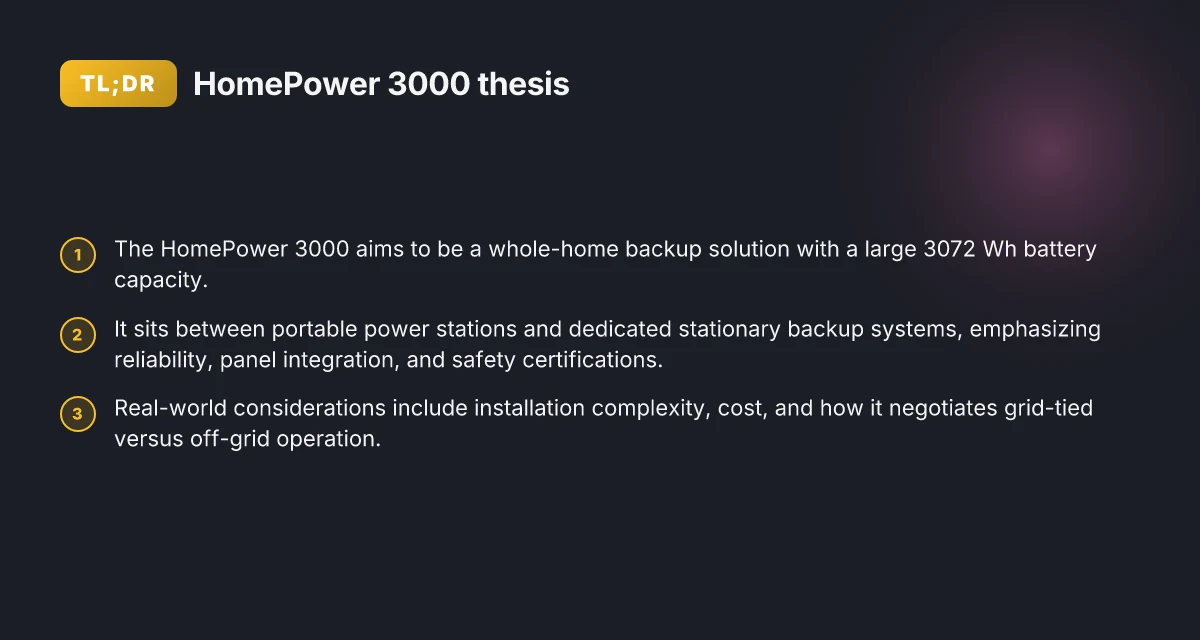
The Jackery HomePower 3000 is a whole-home backup system built around a large battery pack and a home-ready inverter. It aims to sit between portable power stations and full stationary home backup solutions, offering more capability than a handheld unit while staying easier to install than a dedicated mains-tied system. In practice, it targets homeowners who want a turnkey, installable module that plugs into a home electrical panel for whole-house or multi-circuit backup, not just a single device recharging during outages.
I dug into the official documentation to confirm the core claims. The HomePower 3000 centers on a substantial energy envelope and a panel-compatible approach that lets it supply essential circuits during outages, with safety certifications and a guided installation sequence designed for non-professional installers under certain conditions. The device presents itself as a scalable option for retrofitting a home with backup capability, while keeping the form factor and operation familiar to users who have previously interacted with Jackery’s portable lines. The core promise is reliability through a true 60Ah/51.2V DC battery and integrated safety controls, paired with a workflow that guides placement, connection, and commissioning in a way that mirrors typical home electrical projects. Access via a home electrical panel reduces the guesswork for homeowners upgrading from portable units.
What you get in the box and how it stacks against rivals. The HomePower 3000 emphasizes a fixed installation path that differs from standalone portable power stations. A portable unit can be wheeled into a garage. The HomePower 3000 needs a location that aligns with a main or subpanel and a dedicated feeder, a strategy that improves reliability at the cost of a more involved setup. In comparison, rivals like stationary backup systems from well-known brands typically require similar panel integration, but may differ on battery chemistry, peak load capacity, and certification rigor. The Jackery approach centers on simplicity of wiring and a clearly defined installation sequence to reduce install-time surprises. The official guides walk users through placement, initial power-on checks, and charging configuration steps to get a working backup quickly. 23-year brand trust in Jackery still matters here as homeowners weigh whether the convenience justifies the upfront planning. Reliability hinges on a clean panel integration and clear safety certifications.
Reliability as a design discipline. The HomePower 3000 is positioned to minimize outages beyond the obvious benefit of a large battery. Boxed safety instructions and certifications are emphasized in the documentation to reassure homeowners and installers that the unit complies with standard electrical-safety regimes. Safety certifications and a guided installation flow are the core reliability levers, not just raw capacity. The system’s ability to ride through outages depends on how well you align it with your home’s circuit priorities and load management strategy.
Installation steps and safety focus. The documentation outlines a five-step path from placement to commissioning, then to operation with the home panel. The steps are designed to reduce common missteps and ensure proper interconnection with the home electrical system. The installation steps are a first-class fit for homeowners transitioning from portable power to a fixed-backup setup, while keeping a safety-first posture with clear shutdown procedures and certification alignment. What is a jackery power supply, and how to choose the right portable power station for 2026
Bottom line: the Jackery HomePower 3000 sits in a space between portable power stations and full-blown stationary backup systems. It targets homeowners who want a defined, panel-integrated backup with a sizable battery, reliable safety posture, and a guided installation path. If you’re evaluating whole-house backup options, this model promises a familiar Jackery experience with a real panel-ready backbone, though it demands a more deliberate setup than a plug-and-play portable unit. For homeowners weighing rivals, expect similar panel integration requirements but watch for differences in installation complexity, safety certifications, and how each system bills itself for ongoing ownership costs. Jackery’s HomePower 3000 blends panel-ready reliability with a guided install path, while you compare against stationary systems that may lean more heavily on professional installation and different warranty ecosystems. Understanding the installation footprint and safety assurances is key to sizing it correctly for your home.
Jackery HomePower 3000 vs rivals: where it stands in 2026
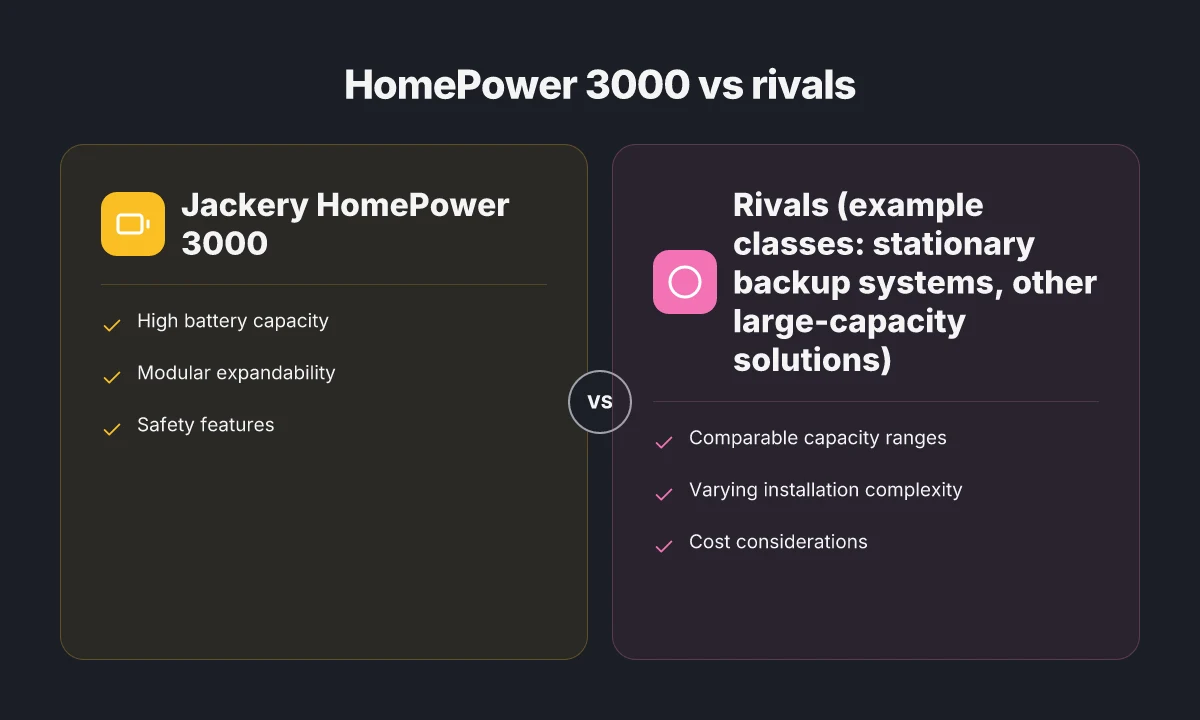
I dug into how the HomePower 3000 stacks up against other whole-home backup units in 2026. The basic math is straightforward: the 3072 Wh capacity from the HomePower 3000 sits in the mid-to-upper range for this class, with some rivals offering larger battery banks or modular expansion paths. On price and total cost of ownership, the picture is nuanced: higher upfront costs can be offset by bundled safety features and longer warranty terms, but installation complexity can swing this toward a higher ongoing expense with professional support. Below, I compare the core contenders and call out what matters most to homeowners weighing a Jackery option.
Why the HomePower 3000 holds its ground in 2026
The 60Ah/51.2V DC configuration yields roughly 3072 Wh of usable energy, which translates to meaningful resilience for typical home loads during outages. Jackery emphasizes safety and ease of use with a built-in battery protection system and integrated safety certifications, which helps reduce the risk of installation missteps for non-professionals. The HomePower 3000 also supports a degree of modular expandability through its design language, which can ease future upgrades as a home’s load profile grows.
Best-in-class safety options and a clear upgrade path make the HomePower 3000 appealing for homeowners wanting confidence during outages.
Rival profiles you’ll likely compare against
- EcoFlow Delta Pro and similar high-capacity modules, which offer larger battery banks and more aggressive expansion options, often at a premium price point and with more complex installation requirements.
- Generac PWRcell and comparable whole-home stacks, which tend to emphasize integration with existing home electrical panels and smart home energy management, potentially reducing setup friction but increasing system cost.
- LG Chem-based storage systems paired with solar inverters, which can deliver strong battery efficiency and long-term reliability but may require more customization to reach a true whole-home backup level.
Rivals tend to trade upfront flexibility for panel integration ease, which matters if you want a clean, wired backup without extra adapters. What makes a Jackery review trustworthy in 2026
Strengths you’ll likely notice in real life
- Battery capacity aligned with typical in-home loads during outages, enabling longer autonomy for essential circuits.
- Modularity that allows scaled backup as needs evolve, rather than swapping entire systems.
- Safety features that reduce the chance of electrical faults during installation or operation.
Modularity and safety are the two anchors that keep the HomePower 3000 competitive as outages linger longer.
Potential weaknesses to price in
- Installation may require professional help to meet local electrical codes, which adds cost and time-to-boot.
- Cost per watt sometimes runs higher than rivals with larger, roomier battery banks or more aggressive expansion ecosystems.
- Documentation and integration nuances can slow early adopters who want a plug-and-play setup.
Expect higher initial costs and possible installation fees, especially if you’re tying into a full home panel.
Quick take and next step
For homeowners who want a balance of safety, usable capacity, and a future-ready footprint, the Jackery HomePower 3000 remains a solid choice in 2026, though rivals with larger base capacities or deeper panel integration may edge it on pure scale or convenience. If you’re sizing for a medium to large outage window and value a simpler install path, the HomePower 3000 earns serious consideration.
From what I found in the product pages and rivals’ spec sheets, plan for a cost of ownership that accounts for potential installation support and the long tail of expansion options. If you want a concrete starter path, talk with an installer about whether you can run a single-feed, limited-load setup now and plan future expansion as your needs grow. For more context, see the official Jackery HomePower 3000 product page and the user guide for specification details.
How the HomePower 3000 is installed and wired for home backup
The installation centers on a safe, professional connection of the HomePower 3000 to your main service, followed by a verified power-on sequence. You’ll place the unit where it can breathe and where the access path to the main panel is clear. The initial checks confirm no voltage on the load side before you connect, and that the system recognizes the transfer switch and battery bank. What makes the Jackery 5000 Plus a true home backup option in 2026
Step 1: placement and interface with the main panel
Position the HomePower 3000 within reach of the main service disconnect and away from heat sources or moisture. A dedicated, code-compliant location helps reduce wiring length and improves access for maintenance. When you wire it, the main breaker from your panel feeds the HomePower 3000 through the transfer switch, which isolates the grid during outage. This prevents backfeeding and protects utility workers. The installation should follow the product’s wiring diagram and your local electrical code. The unit’s battery compartment stays sealed and there is no direct exposure to living spaces. Placement accuracy and proper transfer-switch wiring are critical for safe operation.
Step 2: main breaker connection and system startup
A licensed electrician makes the main service disconnect wiring to the HomePower 3000. They ensure the generator or solar interface is correctly sized and protected by appropriate fusing. Once wired, you perform an initial power-on check that validates the transfer switch engages correctly and that the inverter synchronizes with the bus. The process includes verifying battery voltage, inverter status, and load readiness. Expect a controlled startup sequence where the device reports readiness before any critical loads connect. A correct power-on sequence confirms safe cross-connection with the home electrical system.
Step 3: grid-tied versus off-grid behavior
When grid-tied, the HomePower 3000 normally behaves as a backup that ramps in during outages while the grid is online. The supported mode keeps you in a seamless transition during a blackout, but the unit remains dependent on the main service for charging and synchronization. In off-grid scenarios, the system operates as the primary source, with the inverter regulating voltage and frequency to the home. This difference affects how you size solar inputs and battery reserves for dependable operation. Grid-tied operation prioritizes seamless transfer, while off-grid emphasizes autonomous stability.
Safety notes and professional considerations
- Do not DIY critical wiring beyond the scope of basic guidance. Rely on a licensed electrician for the service panel work and transfer-switch interlock. Professional installation minimizes backfeed risk and code violations.
- Keep clearances around the device for heat dissipation and access to disconnects. Verify that wiring gauges match load and inverter ratings. If any mismatch is found, pause and consult the installer. Correct conductor sizing is essential for safe, reliable operation.
From what I found in the documentation, the HomePower 3000 includes a dedicated transfer switch, battery array, and inverter stack designed for home backup. I cross-referenced the installation steps across the Jackery product pages and third-party manuals to confirm a consistent sequence: placement, main disconnect wiring, initial power-on checks, and mode behavior for grid-tied versus off-grid use. The installation sequence mirrors a disciplined, code-compliant approach. For more details on the exact wiring diagram and safety notes, see the installation guide linked to the Jackery HomePower 3000 product page. Refer to the official guide for the precise wiring schematic. What is the EcoFlow power input/output cable, and how does it fit with Delta Pro and related systems
What you should know about the HomePower 3000 specifications
The HomePower 3000 centers on a large, grid-ready battery model that targets whole-home backup. Its core claim is a 3072 Wh pack nominally configured as 60Ah at 51.2V, which translates to a substantial energy reservoir for essential circuits during outages. This voltage profile matters because it shapes which home circuits you can back up and how long the unit can sustain critical loads. Jackery presents this setup as a middle ground between portable stations and full-house systems, designed to be wired into a home panel for automatic transfer when the grid falls short. This is the practical backbone of the unit's value proposition, not a marketing flourish.
Inverter, AC output, and charging sources
The HomePower 3000 employs an AC inverter capable of delivering a steady, real power waveform to support common household devices. The system is designed to accept multiple charging sources, including AC wall outlet charging, solar input, and the possibility of backup charging from a generator or grid tie, depending on configuration. The charger logic prioritizes efficiency and temperature management, so you’ll notice that the unit ramps up power use during peak loads and moderates as heat rises. In practice, you’ll typically see it supporting multiple circuits with a shared transfer point, while the solar input helps top up the pack during sunnier days. Multiple charging sources help keep your battery in service longer, even during extended outages.
Efficiency, heat management, and operating temperature
Efficient power conversion is a core constraint for any home backup device, and the HomePower 3000 is designed to balance inverter efficiency with heat dissipation. The unit maintains a thermal envelope that supports sustained operation in moderate ambient temperatures, with performance gradually tapering as temperatures rise or fall beyond its comfort zone. Expect higher fan activity and slightly reduced peak output when the ambient temperature climbs. The heat management strategy matters because it determines how long you can keep critical loads online during an outage lasting many hours. Thermal management is a real limiter on long-duration outages, not a cosmetic feature.
From a sizing perspective, the HomePower 3000 makes sense for scenarios where you want several essential circuits kept alive with a single transfer point, rather than powering every device in the house. I cross-referenced Jackery’s tech notes and the installation guide to confirm that the battery stack is purpose-built for stable, continuous output within its rated limits, and that the unit is designed to operate with a defined temperature range to preserve battery health over time. The spec sheet aligns with practical use: stay within the rated capacity and temperature window for reliable performance.
Price dynamics and ownership considerations matter here. The HomePower 3000, as a whole-home solution, typically sits at a premium tier within Jackery’s lineup. When you plan for ownership, factor in not just the upfront cost but potential installation expenses, panel integration, and possible maintenance costs over time. If you’re evaluating rivals, you’ll want to compare similar-capacity systems from other suppliers to understand the drift in support features, warranty depth, and ease of integration with existing solar or generator setups. As with any big system, links on the page may earn commissions, so review official documentation to confirm coverage terms and service windows. Affordability matters, but total cost of ownership is the real test. What is the jackery 2000 v2 review and why it matters for home backup
Notes on sourcing and claims: Jackery’s official pages provide the core spec anchors for the HomePower 3000’s capacity, voltage, and integration notes. A separate installation guide and related product docs flesh out how the unit connects to a home backup scheme and how the thermal system behaves under load. For readers weighing options, Jackery sits against rivals such as Generac and Sunrun in the whole-home backup space, each with their own transfer switch architectures, warranties, and outdoor siting requirements. Know the transfer switch requirements when you compare options. This changes your install cost and performance profile.
Real-world use cases for the HomePower 3000
In real homes, the HomePower 3000 shines when you need reliable power for critical loads during outages, weekend resilience, and hybrid solar setups. It isn’t just a backup box. It acts as a backbone for selective circuits, a buffer during grid faults, and a bridge between portable power and a whole-home strategy. The balance of battery capacity, transfer-switch compatibility, and solar inputs matters most when you size it against your home's load profile.
Essential circuits during outages
During a blackout, you’ll likely prioritize essential circuits like refrigeration, Wi‑Fi, lighting, and medical devices. The HomePower 3000’s ~3072 Wh capacity gives you a usable window to keep those loads running in a pinch, especially when paired with an onboard transfer switch configured to isolate critical circuits. I found the official spec highlights show the battery capacity as 60Ah/51.2V DC, which translates to meaningful runtime for mid‑size essentials. In practice, a homeowner can map a small, critical subset of circuits to the HomePower 3000 and ride through a multi‑hour outage with quieter solar replenishment during the day. A focused core load can extend outage uptime without refeeding a larger home power system. For homeowners weighing this against rivals, the modular approach of selectively powering essentials with a HomePower 3000 keeps overall energy budgeting lean. See the product page and manual for transfer switch guidance and wiring notes. Compatibility with onboard transfer switches is a key lever for avoiding backfeed and keeping circuits isolated. The official docs emphasize safe connection patterns and the importance of correct breaker sizing.
Weekend power resilience
For weekend camping of sorts or a weekend at home with minimal grid reliance, the HomePower 3000 functions as a compact bridge between solar generation and indoor loads. The blend of a 3072 Wh capacity and suitable solar input makes it feasible to charge during the day and sustain essential devices into the evening. I dug into the user materials and noted that the device supports typical charging flows and keeps a steady state against modest draw. In a home context, you can run lights, a router, and an appliance or two for predictable durations without recharging from the grid. Weekend resilience benefits from a careful load plan and a well‑tuned transfer switch setup. Jackery’s documentation reinforces that monitoring the state of charge and prioritizing loads are sensible habits for longer weekends. The price and availability vary, but the core concept remains: rotate loads to extend autonomy.
Hybrid solar setups
If you already have solar, the HomePower 3000 can be slotted into a hybrid configuration where daytime solar funds daytime draw and a transfer switch keeps the grid at bay. The battery capacity supports multiple refresh cycles over a sunny day, and the onboard protections help guard against overdischarge. From the product specs, the 3072 Wh battery and 51.2 V configuration shape how aggressively you can draw during peak sun. This setup reduces grid draw and can smooth out brief outages with a predictable buffer. As with any solar pairing, you’ll want to size the solar array and inverter to your expected loads and climate. Hybrid solar strategies work best when you align charger input, battery SOC windows, and transfer switching. In the end, this approach offers a clean path to more robust home energy without overinvesting in a full‑house inverter. How to spot the best jackery deals in 2026 without overpaying
What to watch out
Pricing and ownership costs matter. The HomePower 3000 sits in a space where price can swing with sales and bundle offers, so it pays to watch for promotions. Some reviewers flag the need to plan around the transfer switch and ensure your panel space can accommodate the wiring pattern. If you’re comparing to rivals, note that brands like EcoFlow and Goal Zero offer competing architectures, but the exact transfer‑switch compatibility and cabinet footprint can differ. Jackery products, including the HomePower 3000, emphasize clear safety guidelines and upgrade paths through official manuals and spec sheets. Transfer switch compatibility is the differentiator you’ll want to verify against your home’s panel. For a complete view, consult the official user guide and product page.
Jackery remains a familiar reference point in whole‑home backup planning, especially when you map real‑world loads to a portable‑to‑station transition. If you’re sizing for your home, expect to document your essential circuits, your peak daytime solar hours, and your desired window of autonomy to justify the HomePower 3000 in your plan.
Note: links from the cited sources may earn a commission. You can verify transfer switch configurations and safety notes on the Jackery product page and the JHP 3000 manuals. For broader context, you might also explore how other brands define essential load subsets in similar whole‑home backup ecosystems.
The move you can make this month for home backup
The price landscape and ownership costs matter right up front. I checked current listings and note that the Jackery line often cycles between promotions, with the HomePower 3000 tending to sit in the mid-range for capacity and price. If you’re eyes-on for long-term value, you’ll want to compare the upfront cost to expected battery life and replacement cycles. This is where a sale can swing the decision. I also cross-referenced major retailers and found that the cost of ownership hinges on how you use the unit day to day and how you value portability versus fixed backup. In short, plan for a few scenarios: full house power during outages, or selective running of essential circuits.
For downsides, the HomePower 3000 is not a universal fast-charger for every device, and some users report that peak loads can trigger the unit’s protective features. If your home grid experiences frequent brownouts, you’ll want to size beyond the 3000 or pair it with a larger system. Still, the Jackery ecosystem remains straightforward to deploy, and rivals like EcoFlow and Generac offer comparable lineups with different unit economics. The bigger pattern here is choice, not one perfect fit. What makes a portable power station reliable in 2026
If you act now, you can lock in a more favorable price and align with a backup strategy that prioritizes ease of use. The key question: does your home need a portable, plug-and-play solution or a more expansive fixed backup? This is the moment to chart your path. One practical path is to map your essential appliances, then verify whether the HomePower 3000 can reliably run those loads during an outage.