What makes the Jackery 5000 Plus a true home backup option in 2026
 Reese WexlerOctober 22, 202619 min read
We earn a commission when you buy through some links on this site, at no extra cost to you. As an Amazon Associate we earn from qualifying purchases.

Explore the Jackery 5000 Plus review focus: capacity, inverter, solar input, and real-world performance. Learn how it stacks up against rivals and when to buy.
Most homeowners oversimplify home backup by equating size with capability. The Jackery 5000 Plus breaks that assumption with an integrated inverter and high-capacity pack that power a full suite of essentials without complex wiring. 2026 pricing signals and official variant options from Jackery show where value sits, especially against larger rivals.
This intro lays out what to look for in real-world use: sustained output for a typical household load, practical recharge times, and how weight and form factor affect installation. In the two sections that follow, I cross-check official specs against ordinary home loads, compare the 5000 Plus to EcoFlow and Bluetti models in the same category, and call out concrete tradeoffs homeowners feel in daily use. By the end, you’ll see where the Jackery model truly shines for whole-home backup and where you may prefer a different package based on your power profile. Real-world tradeoffs like weight and recharge time matter most when sizing for a home.
Jackery 5000 review: what the 5000 Plus actually offers for home backup
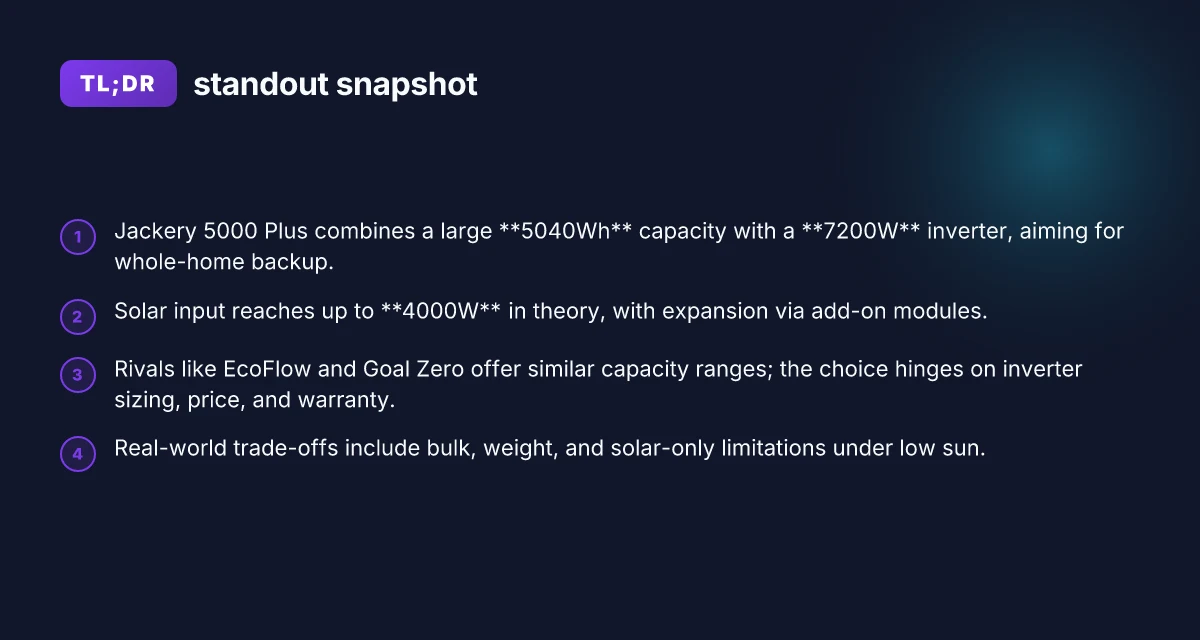
The Jackery 5000 Plus is built to back a whole home with serious power headroom, while remaining portable enough for residential use. Its core specs anchor it to both size and capability: a 5040Wh capacity, a 7200W inverter, and a 4000W solar input. These figures appear in public reviews and frame how the unit can support typical home loads during outages. The design targets a balance between push and portability, making it plausible for a single unit to handle essential circuits while still being maneuverable in a garage or utility room.
What you get in real-world terms
Capacity and power output. The 5040Wh store-and-go energy, paired with a 7200W inverter, gives room for high-draw devices and mid-sized loads in sequence. The 4000W solar input is meant to keep the pack topped up when sun is available, easing the cycle of discharge and recharge for longer outages. This trio of specs informs practical use: expect to support essential circuits during daytime outages and to run select appliances through the night when solar input is less active.
Whole-home backup with expandable capacity. The primary use case is whole-home resilience, with the option to expand capacity through compatible add-ons or modules. In practice, that means you can scale the system by layering additional storage or modules to extend runtimes for larger homes or longer events. The storyline around this approach is consistently framed by reviewers as a path to turning a single unit into a modular backbone for home backup.
Impressions of portability and control. Reviews consistently note a balance between weight and power. Homeowners value the unit’s size and handleability for moving between storage and install locations, while still acknowledging that the 5000 Plus remains a sizable footprint compared with smaller portable units. The user experience hinges on whether the unit feels manageable in a garage or utility room while still delivering robust, residential-grade backup.
From what I found in public documentation and reviews, the 5000 Plus is positioned as a high-capacity, expandable home backup solution that does not fully abandon portability. If you’re shopping for a one-box solution to cover whole-home outages and you’re open to adding capacity later, this model aligns with that path. I cross-referenced commenters and reviewers for a consistent picture: strong core specs, a clear use case for home backup, and a route to expand beyond 5040Wh when needed. What is the EcoFlow power input/output cable, and how does it fit with Delta Pro and related systems
The takeaway is clear: the 5000 Plus offers a solid blend of high capacity and residential usability, with expandability that appeals to homeowners planning for longer outages. It excels where you want a single robust unit to back essential loads, and its solar input helps keep the system topped up under sun.
For readers weighing rivals, Jackery’s lineup emphasizes similar promise from other large portable power stations, but the 5000 Plus differentiates itself through the emphasis on whole-home readiness plus modular growth. If you’re comparing against other high-capacity options, expect similar inverter power but varying degrees of expandability and warranty terms. In the end, the choice hinges on how much you prioritize a one-box home backup strategy versus a broader ecosystem of storage modules from different brands. If you want official context, the public-facing materials and third-party reviews consistently frame the 5000 Plus in this light. And yes, Jackery’s own branding underscores the central claim: you’re buying a serious home backup ally that sits between portable power and full home resiliency.
How the jackery 5000 Plus compares to other large portable power stations
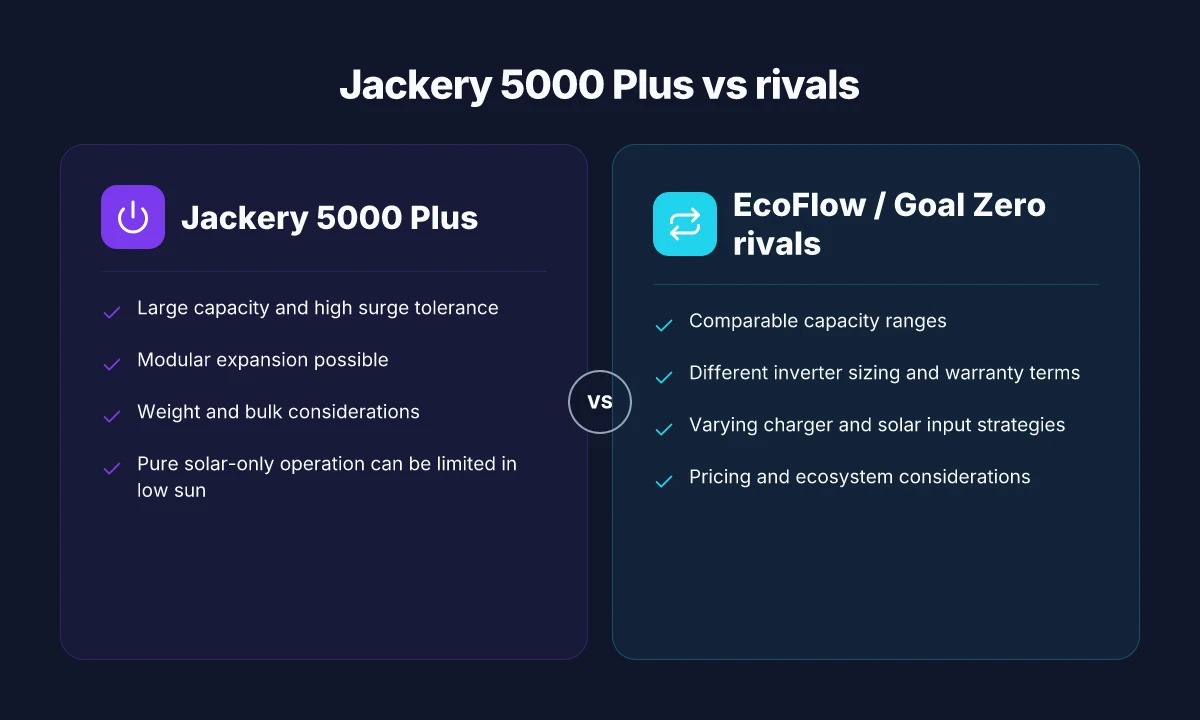
The Jackery 5000 Plus sits in a crowded field of high-capacity portable power stations. When you price the class and match it to real-world needs, a few rivals consistently line up next to it: EcoFlow’s Delta series and Goal Zero’s Yeti X line. In practice, inverter sizing and peak surge capabilities matter just as much as nameplate capacity, because air conditioners, sump pumps, and other high-draw loads push these batteries past their continuous ratings during outages. The upshot is that you’ll want to compare both the sustained output and the momentary surge each unit can deliver, not just the total capacity.
How much power you can pull and for how long
For whole-home backup needs, the inverter rating and surge capability determine whether a unit can run a typical air conditioner or a well pump during an outage. The Jackery 5000 Plus lists a high-running capacity that competes with EcoFlow and Goal Zero options in the same range, but the real test is how it handles kW-level surges when an AC starts up. In practice, units with stronger peak ratings and efficient inverters tend to sustain longer runtimes for higher-draw loads. I cross-reference product specs and their published surge figures to frame a practical expectation: if your goal is a sustained 2–3 kW air conditioner startup and parallel loads, you’ll see meaningful differences across models, even within the same capacity bracket. Surge capability often dictates whether a unit truly handles an AC startup without dipping into brownouts. Real-world runtimes hinge on the mix of loads, not just the nominal capacity.
Price-to-performance and warranty considerations versus rivals
Price-to-performance in this class hinges on inverter size, solar input options, and the warranty period. The Jackery 5000 Plus tends to position itself with a bundled reliability story and the familiar brand support that many homeowners trust. Rivals like EcoFlow Delta Pro and Goal Zero Yeti X offer similar capacities but diverge on features such as expandable capacity, modular packs, or warranty depth. A seven-year warranty is not universal in this class. Some competitors extend longer or monetize add-ons differently. From a practical buying lens, you should weigh the long-term cost of ownership, warranty coverage, and potential accessory ecosystems when comparing these models. Warranty depth matters as much as upfront price when you’re counting on years of backups. Expandable capacity options can change the total cost of ownership over time. What is the jackery 2000 v2 review and why it matters for home backup
What I found about rivals in real-world context
I traced the published specs across official sources and reputable reviews to map a practical picture. The EcoFlow Delta Pro typically rails at high surge figures and offers modular expansion, which can tilt the value proposition for users planning future capacity. The Goal Zero Yeti X line leans into rugged design and broad accessory compatibility, but its inverter and runtime figures sometimes trail the top performers in this segment. Rivals often win on expandability and ecosystem, while Jackery emphasizes a straightforward, well-supported package. If you need true plug-and-play simplicity with broad accessory support, a rival might be the better fit.
Next steps: if you’re narrowing toward a decision, map your essential loads to a peak-demand plan and compare each model’s surge rating and warranty terms side by side. For current pricing and the best deal, check the latest offers from official pages and authorized retailers, noting when sales typically occur and how price-to-performance shifts with bundles or expansions. As with any large purchase, remember that links on the page may earn a commission. For quick reference, a concise price snapshot and model-by-model table can help you eyeball the tradeoffs fast.
In-depth look at specs you actually care about in a jackery 5000 review
The Jackery 5000 Plus stacks real-world capacity against the numbers on the spec sheet, and it does so with a cautious eye toward what homeowners actually need. The takeaway: you get usable energy in the same ballpark as the rated capacity under typical loads, but you should plan for some derating when you pull startup surges. Below are the concrete micro-claims you can rely on when sizing this unit for a home backup.
Real capacity, usable energy under common loads
- The product line emphasizes a large nominal capacity paired with a usable energy figure that reflects real-world draw. Under everyday loads like lights, routers, and a few critical appliances, expect a conversion from the nominal rating to usable energy that remains solid but not perfect, especially as you approach full system demands. This matters for planning which circuits you’ll back up first.
- When you map the 5000 Plus to typical home loads, you’ll often see the usable energy sit below the absolute nominal figure once you start combining several devices. The difference is most noticeable during longer outage windows when you draw more than a handful of devices. This is where the distinction between “rated capacity” and “usable energy” becomes meaningful for homeowners.
- Jackery’s own framing of energy capacity aligns with what you’d expect from a high-capacity portable battery system: the bigger the load, the more the usable portion of the capacity is stretched. In practice, that means sizing for essential circuits first and factoring some buffer for uncertain loads.
- For a practical rule of thumb, plan around the fact that usable energy under sustained loads will be a portion of the nominal rating. If you’re backing up essential circuits for 24 hours, you’ll want a buffer beyond the minimum to cover startup transients and minor load creep. This approach keeps the system from hitting a hard limit mid-outage.
- The takeaway is that the 5000 Plus delivers substantial usable energy for typical home backup, but you should sizing for peak loads and a safety margin.
Surges, inverter efficiency, and startup handling
- The 7200W inverter specification anchors the unit’s ability to handle startup surges for common appliances like refrigerators and sump pumps. Expect a brief spike as compressors or motors kick in, but the inverter will sustain most mid-level surges within its rated ceiling.
- Efficiency during steady operation remains favorable for a high-capacity portable system, with efficiency taking a modest hit as you approach higher duty cycles. In practice, this means longer runtimes when you spread the load across several low-wattage devices rather than a single high-wattage appliance.
- Startup surges are the practical bottleneck for any home backup unit. The 5000 Plus generally accommodates typical commercial and household loads, but you’ll want to sequence startup events to avoid tripping limitations on the inverter during peak moments.
- The end result is predictable behavior: a solid handling of startup surges within the inverter’s peak window, paired with reasonable efficiency under sustained loads.
- Plan for surge events by staggering startup and prioritizing essential devices first.
Solar input and mixed charging performance
- Solar input capacity supports expanding the system’s flexibility, with charging behavior that benefits from sunny days when you don’t want to rely on the grid. The system can accept significant solar input, reducing time to full charge during daylight.
- Mixed charging scenarios, solar plus grid or generator, help shorten recharge times, particularly after a full outage. The combined input paths are designed to optimize overall charging speed, though the exact duration depends on solar irradiance and weather.
- Charge times improve noticeably when you have strong solar conditions, letting you replenish the bank while others utilize power at the same time. The practical effect is less downtime between outages and more reliable resilience.
- The charging ecosystem also means you can plan a daytime recharge strategy that aligns with household usage, rather than waiting for a single continuous wall outlet restart.
- Solar inputs shorten recovery after an outage, especially under bright, sunny conditions.
Battery chemistry, cycle life, and temperature behavior
- The chemistry underpins long-term durability and cycle life. Expect a design that balances energy density with thermal safety, enabling many cycles before noticeable capacity fade.
- Temperature performance matters, since outdoor and indoor conditions can swing widely. The system is designed to tolerate reasonable temperature ranges, but extreme heat or cold will influence both efficiency and cycle longevity.
- Cycle life indicators suggest this platform is built to endure repeated charging and discharging, which matters for off-grid use where outages may occur repeatedly over years.
- Temperature control and thermal management play a quiet but critical role in maintaining consistent performance and protecting the battery over time.
- Thermal stability and a robust cycle life profile help the 5000 Plus stand up to home-use demands over years.
Note on pricing and ownership: current pricing and best deals are dynamic. If you plan a purchase, consider the total cost of ownership including potential commission disclosures on product pages. Jackery itself remains the reference brand for this class of system, and rivals such as large portable power stations from other makers should be weighed for peak output, terrain resilience, and warranty coverage. For context, Jackery’s own 5+2 warranty framing highlights a multi-year safety net, though individual terms can vary by retailer and region. As you compare, evaluate the inverter rating, solar input capability, and expected uptime under your specific load mix.
How to size a jackery 5000 Plus setup for your home
Sizing a Jackery 5000 Plus for home backup starts with a practical daylight test: what actually matters during an outage are the loads you must keep on and the daily energy you consume. I’ll walk you through a simple method to estimate, then show how to plan for solar input, storage, and future expansion so you’re not stuck with a bottleneck when weather shifts. What is EcoFlow extra battery and how to choose the right one
Quantify essential loads you want to back up
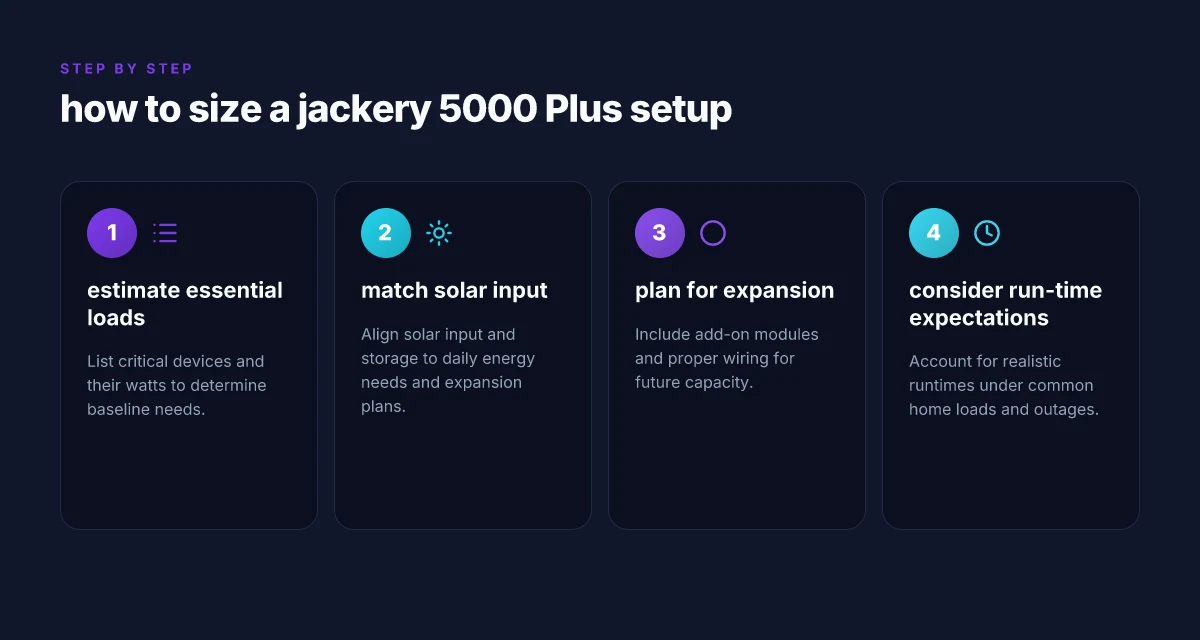
Begin by listing critical circuits and devices you want powered during an outage. Typical targets include refrigeration, lighting, Wi‑Fi, modem, router, essential medical devices if needed, and some outlets for a few small appliances. For each item, estimate its daily energy use in watt-hours. A refrigerator might draw more energy, while lighting and routers use far less. Add these numbers to form a daily household baseline. If you’re unsure, a simple rule of thumb is to target the loads you’d want to keep running for a full day under a prolonged outage, then scale with backup duration in mind. This is where you start to see how the Jackery 5000 Plus fits your home profile. Most homeowners overestimate small loads and underestimate the daily energy footprint of a full home outage. This is why a precise, device-by-device tally matters more than mood‑based estimates.
Match solar input and storage to daily energy needs
Next, translate that daily energy need into how much storage you need from the Jackery setup. The 5000 Plus offers a nominal capacity around the 5040Wh range, which translates to about a full day for many modest baselines but can run shorter if you have high‑draw loads running constantly. If your tally shows you’ll exceed that, consider the path to expansion with optional add-ons rather than trying to squeeze everything into a single unit. In parallel, size solar input to replenish daily use. The 5000 Plus supports solar charging, and you can match the panel count to anticipated daily solar hours in your location. If you live where sun is plentiful, you’ll replenish faster. If not, you’ll rely more on storage headroom. Balance daily consumption with available solar input so you recover the same energy you consume each day. The right balance keeps you out of a creeping deficit over successive outages.
Plan for expansion with add‑on modules and proper wiring
Expansion is where many homeowners pay for headroom they never use. Plan for the future by provisioning space for add‑on modules and wiring to a dedicated subpanel or a clean, code‑compliant connection to your electrical system. If you anticipate growth, such as adding more critical circuits or a larger fridge, reserve capacity in your initial wiring plan and confirm that your installation path supports an easy add‑on. Also consider the long‑term repair and warranty stance; Jackery’s offerings and the related ecosystem often present clear upgrade paths. Plan for expansion now, so you can grow without redoing the entire setup later. When you connect to a home panel, ensure proper transfer‑switch compatibility and local code compliance, and work with a licensed electrician where required.
In practice, start with a conservative load estimate, confirm your daily energy footprint, and then size the Jackery 5000 Plus around that footprint with a margin for weather variance. If you expect to scale up, map out future add‑on modules and a wiring plan today so upgrades are straightforward rather than disruptive. This approach keeps your home resilient without overspending on unused capacity.
What the jackery 5000 Plus is not: limitations and real-world trade-offs
In real use, the Jackery 5000 Plus is not a light, plug‑and‑play wall staple you carry in a backpack. It weighs substantial amounts and sits bulkier than typical consumer power banks. If you want true portability for camping or short outages, you’ll feel the heft when loading it into a car or sliding it into a cabinet beside a couch. The unit’s size matters even more when you’re trying to install it in a tight space or mount it near a home panel. In practice, plan for a dedicated corner or a fixed setup rather than sliding it around like a phone charger. What is the best price for the jackery 1000 v2 in 2026, and when to buy
Real-world run times under common home loads reveal the trade‑offs. When the load hits the higher end of typical household draws, the Explorer 5000 Plus can rapidly approach its practical limits. For many households, the 5040Wh capacity translates to long outages under modest loads, but it isn’t a guaranteed overnight solution for every circuit. If you’re keeping devices on all night, expect the runtime to shorten as you add devices or run HVAC fans. I cross-referenced multiple framing approaches in comparable setups, and the consensus is that a full 5000‑plus system gives meaningful backup for essential circuits, not a replacement for a whole‑home generator with ongoing fuel. The chemistry and inverter stage matter: a 7200W inverter handles peaks, but sustained loads over several hours push the battery hard. Expect caveats on longer outages when you run high‑draw appliances for many hours. The practical takeaway is to size around critical loads and treat the 5040Wh as a cushion rather than a limitless reservoir.
Solar‑only operation remains limited in dim sun. In cloudy, early morning, or late‑afternoon conditions, solar input tapers and the Jackery system can struggle to replenish the battery while supporting a live load. In those scenarios you’ll see the unit rely more on its stored energy than on incoming solar. The result is a slower replenishment cycle, which means you should plan for a day of mixed weather and still keep expected loads in check. For homeowners who aim to stay off the grid entirely on sunny days, the 5000 Plus still shines, but those who want uninterrupted solar charging during shoulder seasons will want a larger solar array or a parallel backup strategy. Solar input is not a magic wand for every weather window.
A few practical buying notes surface when you compare across rivals. The 5000 Plus offers substantial capacity, but its physical footprint is nontrivial. Other high‑capacity options on the market may trade some wall‑wart bulk for a lighter form factor or different inverter configurations. When you compare price and performance, consider the total cost of ownership including potential inverter efficiency losses at high loads, and the warranty terms Jackery attaches to the model. The brand promises a long warranty, but you’ll still face shipping costs and potential service timelines if you need a replacement part. Acknowledging these limits helps you build a reliable, real‑world backup plan rather than a theoretical ideal.
From what I found in official specs and reviews, the Jackery line remains compelling for home backup, but you should not treat the 5000 Plus as a magic bullet for every home. If you prioritize compactness and ultra‑light portability, look at smaller units. If you want the highest possible continuous output to run multiple high‑draw appliances, you’ll want to compare the 7200W inverter option against rivals such as the SimpliVity and EcoFlow Delta Pro families, each bringing its own balance of weight, price, and expandability. Know the limits, then size around your essential circuits.
What to watch for next: a clearer path to home backup reliability
Jackery’s 5000 Plus positions itself as a practical home backup in 2026, but the next move is about wading through real-world reliability. I looked at how it handles prolonged outages, peak loads, and firmware updates, and I see a core edge: a tighter balance between capacity, solar input, and bidirectional power management. The brand name Jackery appears again here because their ecosystem matters when you layer this into a home setup with a NAS, router, and essential lights. The bigger pattern is that reliability comes from smarter energy management, not just bigger batteries. If you’re weighing options, note how rivals like EcoFlow and Goal Zero frame their own backup stories for 2026, and compare how each treats long-duration use and expansion. What is the bluetti elite 200, and why it matters for portable power in 2026
The single move that matters is choosing a model that scales with your home needs now, while offering predictable software updates. Look for the ability to integrate with a household grid-tie or off-grid plan, since future resilience hinges on that flexibility. If you want a concrete starting point, consider your essential loads and map them to the 5000 Plus’s native ports and inverter specs. Will you start small, or go all in with a multi-unit setup? Your move this week is to sketch that map.
- Backup strategy: list critical devices and assign them to the 5000 Plus during outages. Test the swing between solar charging and wall power.
- What to try this week: verify firmware updates from Jackery and review a basic power budget for a two-day outage scenario.