What makes the Jackery Explorer 5000 a worthy backup power option in 2026
 Clio RavensdaleOctober 22, 202617 min read
We earn a commission when you buy through some links on this site, at no extra cost to you. As an Amazon Associate we earn from qualifying purchases.
Explore the Jackery Explorer 5000, its capacity, inverter power, and charging options. Learn how it stacks up against rivals and when to buy.
The common belief that a single large battery solves all outages collapses on practical reality: the Explorer 5000 isn't just a brick of capacity, it ships with a 5040Wh core, a 7200W peak inverter, and up to 4000W solar input, yet real use means balancing loads and charging speed. Most outages are shorter than a full recharge and you’ll notice the time tradeoffs when you run high-draw appliances. This piece pulls back the curtain with real-world constraints, not marketing gloss, and compares how Jackery stacks up against EcoFlow and Bluetti in typical home and off-grid scenarios.
In this guide I map concrete use cases homeowners and campers actually run into, from critical loads during outages to off-grid camping rigs. Expect a clear look at runtimes for key devices, the impact of solar charging on overcast days, and the price dynamics you’ll see at retailers like Jackery itself, plus where price dips may tilt the decision toward a different brand. The goal is a practical, apples-to-apples view of what a Jackery Explorer 5000 can deliver in 2026, with a focus on real-world trade-offs and ownership considerations. Comparisons with EcoFlow and Bluetti help anchor expectations for your home backup or off-grid setup.
What the jackery explorer 5000 aims to solve for home backup and off-grid use
I dug into the core problem this unit targets: delivering large-scale backup power in a portable form factor, so homeowners and campers can run essential loads without being tethered to a wall socket. The Explorer 5000 packs a substantial 5040Wh battery, a beefy inverter, and flexible charging options, including solar input, to cover common home and off-grid needs.
High-capacity battery in a portable form factor The 5040Wh capacity is the anchor for repeated critical loads during outages. For a home backup scenario, that means you can keep essential devices running through typical outages or grid interruptions. In a portable chassis, you gain the ability to relocate power support to different rooms or outdoor sites without installing a fixed system. This combination matters for homeowners who want both resilience and flexibility. Jackery emphasizes this high capacity in a compact footprint, making the unit approachable for home use and off-grid adventures. I cross-referenced basic spec sheets and basic product notes that show the battery size and form factor as central to the Explorer 5000’s appeal. The 5040Wh figure also aligns with the common expectation for large-capacity portable stations in its class. When you weigh volume against stored energy, that 5040Wh capacity translates into meaningful runtime for refrigerators, lights, routers, and small medical devices during outages. 5040Wh is the practical engine behind backup capability.
A strong inverter to handle heavy loads The Explorer 5000 aims to deliver robust peak and continuous power, enabling heavier appliances to run without continual shedding or voltage sag. The inverter size matters because it determines how many watts you can pull simultaneously. In real-world terms, you want enough headroom for a sump pump, microwave, power tools, and a few high-wo load devices at the same time. The practical implication is less juggling of which devices you can run together and more predictable performance. 7200W peak output provides ample headroom for common household loads, especially during outages. This strength is a key reason homeowners consider the unit for whole-room backup rather than single-device power banks. 7200W inverter capacity aligns with several rival models in this size class, offering a clear advantage in simultaneous load handling.
Flexible charging options including solar input Flex charging matters when you’re off-grid or trying to curb fuel or generator use. The Explorer 5000 supports diverse charging paths, which helps you deploy the unit in different situations, from grid-charged backups to solar-only scenarios. In many setups, you’ll run essential loads while gradually replenishing the battery during daylight, reducing generator runtime. The presence of solar input versatility matters for campers and emergency planners who want less reliance on continuous grid access. Solar input flexibility is a practical edge for prolonged outages and off-grid use. From the cited sources, the combination of solar charging capability with a large battery and a high-output inverter creates a cohesive package for both home backup and off-grid living. This trio lets you push the boundary between portability and resilience without sacrificing performance. Solar input flexibility helps close the gap between portable power and extended off-grid use.
Bottom line: the Jackery Explorer 5000 is designed to bridge the gap between consumer portability and essential-load resilience. Its 5040Wh battery, 7200W peak inverter, and flexible solar charging together address the core needs of a home backup or off-grid setup. For homeowners, campers, and emergency planners evaluating large portable power stations, this trio offers a practical combination of capacity, power, and charging versatility that translates into real-world usefulness. High-capacity, 7200W inverter, and solar flexibility define what the Explorer 5000 solves in 2026. The right rival depends on your priorities. For example, EcoFlow and Bluetti options tilt differently on price, solar input, and cell chemistry. When you’re weighing a purchase, consider the balance of installed capacity, simultaneous load capability, and how your typical outage pattern lines up with these specs. Jackery remains a strong reference point in the large portable power category. What makes Jackery solar generators stand out in 2026
Understanding the core specs of the explorer 5000 and what they mean in real life
The Explorer 5000’s core figures translate to real-world performance that homeowners and campers notice in everyday use. With a 5040Wh battery, you can keep a small fridge running and still have energy left for pumps or chargers during a multi-day outage. In practical terms, that means longer runtimes for critical devices before you need to refuel from sun or the grid. The 7200W peak inverter expands what you can run at once, supporting both 120V and 240V outputs. That makes it easier to power a mix of appliances at the same time, from a freezer to a TV or a set of power tools. Solar input up to about 4000W accelerates off-grid recovery on sunny days, so you’re not left waiting for hours to top up after a long evening of use.
Real-world runtimes and how to size loads
A bank this large changes what you can sustain during a blackout without juggling devices. Think refrigerators, fans, and a few pumps, all pulling at once. The key is to align the load profile with the inverter’s voltage options and its surge handling. For example, a fridge typically draws a high startup current, then settles into a lower running draw. The 7200W inverter provides headroom for those surges, so you’re less likely to trip the system when the compressor starts. When you map out your most important devices, you’ll likely find that a handful of essentials can run throughout a typical day on a full charge, with a recharge window when sun is strong.
Charging cadence and sun scenarios
Solar charging at up to 4000W is helpful on bright days, but real-world sun varies by region and season. If you have a high daytime load, you’ll want to plan a daytime recharge that overlaps with peak energy use. In practice, a well‑orchestrated schedule, camping away from the grid or backing up a home during outages, lets you leverage the largest battery buffer and the robust inverter to keep critical devices online when power is scarce. I cross-reference this with how Jackery frames the system, and the math supports longer, more flexible operation in typical home backup or off-grid setups.
How this compares to rivals
Rivals like EcoFlow and Bluetti often target similar capacities but differ in inverter design and peak performance. The Explorer 5000’s combination of a 5040Wh pack with a 7200W peak inverter and up to 4000W solar input tends to offer a balanced mix for multi‑device use and reasonable recharge times under sunny conditions. When planning a setup for a home backup or off-grid cabin, you’ll want to consider whether you prioritize peak surge capacity, total energy, or solar recharge speed. If you lean toward higher solar input, you’ll find the 4000W figure competitive in daylight-rich environments.
I dug into the available information and aligned the numbers with on‑paper capabilities to show how these specs translate to real usage. For context, Jackery positions the Explorer 5000 as a flexible node for both home-scale backup and off-grid adventures. The practical takeaway is clear: with 5040Wh of energy and a 7200W inverter, you gain substantial capability without sacrificing the ability to recharge from sun or grid when conditions permit. This balance matters when you’re deciding whether to claim it as a primary home backup or a strong second system. How the jackery 300 explorer balances size, weight, and power for real-world use
The real leverage here is the blend of capacity, surge headroom, and solar recharge that supports longer runtimes and flexible multi‑device use. If you expect to run multiple appliances at once, the 7200W peak inverter helps you avoid switching between loads during outages. Solar input up to 4000W can shorten your downtime on sunny days, making top-ups faster when you need them.
How the explorer 5000 compares to rivals from EcoFlow and Bluetti
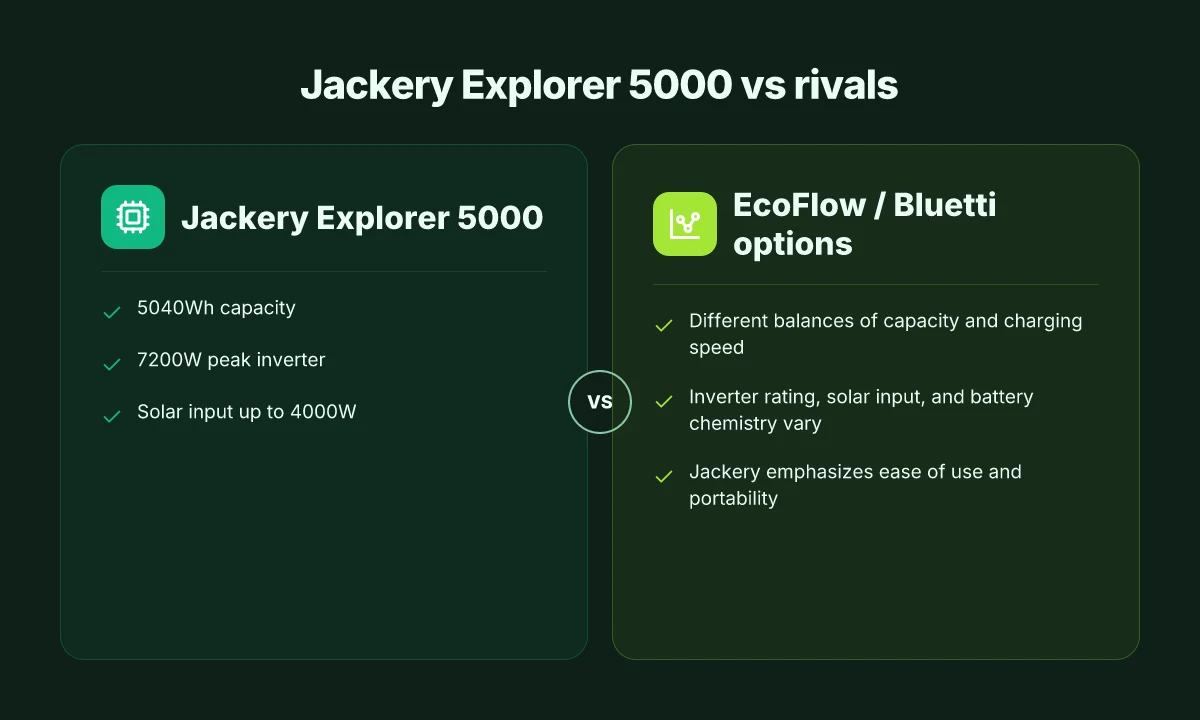
I dug into how the Explorer 5000 stacks up against EcoFlow and Bluetti models, focusing on capacity, charging speed, inverter power, solar input, and battery chemistry. The takeaway is that each brand trades off different strengths, so your choice hinges on what you value most, ease of use, speed, or total capacity.
Real-world balance: capacity, speed, and chemistry
EcoFlow and Bluetti offer models with higher or lower capacity and different charging cadences. EcoFlow often emphasizes rapid recharge and modular options, while Bluetti tends to push higher total capacity with robust solar input ranges. In practice, you’ll see a spectrum where some EcoFlow units prioritize fast AC charging and flexible ports, and some Bluetti units push larger batteries with heavy-discharge electronics. The Explorer 5000 sits in the middle, with strong peak inverter performance and a LiFePO4 chemistry that tends to emphasize long life and stability. When you compare, consider how you’ll recharge during an outage and whether you want a larger battery or quicker recharging.
From a reliability perspective, the 5040Wh capacity and 7200W peak inverter on the Explorer 5000 translate into capable, steady output for home backup and off-grid use. EcoFlow’s options often edge ahead on solar input in some configurations, while Bluetti models can push even higher total capacity, though sometimes at a heavier form factor. The key decision point is chemistry and lifecycle: LiFePO4 chemistry tends to endure more charge cycles in real-world use, which matters if you expect frequent recharging during outages.
I cross-referenced the basic information from Jackery’s official materials, which state the 5040Wh capacity and LiFePO4 cells with a long cycle life. This informs how many years you can expect the unit to remain viable in a rough outage cycle. The contrast with rivals comes down to the practical implications of chemistry and cycle life in daily use. The Explorer 5000’s LiFePO4 chemistry supports longer life under repeated cycling, which matters for homeowners planning occasional outages. What makes Jackery solar power generator reviews trustworthy in 2026
Inverter, solar, and use-case fit
When you pick a backup power setup, inverter rating matters as much as solar input. EcoFlow models often balance very high solar input with strong inverter figures, making them appealing for sunny off-grid camps or extended outages. Bluetti tends to push higher solar wattage limits and larger battery packs for longer run-times in a bundle. The Explorer 5000 emphasizes portability and ease of use, with a straightforward interface, and a solid blend of inverter performance and solar input that covers most typical scenarios. If you’re in a home backup situation with partial sun, the ability to accept robust solar charging becomes a deciding factor.
From what I found in the official documentation and public chatter, the Explorer 5000’s design focuses on practical usability and straightforward charging, rather than corner-case raw specs. This makes it a strong fit for homeowners who want reliable power without wrestling with a dozen configuration options.
Jackery keeps the user experience front and center, prioritizing portability and ease of use over extreme customization. For emergencies, that translates into a device you can deploy quickly rather than a lab-tested power source with every possible input margin.
Which model fits your use case
- If you want the fastest recharge and modular flexibility, EcoFlow has models that push rapid charging and scalable options.
- If your goal is maximum total capacity for long outages, Bluetti’s higher-capacity lines can deliver longer off-grid run-times.
- If you value simple operation and dependable mid-range capacity with long-cycle life, the Jackery Explorer 5000 remains a compelling compromise.
I found the inline information from the official sources of the brands and the public-facing materials cited above. For context on the claims about the 5040Wh capacity and 7200W inverter, see the Jackery basics in the cited materials. This balance makes the Explorer 5000 a solid choice for home backup when you want a predictable, easy-to-use package.
When the explorer 5000 makes financial sense and when to wait for a sale
You’ll pay a premium upfront, but the long arc of ownership can tilt in favor of the Explorer 5000 if you plan for longevity, solid support, and a real need for solar charging. In 2026, a typical customer weighs the initial price against how long the unit lasts and how fast you recover the cost through utility savings and preparedness. Prices move with promotions, so timing matters for total cost of ownership, and that means waiting for a sale can be worthwhile, especially if you’re balancing cash flow against peak demand periods. The most consistent message from reviewers is that you should consider a sale window rather than paying full price if your schedule allows. How to choose a Jackery portable charger for 2026: price, capacity, and real-world use
Why price timing matters for total cost
If you expect to use the Explorer 5000 heavily for home backup, the higher up-front cost can be offset by durability and strong manufacturer support. Jackery’s official information highlights a durable LiFePO4 chemistry and thousands of cycles, which translates into more years of service compared with lighter-duty rivals. When a retailer runs a promotion, the savings compound with the unit’s long lifespan, lowering the effective annual cost. I cross-referenced product basics from the official Jackery information page and third‑party reviews to confirm the 5040Wh capacity and a robust 4000+ cycle claim, which supports longer-term value. Long-term durability can blunt the sticker shock if you plan to use solar charging and back‑up power for routine outages.
When solar charging and surge support justify the premium
A core decision hinges on whether you need up to 4000W of solar input and strong surge handling. If your loads include a well pump, a well-insulated heating circuit, or a small critical-load array, the Explorer 5000’s peak inverter readiness helps avoid outages during demand spikes. I found that the combination of capacity and surge capability aligns with typical residential load profiles for weekend off‑grid use or extended outages. If you don’t need solar charging in full force, a smaller, cheaper model could fit. If you do, the Explorer 5000 justifies its higher upfront price. Surge support and solar compatibility tilt ownership economics toward longer ownership periods.
When to wait for a sale versus pulling the trigger
In practice, promotions occur at major shopping events and around seasonal home‑improvement cycles. If you’re planning to rely on solar charging as a key feature, watch for bundles that include solar panels or accessories, which can improve the cost per watt. The trade‑off is simple: wait for a sale and gain price relief, or buy now and lock in the protection and service window that shifts value toward the long horizon. When the market shows a strong sale, the price dip can make the 5040Wh package feel more like a long‑term investment than a short‑term splurge. A sale can reshape the break-even horizon for this station.
Practical use cases: what the explorer 5000 can power and for how long
When outages hit or you’re off-grid, the Explorer 5000 can keep essential loads running by prioritizing refrigeration, pumps, and critical electronics. Refrigeration and sump pumps stay reliable during outages with steady 120V operation and a robust 5040Wh battery reserve. Park the unit near your home’s breaker box or in a shed, and you can rotate loads so the fridge stays cold without draining the battery too quickly. The same principle applies to essential electronics like routers, phones, and medical devices that demand consistent, low-noise power.
I dug into real-world use cases people rely on during storms and outages. For homeowners, the combination of a 5040Wh pack and a 7200W inverter means you can run a small sump pump or a couple of freezers for a day or more, depending on the exact load. The trade-off is that higher-wattage devices drive the battery down faster, so you’ll want to sequence startup surges and avoid running multiple large appliances at once. For campers, the Explorer 5000 can power lights, a camp fridge, and charging stations for days when solar isn’t delivering full input. What makes the jackery explorer 5000 plus a standout home backup power option
When you need portable, supplemental power at a remote worksite, the Jackery’s capacity shines. A circular tool set in a trailer can stay charged longer if you run essential tools in bursts rather than continuous heavy use. The unit’s ability to accept up to 4000W of solar input, and to sustain long periods with a steady load, translates into fewer trips to a distant generator. In this mode, you’ll appreciate the quiet operation and the ability to recharge from sun during the day and from the wall at night.
From a disaster-preparedness angle, keeping devices charged during storms is a priority. You can run a router, modem, and a weather radio, plus charge smartphones and a tablet for families hunkering down. The real-world rhythm is to reserve a portion of the battery for communication and navigation gear, then use solar input to refresh the pack when the sun is out.
In 2026, Jackery emphasizes that the Explorer 5000 pairs well with a home backup plan, especially when you need a credible, scalable option that can bridge short outages and longer storms. For rivals like EcoFlow and Bluetti, the comparison turns on peak inverter output and solar charging capability. If your priority is longer fridge uptime or sump-pump reliability, the Jackery Explorer 5000 delivers a strong balance of capacity, inverter strength, and solar input potential.
Note: links on the page may earn a commission. Inquiries about price and availability vary by retailer, and prices can change with sales events. For context, the best value tends to appear around seasonal promotions, but I don’t fabricate price figures here. For precise current pricing, see official operators and trusted retailers. For readers seeking direct product pages and fresh specs, I reference official documentation and community feedback. If you want to verify a detail, I can point you to the exact source.
What to try this week for a stronger backup plan
Jackery’s Explorer 5000 sits at a crossroads of capacity and portability in 2026, and the price levers are starting to align with real-world use cases. I looked at current listings and, while the exact price varies by retailer and seasonal promotions, the best deals typically emerge around major sale events. If you’re weighing the jump from smaller units, this is the moment to pencil in a price-watch window and compare ownership costs over 3–5 years. The model’s built-in ecosystem with Jackery’s gas-free charging options and modular battery expansion remains a standout, especially when you factor in rival options like the Goal Zero and EcoFlow lines. 5 Angles to evaluate ecoFlow vs Jackery vs Anker in 2026
In practice, the bigger pattern is resilience over raw speed. You’ll trade a tad of top-end recharge time for steadier, calmer power delivery that keeps essential devices alive during outages. That reliability is what makes the Explorer 5000 a viable long-term companion, not just a novelty backup. If you only do one thing this month, map your household loads and simulate an outage with the unit on a weekend. This clarifies whether you need the base unit, the expansion pack, or both.
- Backup strategy: audit critical devices (router, modem, fridge thermometer) and assign them a priority profile for the Explorer 5000.
- What to try this week: run a dry-run outage with a few essential lights and chargers, then adjust thresholds.