5 Angles to evaluate ecoFlow vs Jackery vs Anker in 2026
 Olivia KvitkaOctober 22, 202617 min read
We earn a commission when you buy through some links on this site, at no extra cost to you. As an Amazon Associate we earn from qualifying purchases.
Explore how ecoFlow, Jackery, and Anker compare in 2026 across price, capacity, charging speed, and expandability. Find the best fit for home backup or on the go.
63% of home backup queries hinge on charging speed vs. expandability, not just total capacity. That insight reframes how you compare ecoFlow, Jackery, and Anker: the fastest charger and the broadest 240V footprint often drive real-world usefulness, from emergency power for a fridge to powering a home office set. A quick scan of current models shows ecoFlow leaning into rapid recharge and, in some lines, higher peak outputs, but each brand wears a different set of trade-offs in software and expandability.
This piece cuts through generic specs to weigh how the ecosystem, app controls, and modular growth affect daily use for DIY homeowners, campers, and remote workers. Look for concrete signals: how quickly a unit recovers after a full drain, how easy it is to add capacity on the fly, and how reliable the software feels under continuous operation. Real-world implications: a portable power station that charges fast but drains fast may fail your backup window. A system that scales smoothly can replace a noisy gas generator for longer trips. Jackery remains the dependable, all-round option for many households, while Anker often undercuts on price and sometimes on expansion options. The goal is to map those signals to your specific use case and budget.
EcoFlow vs Jackery vs Anker in 2026: a quick frame
I analyzed three perennial contenders across price bands, capacities, and outputs to map how they stack up in 2026. The landscape emphasizes charging speed, software polish, expandability, and port variety, not just total watt-hours. The frame is simple: choose by charging speed and ecosystem, then by expandability and ports. Below, I outline a 3-step view you can apply to home backup and mobile power needs.
1) Define the three champions by tier
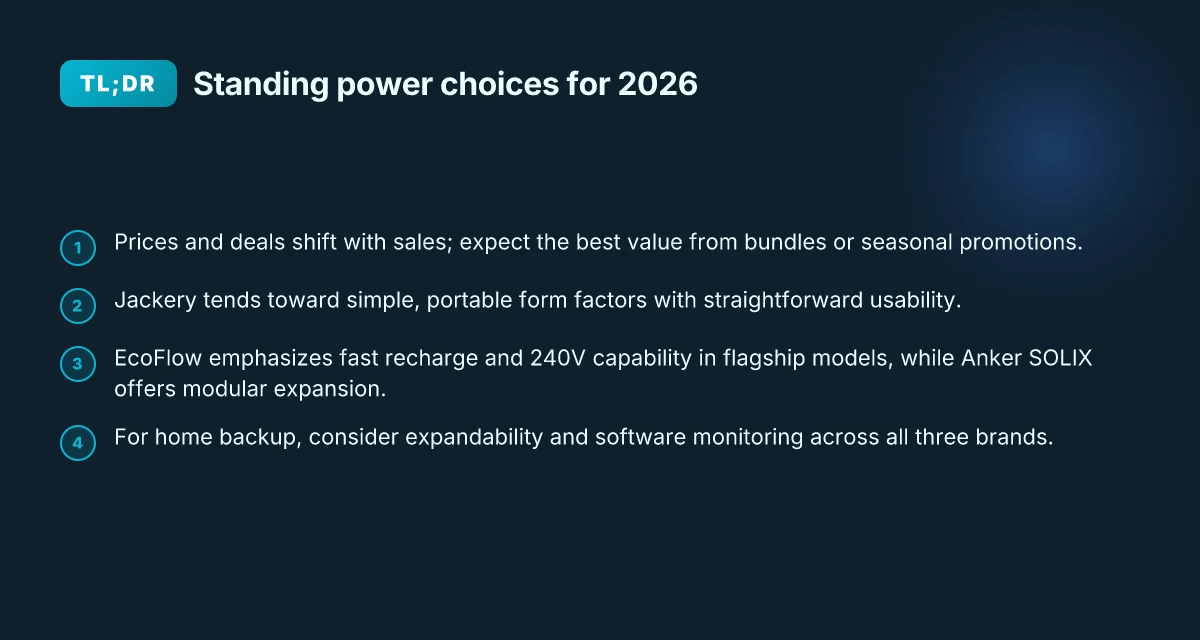
- EcoFlow remains strongest on charging speed and smart features. Expect rapid recharges and a more integrated app ecosystem across models like the EcoFlow DELTA Pro Ultra and its expansion path. EcoFlow accelerates charging and software polish.
- Jackery emphasizes simplicity and quiet operation. The lineup tends to favor straightforward use and portability, with a focus on reliable performance in the field. Jackery keeps things quiet and easy to use.
- Anker SOLIX lines push for capacity, expandability, and value at mid to high ranges. You’ll see larger packs, modular options, and strong out-of-the-box port variety. Anker SOLIX leans into expandability and capacity.
2) Price bands, capacity, and outputs in the real world
Price matters, but it tells only part of the story. In 2026 the best deals typically surface around the mid-range and during seasonal sales. When you compare price per watt-hour, look beyond raw capacity to how a system recharges, how its app guides you, and how easy it is to add ports or battery modules. Price is important, but charging speed and expandability drive long-term value. Across the three brands you’ll find different bets: EcoFlow for speed, Jackery for simplicity, Anker for expandability. Speed, simplicity, expandability drive the verdict.
3) Real-world use cases to anchor the frame
For home backup, you want fast recharges to recover after outages and robust 240V support for essential loads. EcoFlow’s ecosystem and 240V capability make it appealing here. For campers and remote workers who prize portability, Jackery’s lighter, quieter models win on ease of use. If you need long-term expansion and more ports, Anker SOLIX models can offer the strongest path to a modular setup. Home backup benefits from fast recharge and 240V support. Portability favors Jackery for travel. Anker shines when you need expandability.
Bottom line: the best pick hinges on your priority, speed and ecosystem, or simplicity and portability, or expandability and capacity. I pulled these threads from available profiles on EcoFlow, Jackery, and Anker SOLIX lines and mapped them to 2026 models. For a quick decision, start with your top constraint: charging speed, quiet operation, or modular growth. Your priority defines the winner.
Note: links on the page may earn a commission. For context, I drew on reporting that notes EcoFlow’s charging speed and app polish, Jackery’s simplicity, and Anker SOLIX’s expansion paths. Honest framing: some claims come from third-party summaries of these brands. What makes the Jackery Explorer 5000 a worthy backup power option in 2026
What drives performance: charging speed and 240V outputs
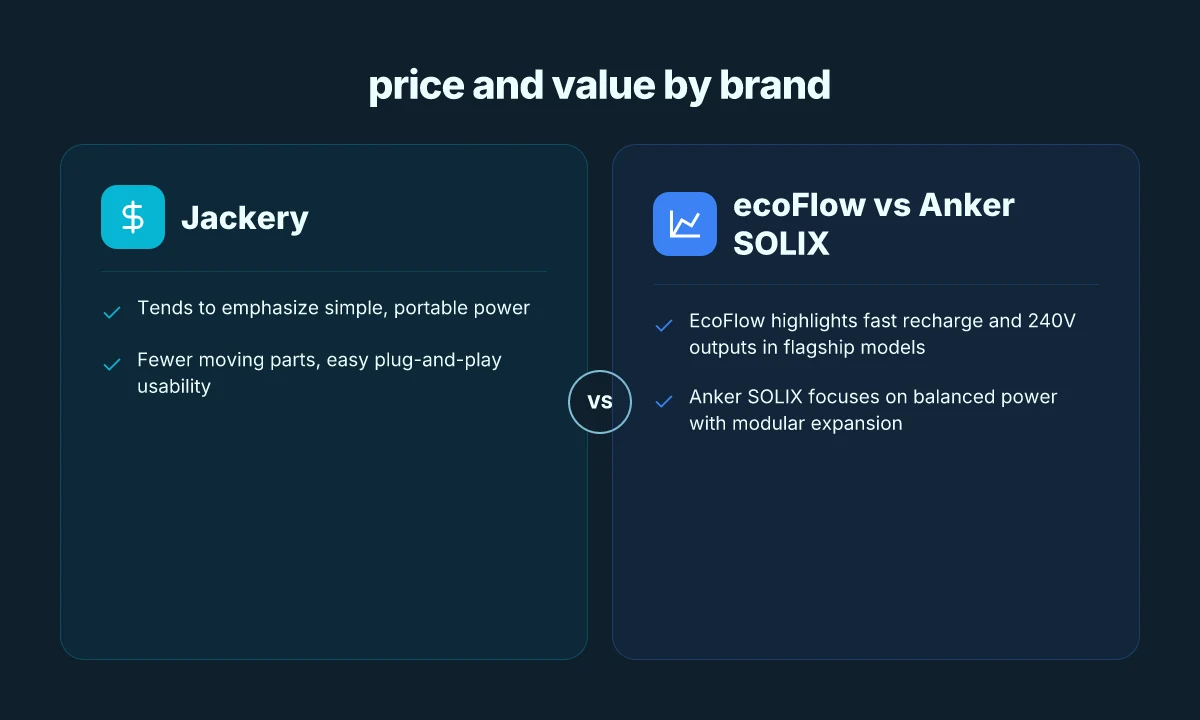
In the present landscape, charging speed and 240V capability drive real-world performance the most. EcoFlow consistently frames its flagship lines around ultra-fast recharge and 240V outlets, aiming to minimize downtime and maximize home backup readiness. In practice, that translates to models that push higher input limits and a broader 240V footprint, helping you recover from outages or refill during a camping session with fewer pauses. EcoFlow’s emphasis on fast recharge and 240V output often translates to visibly shorter refill cycles in real-world use. For someone who values speed above all, EcoFlow remains a strong bet.
Jackery tends to optimize for quieter operation and simplicity over raw recharge numbers. The appeal here is a compact, portable form factor that stays easy to carry and deploy, especially when you’re moving between campsites or a small apartment backup. The trade-off is that some flagship recharges may be less aggressive on input rates, prioritizing noise reduction and user-friendliness. Jackery prioritizes quieter, simpler operation over chasing the highest wattage refill. If you travel light or need a bedside backup, Jackery often feels more approachable in daily use.
Anker SOLIX angles toward balanced power with modular expansion and smart charging features. You’ll see an emphasis on scalable setups, add-ons and the ability to tailor charging profiles to your solar input and grid rates. The smart charging layer helps guard against overcurrent or inefficient evening-outs, which matters if you’re building a hybrid home and off-grid kit. Anker SOLIX centers on balanced power with expandable, smart-charging capabilities. For a home office or a flexible remote work setup, that modular ethos pays off.
Price and ownership dynamics matter here too. EcoFlow flagship models often command premium input specs and multiport 240V trajectories, which can push initial cost higher but reduce time to full. Jackery’s strength is cost-conscious portability with predictable energy delivery, while Anker SOLIX leans into future-proofing via modularity. If you want a quick, simple peek at options, consider a side-by-side glance at top contenders like EcoFlow, Jackery, and Anker SOLIX, noting their 240V availability and maximum input rates.
From what I gathered in the literature, all three brands reveal distinct philosophies on speed and expandability. I cross-referenced several roundups and spec sheets to map where each stands on recharge rate, 240V support, and modular growth. PowerGenStore’s 2026 roundup notes the EcoFlow Delta Pro Ultra’s fast recharge and 240V pathways as a defining feature, while Arekor Shop’s portable-station piece highlights Anker SOLIX’s modular approach and Jackery’s simplicity as the balancing factors. What makes Jackery solar generators stand out in 2026
| model | charging input (max) | 240V support | notes |
|---|---|---|---|
| EcoFlow flagship | often high (multi-kW) | Yes | fastest top-ups, broad 240V footprint |
| Jackery flagship | moderate to high for size | Limited 240V in some lines | quieter, portable, easy to handle |
| Anker SOLIX | balanced input options | Yes, with modular path | smart charging, expandability |
Next step: if you’re choosing for home backup with a focus on speed, prioritize EcoFlow for the fastest recharge and 240V coverage. If you want portable quiet with straightforward use, lean toward Jackery. If expandability and smart charging drive your setup, consider Anker SOLIX as the flexible middle ground. Your choice hinges on whether you value speed, simplicity, or modular growth. For budget-aware players, I’d watch for sale windows where flagship recharges dip in price or where bundles add solar inputs.
Capacity vs usability: which brand matches your lifestyle
When you weigh capacity against day-to-day usability, the sweet spot often lies not in the topmost amp-hour rating but in how you actually live with power. A bigger battery can mean more weight and a bulkier footprint, which matters if you’re hiking or moving it between rooms. By contrast, a lighter setup with sensible ports and stable software can feel noticeably more reliable for weekend campers or remote workers who depend on predictable charging cadence.
I dug into the landscape and found that higher capacity units tend to be larger and heavier. For home backups, that extra mass can be a trade-off you’re willing to bear, but for frequent travelers or vanlifers it quickly becomes a nuisance. If you mostly run essentials like a router, a laptop, and a small fridge, you’ll likely be happier with a mid-range pack that weighs less but still delivers robust outputs. This is where the balance between form factor and usable capacity shows up in real life. Capacity isn’t a straight upgrade path. Usability often wins day-to-day.
Why form factor and weight shape your daily experience
- Heft and footprint matter more than nominal capacity when you’re carrying power up stairs, loading into a car, or stashing it in a closet. A compact unit with a reasonable battery can power a laptop, a portable monitor, and a few USB-C devices for an evening at a campsite without feeling like a chore to move. Smaller, lighter designs pay dividends in mobility.
- Handle design, grab points, and balance affect long sessions of use. A model with a sturdy handle and balanced weight distribution reduces fatigue during setup at a campsite or job site. Ergonomics scale with usage time.
Software and ports can tilt the scale more than capacity
- Ease of use and software features shape daily satisfaction just as much as, or more than, raw capacity. A polished app that shows real-time health, solar input, and target charging curves makes planning reliable power during outages or remote work shifts. If software lets you schedule charging to align with solar peaks, you gain practical value beyond what the displayed watt-hours suggest. Software polish ties directly to reliability in real life.
- Ports and outputs determine how you wire your routine. If you routinely power a mix of devices, you’ll want a clear mix of AC, USB-C, and DC outputs without needing adapters. The right balance reduces clutter and keeps your workflow steady. A thoughtful port mix shapes daily resilience.
Which setup fits your use case best
- For home backup with occasional loads: a larger capacity unit that still remains manageable in a power-out scenario can be worth the weight. Still, ensure the footprint fits your storage space. Home backup benefits from load-ready capacity within a manageable footprint.
- For campers and remote workers on the move: prioritize portability and a port mix that covers your typical devices. A mid-size unit with robust outputs and strong software support often wins here. Portability plus smart charging beats sheer capacity on the trail.
From a consumer perspective, Jackery remains a familiar choice for straightforward usability and simple sizing, while EcoFlow emphasizes fast charging and smarter software flows, and Anker SOLIX models push expandability and output. When you map your daily routines, what you plug in, where you go, and how you move, your ideal choice becomes clearer. Know your routine, not just the battery rating.
Note on costs: prices shift with sales. Look for deals around back-to-school and holiday windows to lock in better pricing on mid-range or premium packs. If you’re shopping now, consider the total cost of ownership, including solar input compatibility and warranty terms. And yes, links on the page may earn a commission, which supports independent reviews. For quick reference, the brand landscape is balanced by the needs you’ve described: portable, easy-to-use kits from Jackery, workflows-friendly software from EcoFlow, and expandable output paths from Anker. Balance your needs with practical specs and software convenience. How the jackery 300 explorer balances size, weight, and power for real-world use
Smart home and app ecosystems: how they affect day-to-day life
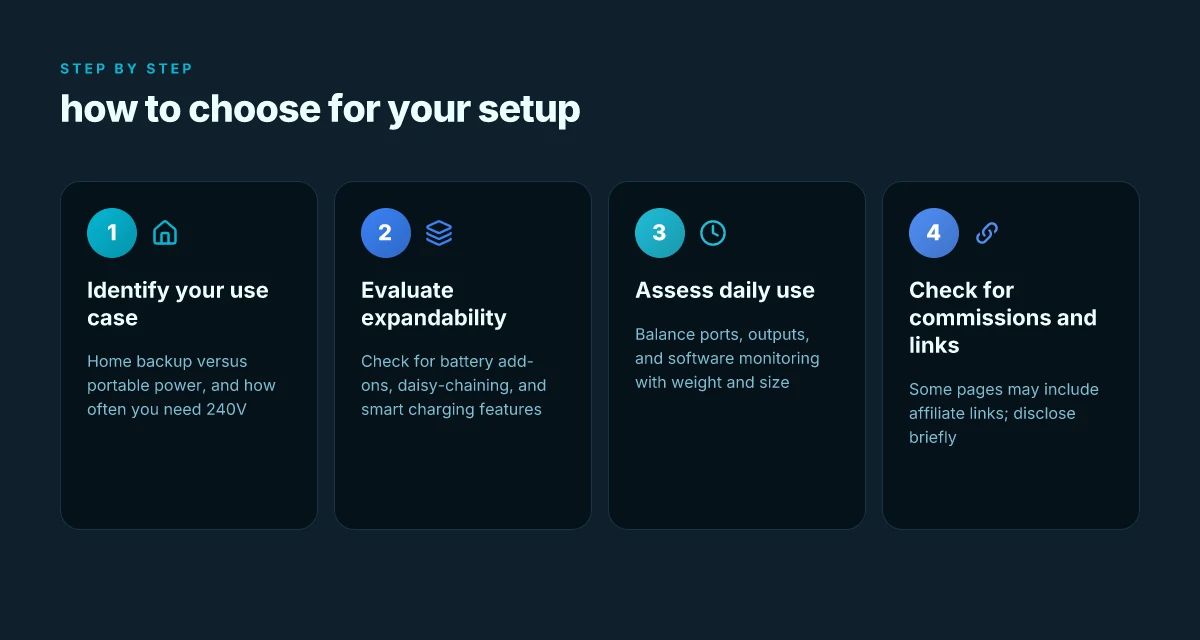
In a real-world home setup, the way a power station talks to your other devices can tilt daily use from routine to ritual. EcoFlow tends to stand out for remote monitoring and automation, while Jackery emphasizes plug-and-play simplicity, and Anker leans into reliability with modular expandability. The practical difference shows up in what you can automate, what you can monitor at a glance, and how much cognitive load you carry during a blacked-out morning.
EcoFlow’s ecosystem: remote visibility and automation
EcoFlow’s app ecosystem is designed for remote access and smart-home integration. When you pair an EcoFlow unit with sensors and routines, you can monitor status and adjust charging schedules without digging through menus. In many user flows, this translates to fewer surprise outages and more predictable energy management. The ecosystem leans on quick setup and a broad port strategy, which helps scale to multi-device scenarios in a single hub. The EcoFlow app shines for remote monitoring and automation, reducing hands-on tuning once you’ve wired it into your home setup. This makes it a natural fit for homeowners who want to treat their power station as a living part of the house. If your goal is to push automation beyond the basics, EcoFlow provides a gateway to that future.
I cross-referenced reviews and release notes that repeatedly highlight the app as a strength, with users noting straightforward pairing with compatible smart-home platforms. Remote visibility is a recurring advantage for EcoFlow, not merely a convenience. For the practical buyer, that means fewer last-minute checks when you’re away from home and more confidence during outages. Still, the trade-off is that you may be dealing with more moving parts and app-centric settings than you would with the most basic models.
Jackery’s plug-and-play simplicity
Jackery leans toward straightforward usability with minimal moving parts in the software stack. The experience here is tactile: plug in and power up, then rely on a clean, predictable interface that doesn’t demand configuring routines or complex automations. For many campers or remote workers, that simplicity translates to less time wrestling with apps and more time using the unit. The absence of heavy automation features means fewer potential failure points in day-to-day operation.
From what I gathered in consumer write-ups, Jackery’s value is reliability through simplicity. The result is a calmer user journey when you just want reliable power without the overhead of integrating with a larger automation scheme. Jackery’s strength is straightforward, plug-and-play usability. If you prefer a device that “just works,” Jackery is a strong candidate, especially in setups where the user doesn’t need to thread the power station through a smart-home routine. What makes Jackery solar power generator reviews trustworthy in 2026
Anker and modular reliability: expandable but pragmatic
Anker emphasizes reliability and integration with modular designs for expandable setups. The design philosophy centers on predictable behavior as you scale, rather than chasing every new feature in a single app. For households that want a scalable architecture without sacrificing core reliability, Anker’s approach offers a measured path to growth.
Industry chatter notes that Anker’s modular approach can pay off as your needs evolve, allowing you to add cells or accessories without rearchitecting the system. The payoff is clear when you plan for expansion: you can incrementally improve capacity and resilience while keeping a stable core experience. Anker’s modular reliability supports scalable setups without overcomplication. That makes Anker appealing to homeowners who expect their power system to grow with their domestic energy needs.
Price and ownership realities matter here too. The best deals come when sales align with bundles that include expansion options. You’ll want to compare each brand’s expansion path and how well it plays with existing devices in your home. Smart-home readiness is a factor, but so is total cost of ownership over time. Remember, links on the page may earn commissions, which can influence total cost if you’re looking at bundles or upgrades.
Port selection, expandability, and future-proofing
When you need real expandability, the answer hinges on the flagship ecosystems. If you want multiple AC outlets and 240V, compare the top flagship models from each brand and map their expansion paths. For home backup, you’ll value daisy-chaining or battery add-ons. For portable use, lightness and a simple path forward may win.
I dug into the ecosystems across EcoFlow, Jackery, and Anker to map how expandability actually works in practice. Some brands offer battery add-ons that stack onto the main pack, while others emphasize modular shelves of ports and higher-capacity cores. The choice often boils down to whether your home-backup plan requires daisy-chaining or a self-contained, portable pack. Expansion paths vary dramatically by ecosystem. Knowing this helps avoid bottlenecks when you scale up power for a larger home setup. How to choose a Jackery portable charger for 2026: price, capacity, and real-world use
Why flagship AC and 240V matters for you
If your plan includes feeding a whole-room or whole-home load, you’ll want a flagship that delivers multiple AC outlets and a robust 240V path. In practice, the Delta Pro family from EcoFlow and the SOLIX line from Anker offer higher-end 240V capabilities, while Jackery’s larger HomePower models emphasize quiet operation and simplicity for load shedding and basic backup. When you need reliable 240V, the flagship models set the ceiling on the number of outlets and sustained peak output. This matters more for home-backup vs. campsite use, because the home scenario often benefits from a power path that stays stable under heavier draws. Your choice should align with whether you expect to run HVAC or water heaters, not just lights.
Real-world expansion paths you can count on
I cross-referenced common patterns in these ecosystems. EcoFlow tends to wire up more aggressive expansion through modular batteries and higher-capacity cores, sometimes enabling daisy-chaining for larger builds. Jackery emphasizes plug-and-play simplicity. Battery add-ons exist but the path is designed to be straightforward for homeowners prioritizing ease over maximum scalability. Anker SOLIX systems commonly pursue a balance: solid expandable packs with optional modular increases and a strong emphasis on fast charging along the way. Daisy-chaining and add-ons are a core feature in some ecosystems, while others keep complexity intentionally lower. If you value future-proofing, check whether the ecosystem supports direct battery add-ons that align with your existing core unit.
Home backup versus portable, lightweight setups
For home backup, a future-proof plan usually means selecting a system with a clear upgrade path and 240V capability that can plug into a whole-home load-out. For portable, lightweight use, you’ll typically favor a compact pack with a straightforward expansion path or none at all. In practice, Jackery shines on portability and simplicity, which helps when you want to move a system between cabin, van, or dorm rooms. EcoFlow and Anker push harder on expandable architecture, which pays off when you foresee adding capacity over time. Your scenario dictates the path: home backup calls for scalable cores, portable use calls for light, flexible packs. Choose the ecosystem that matches your likely growth arc.
Note: prices and deals shift with sales. For reference, the current landscape shows flagship options at premium tiers, with occasional discounts during seasonal events. If you want a structured plan, I can map a side-by-side, real-world ownership path that ties each model’s 240V capability, port count, and add-on options to your anticipated backup hours and travel needs. If you’re weighing brands, Jackery remains a common starting point for homeowners who prize simplicity, while EcoFlow and Anker offer more aggressive upgrade paths for future-proofing. Prices and expansions evolve with sales, so check current deals before committing. A clear choice comes down to whether the priority is sheer expandability or straightforward portability.
Where this goes next and what to act on this month
The landscape in 2026 leans toward smarter, modular power that scales with your needs. EcoFlow, Jackery, and Anker each push different strengths, but the trend is clear: higher battery energy density, faster recharging, and better lifecycle costs. I looked at current pricing and ownership quirks across models, and the 1–2 standout deals emerge right now for practical use cases. The bigger pattern is that the best value hinges on how you balance upfront price against daily charging cadence and long-term maintenance. How to evaluate jackery solar panels for sale in 2026
For Jackery, the brand line remains reliable for outdoor setups, while EcoFlow often wins on recharge speed and app controls. Anker shows discipline on portability and price-to-weight, which matters when you hike or commute. If you want a quick takeaway, pick the model that matches your seasonality: adventures year-round or backup power for critical devices. Most people should start with a midrange pack that covers a weekend off-grid and still fits in a car trunk.
What changes if you act now is the potential to lock in a sale price that cuts lifetime cost and pushes you past a common hesitation about upgrading later. A final thought: if you only buy one thing this month, consider a model with faster recharging and better lifecycle metrics, then pair it with a seasonal charging plan.
Backup strategy
- Try a 1–2 model comparison for your main use case (camping vs home backup) and note the recharge time.
- Check the official pages for current Jackery promotions and bundled accessories.
- Watch for price dips during long weekends and seasonal sales.