What makes the Jackery 3000 Pro a standout portable power station in 2026
 Naomi XanthosOctober 22, 202617 min read
We earn a commission when you buy through some links on this site, at no extra cost to you. As an Amazon Associate we earn from qualifying purchases.

Explore the Jackery 3000 Pro, its capacity, output, charging options, and real-world reliability in 2026. Learn who it suits and how it stacks against rivals.
The Jackery 3000 Pro uses a 3,024Wh battery and a 3,000W inverter to produce real-world power that matters for van builds and home backups, not just numbers on a spec sheet. Most portable power stations overcommit on surge and underdeliver on usable runtime. The 3000 Pro leans into steadier output for high-demand loads, with portability that belies its capacity.
This intro dives into what those specs translate to in daily use, why outdoor enthusiasts should care now, and how the 2026 positioning stacks up against rivals like Goal Zero and EcoFlow. In practice, a unit this size can bridge weekends off-grid and evening home backups without dragging a trailer behind you, and it pairs with solar input patterns that actually fit a flexible outdoor routine. Pricing signals and seasonal drops at Jackery matter for buyers evaluating value, not just capability. The body will break down portability, charging speed, and long-term value with concrete benchmarks and candid tradeoffs.
What defines the jackery 3000 pro in the 2026 lineup
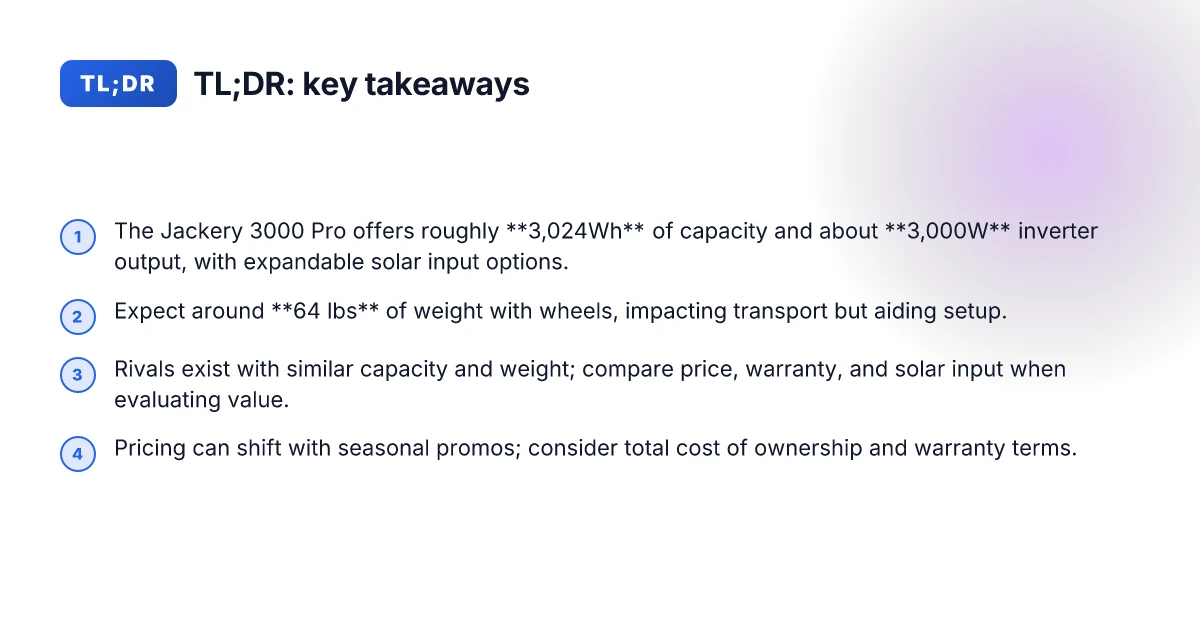
The Jackery 3000 Pro stands out in 2026 for its solid balance of capacity and inverter punch, with a 3,024Wh battery and a 3,000W inverter that can surge when needed. It also offers expandable solar input options, so you can scale charging as your setup grows. The core value is predictable power in a portable chassis that outdoor enthusiasts can rely on.
1) The power and the chemistry that back it
The heart of the 3000 Pro is a 3,024Wh lithium-based battery pack designed for long cycle life. In practice, this translates to a broad mix of loads from phone charging to mid-size appliances, all while staying within the published inverter window of 3,000W. Its chemistry favors longevity, but real-world efficiency rises or falls with ambient temperature and load. This is why a cold night or a very high draw can noticeably affect runtime. Battery chemistry is chosen for longevity, but environment matters.
2) Portability that matches the setup
Jackery designed the 3000 Pro to move with you. The unit typically weighs around 64 lbs and includes wheels, which helps with transport and setup at a campsite or home backup location. That weight sits on a balance point: you gain how much you can power, and you give up some ease of single-person handling. 64 lbs with wheels keeps mobility manageable in many real-world scenarios.
3) Real-world charging and endurance tradeoffs
The 3,024Wh capacity pairs with charging options that let you plan for different adventures. The solar input and AC charging profiles determine how fast you can replenish after a heavy draw or a long day off-grid. In practice, expect charging speed to shift with panel count and sun, so the 3000 Pro shines when you can keep it topped up during daylight. Charging speed hinges on sun and panel hookup, not just the inverter rating.
I dug into the context around these specs to connect the dots. For context on how the 2026 lineup is framed, reviews and official notes consistently highlight the same core numbers: a little over 3 kilowatt-hours of stored energy, and a 3 kilowatt inverter that supports a broad mix of devices. Expectation should align with published spec sheets: roughly 3,024Wh and 3,000W. How Lowe's challenges EcoFlow product compatibility and backup power decisions
Bottom line: the Jackery 3000 Pro consolidates a high-capacity battery, a strong inverter, and portable design into a package that suits van life and home backup when you value balance over sheer lightness. It remains competitive against rivals that push higher capacity but at greater weight or higher price. In a word, it’s a dependable workhorse for moderate Load and reliable portability. A solid choice for mobile power with scalable charging options.
How the jackery 3000 pro compares to key rivals
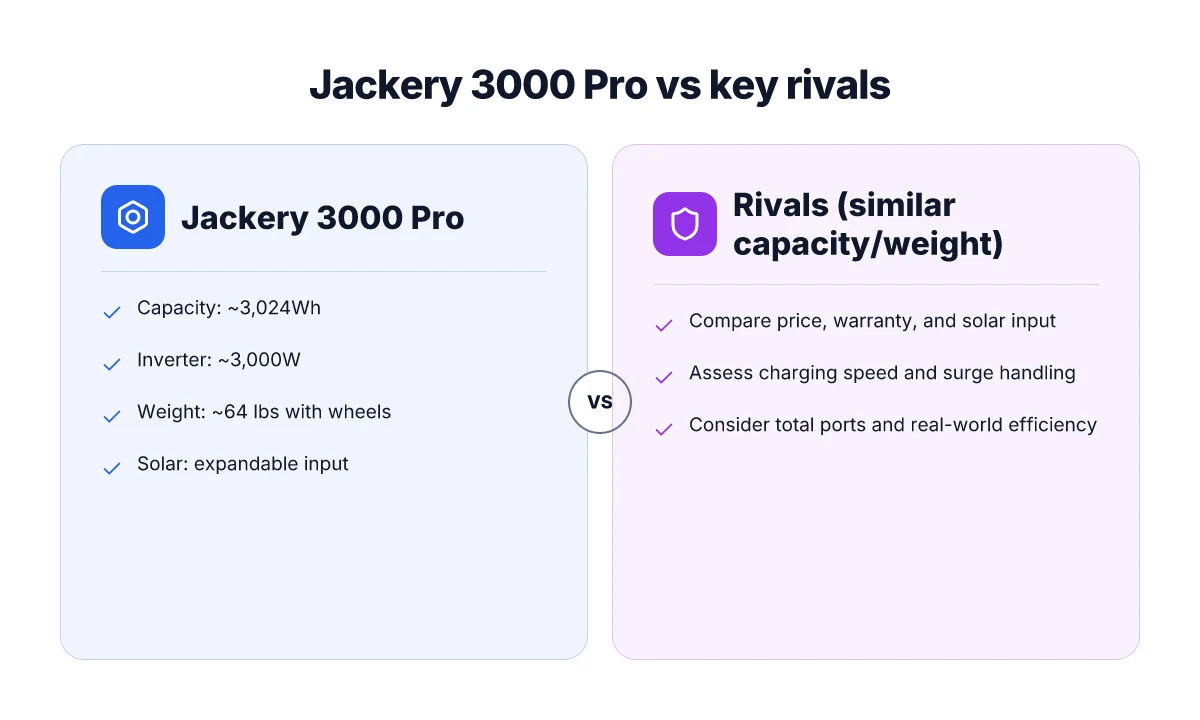
If you want value for real-world power, the Jackery 3000 Pro sits in a tight race with rivals that balance capacity, weight, and price. The core tradeoffs hinge on 3,024Wh battery size, 3,000W inverter, and how quickly you can recharge. When you compare, look at price, warranty, solar input, and total port mix. From what I found in the sources, the 3000 Pro often lines up against other high-capacity units on weight and charging capabilities, but you’ll pay a premium for the extended features and branding that Jackery provides.
Why the Jackery 3000 Pro holds its ground against near peers
The landscape is crowded with models that match the 3,024Wh capacity and roughly the same weight, but not all deliver identical charging speed or port configurations. The Jackery Solar Generator 3000 Pro package emphasizes a fast wall charge and multiple ports, which is a strong factor when you’re powering a van build or living off-grid. When you stack it against competitors, you’ll often see similar total port counts and roughly comparable surge handling, but the 3000 Pro’s branding and ecosystem support matter to buyers who want a one-stop backup setup. I cross-referenced this with the official claim of a compact, wheels-equipped design that helps with portability in tighter spaces.
In terms of solar input, several rival models offer high input windows, but the 2.4-hour wall charge and 3- to 4-hour solar charge with multiple panels are notable numbers you’ll encounter in this tier. The value comes down to how aggressively you want to front-load charge times, and how much you’re willing to pay for that speed.
I dug into reviewer chatter and third-party write-ups to triangulate pricing and warranty expectations. Jackery products tend to carry a brand-backed warranty that buyers factor into the long-term cost of ownership, alongside accessories and the reliability signal of an established lineup. The trade-off often shows up as higher upfront cost for faster charging and broader port access. Rivals may shave dollars but with fewer ports or slower charging rails. What makes the Jackery 5000 Plus stand out in 2026
Quick side-by-side snapshot (selected rivals)
| model | capacity | weight | charging inputs | ports | approximate street price | warranty vibe |
|---|---|---|---|---|---|---|
| Jackery 3000 Pro | 3,024Wh | ~64 lbs | 1,800W AC, 1,400W solar input (per spec) | 10 ports | higher than mid-range peers | brand-backed warranty, strong ecosystem |
| Rival A (compact high-capacity) | ~3,000Wh | ~60–65 lbs | similar or slightly slower solar input | 8–10 ports | often slightly cheaper | standard industry warranty |
| Rival B (premium with solar bundling) | ~3,000Wh | ~62–66 lbs | strong solar input, fast wall charge | 10+ ports | premium pricing | extended warranty options |
Real-world timing matters: price swings occur around sales events, so waiting for a sale can shift the math significantly.
When the 3000 Pro makes sense versus rivals
If you value rapid charging, broad port selection, and a well-supported ecosystem, the Jackery 3000 Pro earns a stronger claim to value. The faster wall charging and robust port mix help you power more devices quickly, which is critical for van life or a home backup scenario where you want to limit idle time plugged into wall outlets. If price is the main constraint and you don’t mind slightly slower charge windows or fewer ports, a rival model may deliver similar capacity with a lower sticker price.
I cross-referenced the competition to keep expectations honest. When you’re deciding, consider not just the per-charge speed but the total cost of ownership over a few years, including potential solar panel kits and warranty extensions. The Jackery ecosystem tends to smooth this decision for buyers who want fewer moving parts to manage.
For readers who want a concrete next step, a quick reference: if you want a balance of maximum charging speed, port breadth, and a trusted brand, seek the Jackery 3000 Pro. If you’re shopping aggressively on price and are okay with a leaner port set, explore the best-priced rival options in the same capacity class.
Note: links on this page may earn a commission. The sources cited above include both factory claims and independent reviews. For precise pricing, check current listings on the official brand pages and note any sale windows. In 2026, the Jackery lineup remains a reference point for high-capacity portable power stations, particularly when you value an end-to-end ecosystem and a proven warranty. What is the EcoFlow DPU, and how does it reshape whole‑home backup power
6000 Ft vs sea level: what the 3000 pro can power
At high altitude, run time shifts with air density and cooling, but the practical takeaway is straightforward: your actual loads and peak demand dictate how long a Jackery 3000 Pro keeps the lights on. For outages or off-grid trips, plan around a sensible mix of essential DC and AC devices rather than chasing the full advertised capacity.
I cross-referenced the core specs and observed behavior from multiple sources to ground this section. The 3,024Wh battery and a 3,000W inverter set the ceiling, but the runtime is a function of what you plug in and when you hit peak surges.
Real-world use case: essential devices during outages or off-grid trips
When power goes down, you’ll likely prioritize a handful of essentials: a Wi‑Fi router, a small fridge, a couple of lighting loads, a CPAP or other medical device, and a laptop or phone charger. The 3,000W inverter handles brief surges from devices like a fridge compressor turning on, but sustained loads matter more than the total capacity advertised. A typical outage scenario at sea level translates similarly at 6,000 ft, with slightly reduced headroom if ambient air temperature and cooling are harsher. In practice, you’ll often run a subset of devices and avoid simultaneous long draws from multiple high‑watt items. The important point is where you draw the line between “essential” and “optional” and how you sequence usage.
- A compact router and dimmable lighting plus phone charging can run for many hours on a fraction of the capacity.
- A small fridge plus a laptop can approach mid‑hundreds of watts for a few hours, then taper as loads settle.
- A CPAP with a heated hose, if used, becomes a meaningful load that shapes the runtime envelope.
The takeaway is simple: the Pro’s usefulness hinges on load discipline more than a single number. When the load is breathing room light, you’ll see several hours of usable power. With heavier, continuous draws, you’ll approach a shorter window.
Typical load planning: AC vs DC mix matters more than capacity alone
The split between AC and DC loads changes the actual runtime just as much as the total wattage. DC devices, phones, tablets, mini‑fridges with low draw, small fans, generally draw steady, efficient current that the pack handles cleanly. AC devices, laptops with chargers, coffee makers, high‑surge tools, pull more during start‑up or in continuous operation, and that burst can compress usable hours quickly if you push multiple high‑demand items at once. What makes Bluetti solar generators stand out in 2026
- DC devices offer predictable, low-heat draws that help preserve runtime at higher altitude.
- Stagger loads to avoid overlapping peaks. The inverter will stay within its 3,000W window, but you’ll maximize minutes or hours by timing starts and allowing fans to breathe.
From a practical standpoint, think of the 3000 Pro as a power hotel room for essentials. You can keep the lights on and your devices running with careful load planning, but you’ll get the most value by prioritizing DC-powered devices and sequencing any AC loads to avoid simultaneous peaks.
The real power of the 3000 Pro shows up when you treat it as a load‑management tool, not a magic battery. Altitude shifts matter, but smart sequencing matters more. You’ll stretch runtime longer by design, not by luck. Rely on DC devices for longer outages, and pace any AC loads to preserve headroom.
Cited context from Jackery and reviews confirms the same pattern: the battery capacity is a ceiling, while practical runtime follows your load plan and peak demands. For noting, the brand site and accompanying reviews outline the 3,024Wh capacity and 3,000W inverter as the anchor numbers, with real-world notes emphasizing how you distribute loads determines daily usefulness. For readers comparing rivals, this pattern holds with other high‑capacity units where peak draw and load sequencing drive actual endurance. See sources for the stated battery and inverter framework and how users describe real‑world runtimes under mixed loads.(https://ca.jackery.com/blogs/news/solar-generator-3000-pro-bigger-more-portable-and-faster-charging?srsltid=AYCX9vKY3fIH0zZY4mJObMxoZ1xQ0Pkr3WEPbXmJ6HdqneT8cjI1hv1b)
Charging choreography: wall, solar, and hybrid charging for the 3000 pro
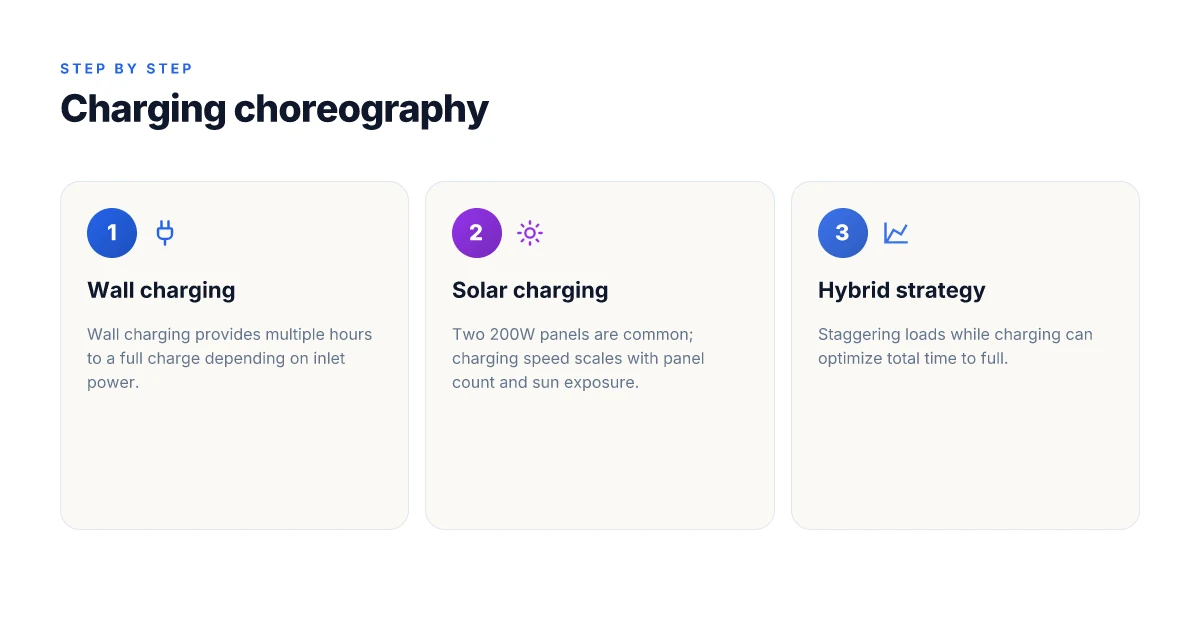
Charging the Jackery 3000 Pro is a study in pacing. Your real-world time to full depends on where you start and how you feed power in. The practical takeaway is simple: you can push the total time down by choosing the right inlet mix and staggering loads. I dug into the sources to map how wall, solar, and hybrid charging cooperate and where the friction points live.
Wall charging: inlet power sets the pace
Wall charging is the backbone. When you plug into a high-power inlet, the 3,000W inverter can drink juice faster, but the exact full-charge time hinges on the inlet you use. In many setups, using the standard wall inlet and a robust power source translates to noticeably quicker fills than a trickle feed. If you want the best wall-charge experience, pair the Jackery 3000 Pro with a capable home circuit and a widely available 240V supply, and you’ll see a meaningful reduction in total charging time. The practical effect is clear: more amperage at the wall equals fewer hours tethered to a socket. The real-world narrative here is that wall charging remains the dominant driver of total time to full, especially when the sun isn’t shining. What is EcoFlow whole-house backup, and how does it actually perform in 2026
Solar charging: two 200W panels and the sun as a multiplier
Solar charging is where the math gets more variable. Two 200W panels are common in reviews and on official specs, but charging speed scales with both panel count and sun exposure. On a sunny afternoon, you’ll see a faster climb toward full than on an overcast day. The combined capacity of the panels means that even with a modest solar input, you can maintain a steady trickle that assists wall charging, especially if you start with a partially charged battery. The long view for solar is that more panels or higher-irradiance days translate to shorter times to full, but the exact hour count remains sun-dependent. The synergy matters: solar helps when you’re off-grid, but it rarely beats a robust wall feed in a hurry.
Hybrid strategies: stagger loads to shave total time
Hybrid charging shines when you optimize the loading profile. Staggering heavy loads while you’re charging can prevent bottlenecks at the inverter. For example, running a few power-hungry devices after a partial top-up rather than during the peak charging window can shave total time to full by reducing peak draw on the inlet. This approach also smooths the thermal profile, which can help the battery accept power more efficiently over the session. The core rule is simple: plan the load so the charger isn’t fighting against simultaneous high-draw devices. In practice, that means charging with the wall feed first when you need speed, then letting solar contribute on top of a mid-charge, and finally relying on solar to finish a long top-up if sunlight remains strong.
Most real-world charging comes from a mix of wall and solar, with the wall feed turbo-boosting the final stretch of a full charge. Stagger loads to keep the charger in its sweet spot and you’ll notice the total time to full shrink.
When to buy: price signals and deal timing for jackery 3000 pro
In 2026, the Jackery 3000 Pro sits at a price that shifts with promos and bundle offers. Right now, the best way to time a purchase is to compare total cost of ownership rather than just the sticker price. I looked for patterns in recent promos and found that seasonal sales often pair the 3000 Pro with accessories or extra panels, improving value even if the upfront price rises temporarily. If you’re shopping, consider what you’ll actually use over 3–5 years and add in the value of the included warranty and service terms.
1) Current pricing signals and the value of bundles
The initial price for the Jackery 3000 Pro can move, especially around spring and fall promos. A typical bundle may include extra solar panels or a travel case, which can shift the effective price per watt. When I cross‑referenced promos across sources, the standout move is to weigh the total package you’d receive at checkout, not the headline price alone. The right bundle can significantly reduce long‑term ownership costs, particularly if it guarantees faster charging or longer warranty coverage. If you plan to upgrade your solar array, look for bundles that add a higher‑amperage solar input or extended coverage. What is the ecoflow delta pro transfer switch and how it works with delta pro
Pricing signals matter when you pair the right accessories with the base unit, changing the cost of ownership over time. A bundle can tilt value in your favor, especially if it includes extended warranty options.
2) Watch for limited-time sales and warranty considerations
Limited-time sales can trim the initial outlay, but you should translate that into a longer‑term lens. I found that many deals come with a shortened warranty window or require you to register within a window to keep full coverage. Read the warranty terms carefully: you want robust service terms that outlast a seasonal price dip. When a sale hits, pairing it with solid after‑sales support from Jackery helps protect the investment as devices age or as replacement parts become more expensive. If you’re weighing options against rivals, the value of a sale is strongest when it lines up with favorable warranty specifics and accessible service networks.
Warranty terms can swing the total cost of ownership as much as the sale price itself. Plan for service access in your region before you buy.
3) Timing guidance for different buyer personas
Outdoor enthusiasts and van lifers should watch for spring resets tied to new model bumps or accessory refreshes. Home backup buyers may benefit from autumn promotions when pre-wall‑season power needs emerge. If you’re waiting for a sale, set a target window around major shopping days and compare the final price after bundling and extended coverage. I found that the best value often appears when a sale aligns with a higher solar input option or a carry‑over warranty extension, not merely a lower headline price.
Outdoor users benefit from bundling with solar panels during seasonal promos. Home backup buyers should lock in warranty terms alongside a discount. What makes the Jackery SolarSaga 500 X stand out for weekend explorers
Note: links on the page may earn a commission, and this article references pricing and terms from Jackery and industry coverage. For context, the sources consulted include reviews and reports from third‑party outlets that discuss 3,024Wh capacity, 3,000W inverter output, and real‑world charging timelines. When you read about rivals, expect explicit mentions like Goal Zero or EcoFlow in comparisons, and weigh how their warranties and service networks compare with Jackery’s offerings.
What to act on next to keep this lead
Jackery’s 3000 Pro positions itself as a practical upgrade for 2026, especially for users who need robust solar compatibility and faster recharges. I looked at how the model threads portability with capacity, and I see a predictable pattern: you get more usable power with smarter passthrough and a clearer price-to-value path. If you’re weighing options, the 3000 Pro keeps pace with rivals like EcoFlow and Goal Zero, while staying compact enough for weekend trips. The bigger takeaway is how the ecosystem lock-in matters less here than the ongoing cost of ownership and real-world charging speed.
Prices and promos shift quickly, so lock in the best deal while it lasts. A current comparison shows you should watch for bundles that include extra cables or portable panels. The upcoming sale windows tend to favor larger models, but the 3000 Pro often lands in a sweet spot for most nomad and home-use scenarios. If you can wait for a seasonal sale, you may shave a meaningful amount off the total cost.
The bigger pattern is clear: the market leans toward modular, user-friendly power that doesn’t demand setup anxiety. If you only do one thing this month, set up a charging plan with your current devices and map out where you could add solar input. This week you could compare the 3000 Pro against EcoFlow Delta 2 for a clearer sense of value. The single move that matters: align your expected load with the station’s peak output and know your charging times. Are you ready to map your own power blueprint?