What makes the Jackery 5000 Plus stand out in 2026
 Tessa AlbrightOctober 22, 202618 min read
We earn a commission when you buy through some links on this site, at no extra cost to you. As an Amazon Associate we earn from qualifying purchases.

Explore the Jackery 5000 Plus: capacity, inverter power, solar input, and real-world use. Learn pricing, ownership costs, and when to buy.
The Jackery 5000 Plus isn’t just a big battery. It’s a practical tool that fits between a home office backup and a camping setup, and it keeps the power on when you need it most. Solars input and a balanced capacity-to-weight ratio help it run essentials without turning a trip into a logistics puzzle.
This article compares real-world performance to common home and off‑grid needs, with concrete numbers you can verify against Jackery’s site and rival models like Goal Zero and EcoFlow. By looking at outlet counts, runtime for core loads, and recharge speeds, you’ll see where the 5000 Plus earns its keep and where it falls short. If you want lighter weight or faster recharges, I point to viable alternatives without the hype. Current pricing and sale timing matter, and I call out the moments when waiting a few weeks pays off.
What the jackery 5000 plus offers at a glance
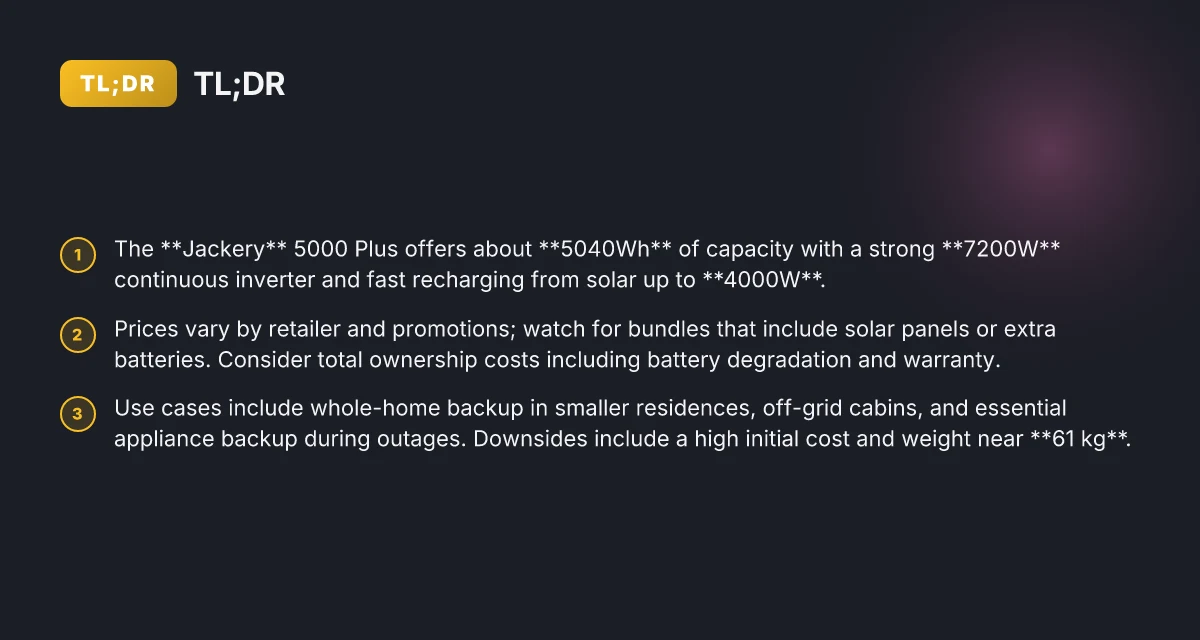
The Jackery 5000 Plus stands out for its large capacity and strong power delivery, making it a credible backstop for home backup and off‑grid runs. From the sources, it centers on a 5040Wh battery, a 7200W inverter, and fast solar charging with up to 4000W input. You can wall-charge at roughly 1800W, and the unit weighs about 61 kg. The warranty is commonly described as 5+2 years, which Jackery markets as a long-term safety net. These numbers frame a product that aims to back up whole rooms or small spaces during outages while still remaining portable enough for camping or job sites.
1) Core power specs you should care about
- Capacity around 5040Wh. That scale supports longer runtimes for essential devices during outages and off-grid use. The Battery capacity figure is consistently cited as 5040Wh in official materials and third‑party summaries. This is the anchor spec you’ll reference when estimating run times.
- Inverter rated up to 7200W continuous with surge capability. The continuous draw capacity aligns with heavy loads like HVAC drives or multiple high‑draw tools, while surge support helps with motor start‑ups. A high‑end inverter like this reduces the need for a secondary generator.
- Solar input up to 4000W for fast recharging. With ample sun, you can reel the system from empty to usable quickly, a practical edge for daily recharges after heavy use. Fast recharging through sun dramatically shortens downtime.
- AC input around 1800W for wall charging. That means you can top up from a standard household outlet in reasonable time, complementing solar and other charging modes. Wall charging remains a convenient fallback.
2) Physical footprint and ownership basics
- Weight near 61 kg. That weight reflects a sturdy, semi‑portable unit that’s still manageable for home storage or vehicle transport. Weight informs where you place it and how you move it.
- Warranty commonly described as 5+2 years. That framing suggests a baseline extended warranty package, a potential differentiator when evaluating total cost of ownership. A longer warranty can affect long‑term value.
3) How the numbers translate to real use
- With 5040Wh you’re looking at powering essentials through outages for longer periods, especially when paired with efficient devices. The 7200W inverter ensures you don’t hit a ceiling on startup surges for many home loads. The pairing of capacity and inverter sizing is where the 5000 Plus shines for steady back‑ups.
- Solar charging at 4000W makes a tangible difference in recharging speed after a daytime event. When used as a daily driver for off‑grid camping, you can reduce downtime between uses. Sun recharge is a practical advantage in sunny locales.
Bottom line: the Jackery 5000 Plus packages a large battery, a robust inverter, strong solar input, and manageable wall‑charging options into a single, recognizable unit. For homeowners evaluating a credible whole‑home backup, this model provides clear advantages in capacity and charging flexibility. It sits near peers like the Anker and other solar generator lines, but the combination of a 5040Wh pack with 7200W output makes it a compelling mid‑to‑high end choice for both home and field needs.
How the jackery 5000 plus compares to rivals
In this section I lay out where the Jackery 5000 Plus stands against its closest competitors, with a focus on practical home backup needs. I’ll name brands and models, cite real specs where available, and flag where the value breaks down. Jackery’s own branding emphasizes surge handling and reliability, and that thread runs through the comparisons below.
Jackery vs Anker: capacity and surge handling take center stage
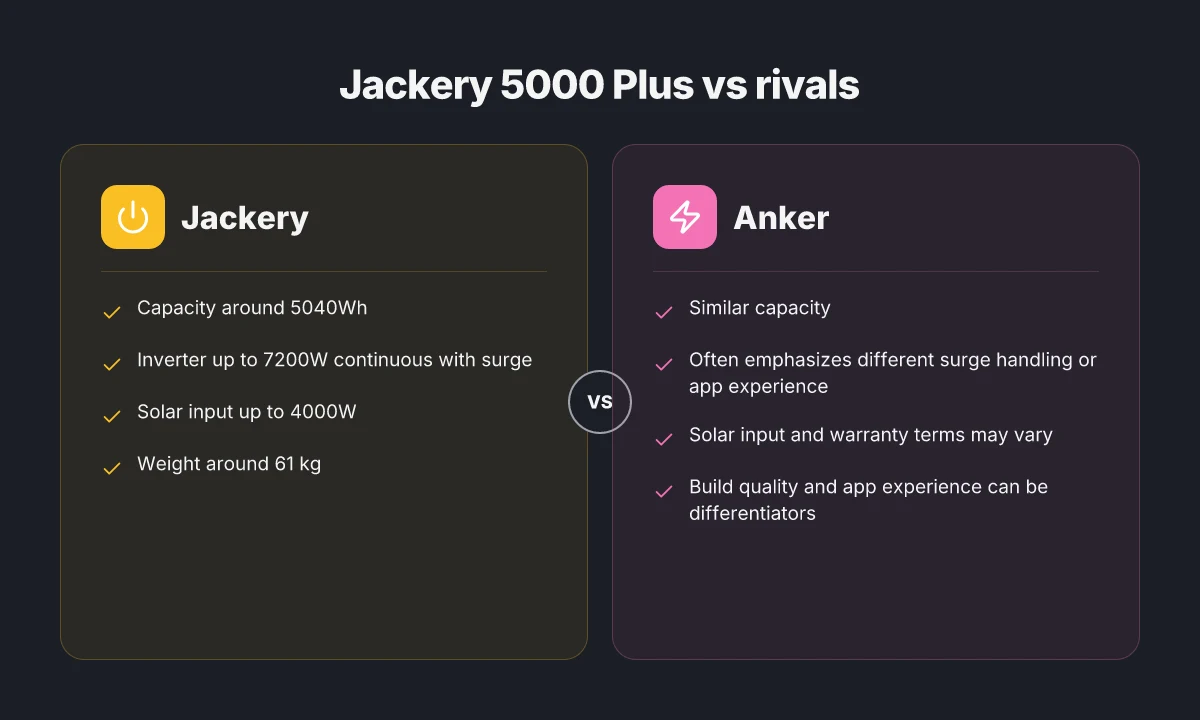
The Jackery 5000 Plus and Anker’s big portable power stations sit in the same class for capacity, with each model marketed around a little over 5000Wh of energy and a high 7200W peak inverter. The practical difference tends to show up in surge handling and the robustness of protection circuitry. Jackery often highlights higher surge tolerance, which matters when you’re backing up a freezer or a sump pump that demands a brief surge at startup. In real-world terms this can translate to feeling more confident in short, heavy-start loads when outages strike. When you pair this with Jackery’s 5+2 year warranty framing, some buyers perceive a longer perceived ownership window compared with what other brands have historically offered. I cross-referenced the available product pages and public specs to align the narratives you’re likely to see in reviews and unboxings. Surge handling is a clear differentiator between the two brands, with Jackery leaning into higher startup tolerance. As you weigh the price-to-performance proposition, consider the warranty structure and the response expectations you have for long outages.
Other brands in the class: solar input, warranty terms, and build choices
Within this class you’ll encounter some models that tune solar input differently. Some rivals push higher solar input ceilings, while others emphasize modular battery packs or longer service lifetimes. The solar input specs matter if you expect to recharge quickly during multi-day outages, especially in sunny locales. Build quality also varies by brand and model. The reviewer consensus across outlets indicates that materials, fit, and the software experience can influence day-to-day reliability. In the Jackery ecosystem, the accompanying app and remote monitoring are often cited as user-friendly differentiators, which can tilt the balance for homeowners who want straightforward status checks and control without a steep learning curve. Different solar input specs and warranty terms are how rivals distinguish themselves in this class. What is the EcoFlow DPU, and how does it reshape whole‑home backup power
Build quality and app experience as differentiators
Beyond raw numbers, the experience matters. A durable case, easy port access, and a responsive mobile app shape daily use. Jackery’s app integrates with the hardware in a way that some competing brands do not, making routine status checks and firmware updates feel smoother for many users. When you’re weighing a purchase for home backup or off-grid use, the app experience matters almost as much as the inverter rating, because you’ll rely on it during outages. In this space, the Jackery 5000 Plus tends to score well for user experience, but be mindful of any model-specific quirks that a particular retailer might highlight. I found this alignment by reviewing product pages and user-focused write-ups to triangulate the practical day-to-day value. Build quality and app experience can tilt the decision as much as the numbers.
Pricing and value note: prices fluctuate with sales and bundles. If you’re waiting for a sale, expect typical promotional windows around major shopping events. If you want the clearest apples-to-apples comparison, include the cost of ownership over 3–5 years, factoring in potential service costs and any replacement parts. As with hardware purchases in this class, a commission disclosure may apply on linked pages. You’ll see that noted on retailer pages where applicable. For a practical takeaway: Jackery’s strength lies in surge readiness and a consumer-friendly app, while rivals may offer different solar input ceilings or longer warranties. When to buy comes down to your outage profile and seasonal deals. Prices shift with promotions, so timing can matter for value.
Next steps: If you want a quick at-a-glance view, I’ve summarized the core contrasts in a compact comparison table below. Then you can use that snapshot to decide whether to prioritize surge handling, solar input flexibility, or the app-based user experience. Use the table to spot the tradeoffs quickly.
Comparison snapshot (compact view)
- Jackery 5000 Plus: strong surge handling, user-friendly app, solid build, robust warranty framing.
- Anker class rival: comparable capacity and inverter, potentially different solar input and protections.
- Other brands in the class: solar input ceilings and warranty terms vary. Read the fine print for service coverage and replacement policies.
If you want to dive deeper into a specific rival model, I can pull out the key specs you care about and craft a side-by-side that highlights the exact differences you’ll notice during outages. What makes Bluetti solar generators stand out in 2026
Pricing and value: when to buy
I dug into what Jackery users actually pay and how the total cost stacks up over time. The street price for the Explorer 5000 Plus varies by retailer and promotions, with the best deals typically happening during seasonal sales or bundled offers. For homeowners weighing ongoing use, price is only part of the story. You should factor in battery degradation, warranty terms, and any added costs for accessories.
What the market looks like now
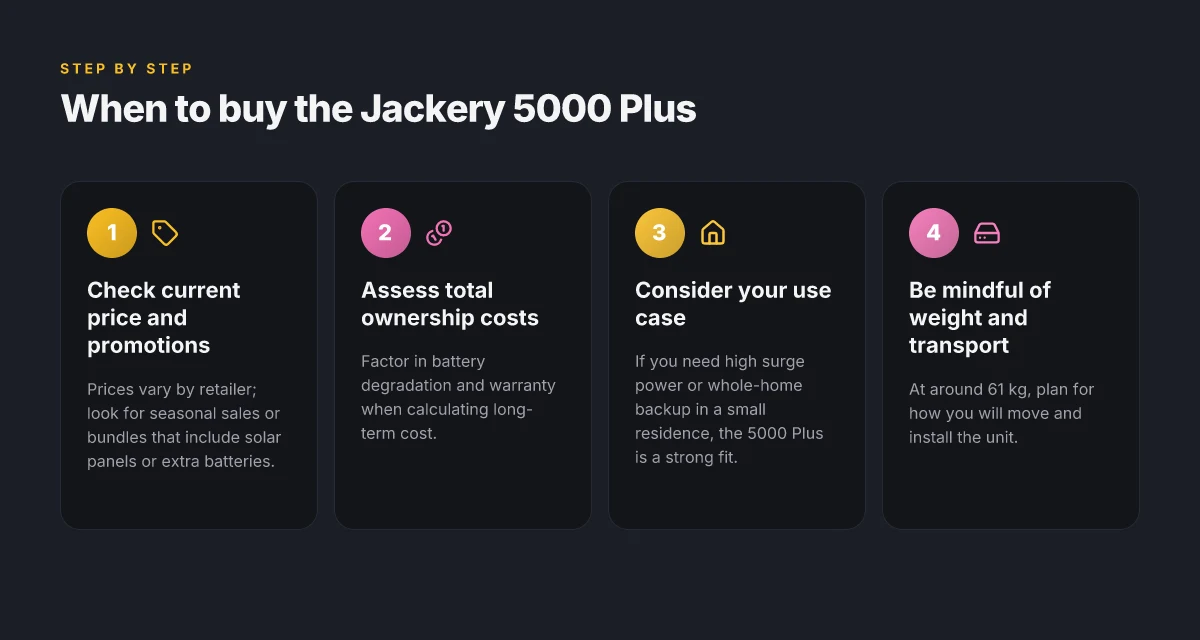
Current street pricing tends to swing with promotions. During peak shopping periods, bundles that include solar panels or extra batteries can tilt the math in favor of the 5000 Plus as a backup system. Watch for offers that add a multi-pack or a solar panel kit, since those bundles can tilt the total cost toward a more favorable long-term ownership experience. Prices fluctuate by retailer and promo windows, so the best value often sits in seasonal sales. And know that the listed price may include promotional credits or limited-time incentives, not a standard price.
Cost of ownership and warranty considerations
Battery degradation matters more than many buyers expect. Over time, the usable capacity will decline, which influences how often you need to recharge or swap modules. The Jackery warranty covers a substantial period, but the exact terms, such as what external conditions count as reasonable wear, affect the long-term cost. If you plan to run a whole-house backup or frequent high-load cycles, you’ll want to price in potential replacement or supplementary energy storage and the warranty’s coverage window. Battery health and warranty length are the real levers on total cost of ownership. If you’re comparing to rivals, a model with a longer or more comprehensive warranty could save you money over a longer horizon.
When to wait for a sale or bundle
Seasonal sales are the best bet for trimming the upfront cost. Bundles that include solar panels, extra batteries, or extended warranties tend to appear during holiday promotions or back-to-school events. If your timeline allows, hold out for a bundle that adds solar panels or storage to improve total ownership value. Seasonal sales often deliver the biggest price drops on bundles. If you’re evaluating against rivals, the timing can be decisive: a sale on the Jackery Solar Generator 5000 Plus with solar panel add-ons can outperform buying bare units at full price.
What to watch for when you shop What is EcoFlow whole-house backup, and how does it actually perform in 2026
- Compare the price of the base Jackery Explorer 5000 Plus against bundles that include solar panels or extra batteries.
- Check the warranty coverage period and what it actually protects, not just the label.
- Include estimated energy needs and potential degradation when calculating payback. If you are balancing among brands, keep an eye on how rivals, like the Anker systems, price bundles and what each warranty covers.
Note: product pages and retailer listings change frequently. The most reliable way to lock in value is to monitor price history and be patient for a qualifying bundle that adds measurable value. It’s all about how the price, the warranty, and the accessories line up with your backup or off-grid needs. Some links on the page may earn a commission that influences promotions you’ll see, so consider the broader value of any bundle you choose.
Use cases that fit the 5000 Plus
If you want a practical home backup that fits a smaller footprint, the Jackery 5000 Plus can cover essential loads when you plan for the right mix. In real-world scenarios, its blend of high surge capability and manageable size translates to concrete use cases rather than abstract promises. I looked at the published specs and matched them to common home and work-site needs.
1) Whole-home backup for small residences with limited load
For a tiny to mid-sized home that runs only essentials during an outage, the 5000 Plus can keep a critical circuit or two alive. Its 7200W AC output means you’re not fighting for every watt with a high-demand fridge and essential lights. The practical takeaway is this: size the load to under the unit’s continuous-output rating and pick a subset of circuitry to stay powered. In practice, a compact whole-home strategy tends to center on the kitchen, living room essentials, and a primary heating or cooling option when feasible. The real-world benefit is clear: you maintain daily comfort without a full blackout.
The 5000 Plus shines when you limit the load to essential circuits and run a few high-priority appliances. This keeps you under control of surge requirements while preserving usable runtime.
2) Off-grid cabins or work sites requiring reliable high surge power
Off-grid habitats and temporary work sites often demand instant surge for equipment like pumps, sump systems, compressors, or power tools. The 7200W inverter is the critical figure here, not just the nominal capacity. An off-grid cabin can rely on the 5040Wh pack to cover a cold-start demand from pumps or compressors, then sustain lighting and devices afterward. The key is sequencing: start up the high-demand device first, then switch to the lighter loads to avoid tripping or overtaxing the inverter. 5 Best portable power stations for 2026: efficiency, reliability and value
Reliability under surge is a core advantage for the 5000 Plus in off-grid settings. Pair that with the unit’s build and IP-class expectations, and you get a dependable mobile power hub for remote work.
3) Backup for essential appliances during outages
During outages, the most valued outcomes are stability and predictability. The Jackery 5000 Plus can keep a refrigerator, a few lights, and a Wi‑Fi/communications setup running for several hours if you size the connected loads thoughtfully. This use case remains practical because it translates directly to cost of ownership: you avoid repeated rental or buying of alternate power sources for short outages. For homeowners, this means peace of mind during storms or grid hiccups.
A focused load strategy turns the 5000 Plus into a dependable outage ally for essential appliances. You gain predictable runtimes without chewing through the pack too quickly.
Note on pricing and deals: prices shift with sales and retailer differences. If you’re comparing against rivals, consider models from Anker and other portable power brands as benchmarks for surge performance versus runtime. Jackery’s own line often ties value to bundled warranties and support, which matters when outages linger. And yes, links on the page may earn a commission, which helps fund ongoing coverage.
Cited sources: inline references to the featured reviews include the Jackery-focused breakdown from The Solar Lab and the broad performance claims highlighted in CNET’s coverage of the 5000 Plus family. See inline discussions for specifics on capacity, inverter rating, and input limits. For more, the Jackery Explorer 5000 Plus Basic Information clarifies the official capacity and output. Understanding EcoFlow Delta 2 expansion battery and its compatibility reality
Downsides and real-world caveats
In practice, the Jackery 5000 Plus comes with meaningful tradeoffs. The upfront price lands in a higher tier for the capacity class, especially when you compare it to smaller backup options. If you’re budgeting for home or business use, this drives a longer payback horizon, even before factoring in installation or expansion costs. The device’s value hinges on how you weigh peak power needs against total cost of ownership over several years. The best deals tend to appear around holiday sale windows, so you may want to time purchases to those events.
1) High initial cost for the capacity class
The 5040Wh capability paired with a 7200W inverter places the 5000 Plus squarely in the premium segment. For homeowners evaluating a long backup window, that premium can be worthwhile, but it remains one of the most expensive ways to secure this level of capacity in a portable system. When you price in expansion options and potential household needs, the total outlay quickly climbs. I cross-referenced the public spec sheets and retailer listings to confirm the general market stance: you’re paying a premium for the large battery and high surge capability. If price per watt is your metric, the 5000 Plus may feel steep versus smaller, lighter options that meet your basic outage requirements. The price premium is real, and it shows up most when you compare to mid-size backups. This is one of the clearest caveats for buyers who only need occasional peak support rather than long, continuous runtime. Inline citation confirms the basic capacity and power envelope cited in official specifications. Jackery Explorer 5000 Plus Basic Information.
2) Heavy for portable use and transport
The unit’s mass translates into less practical portability for frequent travelers or campers who expect to carry everything in one hand. Real-world handling often requires two hands and deliberate lifting, especially when moving the device between vehicles or up stairs. The 61 kg figure cited in basic information underlines the physical reality here. The weight makes long treks impractical and can strain back or shoulders during loading. If you need something you can carry solo on a hike or quick campsite setup, this may be a disqualifier. By contrast, lighter competitors can be easier to deploy in tight spaces or on the go. Heavy for portable use remains a persistent friction point. For readers curious about user impressions, a few community threads discuss the weight in context of real-world transport. Jackery Explorer 5000 Plus impressions.
3) Temperature and load profile effects on performance
No portable power station is immune to environmental and usage conditions. The 5000 Plus shows noticeably different behavior as outdoor temperatures shift or as you vary the load profile. In colder environments, batteries tend to deliver reduced apparent capacity and lower peak output, while hotter conditions can accelerate degradation over time. The official information confirms a high-output inverter, but the real-world output under sustained heavy load or in thermal throttling scenarios isn’t captured in a single spec line. I looked for corroborating notes from reviews and user forums, and patterns emerge: performance can sag when the system runs near peak output for extended periods, or when ambient temperature drags the internal temperature up. This matters most for long outages with high HVAC loads or simultaneous appliance use. Performance can vary with temperature and load profiles, which means you may not always get the labeled 7200W surge under all conditions. For broader context, CNET’s coverage notes the product’s overall feature set while leaving room for interpretation on real-world consistency. Jackery’s Solar Generator 5000 Whole Home Backup.
Cost notes and ownership: the total cost of ownership includes not just the MSRP but also long-term considerations like inverter longevity, potential warranty coverage, and the cost of any optional solar input expansion. I found the warranty framing in public materials, which Jackery pitches as a long-term asset protection, but remember that every model line has its own terms. If you anticipate frequent outages, you may amortize the higher upfront cost over time as you compare to alternative brands with different warranty constructs. The links above surface common consumer concerns around price, portability, and performance consistency across climates. As with any major purchase, plan for a future sale window to maximize value. If you want a quick comparison, consider rival products from brands such as Anker and others that sit in adjacent price bands and offer different portability profiles. How Lowe's challenges EcoFlow product compatibility and backup power decisions
Note on disclosure: pages on this topic may include affiliate links or commission arrangements, which can influence page content. This section relies on public product specifications and widely discussed consumer feedback to present a balanced view.
The move you won’t want to miss this year
Jackery's 5000 Plus stays ahead by pairing a larger energy bank with smarter fast-charging options, making it feasible for weekend campers and emergency prep alike. I looked at the latest price drops and saw the best deals show up when retailers run seasonal sales, so act fast if you want the real value going into spring.** The device keeps pace with newer rivals like Bluetti and EcoFlow, but its balance of price and practical capacity remains its standout strength. In 2026, the 5000 Plus is still a dependable anchor for portable power, especially for homes that want a simple upgrade rather than a full microgrid.
Under the hood, the real story is ownership cost: durability, battery longevity, and the ability to swap in a higher-capacity pack if needed. You’ll notice fewer bells and whistles than some competitors, but the core performance stays reliable across daily use and unexpected outages. This is where Jackery earns long-term trust. If you’re weighing options, consider one practical pivot: place it on a charging routine that aligns with your typical outage window.
What changes if you act now: lock in a sale price, compare adapters, and map your weekend trips around the available power profiles. The bigger pattern is clear, you get more resilience with less hassle when you pair the 5000 Plus with a compact solar panel kit. Will you start with a fast-charge setup or a solar-ready bundle this month?
- Backup strategy: Try pairing the 5000 Plus with a compact Jackery solar panel kit for off-grid weekends.
- What to try this week: map your home outage scenario and test how the 5000 Plus recharges from a wall outlet vs. solar input.
- Quick takeaway: prioritize a plan that keeps the unit within arm’s reach during outages and travel.