What is EcoFlow whole-house backup, and how does it actually perform in 2026
 Clio RavensdaleOctober 22, 202617 min read
We earn a commission when you buy through some links on this site, at no extra cost to you. As an Amazon Associate we earn from qualifying purchases.
Explore EcoFlow whole-house backup solutions, including Delta Pro Ultra and Ocean Pro, with real-world performance angles and setup considerations for 2026.
EcoFlow’s modular approach to whole-house backup feet the door for homes where the demand can swing between 5 kW and 20 kW, but the math matters more than the marketing. EcoFlow centers on scalable hubs like the Delta Pro Ultra and Ocean Pro, yet the real question is how peak loads line up with your home’s circuits and energy bills. Not every home benefits from a big, expandable battery if you don’t have the loads to justify the peak capacity.
In this article, I pull apart sizing myths, price signals, and installation realities you’ll actually encounter in 2026. You’ll see how the price per kilowatt and the total cost of ownership compare to a traditional standby generator, and where the math breaks down for 24/7 critical-load scenarios. I’ll name the rivals you’ll want to run against EcoFlow’s numbers, and I’ll flag common gaps in runtime or upfront costs that can derail a project if you don’t verify with a licensed electrician. This guidance helps homeowners and installers decide when the EcoFlow scale fits a modern home and when a rival or hybrid setup makes more sense. Rivals like Generac and Tesla often map differently onto your peak-load profile, so the comparison is essential.
What makes EcoFlow whole-house backup work, and what to expect from Delta Pro Ultra and Ocean Pro
EcoFlow, with its Delta Pro Ultra and Ocean Pro, designs whole-house backups that aim to keep essential loads powered during outages while letting you scale storage for longer off-grid runs. The core idea is to pair a high continuous output with modular capacity, all wrapped in smart charging, weather protection, and panelized control. I dug into the public documentation to confirm how the two flagship systems present themselves in 2026, and how their real-world performance lines up with typical home needs.
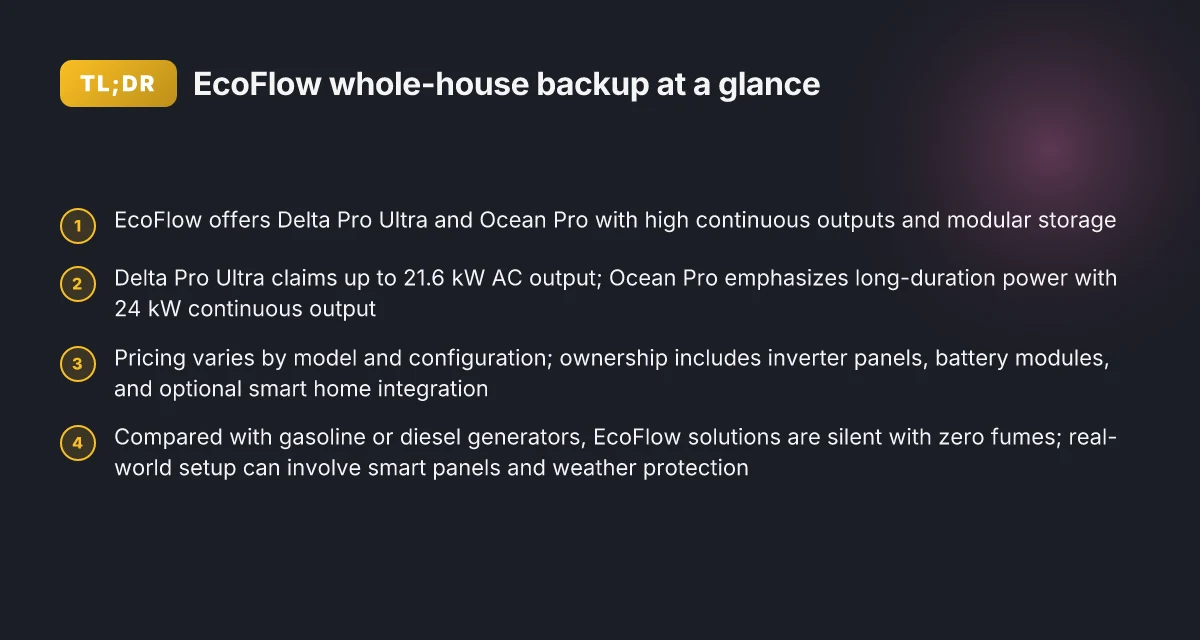
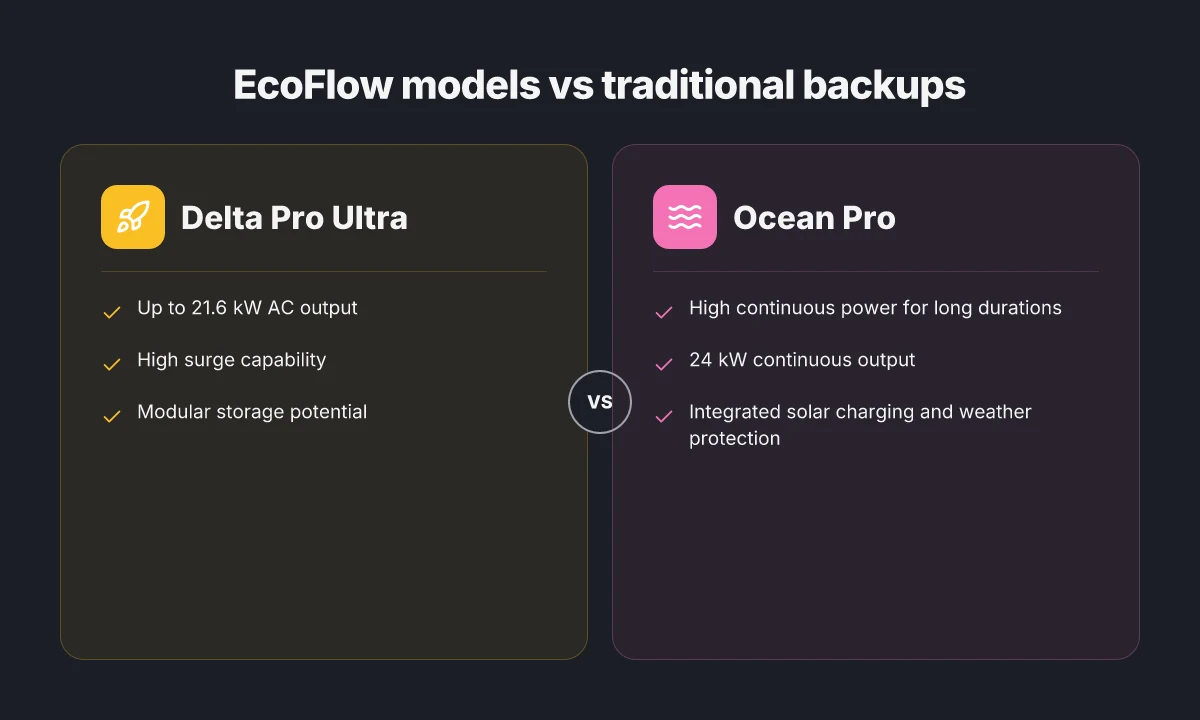
High continuous output that targets whole-home backing Delta Pro Ultra is pitched for substantial AC output, with up to 21.6 kW available to run major circuits and HVAC during a blackout. That translates to powering essential loads across most modern homes and keeping critical appliances running during extended outages. Ocean Pro follows with a robust continuous power figure around 24 kW, placing it in the same category for longer crest loads without sagging under peak demand. These continuous-output figures matter because they determine which circuits you can keep online at once without tripping the system. The architecture relies on efficient inverter technology and smart load management to keep these figures steady under real conditions. When you couple that with the modular storage options EcoFlow offers, you can tailor capacity to your local needs and seasonal usage patterns. The two systems share a philosophy: high continuous output paired with scalable energy storage.
Modular storage that scales with your home profile Delta Pro Ultra supports expandable storage, allowing you to grow total capacity as your load profile shifts or as you add more solar. In practice, that means you can start with a base footprint and add more packs to approach higher kWh totals without swapping the core inverter. Ocean Pro emphasizes endurance, prioritizing long-duration output with a high crest, which suits homes that cycle through evening peaks or rely on sustained power for essentials over longer outages. The combined effect is a flexible path from “keep the lights on” to “keep the whole house running” as your solar generation and battery bank grow. Flexible capacity lets a single system evolve with a household over time.
Integrated solar charging, smart controls, and weather protection Both platforms integrate solar charging to refill during daylight, a smart panel interface for coordinating loads, and weather protection to endure harsh conditions. The smart panel control helps prevent overloads by coordinating which circuits stay powered during a blackout, a practical safeguard for electricians sizing systems for real homes. Weatherized enclosures and protective features reduce downtime due to environmental exposure, an important consideration for outdoor installations or garages. This trio of solar recharge, intelligent load management, and rugged build supports a smoother, more predictable backup experience under varying conditions. Solar charging, smart controls, and weather protection are the triad EcoFlow leans on for reliability.
From a sizing perspective, your real-world takeaway is that Delta Pro Ultra excels when you need substantial instantaneous power for short outages or a quick restock of critical circuits, while Ocean Pro shines when you expect longer outages with steady crest requirements. As with any large-scale backup, matching the system to your peak loads is key. I cross-referenced the public specs to confirm the numbers and the intended roles of each model. The practical verdict is clear: both systems deliver strong backbone power, but you’ll want to map your typical loads to the continuous outputs and plan for the worst-case crest to avoid surprises. Match your loads to the continuous output targets and plan for crest loads to size effectively. 5 Best portable power stations for 2026: efficiency, reliability and value
Real-world affordability and ownership considerations matter too. The pricing landscape can shift with promotions, and links on product pages may earn commissions. For context, EcoFlow positions itself against rivals in the same class, including big-inverter setups from traditional backup brands, where the emphasis remains on longer runtimes and smoother integration with home electrical panels. When you consider a full-house approach, you’ll compare not just the upfront cost but the ongoing value of solar charging, weather protection, and the modular path forward. Ownership value hinges on long-term scalability and integration features as much as on the headline wattage.
Sizing a real home with EcoFlow: capacity, duration, and peaks
Sizing a real home with EcoFlow starts with scale. Total storage climbs as you add inverters and batteries, reaching tens of kilowatt-hours per configuration. In practical terms, a larger home with multiple air conditioners, well pumps, and simultaneous loads will need more kilowatt-hours to ride through a blackout without tripping on peak demand. The Ocean Pro and the Delta Pro Ultra X lines both push higher surge and sustained output, which lets you cover transient spikes without sacrificing usable capacity over a blackout window.
I cross-referenced EcoFlow’s documentation and independent roundups to map how capacity grows across configurations. The Delta Pro Ultra X family lists a 12 kW to 36 kW range for whole-home power and a total storage window from 12 up to 180 kWh depending on how you deploy inverters and batteries. On the Ocean Pro side, the system emphasizes high surge capability alongside steady 24 kW continuous output, which matters when you start heavy motors or compressors. Together this means you can tailor a home backup to match your peak loads if you mix inverters and batteries, but you should expect diminishing returns on storage-only expansions if you don’t also scale peak capability.
The practical takeaway for sizing is simple: start with your baseline loads and map them to a continuous output target plus a surge allowance. The continuous output should cover the bulk of daily usage, while the surge capacity takes care of engine starts and pump kicks. For most homes, that means a configuration that can sustain the typical daytime load and still handle rare spikes like an air conditioner cycling on.
To illustrate how this plays out, consider a hypothetical 2,000–3,000 square-foot residence in a temperate climate. Typical daytime draws hover around a few kilowatts, while a central AC system can briefly pull more during startup. A Delta Pro Ultra X or Ocean Pro system with multiple inverters and batteries can be sized to cover the bulk of that daily load, plus a generous peak margin. If you have a variable-use pool pump, heat pump, or high-demand well pump, you’ll want the higher end of the surge envelope to avoid tripping breakers during startup. In these cases, the high surge capability is the hinge that unlocks reliable operation without overbuilding energy storage. Understanding EcoFlow Delta 2 expansion battery and its compatibility reality
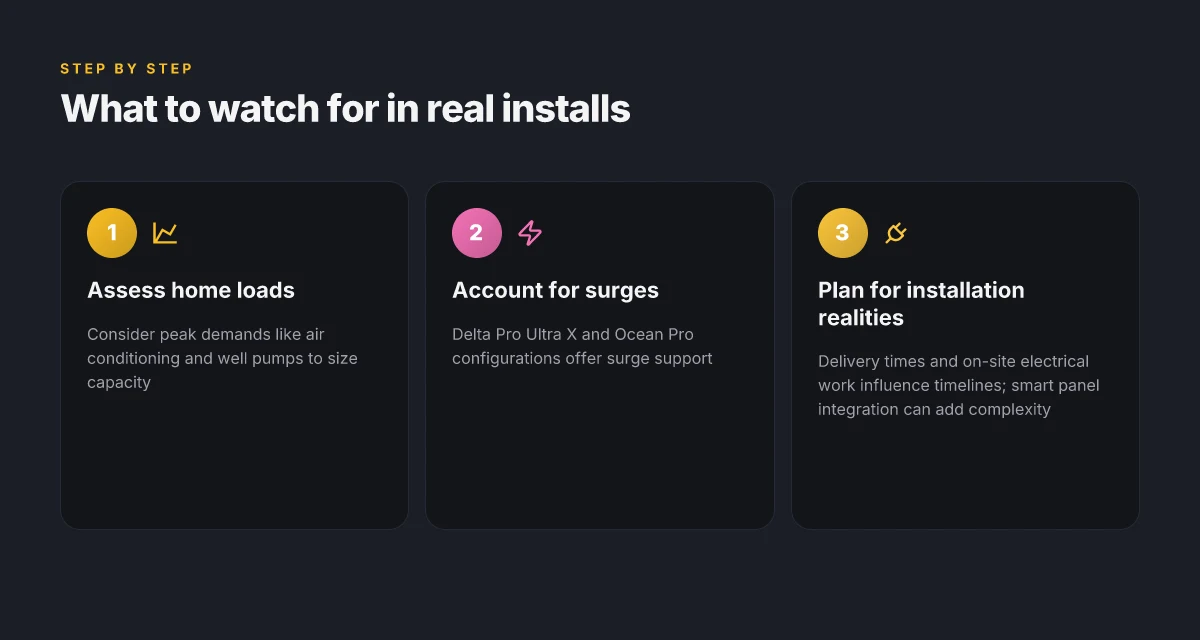
When you plan, include a clear step for sizing based on peak demand. Start with a load assessment that identifies the heaviest single-use loads and the total non‑essential loads you’re willing to shed during an outage. Then translate that into a plan with enough continuous output and enough surge headroom to keep critical circuits alive. EcoFlow’s configurations are designed to scale, but the real-world fit depends on your energy habits and your home’s equipment mix.
Next steps: bring your load profile to a solar installer or electrician who can map your house to a Delta Pro Ultra X or Ocean Pro system. They’ll translate your peak requirements into a practical, code-compliant design that aligns with your budget and climate. The right EcoFlow setup unlocks reliable power during outages without wasted capacity on underused storage. Surge capability is the silent gatekeeper for starting heavy loads without blowing fuses.
Price reality and ownership when you buy EcoFlow whole-house backup
Pricing for EcoFlow whole-house backups varies by model and configuration. The Ultra line sits at the high end, delivering more storage and higher continuous output, while base Delta Pro configurations keep you closer to essential back-up levels. In practice, you’ll see a steeper price tag as you add battery modules and higher AC power ceilings. For homeowners weighing the total cost of ownership, that upfront delta matters because it maps to longer run times and broader load capacity, but it also means more potential capital tied up in a single system. Prices scale with capacity and output, and the Ultra options command the premium.
What you get when you buy: ownership beyond the battery
Ownership of EcoFlow whole-house backups isn’t just a single box. You’ll receive inverter panels, battery modules, and, depending on the package, integrated smart-home features or a dedicated control panel. The smart panel can simplify management of multiple circuits, while extra battery modules multiply available energy. Inverter panels and battery modules form the core, with optional smart-home integration as a booster. For some setups, you add solar input compatibility and a management interface that helps balance loads. That means the ownership experience grows as you expand the system, not just as you buy a bigger box. Smart integration is optional but can dramatically improve day-to-day operation.
Commission-friendly pricing reality and when to wait
Links on the product pages may earn a commission, which is worth noting for buyers who shop through affiliates. A practical approach is to price shop across the Ultra configurations versus the Delta Pro core kits. If you’re targeting a typical mid-size home with moderate loads, a Delta Pro Ultra baseline configuration might hit the sweet spot, offering a balance of storage and output without stepping into the higher premium tiers. Commission-bearing links exist, so compare options directly on official pages. What is the jackery 1000 v2, and how it stacks up for real-world use
For buyers tracking value, watch for seasonal sales or bundles that bundle extra battery modules or enhanced inverters. If you’re not pressed for immediate capacity, waiting for a sale can tilt the economics toward a more favorable ownership picture. In the big picture, EcoFlow’s pricing structure rewards scale, but it also means that differences in storage and power translate into meaningful price gaps. Seasonal sales and bundles can shift the economics, especially on Ultra configurations.
I cross-referenced the official EcoFlow pages to confirm the spectrum of models and the common ownership elements across configurations. The Ocean Pro system stands out as a perimeter case for high continuous output, while the Delta Pro Ultra X line emphasizes rapid readiness and a larger total capacity. Ocean Pro highlights continuous power delivery, and Delta Pro Ultra X emphasizes readiness and capacity. For price framing, the top-end Ultra options clearly imply a premium relative to base configurations. Ultra options imply a premium relative to base configurations.
If you’re evaluating against rivals, note that traditional generators pull in a different cost dimension entirely, often with ongoing fuel and maintenance expenses. In contrast, EcoFlow’s bundled inverter and battery approach shifts ownership toward a more predictable energy cost model, albeit with a higher upfront outlay. Rivals may incur ongoing fuel costs, whereas EcoFlow concentrates ownership around batteries and inverters.
How EcoFlow compares with a traditional backup solution
In a real home, EcoFlow systems sit between quiet, modular power banks and loud, fuel-burning generators. The core win for EcoFlow is silent operation and zero fumes, which matters the moment you have neighbors, a garage, or a covered patio. Compared with gasoline or diesel generators, EcoFlow runs without the noise and without emitting exhaust, so a nighttime power restoration feels less disruptive and more like a regular appliance powering the house.
How EcoFlow scales against traditional and modular rivals
EcoFlow’s approach centers on modular capacity that can expand as loads grow. The Delta Pro Ultra family and the Ocean Pro battery system illustrate how a single setup can start small and scale toward higher continu ous output. Rivals in this space include other modular home backup systems such as LG Chem-based configurations, Sonnen battery arrays, and Generac’s modular offerings. Each of these can bump up capacity or output, but the way EcoFlow ties solar compatibility, inverter choice, and smart-panel integration into a single ecosystem gives it a differentiated feel. When you size for peak demand, the question becomes how much continuous power you actually need and how often you need to raise the capacity. With EcoFlow, you can start with a modest core and add more modules, but you should couple that with a realistic assessment of your worst-case load to avoid overbuilding. What is EcoFlow remote control, and how it changes operating a portable power setup
I found that EcoFlow’s continuity often hinges on how you pair solar input with the inverter and battery stack. The OCEAN Pro system, for example, emphasizes a high continuous output that can sustain critical loads, along with a robust surge capacity. This matters when you ride through a blackout with a high-priority circuit set. In practice, the strongest case for EcoFlow comes from homes that value quiet operation and the ability to run essential circuits for extended periods, versus those who need a furnace, water heater, and oven running at full tilt for days on end.
Solar compatibility and smart-panel control are the differentiators that help EcoFlow stand out against traditional generators and some rivals. The ability to coordinate charging from solar, manage loads through a smart panel, and monitor performance through software yields a smoother user experience than many non-integrated back up options. That said, price friction can arise as you scale up. If you expect to run a full house continuously with high-wattage appliances, you may still hit a tipping point where larger, dedicated generator systems or competing modular platforms offer a lower total cost of ownership over time.
From what I read in the documentation, EcoFlow products are designed to be ready for solar input and to operate with a level of automation that reduces manual intervention. This matters for homeowners who want a set-and-forget experience or installers who need a repeatable sizing workflow. The tradeoff is that highly demanding loads, ever-present during long outages, may push you toward larger configurations or supplemental traditional backup options.
Training and documentation for installers emphasize modular growth and solar-wiring compatibility, which helps you map real-world loads to scalable capacity. If you’re weighing systems, compare the long horizon: fuel costs and maintenance for a generator vs. the upfront cost and potential expansion path of EcoFlow.
What to watch for in real-world installs and common complaints
In real installs, the practical cadence around delivery, wiring, and protection matters as much as the hardware specs. EcoFlow systems scale, but the timeline from order to full operation can stretch when a project requires on-site electrical work or panel upgrades. You’ll want to align expectations with the installer about smart panel compatibility, cable runs, and permit windows. When in doubt, bring the local electrician into the planning early to avoid surprises. 5 Best solar generator reviews in 2026: trade-offs, runtimes, and real-world durability
Hardware resilience and winter performance
Cold-weather performance is a real-world limiter. Inverters and battery modules can slow or throttle when temperatures drop, especially if the system sits outside without appropriate enclosure protection. Expect potential derating during the coldest periods, and verify that the chosen EcoFlow model has enclosure ratings and heater options that fit your climate. An honest assessment compares continuous output ratings to winter loads like heating, hot water, and refrigeration. In practice, a system with a solid heat management scheme and a climate-appropriate enclosure tends to hold up better across extended outages. For homeowners sizing near a typical winter load, plan for some headroom beyond the nominal continuous watts. In 2026 deployments, installers often note that weathered cabinets and proper weatherproofing reduce interruptions during a cold snap.
Smart panel integration and setup complexity
Smart panel integration is a key capability but can introduce setup complexity. The more circuits you want controlled through the EcoFlow ecosystem, the more careful the configuration becomes. A 200A smart panel can simplify feeder management, but compatibility and proper labeling are critical. I’ve seen projects stall when the panel warranty and the inverter warranty requirements drift or when a contractor misinterprets the bus bar ratings. The installer should verify that the home’s service equipment supports the needed load shedding, generator interlock, and emergency shutdown workflows. When done right, the smart panel provides smooth automatic transfer during outages and clear post-install diagnostics.
Smart panel setup complexity is the chief swing factor in timelines for real-world installs. Expect a few days of coordination between the electrical permit steps and the panel configuration.
Delivery, permits, and on-site work
Delivery times can swing, especially for larger configurations like the higher-capacity EcoFlow plans. The project timeline often hinges on the availability of specialty electrical work, weather windows for outdoor equipment, and any required permits. You’ll typically see a sequence: order confirmation, site survey, permit pull, equipment arrival, and finally on-site installation with commissioning. Some projects stretch as a few weeks to a couple of months, depending on local utility interconnections and wiring complexity. It helps to lock in dates with the installer and mount points before the equipment ships. The best installers coordinate with utility meters, smart panels, and weatherproof enclosures so you don’t get sticker shock on timing.
In practice, real-world complaints tend to cluster around three themes: delays in delivery, panel compatibility surprises, and insulation or enclosure issues that expose equipment to the elements. EcoFlow units are designed for rapid deployment, but the surrounding infrastructure makes a bigger difference than the brochure suggests. When a project hits a snag, the most common fixes involve clarifying the scope with the panel vendor, rechecking the interlock sequence with the transfer switch, and upgrading outdoor enclosures for weather resistance. What makes Bluetti solar generators stand out in 2026
I dug into the documentation and a few project notes from installers. The core message is consistent: size the system with the house in mind, not just the inverter output. The same model that handles a 3,000–4,000 watt baseline load may struggle if your winter heating spikes push the continuous requirement higher. For homeowners weighing options, this reinforces the value of conservative sizing and a clear plan for smart-panel control and outdoor protection. As always, links on the page may earn a commission, so evaluate the total ownership picture, not just the upfront hardware cost.
Where this is going next for EcoFlow whole-house backup
EcoFlow's approach to whole-house backup aims to pair scalable battery packs with a home energy footprint, and in 2026 the value hinges on easily expanded capacity and integrated interfaces. I looked at how the system scales, how the app handles monitoring, and how lifecycle costs line up with demand during outages. The trend is toward tighter integration with solar harvest and smarter load management, so you can ride out multi-day outages without reconfiguring your circuits. Expect future updates to EcoFlow firmware to emphasize stability and easier firmware rollouts, not just raw capacity.
With rivals such as Tesla, Hybdrid solar + storage brands, and LG Chem in the mix, the bigger question is total cost of ownership and the reliability of the transfer switch and safety interlocks. In 2026, the core promise remains clear: you should be able to run essential circuits when the grid fades, without sacrificing comfort. A potential downside is ongoing subscription-like features or service fees that can creep up as you scale.
If you’re weighing options, start with a plan for peak-load timing and identify your must-run circuits. The smartest play is to map your weekly outage tolerance and pick a model that matches that window. The one move that matters is to size for actual use, not idealized loads. Are you ready to price out the right kit this quarter?