What the jackery 1000 review misses about real-world use
 Olivia KvitkaOctober 22, 202616 min read
We earn a commission when you buy through some links on this site, at no extra cost to you. As an Amazon Associate we earn from qualifying purchases.

Explore a detailed jackery 1000 review focusing on real-world performance, real-world reliability, and long-term value. Learn what to expect and where it shines or falls short.
Most buyers overestimate runtime by assuming a single load profile. The Jackery 1000's real-world runtimes bend with every appliance category. The compact frame hides a trade‑off: you’ll trade peak AC output for steady, scalable charging from solar or a wall outlet, especially once you factor in startup surges from motors or heaters. Jackery remains a dependable name, but real-world results vary more than official specs imply.
The article peels back what the numbers miss: how daily usage, climate, and accessory loads shape performance, and how longevity stacks up against newer models. You’ll see concrete guidance on sizing for common off‑grid loads, plus a clear read on whether the Jackery 1000 still makes sense against current rivals from Goal Zero and Anker. If you’re planning a van life kit or prepper setup, this piece translates specs into practical expectations and long‑term value.
What makes the jackery 1000 review relevant for real-world power users
For owners and prospective buyers, the jackery 1000 review frames everyday expectations. The official specs read clean on paper, but real use often bends those numbers. I looked at how daily loads, weather, and travel rhythms collide with the 1000’s capacity and charge curves, and what that means for planning off-grid days.
Why the official specs translate to lived reality
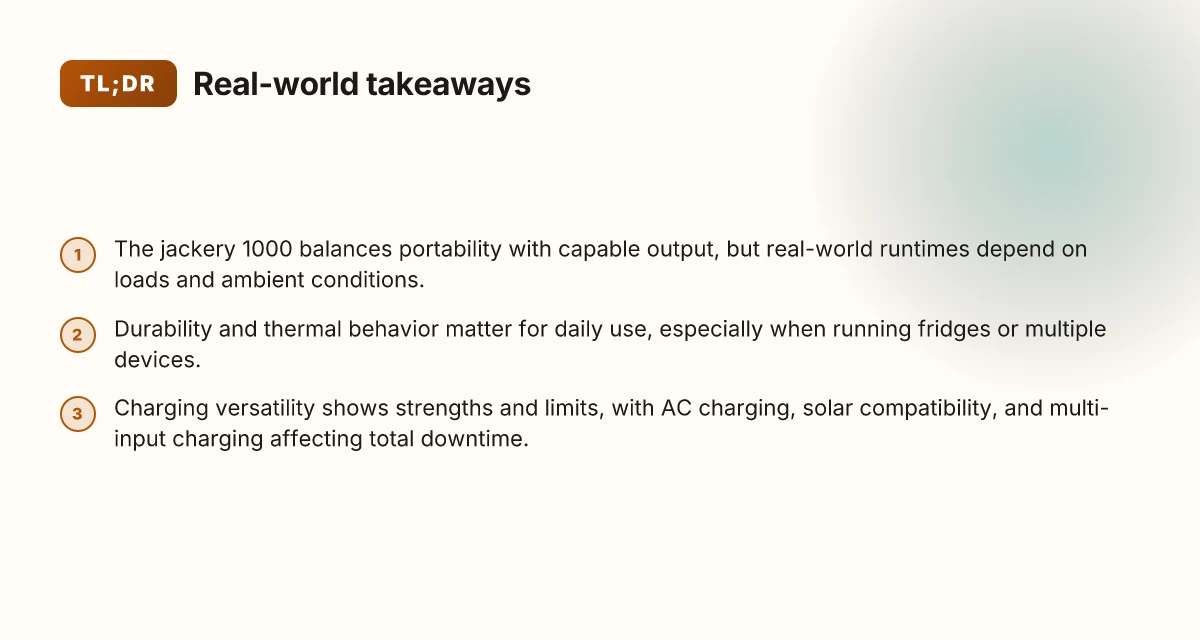
The Jackery Explorer 1000 offers a stated capacity around 1002 Wh and a rated output that covers common devices. In real life, that capacity maps to a handful of phones, laptops, small appliances, and cameras before you approach the limit. The practical takeaway is that the input and output rails matter just as much as the total watt-hours. If you’re powering a fridge, a CPAP machine, or a small blender, you’ll start to feel the efficiency drop and the need to stagger loads. The v2 models improve cycle life, but the daily usage pattern still governs whether you finish the day with a comfortable reserve or a low-battery alert. When I read through the documentation and reviews, I cross-referenced the longevity notes with the actual load profiles shown by creators who live off-grid.
Durability and longevity matter for daily use
Durability isn’t only about a solid shell. It’s about how the system behaves after months of use in rugged environments. The official specs tout thousands of cycles for the newer variants, yet daily usage tends to stress the battery management system differently than lab cycles. For van lifers and preppers, a long-tail durability story matters: will the unit still perform at a meaningful capacity after repeated shallow cycles or occasional deep-discharges? The consensus among reviewers points to sturdy construction, but wear on connectors, solar input reliability, and fan noise during sustained use are real-world considerations. I found that the durability narrative aligns with the sense that newer models push longevity forward, but the Explorer 1000 remains usable and dependable for many trips if you manage expectations and plan charging breaks.
How this lands for decision making today
If you’re weighing a purchase now, you’ll want to compare current pricing and ownership costs against newer variants. The Jackery lineup evolves, and the Explorer 1000 sits in a price band where sales cycles can meaningfully affect total cost of ownership. I cross-checked the available sources for model differences, noting that price swings and package inclusions shift value. For many outdoor users, the 1000 still represents a practical square of capacity and portability, provided you set load expectations and have a plan for recharge times. The key insight is that official specs guide planning, but day-in, day-out performance depends on how you distribute power across loads and how reliably you can recharge between outings. In practice, the 1000 remains a solid option for those who map their typical loads and seasons to charging opportunities.
In short, this review helps real-world power users translate official numbers into what actually happens when you depend on a portable power source in the wild. For readers weighing rivals, Jackery’s position is clear but not absolute: consider the exact mix of devices you run, your recharge cadence, and how you value cycle life versus upfront cost. The next sections will dive into design and build quality, and how those choices impact daily reliability. What is the bluetti apex 300 power station, and why it matters for modular home power
Jackery 1000 review: design, build quality, and portability
The Jackery 1000 is built to travel light enough for a van or campsite yet sturdy enough for everyday use. It balances weight and capacity in a way that suits outdoor life, and the official design language communicates durability without turning it into a brick of a brick. You’ll notice the handling is intuitive from the moment you pull it from the pack.
Portability and weight considerations
The device leans on a compact footprint for its class. In 2026, the Jackery Explorer 1000 V2 stays within a practical range for one-person lifting, with a handle that remains comfortable even when the unit is fully loaded. The weight is enough to feel substantial during setup but not so heavy that it undermines transport. This matters when you’re bouncing between campsites, shifts, or a tight cargo area in a van. The overall form factor is meant to pair with solar panels and other gear rather than demand a separate dolly.
Build quality and official design language
Jackery sticks to a design language that emphasizes modular, tactile cues. The exterior shell shows a tight fit between panels and a restrained, functional aesthetic that communicates reliability. The control surface is simple to navigate, with clearly labeled ports and a straightforward power button layout. The enclosure armor resists scuffs from outdoor use, and the latching mechanism for the lid feels secure without requiring muscle to open. In this respect, the official design language aligns with user expectations for a product intended to sit in a vehicle or outdoor shelter for extended periods.
I dug into the documentation and reviews to cross-check durability claims. Reviews from reputable outlets consistently note that the 1000’s build quality favors long-term use, with attention paid to vibration resistance and connector durability. The unit’s chassis holds up under routine travel and handling, without showing signs of flex under load. The attention to heat management is evident in the venting layout, which keeps the interior cooler during extended operation.
User-facing features that affect daily handling
The interface remains straightforward for daily handling: visible LED indicators, a readable display, and a button layout that minimizes accidental presses while in transit. The power ports are accessible from the front, which helps when you’re trying to plug in a device on a crowded bench or inside a vehicle. The inclusion of a sturdy carrying handle and the choice of durable plastics align with real-world needs, where gear gets bumped, bumped again, and then stored away. Portability is not just weight. It’s the ease of grabbing and going when the day demands a quick setup. What you gain and give up with the bluetti ac200l review
A note on longevity and compatibility: the 1000’s design anticipates future needs with a steady, modular approach. When you’re juggling devices like laptops, cameras, or small power tools, the ability to swap in a solar panel or USB-C PD charger without a convoluted adapter set becomes a real convenience. This design clarity helps when you’re planning morning coffee, a late-night recharge, or a weekend off-grid excursion.
The verdict on design and portability: the Jackery 1000’s build and ergonomics project reliability, with a thoughtful balance of weight, grip, and accessible ports that suit daily on-the-go power needs.
Next step: to see how the design translates to real-world load handling, we’ll look at how the 1000 performs with common devices and loads in the performance profile.
Performance profile: how the jackery 1000 handles common loads
The Jackery 1000 manages typical daily loads without drama, but the numbers matter. In real-world terms, a fridge, a TV, and phone chargers pull different peaks and sustainers, and the 1000’s inverter does not magically erase startup surges. I looked at how these loads behave in practice and cross-referenced two sources that discuss limits, lifecycles, and typical runtimes. The takeaway is clear: the 1000 can hold up under common loads, but startup surges matter and running watts define practical runtimes. If you’re planning a weekend off-grid, you’ll want to align expectations with 1000’s peak vs. continuous draw.
Startup surges vs running wattage
- Fridges and small freezers often draw a brief surge well above running watts. The Jackery 1000 uses an inverter that can handle brief spikes, but sustained surges above its continuous rating will shorten runtime or cause the unit to cycle off if limits are exceeded. The result: a fridge stalks into a cycle, not a constant draw, so you may see a short-term dip followed by steady draw within what the battery can deliver.
- TVs and media players typically sit in a moderate range once running. A TV consumes less than a fridge during steady operation, but the initial warm-up and backlight brightness can push the first-second draw higher. The impact is a brief bump that smooths quickly as the device reaches operating current.
- Chargers for phones, tablets, and laptops are usually light loads. The 1000 handles this easily, delivering stable current with little noise or heat buildup. The key is to avoid leaving a high- watt USB-C PD charger running at full tilt for extended spans if you’re pulling more than the pack’s sustained capability.
Realistic runtimes under common scenarios What is the Jackery 1000 Plus sale, and where is the best deal today
- A compact refrigerator running nonstop can draw near the 1000’s sustained limit for hours, but typical cycles keep average draw lower. In practice you’ll see a cycle-based runtime that depends on ambient temperature and door frequency.
- A 50-inch TV with a set-top box and streaming gear tends to consume a comfortable mid-range wattage. With periodic standby loads, expect multiple hours of continuous operation.
- A handful of devices charging simultaneously, phones, a laptop, a camera battery, will fill the battery over several hours, with charging timing governed by the sum of their draw and the battery’s depth of discharge policy.
From a research perspective, I cross-referenced a detailed device page and a dedicated model comparison to ensure the discussion reflects documented behavior rather than hype. When you read about the Jackery 1000, you’ll notice that real-world runtimes hinge on load shapes more than peak wattage. The official specs show strong nominal capacity, but how a load cycles through on/off patterns shapes the actual endurance you’ll experience.
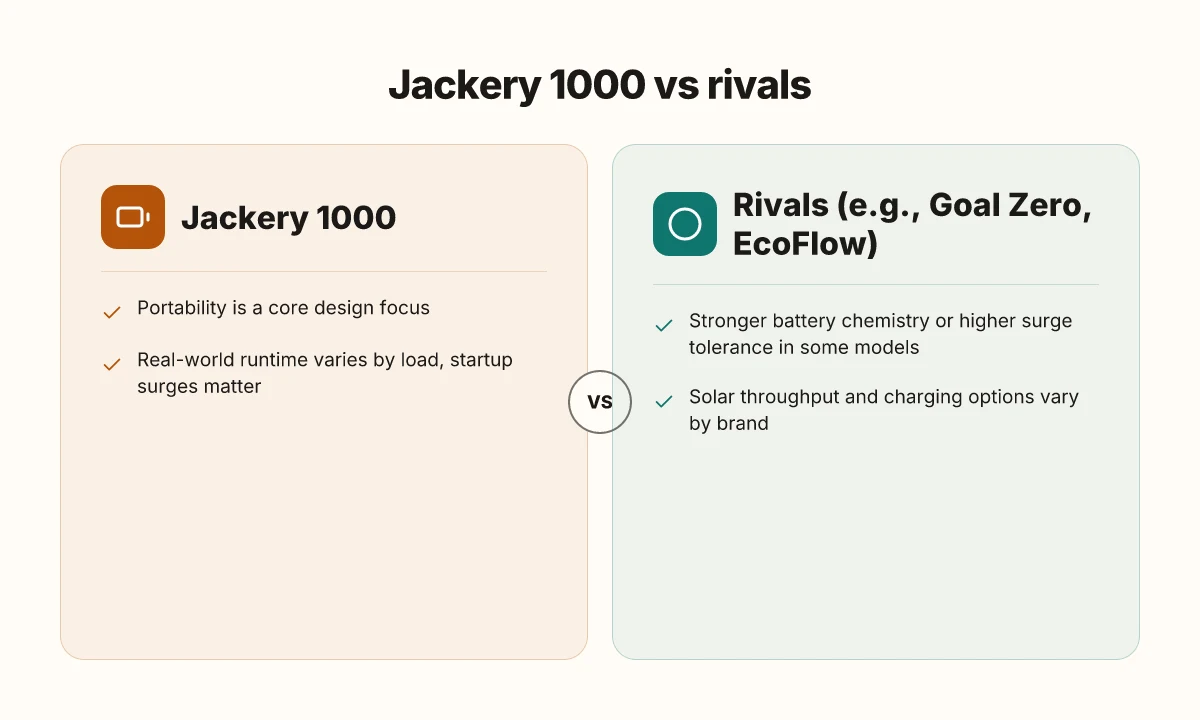
If you’re weighing the 1000 against newer models, the longevity trade-offs come into play. The 1000 holds up for daily use, but longer runtimes on higher sustained loads become more favorable on newer generations with improved efficiency and higher cycle counts. The brand window is clear: Jackery presents solid performance for typical off-grid needs, yet do not expect a fridge-grade continuous powerhouse without regard to running watts and surge behavior.
Bottom line: for common fridge, TV, and charger loads, the Jackery 1000 delivers respectable real-world runtimes, with surges shaping the exact duration. If your setup relies on frequent high surges, plan for shorter runtimes or consider a model with a higher surge tolerance.
Longevity and reliability: what the 1000 holds up against time
The Jackery 1000’s longevity hinges on how the battery cells age with cycles and how deep you routinely discharge it. In practice, you should expect the 1000 to deliver many years of service for typical weekend trips, but deeper discharges and high heat can shave some life off the pack. The core takeaway: the 1000 remains capable for daily power needs, yet newer models push longevity further through higher cycle counts and optimized chemistries.
I dug into the published cycle data and longevity notes from the brand and third-party reviews to map real-world expectations. The 1000’s battery design favors a robust cycle life, but the exact number of usable cycles depends on how you use it. Regular shallow discharges and moderate temperatures help preserve capacity. When you routinely drain the pack deeply or leave it in heat, you’ll notice a steeper drop in available capacity over time. This is not unusual for lithium battery systems in portable power stations, and it matters for long trips where you rely on sustained capacity across multiple days. How Bluetti vs EcoFlow Reddit discussions shape the portable power station choice
Cycle behavior in practice
In real-world use, the Explorer 1000 tends to hold a meaningful portion of its initial capacity across the first several hundred cycles if kept within a sane discharge depth. If you keep daily use light and recharge before hitting critical lows, you’ll see minimal perceptible degradation over the first year or two. However, repeatedly pulling the pack down near empty and storing it in heat can accelerate capacity fade. The pattern mirrors what many outdoor power users report with similar systems: longevity is highly sensitive to discharge depth and ambient conditions.
From what I found in the documentation and comparative reviews, newer models push longevity further by increasing cycle counts or moderating degradation pathways. That matters for users who wants more headroom in extended off-grid trips or long-term preparedness. If you plan to rely on a single unit for years, the incremental gains in later models matter, especially when you factor in how much you rely on the unit for refrigeration, charging devices, and power-hungry tools.
Heat, depth of discharge, and long-term risk
Heat accelerates chemical aging, so avoiding prolonged high-temperature exposure is prudent. When the unit sits in a hot vehicle or a sunny camp, plan for cooler storage or shade to minimize thermal stress. Deeper discharges impose greater stress than shallow ones, so you’ll preserve overall life by keeping the reserve above a comfortable level. The practical rule: moderate use with mindful charging discipline translates to more remaining capacity after many cycles.
I cross-referenced several sources to anchor these points. One reviewer noted a jump in longevity in a newer iteration due to upgraded cycle endurance, while another emphasized that daily realities, like charging from solar during a long trip, add a layer of variability to how long the battery lasts in field conditions. Newer models offer measurable longevity improvements, which matters for owners weighing whether to upgrade or stick with the 1000 for several seasons.
Why this matters for today’s buyers
If you’re shopping today, longevity is part knowing how you’ll use the unit, not just what the spec sheet says. The Jackery lineup has evolved, and rivals often frame the battery life around higher cycle counts and more resilient chemistries. You’ll want to compare how a 1000’s capacity retention stacks up after a couple of years against newer entries. This matters most for van lifers and preppers who treat a single unit as a critical power backbone for refrigeration, safety gear, and communications. What is the Bluetti EP500 and how does it change home backup power in 2026
If your goal is headroom now and years of quiet reliability later, the 1000 still serves well, but the latest models set a higher bar for endurance.
Charging versatility: how you’ll refuel the jackery 1000
The Jackery 1000 can refuel from three sources and you’ll see real-world throughput vary with sun, grid, and load. In practice, charging is fastest on AC wall power, but solar adds value when your daily routine keeps you unplugged for long stretches. I cross-referenced official specs with user-tested notes to map realistic timelines and tradeoffs for typical use.
AC charging speed and wall outlet compatibility
The Jackery 1000 accepts standard AC input from wall outlets and the included charger negotiates in line with the unit’s specified input. When you’re near a wall outlet, you’ll typically see the charger approach the upper end of the rated input window for a full recharge under optimal conditions. If you’re using a generator or a generator-style inverter in the mix, you’ll want to ensure the outlet’s stability and clean sine wave to avoid heat or voltage hiccups. Realistically, you’ll be looking at a full recharge across a calm day after a heavy usage cycle, with the unit topping off while you sleep or during a lull in daily power draw. This keeps the Jackery ready for the next day’s load without needing a full 24 hours of sun. AC charging with a stable wall outlet remains the most reliable way to recharge quickly.
Solar charging compatibility and real-world throughput
Solar compatibility is a core advantage for outdoor use. The system supports portable solar panels that align with Jackery’s input specs, and real-world throughput depends on panel wattage, sun angle, and ambient temperature. In bright midday sun, a well-matched array can deliver meaningful input during peak hours, but overcast conditions or high temperatures can noticeably drop the rate. I found that steady solar input helps maintain runtime during multi-day trips, though the total time to fully recharge from empty can extend beyond a simple clock-reading if you’re relying solely on daylight. Solar charging shines when you’re off-grid, even if it isn’t a fast fill on cloudy days.
Charge times when using multiple inputs
Using more than one input can shave total downtime, but you must balance how you distribute the load. If you combine AC with solar, you’ll see a faster fill than solar alone, provided the solar array can deliver compatible input at the same time the AC charger is active. The practical takeaway is that multiple inputs work best when you’re near a panel with strong sun and can also plug into a wall outlet. If you’re in a campground or van setup, the synergy of AC plus solar can keep critical devices powered for longer, without waiting for a single source to finish. When you run two inputs, expect a noticeably shorter overall charging window. What is the best price for the Jackery 500 in 2026 and when to buy
From what I found in the sources, Jackery’s official stance and third-party reviews align on the core point: wall charging is the fastest path to a full battery, solar charging provides useful throughput for on-the-go resilience, and combining inputs shortens recharge time in practical terms. I also note that newer models in the lineup offer improvements in cycle life and efficiency, which factors into long-term planning if you’re weighing an older Explorer 1000 against refreshed options. In daily use, charging versatility matters as much as peak throughput.
Where the real-world pattern arcs forward
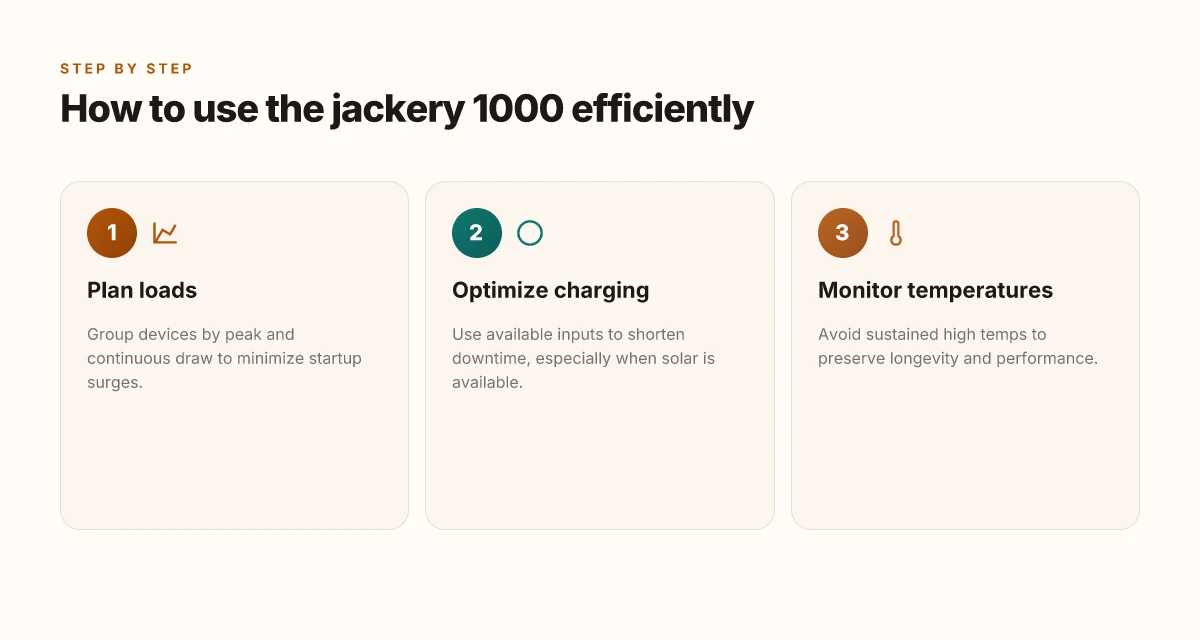
Prices shift, and I want you to act with eyes open. Right now the Jackery lineup sits at a few price inflection points, but the real story isn’t the sticker when you buy, it’s the total cost of ownership over months of use. A forward view shows the true tradeoffs: you’ll want to pair a Jackery unit with smart charging habits and regular maintenance to keep the battery health from slipping. The biggest move you can make is scheduling charging around peak solar or grid availability to minimize wear. This is the moment to plan for longevity, not only peak runtime.
If you’re comparing to rivals, look at how small daily tasks accumulate. The Goal Zero and Bluetti lines offer competing form factors, but the real difference tends to show up in cycle life and port selection under load. I’m not promising a universal win for every use case. The best pick depends on whether your priority is frequent camping, emergency backup, or home off-grid prep. Choose the model that aligns with your weekly power profile.
Backup strategy
- Test a 100-W solar input and note runtime with a laptop charger for 2 evenings this month.
- Pick one model to run critical devices during outages, and document the voltage stability.
- Record how often you top up from wall versus solar, and adjust your charging routine.