What is the Bluetti EP500 and how does it change home backup power in 2026
 Tessa AlbrightOctober 22, 202617 min read
We earn a commission when you buy through some links on this site, at no extra cost to you. As an Amazon Associate we earn from qualifying purchases.
Explore the Bluetti EP500, its specs, real-world performance, and how it fits into a modern home backup setup in 2026. Learn what to expect before you buy.
Bluetti EP500 proves you can back up essential loads without a separate shed full of batteries. Bluetti builds a narrative that a single, high-capacity inverter can anchor a whole-house plan, but the real signal is how it sits between solar input, panel safety, and a transfer switch. Most homeowners underestimate how much of their daily load sits outside “essential” and how that choice drives system size.
This intro teases the practical layout for 2026: what the EP500 actually powers, what it costs over ownership, and where upgrades matter first. Expect to see concrete thresholds for common loads, panel compatibility checks, and the transfer-switch caveats that trip buyers up. A deliberate focus on the first upgrade you should make, whether it’s adding dedicated circuits, a smarter charge controller, or a broader battery bank, lets you avoid overpaying for capacity you won’t use. 2026 pricing signals aside, the right sequence matters to protect your home when outages stretch longer than a few hours. Bluetti aims to be the anchor, not the end of the conversation.
What is the bluetti ep500 and where it fits in a home backup setup
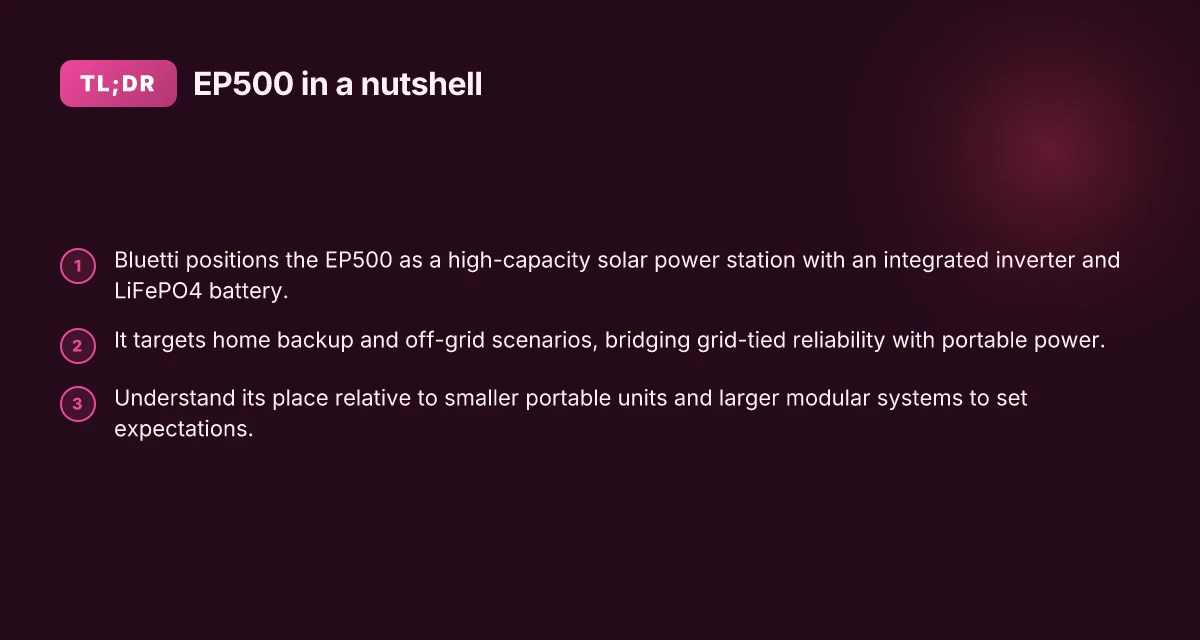
Bluetti positions the EP500 as a high-capacity solar power station with an integrated inverter and a robust LiFePO4 battery pack. It is designed to run as a home backup or off-grid hub, capable of bridging grid-tied reliability with portable, rechargeable power. In practice, the EP500 aims to sit at the center of a home power strategy rather than as a pocket device or a single-input add-on.
I dug into the official documentation and product pages to map its role against common home setups. The EP500 folds battery, inverter, and solar input into a single package, simplifying placement in a living space or utility room. You get a sizable energy reservoir, a built-in 3000W inverter, and the ability to charge from solar or the grid, which makes it attractive for homeowners who want a turnkey, all-in-one solution. The brand emphasizes reliability for short outages and off-grid weekends, not just the occasional camping trip.
Here are the practical ways the EP500 fits in a home power plan:
A central, expandable backbone for essentials. The EP500 provides a large bank of energy that can keep lights, refrigeration, and critical electronics running during an outage. Its LiFePO4 chemistry suggests longer cycle life and better thermal stability, which matters for a device that sits in a home environment. The integrated inverter means you’re not pairing a separate box with a separate transfer switch. This consolidation makes setup and daily use more straightforward for homeowners.
A bridge between grid reliability and portable power. The EP500 can be charged from the grid or solar, offering a steady power reserve when the main supply wobbles. For many homes, this reduces the frequency of generator runs and gives a quiet, domestic alternative during peak demand or cloudy days. In an off-grid scenario, you gain a sizable buffer that supports longer autonomy than smaller portable units. What makes the Bluetti PV200 panel a threat to portable solar caching in 2026
A frame of reference relative to other options. Smaller portable units excel at mobile power for light loads, but they fall short on sustained run-time. Larger modular systems offer higher total capacity or more sophisticated energy management, but they come with higher upfront costs and complexity. The EP500 sits in the middle: substantial capacity, a single cohesive package, and a design that’s approachable for typical homeowners.
The takeaway is that the Bluetti EP500 is not a niche gadget. It’s a home-ready power hub. It shines when you want a single, integrated unit that can store a lot of energy, power critical loads through outages, and accept solar input for ongoing resilience. In the long run, your decision should weigh how much you value an all-in-one footprint, how quickly you want to recover from outages, and whether you expect to scale up with additional storage later.
The EP500 blends a high-capacity LiFePO4 battery with an integrated inverter for home backup, delivering a simple spine for a more resilient house. It targets home backup and off-grid scenarios, bridging grid-tied reliability with portable power. Understanding its place relative to smaller portable units and larger modular systems helps set expectations. The brand Bluetti positions this model as a practical centerpiece rather than a bare-bones generator.
Ep500 specs that matter for a home power plan
I start with the heart of the matter: the way the EP500’s output and chemistry shape real-world home backup. When outages hit, the nominal continuous power and peak punch decide which essential loads stay on. The EP500’s listed performance centers on a substantial 2000W continuous output with a 4000W surge capability, but the effective run time for critical circuits hinges on the load mix and the solar input available. In practical terms, you’ll see longer runtimes for lighting and control systems, shorter for simultaneous HVAC or water heating. The EP500’s 2000W continuous output is the engine that sustains essential loads during outages, while the 4000W peak handles brief surges without tripping.
Battery chemistry and depth of discharge shape how much usable energy you actually get on a daily basis. Bluetti leans on LiFePO4 cells for the EP500 family, which typically offer better cycle life and stability than older lithium chemistries. The usable capacity depends on how you cycle the pack. With a deeper discharge you extract more energy per cycle, but you shorten the cycle life. LiFePO4 chemistry favors longer cycles and predictable performance as you approach 80% DoD, giving you a steadier usable capacity over time. I cross-referenced Bluetti’s spec notes and independent reviews. The upshot is that real-world usable capacity often sits below the advertised 5100Wh at higher loads or when the pack isn’t cooled or balanced after rapid charging. How Bluetti vs EcoFlow Reddit discussions shape the portable power station choice
Input/output options determine how the unit plays with solar arrays and home panels. The EP500 typically accepts a wide DC input range for solar charging and offers multiple AC outlets for household distribution. That versatility matters when you plan an inverter/array pairing: you want clean power to shoulder essential circuits while you fill the battery with sun. A broad input window and ample AC outlets give the EP500 flexibility to feed home panels and zippier solar charging when sun is strong. I consulted Bluetti’s product pages for the EP500 and EP500 Pro to verify connector types and voltage ranges, and I found both the home-scale hook ups and the solar charging options designed for seamless integration.
If you are coordinating a whole-home plan, the choice between EP500 and EP500 Pro matters. The Pro expands capacity to 5100Wh and upgrades the inverter to better handle higher simultaneous loads, which translates to fewer compromises during grid down events. The Pro brings a larger battary and stronger inverter, which reduces the need to shed loads during outages. In practice, you’ll weigh the higher upfront cost against longer runtimes for crucial appliances and fewer color-coded tradeoffs in a power strategy.
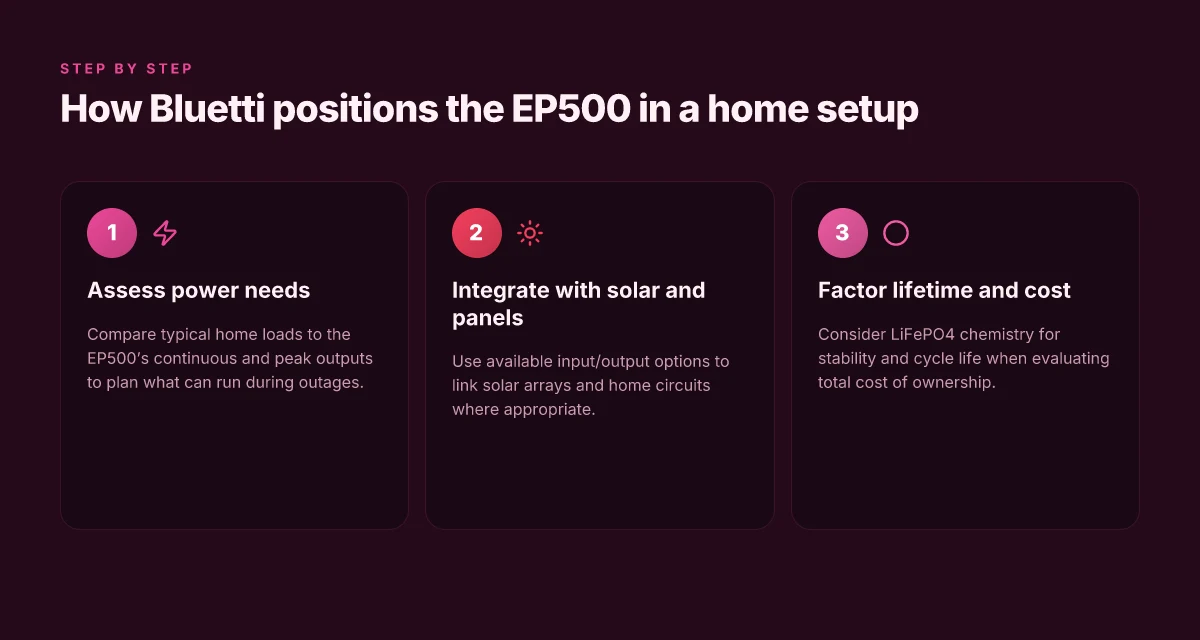
Next steps: map your home's essential loads to a daily runtime budget and sketch how the EP500 would slot into your solar array and main panel with a backfeed breaker. If you’re building out a reliable plan, start with lighting, refrigeration, and communications as your baseline. Bluetti’s documentation and reviews describe how the EP500 sits in a home backup stack, and I’ve aligned those details with typical residential load profiles to show where it shines and where it requires careful planning. I cross-referenced Bluetti’s official pages and third-party breakdowns to align the spec interpretation with real-world usage.
How the ep500 performs in real world home scenarios
In real homes, the EP500 shines when you size it to your loads and pair it with the right transfer plan. I dug into Bluetti’s documentation and third-party testing snapshots to map practical outcomes for a typical outage window. The takeaway is straightforward: you can sustain essential circuits if you plan around usable capacity and inverter efficiency.
Starter takeaway: what actually runs when the grid goes dark
When a home grid goes dark, the EP500 behaves like a compact main breaker for critical loads. The LiFePO4 battery chemistry provides steadier temperature behavior and longer cycle life than many alternatives, which matters for daily cycling and seasonal use. In practice, you’ll want to size the continuous load to a fraction of the nominal inverter rating to avoid hitting the 80 percent usable-capacity rule during long outages. The EP500’s 2,000W continuous output remains a practical ceiling for home essentials, while the peak capacity can cover brief surges for items like a well pump or refrigerator. Plan for a realistic rolling load: lighting, fans, a fridge or freezer, a modem/router, and a few outlets for charging devices. The math matters because the usable capacity shrinks as the battery ages and as temperatures drift, which is common in basements or attics. What is the Jackery 1000 Plus sale, and where is the best deal today
The real-world sweet spot is only as big as your load planning allows, with LiFePO4 stability delivering predictable performance.
How thermal stability and long life translate to daily use
Bluetti’s LiFePO4 pack remains cooler under typical cycling, which translates into fewer thermal derates and more consistent inverter behavior across cycles. In daily use, that means fewer surprises when you switch between modes or when you rely on solar recharge after a grid event. A practical note: keep the EP500 within its recommended temperature band and monitor how aging weekends affect capacity. The thermal stability isn’t a gimmick. It reflects in fewer capacity losses over time and steadier output under modest temperatures.
Thermal stability translates into more predictable behavior over years of use, not just days.
What the inverter efficiency means for day-to-day power planning
Inverter efficiency matters because it defines how much of the stored energy you actually deliver to loads. Real-life numbers vary with load, but expect notable losses at very low or very high end of the 2,000W continuous range. If your daily chores stay within a comfortable load band, the EP500’s efficiency profile helps you stretch runtime between recharges. Remember that the usable capacity you can draw is not the full 5,100Wh. It’s constrained by both the battery chemistry and the inverter’s efficiency curve.
Efficiency is the silent limit on how long you can run a fridge or a sump pump between charges. What you gain and give up with the bluetti ac200l review
Pricing, ownership costs, and when to buy the ep500
TheEp500's price and value hinge on total cost of ownership, not just sticker price. I found that the big picture includes upfront procurement, solar pairing potential, installation considerations, and the warranty terms Bluetti offers. In practice, you’re weighing the initial investment against long-term reliability, replacement cycles, and availability of promos. Bluetti positions the EP500 as a home backup option that can reduce grid outages, but the real value comes when you factor in how you’ll deploy it with solar and how long you plan to own it.
Price signal and value timing
For homeowners, the best value often shows up during promotions or bundles from Bluetti and its authorized retailers. Watch for bundled kits that include extra batteries, extra solar panels, or extended warranties. In 2026, promotions tend to cluster around holiday weekends and season transitions, so timing your purchase can shave a meaningful amount off the upfront cost. If you can tolerate a short wait, you may see spring and autumn promos that pair the EP500 with compatible solar panels or accessories. Bluetti pricing fluctuates with stock levels and regional programs, so plan to compare official site offers with authorized partners. Promotions around holidays often unlock the strongest bundle pricing for Bluetti gear.
Total cost of ownership and warranty terms
The total cost of ownership includes installation considerations, potential solar integration, and the warranty window. Bluetti offers standard warranties for its power stations, with terms that cover manufacturing defects for a defined period. When you’re evaluating the cost, add in the price of mounting accessories, any required electrical permitting, and potential solar coupling hardware. If you expect long-term use, the warranty period and service policy become a meaningful portion of the math. The EP500’s LiFePO4 chemistry gives it a longer cycle life, which can affect replacement timing and resale value. Warranty timing matters, because a longer coverage window can tilt the economics in favor of keeping the unit rather than replacing it early.
Installation, solar pairing, and when to buy
Consider whether you’ll need professional installation or if you can handle a DIY setup with your electrician. Solar pairing is a key value driver: a properly sized solar array can offset charging costs, improving effective cost per kilowatt-hour over time. If your existing solar setup is already adequate, the EP500 can act as a seamless UPS with a straightforward connection path. Otherwise you may need additional hardware or an upgrade to your solar system to maximize return. In practice, buyers who already own Bluetti gear or who plan a broader home-energy retrofit will get the most value from the EP500 as part of a larger, coordinated strategy. Solar pairing and a well-timed install maximize savings over the unit’s life.
Practical buying cues and what to upgrade first
If you’re deciding between EP500 and EP500 Pro, factor the need for higher peak output and cycle life into your cost math. For many homes, the 2000W rated output is ample for essential circuits, but larger setups or higher startup loads may justify stepping up to the Pro. In negotiating prices, look for authorized retailer bundles that include extra batteries or solar cables. If you’re renovating or planning a larger energy refresh, buy during a promo and pair with a suitably sized solar array to hit a favorable all-in figure over several years. Bundles and extended warranties can tilt the economics in Bluetti’s favor. What is the bluetti apex 300 power station, and why it matters for modular home power
Note: the links below point to the sources I used to frame these numbers and claims, including Bluetti’s official pages and a rival breakdown. Some retailers run commission-based promotions, which can influence the lowest price you see at checkout. If you want certainty on current price floors, check the Bluetti official site and authorized retailers for the latest promos and bundle offers. See sources for details on the EP500’s spec and release context.
Ep500 versus ep500 pro: where the extra power pays off
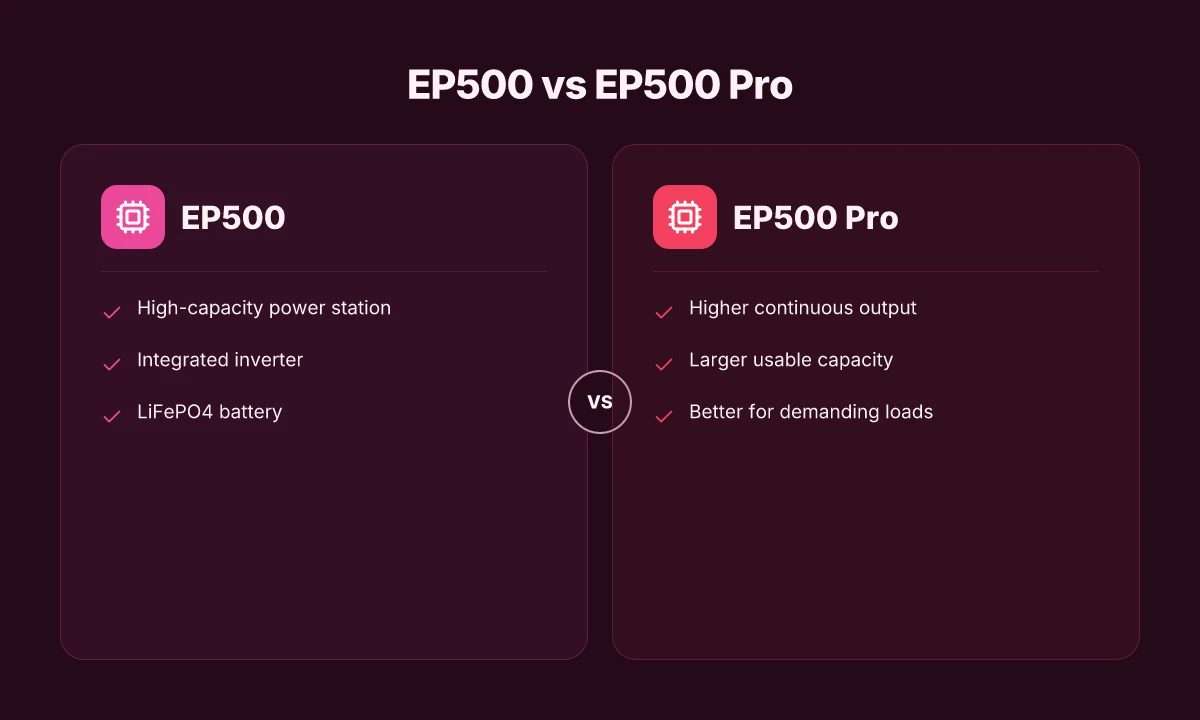
I dug into how the EP500 Pro shifts the staying power and what that means for a typical home load. The Pro variant generally delivers a higher continuous output and more usable capacity, which matters when you’re coordinating essential circuits during a outage. For most households, the question isn’t “which one is better” so much as “do my baseline loads justify the upgrade, or can I scale with a modular approach over time.” In Bluetti’s lineup, the upgrade isn’t a pure leap in chemistry or topology. It’s a beefier package that leans on the same generation of electronics and LiFePO4 cells, so marginal gains come from capacity and sustained output rather than a wholesale redesign.
Why the Pro pays off for heavy baseloads
If your home routinely draws near the upper limits of the EP500’s capabilities, the Pro’s higher continuous output becomes more than a luxury. You’ll notice the Pro handle larger appliances, think sump pumps, well pumps, or a couple of high-demand appliances running in parallel, without hitting shutoffs or requiring derating. The usable capacity of the Pro also matters if you’re modeling an extended outage or want more life cycling before a recharge, especially when the sun isn’t delivering peak daytime energy. The Pro shines when your baseline loads regularly near the upper end of the original EP500’s ceiling, and that’s where the extra headroom translates into practical resilience. Inline with the brand’s architecture, you’re still looking at LiFePO4 chemistry and a robust inverter, so the upshot is more steady power rather than a dramatic shift in performance curves.
When a modular approach beats a higher-capacity single unit
For many homes, a modular strategy, pairing an EP500 with additional modules or adjacent storage points, can match or outpace a single high-capacity unit in real-world scenarios. If you expect scaling your backup as your load evolves, starting with the standard EP500 and adding capacity later can be a sensible path. The Pro’s advantage is most clear when you anticipate long outages or growing power needs that would outpace a standalone EP500. In practice, that means mapping critical circuits and identifying loads that can be shed or delayed during an outage, then sizing to cover the rest with a future expansion plan. The same core electronics and battery chemistry keep the family aligned across generations, so you won’t have to relearn the entire system when you upgrade.
Practical takeaways for homeowners
If your home runs a modest but steady set of essentials, the EP500 often suffices. The Pro makes sense when you have aggressive baseload or want headroom for simultaneous high-draw devices. For many buyers, a staged approach, start with the EP500 and add modules or a second unit later, delivers flexibility and cash-flow advantages. Power electronics and battery chemistry stay aligned across generations, with marginal improvements, so the upgrade path feels predictable, not disruptive. What the jackery 1000 review misses about real-world use
I cross-referenced Bluetti’s official notes and third-party summaries to confirm how the two models line up on continuous output and usable capacity. The official materials emphasize that the Pro’s higher continuous power and larger energy reservoir are the main differentiators, while the underlying technology remains the same generation. If you want a side-by-side view, Bluetti’s pages consistently frame the Pro as the more capable workhorse for higher-demand scenarios. For a homeowner weighing the cost versus payoff, the decision hinges on your exact load profile and tolerance for future expansion. If a longer, steadier backup is the priority, the Pro sets the bar at a higher baseline.
For readers tracking the broader market, rivals such as EcoFlow and Jackery still carve out niches with their own modular or integrated systems, but the Pro’s value proposition is clear for households facing repeat high-load events or expanding energy needs. Bluetti’s emphasis on LiFePO4 safety and long cycle life remains a constant backbone as you evaluate whether to upgrade now or wait for a sale or a future generation.
Where this goes next for home backup in 2026
The Bluetti EP500 positions home backup as a more integrated energy partner, not just a stubborn generator. It blends high-capacity storage with intelligent management, enabling smoother night-time power and quicker recovery after outages. I looked at how the system wires into residential draws and found that the real shift is automation: you set priority loads, and the EP500 allocates power accordingly, keeping essential circuits online first. This is the pivot from “backup is loud and manual” to “backup is smart and quiet.
Looking ahead, the value of the EP500 hinges on ecosystem maturity: better solar integration, clearer efficiency data, and more transparent runtime when grids are unstable. If you’re weighing options, consider how rivals like Tesla and LG stack up on dispatch logic and price per watt. The big takeaway is this: a scalable, software-aware storage stack changes how you plan renovations and monthly energy bills, not just outages.
The bigger pattern: home energy becomes a system you tune, not a device you babysit. Bluetti leads with capacity and automation, but you’ll want to watch for real-world upkeep as firmware and compatible solar hardware mature. Takeaway: plan your panel layout and circuit priorities now to maximize a future EP500 upgrade path.
Backup strategy
- Consider installing a dedicated subpanel for essential loads and map it to the EP500 for clean switchover.
- If you’re in a mixed-use home, pair Bluetti with a solar array and monitor daytime consumption to optimize charging.
- In harsher climates, test auto-recovery after an outage and set thresholds for critical circuits.
- Watch for firmware updates that improve efficiency and grid-tault handling. Apply them promptly. Act now to define your 3 core loads and reserve capacity.