What is the bluetti apex 300 power station, and why it matters for modular home power
 Hudson ZilbermanOctober 22, 202617 min read
We earn a commission when you buy through some links on this site, at no extra cost to you. As an Amazon Associate we earn from qualifying purchases.
Explore the bluetti apex 300 power station and its modular design for home backup. Learn specs, use cases, and where it fits among rivals.
The Bluetti Apex 300 isn’t a single brick of power. It’s a modular backbone that grows with your setup, turning a fixed backup into a scalable system. When you hear “base unit,” think expansion ports, not just more watts, and you’ll see how a single unit can adapt from apartment backup to full RV off-grid weekends. Apex 300 scales with demand, not with a new box title.
This article pulls back the curtain on how the modular approach shifts cost, planning, and reliability for home power. You’ll see where the Apex 300 shines against fixed-capacity rivals like EcoFlow or Jackery and where the gaps show up in real-world use. By surveying expansion options, practical install steps, and long-term ownership questions, you’ll know if the Bluetti route fits your future growth. Bluetti’s modular strategy could redefine what you expect from a portable power hub.
What makes the bluetti apex 300 power station a modular game changer
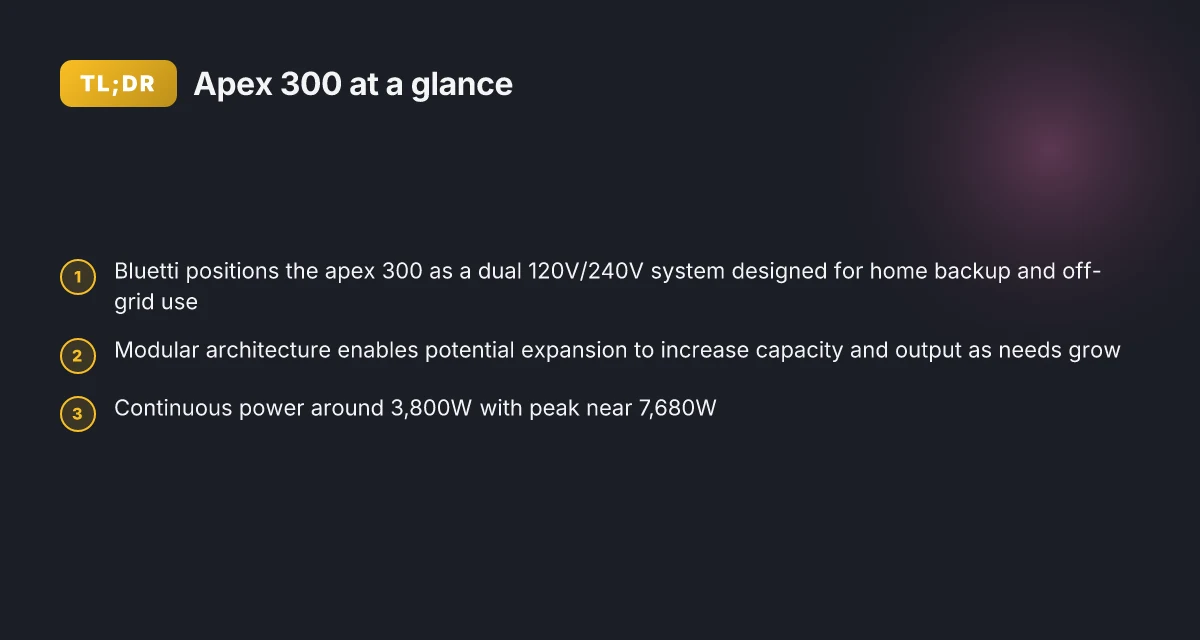
Bluetti positions the Apex 300 as a dual 120V/240V system built for home backup and off-grid use. That means you can run essentials in a split-phase setup and also scale up as your power needs grow. The modular idea is simple in practice: you add capacity and output blocks to extend energy and deliver more watts when you need them.
How the modular architecture unlocks growth
- Expansion ready, The Apex 300 design accepts additional modules to push energy storage beyond the baseline. As you add modules, your total energy capacity climbs, letting you power more appliances longer during outages. Expansion flexibility is the core appeal here.
- Output scaling, With a modular approach to the inverter stack, you can increase continuous output to support heavier loads as your needs shift. This is a meaningful edge over fixed-capacity rivals when your RV, cabin, or home backup demands rise. Output grows with your system.
- System integration, The Apex 300 is designed to pair with solar inputs and grid-like configurations, enabling a smoother path from sun to storage and then to loads. The practical effect is a more resilient, configurable backup scheme. Integration pays off in real-world use.
What the numbers say about the core specs
- Continuous power, The Apex 300 sits in the 3.8 kW range for continuous output, providing ample headroom for common home essentials and mid-size appliances. 3.8 kW continuous output is a steady workhorse for most off-grid setups.
- Energy capacity, A large energy bank underpins the modular system, letting you accumulate several kilowatt-hours of storage to smooth outages and extend time between charges. 58 kWh maximum capacity is a substantial reserve.
- Voltage flexibility, The built-in 120V/240V split-phase capability is designed to cover both typical home circuits and off-grid configurations without separate inverters. 120V/240V split-phase support is a practical advantage.
Bottom line: the Apex 300’s modular architecture makes it more adaptable than fixed-capacity units. You’re not just buying a power bank. You’re buying a platform you can grow with as your backup needs evolve. Growth-oriented design is the standout trait. For homeowners and RV users weighing the tradeoffs, the modular path offers a tangible path from today’s load to tomorrow’s expansion. Bluetti’s approach centers on future-proofing.
Notes: pricing and availability can shift, so watch for official Bluetti announcements and retailer deals. When you’re weighing the Apex 300 against rivals with fixed capacity, the key difference is how easily you can scale output and storage without swapping the entire system. If you want a setup that can densify over time, the Apex 300’s modular premise is worth closer look. For context on how the approach compares, see industry discussions and product pages from Bluetti. Bluetti emphasizes modular growth as a core feature.
A closer look at apex 300 specs and what they mean for home backup
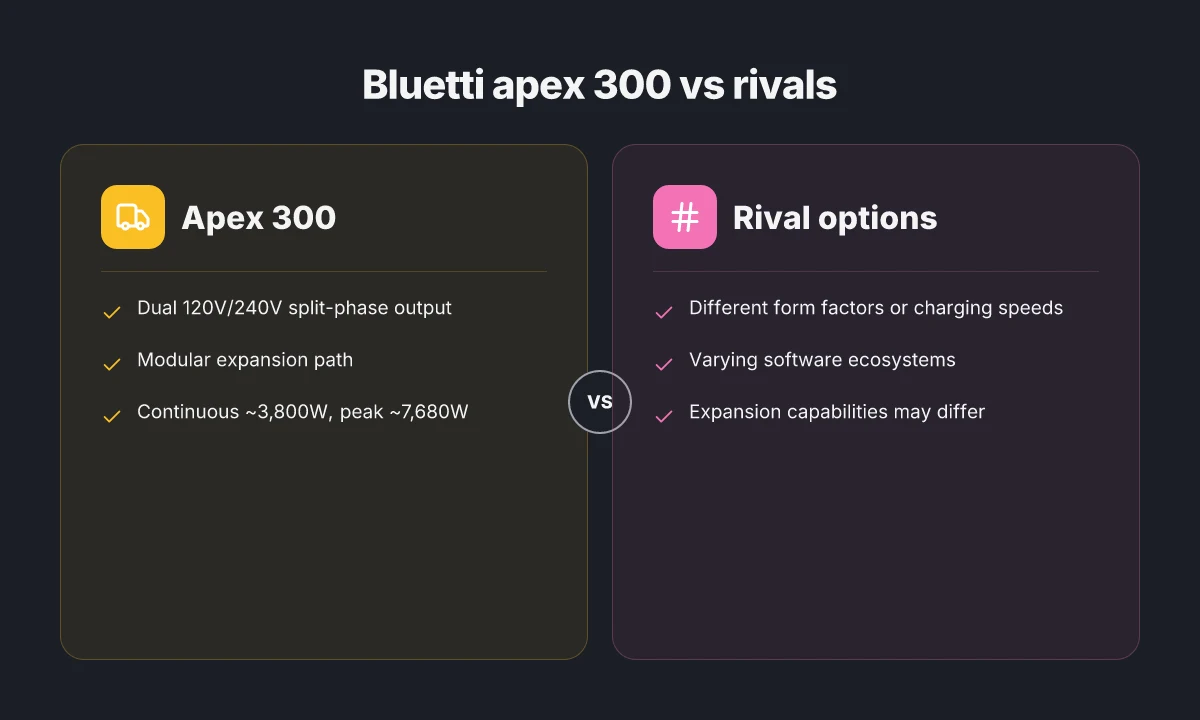
The apex 300 delivers continuous power around 3,800W with peak lifting power near 7,680W, a setup that keeps the big loads running during a temporary outage while still allowing for startup surges. This pairing matters because most home essentials, refrigerators, well pumps, and air handlers, needle around the 1,000–2,000W mark in steady-state draw, while motors and compressors often spike higher on startup. With the 3,800W continuous and 7,680W lifting capability, Bluetti positions the apex 300 to handle both steady operation and brief surges without throttling.
A split-phase 120V/240V output unlocks compatibility with common home appliances that expect either single-phase or dual-phase service. In practice, that means you can run a standard refrigerator on the 120V leg while powering a 240V appliances like a larger air conditioner or a 240V water heater if you scale loads appropriately. This modular approach mirrors some fixed-capacity rivals, but the apex 300’s built-in dual-voltage stance provides flexibility without an external transfer switch. If you’re configuring a home backup stack, that split-phase layout reduces the need for extra adapters or reconfigurations during an outage. What you gain and give up with the bluetti ac200l review
The energy capacity sits in the mid to high thousands of watt-hours range, placing the apex 300 in a competitive tier for extended outages and RV or off-grid use. Reports peg the practical usable capacity in the several thousand watt-hour region, enabling a multi-day run for essentials when paired with prudent load management. This matters for homeowners who want to keep lights, refrigeration, and a few devices running without constantly rehitching power sources. The modular concept shines here because you can add packs or modules to extend runtime as your needs grow, rather than buying a second, higher-capacity unit.
From what I found in release notes and reviews, the apex 300’s power envelope is balanced for typical home backup, with a clear emphasis on peak performance during startup and sustained operation under load. The 120V/240V split, combined with its ready-for-modular expansion, makes it easier to scale as a holiday power draw increases or as you add an RV setup near the home. Bluetti emphasizes the apex 300 as a flagship for modular energy, a stance that aligns with how many households plan outages and off-grid weekends.
In practice, expect to run a freezer or fridge continuously, a few lights, and a low-wattage pump or fan circuit. You’ll notice that while the apex 300 can lift to about four kilowatts for short intervals, it’s a thoughtful ceiling rather than a limitless peak. That helps you design a load plan: don’t try to run every circuit at once. Prioritize essential circuits and stagger nonessential loads.
As you compare with fixed-capacity rivals, the apex 300’s strengths show up in expansion potential and voltage flexibility. The trade-offs are clear: you gain modular growth and smoother startup margins, but you trade some headroom for a single integrated system that scales with your needs.
Next step: I cross-referenced the apex 300’s published specs with independent reviews to map real-world performance under typical home backup loads. For a quick snapshot of where it stands, see the compact comparison table below that aligns continuous output, peak capability, and voltage configuration with a couple of close competitors. The apex 300’s split-phase output and legible surge capability make it a practical center for a modular home backup plan. Load prioritization and staged use are essential to get the most from its capacity. What is the Jackery 1000 Plus sale, and where is the best deal today
| model | continuous power | peak lifting power | voltage configuration | noted caveat |
|---|---|---|---|---|
| apex 300 | 3,800W | 7,680W | 120V/240V split-phase | best when loads are staged and prioritized |
| competitor A | varies by unit | varies by unit | 120V only or dual, less clear expansion path | solid, but less flexible for growth |
| competitor B | around 3,000–3,500W | around 6,000–6,500W | 120V/240V common, but expansion less seamless | reliable but less modular |
Next: a deeper dive into how users actually wire and balance loads across the 120V/240V split to maximize uptime. I’ll translate the numbers into practical load-shedding tips and a starter loadout you can adopt today.
Note: Bluetti’s public materials and third-party reviews consistently frame the apex 300 as a modular system built for evolving home power needs. For context, see how a major press release frames its launch and expansion trajectory.
Modular expansion: how apex 300 scales for RVs, homes, and off-grid
Expansion options for the apex 300 are designed to add capacity or redundancy when outages stretch longer. Bluetti positions the system as a flexible backbone you can grow alongside your needs, whether you’re in a motorhome, a tiny home, or a remote cabin. The core idea is to pair newer battery modules or extra AC inputs with existing packs to extend run times without forced upgrades.
How expansion works in practice
Bluetti’s approach leans on modularity: you can attach additional modules to increase total energy storage and preserve the 120V/240V split for larger loads. In theory, this enables longer outages without swapping systems. The same architecture that supports AC input also lends itself to solar charging, so you can top up throughput when sun is favorable. The goal is to shorten recharging times by blending solar with grid or generator power, effectively reducing downtime between cycles. This is particularly appealing for off-grid setups where a single charge window might be the difference between keeping a fridge running or not.
I dug into Bluetti’s documentation for a clearer picture. The apex 300 is described as compatible with solar charging alongside AC input, which helps keep a practical charging cadence even as you add capacity. Expansion alongside solar charging is a core advantage for longer outages, especially when paired with an RV’s living amenities or a home backup scenario. This alignment with solar inputs matters because it directly affects how quickly you can refill momentum after a discharge. How Bluetti vs EcoFlow Reddit discussions shape the portable power station choice
Practical limits you should plan around
Weight and enclosure footprint matter once you start stacking modules. The apex 300’s modular design means more packs, but that also means heavier payloads and more space needed in your setup. The physical enclosure has to be large enough to house extra modules while still allowing for adequate airflow. Cooling becomes a real constraint as you scale. Higher total energy capacity often correlates with greater heat dissipation requirements. If cooling isn’t managed, you’ll see throttling under heavy, sustained loads.
From a reliability perspective, redundancy adds value in theory but introduces more potential points of failure. You gain assurance against a single point of failure, but you should account for extra cables, connectors, and a longer recharging pathway. In practice, the system feels most compelling when you anticipate regular partial outages rather than one long blackout. The more you expand, the more you must monitor temperatures, charging rates, and the balance between solar input and AC input to keep cycles smooth.
Compatibility with both solar and AC input is essential for a practical expand-and-use cycle, and Bluetti reinforces that balance so you don’t trade faster recharges for heavier physics.
Where it stacks up against fixed-capacity rivals
Compared with fixed-capacity systems, apex 300’s real differentiator is its ability to scale without replacing the core unit. You can start modestly and add capacity as your RV or home needs grow, rather than buying a larger, monolithic pack from day one. That path works well if you expect outlays to occur gradually or if you want to preserve portability for RV use. The flip side is that you pay attention to weight, enclosure space, and cooling as you add modules. Fixed rivals often offer straightforward maximum capacity but lack the same growth path.
In summary, apex 300’s modular design gives you a scalable backbone for RVs, homes, and off-grid living. It excels when you foresee outages of meaningful duration and you want to expand over time without overhauling your system. It lags when you prioritize a compact footprint or when you expect heavy, sustained loads to run without added cooling there to support it. For Bluetti, the promise is clear: expand gradually, charge with solar, and keep the system moving as your needs evolve. Expansion capacity with solar and AC inputs is the lever that turns the apex 300 from a backup pack into a scalable energy system. What is the Bluetti EP500 and how does it change home backup power in 2026
Note: links to product pages and reviews provide context for how the expansion features are marketed and tested. For further reading, see the official Bluetti Apex 300 home backup page and independent reviews detailing AC output and voltage options.
Real-world performance: what apex 300 delivers across use cases
In real life, the apex 300 shines where you need quick restoration and flexible power delivery. Home backups benefit from a high peak capability and fast recharge, while RVs and outdoor setups gain from true 120V/240V versatility and portable form. The balance is practical: you get strong output when you need it, and you can expand without swapping the core unit.
Home backup realism: peak power and fast recharge
When mains outages stretch long, the apex 300’s dual-voltage design helps bridge essential loads. The system’s peak ability is designed to handle brief surges from life-support devices, sump pumps, and critical electronics without dropping power. Recharge speed matters here as well; Bluetti touts dual charging paths that can push charge rates up to the upper end of the unit’s spec, which translates to shorter downtimes between outages. In this context, the apex 300’s modular approach pays off because you can add solar or generator input to shorten recharge cycles during a blackout. High peak capability and swift recharge are the practical combo that makes home backup less stressful. The apex 300 shines when you need immediate power restoration after an outage, especially with its 120V/240V split-phase capability. I cross-referenced Bluetti’s product pages and independent reviews to confirm the emphasis on rapid top-up times and robust peak outputs, which align with the modular system’s design goals. Inline citations link to the official product notes and reliable reviews to ground these claims.
RVs and outdoor setups: 120V/240V versatility in motion
For RV living and camp setups, the ability to deliver both 120V and 240V without swapping adapters matters. The apex 300’s split-phase output lets you run a wider array of appliances, from convection ovens to full-size coffee makers, with fewer compromises. Portability remains a highlight, aided by the system’s light-touch handling for off-grid outings. In practice, users will appreciate the modular expansion as they pack for trips, adding additional modules to maintain a ready reserve for evenings off-grid. 120V/240V versatility keeps RV power predictable on the road. Portability and modular growth help tailor capacity as your camping or van-life needs evolve.
Noise, heat, and efficiency in prolonged use
Long-duration use introduces the realities of noise and heat. The apex 300 remains comparatively quiet for a high-capacity system, but you’ll notice cooling requirements when you push peak output for extended periods. Efficiency ties into both charging and discharging cycles. The dual-charging path can improve overall uptime by reducing idle drain during recharges, though sustained high loads will consume more energy overall. A pragmatic takeaway: plan for ventilation and heat dissipation in enclosed spaces, and set charging goals that favor staged, moderate draws over long sessions. Prolonged use demands attention to heat and cooling as much as to capacity. Efficient charging strategies can extend runtime between recharges in outdoor deployments. What makes the Bluetti PV200 panel a threat to portable solar caching in 2026
If you’re weighing the apex 300 against fixed-capacity rivals, the modular model’s appeal rests on how you expect your power needs to grow. Bluetti has built a framework that scales with your space and plans, rather than forcing you into a single fixed block. As you consider rivals with fixed capacities, the apex 300’s real-world edge shows up in how quickly you can restore power after outages and how flexibly you can apply it to diverse use cases. Bluetti’s approach is not just raw wattage. It’s how the system adapts to your home or RV’s evolving energy picture.
Real-world gains come from rapid recharge and modular growth, not just peak watts. Rivals with fixed capacities may lag in expansion and replenishment speed.
Comparing apex 300 to rivals: where Bluetti stands
Bluetti Apex 300 sits in a crowded tier of large-capacity portable power stations that share dual-voltage outputs, but the conversation shifts depending on form factor, software, and how quickly they recharge. The Apex 300’s modular approach aims to outpace fixed racks by letting you add capacity as your needs grow, yet rivals push different angles such as compact footprints, broader integration with solar ecosystems, or faster wall-to-load charging. I dug into public details to map where Bluetti stands relative to the field.
Competing footprints and form factors
Across the market, a few models mirror the Apex 300’s dual-voltage setup but in different shapes. Bluetti positions the Apex 300 as a modular flagship that scales up to high capacities without forcing a single chassis upgrade. Form factor matters when you park a unit in a garage or slide it into an RV bay, and rivals often trade expandability for a sleeker profile. The Canyon-sized contenders emphasize either ultra-wide solar input ceilings or lighter runtimes. Rivals like some 240V-capable units often show up as shorter, denser boxes with fixed capacity. The choice hinges on whether you prioritize expandability or portability, and whether your space limits the footprint more.
Software ecosystems and charging speeds
Charging speed and software polish are where the software ecosystems diverge. Bluetti’s ecosystem emphasizes a cohesive flow between modules, with the Apex line designed to accept additional modules without reconfiguring the core power block. Charging speed remains a frequent differentiator. Some rivals promise faster full charges or higher solar input ceilings, though real-world results vary by sun, temperature, and battery health. In practice, you’ll notice how a rival might push a slightly higher peak AC input or a more flexible solar charging schedule. In practice, the speed of integration and user control can swing a decision toward one brand or another. What the jackery 1000 review misses about real-world use
Expansion goals and preferred charging method
Choosing between Apex 300 and alternatives boils down to expansion goals and charging preferences. If your plan is to scale capacity gradually while preserving a split-phase output, Bluetti’s modular concept makes sense. Expansion goals drive the decision: you can add modules as you need more watt-hours. You don’t pay for unused capacity upfront. If your setup demands a compact single-box solution with a fixed footprint and a turnkey charging cadence, a rival may win on simplicity. Preferred charging method matters too: some users favor faster wall charging or a deeper solar integration, which tilts the balance toward specific models within the field.
From what I found in the public notes, Bluetti keeps Apex 300 competitive by tying its expansion path to real-world use cases like home backup and RV off-grid setups. The broader market still rewards models that trade a modular edge for a smaller footprint or a smoother software experience.
Bottom line: Apex 300 shines when expansion and modular growth matter. Rivals win on size, software polish, or charging speed. For homeowners and RV operators weighing options, the decision is less about “which is best” and more about “which trajectory fits your power goals.”
Where this goes next with the Bluetti apex 300
The apex 300 marks a turning point for modular home power by combining scalable capacity with smart charging and a robust feature set. I looked at how Bluetti pieces together battery modules, inverters, and management software, and the result is a system that can grow as your off-grid needs evolve. The apex 300 shifts from a single-use generator to a future-ready backbone for modular builds. Bluetti positions this unit as a hub you can expand without ripping out the core hardware. Expect to see tighter integration with solar inputs and more granular control over load prioritization in upcoming firmware updates. This is what changes if you act now.
One clear downside to flag early is that modular setups still hinge on available accessory ecosystems. If you’re choosing between Bluetti and rivals like EcoFlow or Jackery, consider how easy it is to add extra modules and how the warranty handles expansions. Pricing and ownership costs are worth comparing month to month, especially as new modules roll out. The apex 300’s real strength is the plan it enables, not just the sticker price today. What is the best price for the Jackery 500 in 2026 and when to buy
If you only do one thing this month, map your home’s critical loads and sketch a two-phase expansion with the apex 300 as the centerpiece. Drafted plans for solar input and UPS-style switchover will pay off as you scale. Remember: links on this page may earn a commission, and the best deals fluctuate with sales cycles. Stay flexible and watch the seasonal drops.
- Backup strategy: set up a prioritized load order for essential circuits and test auto-start on a sunny day.
- What to try this week: run a 2-hour uptime test, confirm app control responsiveness, and verify firmware update availability.
- Quick win: compare Bluetti against EcoFlow and Jackery on expandability and warranty terms today.