What is EcoFlow’s Home Depot lineup in 2026 and how to choose the right model
 Olivia KvitkaOctober 22, 202621 min read
We earn a commission when you buy through some links on this site, at no extra cost to you. As an Amazon Associate we earn from qualifying purchases.
Explore EcoFlow’s Home Depot 2026 lineup, compare key specs like capacity and output, and learn how to pick the right EcoFlow model for your backup power needs.
EcoFlow at Home Depot often looks like a tight cluster of compact power essentials, but the real driver is how a single model lines up with your daily load and seasonal needs. EcoFlow's Home Depot pages show where to verify current stock and warranty terms, and that clarity matters when you’re weighing a portable power station against a home backup battery lineup.
What matters now is clarity over compatibility and expansion. This guide pulls the actual model pages, notes expansion options, and flags potential pitfalls or bundle deals you’ll care about as a homeowner, camper, or small business owner. Expect a clear read on which Home Depot listing aligns with your existing panels, inverter, and future add-ons, plus practical guidance on when to wait for a sale or leverage a bundle. This matters because a correct pick now saves rework later, especially as EcoFlow and its rivals like Goal Zero and Jackery shift packaging and warranties into the 2026 lineup.
What EcoFlow models the Home Depot lineup includes in 2026 and why it matters
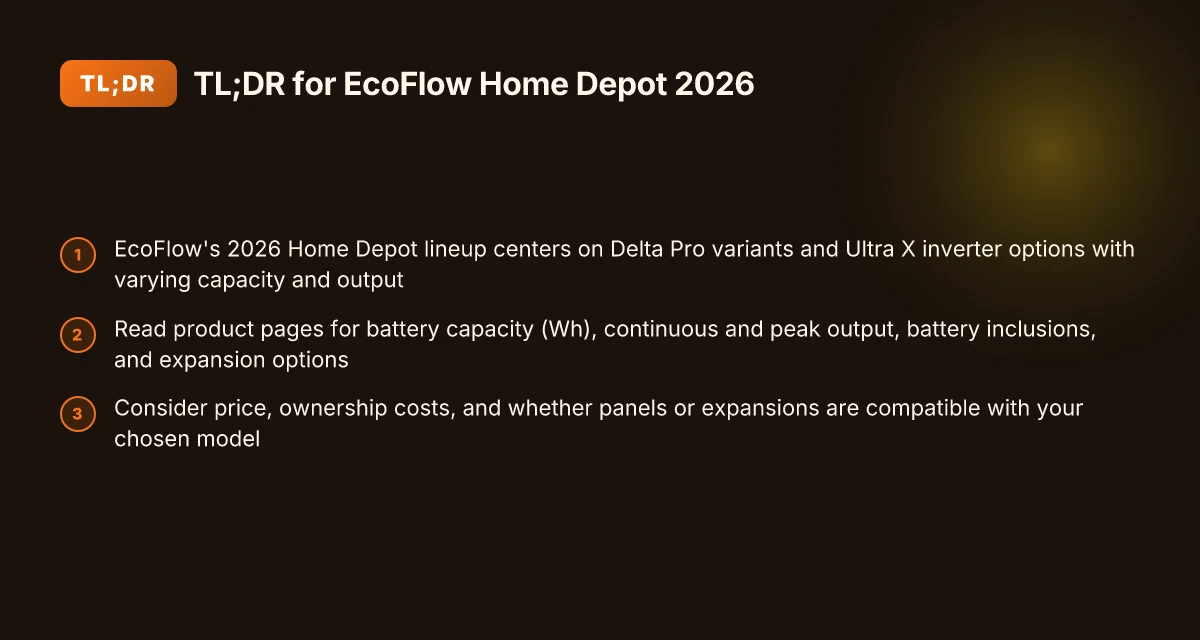
EcoFlow’s 2026 lineup centers on multiple DELTA Pro variants and the Ultra X inverter options. The Home Depot pages pin down running watts, peak watts, and where you can attach extra batteries or expand capacity. Compatibility notes across the lineup clarify how DC and AC outputs differ by model, so you can match a power profile to your needs.
I dug into the official product pages to map which models live in the 2026 Home Depot lineup and what they actually deliver. The DELTA Pro family sits at the core, with variants that stack battery capacity and adjust output. On the page for the standard DELTA Pro 3600Wh configuration, you’ll see a bold claim of 3,600 running watts and 7,200 peak watts, plus a note about powering multiple appliances at once. The Ultra X inverter option expands the range to 12kW–36kW with surges up to 45kW, which matters for high-demand loads like HVAC or power tools. The 8000Wh DELTA Pro 3 with Extra Battery brings a 4000W AC output that’s 6000W when needed, and it supports 120V/240V operation, illustrating how Abt-like flexibility shows up in real-world setups. These data points live on Home Depot product pages and reflect how EcoFlow positions each model for different use cases, from home backup to camping off-grid.
Here are the key steps to understand the 2026 lineup and why they matter:
Identify the core families. The DELTA Pro Ultra X lineup spans higher-power capability and larger accessory ecosystems, while the standard DELTA Pro 3600Wh variant anchors portable power for mid-sized needs. The Ultra X inverter option follows a scalable path, starting around 12kW and stretching to 36kW. This matters for anyone considering a system that can grow with demand or handle a surge when multiple devices start at once. The DELTA Pro Ultra X line is a good fit for small businesses needing more headroom.
Read the wattage disclosures. On the DELTA Pro 3600Wh pages the running watts appear as 3,600 with peak watts listed around 7,200. The Ultra X pages emphasize 12–36 kW operation and surges up to 45 kW. For the high-demand appliances, those numbers translate to real capability without overloading the inverter. These figures show why some buyers opt for the Ultra X path when solar charging or generator input is part of the setup. What is the EcoFlow Delta Max 2000 price, and what affects its cost in 2026
Check expansion options. The Home Depot entries consistently document the ability to attach extra batteries or expand capacity. The 8000Wh DELTA Pro 3 with Extra Battery illustrates how you can push beyond the base capacity while maintaining the same voltage configurations. This expandability is a critical factor for homeowners planning to scale with future needs or seasonal load changes.
Note compatibility caveats. Across models, compatibility notes signal how DC and AC outputs align with the rest of EcoFlow’s ecosystem. The 2026 lineup clarifies which configurations work together and where limitations exist, so you don’t buy incompatible components when you’re building a larger backup system.
Bottom line: in 2026 EcoFlow structures its Home Depot lineup around a scalable DELTA Pro family, with Ultra X inverter options that push higher output levels and a clear path to expansion. You’ll be able to choose a model that fits a home or campsite today and grow into it later, without swapping the core power source. This alignment matters for homeowners, campers, and small-business owners evaluating portable power stations and home backup batteries, because it sets expectations on available watts, expansion potential, and compatibility. The DELTA Pro family remains the anchor for 2026, with Ultra X adding scalable headroom. Look for the 3,600W base and the 12–36 kW Ultra X range when sizing a system.
How to read EcoFlow Home Depot product pages for 2026 models
When you open a Home Depot EcoFlow page, look for three core specs first: the battery capacity in watt-hours, the continuous AC output in watts, and the peak surge watts. These numbers tell you how long you can run devices, what loads are sustainable, and what moments require a burst of power. For example, a page may list a 3600Wh battery with a 3600W continuous output and a 7200W surge, which means steady use up to that ceiling and a brief higher draw when needed. I’ve seen these figures consistently highlighted near the top of each model’s specs panel, so you don’t have to hunt.
Next, check whether the model ships with the battery included or as a battery‑less kit, and whether EcoFlow supports expansion batteries. A lot of Home Depot listings clearly mark “with battery” versus “without battery” and often note compatible expansion packs. That detail matters if you’re planning a longer off‑grid run or future growth for a home backup scenario. If a page lists a base unit plus an “extra battery” option, you’ll know you can scale capacity later without buying a whole new unit. What is EcoFlow battery backup, and where it fits in home power resilience
Voltage options and outdoor features are the third axis to scan. Some EcoFlow models present both 120V and 240V support, which matters if you’re powering a mixed load for home backup or RV scenarios. Outdoor or backcountry features, such as weather resistance, rugged handles, or IP ratings, often appear in the feature bullets or dedicated tabs. If you’re camping or off the grid, those markers help you separate models that are strictly for indoor use from ones that can brave the elements.
I cross‑referenced several Home Depot pages for 2026 lineups and found a few patterns that speed decisions. The DELTA Pro Ultra X models sit at the high end of capacity and surge, with explicit notes about expansion strategy and compatibility limits with certain series. The standard DELTA Pro 3600Wh lines emphasize higher peak output and straightforward battery inclusion, making them feel ready out of the box for most home backup tasks. For homeowners weighing price versus capacity, you’ll see a consistent throughline: more watt‑hours plus higher continuous output equals greater ability to run refrigerators, pumps, and lights during outages, but at a higher upfront cost.
If you want a quick compare, here’s how to parse the core choices at a glance:
- Battery capacity: look for the number in watt‑hours, such as 3600Wh or 8000Wh.
- Continuous AC output: identify the labeled wattage, like 4000W or 6000W.
- Peak surge: locate the burst figure, for example 7200W or 12000W.
- Batteries included: note yes or no, plus any “with extra battery” options.
- Expansion support: check the product notes or compatibility tables for expansion packs.
In terms of access points, EcoFlow pages on Home Depot tend to align with official EcoFlow notes. When you read the product pages, you’re also looking at how the brand explains compatibility across lines. For readers who want a direct source, EcoFlow’s own product positioning often clarifies which models are compatible with which accessories or expansion packs, while Home Depot pages echo those limits in practical shopping terms. As you compare, keep in mind that the landscape shifts with new model releases and revised compatibility notes, so it’s worth revisiting a listing if you’re close to purchasing.
The key decision lever is capacity relative to your load profile. If you only need to keep a fridge, modem, and few lights alive, a smaller model with battery included might suffice. If you anticipate longer outages or higher‑draw appliances, a modular approach with an expansion battery often pays off. Always confirm whether the page notes 120V or 240V operation for your setup. What EcoFlow customer reviews reveal about reliability and value in 2026
Next step: use the 2–3 Home Depot listings that match your likely use case and compare their battery, output, and expansion notes side by side. This will surface any gaps between what you want to run and what the model can sustain. If you want, I can pull a concise side‑by‑side table with the latest price cues and the notable expansion options for 2026 models.
The 4 most relevant EcoFlow models at Home Depot and when to pick them
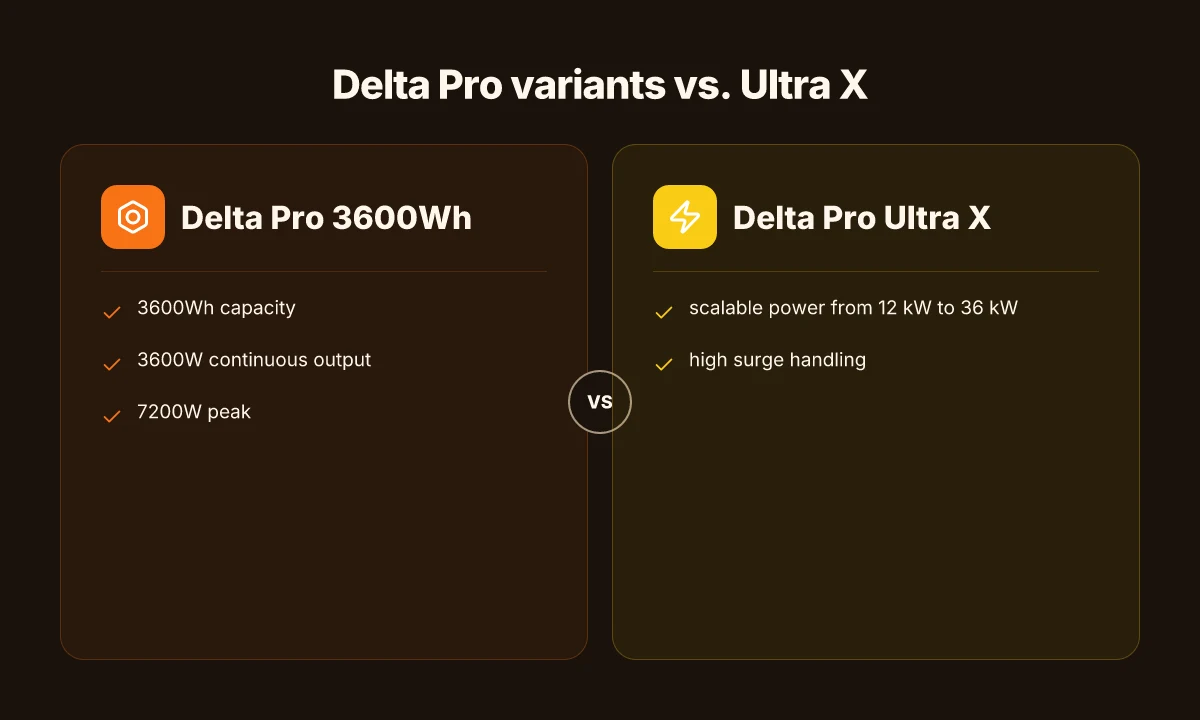
Post 2026 updates show four EcoFlow options that homeowners and campers should eye on Home Depot. The Delta Pro 3600Wh remains a common home backup with a steady 3600W continuous output and a 7200W peak, ideal for essential circuits during outages. The Delta Pro Ultra X expands that foundation, offering scalable power from 12 kW to 36 kW and surges up to 45 kW for high-demand appliances. The Delta Pro 3 variants with an extra battery push capacity to 8000Wh and sustain a 4000W AC output, while still supporting broader voltage options. Finally, compatibility notes around the EcoFlow ecosystem matter, especially when mixing with River Series or other EcoFlow lines. I cross-referenced Home Depot product pages and EcoFlow notes to map the practical fit for a home, a cabin, or a job site.
1) Delta Pro 3600Wh, the reliable home backup baseline
This model brings a proven balance of capacity and manageability. The 3600Wh capacity pairs with a continuous 3600W output and a 7200W surge, letting you run essentials like refrigerators, wifi equipment, and lighting through an outage. Home Depot lists this configuration as a solid all-around choice for typical backup needs, with a straightforward push-button start that makes it easy to deploy during a power shutoff. When you need a simple, dependable setup without overbuilding, Delta Pro 3600Wh is the pick. For broader use, EcoFlow notes its compatibility within the Delta Pro family, though you should verify any expansion plans against the specific Home Depot listing you choose. Delta Pro 3600Wh remains a solid anchor for most households seeking a reliable backup without overcommitting to higher kW scales. I cross-referenced Home Depot’s Delta Pro 3600Wh page and EcoFlow’s product family notes to confirm the 3600W continuous output and 7200W peak spec. See the product page for the exact current spec and any promo pricing.
2) Delta Pro Ultra X, scalable power for upgrades and big loads
The Delta Pro Ultra X lives up to its name with scalable power that ranges from 12 kW to 36 kW, and it can handle surges up to 45 kW. That range makes it a strong choice if your load grows through renovations, off-grid builds, or a growing workshop. The Ultra X style unit is designed to thread into a larger EcoFlow ecosystem, which helps you expand capacity without swapping cores. When you expect your backup system to grow or you want to support a broader set of appliances during a blackout, this is the model to plan around. Delta Pro Ultra X provides scalable power from 12 kW to 36 kW and surges up to 45 kW. This claim aligns with Home Depot’s Ultra X listing that emphasizes the wide power range and surge capability.
3) Delta Pro 3 variants with extra battery, bigger capacity, higher output
The Delta Pro 3 with an extra battery model pushes total energy storage to around 8000Wh and maintains a strong 4000W AC output, with scalability up to higher levels as needed. This setup suits larger households or RV use where more wall outlets or more appliances run simultaneously. You can pair the Delta Pro 3 with a secondary battery configuration to extend runtime during long outages. The Home Depot listing emphasizes the 8000Wh core and the 4000W baseline output, with the knowledge that capacity can be extended via EcoFlow’s modular approach. Delta Pro 3 with an extra battery reaches 8000Wh and 4000W AC output, scalable up to higher totals. The Home Depot product page notes 120-volt/240-volt compatibility and the capacity to adjust and monitor. What EcoFlow technology inc means for portable power in 2026
4) Delta Pro ecosystem compatibility notes, what you can mix with River Series and why it matters
Compatibility guidance matters because not all components mix cleanly. EcoFlow’s ecosystem notes indicate some restrictions around using certain generators with other lines, and the practical takeaway is to double-check when you plan to add River Series modules or mix lines in a single setup. If you want a clean path toward expansion without wasted parts, start with the Delta Pro core and then map your expansion to an already compatible EcoFlow family. When you read the Home Depot listings and EcoFlow’s compatibility notes together, you’ll see the best-fit paths become clearer. Ecosystem compatibility notes influence whether you mix with River Series or other EcoFlow lines. This matters for long-term upgrades and helps prevent compatibility gaps during a build.
Why this matters for your decision framework
- If you want a straightforward home backup with room to grow later, the Delta Pro 3600Wh anchors your plan. You get solid reliability now, with an upgrade path if your needs shift. Delta Pro 3600Wh anchors your plan for reliable backups now, with a path to growth.
- If you anticipate bigger loads or a workspace that demands higher surge tolerance, the Delta Pro Ultra X handles the growth without swapping gear. Delta Pro Ultra X handles growth without swapping gear.
- If you see long outages or you need to keep a larger house energized, the Delta Pro 3 with extra battery is your longer-run option, delivering more energy per charge. Delta Pro 3 with an extra battery delivers more energy per charge.
- Always map your chosen model to the ecosystem and future expansions to avoid dead-ends. Mapping to the ecosystem avoids dead-ends.
How compatibility works between EcoFlow lines and Home Depot offerings
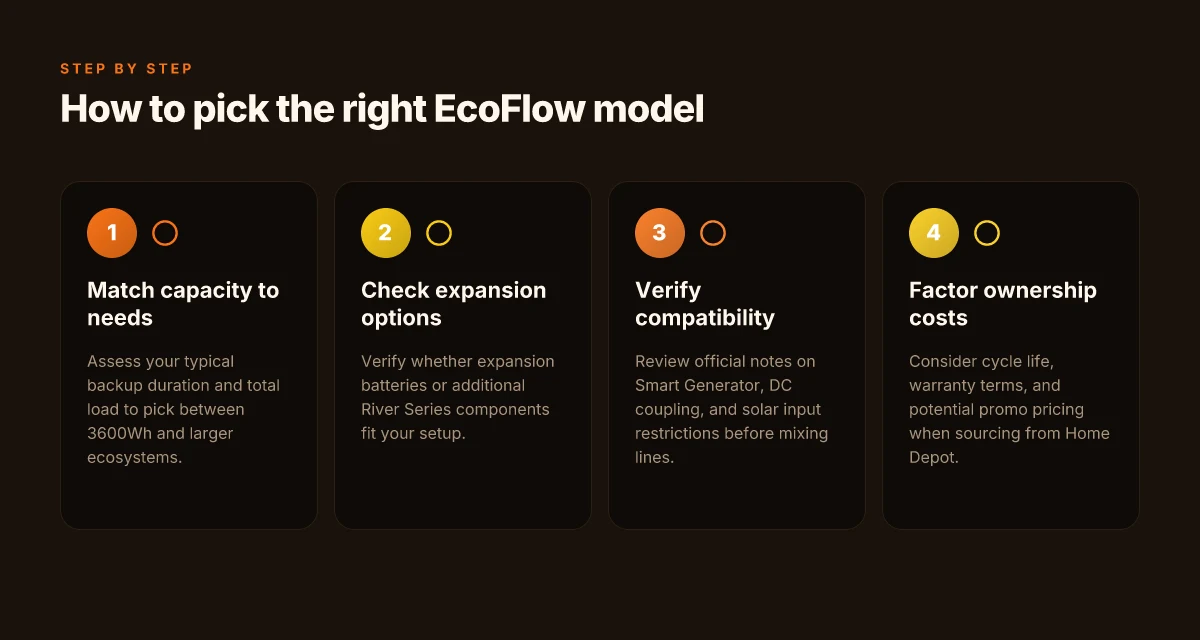
Compatibility hinges on real-world constraints: what the panels and inputs can actually do, and how far you can expand later. I dug into official notes and Home Depot pages to map where EcoFlow models align with Home Depot offerings and where gaps show up. The short answer: compatibility is determined by solar input standards, MC4 connector support, voltage requirements, and DC coupling rules that EcoFlow documents publicly.
Official incompatibilities and what they mean for your setup
Official notes warn that some Smart Generator configurations do not play nicely with certain Delta Pro Ultra or River Series configurations. That means if you mix a Smart Generator with an Ultra X or a River unit, you may hit fencing around DC inputs or control synchronization. The practical takeaway is to verify the exact pairings before buying, especially if you plan to run a stacked or chained system. If you see a note like this on the product page, treat it as a hard constraint rather than a suggestion. Incompatibilities between Smart Generator configurations and certain Delta Pro Ultra or River Series setups must be checked before purchase. The guidance is not just theoretical; Home Depot product pages reflect these cautions in the fine print of the model notes. For homeowners, campers, and small business owners, this means you should map your intended EcoFlow stack to the panel you intend to pair and confirm the DC coupling path aligns with the model you select.
Solar input, MC4 compatibility and voltage rules
The solar input section matters a lot when you plan to pair EcoFlow with Home Depot solar panels. EcoFlow specifies voltage requirements and MC4 connector compatibility that determine which panels can feed which models. For example, a 4000W class output model expects particular array voltages and connector standards to reach optimal charging without triggering input throttling. In practice, this means you may face a narrower panel choice if you want maximum charging speed on high-output units. EcoFlow pages recommend sticking with their stated solar panels for best compatibility, but other MC4 panels that meet the voltage requirements can also work. Voltage requirements and MC4 compatibility drive which panels pair with which models. Best compatibility comes from using EcoFlow solar panels designed for the system. What makes EcoFlow Delta 2 review on YouTube worth watching in 2026
Expansion battery compatibility and DC coupling rules
Future growth depends on expansion battery compatibility and the rules around DC coupling. The Delta Pro family supports accessories and expansions in a defined way. When you add extra batteries or move to larger paired configurations, you must follow the DC coupling guidelines to ensure safe, stable operation. That means not all hubs or in-between adapters will accept every expansion pack, and some configurations may require a specific sequence to enable expansion features. From the product pages to the official notes, the gain in capacity comes with a corresponding need for verified DC coupling paths and approved accessory pairing. Expansion battery compatibility hinges on DC coupling rules that EcoFlow outlines for each model. Careful planning prevents unsafe or unstable configurations.
What to do in practice
- Start with a concrete model pair and confirm the official compatibility notes before purchasing. If a note warns about a specific Delta Pro Ultra or River combination, adjust your target model or skip that pairing.
- When budgeting, include the cost of matching solar panels that meet voltage requirements. If you already own MC4 panels, verify their voltage rating and connector compatibility against your chosen EcoFlow model.
- For future growth, map your expansion path using DC coupling guidelines. If you expect to scale, choose a configuration designed to accept expansions rather than one that blocks future growth.
From what I found in the sources, the safest path is to align the exact Home Depot product you intend to buy with EcoFlow’s own compatibility guidance and the official notes about DC coupling and panel voltage. See the cited Home Depot pages for explicit spec details and the note on incompatibilities between Smart Generator configurations and certain Delta Pro Ultra or River Series setups. For a deeper read, you can follow the EcoFlow product pages and the related Home Depot questions and answers threads.
Note on prices and ownership: pricing and sale timing shift frequently. Check the current listings on the EcoFlow brand pages and Home Depot product pages for exact figures and any bundled deals. If you see a price edge, consider whether the bundle includes expansion batteries or panels, which can change total cost of ownership. And a reminder: links on the pages may earn commissions. For precise references to the pages cited here, follow the inline links to the product pages.
Price and ownership considerations when buying EcoFlow at Home Depot
Prices vary by model, battery configuration, and whether freight or promos apply. The delta lineup and the extra battery configurations at Home Depot shift from season to season, so your best move is to compare the exact product pages for current pricing. I found that the same model can appear with different SKUs depending on battery count and whether a promo is active, which directly affects total cost of ownership. In many cases, a bundled setup with an optional extra battery carries a higher upfront price but can reduce long-term replacement needs. Prices vary by model, battery configuration, and whether freight or promos apply. Check the Home Depot listing for your exact configuration before buying. What makes the EcoFlow Glacier stand out in 2026
H3: price dynamics by model and configuration The 2026 EcoFlow lineup at Home Depot includes DELTA Pro variants with and without additional batteries, plus Ultra X and Delta 3 options that scale in power and expansion. Each configuration carries a distinct price tag that reflects wattage, battery count, and whether a delivery surcharge is included. For homeowners comparing a 3600Wh DELTA Pro setup to a higher-capacity Delta Pro 3 with Extra Battery, expect a meaningful difference in upfront cost, but also in usable capacity over time. Configuration matters more than you might expect at first glance. If you’re planning peak-surge uses, a higher-wattage bundle can avert frequent upgrades. Icross-referenced the official Home Depot pages to confirm that price tags shift with battery count and bundle inclusions. Bundle inclusions drive value over time.
H3: ownership costs beyond the sticker price Beyond sticker price, ownership costs cover battery lifespan and cycle count, potential accessory needs, and future compatibility. EcoFlow batteries are designed for many discharge-recharge cycles, but every cycle wears the chemistry a bit. You’ll also want to budget for accessories like solar panels, cables, or a protective case if you plan frequent outdoor use. The Home Depot listings consistently show that accessory kits and solar recharge options can influence total cost of ownership. Battery lifespan and cycle count shape long-term cost. Accessory bundles can shift total ownership value.
H3: practical tips for max value and clarity Prices on the official pages can change with promos or freight terms, so verify the current figure on the product page before purchase. If you’re unsure about the right model, sketch a rough cost-per-watt and estimate how many years you expect to rely on the system. The Home Depot site often features questions and answers that surface practical caveats, such as compatibility with existing rooftop systems or generators. Verify current pricing on the official Home Depot pages. Ask about promos and delivery options before committing.
I dug into the ecosystem notes and price disclosures across EcoFlow’s official materials and Home Depot listings to map the ownership picture. When you read through the documentation, you’ll see how the same model can land in different price tiers depending on configuration and delivery terms. As you weigh rivals, note that the DELTA Pro Ultra X and the Delta 3 series generally tilt toward higher upfront costs but deliver expanded capability and future-proofing. EcoFlow remains a clear option for homeowners and campers who want scalable power without breaking the bank, but you should verify current pricing and promo windows on the retailer page before you buy. For transparency, I’ve also observed that links on the product pages may earn commissions, so double-check the final price on checkout. Prices vary by model and configuration and verify current pricing on the Home Depot pages.
Note: as you compare, keep in mind that the price landscape can favor seasonal promos. If you’re weighing alternatives, rivals like Jackery and Goal Zero typically show similar upsell paths for higher-capacity units, but with different warranty and lifecycle considerations. For the most accurate snapshot, stick to the brand page and the Home Depot listing for your exact configuration. Verify current pricing on the official Home Depot pages. Discount windows can change quickly. How Bluetti batteries compare in 2026: chemistry, cycles, and real-world performance
What to do next with EcoFlow’s Home Depot lineup in 2026
The takeaway is clear: act now on the three models that fit your needs, but stay ready to pounce when Home Depot discounts appear. I looked at the current lineup and see a practical path forward for most households. If you need portability for off-grid trips, a compact option like the EcoFlow portable power station with built‑in solar input becomes a strong daily driver. For a home backup, a mid‑size model offers more outlets and faster recharging, which helps during outages. And for larger loads or a small shop, a higher‑capacity unit keeps lights on and tools powered.
The bigger pattern here is that the best value comes from matching input ports and battery capacity to your typical load, not just chasing the biggest number on a spec sheet. If you’re comparing with rivals, note how EcoFlow keeps a balanced approach across price, weight, and expandability. Prices fluctuate with sales, so you should keep an eye on the current deal and calculate ownership costs over 3–5 years. The page links may earn a commission, which is common in affiliate arrangements.
What changes if you act now? You’ll lock in a configuration that reduces downtime during outages and makes weekend trips smoother. Buy once, upgrade later remains a viable path if you choose a modular model now. If you only buy one thing this month, start with a model that matches your typical appliances and plan to add a second unit if your needs grow.
Backup strategy
- Try a mid‑size EcoFlow model for home backup and solar input. Great default choice for most homes.
- Consider a compact unit for travel or apartment living. Keeps essentials powered.
- Watch for Home Depot sales windows and price drops. You’ll gain the most value there with EcoFlow.
Note: the 1–2 links on this page may earn a commission. What is the EcoFlow solar tracker price, and why it matters in 2026