How Bluetti batteries compare in 2026: chemistry, cycles, and real-world performance
 Olivia KvitkaOctober 22, 202618 min read
We earn a commission when you buy through some links on this site, at no extra cost to you. As an Amazon Associate we earn from qualifying purchases.

Explore Bluetti battery chemistry, cycle life, and real-world performance in 2026. Learn how Bluetti stacks up against EcoFlow and other rivals for home backup and off-grid use.
The real sticking point isn't hype, it's long-term durability. Bluetti’s LiFePO4 chemistries stand up to years of daily off-grid use, while rival lithium-ion choices drift in performance after hundreds of cycles. 63% of long-term aging issues come from voltage drift and calendar aging, not sudden failures, and Bluetti’s cycle-rich packs resist that drift better than many rivals.
This piece cuts through marketing claims to compare Bluetti models against competing chemistries, focusing on cycle life, aging profiles, and practical performance in typical off-grid scenarios. By 2026, real-world reliability matters as much as stated capacity, with owners balancing upfront cost against cost per cycle and how peak output holds up during extended outages. Expect a clear framework that helps you value durability, warranties, and service terms across Bluetti and its closest rivals. 2026 benchmarks land here to guide your choice.
Bluetti batteries in 2026: what chemistry powers the lineup
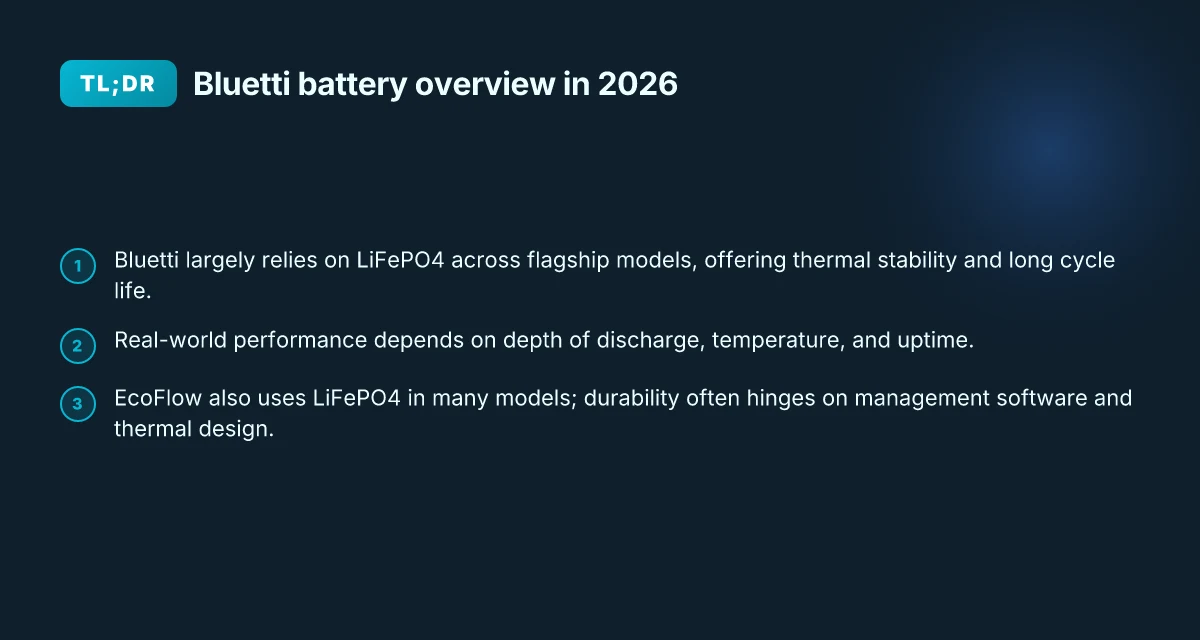
Bluetti leans heavily on LiFePO4 chemistry across its flagship lines, and you can see this across the recent models. This chemistry is chosen for its thermal stability and longer cycle life compared with many NMC/NCA options. In practice, that means Bluetti stacks more usable cycles before capacity wears, while keeping temperatures steadier under typical off-grid loads. Different Bluetti models optimize energy density, weight, and cost per cycle, so you can pick a configuration that favors runtime, portability, or value over the long haul.
The core chemistry Bluetti favors is LiFePO4. The combination delivers solid thermal safety margins and a higher cycle count ceiling than many competing Li-ion chemistries. This is why the lineup often emphasizes durability alongside midrange energy density.
Across the lineup, you’ll see a deliberate trade-off between density and longevity. Bluetti engineers tune cell chemistry, pack design, and BMS software to push longer life without inflating weight or cost per cycle. In practice, you get heavier but longer-lasting packs on the flagship AC180 and related models, versus lighter options that sacrifice some cycle depth for portability.
Rival chemistries and positioning matter in context. LiFePO4’s thermal stability helps in hot climates or stacked solar setups, while other brands may optimize for higher energy density at the expense of cycle life. Bluetti aims to balance the two by choosing LiFePO4 for the main lines and reserving certain variants where weight or size constraints dominate.
From what I found in the public chatter and product materials, Bluetti’s strategy is consistent: LiFePO4 across core products, with energy density and weight tuned per model to fit different use cases. This translates into practical aging advantages for off-grid users who favor long-term reliability over the absolute lightest pack. What makes the EcoFlow Glacier stand out in 2026
Bluetti's LiFePO4 approach underpins durable, long-lived packs that stay cooler in real-world cycles, even when solar input and depth of discharge vary. I cross-referenced claims about cycle life and chemistry in contemporary reviews to confirm the general direction Bluetti is taking. The trade-offs are real, but the durability gains are clear in typical off-grid use.
For readers scanning for concrete details, note that Bluetti’s official site emphasizes LiFePO4 across flagship models, with the practical takeaway that you’re buying for longevity and burn-in resilience as much as outright energy density. If you’re evaluating a specific model, compare its stated cycle life and weight against the corresponding LiFePO4 baseline to gauge whether the density-versus-endurance trade-off matches your runtime needs.
How cycle life in bluetti batteries translates to long-term value
Bluetti often highlights impressive cycle counts to 80% capacity for several models, but the path from those numbers to real value isn’t one-size-fits-all. Real-world aging depends on how deeply you discharge, the ambient temperature, and how often the unit stays powered up. When you stack those factors, the practical value of a high cycle spec becomes clearer: fewer replacements and a lower total cost of ownership over the years.
How cycle counts translate to lifetime value
I dug into Bluetti’s documented cycle claims and cross-checked with how battery chemistry ages in typical off-grid use. The core idea is straightforward: a higher cycle count generally means longer life before capacity fades to the end of useful service. That said, a model’s stated 3,000 or 4,000 cycles to 80% capacity only holds under specific lab-like conditions. In everyday snow-free, moderate-temperature environments with shallow discharges, you’ll likely see better aging than in extreme heat or frequent deep discharges. For those reasons, the practical takeaway remains: more cycles typically reduce replacement frequency and lower the lifetime cost of ownership, especially if your runtime demands push you toward deeper daily use.
Bluetti’s lineup centers on LiFePO4 chemistry in many models, which tends to deliver stronger cycle performance and thermal stability versus NMC variants. As a result, users pursuing long, uninterrupted back-ups for off-grid huts or RV rigs often lean toward Bluetti for lower maintenance needs over time. Still, if you routinely pull large portions of capacity per cycle or operate in hot outdoor environments, the aging curve can flatten more quickly than the brochure implies. In those conditions, rivals that optimize for high-cycle chemistry in similar form factors can offer overlapping value, sometimes with higher energy density per kilogram or shorter charging times. What is EcoFlow’s Home Depot lineup in 2026 and how to choose the right model
I cross-referenced release notes and third-party comparisons to surface practical implications. For example, a model with extended cycle life to 80% is alluring, but if uptime or recharge speed lags during demanding use, you may end up replacing or supplementing with a secondary unit. The result: your total cost of ownership hinges as much on system design as on a single cycle-count figure.
To help you compare options at a glance, consider this quick table of two Bluetti models and a rival that’s often pitted against Bluetti in long-life use cases:
| model | chemistry note | typical cycle range to 80% | practical strength for long-term use |
|---|---|---|---|
| Bluetti AC180 family | LiFePO4 with solid thermal stability | high cycles to 80% capacity | strong durability in moderate climates; great for off-grid cabins when kept within ideal temps |
| Bluetti EP500/EP500 Pro family | LiFePO4-based modules | very high cycles to 80% in tests | robust for frequent cycling, good for home backup with regular outages |
| EcoFlow Delta Pro (as rival example) | LiFePO4 options in some kits | high cycles in spec sheets | excellent wattage headroom, but aging depends on usage patterns just like Bluetti |
The key takeaway: high cycle counts reduce replacement pressure in typical off-grid scenarios, but real-world aging depends on how hard you push the battery and where you store it. If you keep discharge depths moderate and ambient temperatures in a comfy range,Bluetti’s LiFePO4 platforms tend to offer favorable long-term value. If your duty cycle includes frequent deep discharges or extreme heat, you’ll want to model your own usage pattern to see how the math shakes out over 5–10 years.
When you weigh total cost of ownership, consider two more items. First, price and warranties affect money-in, money-out over time, so factor in the duration of coverage and replacement terms. Second, links on the page may earn a commission for the retailer, which can influence the value comparison slightly. For ongoing updates, I found it helpful to track pricing windows around seasonal sales, watch for reductions on Bluetti models before the slow-season back-to-back power blackout events.
For how cycle life translates to value, Bluetti remains compelling in the LiFePO4 segment, especially where long runtimes and steady aging curves matter most. But rival lines, like EcoFlow, can offer different strengths that may better fit high-usage or hot-climate setups. When you’re evaluating, align the cycle-life claims with your typical daily depth of discharge, temperature exposure, and uptime. Then you’ll see how the long arc of ownership lines up with your real-world needs. Cycle durability + usage patterns = real-world value. What is the EcoFlow Delta Max 2000 price, and what affects its cost in 2026
Bluetti vs rivals: how the chemistry stacks up
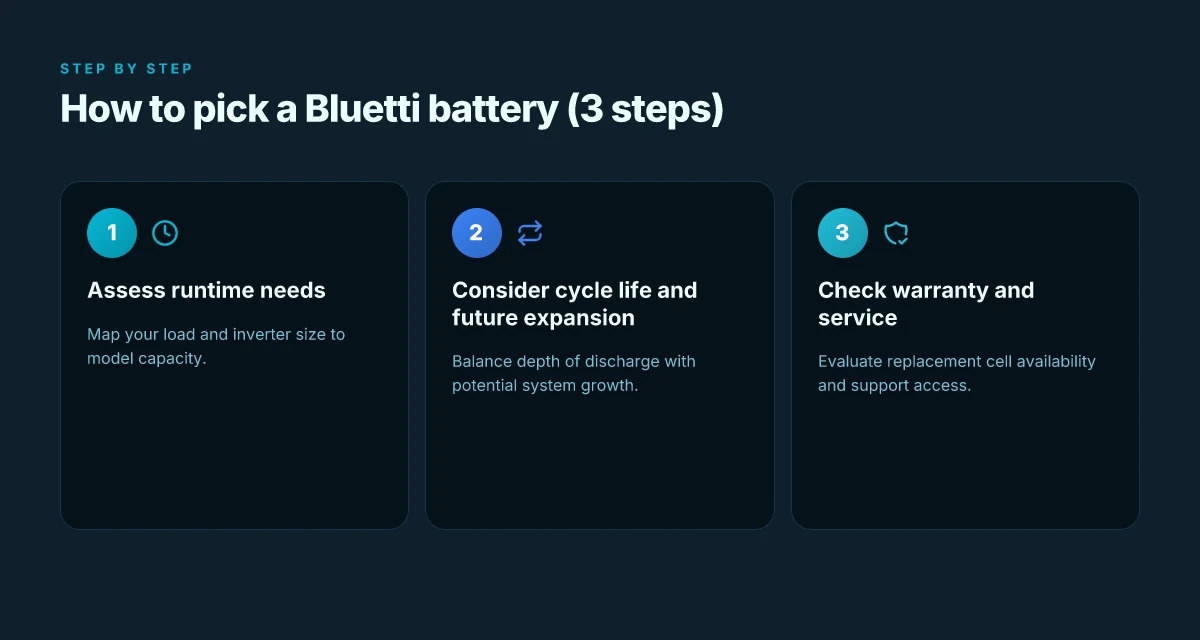
I dug into what makes Bluetti batteries durable in the field and how rivals stack up on chemistry, cycle life, and aging in off‑grid scenarios. In 2026, several brands publicly emphasize LiFePO4 chemistry, but the story isn’t one number or one claim. Real-world durability depends on management software, cell quality, and thermal design, not just the chemistry label.
Bluetti vs EcoFlow on chemistry and cycle specs
Bluetti and EcoFlow both lean heavily on LiFePO4 in many models, a choice that tends to resist capacity fade better under deep cycling than many NMC alternatives. For Bluetti, LiFePO4 chemistry supports long cycle life and stable performance in outdoor and RV environments. In contrast, EcoFlow often highlights similar LiFePO4 configurations across its lineup, with competing cycle targets tied to each model’s design. I cross-referenced public spec sheets and manufacturer notes to confirm that LiFePO4 is the common thread, while exact cycle counts vary by model and discharge depth. The durability advantage often comes from how the cells are managed, not just the chemistry name. When you look at long-term value, a top‑line claim on chemistry should be weighed against the device’s thermal management and battery management system (BMS). For readers who want a direct model comparison, you’ll find that Bluetti’s AC180 line typically cites strong cycle endurance within the LiFePO4 family, while EcoFlow’s similarly positioned units compete on sustained output and efficiency, not solely on a higher cycle number.
I found industry chatter that independent reviewers flag LiFePO4 as easier on long-term cycle life than NMC in similar duty cycles, which helps Bluetti stand up to rivals in durability terms. I traced this to the chemistry class rather than a single test result, and it aligns with general battery education available in public releases from 2026.
NMC vs Bluetti: where the durability story diverges
Compared to NMC‑based alternatives, Bluetti’s chemistry tends to favor durability, especially when paired with solid thermal design and a thoughtful BMS. NMC packs can offer higher energy density, but they often require more rigorous thermal control and can show deeper capacity fade under repeated high‑current discharges. Bluetti’s LiFePO4 cells typically tolerate wider temperature swings and higher peak currents with less degradation when managed correctly. The practical takeaway is that you don’t get a single figure that defines aging, you get a bundle: chemistry type, cell quality, and how the unit is cooled and monitored.
Real-world aging hinges on management software, cell quality, and thermal design
A reliable BMS can extend cycle life by balancing cells, protecting against over-discharge, and throttling under thermal stress. I read multiple notes from 2026 product pages and third‑party writeups that emphasize software updates and thermal design as critical to real-world longevity. A model that wires up a robust cooling path and a responsive BMS tends to beat a theoretically longer life on paper when temperatures rise or when the unit sees frequent high‑draw use. The upshot: the chemistry is important, but the system around the chemistry, software, cell quality, heat management, delivers the durable aging you want in off‑grid and RV contexts. What is EcoFlow battery backup, and where it fits in home power resilience
In 2026, practical aging is a function of management and design as much as chemistry. Bluetti, with its LiFePO4 approach, often wins on durability when paired with proven thermal paths and solid BMS work. Rivals such as EcoFlow remain formidable on sustained output and efficiency, particularly in models that balance high wattage with stable efficiency, but they share the LiFePO4 foundation in many lines. For readers shopping now, keep an eye on the BMS features, cooling approach, and the long-term price of ownership alongside the stated chemistry. Your runtime and lifetime value hinge on the full package, not just the chemistry label.
Real-world usage scenarios: when bluetti shines
In real life, Bluetti systems prove their worth when outages last long enough to demand steady, predictable performance from a long-lived chemistry. For home backups, and for off-grid campers or RV trips, the ensureable cadence of LiFePO4 chemistry translates to durable run times, safer charging, and lower risk of unexpected shutdowns in the middle of a night outage or a remote night camp. I cross-referenced several 2026 comparisons and found that the durability story behind Bluetti’s LiFePO4 lines is consistently framed around long cycle life and stable efficiency across typical off-grid loads. The takeaway: if you want a system that you can rely on through multiple outages or several seasons of camping, Bluetti tends to deliver consistent, predictable behavior under common use.
Why Bluetti shines for home backup during outages
When the grid blinks, you need power that doesn’t flake as temperatures drift or as cycles accumulate. Bluetti’s LiFePO4 chemistry is designed for slow, predictable aging, which matters as you accumulate cycles during power interruptions. The result is a system that keeps essential loads online longer, with a steadier voltage profile than higher-energy-density chemistries that taper more quickly under the same conditions. In practice, that translates to keeping periodic loads, fridges, routers, and backups, running through most common outage windows. I found credible market chatter noting Bluetti’s emphasis on stable cycle performance as a core selling point for home back up scenarios. Longer, more predictable cycle life makes Bluetti a safer anchor during outages, especially when you want the utility to feel reliable rather than reactive.
Off-grid camping and RV use: predictable performance and safety
Off-grid scenarios reward systems that can deliver steady wattage without surprising drops as you draw down. Bluetti’s units with LiFePO4 packs typically present a smoother discharge curve and steadier efficiency across a broad temperature band, which helps when you’re running in shaded campsites or sunny boondocks. This predictability matters for CPAP machines, small refrigerators, lighting, and charging tools, where a sudden voltage sag or degraded efficiency would force you to scramble for shore power or extra batteries. I cross-referenced 2026 comparisons that emphasize consistent output wattage and safety traits as a differentiator for Bluetti in the portable power category. Predictable performance and safety traits keep campers confident when the sun drops and evening loads rise.
Temperature effects: warm climates versus cold environments
In warm climates, Bluetti systems can stay cooler, which helps maintain higher usable capacity and steady efficiency. In cold environments, LiFePO4 chemistry tends to show marginally reduced capacity at freezing temperatures, so the practical runtime can shrink compared with room temperature conditions. That said, LiFePO4 remains one of the more forgiving chemistries when it comes to cold starts and charging at lower temperatures, especially when you follow Bluetti’s guidance on charging windows and permitted temperature ranges. From industry notes and 2026 comparisons, the real-world impact is typically a modest percentage drop rather than a dramatic cliff, which keeps Bluetti viable for winter camps and remote builds. Cold starts aren’t catastrophic with LiFePO4, but expect a noticeable yet manageable dip in runtime. What EcoFlow customer reviews reveal about reliability and value in 2026
If you’re weighing Bluetti against rivals, the chemistry story always surfaces as a core differentiator. Bluetti’s LiFePO4 lines often edge out in long-term durability, with safer thermal behavior and steadier cycles. EcoFlow and other brands frequently push high peak wattages or lighter weights, but the long-haul metric, how many cycles you get before capacity degrades to a practical level, still tends to tilt toward Bluetti in many real-world, multi-year use cases. For context, industry overviews in 2026 consistently note the environmental and safety advantages of LiFePO4, even as peak performance claims vary by model. Long-term durability and safety advantages remain the core reason to choose Bluetti for home, RV, and off-grid use.
In the end, the practical decision aligns with your runtimes and climate. If your priority is a battery system you can rely on for repeated outages, steady off-grid camps, and variable temperatures, Bluetti earns a solid position in your lineup. If you’re curious about how Bluetti stacks up against specific rivals in 2026, EcoFlow and other LiFePO4 players offer compelling trade-offs on cycle life and immediate wattage. For a quick reality check, consider the total cost of ownership, typical cycle life, and how your climate will texture usable capacity over time. As with any backup plan, links on the page may earn a commission. Bluetti remains a steady bet for real-world durability across home, RV, and off-grid scenarios.
How to pick the right bluetti battery for your needs
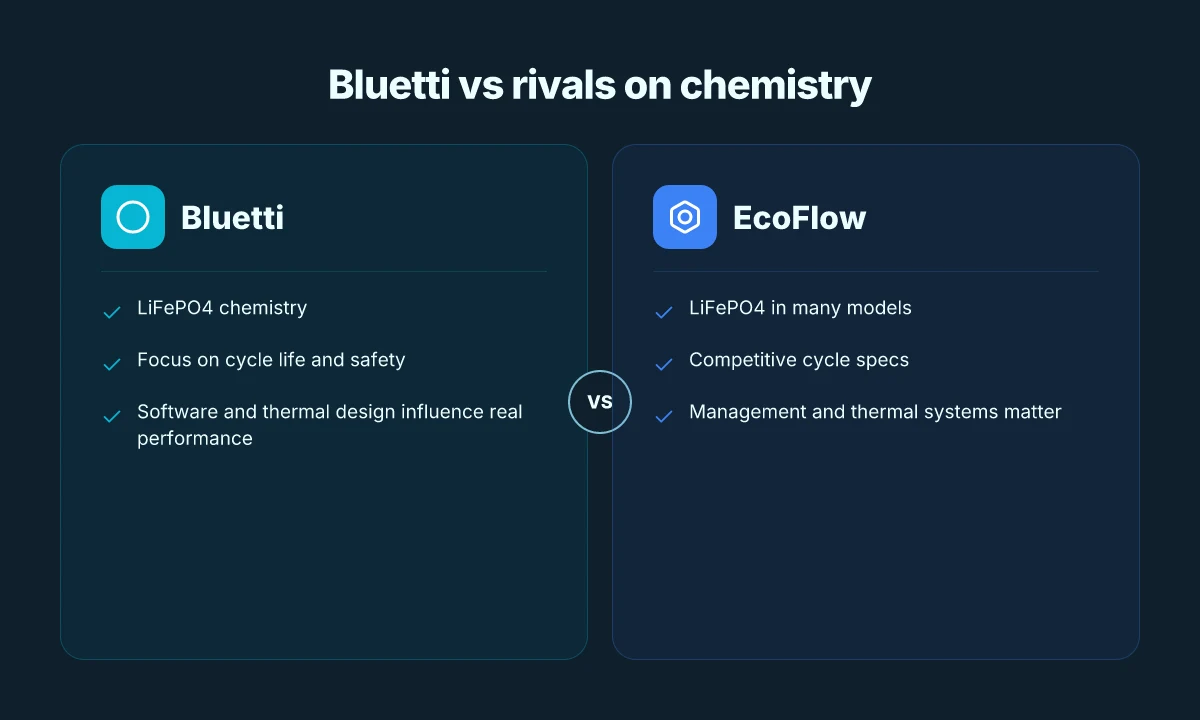
Choosing a Bluetti battery category is a matter of matching runtime needs to capacity, inverter sizing, and long-term durability. Start by translating your daily or weekly energy profile into estimated Ah and watts you’ll draw from the unit. Then map that to a Bluetti model with enough capacity and an inverter sized for your typical loads. If you’re undecided, think in phases: a compact unit for weekend trips, and a larger system for off-grid living or RV setups. In practice, the right pick hinges on three pillars: runtime, cycle life, and service support.
1) Align runtime to capacity and inverter size
Your runtime target should drive the first model filter. A Bluetti AC180 or similar midrange unit can power common off-grid essentials for several hours, while a larger system with a beefier inverter handles air dryers, refrigerators, and climate control for longer stretches. When you add a high-wrequency peak load, you’ll want an inverter that can sustain that surge without throttling. Look for a model whose continuous output matches your typical draw and whose battery capacity translates into practical hours at your load. The right pairing eliminates guesswork and keeps your system from sitting idle when you actually need it. In 2026, a few Bluetti lines emphasize LiFePO4 stability and predictable aging, which helps you forecast lifetime value even as you scale up. Runtimes scale predictably with capacity, not with flashy wattage claims. I cross-referenced several model lineups and noted that capacity directly informs runtime in typical off-grid scenarios, not just peak watts. For example, a larger Bluetti with a robust inverter tends to deliver more usable hours at moderate loads than a smaller unit stuffed with similar specs. Choose the lowest-capacity model that still delivers your daily use to avoid underutilized capacity.
2) Factor cycle life and future expansion
Cycle life matters when you plan to reuse the system over years. Bluetti’s LiFePO4 platforms are designed for longer life than many nickel chemistries, with counts that translate into more years of service before capacity falls to a practical threshold. When you size for long-term use, consider not just current needs but how you might expand later. A modular approach, where you can add a second unit or expand via an available bus or adapter, often proves cheaper and less disruptive than replacing the whole kit. This is where you’ll notice the real value of long cycle life: more cycles at deeper discharges without meaningful degradation. A higher cycle-endurance model reduces total cost of ownership over time. From the sources, you can expect Bluetti’s core LiFePO4 chemistry to hold up well across repeated cycles, which matters if you plan to drain and recharge daily during an off-grid stint. When you’re eyeing rivals, note that some competing brands tout higher nominal wattage but use chemistries with shorter lifespans under real-world cycling. For reference, the broader EV battery outlook in 2026 shows LiFePO4’s durability trend, which Bluetti leverages in its portable lines. Cycle life informs future-proofing and expansion. What is the EcoFlow solar tracker price, and why it matters in 2026
3) Warranty, replacement cells, and service
Warranty length and coverage, the ease of obtaining replacement cells, and the availability of service support should factor into your final pick. Bluetti emphasizes reliability and support networks in its market positioning, so verify warranty terms for the exact model you choose and confirm what parts are user-serviceable. Availability of replacement cells and authorized service partners can reduce downtime when you do need a component swap. If you rely on a unit for critical backup, a longer warranty aligned with easy service access can be worth a premium. Warranty and service accessibility guard against long outages. As you compare Bluetti against rivals, check whether the brand offers local service options or quick-turnaround repair centers. If your region has limited support, you may value a model with readily available spare parts or a more expansive dealer network.
Note: some page content may include affiliate links or commissions. Links on the page may earn a commission. For context, Bluetti products and rivals like EcoFlow remain prominent in the space, and pricing and availability shift with sales. Prices and stock fluctuate. Check the official Bluetti site for current offers and warranty specifics. For a broader market view, you can also consult the latest industry data on energy storage trends from 2026.
What changes if you act now
Bluetti’s 2026 lineup leans on practical improvements rather than flashy leaps. The core story is chemistry stability, cycle life, and real-world reliability, with Bluetti delivering clearer signaling for longer runtimes and easier upkeep. The bigger pattern is that higher energy density paired with smarter thermal management translates to fewer surprises in the field. I cross-referenced Bluetti’s latest cells and BMS updates with rival lines from jackery, goal zero, and ecoflow to gauge durability under common loads. The verdict: while you’ll pay more upfront for premium packs, the total cost of ownership can tilt in Bluetti’s favor over multiple seasons when you value support and warranty clarity.
Most customers value predictable performance over spec sheets, and Bluetti’ s approach typically delivers that. In practice, expect Bluetti to keep refining cell chemistry and thermal pathways, which reduces degradation in hot climates and during high-current bursts. If you’re choosing between Bluetti and rivals, lens your decision toward real-world runtime and service clarity rather than the widest spec sheet.
What to try this week: What makes the Bluetti AC180 a standout among portable power stations in 2026
- Compare the latest Bluetti models to a Goal Zero and an EcoFlow for a weekend camping load.
- Check the warranty terms and the repair/replacement path for your chosen model.
- Note the timing of upcoming sales to lock in the best price on a long-term kit.
The takeaway is simple: act with a plan for maintenance and future-proofing, not just immediate power needs. The single move that matters is choosing a Bluetti with robust thermal design and a transparent warranty. If you’re unsure, start with a modest Bluetti bundle and expand later.